Quotulatiousness

March 10, 2023

The evolution of a slur

Filed under: Britain, History, Japan, USA, WW2 — Tags: , , , , — Nicholas @ 03:00

Scott Alexander traces the reasons that we can comfortably call British people “Brits” but avoid using the similar contraction “Japs” for Japanese people:
Someone asks: why is “Jap” a slur? It’s the natural shortening of “Japanese person”, just as “Brit” is the natural shortening of “British person”. Nobody says “Brit” is a slur. Why should “Jap” be?

My understanding: originally it wasn’t a slur. Like any other word, you would use the long form (“Japanese person”) in dry formal language, and the short form (“Jap”) in informal or emotionally charged language. During World War II, there was a lot of informal emotionally charged language about Japanese people, mostly negative. The symmetry broke. Maybe “Japanese person” was used 60-40 positive vs. negative, and “Jap” was used 40-60. This isn’t enough to make a slur, but it’s enough to make a vague connotation. When people wanted to speak positively about the group, they used the slightly-more-positive-sounding “Japanese people”; when they wanted to speak negatively, they used the slightly-more-negative-sounding “Jap”.

At some point, someone must have commented on this explicitly: “Consider not using the word ‘Jap’, it makes you sound hostile”. Then anyone who didn’t want to sound hostile to the Japanese avoided it, and anyone who did want to sound hostile to the Japanese used it more. We started with perfect symmetry: both forms were 50-50 positive negative. Some chance events gave it slight asymmetry: maybe one form was 60-40 negative. Once someone said “That’s a slur, don’t use it”, the symmetry collapsed completely and it became 95-5 or something. Wikipedia gives the history of how the last few holdouts were mopped up. There was some road in Texas named “Jap Road” in 1905 after a beloved local Japanese community member: people protested that now the word was a slur, demanded it get changed, Texas resisted for a while, and eventually they gave in. Now it is surely 99-1, or 99.9-0.1, or something similar. Nobody ever uses the word “Jap” unless they are either extremely ignorant, or they are deliberately setting out to offend Japanese people.

This is a very stable situation. The original reason for concern — World War II — is long since over. Japanese people are well-represented in all areas of life. Perhaps if there were a Language Czar, he could declare that the reasons for forbidding the word “Jap” are long since over, and we can go back to having convenient short forms of things. But there is no such Czar. What actually happens is that three or four unrepentant racists still deliberately use the word “Jap” in their quest to offend people, and if anyone else uses it, everyone else takes it as a signal that they are an unrepentant racist. Any Japanese person who heard you say it would correctly feel unsafe. So nobody will say it, and they are correct not to do so. Like I said, a stable situation.

He also explains how and when (and how quickly) the use of the word “Negro” became extremely politically incorrect:

Slurs are like this too. Fifty years ago, “Negro” was the respectable, scholarly term for black people, used by everyone from white academics to Malcolm X to Martin Luther King. In 1966, Black Panther leader Stokely Carmichael said that white people had invented the term “Negro” as a descriptor, so people of African descent needed a new term they could be proud of, and he was choosing “black” because it sounded scary. All the pro-civil-rights white people loved this and used the new word to signal their support for civil rights, soon using “Negro” actively became a sign that you didn’t support civil rights, and now it’s a slur and society demands that politicians resign if they use it. Carmichael said — in a completely made up way that nobody had been thinking of before him — that “Negro” was a slur — and because people believed him it became true.
March 5, 2023

MacArthur and Nimitz Go Head-to-Head – Week 236 – March 4, 1944

World War Two
Published 4 Mar 2023

The American attacks against the Admiralty Islands are successful, but this causes real tensions between commanders Douglas MacArthur and Chester Nimitz. Much of this week is taken up by planning and meetings on both sides — Adolf Hitler plans the occupation of Hungary, Josef Stalin plans new offensives in Ukraine, and the Allies plan to reconfigure their whole front in Italy. It’s all the prelude to an explosion of action.
(more…)

February 27, 2023

Luftwaffe Defeated in One Week?! – War Against Humanity 099

World War Two
Published 26 Feb 2023

Allied and German Air Forces fight fierce battles over Europe with civilians caught in the crossfire, while Joseph Stalin and Lavrenti Beria deport two entire ethnicities of half a million in just one week.
(more…)

February 26, 2023

Tojo Takes Control – Week 235 – February 25, 1944

Filed under: Asia, Britain, Germany, History, India, Italy, Japan, Military, Pacific, Russia, USA, WW2 — Tags: , , , , , , — Nicholas @ 04:00

World War Two
Published 25 Feb 2023

Now that the Americans have seized the Marshall Islands, they can bypass the Japanese base at Truk. This impels Prime Minister Hideki Tojo to shake up both army and navy command, and he even takes personal control over the Japanese Army. On the Anzio Front, Lucian Truscott replaces John Lucas as Allied Commander. In the field, the Allies win a big victory in Burma, and in Ukraine, the Soviets are still on the move.
(more…)

February 23, 2023

Type 99 Arisaka Sniper Rifles

Filed under: History, Japan, Military, Weapons, WW2 — Tags: , , — Nicholas @ 02:00

Forgotten Weapons
Published 29 Nov 2016

The Japanese Army made significant use of snipers (or in today’s terminology, designated marksmen) as part of its infantry combined arms doctrine, and produced about 22,000 Type 97 sniper rifles for use in WWII and the Sino-Japanese War. In 1941, shortly after the adoption of the new 7.7mm rifle cartridge, it was decided that a sniper rifle variant of the Type 99 should be made in addition to the Type 97 (which was basically a scoped Type 38).

Testing through 1941 determined that there was almost no practical difference in accuracy between scoped examples of the Type 99 long and short rifles, and so the short rifle was chosen to be the basis for the Type 99 sniper (the Type 99 long rifles would drop from production altogether pretty quickly anyway). About 1,000 of the scoped 99s were manufactured by the Kokura Arsenal using the same 2.5x scope as on the Type 97 sniper, while the Nagoya Arsenal instead used a 4x scope, offering more magnification at the expense of a narrower field of view. Nagoya would produce approximately 10,000 of these rifles, with 4x scopes except for a period between serial numbers 5,000 and 7,000 with 2.5x scopes (most likely the remainder stored at Kokura when that plant ceased production). The rifles made into snipers were given no special selection criteria; simply taken at random from normal production. The utility of the weapon in Japanese practice came not from it being mechanically more accurate than any other issue rifle, but rather from the optical sight allowing better exploitation of that standard rifle’s inherent accuracy.
(more…)

February 19, 2023

The Destruction of Monte Cassino – Week 234 – February 18, 1944

World War Two
Published 18 Feb 2023

The Allies bomb the monastery atop Monte Cassino in Italy, but just to the Northwest it’s the Germans attacking them at Anzio this week. In the Soviet Union, the Axis break out of the Korsun Pocket, but at great cost, and in the Pacific comes a major Allied raid on the Japanese base at Truk and landings on Eniwetok Atoll.
(more…)

February 17, 2023

Spy ballooning has a remarkably long history (that’s clearly still ongoing)

Filed under: Cancon, China, France, History, Japan, Military, Technology, USA, WW1, WW2 — Tags: , , , , — Nicholas @ 05:00

In The Line, Scott Van Wynsberghe outlines the history of balloons in wartime and (as many are now aware from recent events) in peacetime:

China’s balloon spying is shocking on so many levels that you can take your pick. There is the ultra-flagrant violation of foreign sovereignty, the stunningly surreal air of denial exhibited by Beijing, and the fearful sense that something in the world order just lurched. There is also puzzlement: what, balloon spying is still a thing? Indeed it is, and its centuries-long history is instructive as to what China is now doing. It also makes clear that the U.S. is no innocent victim here but rather a past offender with a cleaned-up act.

Among the first major studies of aerial reconnaissance was a book brought out by military author Glenn B. Infield way back in 1970. In a way, Infield was charting unknown territory. When he addressed balloons in particular, he traced their use in spying to the many wars associated with the French Revolutionary and Napoleonic eras. In 1794, he related, the French military officer Jean-Marie-Joseph Countelle made an ascent at the city of Maubeuge in order to monitor enemy forces in the area. In the process, Countelle became the first balloon spy.

As technology improved, other firsts followed. By the 1850s, cameras were mounted on French military balloons. In the 1860s, during the American Civil War, Union forces battling the Confederacy used balloons trailing telegraphic wires, which transmitted immediate updates from the balloonists. Yet technology cut both ways. By the early 1900s, balloons had a nemesis in sight, in the form of winged and powered aircraft.

The inevitable showdown occurred in the First World War, and it was ugly. Large numbers of observation balloons were used by all sides in the conflict, and WWI historian Denis Winter claims the Germans alone deployed 170 of them in France by 1917. Typically, such balloons were tethered in place near the frontline, floating at several thousand feet, with telephone wires dangling to the ground. Although they seemed vulnerable, they were actually protected from below by anti-aircraft units, which blasted at any enemy plane that got too close. However, the reverse was also true, with balloons themselves being fired at from the ground. By 1915, says aviation writer Ralph Barker, the British were losing at least a dozen balloons a month from all forms of enemy action. Those balloonists who were not shot to pieces often had to bail out, putting their faith in parachutes that did not always work. (Horrified onlookers called them “balloonatics.”) The fighter pilots responsible for much of this mayhem — which they called “balloon-busting” — may not have had an easy time, but some of them scored heavily, with one Frenchman named Coiffard tallying 28 balloons. Although observation balloons managed to make it to the end of the war, it was a near-run thing. According to author Linda Hervieux, nobody after the war was talking about repeating that experience in any future fighting.

[…]

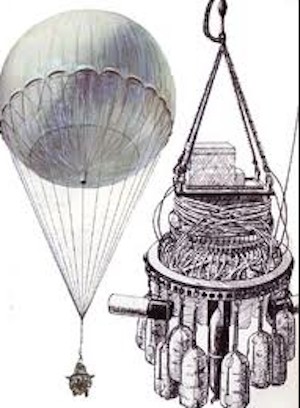
Once the Second World War was underway, some propaganda leafleting did occur, but secret balloon activity seemed to be at a low level. That was very misleading, because one of the tensest moments in ballooning history was playing out in the background, but it occurred amid so much security that the entire tale took years to emerge. In 1944, Japan launched the first of over 9,000 bomb-rigged balloons​ across the Pacific. Robert C. Mikesh, in a comprehensive 1973 monograph issued by the Smithsonian Institution, noted that almost a thousand of the balloons may have reached North America, but the true number is unknowable, because so many came down in remote wilderness. (One was found by forestry workers in British Columbia as late as 2014.) Mikesh tabulated 285 known incidents, ranging from Alaska all the way south to Baja California and as far inland as Manitoba. Both the U.S. and Canada clamped down hard on any news about the balloons, for fear of providing Tokyo valuable feedback about the results of the campaign. (In other words, balloon counterintelligence became a priority.) In general, the balloons did not cause a lot of harm, but one of them slaughtered six people in Oregon in 1945. By a strange fluke, one of the few groups in the U.S. that knew the full story of the balloons was an element of the Black community. The all-Black 555th Parachute Infantry Battalion was sent to the U.S. West to handle emergencies caused by the balloons.

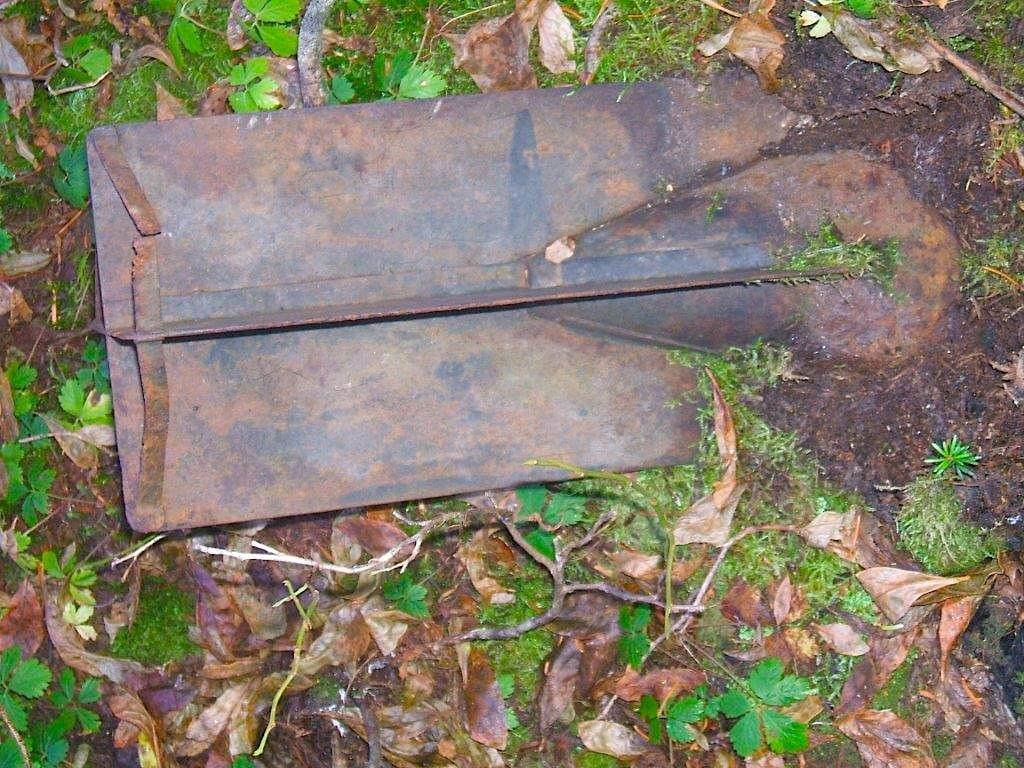
The remains of a Japanese balloon bomb found in the Monashee Mountains near Lumby, BC in 2014. It was detonated on-site by the bomb disposal unit of Maritime Forces Pacific of the Royal Canadian Navy.

There is a strong temptation to blame the Japanese balloon bombs for what happened next, because the U.S. unaccountably entered the Cold War as the most pugnacious exponent of clandestine ballooning up to that time. Whatever the explanation, the epic struggle between the United States and the Union of Soviet Socialist Republics plunged U.S. ballooning into a tangle of psychological warfare, shadowy science, under-the-table finances, and clandestine belligerence indistinguishable from military attacks. Plus, UFOs and breakfast foods were involved (seriously).

America’s War on Japanese Shipping – WW2 Special Documentary

Filed under: History, Japan, Military, Pacific, USA, WW2 — Tags: , , — Nicholas @ 04:00

World War Two
Published 15 Feb 2023

We’ve covered in great depth the Battle of the Atlantic and the war by and against German U-Boats, but what about the other side of the world? Why has the war on Japanese shipping been so much quieter? There are several very specific reasons for that, which we look at today.
(more…)

February 12, 2023

German Desperation in Korsun Pocket – Week 233 – February 11, 1944

Filed under: Britain, France, Germany, History, Italy, Japan, Military, Russia, USA, WW2 — Tags: , , , , , — Nicholas @ 04:00

World War Two
Published 11 Feb 2023

It is crisis mode in the Korsun Pocket this week for the Axis troops surrounded, but they are also losing ground all over the Eastern Front this week, including the big prize of Nikopol. In Italy, it is a different story as the Germans play offense at Anzio, though with only small gains.
(more…)

February 10, 2023

When “Taffy 3” kicked the ass of the pride of the Imperial Japanese Navy

Filed under: History, Japan, Military, Pacific, USA, WW2 — Tags: , , — Nicholas @ 05:00

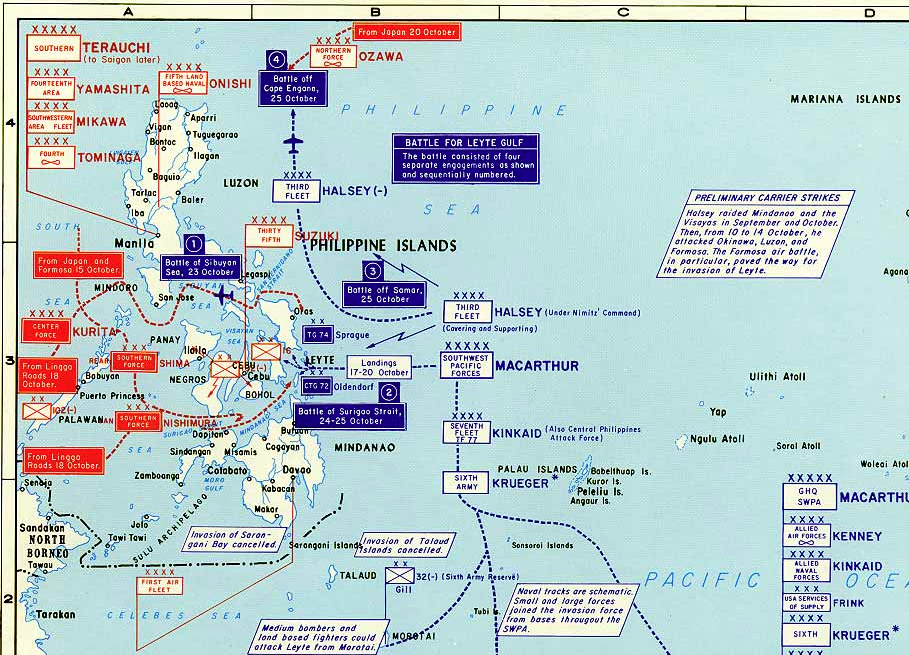
Chris Bray isn’t a milblogger, but I thought his summary of the Battle of Leyte Gulf was pretty darned good:

In October of 1944, US troops landing on Leyte Island in the Philippines were menaced from the sea by an enormous Japanese naval fleet that was divided into three separate attack forces.

Detail of the West Point Military Atlas: World War II: Asia-Pacific Invasion of Leyte, October 1944 map.
https://www.westpoint.edu/sites/default/files/inline-images/academics/academic_departments/history/WWII%20Asia/ww2%2520asia%2520map%252029.jpg

Summarizing aggressively, the American ground forces were protected against an attack from the sea by the US Navy’s Third Fleet, commanded by Bull Halsey. But Halsey suddenly wasn’t there anymore, taking the bait of a decoy attack force [of de-planed Japanese carriers] and chasing it out into the sea. The Third Fleet’s departure uncovered Leyte Gulf, and the largest of the Japanese attack forces sailed in. Disaster became likely.

There were two American naval task forces in the path of the Japanese attack force, Taffy 2 and Taffy 3, but neither were meant for serious naval combat. They were supporting forces, designed to help the troops on the ground: a few escort carriers, a few lightly armed destroyer escorts, a very few destroyers. Aircraft on the American escort carriers were armed with 100-pound bombs to provide close air support to the infantry. The Japanese First Task Force had four battleships, eight cruisers, and eleven destroyers. One of the Japanese battleships was the Yamato, armed with 18-inch guns. The Japanese attack force sailed directly into contact with Taffy 3, which didn’t realize they were about to face the main Japanese attack force until they were already within range of its guns.

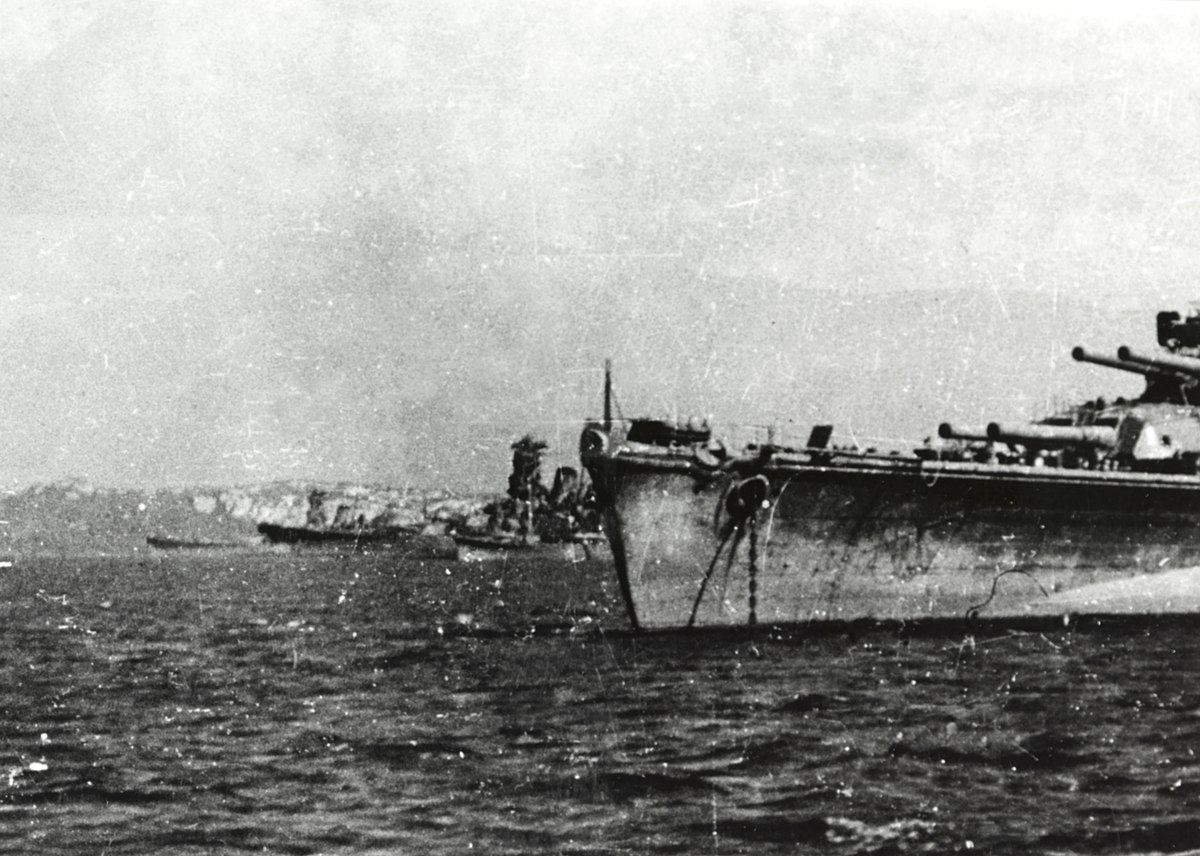
Imperial Japanese Navy ships at anchor in Brunei, Borneo shortly before the Battle of Leyte Gulf. Left to right, Musashi, Yamato, an unidentified cruiser, and Nagato.
Photo by Kazutoshi Hando from the US Naval History and Heritage Command collection.

The commander of Taffy 3, Rear Admiral Clifton Sprague, saw immediately that his task force couldn’t survive the engagement, so he tried to salvage what he could: He ordered his destroyers and destroyer escorts to attack, to cover the hoped-for withdrawal of the escort carriers. The resulting battle is one of the best-known in naval history — and one of the least plausible, because Taffy 3 kicked the everloving shit out of that much larger Japanese attack force, compelling the Japanese to withdraw in the panicked belief that they’d sailed into the bulk of Halsey’s Third Fleet.

If you haven’t read [the late] James Hornfischer’s magnificent book about the battle, The Last Stand of the Tin Can Sailors, you should read it. The details are far beyond anything that could be summarized in a single short piece. But the battle was won by a remarkable combination of disciplined obedience, independent audacity, and a paradoxically disciplined disobedience — by men aggressively refusing to obey orders that threatened their cause.

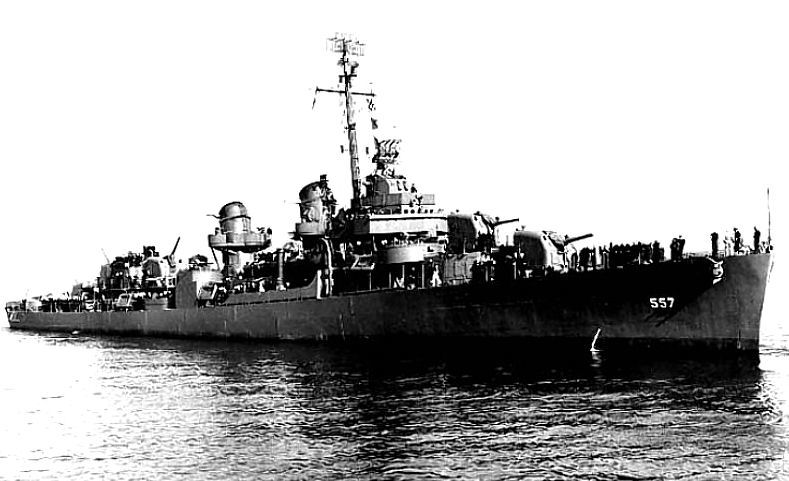
The Fletcher-class destroyer USS Johnston (DD-557), sunk in the Battle off Samar, 25 October, 1944.
US Navy photo with enhancement work by Wild Surmise via Wikimedia Commons.

The battle began with one of the US Navy’s most famous moments. Before Sprague had time to order anyone to do anything, the captain of the Johnston, one of Taffy 3’s few destroyers, turned to attack the Japanese fleet. We have confused and contradictory accounts of the orders given by Cmdr. Ernest Evans, because the man who gave them, and most of the men who heard them, died soon afterward, but he is supposed to have said something like this:

1.) We’re under the guns of a much larger Japanese fleet.

2.) Survival is not to be expected.

3.) Hard left rudder, all ahead flank.

We’re all going to die; attack. The Johnston sank, and Evans died, but his first torpedo run blew the bow off a Japanese cruiser — setting the tone of the fight.

February 5, 2023

Leningrad: NO STEP BACK! – Week 232 – February 4, 1944

World War Two
Published 4 Feb 2023

The Allies begin a new operation in the Pacific this week: assaulting the Marshall Islands. They also make big attacks from their beachhead in Italy at Anzio, but these are called off after only a few days in the face of heavy enemy resistance. However, in the USSR there are several successes against the Axis, as they are pushed back both in the far north and the far south of the front, and still surrounded near Korsun.
(more…)

January 31, 2023

The Allied Flying Aces of World War Two – Documentary Special

Filed under: Britain, Germany, Greece, History, Japan, Military, Russia, USA, WW2 — Tags: , , , , — Nicholas @ 04:00

World War Two
Published 30 Jan 2023

Young, daring, and handsome, the Allied fighter aces of World War Two have captivated the public with their thrilling exploits. Join us as we take a look at the top scorers! Thanks to Curiosity Stream for sponsoring today’s video.
(more…)

January 29, 2023

Anzio Begins – Allies Already Pinned Down – Week 231 – January 28, 1944

World War Two
Published 28 Jan 2023

Some big news is the Allies amphibious offensive to hit the Germans behind their lines at Anzio in Italy, some other big news is that after nearly two and a half years, the Soviets have broken the siege of Leningrad and their twin northern offensives keep pushing back the enemy. Yet more big news is that the Soviets have managed to surround and cut off over 50,000 Axis troops near Korsun. This is one big week of action!
(more…)

January 23, 2023

Monte Cassino, the Battle Begins – Ep 230 – January 21, 1944

Filed under: Britain, Germany, History, Italy, Japan, Military, Pacific, USA, WW2 — Tags: , , , , , — Nicholas @ 04:00

World War Two
Published 21 Jan 2023

The Allies have reached the linchpin of the German defenses in Italy, but a first attack proves disastrous. It does, though, divert troops from where they soon plan to make landings behind enemy lines. Meanwhile in the USSR, the huge Soviet offensive in the north makes great gains against the stunned Axis forces.
(more…)

January 21, 2023

When the SS Go Too Far – War Against Humanity 096

World War Two
Published 20 Jan 2023

The internal conflict between Poland and the other United Nations Allies deepens as Churchill faces them with diplomatic defeat over Soviet land grab. In the Occupied Netherlands and Poland the Nazis continue their atrocities.
(more…)

« Newer PostsOlder Posts »

Powered by WordPress