Quotulatiousness

July 3, 2018

Andrés Manuel López Obrador wins Mexican presidential election

Filed under: Americas, Government, Politics — Tags: , — Nicholas @ 03:00

Tom Phillips and David Agren report from Mexico City for the Guardian:

A baseball-loving leftwing nationalist who has vowed to crack down on corruption, rein in Mexico’s war on drugs and rule for the poor has been elected president of Latin America’s second-largest economy.

Andrés Manuel López Obrador, President-Elect of Mexico, who will assume office on 1 December, 2018
Photo via Wikimedia Commons

Andrés Manuel López Obrador, a silver-haired 64-year-old who is best known as Amlo and counts Labour leader Jeremy Corbyn among his friends, was elected with at least 53% of the vote, according to a quick count by Mexico’s electoral commission.

López Obrador’s closest rival, Ricardo Anaya from the National Action party (PAN), received around 22% while José Antonio Meade, a career civil servant running for the Institutional Revolutionary party, or PRI, which ruled Mexico for most of last century, came in third with around 16%.

Addressing the media after those results were announced, López Obrador vowed to repay the trust put in him by millions of Mexicans. “I will govern with rectitude and justice. I will not fail you. I will not disappoint you. I won’t betray the people,” he said.

Mexico’s president-elect vowed to rule for people of all social classes, all sexual orientations and all points of view. “We will listen to everyone. We will care for everyone. We will respect everyone,” he said. “But we will give priority to the most humble and to the forgotten.”

[…]

Analysts also expect him to pursue a less aggressive and less militarised approach to Mexico’s 11-old ‘war on drugs’ which has claimed an estimated 200,000 lives and is widely viewed as a calamity. During the campaign, Amlo has argued “you cannot fight violence with more violence, you cannot fight fire with fire” and proposed an amnesty designed to help low-level outlaws turn away from a life of crime.

Eric Olson, a Mexico and Latin America specialist from Washington’s Woodrow Wilson Centre, said he saw Mexico stepping back from regional affairs under its new leader. “Amlo is not an internationalist … we can expect him to play less of an active role in the region on Venezuela, on Nicaragua and other trouble spots.”

Olson also expected tense moments with US president Donald Trump whose family separation policy Amlo recently denounced as arrogant, racist and inhuman. “But it’s impossible for the US to walk away from Mexico or for Mexico to walk away from the US. They are joined at the hip and need to work together even if their presidents don’t like each other and don’t get along.”

Carlos Bravo, a politics expert from Mexico City’s Centre for Economic Research and Teaching, predicted President Amlo would make fighting poverty a flagship policy, just as former Brazilian president Luiz Inácio Lula da Silva did after his historic 2002 election with projects such as Bolsa Família and Zero Hunger. Under Amlo he foresaw “massive investment in social policy” which Mexico’s new president could use to show he was attacking not just poverty and inequality but also the social roots of crime and violence.

However, Bravo said the “motley coalition” behind Amlo’s election triumph was so diverse – featuring former communists, ultra-conservatives and everything in-between – that trying to guess how he might rule was a fool’s errand. “Quite frankly, right now there is a lot of uncertainty regarding what the López Obrador government will do.”

June 29, 2018

Honduran refugees and the hellhole they’re fleeing

Filed under: Americas, Business, History, USA — Tags: , , , , , — Nicholas @ 03:00

Justin Raimondo on the plight of Honduras, and how it got to be the hellhole it is:

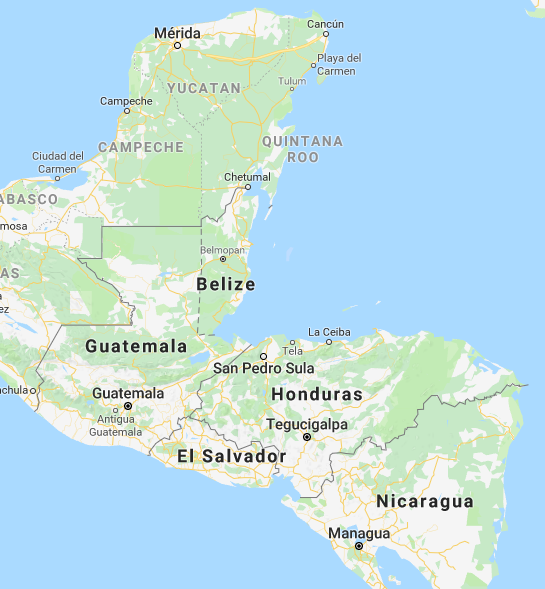
Honduras, Guatemala and El Salvador
Image via Google Maps.

As tens of thousands gather at our southern border, roiling US politics, the question arises: why are so many of the asylum-seekers and migrants crossing the border illegally from three Central American countries in particular: El Salvador, Honduras, and Guatemala?

To begin with, it’s no coincidence that these are the three “most invaded” countries south of the Rio Grande – that is, invaded by the United States and its proxies.

[…]

So what are these “refugees” fleeing? Is it so bad that parents are justified in paying smugglers to guide their underage children – traveling alone! – across the US-Mexican border?

Unlike the rest of the media, which has routinely ignored most of what goes on in Latin America since the end of the cold war, I’ve been covering the region regularly. […] As I wrote last year:

    “Honduras has always been an American plaything, to be toyed with for the benefit of United Fruit (rebranded Chiquita) and the native landowning aristocracy, and disciplined when necessary: Washington sent in the Marines a total of seven times between 1903 and 1925. The Honduran peasants didn’t like their lands being confiscated by the government and turned over to foreign-owned producers, who were granted monopolistic franchises by corrupt public officials. Periodic rural revolts started spreading to the cities, despite harsh repression, and the country – ruled directly by the military since 1955 – returned to a civilian regime in 1981.”

That column was about the Hillary Clinton-endorsed coup against the democratically elected President, Manuel Zelaya. The popular conservative-turned-reformer had pushed through a number of measures designed to alleviate the peasantry’s hopeless poverty and shift power from the military to the presidency, which angered the Honduran elite. They were triggered, however, when Zelaya joined the ALBA alliance of Latin American countries allied with Hugo Chavez’s Venezuela. While ALBA never really amounted to much, either economically or militarily, the symbolism of this move was too much for the Honduran military, which was trained in the US and generously subsidized by Washington. The generals soon had Zelaya on a plane out of the country – while still in his pajamas. Washington issued a perfunctory scolding, but Hillary’s State Department had approved the coup in advance. It’s always been done that way, and this time was no exception.

[…]

So is the Honduran hegira to the Rio Grande a direct result of US foreign policy: is it “blowback,” to utilize CIA parlance for the unpleasant consequences of US actions abroad? It would be easy to say this is yet another example of how our foreign policy of global intervention comes back to haunt us, because that is partially true. Yet the old familiar story of the Ugly Americans backing the even uglier Local Despot doesn’t quite fit the most current facts: there has been an amazing drop in US military aid to Honduras. In 2017 it was over $19 million. This year it’s a mere $750,000!

The history of Honduras before the rise of American hegemony has done more to shape the country than any other single factor: the vital question of land ownership is the central issue here and in the entire South. Feudalism was never really abolished, and the feudalist remnants that persist to this day in the region delayed economic and technological development and kept the vast majority in penury. US foreign policy helped to sustain the life of this systemic repression: it didn’t create it. Whatever the “root causes,” the blowback from all this history has created something very close to a failed state.

This is why tens of thousands are making the long trek to the US-Mexican border: the social and institutional basis of human civilization is breaking down, not only in Honduras but throughout Latin America. Yet this is neither new nor is it primarily attributable to the actions of the US. Yes, our “war on drugs” has created a criminal class that is rivaling the power of the local governments to keep order, but hard drugs are illegal everywhere, not just in North America.

May 22, 2018

The Fightinest Marine – Dan Daly I WHO DID WHAT IN WW1?

Filed under: Americas, China, History, Military, USA, WW1 — Tags: , , — Nicholas @ 04:00

The Great War
Published on 21 May 2018

Dan Daly was one of only two Marines to be awarded Medals of Honor in two separate conflicts. The first, for his actions in 1901 during the China relief. His second, for his actions during the U.S. invasion and occupation of Haiti in 1915. But he wasn’t done yet and after the U.S. entry into WW1 in April 1917, he was close to receiving his third one on the battlefield of Belleau Wood in France.

April 4, 2018

DicKtionary – I is for Investment – Gregor MacGregor

Filed under: Americas, History — Tags: , , , , , , — Nicholas @ 04:00

TimeGhost
Published on 3 Apr 2018

I for investment, for financial success,
Or for a failure, cause it’s hard to guess,
But if there’s one man who could make you a beggar,
It’s today’s star, Gregor MacGregor.

Join us on Patreon: https://www.patreon.com/TimeGhostHistory

Written and Hosted by: Indy Neidell
Based on a concept by Astrid Deinhard and Indy Neidell
Produced by: Spartacus Olsson
Executive Producers: Bodo Rittenauer, Astrid Deinhard, Indy Neidell, Spartacus Olsson
Camera by: Ryan Tebo
Edited by: Bastian Beißwenger

A TimeGhost format produced by OnLion Entertainment GmbH

March 16, 2018

QotD: Achieving socialist nirvana

Filed under: Americas, Economics, Government, Quotations — Tags: , , , , — Nicholas @ 01:00

The evidence is in. Again. Socialism and government statism is the only way to eliminate income inequality.

As reported in Reuters, a 3 university study of conditions in Venezuela has shown that 90% of citizens now live in poverty. But socialism can only achieve so much. The other 10% must suffer in abject affluence so that the 90% can have income equality.

That in Venezuela income equality necessitates poverty is a design feature of the policy and not a fault.

Venezuela has also demonstrated that socialism can not only eliminate income inequality, it can also eliminate obesity. There was no need to deploying a sugar tax, when the income equalization policies achieved the same ends. You see, Venezuelans reported losing an average of 11 kilograms in 2017. This was on top of losing an average of 8 kilograms in 2016.

Viva Venezuela. Viva Chavez. Viva Maduro.

“I Am Spartacus”, “Nirvana – income equality and a truly fair society”, Catallaxy Files, 2018-02-23.

March 3, 2018

Cuban Missile Crisis – Black Saturday – Extra History – #3

Extra Credits
Published on 1 Mar 2018

*Sponsored by DomiNations: https://smarturl.it/CubanMissile1

With simultaneous nuclear tests by both the US and Russia, and tense miscommunications among troops on the ground, in the air, and on the water, the doomsday clock ticked to 11:59 PM for one fateful day.

February 24, 2018

“Oxfam, like many large British charities, has long been a villainous organisation”

Filed under: Africa, Americas, Britain — Tags: , , , , , — Nicholas @ 03:00

Theodore Dalrymple puts the boots to Oxfam:

It is very wrong, morally, to take pleasure in the misfortunes of others, but I cannot disguise from myself the intense pleasure, amounting almost to joy, with which I learned of the public exposure of the wrongdoings of Oxfam in Haiti, Chad, and elsewhere. Its workers, sent to bring relief to the acute and chronic sufferings of those countries, used the charity’s money, partly derived from voluntary contributions and partly from government subventions (the British government and the European Union are by far the largest contributors to British Oxfam), to patronise local prostitutes, some of them underage, and also to conduct orgies, no doubt at a fraction of what they would have cost to conduct at home.

Oxfam, at least in Britain, has long been one of the most Pecksniffian of organisations, much give to auto-beatification. Mr. Pecksniff, in Dickens’ Martin Chuzzlewit, introduces his daughters, called Charity and Mercy, to Mrs. Todgers, adding ‘Not unholy names, I hope.’ It is therefore of the hypocritical Mr. Pecksniff that I think whenever I pass the Oxfam shop in my small town, with its unctuous slogan, Thank you for being humankind, posted in the window. It is only with difficulty that I resist the urge to throw a brick through it.

Of course, Oxfam, like many large British charities, has long been a villainous organisation — and the sexual exploits (or should I say exploitations?) of its workers in Haiti and elsewhere are the least of it. In the moral sense, though not the legal, it has for many years been guilty of fraud, of misleading the public.

I first realised this some years ago when I found a used book dealer of my long acquaintance poring in his shop over Oxfam’s annual accounts.

‘Look at this,’ he said, but I saw nothing until he pointed it out to me.

Oxfam, in common with many other charities in Britain, runs thrift stores in practically every British town and city. Such thrift stores are now more numerous even than Indian restaurants: they allow people to give away their unwanted belongings in the belief that, by so doing, they are furthering a good cause.

My acquaintance pointed out that, despite receiving their goods free of charge, paying practically nothing for their labour (which was voluntary), and paying much reduced local taxes, Oxfam shops made a profit on turnover of a mere 17 per cent, much less than his own, despite his incomparably greater expenses. How was such a thing possible, by what miracle of disorganisation (or malversation of funds)?

Until then, I had carelessly assumed that the great majority of any money that I gave to a large charity went to serve its ostensible end, say the relief of avoidable suffering. I was not alone in this, of course. When I asked the volunteer ladies in a local shop run on behalf of the British Red Cross what percentage of the money I paid for a book there went to the Red Cross, they looked at me as if I were mad.

‘Why, all of it of course,’ piped up one of the ladies.

The real average figure at the time for Red Cross thrift stores was 8 per cent; but the volunteer ladies supposed, because the goods they sold were free to the Red Cross and they themselves were not paid, that (apart from a small amount for unavoidable expenses) all the money raised went directly to victims of earthquakes and the like.

February 23, 2018

Cuban Missile Crisis – Eyeball to Eyeball – Extra History – #2

Extra Credits
Published on 22 Feb 2018

Sponsored by DomiNations: https://smarturl.it/CubanMissile1

After President Kennedy’s television address, tensions are rising. Fidel Castro is getting annoyed at the US and Soviet Union alike, and everyone else has their own ideas on what retaliation looks like.

February 17, 2018

Cuban Missile Crisis – I: The Failed Checkmate – Extra History

Extra Credits
Published on 15 Feb 2018

An eye for an eye, a missile for a missile — that’s how the saying goes, right? So thought the Soviet Union and the United States in the early fall of 1962, kicking off a 13-day staring contest that scared the world.

February 13, 2018

Feature History – Seven Years’ War

Filed under: Americas, Britain, Europe, France, History, India, Military, Russia — Tags: , , , — Nicholas @ 02:00

Feature History
Published on 14 Jan 2017

Hello and welcome to Feature History, featuring the Seven Years’ War, an overdue video, and the reason you don’t record after just waking up

February 2, 2018

Castro’s son “Fidelito” is dead

Filed under: Americas — Tags: , , , — Nicholas @ 05:00

BBC News just reported:

The 68-year-old son of Cuban revolutionary Fidel Castro, Fidel Ángel Castro Díaz-Balart, has died in Havana after taking his own life, according to state media.

He was found on Thursday morning and is said to have suffered from depression.

Popularly known as “Fidelito”, he was first born son of the former president, who died in November 2016.

Castro Díaz-Balart worked as a nuclear physicist and an adviser to the Council of the State of Cuba.

January 28, 2018

Day 13 Cuban Missile Crisis – The End to End All Things and Almost Everything

TimeGhost
Published on 21 Dec 2017

On Sunday, 28 October, 1962 the Cuban Missile Crisis is supposed to end, but there are still two nuclear armed Soviet submarines in the waters around the island hunted by the US Navy. And what about Fidel Castro?

January 27, 2018

Day 12 Cuban Missile Crisis – Black Saturday, nuclear war on autopilot…

TimeGhost
Published on 7 Dec 2017

On October 27, 1962 a deal to resolve the Cuban Missile Crisis is ever so close, but then almost everything that can go wrong, goes wrong. Political confusion between the leaders, lost and shot down airplanes, errant nuclear armed submarines and exhaustion takes its toll. For those immediately involved it will go down in memory as the Black Saturday.

January 26, 2018

Day 11 Cuban Missile Crisis – Will President Kennedy invade Cuba after all?

TimeGhost
Published on 30 Nov 2017

On 26 October 1962, USSR Premier Nikita Khrushchev is preparing to offer the US an olive branch. Meanwhile US President John F Kennedy continue to plan an invasion of Cuba. While the politicians make new plans, their previous military plans take on a life of their own

January 25, 2018

Day 10 Cuban Missile Crisis – Showdown at the U.N. Corral

TimeGhost
Published on 27 Nov 2017

On October 25, 1962 while the US Navy are looking for something to do in the Caribbean, both USSR Chairman Khrushchev and US President Kennedy are questioning the success of their actions. Meanwhile US Ambassador to the UN Adlai Stevenson is about to face off with USSR Ambassador to the UN, Valerian Zorin in a historic showdown at the United Nations headquarters in New York.

« Newer PostsOlder Posts »

Powered by WordPress