
Handre discusses the book George Soros wrote (or had written) after he gained a huge sum of money by speculating against the Bank of England in the 1990s:
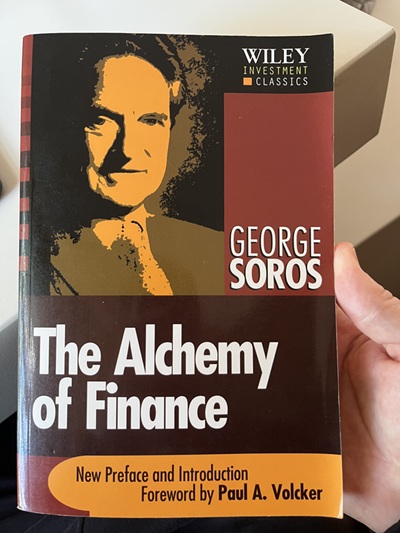
George Soros made a billion dollars betting against the Bank of England in September 1992, and then he wrote a book explaining that markets are fundamentally irrational. Notice the tension there.
The Alchemy of Finance, published in 1987, gives you Soros’s theory of reflexivity. The idea runs like this: participants in a market do not observe prices from the outside. They shape the reality they are trying to measure. Their biased expectations feed into prices, prices feed back into expectations, and the whole thing spirals away from any “equilibrium”. Soros presents this as a devastating blow to the neoclassical economists who model markets as tidy machines grinding toward a single clearing price.
He is right, but misses one fundamental point. The equilibrium fetish deserves a beating. Ludwig von Mises and Friedrich Hayek spent decades explaining that the market is a process, not a photograph, and that no equation captures the discovery going on inside it. Prices carry dispersed knowledge. Entrepreneurs guess, act, and get corrected by profit and loss. Soros rediscovered a slice of this in his trading room, and called it “alchemy”.
But, Soros treats his “far from equilibrium” boom-bust sequences as proof that free markets are inherently unstable and require an adult (usually a central bank, sometimes Soros himself) to supervise them. He points at the credit bubbles of the 1980s and sees capitalism failing. He never asks who prints the credit.
The Federal Reserve does. Cheap money floods in, entrepreneurs misread the artificially low interest rates as real savings, and they pile into projects that cannot pay off. That is the boom. The bust arrives when reality collects its debt. Soros describes the symptom with real skill and misses the pathogen entirely.
So the man who broke sterling by exploiting a currency that politicians pegged at a lie somehow concludes that governments need more discretion, not less. The 1992 pound was a government price-fix collapsing, exactly as Mises predicted such fixes always do.
The reflexivity part is spot on, but send the bill for the bubbles to the people with the printing press.


