
The music here is “free-form jazz”, which appears to be several heroin addicts chasing a melody glimpsed in a hallucination.
James Lileks, The Bleat, 2005-09-05.
December 15, 2025
QotD: Free-form Jazz
Comments Off on QotD: Free-form Jazz
December 14, 2025
Andrea Dworkin – feminism’s anti-sex evangelist
On her Substack, Janice Fiamengo examines the life and work of Andrea Dworkin, whose influence on modern feminism is still quite strong, twenty years after her death:

A friend wrote a couple of days ago to say that he had seen shiny new copies of works by feminist author Andrea Dworkin (1946-2005) in Munro’s Books, one of Canada’s premier independent bookstores. One of the books was positioned on a shelf with the cover facing out to indicate that it was being showcased.
It is both shocking and unsurprising that Picador Books decided to reprint three of Dworkin’s texts in the past year, calling her a “prescient and visionary writer” who was “ahead of her time”. Anti-male paranoia is a sanctioned, cultivated taste more popular now, perhaps, than ever before, and Andrea Dworkin is its most notorious propagandist.
Known for her physical bulk, impassioned rhetoric, unkempt hair, and lesbian-identified overalls, Dworkin was a feminist icon in the 1980s and 90s, loved and hated in equal measure. No one did more to outline and consolidate the modern feminist understanding of sex than she, writing on the subject obsessively and with unparalleled fervor in books with titles such as Woman Hating (1974) and Pornography: Men Possessing Women (1981). The MeToo movement is almost unimaginable without the influence of Dworkin’s pronouncements.
Like other radical feminists, Dworkin wrote about rape, pornography, and prostitution, but her special focus was the degradation for women of sex itself: regular sex, the commonly accepted, normalized indignity that men allegedly inflict on women every day. Tempering her words in the white-heat of her revulsion, Dworkin became feminism’s anti-sex evangelist.
Sex, Dworkin believed, embodied nothing less than men’s hatred of everything female: “Intercourse is the pure, sterile, formal expression of men’s contempt for women” (p. 175). This is the thesis of her most representative book, Intercourse, which was first published in 1987 when Dworkin was 41 years old. Dworkin’s characterization of heterosexual sex as the ultimate enactment of misogyny has had an enduring impact on North American culture.
Intercourse set out to illuminate, through select readings of literary texts, what Dworkin believed to be a constant of male culture: the “hatred of women, unexplained, undiagnosed, mostly unacknowledged, that pervades sexual practice and sexual passion” (pp. 175-76). The phrase she most often used in the book to refer to intercourse was “the fuck”, which was meant to signify the raw dehumanization that supposedly characterized it.
Dworkin nominated herself the expert on male contempt for women because she had been its victim. “Specifically, am I saying that I know more than men about fucking?” she asked defiantly in the book’s preface, and answered, “Yes, I am […] the way anyone used knows the user” (p. xxxi).
While she also claimed in the preface that the book “does not say that all men are rapists or that all intercourse is rape” (p. xxxii), she does essentially say that, if not in quite those words. As she asserted only a page after the denial, “Intercourse conveys […] what it means that men — and now boys — feel entitled to come into the privacy of a woman’s body in a context of inequality” (p. xxxiv).
In another segment, she clarified that most, even the vast majority, of men were sexually abusive. She charged that men object to feminist criticism of pornography and prostitution because “So many men use these ignoble routes of access and domination to get laid,” that “without them the number of fucks would so significantly decrease that men might nearly be chaste” (p. 61). The implication was that men who objected to her arguments about the omnipresence of sexual exploitation were themselves sexual abusers who didn’t like the thought of their exploitation being curtailed.
This was the Dworkin who made feminists swoon with admiration: bombastic, hyperbolic, and incandescent with accusatory rage.
Comments Off on Andrea Dworkin – feminism’s anti-sex evangelist
Hitler becomes a German – Rise of Hitler 23, January-March 1932
World War Two
Published 13 Dec 2025The big news this winter is the German Presidential elections, held now in March for the first time since 1932, which pit current President Paul von Hindenburg against Nazi Party leader Adolf Hitler. Hitler, though, must become a German citizen before he can run; he been stateless since he gave up his Austrian citizenship seven years ago. The campaigns are quite different, but both effective, and the German people head for the polls.
(more…)
Comments Off on Hitler becomes a German – Rise of Hitler 23, January-March 1932
Where does all the money go for so many First Nations bands?
Earlier this month, I shared a long thread highlighting some incredible findings from the audit of a single First Nations group in Saskatchewan (here). On the social media site formerly known as Twitter, @Martyupnorth discusses how the federal government has gone out of its way not to ensure that First Nations funding is transparent:
Cory Morgan @CoryBMorgan
The Siksika reserve got $1.3 billion a few years ago and the housing is still predominantly shit.It’s not lack of government funding folks.
It’s a broken system of racial apartheid.
This ruling won’t help a bit.
Let’s talk about transparency in First Nations reserve finances in Canada. It’s topic that’s sparked a lot of debate.
Back in 2013, the Harper government passed the First Nations Financial Transparency Act (FNFTA), which required chiefs and councils to publicly disclose their salaries, expenses, and audited financial statements. The goal? To ensure accountability for the billions in federal funding going to reserves, empowering community members to hold leaders responsible and curb potential corruption.
But the Act was controversial from the start. Critics, including many First Nations leaders (no surprise there), called it paternalistic, imposed without proper consultation, and an infringement on Indigenous sovereignty. Some argued it violated privacy by forcing the public release of sensitive financial details, like personal remuneration schedules.
Enter Justin Trudeau. During his 2015 campaign, he promised to repeal the FNFTA, saying it wasn’t “respectful” to First Nations and needed replacement with a co-developed approach. Once in power, his government didn’t formally repeal the Act, but effectively reversed it by suspending enforcement. They stopped withholding funds from non-compliant bands, halted court actions, and reinstated frozen money. Compliance rates plummeted afterward, with fewer bands disclosing info publicly.
See the screen shot below. The Siksika Nation, to whom Cory refers to, hasn’t dislosed financial data since 2013.
The Liberals’ rationale? Building “mutual accountability” through partnership rather than top-down rules, addressing privacy concerns and respecting self-governance. But a decade later, as of 2025, the Act remains on the books unenforced, while polls show most Canadians still want transparency in how reserve funds are mis-managed.
What do you think? Does ditching enforcement help or hinder real accountability?
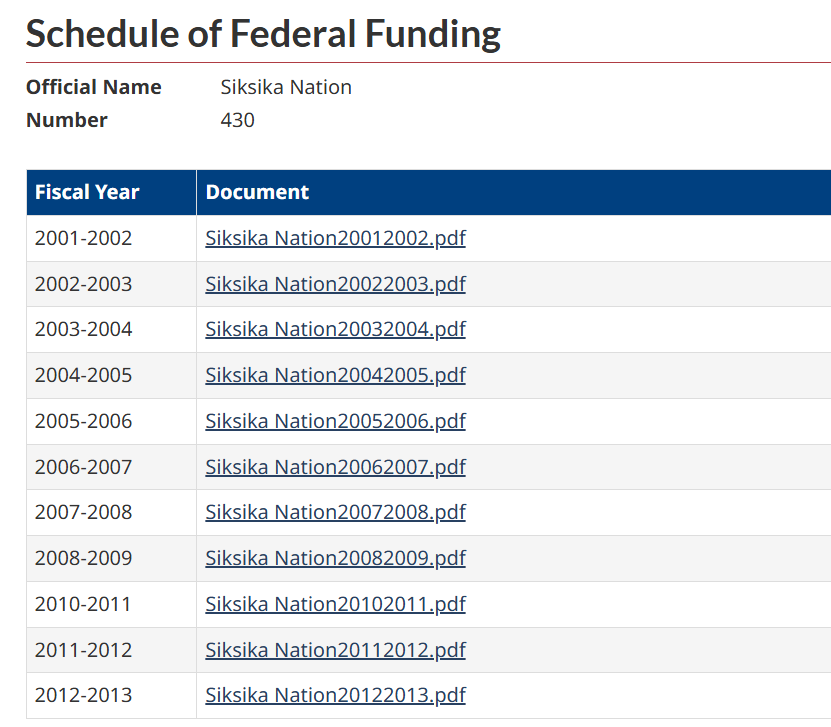
Update: At some point, the audits have to start and the government and the courts will then have their hands full:
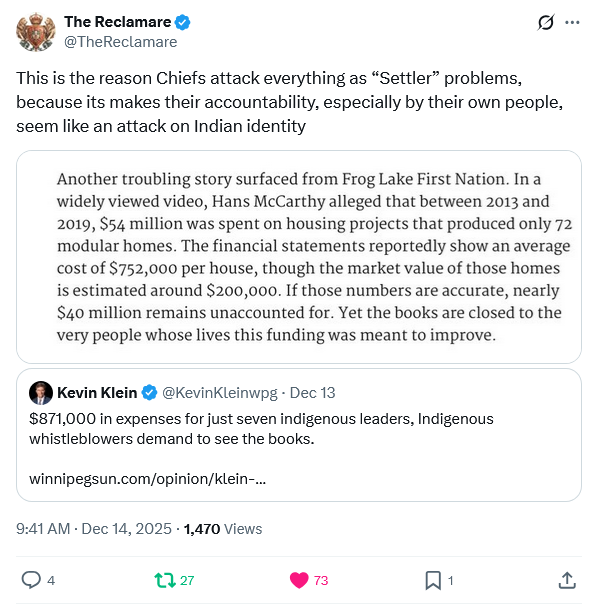
Comments Off on Where does all the money go for so many First Nations bands?
A Fire Upon The Deep and the Identity Gradient
Feral Historian
Published 8 Aug 2025Vernor Vinge’s A Fire Upon The Deep would take a two-hour video to completely dissect. This is not that video. Instead, I’m looking just at the recurring ideas of collective identity and distributed consciousness. And all without a single mention of Skroderiders.
This one has been sitting around for about a year, due to lack of b-roll to cover the numerous jumpcuts due to my rambling and the rather persistent flies on that particular day. It’s a little rough, but let’s just roll with it.
(more…)
Comments Off on A Fire Upon The Deep and the Identity Gradient
QotD: Why are Castles?
Castles differ from that other standby of medieval fortifications — city walls — in one crucial way, and that difference sheds a lot of light on their military application.
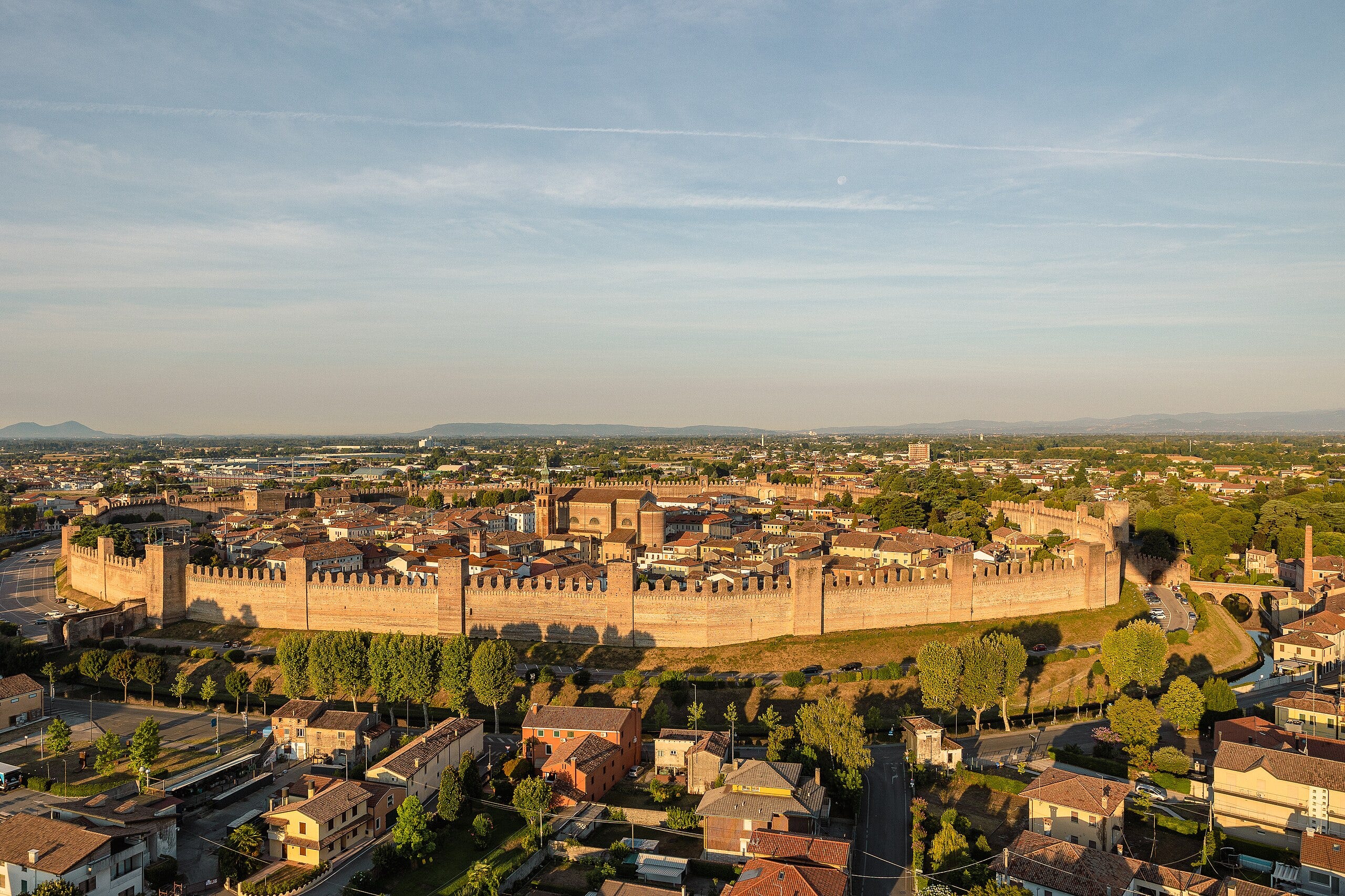
The walls of Cittadella, Italy (photo by Edoardo Bortoli, CC BY-SA 4.0).
A massive city wall, like the one shown above, has the very clear purpose of limiting access to a city or town. Close the gates, and no one can get in. Try to get in, and we’ll shoot you! The walls are meant to protect the settlement, both its inhabitants as well as its structures and physical wealth.
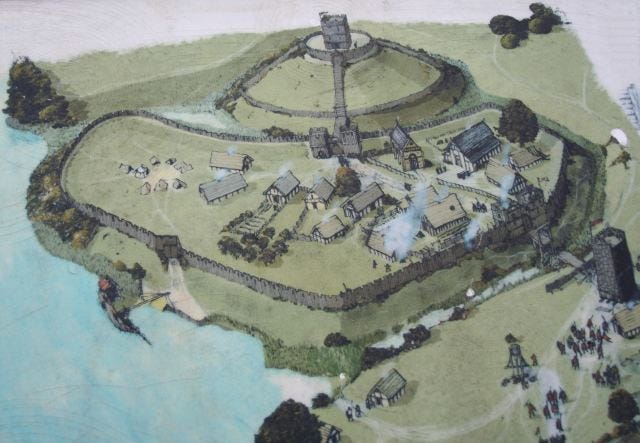
A castle, on the other hand, has a much smaller footprint than a city. It might only be a few buildings and a courtyard. Indeed, as we’ll see later in the series, the earliest castles (the classic “motte and bailey” design) were relatively small fortifications of earth and timber, capable of being built in a matter of days.
Image of a motte and bailey style castle. This particular one would take much longer than a few days to make, but it’s worth noting that even this “primitive” castle of timber and earth would have been a serious problem for any attacker. (Duncan Grey – Display Board of Huntingdon Hill Motte and Bailey Castle – CC BY-SA 2.0).
Especially if a lord was not in residence, a castle might only have a garrison of a few dozen, a far cry from the walls around urban centers that protected thousands or tens of thousands of lives!
So why bother?
Because, unlike a city wall which is meant to defend everything within it, a castle isn’t built in order to protect a tiny bit of land on top of a hill. Instead (say it with me, class): a castle is built to deny an enemy freedom of movement.
It’s not about what’s inside the walls. It’s about what’s outside the walls.
A castle allows you to control a disproportionately large area of land.
That control matters a great deal, because land was the source of wealth in pre-modern contexts. In societies where 80-95% of the populace were farmers, wealth and power came from controlling arable land. Capital did not derive principally from urban centers — wealthy and valuable as those were.1
Before we go further into how that impacts war and politics, I want to take a moment and dig deeper into why a castle allows its owner to control the land, because it’s something that’s usually glossed over, and understanding this dynamic will have a significant bearing on everything else we talk about here.
The Ugly Nature of Rule
As I’ve explained before, in order to actually rule an area, the ruler needs to have a monopoly on legitimate violence within that area. The emphasis here is on legitimate violence, which is significantly different than just “brute force”; force alone will always be a temporary and unstable method of rule. [You can read this explainer for more on that.] A ruler’s legitimacy allows that monopoly to continue unopposed.
One of the main reasons why a ruler needs that monopoly is that it allows for the collection of resources for use by the state. I’m going to lump all this together under the word “taxes”, but to be clear: in pre-modern societies, “taxes” could include manual labor commitments, payments in kind (in crops, in material, etc.), or in cash.
For all that, the ruler needs his agents to have unfettered access to the country he aims to rule; his tax collectors, law enforcers, merchants, judges, and certainly his lords and military all need to be able to move freely throughout the realm in order to do all the necessary business of maintaining law, order, and the collection of taxes.
Those are the most basic elements of statehood, the most basic mechanism of ordinary, everyday governing.
Castles fit into that system the same as any other governmental or administrative center: it’s a place to collect and store resources, a place for state agents to shelter, a locale for arbitration of justice, a residence for a lord … A castle can be a courthouse, police station, secret service listening post, governor’s mansion, and revenue service office all in one.
And a castle is fortified for much the same reasons that governmental buildings across history have always been fortified.
Even if the majority of a subject populace believes your rule is legitimate — a big if! — then there will still be people who chafe at the collection of taxes and who feel wronged by the administration of justice. Those outliers — if indeed they even are outliers — might try something stupid, like taking back their resources or stabbing your
thugspeace-loving tax collectors. Better to have everything locked up, right?And if the castle is large, and visibly imposing? Well that doesn’t hurt, does it?
That’s the every-day purpose of castles, at least in the sense that on any average Tuesday morning, that’s what the castle is for. That’s what people in the castle are doing. Ruling.
Eric Falden, “What Were Castles Actually For?”, Falden’s Forge, 2025-07-29.
1. There are exceptions, of course, such as thassalocratic polities. But sea-faring societies don’t built castles and are therefore WAY outside the bounds of this discussion.
Comments Off on QotD: Why are Castles?
December 13, 2025
Misunderstanding the causes of wealth
As most economists could point out, there’s no point asking what are the causes of poverty, because poverty is the default condition. Getting people out of poverty, that is a much more interesting discussion. Tim Worstall responds to a recent video from someone who clearly doesn’t understand where wealth comes from:
From this video here. Given that Grace [Blakeley] herself posts it she must approve the content.
Because the way that capitalism generates prosperity for some is by generating misery for others. You cannot have universal prosperity in a capitalist system. Just think about, like, this phone. What has happened for me to be able to hold this phone in my hands right now? A bunch of kids in the Democratic Republic of the Congo, at gunpoint, have been sent to scratch coltan out of the ground …
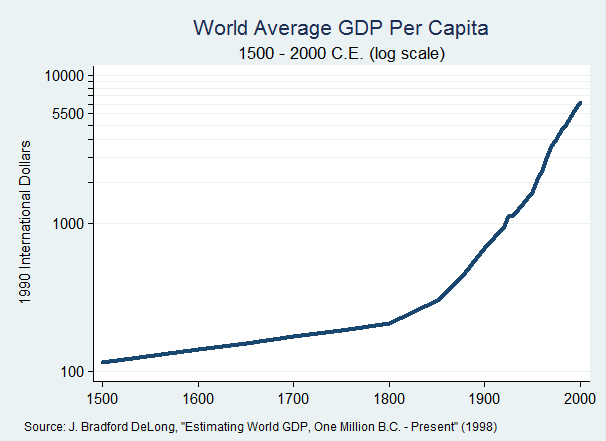
So, first thought. If the world, the economy, is a zero sum game then yes, we can only have some prosperous if others are not — some can only have more pie if others have less. On the other hand if we know how to bake the pie bigger then all can have more at the same time.
So, do we know how to make the pie bigger?
That source of Brad DeLong means yes, this is correct. Where’s that inflexion point, that bend in the curve? About where we start doing capitalism with free markets. As Marx, K himself pointed out capitalism is really very productive.
OK, so we know how to increase the size of the pie, it is possible for all to gain. It is not necessary for some to get less in order for others to gain more. The central contention is wrong. Provably, obviously, wrong.
Oh, sure, sure, it could work out that we take stuff off others in order to feed some. You know, say taxing child carers in order to pay train drivers massive salaries, as we do. But it’s not in fact necessary.
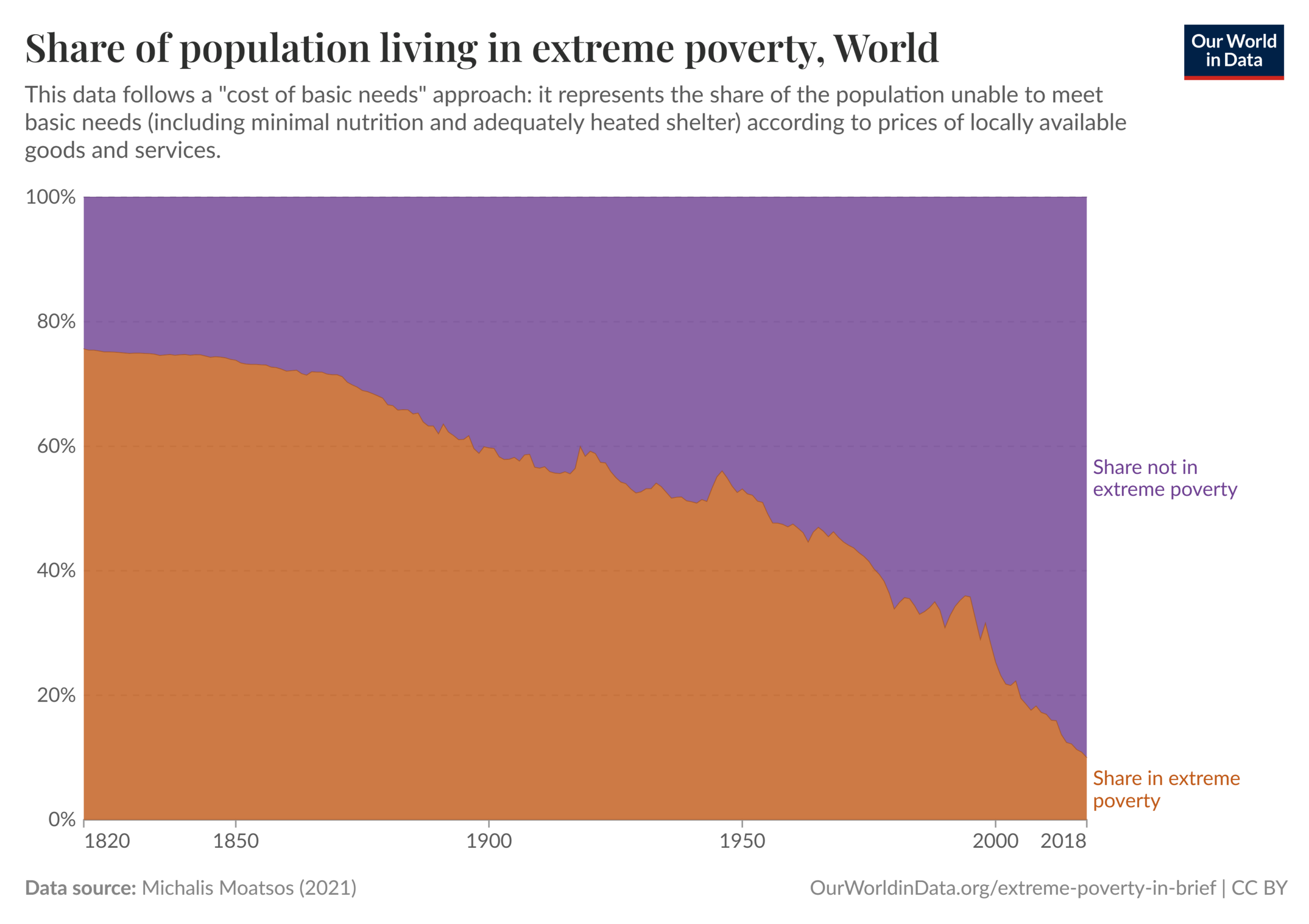
We can also check this another way:
So, lots and lots have become better off in this period of capitalism. Sure, sure, we should do better as a civilisation, we want all to do so. But while so many have got better off no, it is not possible to say that this has been done at the expense of those in extreme poverty. Because extreme poverty itself is set at the subsistence level. If you take stuff off the extreme poor then they die — that’s what subsistence level means. So that majority of humanity has not got rich by nicking it off the extreme poor. Because if they had there would be no extreme poor as they’d all be dead.
So, the overall claim is simply wrong. But it’s also wrong in specifics.
Comments Off on Misunderstanding the causes of wealth
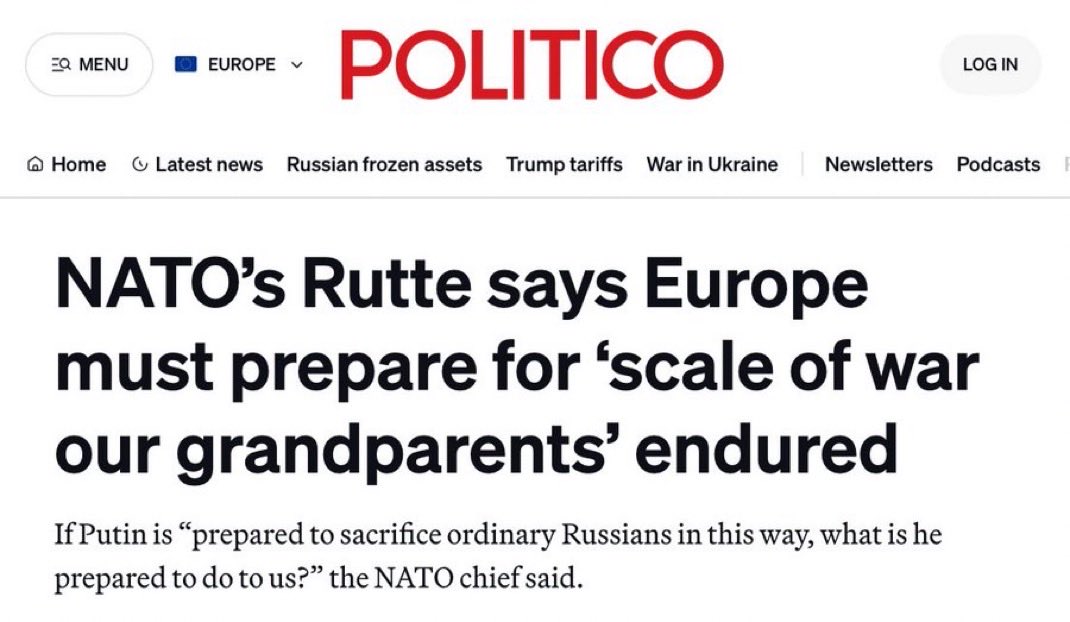
“Europe must prepare for ‘scale of war our grandparents’ endured”
On the social media site formerly known as Twitter, @InfantryDort responds to the NATO Secretary General’s announcement that Europe should gird its collective loins for combat on a scale similar to the World Wars:
Fighting Like Our Grandparents, Without Becoming Like Them?What a strange moment it is to belong to the warrior culture in the West.
To watch your society fracture in real time. To see cohesion traded for comfort. And to be told to prepare for wars of national survival while the nation itself dissolves at home.
Europe, in particular, has already spent its strongest men. Bled out across the killing fields of the 20th century. Now it is warned to fight like its grandparents once did.
The warning is correct, but not in the way people think.
Violence, chaos, entropy … these are the default state. They pull on human societies the way gravity pulls on matter. Left alone, everything falls.
Function requires resistance. A rocket escapes gravity only by burning fuel. An exoskeleton works only by pushing back. Civilization is no different.
You cannot fight a war of national survival abroad when the nation no longer coheres at home. When families are exposed, trust is gone, and the social fabric has been cut to make the room feel larger.
It’s not strength. It is just removing load-bearing walls and mistaking openness for stability.
The lesson: Our grandparents didn’t just fight with weapons. They fought with unity, discipline, restraint, and shared purpose.
Without those, you don’t get their victories. You only inherit their destruction. And all without the moral scaffolding that survived it. Wars are not won by nostalgia. They are won by societies that still function.
TLDR: Few sane men will go off to war in a far away land when hordes of their previous battlefield opponents have moved into their neighborhoods.
Update, 13 December: On the social media site formerly known as Twitter, John Carter responds to Rutte’s speech:
These are just empty rituals indulged in by the clerisy of hermetically sealed institutions. They have no ability to mobilize for war. The financialized economies they preside over have been hollowed out by deindustrialization, over-regulation, and climate hysteria. The populations of their countries are deracinated, alienated, and ethnoculturally fragmented. They did all of this themselves, deliberately and systematically, over decades, because it benefited them to do so. It made the institutions stronger, and enriched them as a class. That it came at the expense of the viability of their societies didn’t bother them in the slightest.
Membership in the institutional theocracy is predicated on absolute alignment with internal narratives. Those narratives are simply whatever the theocracy needs to believe at any given moment to justify itself. At the moment, they need to believe that nothing fundamental has shifted in Western countries since the end of WWII, in particular that it is still in principle possible to mobilize a (non-existent) industrial base for wartime production, and that it is possible to motivate an alienated population to fight. They also need to believe that the loathing with which native populations regard them is inorganic, a function of narrative warfare from the troll farms of foreign adversaries, and that this resentment can be effectively curtailed with censorship and propaganda.
Internally they see themselves as very serious people, statesmen and generals, guardians of the moral order.
From the outside, they are clowns engaged in a pantomime.
Comments Off on “Europe must prepare for ‘scale of war our grandparents’ endured”
ZK 381: Czech Pre-War Prototype Battle Rifle
Forgotten Weapons
Published 28 Jul 2025The ZK-381 was designed by Josef Koucký, his first design of 1938 (hence 381). This is one of the last of the Czech pre-war self-loading rifle projects, of which there were quite a lot. It uses a tilting bolt and a short-stroke gas piston, with ZB26 machine gun magazines and chambered for 7.92mm Mauser (although they would have been happy to offer a model in any other modern rifle cartridge). It was tested in the spring of 1938 by the Soviet Union, which liked it enough that they requested a model in 7.62x54R — and those were tested in November 1938. Ultimately domestic Russian designs were chosen instead, and tests in German, France, Spain, and Italy also led to naught.
Thanks to the Czech Military History Institute (VHU) for graciously giving me access to this one-of-a-kind prototype to film for you! If you have the opportunity, don’t miss seeing their museums in Prague:
https://www.vhu.cz/en/english-summary/
(more…)
Comments Off on ZK 381: Czech Pre-War Prototype Battle Rifle
QotD: Victorian mores, homosexuality, and the Empire
This is where modern identity politics really messes up historical analysis. We probably all know that the vast majority of Victorian homosexuals were married, because the vast majority of Victorians were married. This isn’t my professional field, but because I went to grad school I’m pretty well up on it – the ivory tower finds Victorian poofters endlessly fascinating, because they are huge homo cheerleaders (obviously), but also because of the costumes.
Women and gay men love playing dress up — have you noticed? — and Victorian dress up is the best, because it’s a) expensive, and b) time consuming, but also c) flattering to just about any body type. It was socially acceptable among the upper classes to be porky (and nobody dresses up like a chimney sweep or factory hand), so both men’s and women’s fashion in the Late Victorian era can accommodate modern bodies. (Unlike the early Victorian era, which continued Regency fashion. They’d love to dress up Regency style — there’s a reason “Regency romance” is the most popular genre of light porno books for cat ladies — but it takes a specific physical type to pull off, and they don’t have it). […]
Anyway, where was I? Oh yeah — lots of people in grad school really, really into Victorian queers, so if I seem extremely well informed on this topic, don’t read too much into it.
“Repressed homosexual” was redundant back then. Oscar Wilde, for instance, was sort of the ur-homo — he was so gay, just gazing too long at a picture of him at his dandiest could give you an uncomfortably strong urge to touch a penis. […] Oscar Wilde was also married, and had two children, because that’s how even the queerest of the queer rolled in Victorian London.
Given that, you’d expect one of two things to happen to public schoolboys once they got out into the bush. Either they’d totally let their freak flag fly — you know, given that everyone else in their social world was an equally repressed public schoolboy — or they’d bottle it up even further, because it was important to show nothing but the best image of Her Majesty’s servants to the wogs at all times.
As far as I know, the latter was almost universally the case. Before the opening of the Suez Canal (1869), you could have a nonstop bacchanalia over there … if you were straight. Those guys could, and did, rock the casbah with extreme prejudice. It started tapering off early in Victoria’s reign, but in the late 1700s you had British army officers converting to Islam (no, really) for the express purpose of getting even more tail, by marrying the Koranically sanctioned four wives (sometimes with all the age of consent queasiness that implies).
The repressed homos, on the other hand, got really into scholarship. It’s not generally known (because even then the vast majority of their works were of interest only to micro-specialists) but Anglo-Indians were insanely productive scholars, on every conceivable topic. You could fill a decent sized library with their five-, seven-, nine-volume works on Sanskrit philology, and the botany of the lower Himalayas, or the migratory habits of tigers, or pretty much anything. And if they weren’t the scholarly sort, the repressed homos simply threw themselves into their work, of which there was always an endless supply — take a look at a map of India, recall that there were at most 200,000 Britons in the whole place, and you’ll see what I mean.
So: Were they going out there to get away from Victorian women? Absolutely. Were they therefore going to turn the place into Studio 54? Absolutely not.
Severian, “Ruling Caste II”, Founding Questions, 2022-03-10.
Comments Off on QotD: Victorian mores, homosexuality, and the Empire
December 12, 2025
British Columbia’s embrace of UNDRIP entails vast unintended consequences
The government of British Columbia may have downplayed or even deliberately lied about the impact of incorporating the United Nations Declaration on the Rights of Indigenous People (UNDRIP) into BC’s legal system, but I suspect even they are suddenly realizing just what a legal disaster they have unleashed on their province (and indirectly, on the rest of Canada):
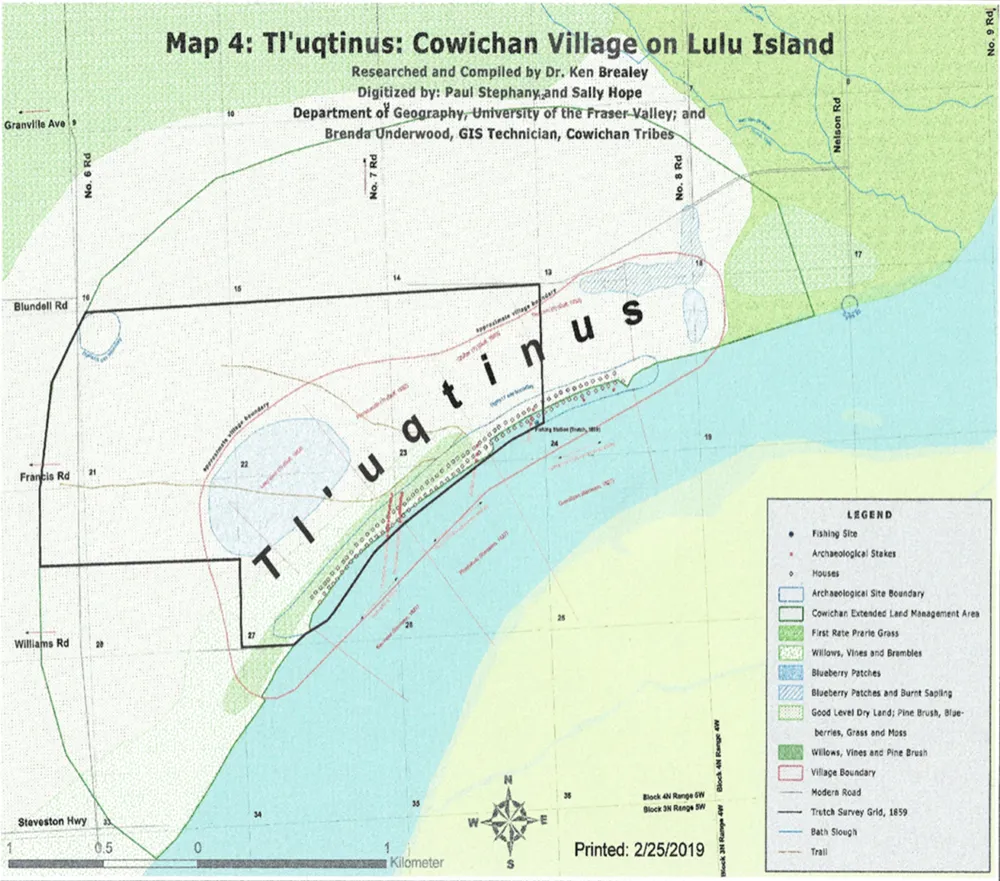
A map showing the Cowichan title lands outlined in black. These lands were declared subject to Aboriginal title by the BC Supreme Court earlier this year, in accordance with the UNDRIP provisions added to BC law in 2019.
When the B.C. NDP introduced a 2019 act committing the province to the United Nations Declaration on the Rights of Indigenous People (UNDRIP), they very specifically assured critics that it would not be a “veto” over existing laws.
“The UN declaration does not contain the word veto, nor does the legislation contemplate or create a veto”, Scott Fraser, the province’s then Indigenous relations minister, told the B.C. Legislative Assembly.
Fraser explained that it was not “bestowing any new laws”, it would not “create any new rights” and it certainly wouldn’t make B.C. subservient to a UN declaration.
Fraser would even explicitly assure British Columbians that there was no conceivable future in which, say, a private landowner could suddenly see their property declared Aboriginal land.
“We are not creating a bill here that is designed to have our laws struck down,” he said.
That it only took six years for all of these scenarios to take place may explain why there is so much panic in B.C. right now.
The newly appointed head of the B.C. Conservative Party is calling for an emergency Christmas session of the legislature to excise UNDRIP from provincial law, saying it has become an anti-democratic tool.
Even B.C. Premier David Eby — a onetime champion of the legislation — has said that “clearly, amendments are needed”.
And British Columbians, whose support for the UN law was already not great, are growing restless. According to an Angus Reid Institute poll released on Wednesday, Eby ranks as one of the least popular provincial leaders in the country.
What changed was a Dec. 5 B.C. Appeals Court ruling that not only struck down a B.C. law (the Mineral Tenure Act) on the grounds that it violated UNDRIP, but effectively ruled that any law or government action could similarly be overturned if it wasn’t in line with the 32-page UN declaration.
By writing UNDRIP into B.C. law, the province had adopted the Declaration as “the interpretive lens through which B.C. laws must be viewed and the minimum standards against which they should be measured”, read the majority decision.
Although UNDRIP is mostly filled with uncontroversial declarations about languages and traditional medicine, its clauses are pretty uncompromising when it comes to issues of land use or resource development.
“Indigenous peoples have the right to the lands, territories and resources which they have traditionally owned, occupied or otherwise used or acquired”, reads a subsection of Article 26. It also states that Indigenous peoples “own, use, develop and control” any land that they’ve held traditionally.
Eby is saying that the courts took it too far, and that writing UNDRIP into B.C. law was only ever meant as a holistic decision-making guide, rather than a law superceding all others.
As Eby told reporters this week, by signing onto UNDRIP, B.C. wasn’t intending to put courts “in the driver’s seat”.
Comments Off on British Columbia’s embrace of UNDRIP entails vast unintended consequences
If You Want to Start Woodworking — Build This First
Rex Krueger
Published 10 Dec 2025Join the Mailing List: http://eepurl.com/g3rkmv
Take a course: https://www.rexkrueger.com/courses
Compass Rose Toolworks: https://www.compassrosetools.com/
Get my woodturning book: http://www.rexkrueger.com/book
Follow me on Instagram: @rexkrueger
Comments Off on If You Want to Start Woodworking — Build This First
Re-orient your map to understand China’s view of the world
CDR Salamander provides a helpful guide to seeing the world, specifically their Pacific front, by turning your map sideways. I hope you won’t look back on this from a slightly later date when the maps get all flaggy and arrow-y:
I first saw this map three years ago, and it recently resurfaced in my thoughts.
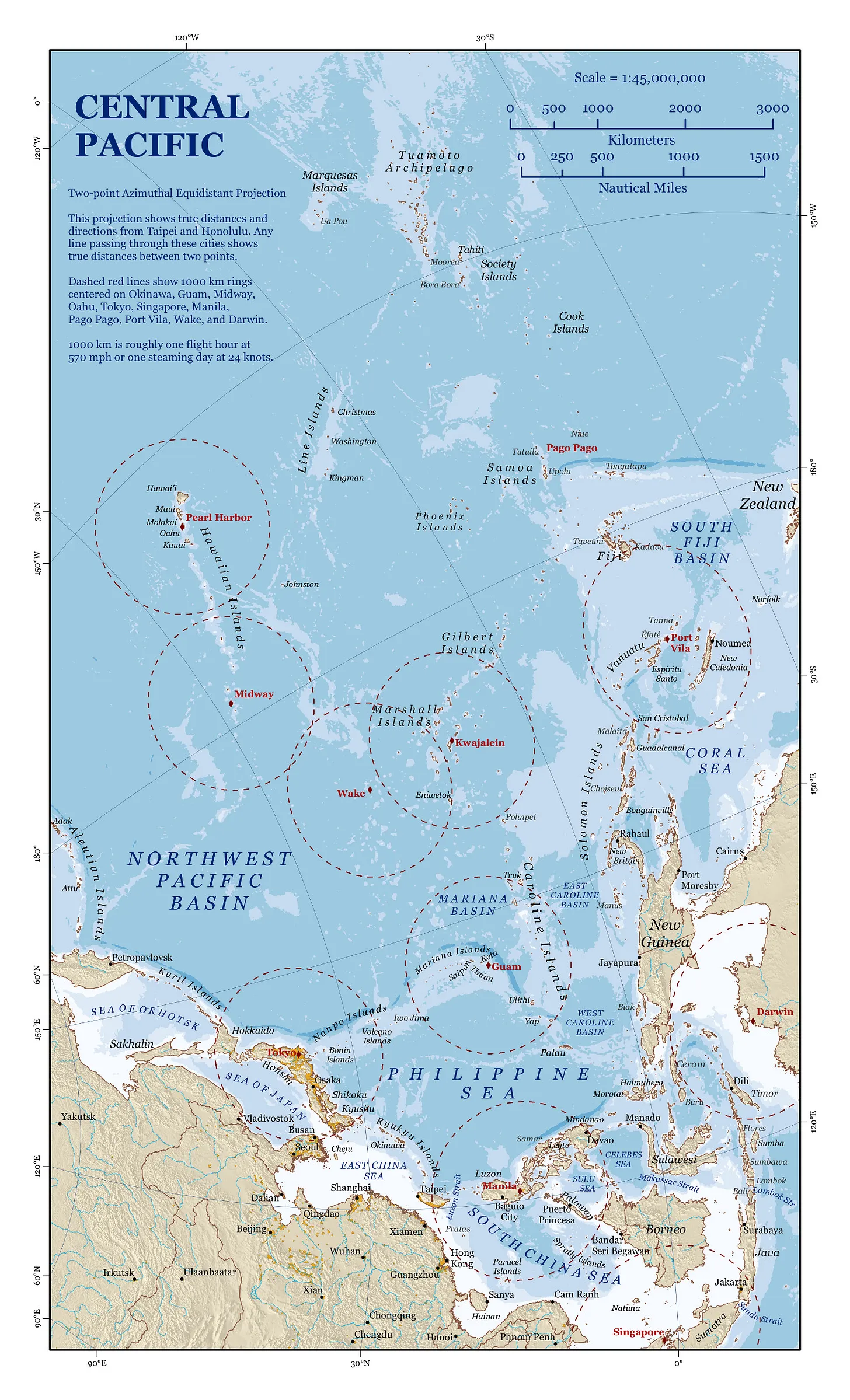
I remain convinced that a lot of the problem with trying to get everyone to fully understand the challenge in the Western Pacific is that to a large part, we think in a “north-up” orientation.
I don’t think that is all that helpful.
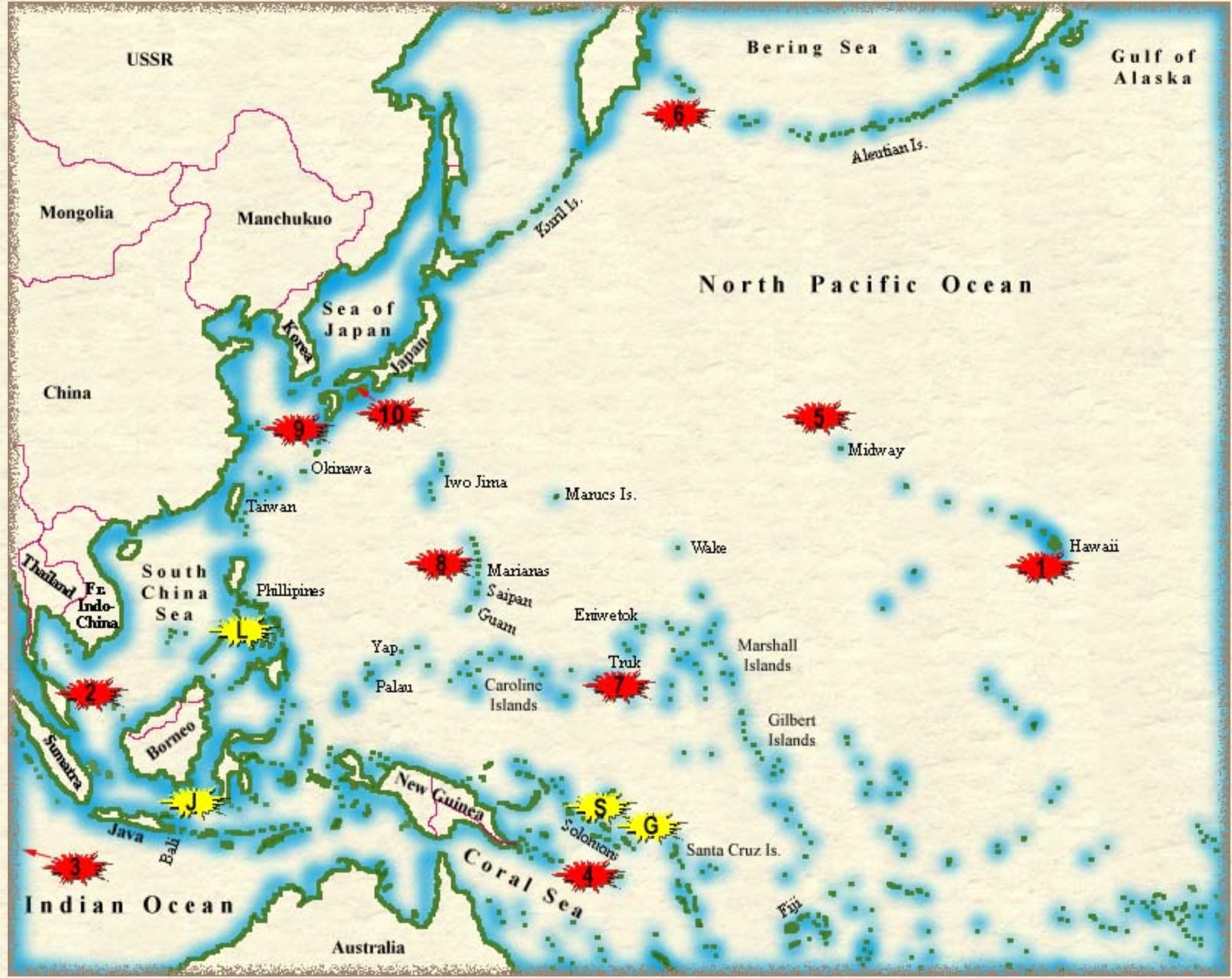
Just a few days ago, we had another Pearl Harbor Day anniversary and we’ve all seen the maps, usually centered on Hawaii, where the Imperial Japanese Navy’s Kidō Butai comes at the Pacific Fleet from stage left off the map. Then we fought battles in the Coral Sea, Midway, and so on.
To the lay eye — or to those who don’t have time to dig into the reasons — a traditional north-up map looks disjointed; things seem all over the place.
No, not really. Let’s bring back that first map.
[Click to embiggenate]
For both Imperial Japan in the early-mid 20th century and Communist China today, the most important part of this map is the access to the resources in or going through the bottom-right hand corner.
Today’s greatest bone of contention — not unrelated to the most important part of the map mentioned above — is Taiwan, right at the mouth of the funnel.
If we need to bring a fight there, that is one hell of a fight to get there if the People’s Republic of China (PRC) wants to prepare a proper welcome for us.
For the PRC, the primary military threat to plan for comes across the Pacific into a funnel that terminates at its most important SLOC. It’s the United States of America, and the US has a series of islands leading right into the heart of the PRC’s. It starts in Hawaii — Midway, Wake, Guam — and then to U.S. allies: the Philippines, Japan, and Australia.
They’re planning a layered defensive fight. Their actions make that clear.
Make no mistake, we may say we are going to “defend Taiwan”, but to do that we will have to fight an aggressive war across the Pacific, into the enemy’s prepared funnel.
Update, 13 December: Welcome, Instapundit readers! Please do have a look around at some of my other posts you may find of interest. I send out a daily summary of posts here through my Substack – https://substack.com/@nicholasrusson that you can subscribe to if you’d like to be informed of new posts in the future.
Starships and Walls : Which Shall We Build?
Feral Historian
Published 25 Jul 2025While faster than light travel may be impossible, proclaiming absolutes based on the understanding of a particular time has a spotty record. But even if we are limited to sublight travel by the fundamental nature of the universe, we as a civilization have several macro-level choices to make, one of the most significant being which foundational concept do we want to build a future on: Ships? Or walls?
00:00 Intro
01:50 The Athenian Sailor
05:25 Frontiers
06:00 Assuming it’s Impossible
07:26 Picard Without Starfleet?
09:40 Culture over Economics
15:28 Founders of Worlds🔹 Patreon | patreon.com/FeralHistorian
🔹 Ko-Fi | ko-fi.com/feralhistorian
Comments Off on Starships and Walls : Which Shall We Build?
QotD: Crime and the army
But in the Army, “crime” is capable of infinite shades of intensity. It simply means “misdemeanor”, and may range from being unshaven on parade, or making a frivolous complaint about the potatoes at dinner, to irrevocably perforating your rival in love with a bayonet. So let party politicians, when they discourse vaguely to their constituents about “the prevalence of crime in the Army under the present effete and undemocratic system”, walk warily.
Ian Hay (Major John Hay Beith), The First Hundred Thousand: Being the Unofficial Chronicle of a Unit of “K(1)”, 1916.
Comments Off on QotD: Crime and the army


