At Postcards from Barsoom, John Carter explores the dangerous psychological rift in western thought that casts young men into a literal no-win situation and yet blames them for not succeeding:
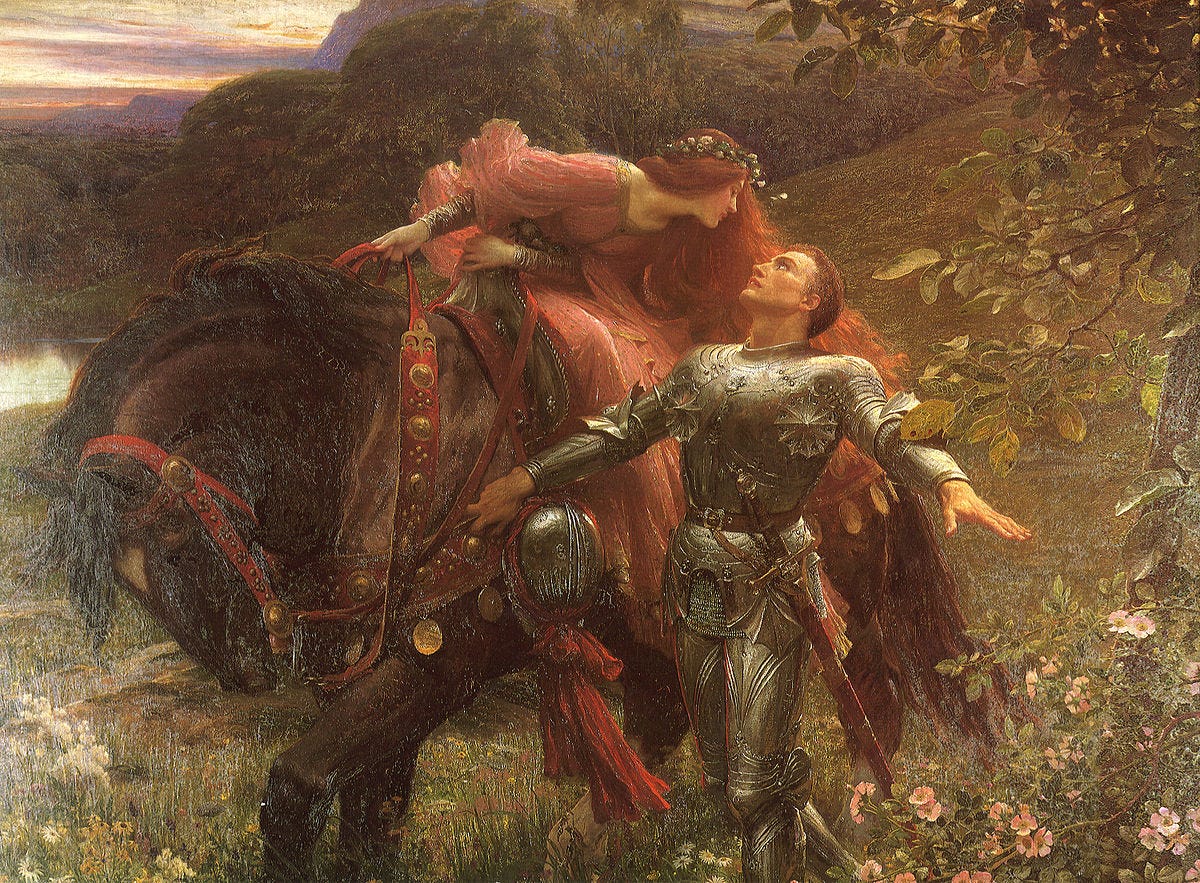
La Belle Dame Sans Merci by Frank Bernard Dicksee, 1901
A great deal of Discourse revolves around the desultory state of the broken modern young man. We wring our hands about porn brained incels, and about the incel’s mirror image in the sociopathic gym bro fuckboy. We talk about how men need to man up, put down the console controller, get out of the basement, talk to real girls, and wife them up. At the same time, we do everything we can to make this as difficult and unappealing as possible. Male sexuality is relentlessly demonized, and this is at the root of great deal of social dysfunction.
Our society has established new social norms that make talking to girls in the wild, or even looking at them, tantamount to a sex crime. Buying a girl a drink at the bar is an imposition, an implicit expectation that she will at the very least say thank you, and this is essentially sexual harassment. As a result of this men do not buy girls drinks anymore. Glance at a girl’s cameltoe as she places her yoga pants between you and the mirror to do hip thrusts while you’re trying to focus on your deadlift, and get put on blast on TikTok as a perv. As a result men carefully avoid looking at girls, and girls wonder why they don’t get attention. Office romances are right out: ask Betty from accounting if she’d like to get a coffee, and you’re rolling the dice between getting lucky and getting a talking to from HR (if you’re lucky). Friend-group romances are discouraged: they bring too much drama.
The only romantic avenue still permitted is the dating apps. The de facto proscription of every other venue was so abrupt and thorough that I can’t help but wonder if MeToo was engineered by Match Group, in order to do to dating what Uber did to taxis. Just like Uber took an occupation that was able to provide a reasonable living standard for working class guys and turned it into piece-work for an imported third-world precariat, so Tinder wiped away thousands of years of accumulated social technologies optimized for the purpose of bringing young men and women together into stable, loving, and fecund matrimony, and replaced it with a winner-take-all meat market in which a small minority of the best-looking men swipe their way through a digital harem of emotionally crippled cum-dumpsters, while women retaliate by using their matches to get free meals and ghosting as soon as the cheque comes without so much as a thanks for the company. Commoditizing romance left everyone more lonesome and miserable than ever, but would you look at that market cap.
The decay set in long before Tinder, however.
Feminists have gotten a great deal of mileage out of Freud’s Madonna-whore complex. This is the idea of a Manichean division of femininity: the chaste purity of the innocent nurturing mother, contrasted with the wanton looseness of the degraded prostitute. The Madonna is embodied by the Virgin Mary, whose only begotten child was conceived immaculately, which is to say without actually having sex. Both archetypes are caricatures that fail to capture the full range of feminine sexuality, but a traditional, god-fearing society effectively forced women to choose between one or the other. Either she represses her instincts and lives a passionless life of quiet misery, or she becomes a fallen woman.
Unlike much of Freud’s oeuvre, which largely consisted of the author’s barely concealed fetishes, the Madonna-whore complex has held up fairly well in the era of evolutionary psychology. Freud’s explanation for the phenomenon – that it is rooted in the Oedipal desire to rut with your own mother – is of course nonsense (except possibly insofar as it may have applied to him). Its origin is more plausibly in the predicament of paternal uncertainty which has bedevilled men since before the dawn of mankind, and which leads to a trade-off between short- and long-term mating strategies with easy women on the one hand (with whom paternity is always in question, and in whom investment should therefore be kept to a minimum, but since they’re easy you can sow your seed in lots of them), and chaste women on the other (with whom paternity can be more reliably determined, and in whom greater investment is therefore warranted). It doesn’t matter that we have paternity tests now: evolved instincts don’t care about your technology.
In the aftermath of the sexual revolution female sexuality was freed from these ancient constraints. Women are permitted to dress as they please, date who they want, have sex with as many partners as they desire. Any attempt to dissuade women from such behaviour is attacked as slut shaming, a ploy by the patriarchy to control their bodies.
Promiscuous premarital sex was once a one-way street to single motherhood. The pill and legal abortion reduced that risk considerably, which provided the justification for eliminating sexual restraint in the first place. Male sexual psychology presents its own problems, however. Revealing attire invites male attention, and often not from the males whose attention a woman wants to attract. Women enjoy male attention, and so dress to attract it. Sexually excited men are liable to behave badly. Badly behaving men result in women getting hurt. Obviously, if a man behaves badly, society will punish him … but the wise course is to avoid putting temptation in his way in the first place. Those ancient restrictions on female sexuality weren’t there to oppress women: they were there to protect women from themselves.
Women may have chafed under the chastity belt of the Madonna-whore complex, but it caused problems for men too. Men don’t generally want either a frigid Victorian schoolmarm or a drunken slattern for a wife: he wants the happy medium between the two, purity in the streets but a prostie in the sheets, a girl who enjoys sex and is good at it, but only has it with him. The Madonna-whore complex is a schizoid separation of these two conflicting desires, which then leads to the romantic frustration of both sexes: men have to choose between two equally unappealing options, and women are required to deny one or the other aspect of their own sexuality.
Just like men, women tend to want two, somewhat contradictory things from the opposite sex. First, they want men to protect and provide for them: to build what needs building, fix what needs fixing, pay for dinner, buy them pretty jewellery. In other words, they want men to sacrifice their time and energy of their behalf. At the same time they want men who are dominant, strong, confident, and at least potentially dangerous, for the obvious reason that men must compete with other men, and men who do not possess these traits make terrible protectors and providers in comparison with men who do. The necessary tension is that dominant, aggressive men are generally much less interested in protecting and providing: a man who won’t submit easily to other men, won’t submit to women either; a man who can force other men to submit to his will, can also force a woman to do the same. This mirrors the tension in male desires: a girl who’s a good lay might not be the most impeccably virginal of innocent maidens.
We can’t call women whores anymore in order to enforce virginal purity, but bad romantic decisions still carry bad consequences, and women also need to be protected from those consequences (and can’t ever be held responsible for them). The emphasis has therefore shifted from policing female sexuality to policing male sexuality. The result of this is the emergence of the simp-rapist complex.
The only way to create a safe environment for women whose behaviour is entirely unrestricted is to ruthlessly suppress precisely those masculine traits of dominance and aggression that women find attractive in the first place. All of these traits get included into the broad category of “rape culture”. Even looking at a woman without her expressly stated positive consent becomes a problematic act. Men who violate these norms become, according to this standard, “rapists”.
Update, 1 December: Welcome, Instapundit readers! Please do have a look around at some of my other posts you may find of interest. I send out a daily summary of posts here through my Substack – https://substack.com/@nicholasrusson that you can subscribe to if you’d like to be informed of new posts in the future.