Quotulatiousness

October 19, 2025

Reframing the loss of elite legitimacy as a “loss of faith in democracy”

On his Substack, Frank Furedi illustrates how the public’s declining trust in political elites across the western world is being reframed in the legacy media as declining faith in democracy itself:

No doubt you have come across commentators and legacy politicians whining about the public’s loss of trust in democracy and in the key institutions of society.

“France is not alone in its crisis of political faith – belief in a democratic world is vanishing” commented Simon Tisdall last week in The Guardian.1 He noted that “belief that democracy is the form of governance best suited to the modern world is dwindling, especially among younger people“.

The tendentious claim that the current era of political malaise is an outcome of a loss of commitment to democracy is regularly echoed by mainstream commentators. This was the message of a recent Politico headline that stated that “Europe’s democracies are in danger, warn Merz and Macron”.2 It cited the German Chancellor Friedrich Merz stating that these “threats dwarf anything seen since the Cold War”. He noted that “the radiance of what we in the West call liberal democracy is noticeably diminishing”, adding: “it is no longer a given that the world will orient itself towards us, that it will follow our values of liberal democracy”.

If anything, the French President Macron was even more pessimistic than Merz. He warns that Europe is undergoing a “degeneration of democracy due to attacks from without and from within”. He was particularly concerned about the loss of faith in democracy within France. “On the inside we are turning on ourselves; we doubt our own democracy”, he noted, before adding, “we see everywhere that something is happening to our democratic fabric. Democratic debate is turning into a debate of hatred.” This statement coming from a man, whose presidency lacks a genuine mandate and relies on bureaucratic maneuvering exposes the cynicism of his concern for the “degeneration of democracy”.

[…]

Loss of elite authority

In reality the crisis of democracy narrative serves to mystify the real issues at stake. This narrative offers a misdiagnosis of the very real loss of legitimacy of the ruling elites as a loss of belief in democracy. As far as this dominant narrative is concerned every time people vote against the representatives of the legacy political establishment democracy is in trouble. So long as they win elections and populists aspirations are confined to the margins of society democracy is represented as a big success. But the very minute people vote the “wrong way” the mainstream commentators craft alarmist accounts about democratic backsliding. That is why the Remainer lobby often represents the outcome of the Brexit Referendum as an expression of “democratic backsliding”.

In theory, the term democratic backsliding refers to the declining integrity of democratic values. In practice it means the estrangement of significant sections of the public from their political institutions. The term democratic backsliding serves to mystify a very significant development, which is the legitimacy crisis of the legacy political establishment. Once understood from this perspective it becomes evident that it is not democracy that people no longer trust but the people and the institutions that rule over society.

As it happens the narrative of “democracy is in trouble” smacks of pure hypocrisy. Those who communicate this narrative are not so much interested in the integrity of democracy but in ensuring that people vote the right way. From their perspective if people vote the wrong way than democracy becomes dispensable. That is why more and more we hear the refrain that there is “too much democracy”. “Democracy Works Better when there is less of it” warned Financial Times commentator, Janan Ganesh.3 As far he is concerned, “no global trend is better documented than the crisis of democracy”, by which he means that too often people vote against the advice of the elites.


  1. https://www.theguardian.com/commentisfree/2025/oct/12/france-crisis-political-faith-belief-democratic-world-vanishing
  2. https://www.politico.eu/article/europe-democracies-danger-warn-friedrich-merz-emmanuel-macron/
  3. https://www.ft.com/content/f68c13a4-1130-49d5-b3c6-2270711d819e

North Africa Ep. 4: Quiet Week Before the Desert Storm

World War Two
Published 18 Oct 2025

Late Feb–early Mar 1941: convoys from Naples build up 5th Light as MG Battalion 8 and artillery arrive; Rommel wins deployments and edges the line from Nofilia toward Arco dei Fileni. Luftwaffe raids batter Malta, mines choke Suez, RAF assets drain to Greece, and Axis forward probes tighten the noose around El Agheila while Britain improvises under strain.
(more…)

Mandating the use of bodycams for ICE agents

On the social media site formerly known as Twitter, ESR discusses the results of mandating bodycams for police officers, suggesting that bodycams on ICE agents won’t drive the changes activists are hoping for:

This is a followup on my earlier post about the expected effects of requiring bodycams on ICE agents.

I used Grok to do some digging into the literature examining the effects of bodycams on measurable statistics of unlawful police violence.

I did not have any strong expectations about what I was going to find.

Do the query yourself if you like, but I can tell you that the answer is going to reduce to two sentences:

1. Bodycams do not have any statistically significant effect on measures of unlawful police violence.

2. Body cams do have a statistically significant effect, reducing allegations of unlawful police violence.

This means that the only statistically significant effect of bodycams is to deter false claims of police brutality and bigotry.

Note: do not read this as me claiming that cops are untarnished angels. I know people who have been brutally abused by police. I know this does occasionally happen, and I condemn the police culture of silence about such abuses.

What I am saying is that what you see on bodycam footage, which is almost always police exercising commendable restraint in dealing with extremely violent and stupid people, reflects reality. If it didn’t, reality would leak around the edges of the camera non-coverage as an observable effect on incident statistics.

I don’t expect the effect on ICE to be any different. I expect mandatory body cams to backfire rather badly on people who pushed them in the hopes of exposing ICE as some sort of out-of-control Gestapo.

If anything, I expect the consequence to be an increase in already high levels of public support for mass deportations of illegals. Because I know what the results of lots of bodycam and security camera footage has been about public perception of underclass criminality. It gets more difficult to sell the narrative of these people as innocent victims of a repressive society after you’ve seen your 47th video of a screaming semi-psychotic trying to knife a cop during a traffic stop.

Some of the activist orgs that wanted the body cams made mandatory for street cops now want them turned off. I think it’s pretty likely the same thing is going to happen with immigration enforcement sooner or later. Most likely sooner.

Forever War: Becoming the Enemy

Filed under: Books, History, USA — Tags: , , , — Nicholas @ 02:00

Feral Historian
Published 8 Mar 2024

The Forever War is a great piece of post-Vietnam social critique, not least in its depiction of a society that deserves to lose the war that its chosen to fight. Here I talk about the story through that lens, meandering toward a point in the usual Feral Historian manner.

Also I wanted to get this one out because I’m going to make some Forever War comparisons in an upcoming video.

Most of the B-Roll is from the Forever War comic adaptation, both the original black and white version and the later color release. Also threw in some clips from Starship Troopers: Traitor of Mars just to mix up the visuals a bit because there’s already too much of me sitting on a rock.

00:00 Intro
00:53 The Draft
03:25 It’s so Army …
06:54 No Civilization
09:35 War’s Over. My Bad
13:14 Parting Thoughts

QotD: The Indian Civil Service

Filed under: Books, Britain, Bureaucracy, Education, History, India, Quotations — Tags: , , , , — Nicholas @ 01:00

There’s actually a great book called The Ruling Caste. It’s a “collective biography”, for lack of a better term, of the Indian Civil Service (ICS), by Sir David Gilmour. You can of course find biographies of the individual Governors-General (Gilmour wrote one, also excellent, on Lord Curzon), but this is the only study I know of the lower levels — i.e. the guys who really ran the Raj. Gilmour is literally a gentleman amateur, so while he’s also an excellent historian (and The Ruling Caste conforms to all the canons of scholarship), he tells an engaging story, too.

I think about The Ruling Caste often when I think about the turds in the Apparat. Looked at from the outside, the ICS were apparatchiks, too. Indeed, even more so than actual apparatchiks, since “apparatchik” means something like “expert without portfolio” and while the ICS had two broad “tracks” (if I recall correctly), “civil” and “legal”, in practice most every ICS man was supposed to be able to do pretty much everything, including (again IIRC) assume military command of local forces if necessary.

Given that there were never more than 200K Britons in the Raj at any one time, how could it be otherwise?

And the ICS was as fully ideologized as the Soviet (or AINO) Apparat. The French gave us the lovely phrase mission civilisatrice, but that’s what the ICS was doing, too. Lord Macauley was the big mover behind the English Education Act of 1835, which explicitly designed to

    form a class who may be interpreters between us and the millions whom we govern – a class of persons Indian in blood and colour, but English in tastes, in opinions, in morals and in intellect. To that class we may leave it to refine the vernacular dialects of the country, to enrich those dialects with terms of science borrowed from the Western nomenclature, and to render them by degrees fit vehicles for conveying knowledge to the great mass of the population.

There were two huge differences between the ICS and the Apparat, though, that really come out reading Gilmour’s book. First, and actually least important, was the obvious fact that English education was superior. Macauley really gave “native” literature both barrels — nobody condescends like an Englishman — but he wasn’t wrong. In 1835 you could take the “scientific” literature of every other race on the planet combined and get … the Iron Age? Maybe? 200K Britons could dominate 750 million Indians because

    whatever happens, we have got
    the Maxim gun, and they have not.

Or “steam power” or “replaceable parts” or “calculus” or what have you. Season to taste.

The second — and far, far more important — difference between the ICS and the Apparat, though, was that the ICS was in general composed of decent people. In a very real sense, all imperialism is “cultural imperialism”. Rome became an empire by whomping all its enemies, but it stayed an empire by giving its enemies a great deal. Life was simply better — orders of magnitude better — inside the Empire than outside.

And the reason for this is simple, so simple that you need many years of long and hideously expensive training, by highly skilled and fanatically motivated indoctrinators, to miss it. Macauley, Caesar, Confucius, anyone who wrote anything on barbarian management at any point, anywhere in the world, well into the 20th century, said basically the same thing: Our material culture is the result of our cultural culture.

You can learn to operate our stuff. Obviously so — with only 200K Britons throughout the Subcontinent, the Raj was quite obviously run by Indians. And they did a bang-up job, too, such that India at independence had the real potential to become a first world country (note to folks getting ready to break away from a globe-spanning empire: Never elect a lunatic socialist yoga dude as your first prime minister. He’ll go full retard and set you back 50 years … and he’ll be shooting for 500). You might even learn how to maintain our stuff, maybe even build a few cheap knockoff copies of our stuff.

But it’ll never be more than that — shitty knockoff copies, gruesomely expensive, and available only to the elite — unless you embrace as much of the culture that created the stuff as you can stand. The English themselves are a great example: They were blue-assed savages when Caesar found them, but they got with the program, and look how well that worked out. Ditto the Gauls (“Our ancestors, the Gauls!”) and all the rest.

It’s the culture, stupids. The culture of the ICS was English culture — “play up, play up, and play the game!” sounds like baloney to jaded Postmodern ears, but listen:

    The sand of the desert is sodden red,—
    Red with the wreck of a square that broke; —
    The Gatling’s jammed and the Colonel dead,
    And the regiment blind with dust and smoke.
    The river of death has brimmed his banks,
    And England’s far, and Honour a name,
    But the voice of a schoolboy rallies the ranks:
    “Play up! play up! and play the game!”

As poetry it’s shit, but if that doesn’t make you want to get up out of your chair and take a swing at somebody, then you, sir, have no hair on your scrotum, and will never know a woman’s touch (trannies don’t count).

They really believed that, those Eton schoolboys out there East of Suez. Or, at least, they behaved as if they did, and everything else flowed from that behavior. Recall that it was a coin flip, going East of Suez — chances are you wouldn’t be coming back, or if you did, it would be as a malarial ruin. But they went anyway, though England’s far and Honour a name, because that’s just what they did. Even at their worst — and their worst was very bad; Gilmour pulls no punches — you can’t help but admire them a little, the arrogant bastards. Their convictions were sometimes awful, but they had the courage of them … and courage is magnificent.

Severian, “Ruling Caste II”, Founding Questions, 2022-03-10.

October 18, 2025

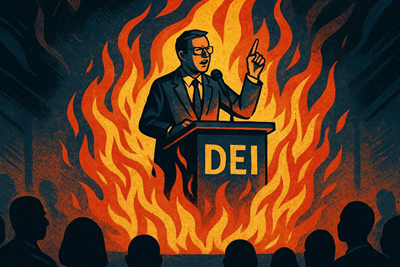
The corporate world is (slowly) backing away from DEI

Filed under: Bureaucracy, Business, Politics — Tags: , , , — Nicholas @ 05:00

On his Substack, Andrew Doyle describes what he calls the “death rattles” of the diversity, equity, and inclusion grifters:

In 180 AD, the Roman satirist Lucian wrote an account of a man called Alexander who had founded a cult of the serpent-god Glycon. According to Lucian, Alexander was much in demand as a prophet, and would charge money to answer questions from those seeking the wisdom of the serpentine deity that he had invented. Lucian records that he “gleaned as much as seventy or eighty thousand [drachmas] a year”.

Some of our modern-day Alexanders take the form of “diversity experts” who have made a fortune from the snake-god of DEI (Diversity, Equity and Inclusion). These cheerless mountebanks form part of an industry that rakes in a whopping eight billion dollars annually. According to Glassdoor, a website that provides salary estimates, a Chief Diversity Officer earns an average of $250,000 per year. Oppression is a lucrative business.

Perhaps the most egregious example is that of Robin DiAngelo, a self-proclaimed expert in “whiteness”, who charges $14,000 for every speech, and earns $728,000 every year. At one of her speeches at Coca Cola, DiAngelo’s advice to employees was to “try to be less white”. As the comedian Heydon Prowse observed: “anyone who has had the misfortune of passing a group of Eton boys at Notting Hill Carnival will know that trying to be less white is literally the whitest thing anyone can do”.

But it looks as though the gravy train might finally have been derailed. Yesterday, the This Isn’t Working podcast posted an image of a statement from Jake Graf, a regular DEI speaker who, according to his website, “works with organisations to improve LGBTQ+ representation, mental health awareness, and trans inclusion”. In his statement, posted on LinkedIn, Graf struck a sombre note:

    The pendulum of progress swings in mysterious ways. Just months ago, following the Supreme Court ruling and subsequent EHRC interim guidance, businesses rallied with open arms and vocal support for their trans team and clients. Now, that warmth has slowly given way to a worrying silence, as if someone pressed pause on the march toward inclusion.

The half-hearted poeticism barely masks the anxiety of man who fears that his racket has been exposed. The predominance of the creed of DEI, and its usurpation of meritocracy as the guiding principle in the corporate world, is a testament to the success of culture warriors. They have made plenty of know-nothings very wealthy by promoting ideology as though it were uncontested truth. But now it might well be coming to an end.

The Battle of Sedan: The Anatomy of Failure

Filed under: Britain, France, Germany, History, Military, WW2 — Tags: , , , , , — Nicholas @ 04:00

World War Two
Published 17 Oct 2025

In May 1940, a period of ten days flipped the world order on its head. France, the titan of the Great War, was carved apart by the armored fist of the Wehrmacht: Panzergruppe Kleist. Now, in this new feature-length production, we explore why it happened, whether this was ever avoidable, and whether France’s flaws stemmed from incompetence, or something far more sinister.
(more…)

Remembering GamerGate

We’ve lived through such a tumultuous decade that it’s sometimes difficult to remember what things were like in the “before times”. On Substack chat, John Carter linked to this essay by Billionaire Psycho which helps refresh memories about one of the seminal events that kicked off the political and social chaos of the last decade:

GamerGate is maybe the most important event of the past 20 years which never receives mainstream media coverage. Lomez will be publishing an in-depth history of GamerGate, to serve as an official record going forward, and that’s crucial as part of building a foundation for a new culture — fighting the narrative war over how history is remembered, how history is interpreted, what events are recognized as significant and influential moments in culture, and how Western identity is defined.

GamerGate was only possible because a generation of incompetent Leftists inherited an empire built on propaganda that came without a legible instruction manual. Leftists forgot how to run their imperial machine. Video games sedated young white men, funneling their energy into a simulation of achievement, an illusory power fantasy of digital significance. Leftists forgot that porn, video games, movies, junk food, and other passive consumption activities primarily existed to prevent young white men from doing anything useful with their lives. And this zone of sedation was viewed as another industry to conquer so that DEI activists could bully the video game industry into providing overproduced elites with fake jobs.

This event was important for several reasons.

GamerGate exposed American Sharia laws. It unveiled the shibboleths, religious taboos, and blasphemy codes which were considered more important than Constitutional protections on “free speech”. A gulf emerged between written laws, and selective enforcement.

GamerGate was maybe the first time in 50 years that Leftists suffered a real, measurable defeat.

It functioned as a generational awakening: a catalyst that activated a decentralized army of shytpoasters, bloggers, podcasters, streamers, journalists, and RW activists.

It mapped out in real-time the architecture and OODA loop of the Leftist hivemind, providing empirical data on how the swarm intelligence perceives, coordinates, reacts, propagates … and suffers damage.

It educated critics of the hegemonic monoculture that rules the Global American Empire.

But I think the most important aspect of GamerGate was that it disproved the narrative illusion that everyone more or less accepted as conventional wisdom, the bedrock of the uniparty worldview. Before GamerGate, it was taken as a self-evident fact that America was a capitalist country, and that all of the evil in the world was caused by Wall Street corporations chasing “shareholder value” and advancing “the profit-motive”. Capitalism and racism were the invisible demons which could be used as scapegoats for anything bad that ever happened at any point and at any place in American society.

Leftism could do anything it wanted, no matter how dumb, destructive, intrusive, or evil — and then blame capitalism and racism for the consequences.

This illusion was shattered by GamerGate.

[…]

There’s one important thing that’s been lost since GamerGate (GG) and the Meme War of 2016, which is the adolescent fun, transgressive irreverence, and juvenile sense of humor which once characterized the RW youth. There was a brief window when video game enthusiasts believed they could meme their way to victory (they did), win a landslide election (they did), and reverse imperial decline (they didn’t). Ten years have passed since then. Countless accounts have been banned, doxxed, deplatformed, debanked. Dissidents have been prosecuted and imprisoned. The presidency of 2016 was stalled out and subverted, the election of 2020 was stolen, the election of 2024 almost ended in an assassination on live television. Covid lockdowns crashed the economy and trapped everyone in their homes, while Antifa and Black Lives Matter rioted outside in the name of George Floyd.

At some point, it stopped being fun, and the contest turned into a forever war.

Comedy turned serious.

But it should be remembered that in the aftermath of GamerGate, humor and a playful, childish energy fueled the engine of RW victories. That’s the secret ingredient.

Samizdat is the key to winning.

Always remember to keep having fun, and keep laughing, because our enemies are ridiculous.

Gerät Potsdam: Mauser Copies the Sten Gun

Filed under: Britain, Germany, History, Military, Weapons, WW2 — Tags: , , , — Nicholas @ 02:00

Forgotten Weapons
Published 2 Jun 2025

In the fall of 1944, the Mauser company was given a contract to develop drawings of a direct copy of the British Sten gun (code named Gerät Potsdam), and to manufacture 10,000 of them. In fact, they were to make two different sets of drawings; one suitable for large factory use (like their own) and one for use with distributed small shops making parts for final assembly elsewhere (which is how much of British Sten production was done). The contract was fulfilled and 9972 guns in total were produced and accepted by the German military in November and December of 1944.

Why would Germany was a copy of the Sten? Well, they actually had a decent number of them. The Allies were air-dropping Stens all over Europe, and a lot of those drops were captured by German troops, not the resistance fighters they were intended for. By the end of the war the Germans were in desperate need of arms, and the Sten was both simple and already in some German use with the Volkssturm … so it actually was not a totally unreasonable idea to produce more of them.

Today, the Potsdam is an extremely rare gun to find. The two visible identifying features are the magazine well and barrel shroud, which are both made with a folded and spot welded seam. The barrels are also identifiable as they have 6 groove rifling, which the British did not use in the Sten.

Before the Potsdam production was finished, Mauser began working on further plans to simplify the design. That would be the Gerät Neumunster, aka the MP 3008. For that part of the story, see my video on the MP 3008:
German Sten Copy: MP 3008, aka Gerät Neumü…
(more…)

QotD: Civilizational survival after the Bronze Age Collapse

If post-Collapse Egypt is Britain, then perhaps post-Collapse Phoenicia is America: a relative backwater, dwarfed by the Great Powers of its day, that suddenly leaps to global prominence when the opportunity arises … but in doing so, changes in some very fundamental ways. Which raises a question about Cline’s subtitle, “The Survival of Civilizations”: what does it actually mean for a civilization to survive?

Sometimes the answer is obvious. The Assyrians and Babylonians clearly survived the Collapse: if you compare their architecture, inscriptions, artwork, settlement patterns, and political structures from the Late Bronze Age to the Iron Age, they are recognizably the same people doing the same things and talking about them in the same way. The Egyptians, too, are plainly the same civilization throughout their (very long!) history, even if they were notably weaker and less organized after the Collapse. The Hittites, just as obviously, did not survive (at least not outside their tiny rump states in northern Syria). But the Greeks and the Phoenicians are both murkier cases, albeit in very different ways.

On the one hand, Mycenaean civilization — the palace economy and administration, the population centers, the monumental architecture, the writing — indisputably vanished. The Greeks painstakingly rebuilt civilization over several hundred years, but they did it from scratch: there is no political continuity from the Mycenaean kingdoms to the states of the archaic or classical worlds. And yet as far as we can tell, there was substantial cultural continuity preserved in language and myth. Admittedly, “as far as we can tell” is doing a lot of work here: Linear B was only ever used for administrative record-keeping, so we can’t compare the Mycenaeans’ literary and political output to their successors the way we can in Assyria or Egypt. We can’t be sure that the character, the vibe, the flavor of the people remained. But the historical and archaeological records of the later Greeks contain enough similarities with the descendants of the Mycenaeans’ Indo-European brethren that the answer seems to be yes.

By contrast, civilization never collapsed in central Canaan. No one ever stopped having kings, writing, building in stone, or making art. The Bronze Age population centers were continuously occupied right up to … well, now. And yet their way of life shifted dramatically, to the point that we call them by a new name and consider them a different people. Cline thinks this is a success story: borrowing an analytical framework from a 2012 Intergovernmental Panel on Climate Change report, he praises their “transformation”,1 which “include[d] actions that change the fundamental attributes of a system in response to actual or expected impacts”. (The Assyrians, by contrast, merely “adapted”, while the Egyptians barely “coped”.) But does there come a point when the change is so great, so fundamental, you’re no longer the same civilization? Can the Ship of Theseus really be said to have “survived”?

In the final section of his book, titled “Mycenaeans or Phoenicians”, Cline asks how we’ll react to the societal collapse we all sort of know is coming sooner or later. Our world just is too complicated, too interconnected, to survive a really massive shock (or, as in the Late Bronze Age, a “perfect storm” of smaller ones). Even the relatively mild disruptions of the past few years have revealed fragilities and vulnerabilities that we’ve done nothing to shore up since. Of course, he has an answer: Transform! Innovate! Flourish amidst chaos! Become a new iteration of yourself, like the bog-standard Canaanite cities that reinvented themselves as an Iron Age mercantile superpower and turned the Mediterranean into a “Phoenician lake”. But at what price?

Or, to think of it another way, what would you prefer for your society five hundred years from now?

Behind Door Number One: governmental collapse, abandonment of the population centers, dramatic reduction in societal complexity, and then a long, slow rebuilding where your time and your people are remembered only as myth — but when civilization is restored, it’ll be by people whose the desires, values, attitudes, and beliefs, their most basic ways of understanding the world, are still recognizably yours. They may have no idea you ever lived, but the stories that move your heart will move theirs too.

And behind Door Number Two: expansion, prosperity, and a new starring role on the world stage — but a culture so thoroughly reoriented towards that new position that what matters to you today has been forgotten. Do they remember you? Maybe, sort of, but they don’t care. They have abandoned your gods and your altars. Those few of your institutions that seem intact have in fact been hollowed out to house their new ethos. A handful of others may remain, vestigial and vaguely embarrassing. But boy howdy, line goes up.

Obviously, given our druthers, we’d all be the Assyrians: seize your opportunities, become great, but don’t lose your soul in the doing. But if it comes down to it — if, when the IPCC’s warning that “concatenated global impacts of extreme events continues to grow as the world’s economy becomes more interconnected” bears out, the Assyrian track isn’t an option — then I’d take the Greek way.

I don’t care whether, on the far side of our own Collapse, there’s still a thing we call “Congress” that makes things we call “laws”. Rome, after all, was theoretically ruled by the Senate for five hundred years of autocracy as all the meaning was leached from the retained forms of Republican governance. (Look, I’m sorry, you can call him your princeps and endow him with the powers of the consul, the tribune, the censor, and the pontifex maximus, but your emperor is still a king and the cursus honorum has no meaning when the army hands out the crown.) I don’t even really care if we still read Shakespeare or The Great Gatsby, although it would be more of a shame to lose those than the Constitution. But I do care that we value both order and liberty, however we structure our state to safeguard them. I care that we’re the sort of people who’d get Shakespeare and Fitzgerald if we had them around. Maybe we should start thinking about it before our Collapse, too.

Jane Psmith, “REVIEW: After 1177 B.C., by Eric H. Cline”, Mr. and Mrs. Psmith’s Bookshelf, 2024-07-08.


  1. “Transformation” is always a term worth taking with a pinch of salt because so often it’s a euphemism for “total civilizational collapse”. In the chapter on the Hittites, for example, Cline quotes one archaeologist to the effect that “[a] deep transformation took place in the former core of the empire around the capital Hattusa, resulting in a drastic decrease in political complexity, a shift to a subsistence household economy and a lack of evidence for any public institutions”. Relatedly, one of my children recently transformed a nice vase into a pile of broken glass.

    In this case, though, Cline really does mean transformation.

October 17, 2025

Stellantis took the bribe, left Canada anyway

Filed under: Business, Cancon, Government, Politics, USA — Tags: , , , , , — Nicholas @ 04:00

The former American Motors plant in Brampton, now owned by Stellantis, was supposed to be the manufacturing site for a new Jeep vehicle. The federal government under Justin Trudeau handed about $15 billion to Stellantis to build an EV battery complex in Windsor, Ontario. It was apparently just assumed that this meant that Stellantis would keep the Brampton facility open and operating, but that assumption was faulty:

Stellantis has announced they’re leaving Brampton. That’s it. End of story.

Three thousand workers. Gone. A manufacturing base gutted. A city thrown into economic chaos. And a federal government left holding a $15 billion bag it handed over like a drunk tourist at a rigged poker table.

The Jeep Compass — the very vehicle they promised would anchor Ontario’s role in the so-called “EV transition” — will no longer be built in Canada. Production is moving to Belvidere, Illinois. The same company that cashed billions of your tax dollars under the banner of “green jobs” and “economic transformation” has slammed the door and walked out. And no, this isn’t a surprise. This was baked into the cake from day one.

Let’s rewind.

In April 2023, under Justin Trudeau’s government, Chrystia Freeland — then Finance Minister — and François-Philippe Champagne, the Industry Minister, announced what they called a “historic” agreement: a multi-billion-dollar subsidy package to Stellantis and LG Energy Solution to build an EV battery plant in Windsor, Ontario.

It was sold as a turning point. The future. A Green Revolution. Thousands of jobs. A new industrial strategy for Canada. But in reality? It was a Hail Mary pass by a government that had already crippled Canada’s energy sector and needed a shiny new narrative heading into an election cycle.

And here’s what they didn’t tell you: the deal had no enforceable commitment to keep auto production in Brampton. There were performance-based incentives — yes — but only for the battery plant. Not for the Brampton assembly line. Not for the existing workforce. And certainly not for ensuring the long-term health of Canada’s domestic auto industry.

They tied this country’s future to a globalist fantasy. A fantasy that assumed the United States would remain under the control of climate-obsessed technocrats like Joe Biden. A fantasy that required a compliant America pushing carbon neutrality, electric vehicle mandates, and billions in matching subsidies for green infrastructure.

But in November 2024, Americans said no.

Donald Trump was elected president. And just as he promised, he tore Biden’s green agenda to shreds. He pulled out of the Paris Climate Accord — again. He dismantled the EV mandates. He unleashed American oil and gas. But he didn’t stop there. Trump imposed a sweeping America First manufacturing policy, pairing 25% tariffs on imported goods with aggressive incentives to bring factories, jobs, and supply chains back onto U.S. soil.

And, as Conservative deputy leader Melissa Lantsman points out, it’s just the beginning:

You probably heard the news by now: Stellantis is cancelling its opening of a Jeep factory planned in Brampton, taking over 3,000 jobs and USD $600 million of investment out of Canada and moving it to the U.S.

This is the latest development in the growing trend of companies scaling back their operations in our country and choosing instead to grow in the US. Whisky maker Diageo found its name in the headlines last month when they announced they’d move their Crown Royal bottling facility south. GM laid off or cut down shifts for 750 autoworkers in Oshawa and 900 in Ingersoll while sending $4 billion to the U.S. Those are the ones that drew the headlines.

Why is this happening? Well – the reason on everyone’s mind right now is tariffs. And it’s true – tariffs are having a big impact on the Canadian economy and on our trading relationships. But there are other, deeper reasons at play, too.

Companies don’t just make decisions on a whim – especially those related to long-run production and fixed investments totalling hundreds of millions or even billions of dollars. Those decisions are made as part of detailed, multi-year analyses that take into account predicted economic conditions, market forces, and many other factors. A massive move of your production facility isn’t a temporary, six-month decision to be trifled over – it’s a permanent thing and that means they aren’t coming back.

The objective is to decrease uncertainty, cut costs, increase production, etc. etc. all to work in favour of any company’s ultimate goal, which is, of course, to make money.

So let me translate what all these investment and job cuts really mean: they’re not a knee-jerk reaction to the tariffs, although those play a part. They’re a statement about the long-term trajectory of the Canadian economy and the kind of climate that a decade of Liberal government has built for businesses in this country.

If these companies thought the U.S. tariffs would be transitory, a six-month blip, an economic fad – then they’d have no reason to cancel factories that will be producing goods for 20 or 30 years. That wouldn’t make financial sense.

[…]

If things get worse, the government might resort to its favourite strategy of just offering more hand-outs for businesses to try and entice them to stay here, but that only works for so long. That Stellantis plant in Brampton? The one that’s moving to the U.S.? The Ontario government promised them over $500 million just a few years ago – and the feds followed.

Turns out, you can promise to cut somebody a giant cheque and it’s still unprofitable for them to do business here.

As I mentioned, the continued trade uncertainty doesn’t help our situation, and the Prime Minister’s failure to get a deal is costing us big-time – especially as he promises to drive a trillion dollars of investment southbound at the expense of our workers here.

But as long as the Liberals keep the same old approach towards economics and business in this country, as long as the Liberals keep the taxes high, the productivity low, and the red tape piled up high — expect to see more headlines like the one about Stellantis, not fewer.

How many more job losses will it take for our leaders to realize that?

Civilizational collapse is … female

On her Substack, Janice Fiamengo addresses the unpalatable contention that female power leads to civilizational disaster:

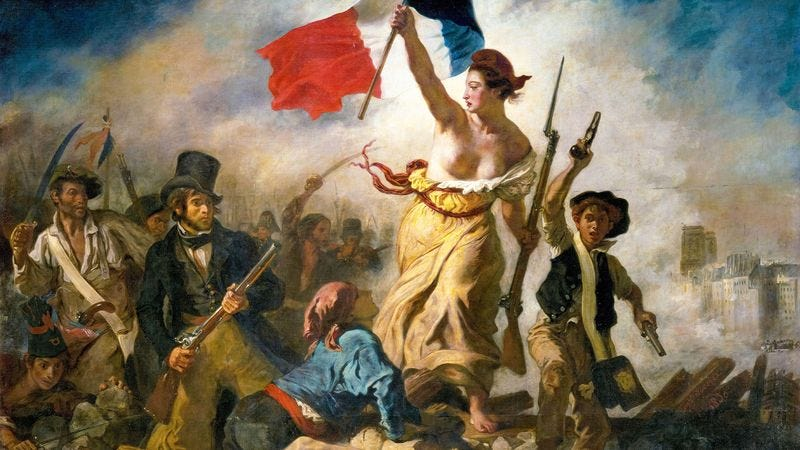
Liberty Leading the People by Eugene Delacroix

Multiple surveys (see, for example, with thanks to James Nuzzo, here, here, here, here, here and here) suggest that when women hold power, they pursue typically feminine preferences and policies. Female-led institutions become more oriented to social justice than objective truth. Feelings matter above facts, context above law, and victimhood above expertise.

Protecting and promoting the allegedly vulnerable — through censorship, shaming, coercion, or lawbreaking/lawfare — becomes a greater priority than excellence or impartiality. Truth-tellers find themselves cancelled, Nobel prize winners reduced to tears, laws and policies applied unequally, white men accused and vilified, criminals cossetted, mental illnesses affirmed, and destructive policies embraced. No one who has paid attention over the past 20 years can be surprised by the findings.

Moreover, our ability to discuss this feminine revolution in values is hampered by the very logic of the revolution, as I will show. Both women and men, deeply disinclined to “harm” women, fail to confront the problem adequately.

Two discussions of the subject — an essay by two social psychologists at Quillette and, more recently, a conference speech by a feisty conservative woman — draw a line under the seeming inevitability of the west’s collapse. Even faced with that alarming prospect, most pundits cannot bear to imagine an alternative to the female-led assault on our core institutions.


Cheering on Women’s Empowerment

A 2022 article in Quillette, “Sex and the Academy“, provides a stark illustration of my thesis. The subtitle rules out the very conclusion the data supports, with the authors emphasizing that “The inclusion of women in higher education is a great achievement for Western liberal societies. How is this changing academic culture?”

The “great achievement”, as it turns out, will almost certainly be a lethal one.

The article was written by two academics, Cory Clark and Bo Winegard, both PhDs in social psychology. Winegard, a male scholar, had an unfortunate run-in with academic orthodoxy that led to his loss of employment; Clark, a female scholar, has a secure academic position. Both authors express enthusiasm for the takeover of academia by women even as they point out its damaging consequences. Neither one advocates any form of resistance, no matter how mild, to feminine academia’s assault on truth.

Summarizing the results of many surveys, Clark and Winegard demonstrate that while a majority of men favor free speech and the advancement of knowledge over emotional comfort, a majority of women prefer conformity, safety, and the protection of victim groups’ feelings. Not all women are indifferent to the traditional underpinnings of western civilization (and not all men support those underpinnings), but the general trends are clear.

Women are significantly more likely than men to support the cancellation of controversial speakers or the suppression of controversial research.

Women also tend to favor the existence of snitch lines to report people who cause offence. Women are more supportive than men of diversity quotas that exclude white men from consideration for prizes, positions, and promotions. (It would be interesting to know how many white women support diversity quotas that exclude white women from consideration for prizes, positions, and promotions.)

[…]

Asserting that both sides are pursuing worthy goals, the authors downplay the shock value of the findings, which show that women are, overall, less interested in truth and accuracy than men are. Imagine assessing such a finding as anything but catastrophic. Imagine calling the disregard for truth moral.

In place of truth, women value a utopian ideology that they perceive — usually without any consistency or adherence to fact, but nonetheless granted by Clark and Winegard — as “morally desirable”. But morally desirable for whom, and to what end? The use of the phrase, a misnomer, demonstrates how thoroughly the authors themselves are in thrall to the corrosive feminine culture they examine.

There is nothing moral (or generally desirable) about the suppression of truth-seeking research when it conflicts — or is perceived to conflict — with an allegedly emancipatory social goal. There is nothing morally desirable or indeed “protective” about shouting down an academic speaker because of the alleged harm of the speech. Naturally, social justice proponents would be outraged if their speeches were shouted down or their research blocked and censored.

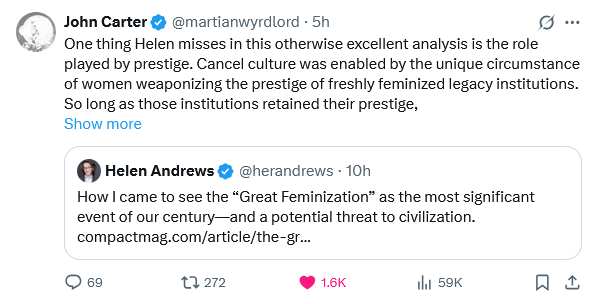
I saw a link to this Helen Andrews article which seems to go well with Janice Fiamengo’s article linked above describing the “Great Feminization”:

… Cancel culture is simply what women do whenever there are enough of them in a given organization or field. That is the Great Feminization thesis, which the same author later elaborated upon at book length: Everything you think of as “wokeness” is simply an epiphenomenon of demographic feminization.

The explanatory power of this simple thesis was incredible. It really did unlock the secrets of the era we are living in. Wokeness is not a new ideology, an outgrowth of Marxism, or a result of post-Obama disillusionment. It is simply feminine patterns of behavior applied to institutions where women were few in number until recently. How did I not see it before?

[…]

The substance fits, too. Everything you think of as wokeness involves prioritizing the feminine over the masculine: empathy over rationality, safety over risk, cohesion over competition. Other writers who have proposed their own versions of the Great Feminization thesis, such as Noah Carl or Bo Winegard and Cory Clark, who looked at feminization’s effects on academia, offer survey data showing sex differences in political values. One survey, for example, found that 71 percent of men said protecting free speech was more important than preserving a cohesive society, and 59 percent of women said the opposite.

The most relevant differences are not about individuals but about groups. In my experience, individuals are unique and you come across outliers who defy stereotypes every day, but groups of men and women display consistent differences. Which makes sense, if you think about it statistically. A random woman might be taller than a random man, but a group of ten random women is very unlikely to have an average height greater than that of a group of ten men. The larger the group of people, the more likely it is to conform to statistical averages.

Female group dynamics favor consensus and cooperation. Men order each other around, but women can only suggest and persuade. Any criticism or negative sentiment, if it absolutely must be expressed, needs to be buried in layers of compliments. The outcome of a discussion is less important than the fact that a discussion was held and everyone participated in it. The most important sex difference in group dynamics is attitude to conflict. In short, men wage conflict openly while women covertly undermine or ostracize their enemies.

Bari Weiss, in her letter of resignation from The New York Times, described how colleagues referred to her in internal Slack messages as a racist, a Nazi, and a bigot and—this is the most feminine part—”colleagues perceived to be friendly with me were badgered by coworkers.” Weiss once asked a colleague at the Times opinion desk to get coffee with her. This journalist, a biracial woman who wrote frequently about race, refused to meet. This was a failure to meet the standards of basic professionalism, obviously. It was also very feminine.

Men tend to be better at compartmentalizing than women, and wokeness was in many ways a society-wide failure to compartmentalize. Traditionally, an individual doctor might have opinions on the political issues of the day but he would regard it as his professional duty to keep those opinions out of the examination room. Now that medicine has become more feminized, doctors wear pins and lanyards expressing views on controversial issues from gay rights to Gaza. They even bring the credibility of their profession to bear on political fads, as when doctors said Black Lives Matter protests could continue in violation of Covid lockdowns because racism was a public health emergency.

[…]

The Great Feminization is truly unprecedented. Other civilizations have given women the vote, granted them property rights, or let them inherit the thrones of empires. No civilization in human history has ever experimented with letting women control so many vital institutions of our society, from political parties to universities to our largest businesses. Even where women do not hold the top spots, women set the tone in these organizations, such that a male CEO must operate within the limits set by his human resources VP. We assume that these institutions will continue to function under these completely novel circumstances. But what are our grounds for that assumption?

The problem is not that women are less talented than men or even that female modes of interaction are inferior in any objective sense. The problem is that female modes of interaction are not well suited to accomplishing the goals of many major institutions. You can have an academia that is majority female, but it will be (as majority-female departments in today’s universities already are) oriented toward other goals than open debate and the unfettered pursuit of truth. And if your academia doesn’t pursue truth, what good is it? If your journalists aren’t prickly individualists who don’t mind alienating people, what good are they? If a business loses its swashbuckling spirit and becomes a feminized, inward-focused bureaucracy, will it not stagnate?

If the Great Feminization poses a threat to civilization, the question becomes whether there is anything we can do about it. The answer depends on why you think it occurred in the first place. There are many people who think the Great Feminization is a naturally occurring phenomenon. Women were finally given a chance to compete with men, and it turned out they were just better. That is why there are so many women in our newsrooms, running our political parties, and managing our corporations.

On the social media site formerly known as Twitter, John Carter comments on Helen Andrews’ article:

One thing Helen misses in this otherwise excellent analysis is the role played by prestige. Cancel culture was enabled by the unique circumstance of women weaponizing the prestige of freshly feminized legacy institutions. So long as those institutions retained their prestige, what the people who ran them said really mattered.

Unfortunately for the ladies (but luckily for civilization), this is self-limiting, because prestige is fundamentally an emergent property of masculine competence hierarchies. We see this demonstrated whenever a profession becomes coded as women’s work: its prestige immediately crashes. Feminists have complained about this for years, though of course they misunderstand the mechanism (prestige is a component of male sexual attractiveness, but not of female, and this is biologically hard-wired).

This prestige collapse is now affecting essentially every coopted, feminized institution — universities, news media, publishing houses, movie studios, large corporations, various government agencies, hospitals, courts, churches, all of them wield far less cultural power than they did even a few years ago. The only people who really care what these legacy institutions say are the women who took them over. To everyone else, the angry sounds they make are nothing more than background noise.

This is probably the main reason for the vibe shift. Once the prestige of feminized institutions declined below a certain threshold, their ability to enforce social consensus began to evaporate.

It’s also probably no accident that the Trump administration seems to care a lot more about what the anons of the Online Right say than it does about the opinion of the universities or the news media. All the intelligent young men got pushed out of the institutions, and those ionized particles of free male energy then began to self-assemble online into an ad hoc competence hierarchy where prestige is measured by clout rather than professional degrees, job titles, or institutional affiliations. The anon swarm is entirely informal, meaning that its outcomes are not amenable to antidiscrimination legislation or to procedural manipulation; you can screw with the algo all you want but you can’t actually force people to care what women say just because they’re women (thereby placing women into the position of openly trading in thirst, which gets them attention but certainly doesn’t mean that anyone has to pretend to take them seriously).

All that’s happened so far is that people’s attention has been redirected away from crazy woke females and towards the influencers of the online right. The fever has broken but society is a long way from recovered. The institutions are still under the control of crazy woke females, and this is extremely bad, especially because they are – for biological reasons related to childlessness — only going to get crazier as time goes on. Fortunately no one really cares what they say anymore, so as they throw tantrums as the institutions are reclaimed over the next decade or so, their protests won’t register as anything but irrelevant toddler noise.

The Original Kaiserschmarrn of the Austrian Empire

Filed under: Europe, Food, History — Tags: , , , — Nicholas @ 02:00

Tasting History with Max Miller
Published 13 May 2025

Scrambled pancake with raisins and plum compote

City/Region: Austria
Time Period: 1858

Like many food origin stories, the ones for kaiserschmarrn are varied and no one knows which, if any, are true. What is true is that Kaiser Franz Joseph I did really enjoy this dish, and as a result kaiserschmarrn became popular throughout the Austrian Empire and is still served in many restaurants today.

This kaiserschmarrn isn’t as sweet as modern versions I’ve had, but it’s still delicious. The vanilla sugar caramelizes and adds a pleasant bit of crunch, the cream makes for a richer pancake, and the plum compote is a lovely addition.

    Kaiser-Schmarren.
    Whisk 4 decilitres of sweet cream with 4 egg yolks, 2 decilitres flour, and a little salt, add 4 egg whites, beaten to snow, and raisins. Pour the whole thing into hot beef fat or butter, let it get nicely brown like Mehl-Schmarren, prepare it in the dish and sprinkle it with vanilla sugar.
    Mehl-Schmarren.
    … Place it in the oven so it rises nicely. Then remove it and place it on a rapid heat. When it’s stiff and browned on the bottom, you turn it over with the pancake spatula, let it brown again on the bottom, then tear it into large pieces with a fork and serve it quickly so it doesn’t dry out.
    Plum Compote.
    Plums are either halved or left whole and peeled. They are placed in hot water where the skin can easily come off. They are then simmered with a little sugar, water, and cinnamon.
    Die Süddeutsche Küche by Katharina Prato, 1858

(more…)

QotD: Wickermanism

Filed under: Government, Politics, Quotations — Tags: , , — Nicholas @ 01:00

“What do you call your ideology”

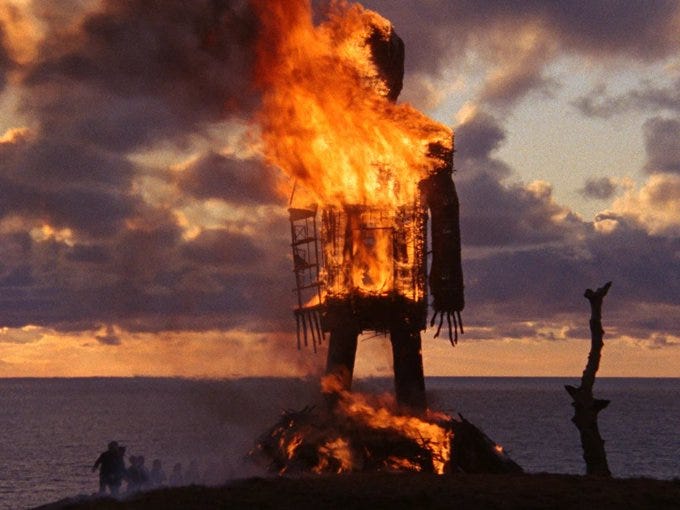
I’m a Wickermanist.

Conservative? Classical Liberal? Libertarian? Anarcho-Capitalist?

All of these got immediately diluted by moderates and blackmail curious boomer compromisers.

Conservative … “but leave the blackmailed pedos alone.”

Classical Liberal … “but let us just have totalitarian surveillance.”

Libertarian … “but what do you mean ‘taxation is theft’ and IRS agents should die in work camps … We’re Socially liberal and fiscally conservative.”

Anarcho-Capitalists … “But like private violence to enforce natural law doesn’t mean YOU should shoot criminals and state enforcers.”

I’m a Wickermanist.

I’m naming my ideology after the execution method I want to see practiced annually either by governing entities, private paramilitaries, or radicalized individuals.

Pedos. Corrupt politicians. Traitors to foreign governments. Would-be tyrants. I want them burnt alive in giant Wickermen every year.

Not one time during the revolution, not once everyone agrees, but irrespective of any institutional authority save the match lighter. That ongoingly every year to appease the sun or whatever.

If it’s formalized and good governance is actually achieved and they didn’t find suitably corrupt politicians one year, they can draw lots or an extra old one can volunteer and be remembered as a hero. but I want wickermen burning.

I’m tired of having to constantly rebrand as somehow every ideology becomes “Pay your taxes, don’t ask about Epstein, don’t enact private vengeance no matter how precedented or implied by the ideology or demanded by the founders and the entire western cannon.”

Even “Nazi” has become something Elon, Trump and Grok are …

“MechaHitler” is a popular product by a Fortune 500 and somehow IT got lame within 24 hours.

I’m naming my ideology after an execution method so you moderate losers can’t poison it.

“But muh mass appeal!?”

Democracy is old women and the hormonal equivalent, who can’t commit violence, betraying their kinsmen who can so that the enemies of their nation will tell them their opinions matter.

No change that has ever mattered has been spearheaded by the Median voter, and no great person in history has ever paid them any note.

The only tragedy is that there is neither the time nor the lumber to burn the average voter.

Kulak, Substack Notes, 2025-07-12.

October 16, 2025

“The ‘big secret’ of the Soviet archives was that the communists really were communist”

Filed under: Books, Germany, History, Military, Russia, WW1, WW2 — Tags: , , , , — Nicholas @ 05:00

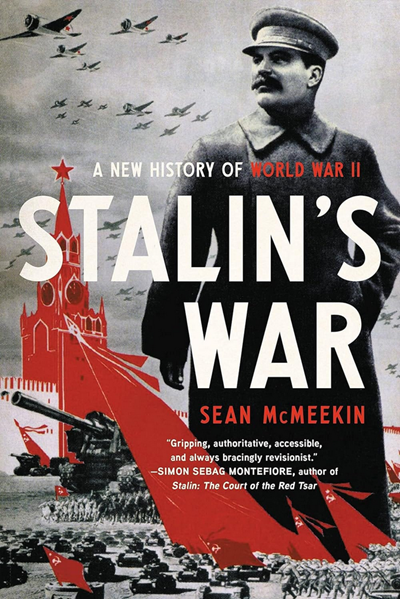
Big Serge talks to historian Sean McMeekin, the author of Stalin’s War and other works that some call “revisionist” for their different views of “settled” historical events:

Big Serge: “One of the first things that stands out about your work is that you have found success writing about topics which are very familiar to people and have a large extant corpus of writing. World War One, the Russian Revolution, World War Two, and now a broad survey of Communism – these are all subjects with no shortage of literature, and yet you have consistently managed to write books that feel refreshing and new. In a sense, your books help “reset” how people understand these events, so for example Stalin’s War was very popular and was not perceived as just another World War Two book. Would you say that this is your explicit objective when you write, and more generally, how do you approach the challenge of writing about familiar subjects?”

Dr. McMeekin: “Yes, I think that is an important goal when I write. I have often been called a revisionist, and it is not usually meant as a compliment, but I don’t particularly mind the label. I have never understood the idea that a historian’s job is simply to reinforce or regurgitate, in slightly different form, our existing knowledge of major events. If there is nothing new to say, why write a book?

Of course, it is not easy to say something genuinely new about events such as the First World War, the Russian Revolution, or World War Two. The scholar in me would like to think that I have been able to do so owing to my discovery of new materials, especially in Russian and other archives less well-trodden by western historians until recently, and that is certainly part of it. But I think it is more important that I come to this material – and older material, too – with new questions, and often surprisingly obvious ones.

For example, in The Russian Origins of the First World War, I simply took up Fritz Fischer’s challenge, which for some reason had been forgotten after “Fischerites” (most of them less than careful readers of Fischer, apparently) took over the field. In the original 1961 edition of Griff nach der Weltmacht (Germany’s “Bid” or “Grab” for World Power, a title translated more blandly but descriptively into English as Germany’s Aims in the First World War), Fischer pointed out that he was able to subject German war aims to withering scrutiny because basically every German file (not destroyed in the wars) had been declassified and opened to historians owing to Germany’s abject defeat in 1945 – while pointing out that, if the secret French, British, and Russian files on 1914 were ever opened, a historian could do the same thing for one of the Entente Powers. I had already done a Fischer-esque history on German WWI strategy, especially Germany’s use of pan-Islam (The Berlin-Baghdad Express), inspired by a similar epigraph in an old edition of John Buchan’s wartime thriller Greenmantle – Buchan predicted that a historian would come along one day to tell the story “with ample documents”, joking that when this happened he would retire and “fall to reading Miss Austen in a hermitage”. So it was a logical progression to ask, if Fischer can do this for Germany’s war aims, why not Russia?

Readers may have missed the obvious Fischer inspiration for Russian Origins owing to the editors at Harvard/Belknap, who thought my original title – the obviously Fischer-inspired Russia’s Aims in the First World War – was boring and unsexy. Probably this helped sell books, but it did lend my critics an easy line that I was “blaming Russia for the First World War” rather than simply applying a Fischer-esque lens to Russia’s war aims. Some also called me Russophobic, which is understandable, though I think it misses the point. To my mind, subjecting Russian strategic thinking, wartime diplomacy and maneuvering to the same scrutiny as those routinely applied to Germany and the other Powers is taking the country seriously on its own terms, rather than ignoring Russia, as nearly every historian of, say, Gallipoli has done.

A book on Russian war aims was also long overdue. Other than an underwhelming Chai Lieven study from 1983 and a few articles, no one had really done this for Russia since Soviet scholars and archivists had (with very different motivations) published annotated volumes of secret Russian diplomatic correspondence back in the 1920s. For me, this was a door wide open, and I walked right in. Stalin’s War is in many ways a sequel to Russia’s Aims in the First World War (my own title!), written in a similar spirit, albeit much longer and in some ways more ambitious.

With the Russian Revolution, it was probably still harder to say anything really new, particularly after the popular histories of Richard Pipes and Orlando Figes (and a huge new literature written partly in response to them) came out in the 1990s. And I do not think my “take” was quite as revisionist or controversial as those on WWI or WW2. What I did try to do, in order to add something new to the story, was to combine my own research in a number of areas (Russian army morale reports before and after Order No. 1, depositions taken after the July Days, police reports from 1917, Bolshevik finances and expropriation policies, etc.) with new work done by others since 1991 on, especially, Russia’s military performance in WWI (a topic almost completely ignored in Cold War era literature on the Revolution, both Soviet and western), to reinterpret both the February and October Revolutions. In full disclosure, I would have preferred to write an ambitious history on just 1917, where I had the most original material and new points to make, but my publisher wanted a one-volume “comprehensive” history of the Revolution, so that is what I wrote. Like most historians and writers, I like to think that I write entirely from inspiration with a free hand, but of course there are all kinds of factors that play into our work.

Getting back to your question – while I have certainly done original research for all of these books, I am hardly the only historian to take advantage of Russian archives opened after the collapse of the USSR in 1991 – including, I should add, all the incredible archival material compiled by Russian researchers in the 1990s and 2000s into huge published volumes of Soviet-era documents. I think it is my mindset that differentiates me from other scholars who have taken similar advantage of this opportunity. Simon Sebag Montefiore, for example, uncovered incredibly rich veins of new material for Stalin. Court of the Red Tsar, as Antony Beevor did for Stalingrad, both of which books made an enormous splash. They’re not exactly “revisionists”, though. Rather, these historians retell stories already partly familiar, but with reams of fascinating new details that greatly enrich the story. I think this is a wonderful way to write history, and thousands of readers evidently agree. It is just not what I do.”

Big Serge: “I’m glad you brought up The Russian Origins of the First World War. This was the first of your books that I read, and I found it interesting for a counterintuitive reason, in that its arguments seem like they should be obvious and not particularly controversial. The essence of the book is that the Tsarist state had agency and tried to use the First World War to achieve important strategic objectives. That should be obvious, after all this was an immensely powerful state with a long pedigree of muscular foreign policy, but people are very accustomed to the Guns of August sort of narrative where all the agency and initiative is with Germany, and everyone else is reduced to the role of objects in a story where Germany is the sole subject.

It makes me think somewhat of a quip that Dr. Stephen Kotkin has used in interviews about his Stalin biographies, when he says that the “big secret” of the Soviet archives was that the communists really were communist. His point is that, even in a very convoluted and secretive regime, sometimes what you see really is what you get. I think you made a similar sort of point with Russian Origins. If I could paraphrase you, the big reveal is that the big, powerful Tsarist Empire was behaving like a big powerful empire, in that it had cogent war aims and it consistently sought to work towards those – so consistently in fact that the war aims were initially largely unchanged after the fall of the monarchy in 1917. You’re saying something very similar with Stalin’s War: the shocking secret here is that a powerful, expansionist, heavily militarized Soviet regime acted like it and worked aggressively to pursue its own peculiar interests.

How do you conceptualize this? It strikes me as a little bit odd, because, as you say, there is sometimes a bit of a stigma round the label “revisionist”, but your books generally present schemas that are fairly intuitive: Tsarist Russia was a big, powerful empire that pursued big imperial aims; Stalin was the protagonist of his own story and exercised a muscular, self-interested foreign policy; the Bolsheviks used extraordinary violence to conquer an anarchic environment. Are you surprised that people are surprised at these things?”

Dr. McMeekin: “I wish I was surprised, and perhaps at first I was, but I suppose that, over the years, I have become inured to the shocked! Shocked! reactions I receive when I point out fairly obvious things. Historians, like most groups, tend to be pack animals, who like to run in safe herds. When it comes to a familiar subject such as the outbreak of World War I, the literature tends to groove around well-trodden themes and questions. Certainly it has done since Fischerites took over the field: it’s Germany all the time, with perhaps a nod to Austria-Hungary in the Serbian backstory, or Britain with the naval race. France and Russia had almost disappeared from the story, as if one of the two major continental alliance blocs was irrelevant. I was heartened that my own treatment of Russia’s role in the outbreak of the war and Russia’s war aims garnered attention and shaped the conversation, both in itself and through Christopher Clark’s bestseller Sleepwalkers (which draws on Russian Origins). By contrast, Stefan Schmidt’s pathbreaking 2009 study of the French role in the outbreak of the war (Frankreichs Aussenpolitik in der Julikrise 1914), which Clark and I draw on heavily, has still not been translated into English, making barely a ripple in the profession. Clark and I have poked around with English-language publishers, trying to gin up interest in a translation, but so far without luck.

With the Second World War, I suppose the “shock” value is still greater, and perhaps therefore even less surprising. In Germany, after all, there are laws on the books making it illegal to “trivialize” the Holocaust, for example by foregrounding Soviet war crimes on the eastern front, and of course whole areas of the war such as the Molotov-Ribbentrop Pact, Soviet war plans in 1941, and even Lend-Lease are highly sensitive in Russia, though I’ll note that there has been a curious exception for the “full-on” revisionism of Rezun-Suvorov (Icebreaker, etc.) – perhaps because his thesis is so extreme as to be easily caricatured, or maybe just because his books sell so well, it has never been difficult to find them in Russian bookstores. In a way, I also think the popularity of Suvorov’s books in Russia relates to the way they do take the Soviet Union seriously as a great power, as I do, of course – whether or not one agrees with his thesis, and I’m sure many of his Russian readers do not, it is less condescending than western histories that treat the Soviets as passive victims of fate in the Barbarossa story before Stalin woke them up.

I was perhaps more surprised at the visceral reaction to Stalin’s War in Britain, particularly my discussion of Operation Pike (eg British plans to bomb Soviet oil installations in Baku in 1940), which sent certain reviewers into paroxysms of rage I found absolutely bewildering. If anything, I should have thought my sharply critical treatment of Hopkins and Roosevelt would have offended Americans far more gravely than my slightly more sympathetic portrayal of Britain’s wartime statesmen, but it was quite the opposite. Certainly some American Roosevelt admirers were annoyed, but this was nothing like British reviewers’ hysteria over Operation Pike. Curiously enough I had dinner not long ago with one of these reviewers, and he brought up Stalin’s War. He was very civil, full of British charm, but he still wanted desperately to know why I had argued that Britain “should have gone to war against the Soviet Union instead of Nazi Germany”. As always when I am accused of this – another reviewer stated this point blank in the TLS – I simply asked him if he could locate a passage in the book where I had stated any such thing? The entire subject of World War II has become so encrusted with emotion and taboos that I think it clouds people’s vision. They see ghosts.”

« Newer PostsOlder Posts »

Powered by WordPress