Quotulatiousness

July 22, 2025

Age verification schemes are just another attempt to control everyone’s internet usage

Filed under: Britain, Government, Law, Technology — Tags: , , , , , , — Nicholas @ 03:00

Marian Halcombe is specifically discussing the British age verification provisions of their Online Safety Act, but similar schemes are popping up all over the west, and they’re only pretending to be about protecting young people from online content:

“Privacy” by g4ll4is is licensed under CC BY 2.0 .

The British State, in its infinite filth and hypocrisy, would like you to believe that it is deeply concerned about what you do with your penis. Or more precisely, what you look at while your hand is on it. The latest wheeze — part of the Online Safety Act — is mandatory age verification for all pornographic websites. We’re told it’s to stop children from seeing naughty videos. In reality, it’s a spyware regime disguised as child protection, devised by a ruling class that snorts coke with one hand while signing surveillance warrants with the other.

Let’s start with the pretence. No one in Westminster cares what children watch online. These are the same people who presided over the industrial-scale rape of working-class girls in Rotherham, Telford, Rochdale, and elsewhere — refusing to intervene for fear of “racism”. The idea that they now lie awake worrying about a Year Eight boy glimpsing a MILF thumbnail on Pornhub is an insult to the intelligence. They don’t care about children. They care about you.

The age-verification scheme isn’t just about proving you’re eighteen. It’s about linking your name and your age, and your IP address to your viewing habits. Whether it’s ID upload or facial recognition or some third-party database, the outcome is the same: a digital file that knows what you watch and when you watch it.

In a normal country, this would be recognised as deeply perverse. In ours, it’s dressed up as safety. The State that can’t fix the trains, that can’t keep the hospitals clean, now wants the power to log whether you’re big-enders or little-enders. And all under the banner of protecting the kiddies.

Yes, of course it’s technically possible to anonymise verification. But only if you believe that governments, regulators, and their corporate collaborators are incapable of abuse. That’s a belief I do not share. This is the same British government that let GCHQ harvest your webcam feeds and your phone calls under the TEMPORA programme. You didn’t vote for that. You weren’t told about it. You found out because Edward Snowden blew the whistle.

Do you really think the same regime won’t take an interest in which adult videos you watch? Anyone with an ounce of memory knows how this goes. Every intrusive policy begins with “think of the children”. The Video Recordings Act. The Dangerous Dogs Act. The Terrorism Act. And now the Online Safety Act. Once the infrastructure is in place, it never stays limited to its original purpose.

The definition of “harmful content” is vague for a reason. It can grow. It can stretch. Today it’s Pornhub. Tomorrow it’s Twitter. Then it’s dissident blogs, pro-life websites, or even a dodgy meme about immigration statistics. In the end, the target isn’t porn — it’s dissent.


Battle for Gaza 1917: The Palestinian Campaign of WW1

The Great War
Published 14 Feb 2025

The ongoing Israel-Palestine conflict has its roots in another war more than a century ago. When the First World War began in 1914, the territory of today’s Israel and Palestine was part of the Ottoman Empire. But in 1917 the British Empire began a campaign that would change history: there would be bitter fighting in Gaza, wild cavalry charges, even talk of a modern crusade. And it would lay the foundations for a century of violence.
(more…)

QotD: Social assistance as a Western cargo cult

Filed under: Education, Government, Quotations, USA — Tags: , — Nicholas @ 01:00

Part of the problem with social policy here in America is that it is conducted like a South Pacific Cargo Cult. We looked around and saw that the majority of successful people owned their own homes and had college degrees, so we figured that if we grabbed any old slacker and subsidized them a home and a college degree, then they, too, would become successful. It’s got cause and effect completely out of whack.

Tamara Keel, “From a conversation elsewhere…”, View From The Porch, 2020-06-10.

July 21, 2025

“Normal”? Dude, that’s extremist right-wing hate speech!

Filed under: Education, Health, Media — Tags: , , , , , , — Nicholas @ 05:00

The Bone Writer on the huge increase in young people “identifying” as something other than what unreconstructed cavemen used to call “normal”:

Walk through any high school, scroll through TikTok, or attend a freshman orientation, and you’ll see the new hierarchy of modern identity:

  • Straight white male? Bottom rung.
  • Bisexual nonbinary neurodivergent? Stunning and brave.
  • Confused, anxious, fluid? You’re seen. You’re valid.
  • Rooted, stable, and clear? YOU must be dangerous.

It’s not just a cultural shift anymore. It’s a cultural mutation. A slow but total dislocation from reality.

We are no longer celebrating the diversity of life. We are celebrating the diversity of escape routes from it.

Identity as a Compass? No … It’s Identity as Camouflage

There was a time when “identity” meant something integrated, a clear expression of who you are, shaped by your values, your upbringing, your nature.

Now, identity is:

  • A product
  • A protest
  • A mask

It’s often less about expressing truth and more about shielding from judgment.

And nowhere is that clearer than in the explosion of LGBT+ self-identification, especially among the young.

The Numbers Don’t Lie but No One Wants to Look at Them

In 2012, Gallup found ~3.5% of Americans identified as LGBT.

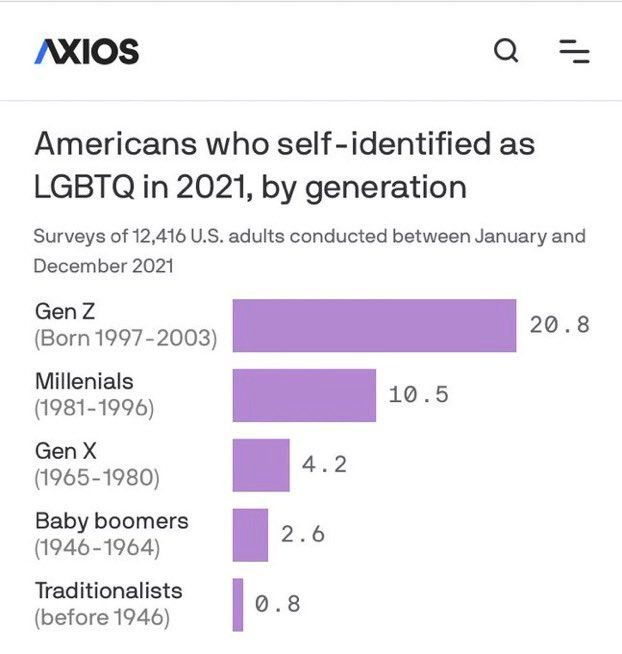
By 2021? Over 20% of Gen Z now identify somewhere on the spectrum.

Among Gen Z women, bisexual identity has grown by over 400%.

Do you really believe this is all “just visibility”? Do you really think the human genome changed this much in 10 years?

Of course not.

What changed was the culture. And culture now rewards deviation and punishes normativity.

Reported by Axios in 2021

Was Juan Perón a Fascist? The Cold War Origins of Peronism – W2W 037

TimeGhost History
Published 20 Jul 2025

Was Juan Perón really a fascist, a socialist, or something entirely different? In this episode of War 2 War, we explore the rise of Peronism in post–World War II Argentina and how Perón tried to position his country between the superpowers of the Cold War.

Through labour reforms, nationalist rhetoric, media control, and brutal repression of dissent, Juan and Eva Perón created a powerful populist regime that borrowed ideas from both fascism and socialism, while claiming to reject both. From Argentina’s “Third Way” to its complicated ties with the US, USSR, and even Nazi fugitives, we examine the ideology, contradictions, and legacy of Peronist rule.

Was Peronism a unique form of authoritarian populism, or just another face of fascism?

Join us as we uncover the foundations of Argentina’s Cold War identity and the true political nature of Juan Perón.
(more…)

AI slop seems to have finally triggered significant pushback

Filed under: Business, Media, Technology — Tags: , , , , , — Nicholas @ 03:00

Ted Gioia says that he’s seeing strong indicators that the AI slop superabundance has helped create a widespread rejection of it and all its works:

2025 has been the year of garbage culture.

Creators watch in horror as dismal AI slop threatens their livelihoods — and the integrity of their fields. It’s everywhere, spreading faster than a pharaoh’s plague.

In recent months, we’ve been bombarded with millions of lousy AI songs, idiotic AI videos, and clumsy AI images. Error-filled AI texts are everywhere — from your workplace memos to the books sold on Amazon.com.

Even my lowly vocation, music journalism, gets turned into a joke when it’s accompanied by slop images of fake events.

No, these things did not really happen.

But something has changed in the last few days.

The garbage hasn’t disappeared. It’s still everywhere, stinking up the joint.

But people are disgusted, and finally pushing back. And they are doing so with such fervor that even the biggest AI companies are now getting nervous and pulling back.

Just consider this surprising headline:

This was stunning news. YouTube is part of the biggest AI slop promoter of them all — namely the Google/Alphabet empire. How can they possibly abandon AI garbage? Their bosses are the biggest slopmasters of them all.

After this shocking news reverberated through the creative economy, YouTube started to backtrack. They said that they would not punish every AI video — some can still be monetized.

But even the revised guidelines are still a major blow to AI slop purveyors. YouTube made clear that “creators are required to disclose when their realistic content is altered or synthetic”. That’s a huge win—we finally have a requirement for disclosure, and it came straight from the dark planet Alphabet.

YouTube also stressed that it opposes “content that is mass-produced or repetitive, which is content viewers often consider spam”. This is just a step away from blocking slop.

Update, 22 July: Ted posted a follow-up with a bit more evidence that the pushback is working:

In my latest article I criticized Spotify for allowing uploads of unauthorized AI tracks to the profiles of dead musicians.

But the company may finally be listening to criticisms of its AI policies. In this case, Spotify has now taken steps to stop the abuses, and a spokesperson reached out to me today with an update and expressing a clear and proper policy on AI fraud.

I share it below (and have also updated my article):

    We’ve flagged the issue to SoundOn, the distributor of the content in question, and it has been removed. This violates Spotify’s deceptive content policies, which prohibit impersonation intended to mislead, such as replicating another creator’s name, image, or description, or posing as a person, brand, or organization in a deceptive manner. This is not allowed. We take action against licensors and distributors who fail to police for this kind of fraud and those who commit repeated or egregious violations can and have been permanently removed from Spotify.

They acted quickly, and I give them credit for that.

Update the second, 23 July: Ah, Spotify giveth and Spotify taketh away:

“Spotify is publishing new, AI-generated songs on the official pages of artists who died years ago without the permission of their estates or record labels,” reports 404 Media.

This scandal came to light because of an AI song attributed to Blaze Foley, who died in 1989. The bogus track is accompanied by an AI-generated image of a man who bears no resemblance to the singer.

What’s going on here? Is this just ignorance or carelessness at Spotify? Or does it represent something more sinister — another example of the company’s willingness to deceive users in the pursuit of profits?

These scams must stop. If Spotify doesn’t fix this mess immediately, courts should intervene.

But the dead musician scandal is just a start — because other bizarre things are happening at Spotify.

The whole situation is positively surreal.

Caligula: Was He Really Mad?

The Rest Is History
Published 3 Feb 2025

Enough of the Princeps, what remains to be described, is the monster …

The Roman emperor Caligula endures as one of the most notorious figures in not only Roman history, but the history of the world. Famed as a byword for sexual degeneracy, cruelty and corruption, the account of his life written by the Roman historian Suetonius has, above all, enshrined him as such for posterity. Throughout the biography there is a whiff of dark comedy, as Caligula is cast as the ultimate demented Caesar, corrupted absolutely by his absolute power and driven into depravity. Born of a sacred and illustrious bloodline to adored parents, his early life — initially so full of promise — was shadowed by tragedy, death, and danger, the members of his family picked off one by one by the emperor Tiberius. Nevertheless, Caligula succeeded, through his own cynical intelligence and cunning manipulation of public spectacle, to launch himself from the status of despised orphan, to that of master of Rome. Yet, before long his seemingly propitious reign, was spiralling into a nightmare of debauchery and terror …

Join Tom and Dominic as they discuss the most notorious emperor in Rome: Caligula, a man said to have slept with his sister, transformed his palace into a brothel, cruelly humiliated senators, and even made his horse into a consul. But what is the truth behind these horrific legends? Was Caligula really more monster than man …?

00:00 A mysterious emperor
05:18 Why are the stories about Caligula so bad?
08:40 Germanicus: the best man in Rome
16:20 Caligula is the heir
19:30 The death of Tiberius
20:55 Caligula’s cynical intelligence
22:50 Caligula’s skill playing to the gallery
28:39 Caligula’s turn to evil (according to Suetonius)…
31:35 Caligula as Suetonius’ monster
37:22 Caligula confronts the senate
45:10 The conspiracy against him moves
48:14 Did all this actually happen?
58:43 Did he make his horse a consul?

Producer: Theo Young-Smith
Assistant Producer: Tabby Syrett
Video Editor: Jack Meek
Social Producer: Harry Balden
Executive Producers: Jack Davenport + Tony Pastor

QotD: The parasitic classes

Filed under: Bureaucracy, Economics, Education, Government, Quotations — Tags: , , , , — Nicholas @ 01:00

A parallel case may be found in the “civil” services, regulating authorities, non-profits, &c. Jobs in these areas, which command high salaries and pensions, and present delicious opportunities for graft, are outwardly the opposite of productive. They parasitically consume, on a colossal scale, the resources of the productive.

Look into almost any kind of “charitable” activity, such as social work, and one will find that only a tiny proportion of the cash “trickles down” to the characteristically desperate “clients”. And when it does, they use it to buy not only drugs and licker, but truly useless things, such as lottery tickets.

“Education” systems, in the modern West, exist chiefly to enrich semi-literate, unionized schoolteachers. In many parts of Ontario, for instance, a teacher will make at least double what the average parents make, and therefore feel justified in sneering. The teachers naturally consider that the little ones belong to them, for they are the necessary source of their income. What rights should parents have to interfere in their upbringing?

My best argument for the parasite class (always granting that some may be sincere), is that they protect society from gathering excessive wealth, or living lives of too much ease. Without them, we might easily suffer from the vices associated with too much freedom.

How I preferred the deadbeat, layabout, very English London of the Labour Party, when I lived there in the ‘seventies — to the cosmopolitan, rich, over-swept London of the Thatcher years. There are some advantages to socialism.

And there are other arguments, too, for putting depraved Leftists in power, though on examination they reveal special pleading. For instance, teachers may claim to offer child-minding services, so that mothers, especially, can go to work. But it is because heavy taxation requires the dual income, or women to do horrible and demeaning paid work when their husbands run away, that these services were ever made necessary.

The government does, arguably, “create” employment. Among the most farcical examples are the tax lawyers and consultants. Taxpayers need these to navigate incredibly elaborate tax codes, for their own protection. Only a professional can find the loopholes. Whereas, a comprehensible, flat tax system would put all these “experts” out of business. It would shrink revenue departments spectacularly, and by extension, threaten to shrink taxes. To a professional politician, this would never do. It would shrink his power.

David Warren, “Answering to a ‘need'”, Essays in Idleness, 2020-06-18.

July 20, 2025

Generational differences about … ugh … talking on the telephone

Filed under: Business, Cancon, Media, Technology — Tags: , , — Nicholas @ 05:00

As a late boomer — and unlike most of my cohort — I’ve always hated talking on the telephone to someone. I’m sure part of it is my innate shyness and social awkwardness: if I can’t see how the other person reacts to my verbal blundering, how can I correct myself in time to salvage something from the call? As a result, I’m rather more sympathetic to younger Millennials and Gen Z’ers who have a common generational aversion to telephone calls:

“Candle-stick phone with courtesy pay box” by CodeName47km is licensed under CC BY-SA 4.0 .

I’ve been working to wean myself off the phone. I try to use it only when it feels necessary: we require an answer now, things are too complex to lay out in an email, or I want to be sure what I’m saying is received as I intend it. Sometimes these calls are spontaneous. Increasingly, I schedule them, or ask permission first.

I’ve done this because it’s how business communications work today, and I don’t like to remind people that I’m getting on. I also do it in deference to my colleagues, all of whom are much younger than me. They prefer email, texts, or the group chat.

The landline decision was forced by our acquisition of Fitzhenry & Whiteside, which has had the same telephone number for decades. F&W has many more authors than does Sutherland House, and a good number of them are over sixty. We’re trying to make the transition to new ownership seamless. We didn’t want people calling up to hear “this number is no longer in service”. So the newly installed phone sits on a stand beside the desk I share with Shalomi. I call it Shalomi’s phone and make her answer it when she’s around. Mostly it goes to voicemail and tells people how to contact us by email.

Accustomed as I’ve become to phone-free work, I was taken aback this week when I asked one of our interns to call a printer — we needed a quick quote — and she responded, “I don’t do telephones”. She looked at me bewildered. I responded in kind.

My mind was racing to figure out if I’d mishandled the matter. I’d just read that story in the New York Times about the “Gen Z stare”, the blank look given by a young person (usually in a service job) where a verbal response would be common. It is often interpreted as a freeze on the part of the starer, an inability or reluctance to engage, perhaps rooted in anxiety, perhaps a remnant of the pandemic’s social dislocations, although some insist the starer is telling their interlocutor “you’re in my space and you ought to back off”.

I heard from a number of people about that article this week, and while the Times had not mentioned phone usage and etiquette, my conversations did. Apparently there are a lot of young people who don’t know how to answer their phones. They see a call pop up on their screen and they stare at it, waiting for it to go away. Or they press answer and listen without saying anything. Some, I’m told, answer even scheduled calls from people they know with silence.

I’ve heard parents say they didn’t expect they’d have to teach their children to answer a phone. A university lecturer explained that journalism professors now demonstrate use of a telephone before instructing students on how to conduct an interview over it. Apparently, the same goes for rookie salespeople.

Poking around online, I found a BBC article reporting that a quarter of people aged eighteen to thirty-four never answer their phones, more than half of them interpret any unexpected call as bad news. CBS reports 90 per cent of Gen-Z are anxious about phone calls.

In fairness, a lot of adults are similarly leery of their phones. They don’t want to engage with spam dialers or scammers — they answer and listen for the brief pause that betrays a call centre. Some let every unrecognized call go to voicemail. The savvier ones have figured out that your iPhone, properly configured, will send calls from people not in your contacts directly to voicemail.

Back to our intern. Eventually, I recovered myself. This wasn’t an instance of Gen-Z awkwardness or anxiety around real-time conversations. She is bright, confident, and as socially adept as anyone in the office. I asked if she had a phone. She did. I asked if she used it for calls. She said only to speak to her mom, who pays for her phone. Perfectly reasonable. And it was her personal phone, not a company phone, so she was under no obligation to use it at work. So we suggested she make the call on the company phone, which she cheerfully did.

We spoke later about generational differences with regard to communications technology. She likes the control one has over email communication as compared to the unpredictable nature of phone calls. I told her about life when no one had phones, yet we could all somehow manage to show up at the same place and the same hour. I can hardly believe I lived in such times. Hearing this must have hit her like I was once hit by the reporter Ray Stannard Baker’s account of how he used to walk up to the White House, knock on the front door, and ask to speak with the president.

Day Eight – Can Charles de Gaulle Save France? – Ten Days in Sedan

Filed under: Britain, France, Germany, History, Military, WW2 — Tags: , , , , , — Nicholas @ 04:00

World War Two
Published 19 Jul 2025

Ten Days in Sedan continues as our WW2 Blitzkrieg documentary follows the first serious counterblow against the German spearhead. Colonel Charles de Gaulle leads the 4th Armoured Division in an attack against the German flank. De Gaulle’s units are understrength and his assault is improvised but he catches Heinz Guderian by complete surprise. Is this just a fleeting gesture of defiance, or a new kind of French resistance?
(more…)

“[T]he job of a manager [is] to get all C Northcote on bureaucracy”

Filed under: Bureaucracy, Government, USA — Tags: , , , — Nicholas @ 03:00

Tim Worstall discusses the recent announcements about the US State Department significantly reducing their staff levels — a “Reduction In Force” or RIF — that is being lamented by the Washington bureaus of all the surviving mainstream media as a world tragedy:

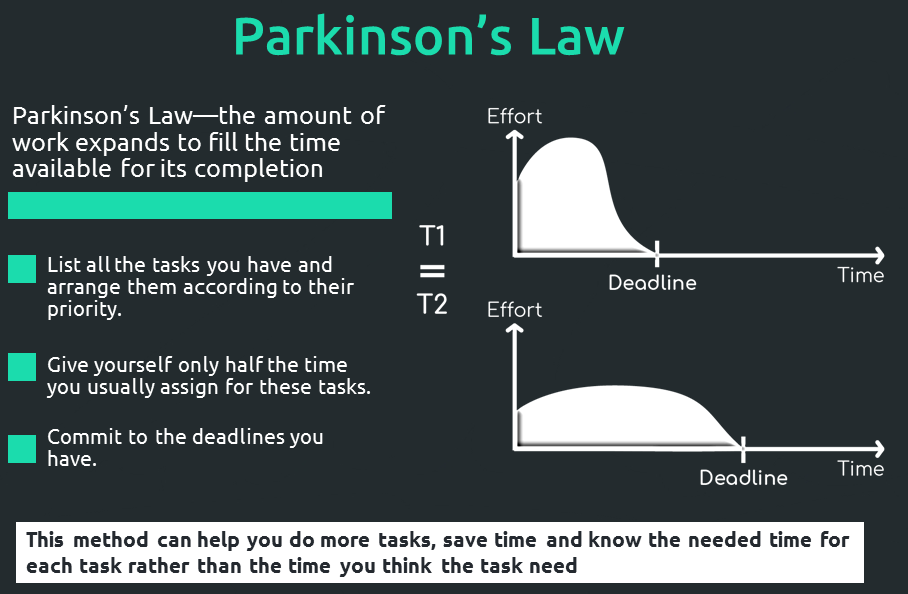
The Guru here, the epitome of the management science, is C Northcote Parkinson. Best remembered for Parkinson’s Law — work expands to fill the time available for its completion. But a deeper thinker than that aphorism.

The essential point being that the output of a bureaucracy is bureaucracy. There is nothing measurable that is being done, no financial value being put upon the work. Sure, sure, it might even be that what is being done is of value — we’ve not got a simple measure of it though.

Therefore a bureaucracy measures itself by the budget and staff count. The success of a bureaucracy — a bureau perhaps — is measured by increases in either or better both. Which really does mean that the output of having a bureaucracy is more bureaucracy.

In the private sector this occurs as well. That’s how the power skirts get to take over large corporations. Of course, at some point in that process the company runs out of money and goes bust — the land is cleared for the next attempt to actually add value.

With government that doesn’t happen. Which leads to one of my favourite little thoughts — every civilisation survives until it is parasitised, eaten from within, by its own bureaucracy. We’d probably prefer that this didn’t happen. Yes, anarchy is all very well in theory but no one does like it when the bins aren’t emptied and there’s no state left to keep the French at bay.

The result of this is that the state bureaucracy needs to be pruned. Always. The actual job of a minister is — should be at least — to muse on what shouldn’t be done any longer and who can we fire? As should be the waking thought of any CEO of course.

My preference — because I’m extremist, obviously — is that we just fire them all. Then hire back the 2% we actually do require in order to have a civilisation. Remember, the Empire ran India with 1,000 men. And, well, it’s not wholly obvious that it’s been run any better than that since then.

That’s therefore the job of a manager. To get all C Northcote on bureaucracy. Always and everywhere. If you prefer your phrasing a little more red blooded the answer to bureaucrats is the Carthaginian Solution. Not that anyone would buy them as slaves, not productive enough, but we can try, right?

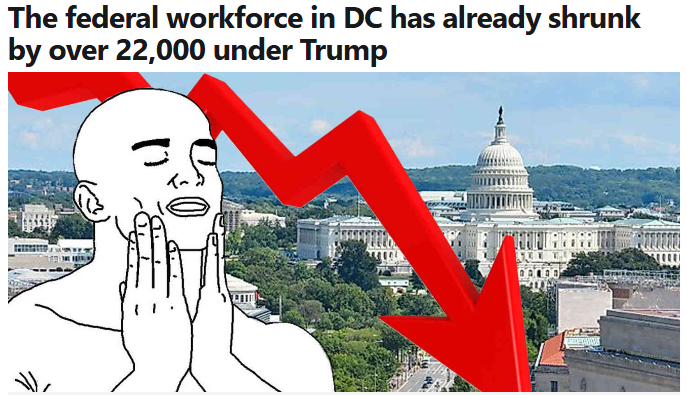
What do you call 22,000 fewer civil servants in Washington? A good start:

Update: Fixed missing URL.

Star Trek and the New Frontier Story

Filed under: History, Media, Space, USA — Tags: , , , , , — Nicholas @ 02:00

Feral Historian
Published 28 Feb 2025

Star Trek has been the “new frontier” story for so long that it’s become more retro than futurist. But that doesn’t mean the frontier story itself is dead, only that there’s a disconnect between the future we want and the visions of it that we have.

00:00 Intro
02:19 Time and Space
06:06 Inhabited Spaces
09:44 A story of the Past

QotD: Above all else, helicopter parents hate … helicopter parenting

Filed under: Education, Quotations, USA — Tags: , , , — Nicholas @ 01:00

It’s a very weird, but oft-observed, phenomenon that the biggest opponents of “helicopter parenting” are … helicopter parents. You can go into a Starbucks and announce to the gaggle of Karens: “Kids these days are so soft; their parents never let them get hurt or make any mistakes, and so they never learn anything!” all you’ll get complete, enthusiastic agreement. Meanwhile, they’ve got their Jayden and Kayden and Brayden and Khaleesi coated in bubble wrap, wearing three masks and taking hand-sanitizer baths every half hour.

If the kid gets anything less than an A-triple-plus in Zoom School, Karen is immediately on the horn to the teacher … and since all schools these days, even the rare physical ones, are all wired up with “classroom management software”, they can bombard their kids’ teachers with emails and text messages 24 hours a day, 7 days a week.

Helmets, knee pads … kids these days wear more safety gear than a mountain climber just to ride their bikes, and I wouldn’t be at all surprised to see them kitted out like hockey goalies if recess ever becomes a thing again. Can the day be far off when every kid is trailed by xzheyr own personal injury lawyer, and parents are forced to sign waivers to let their kids use the bathroom?

Everyone knows how bad this is for childhood development, but if I told some kid with a scraped knee to rub some dirt on it, you’ll be fine, I’d probably get hauled up on child endangerment charges.

How can kids advance past age twelve, mentally and emotionally, if they’re never allowed to get hurt? To fail? To suffer the consequences of their own bad decisions?

I’m no developmental psychologist, but it seems obvious that such learning is time-limited. If you haven’t learned that X brings pain — and WHY — by the time you hit twelve years old, then on some fundamental level you’re never going to learn it.

Severian, “On Being Bad”, Founding Questions, 2021-12-12.

July 19, 2025

No issue is so important that we can’t have a proper debate on the merits

Filed under: Government, Media, Politics — Tags: , , , , , — Nicholas @ 05:00

On Substack, Lorenzo Warby refutes the claim that some issues are just too important/too urgent/already decided:

One of the features of the “progressive” politics of the unaccountable classes — those who are just paid for turning up — is the demand that there be “No Debate” about various issues. The most obvious instances are “No Debate” about Trans and “No Debate” about climate change — hence demands that climate scepticism be outlawed.

All such “No Debate” claims are crap. First, any “No Debate” claim is presumptive evidence that what you are pushing is either not true or, slightly more subtly, is a mountain of bullshit erected on a molehill of truth. Robust cases for claims about the world are not afraid of debate.

Various moral urgency claims are mounted to support such “No Debate” claims. How do we determine moral urgency? From the evidence. If the evidence is clear, debate will not threaten that alleged urgency. On the contrary, it will reveal the urgency more clearly.

The underlying philosophical dynamic underlying “No Debate” claims is Critical Constructivism — the claim that reality is socially constructed; that all statements and knowledge claims are, in fact power claims; and that the righteousness of a claim can be determined by their (alleged) effects on (morally differentiated) social groups.

The underlying social dynamic is the use of affirmed beliefs to determine and display righteousness. If affirming X shows one to be one of the righteous, then not believing X shows one to be of the unrighteous. This is typically expressed in various terms of moral abuse (racist, Transphobe, Islamophobe, etc) whose use in media and academe has soared since 2014.

This is not because Western societies have become more bigoted — on any reasonable measure they have become far less so over time — but because the politics of Righteous Affirmed Belief has dramatically surged and so has therefore the stigmatisation of dissent.

To claim that affirming X shows ultimate moral propriety requires stigmatising not-X. For something is morally proper — indeed morally trumping — only if the opposite is morally improper. Thus is moral propriety is enforced by stigmatisation. Hence silence is violence — one must profess righteousness. Hence also words are violence — if affirmation of belief is the ultimate marker of righteousness then expressed disbelief becomes the ultimate marker of abusive malevolence. These dynamics lead to a great deal of preference falsification — people publicly affirming, or at least not opposing, claims that they do not privately believe.

Old and tired: the Overton Window … New and hot: the Trump Door

Filed under: Government, Media, Politics, USA — Tags: , , — Nicholas @ 04:00

In The Line, Mike Colledge considers how Trump has managed to change the political environment that used to be fairly well described by the Overton Window:

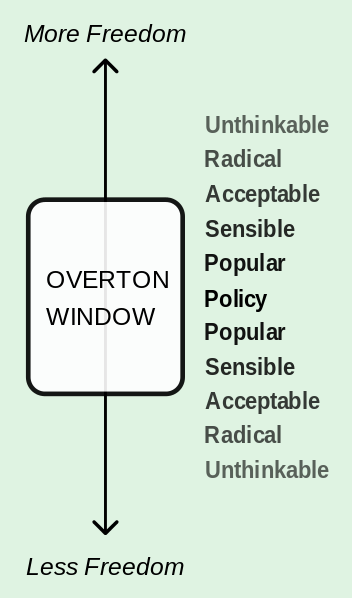
Diagram of the “Overton Window”, based on a concept promoted by Joseph P. Overton (1960–2003), former director of the Mackinac Center for Public Policy. The term “Overton Window” was coined by colleagues of Joe Overton after his death. In the political theory of the Overton Window, new ideas fall into a range of acceptability to the public, at the edges of which an elected official risks being voted out of office.
Illustration by Hydrargyrum via Wikimedia Commons

The Overton Window, named after Joseph Overton of the Mackinac Center for Public Policy, is used to explain how policy ideas gain acceptance and move from idea to policy. The “window”, as Overton saw, could include a wide range of ideas from those with little to no support to those that have matured, gained public traction, and could be supported by the public as legitimate policy options for governments. The “window” was not static. It could — and did — shift, expand, or contract based on social movements, economic pressures, cultural trends, and/or the actions of leaders in the public and private sectors.

Those who wanted to push ideas into the window and gain acceptance and support usually had to spend considerable effort — and sometimes years — promoting and making the case for their cause and moving it into the mainstream. Al Gore’s documentary An Inconvenient Truth and Greta Thunberg’s ongoing efforts to push for action on climate change are examples of leaders using their profile to push and keep climate change action in Overton’s Window.

Lately, though, it feels like the Overton Window has been replaced by the Trump Door. While Overton observed and studied what was happening, Trump is more of an active participant. Overton provided us with an analytical framework; Trump’s door is more of a tactical approach.

And this is a big change. The world moves much faster than it did in the mid-90s when Overton first created his “window”. The democratization of communications and the speed of communications means anyone can comment, report, or share an opinion instantly (and often without considering the consequences). Increased polarization means that leaders looking to act and to reinforce support for their desired policies do not have to wait for a majority to support a given policy before they act. They merely need a vocal plurality of their own supporters to move forward with an idea.

Trump hasn’t so much smashed the window as he has replaced it with a large swinging Western saloon-style door. He has shown no interest in framing and positioning an issue for the public’s consideration in hopes of building support from a majority. He is throwing ideas into and out of the public-consideration saloon as fast as possible. Some ideas he throws in as distractions. Others he throws in as announcements of his intent regardless of the public’s perspective.

To those of you saying in your head “I don’t think Trump thinks this deeply about what he is doing,” you could be correct. But the net impact of his actions is the creation of a Trump Door that, unlike a window, is not transparent and, again unlike Overton’s Window, is not about building public acceptance. It is a tool to achieve his goals as fast as possible. When obstacles require a shift in policy — given there is no need to engage the public — he simply throws another idea into the saloon.

« Newer PostsOlder Posts »

Powered by WordPress