
This “vibe shift”, as Gen Z calls it, reminds me of my then three-year-old nephew’s weekly blasphemy tour of the local supermarket. Back then, corralled into carting the little critter around town, I’d fasten little Jack into a pushchair and head off. He’d say little to nothing between the front door and the edges of the high street.
As we crept closer, mischief would smear across his lips. He’d bide his time. “Now, Jack,” I’d plead. “Remember what your mother said …”
We’d land in the supermarket. Jack would survey the crowds. At the top of his lungs, he’d bellow: “Boobies! Boo-BEES! Ha-ha-ha-ha! Fat — FAT boobies!” With a visceral joy on his face, he’d fold over and repeat the lung-puncturing cycle, laughing himself into a pram-splayed stupor.
For the first time, Jack indulged the timeless power inherent in saying a few forbidden words and basking in the illicit result. Freud, for all of his faults, called this joy “evading the censor”. Of course, Jack hadn’t read much Freud by then. All he knew was that saying what he was forbidden to say was, in fact, uproariously funny.
No doubt, modern scolds would pen a 5,000-word buzzword soup condemning Jack’s internalised misogyny, his unconscious patriarchal programming or some such modern voodoo. They’d miss the point: saying what one is forbidden to say is — and always will be — funny.
Christopher Gage, “No Laughing Matter”, Oxford Sour, 2025-03-14.
June 16, 2025
QotD: Evading the censor
June 15, 2025
Day Three – Guderian, Rommel, and The Race to Cross The Meuse – Ten Days in Sedan
World War Two
Published 14 Jun 2025May 12, 1940: Blitzkrieg, WW2’s new form of war, arrives in Sedan as Heinz Guderian’s Panzers capture the town and prepare to cross the river. Further north, Erwin Rommel drives toward the Meuse in the face of fierce French resistance. With the Luftwaffe dominating the skies and French reinforcements en route, the battle for Sedan is about to ignite.
Militarizing the Canadian Coast Guard (or not?)
Noah tries to get some solid information on the recent announcement by the Prime Minister that as part of changes to bring Canada into line with our decade-old NATO commitments, the Canadian Coast Guard would be moved from the civilian oversight of the Ministry of Fisheries and Oceans to the military oversight of the Ministry of National Defence. Oddly, the government seems to have been caught rather flat-footed by the PM’s announcement:

When Monday came I was invited to take part in a Media Briefing before [the PM] took questions. My immediate goal was to bring this topic up and get some sort of official words on what these plans were, especially after it wasn’t mentioned in [Carney’s] speech beforehand.
[…]
What we were told was that no such move was taking place, nor plans to arm the Coast Guard and that the current plan was to focus on augmenting their capabilities through new sensors and further collaboration with the RCN.
It was a definitive statement, one that we all agreed was cut and dry. I even reached out to other journalists before adding it to the livethread to make sure we were on [the same] page.
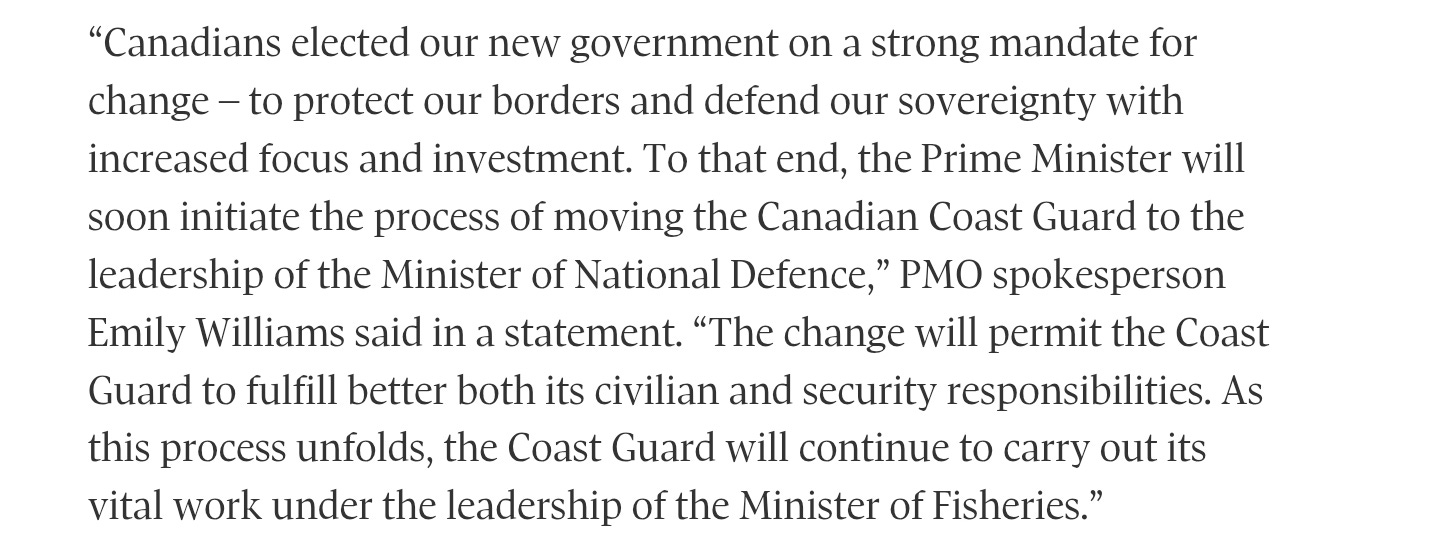
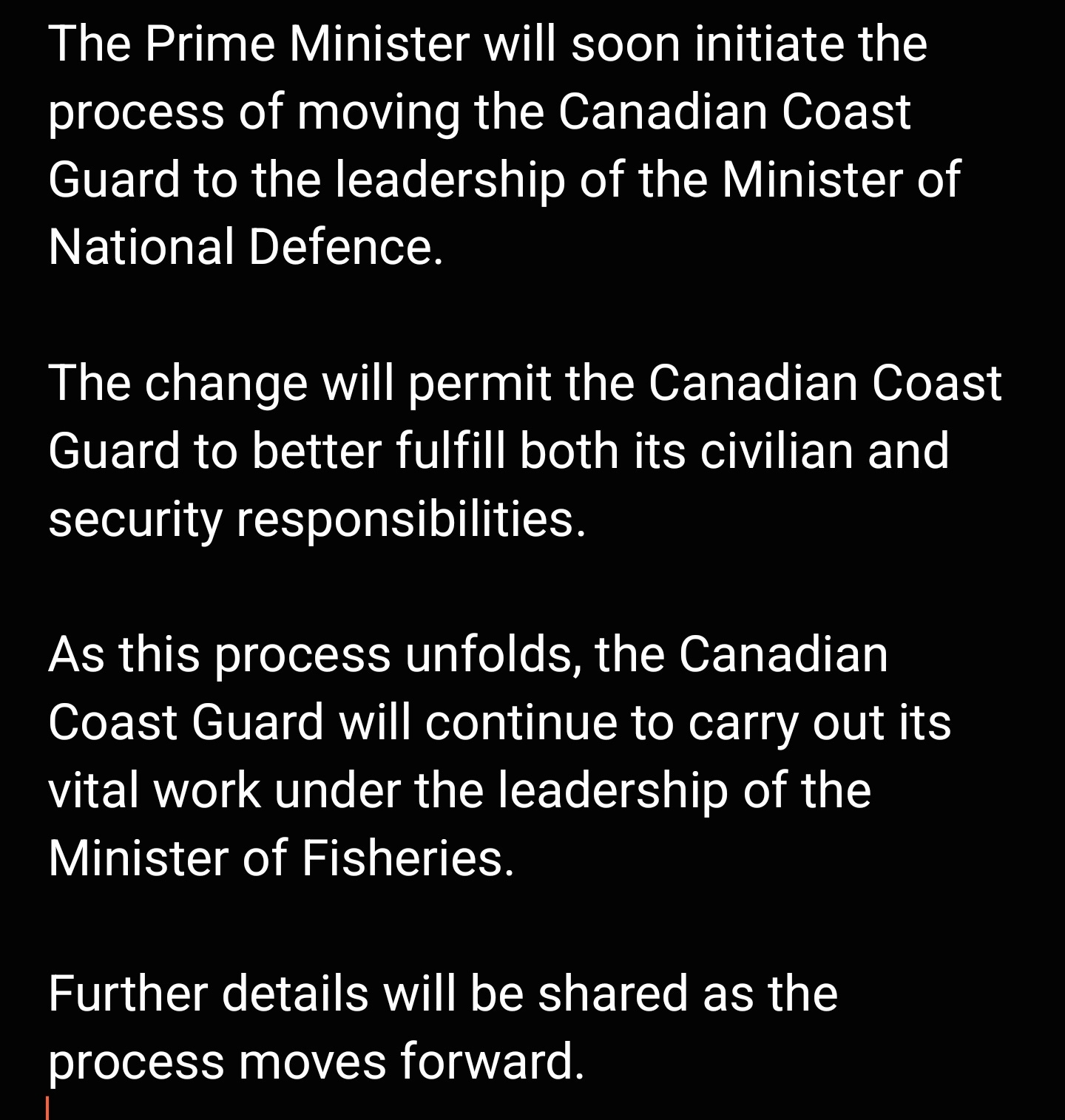
So imagine my surprise when Steven at the G&M came out blazing with a straight no, the plan is to move them. He even came backed up with a statement from the PMO, and credit to Steven, he was quick on this:
Credit to Steven Chase at the Globe & Mail
So as you can imagine my new goal was to figure out what exactly the hell was happening to the Coast Guard, with multiple competing statements on the subject. I made it my mission to have a definitive answer.
So it was back to asking, and emailing, everyone, from the DND to the PMO, CCG to the DFO. I got in contact, I dug into sources, even went as far as to ask people in industry if they had heard anything.
What I got for the first few days was chaos. Multiple statements saying that info wasn’t available, more time was needed. I got outright denial from the DND, only to be told they would email me back with info (they never did)
The PMO also told me info would be available when they had it. Evidently as of the time of this writing they have not responded. The only one to stay in contact and provide an answer to my question:
So as far as I was concerned this was a deal closer. The Coast Guard will be moving under the leadership of the Minister of National Defence. What will this look like? We don’t know. I had hit a dead end at this point, where sadly my reach was no longer wide enough for info.
Thankfully, there were others also keen on this, and wanting to get to the bottom of this, and they got farther than me. I will highly recommend my boy Stuart’s article on this as he got farther than me.
What has become evidently clear is:
- The Coast Guard is moving
- The idea is facing stiff resistance
This isn’t a shock at all. The DFO folks I talked to felt very caught off guard by everything, and the general reaction I have talking around was that this was a bit unexpected.
If accurate, then it is clear that this is the choice of the Prime Minister. He is the one who wants this, and so is making the final push. That isn’t to say he is the only one, but this has his backing and he will push that through.
America’s Forgotten SMG: The Hyde/Marlin M2
Forgotten Weapons
Published 4 Oct 2019 #36270The United States went into World War Two with the Thompson submachine gun — a weapon far too heavy and too expensive for its role. The British went to the other extreme with the Sten and while the US did not want a gun quite that crude, the Sten did spur a desire for something cheaper than the Thompson. George Hyde (then working for the Inland Division of GM) had worked on submachine gun designs in the 1930s, and he put together a weapon that would fit US needs. It was much cheaper than the Thompson and weighed in a full 2 pounds lighter. At tests in the spring of 1942, it also proved to be much more accurate in automatic firing, as it had a much more ergonomic stock design than the Thompson. The weapon was approved as the M2 submachine gun in 1942, and a contract went to Marlin to produce it (Inland had no extra production capacity at the time).
The receiver of the M2 was made through a metal sintering process, and Marlin had trouble getting this properly tooled up. The first gun delivery didn’t actually happen until May of 1943, and by that time Hyde had finished designing the M3 “Grease Gun”, which was cheaper still, and more attractive to the military. The contract for the M2 was cancelled in June of 1943, with only 400 guns delivered. There are only six known surviving examples today, split between private collections, museums, and military institutions.
(more…)
QotD: Four stages of revolutions
Professor Chirot writes extremely well and is never less than clear. He uses no jargon and he has a gift for condensing complex historical events into a short compass without resort to procrustean simplification. I would imagine that he is an excellent teacher.
He does not claim to have found a universal law of history that applies at all times and in all places, but he says that large-scale revolutions in the modern world have had a tendency to go through four discernible stages. First, an outmoded governing power refuses to accept that change is necessary and consequently refuses to make the necessary concessions to save itself. This leads to overthrow by relatively moderate leaders who would once have accepted compromise but see that change can only come about by revolution. Second, there is a counter-revolutionary reaction by those who do not accept their loss of power and who provoke a civil war or call for foreign intervention, or both. As a result, much more radical revolutionary leaders come to the fore and defend the revolution by increasing repression of enemies or supposed enemies. Third, the radical leaders, because they hold extreme views and are imbued with unrealistic notions of the complete redemption of mankind from all its earthly ills, impose experimentation on the population which is economically and socially disastrous. Fourth, in the case of its evident failure, the revolutionary regime loses its ideological ardour, and settles down to a kind of routine and less violent authoritarianism accompanied by large-scale corruption and cronyism.
Theodore Dalrymple, “Longing for Revolution”, Law & Liberty, 2020-05-13.
June 14, 2025
Mere disagreement on a political point does not rise to the level of “causing harm” … even in Canada
In The Free Press, Rupa Subramanya reports on a Canadian school board’s attempt to paint a parent’s (valid) objection to the forced speech of modern-day “land acknowledgements” as causing “harm” and not acceptable:
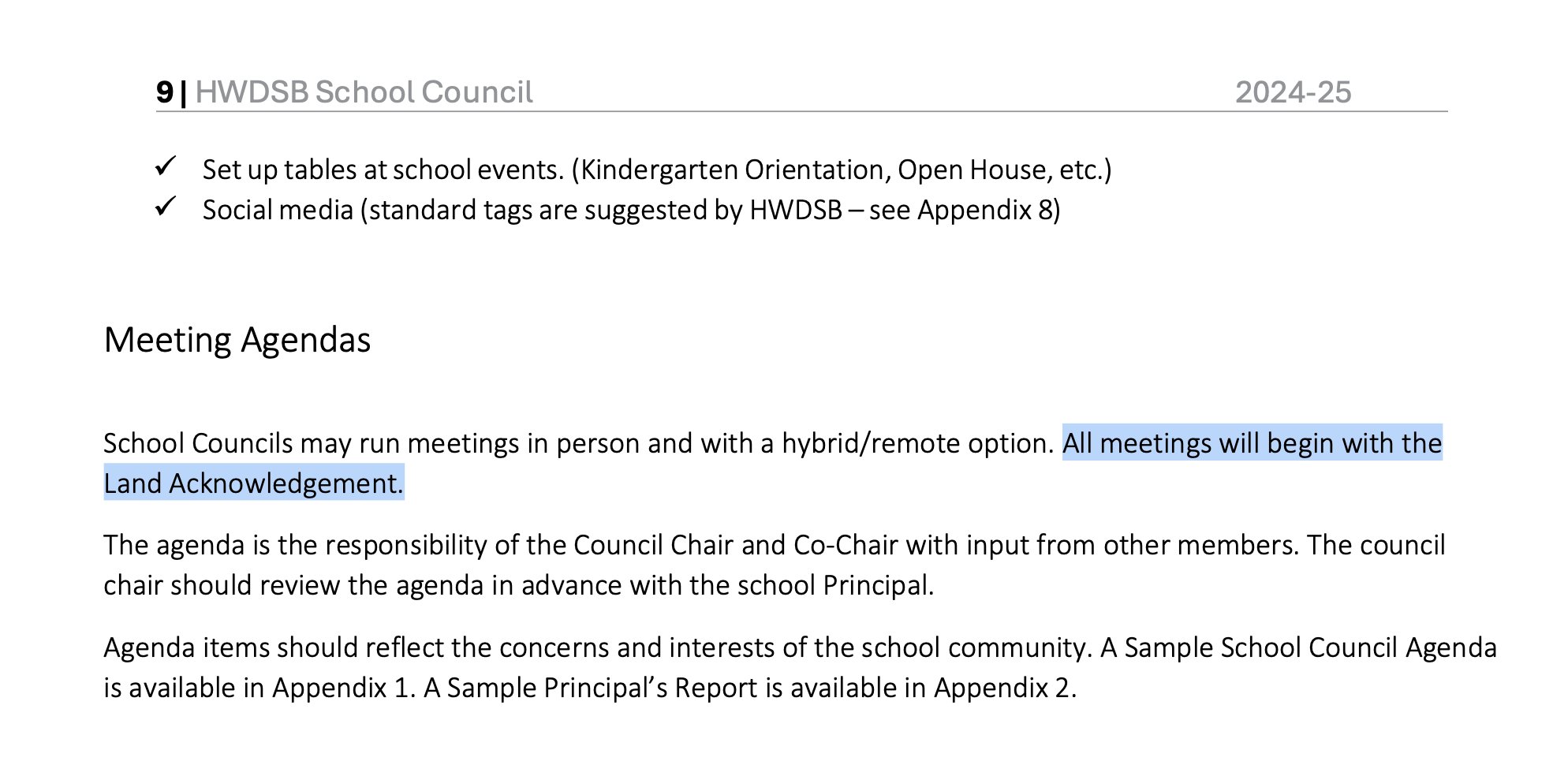
Late last month, a Canadian school board informed Catherine Kronas, a parent serving on her child’s local school council in Ontario, that her role was being “paused” for allegedly causing “harm” and violating board policy.
Her offense? “Respectfully” requesting during an April 9 council meeting that her objection to the land acknowledgment be recorded in the meeting minutes. Kronas argued that the Hamilton-Wentworth District School Board lacks an official mandate to require land acknowledgments at school council meetings and that such statements “undermine the democratic process”, amount to “compelled speech”, and are “divisive” and “inappropriate”.
Kronas, who has served on the board for the past year and like all board members is a volunteer, has since been barred from attending upcoming meetings, including virtual ones, while the board reviews the allegations.
“They’ve ostracized me and painted me as someone who harms others,” Kronos told me, pointing to the letter she received in May.
Parents who once expressed similar concerns about land acknowledgments privately have all “slunk away” and “gone silent”, she said. She is convinced that if even one other parent had publicly backed her objection, she wouldn’t have been suspended.
“I have no support,” Kronas says.
But Kronas is far from alone in her views. A new poll shows that a majority of Canadians — 52 percent — reject the idea that they live on “stolen” indigenous land. In Kronas’s own region, Hamilton-Niagara, a suburb just outside Toronto, 50 percent said “no” to the concept.
There’s also a political shift underway that reflects this: New legislation from Ontario premier Doug Ford that is widely viewed as effectively anti–diversity, equity, and inclusion (DEI) aims to roll back some of the ideological activism that has spread through school boards. The bill will, among other things, ban the renaming of schools based on the belief that historical figures are linked to “systems of oppression” and mandate the return of school resource officers, a form of law enforcement, in jurisdictions where police services provide them. In recent years, many Ontario school boards have removed police from schools on the grounds that their presence causes harm to “racialized” groups — a peculiarly Canadian euphemism for non-white people that casts them as perpetual victims in need of saving — and makes at least this brown Canadian feel like something is inherently wrong with us.
Damian Penny’s diligent recycling efforts pay off
At Rigid Thinking, Damian Penny has to be given top marks for recycling this week, although it’s not newspapers or plastic cartons he’s getting to do twice the work:

Please keep psychotic Twitter accounts with animated-squirrel avatars in your thoughts and prayers this weekend. They’re going through a tough time right now.
And, once again, the point I made last week is proven:
Did this operation really do as much damage as the
UkrainiansIsraelis say? I dunno. I don’t begrudge theUkrainiansIsraelis their own propaganda weapons.(Plus, these are
Russian planesShah-era jets for which getting parts is a massive pain in the ass, so there’s a good chance they might have just exploded on their own, like a Soviet television set left plugged in overnight.)But the mere fact that
UkraineIsrael was able to pull this off at all, right under theRussians’Iranians’ noses, is a game changer. The message toCzar Vladimirthe Mullahs, that we can strike literally anywhere, couldn’t be more clear.We’ll get the whole story from the
UkrainianIsraeli side soon enough. What I’m chomping at the bit to see is what’s in theRussianIranian archives someday, whenPutinthe “Islamic Republic” is gone and McDonald’s has been restored to its rightful place inRed SquareAzadi Square.A few weeks after the Russian invasion, when it became clear that they were in for a much harder time than anticipated, I wrote about how what would appear to be an authoritarian government’s great advantage over liberal democracy — the ability for its leaders to just “get stuff done” instead of having to put up with the horse-trading and lobbying and arguing and mean tweets which make can make things so exhausting and frustrating for a more open society — eventually becomes a disadvantage.
[…]
If the leader can do whatever he wants without any serious resistance, everyone else learns to keep their heads down and not do nor say anything which will make him angry.
Because you really, really wouldn’t like him when he’s angry.
As a result, the guy in charge is surrounded by sycophants and yes-men who will nod along and feign enthusiasm for whatever he wants to do, even if they know it’s really risky and/or really, really stupid.
That filters down to the drones (the human kind) and proles, too. I’m not a betting man, but I’d bet my entire hoard of Hawk Tuah meme coins that
RussianIranian intelligence services actually knew, or at least strongly suspected, that something likeOperation SpiderwebOperation Rising Lion was in the works.Good for them. Now, you go and tell the
CzarAyatollah that there areUkrainianMossad operatives (and, at the risk of wishcasting, someRussiansIranians brave enough to assist them) thousands of miles away fromUkraineIsrael, ready to take out much of thestrategic bomber fleetair defences.
UkraineIsrael, by contrast, is an open enough society to learn from its mistakes, see what actually works, and adapt accordingly.RussiaIran is a closed society which keeps doubling down on what it was already doing, and woe is you if you suggest a change of course.It doesn’t matter how much stronger you are in terms of weaponry, if your society and political system punishes anyone who might tell the leader he’s wrong.
Well, that was surprisingly easy to write about. Here’s hoping I don’t get lazy and get into the habit of throwing on old reruns, assuming you kids won’t know the difference.
Surviving on Tulip Bulbs during World War 2 – Dutch Hunger Winter
Tasting History with Max Miller
Published 14 Jan 2025Mashed potatoes, red cabbage, carrots, kale, and tulip bulbs
City/Region: The Netherlands
Time Period: 1945The Netherlands was relatively well off for food during much of WWII up until the harsh winter of 1944-1945. A combination of factors like German occupation, extreme weather conditions, and lack of Allied relief resulted in the population existing on only 500 calories a day. Tulips, a major Dutch export, were stored as dried bulbs, and the government issued documents that instructed people on how to prepare them safely.
If you make this dish, be sure to use organic bulbs and remove the yellow sprout in the center of the bulb completely as described in the instructions below. The yellow center is what can make you sick.
The flavor of the dish comes from the vegetables, and the unique flavor of the bulbs is lost in everything else. Save at least one bulb back before you mash it to taste it. Different varieties of tulip bulbs are supposed to have different flavors, and mine had a kind of earthy metallic sweet taste that was quite unlike anything I’ve ever had.
Stamppot with Tulip Bulbs
1 kg of vegetables, 1/2 kg of potatoes, 1/2 kg tulip bulbs, salt, oil.
Clean and finely chop the vegetables. Scrub the potatoes and quarter them. Clean the tulip bulbs. Put everything in a pot with a little water and salt. Boil for 30 to 45 minutes. Mash everything and add oil to taste.
— Dutch State Office for Preparation of Food Distribution, 1945
QotD: University students or NPCs?
A few semesters on, and that no longer applied. Sure, sure, they were still teenagers, and still pulled typical teenager capers … but a new set of behaviors crept in. I can’t describe them exactly, in detail, but the overall impression was: here’s someone doing a pretty good impersonation of a teenager. Most every kid goes through the faux-sophisticate stage, usually somewhere around age 12, and this kinda looked like that — young kids pretending to be a lot older — but it also looked a lot like the opposite end of the spectrum. Not quite “hello, fellow teens!” — not yet — but there was something like that going on, too. It was weird, but I figured it was mostly in my head — I’ve always been a grouchy old man, but now I was actually chronologically old enough to let my freak flag fly, so I assumed that’s what I was doing. They’re not changing, I am …
Fast forward a few more semesters, and nope, it’s definitely them. The kids at the tail end of my career still looked like bargain basement Rich Littles, doing impersonations of teenagers, but their act was terrible. Remember a few years back, when Facebook or Twitter or whoever tried to make an AI chat bot, and it immediately turned super racist? Not that these kids were racists — they were the furthest thing from that — but they all seemed to have a small stock of crowdsourced responses. And that’s ALL they had, so no matter what the situation, they’d shoehorn it in to one of their canned affects, because that’s all they had.
By the very end, interacting with them was like playing one of those old text-adventure games from the very dawn of the personal computer, like Zork. They’d respond to commands, but only the right commands, in the exact word order. No deviations allowed, and of course their responses were equally programmed.
Severian, “Terminators”, Founding Questions, 2021-12-04.
June 13, 2025
The new marketing strategy is “Always Be Annoying”
Ted Gioia explains that the rules of marketing as explained in Glengarry Glen Ross no longer apply:

The rules of marketing never change. That’s what they told me in business school.
If you could peer inside the meetings at head office, you would see a never-ending loop of Glengarry Glen Ross.
Always be closing. Those are the A-B-Cs of business.
But that’s not true anymore.
In recent days, a new marketing strategy has emerged. I’ve never seen it before. And I wish it would go away. You probably do too.
It’s a new way of advertising. It’s a new way of marketing. It’s a new motivational tool.
It didn’t exist when I studied marketing back at Stanford GSB. I had the best marketing teachers in the world, but they never dreamed of doing this to customers.
Here’s the new marketing playbook of 2025:
- Do NOT try to close.
- Do NOT try to sell.
- Do NOT try to persuade.
- Don’t even listen.
The goal now is merely to ANNOY. The big companies do it on purpose.
Big streaming platforms are the experts at this new marketing tool. They want you to pay for a premium, ad-free subscription. The more annoying the commercials, the more likely you are to pay.
You will pay just to get rid of the ad.
In this topsy-turvy world, the more painful the ad, the better it works. The digital platforms have studied this — YouTube has tested using up to ten unskippable ads on users.
That’s not marketing — it’s water-boarding. But they need to test these techniques. Their business model is built on optimizing the level of annoyance.
And guess what? Even paying for premium doesn’t guarantee escape from ads. Welcome to the new digital platforms — which increasingly resemble prisons.
[…]
We once lived in an industrial economy — built on industry. Then we shifted to a consumer economy — built on consumption. And more recently we lived in a service economy — built on service.
But we now are entering the age of the Annoyance Economy. And it is the inevitable result of corporations battling for your attention.
They monetize your eyeballs — measured in clicks and microseconds — and they will do anything to hold on to them. This increasingly involves annoying, intrusive actions that no business would have dared to implement in a consumer-oriented economy.
HMS Eskimo (F75) – Guide 362
Drachinifel
Published 18 Nov 2023HMS Eskimo, a destroyer of the British Royal Navy, is today’s subject.
(more…)
QotD: The Subaru BRAT
If you know this truck, you also know why it’s no longer available.
Such fun things are no longer allowed.
They are not saaaaaaaaaaaaaaaaafe! “Moms” are “concerned”!
But in 1977, the Safety Cult — which ended such fun things — was still a backwater aberration, like dancing with rattlesnakes — and most people still esteemed fun over fear. There were roofless Broncos and K5 Blazers — and cars with beds.
You could buy all kinds of different stuff back when America was still a fairly free country — and the Subaru BRAT was as different as it got.
BRAT — all caps — was short for Bi-Drive Recreational All-Terrain Transporter. It was superficially similar to other small import pickups of the ’70s, such as the Datsun 620 and similar models from Toyota (SR5), Mazda (B210), and Chevy (via Isuzu) Luv.
But unlike them, it was a four seater — with two of the four in the bed, facing the other way. The seats were made of all-weather plastic and far from the most comfortable — but the view was spectacular. Watching the world recede as you progressed is another one of many freedoms denied today in the name of “safety”.
Subaru wasn’t “unconcerned” about “safety”. Grab handles — to keep passengers from bouncing out of the bed — were included. Though holding onto them made it harder to reach for a cold one in the cooler. That was another fun thing people did in pickups back in the day — before the Safety Cult put the kibosh on that, too.
The seats were actually a dodge — of a federal fatwa known as the “chicken tax”, which was a retaliatory tariff of 25 percent applied to import-brand pickups manufactured outside the United States as tit-for-tat for tariffs applied by foreign countries to American chicken exported outside the United States.
The “chicken tax” hit trucks with just two seats — at the time almost exclusively the small import models, which didn’t offer the extended and crew cab configurations that are commonplace today.
By adding the extra seats in the bed, BRAT qualified as a passenger vehicle rather than a “light truck”, and thus Subaru evaded the chicken tax on a happy technicality — and was also able to sell the BRAT for less than two-seater rivals that had the cost of the tax folded into their MSRP.
Eric Peters, “Doomed: Subaru BRAT (1977-87)”, The American Spectator, 2020-04-26.
June 12, 2025
Why it’s economically impossible for Walmart to “eat the tariffs” as Trump demands
At FEE, Peter Jacobsen shows the clear financial reason why Walmart and other big US retailers are passing along the price increases due to Trump’s tariffs rather than “eating them”:
Recently, a post from President Trump on Truth Social went viral. An attempt to convince retail giant Walmart to keep prices down despite the tariffs, it read:
Walmart should STOP trying to blame Tariffs as the reason for raising prices throughout the chain. Walmart made BILLIONS OF DOLLARS last year, far more than expected. Between Walmart and China they should, as is said, “EAT THE TARIFFS”, and not charge valued customers ANYTHING. I’ll be watching, and so will your customers!!!
Trump’s demand here is, simply put, unreasonable, and it reflects a basic misunderstanding of how pricing decisions are made in a market economy. Let’s unpack why.
Walmart’s Thin Margins
The biggest problem with the President’s view is that it doesn’t pass a basic numbers test. To break it down, let’s look at Walmart’s financials.
It’s true that Walmart generates billions of dollars in revenue each year, but revenue alone doesn’t tell us how much Walmart makes.
To understand that, we need to consider profit, which accounts for the company’s costs. More specifically, we want to look at Walmart’s net profit margin, because that’s an extremely important indicator of whether Walmart could realistically “eat the tariffs”.
Depending on the source, Walmart’s net profit margin is somewhere between 2% and 3%. Let’s split the difference and say it’s 2.5%. What does that mean?
That means, if Walmart sells you $1 of goods, it only keeps 2.5 cents in profit. That’s right, 97.5 cents goes toward inventory, employee wages, store maintenance, and a variety of other operating costs.
Put another way, if you spend $100 at Walmart, they make $2.50 in profit.
Now let’s say you buy a $100 television that Walmart imports. A $20 tariff is imposed — an added cost Walmart has to pay to import the TV. Before the tariff, Walmart was making $2.50 in profits. After the tariff, it’s now taking a $17.50 loss.
The only way Walmart can still sell this TV is by raising the price.
At this point, a tariff supporter might respond: “The easy way to fix this is to buy US-made TVs instead!”
Sure — you can avoid tariffs by only buying domestic, but the problem is that domestic TVs tend to be more expensive. If they weren’t, Walmart wouldn’t be importing them in the first place. So even if Walmart pulls international TVs off the shelves and replaces them with US-made ones, the prices still increase.
Here’s the key point: “eating” the tariffs is not an option. Walmart operates on slim margins, barely making pennies on the dollar — there isn’t room to eat 20% cost increases!
There definitely used to be a gender pay gap
I’m sure activists will keep slinging around the “women are paid 82 cents for every dollar men are paid” factoid, because it’s politically useful (if statistically untrue in the way most people interpret it). But it used to be true that women were systematically paid less for doing the same work as men:

Dame Stephanie Shirley, entrepreneur, IT pioneer, philanthropist, at her 80th birthday party in September 2013.
Photo by Lynn Hart via Wikimedia Commons.
At which point enter Dame Stevie:
Dame Stephanie Shirley, 91, is a tech pioneer and philanthropist who came to Britain on the Kindertransport in 1939. She built a £3 billion business, Freelance Programmers (later renamed F International), and 70 of her staff became millionaires due to its shared ownership structure. Since retiring in 1993 she has donated more than £70 million to charity. She was made a dame in 2000 and became one of the prestigious few members of the Order of Companions of Honour in 2017.
Back when she was building F1 the sexism in industry was such that she called herself Stevie, not Stephanie. You know, deniably pretending to be male sorta thing. Also, given that background, something of a tough nut and certainly nobody’s fool. F1, among other things, did the programming on the Black Box for Concorde. Proper, serious, company.
The sexism in industry was such that there really was a gender pay gap. A general assumption — to the point of rigid rule — was that wimmins didn’t work after marriage and certainly not when they had children. So, Stevie went out and hired all those birds who had been programmers before parturition, set ’em up with a home terminal and paid ’em peanuts. Then went around winning vast contracts with her price advantage.
This worked. To the extent that Stevie is on record as saying the Equal Pay Act was the worst thing ever for her business (note, not societally wrong, but bad for her business).
Which actually gives us a nice test of something that bastard neoliberals like me insist upon. Or as Gary Becker pointed out. If it is true that wimmins is underpaid in our capitalist bastardry patriarchal society then it must also be true that it’s possible to deliberately and specifically hire women and so gain a price advantage.
Dame Stevie did this and did so very successfully. Which is a nice proof that the first part of the contention works. If women are underpaid then hire them and make a fortune. Cool!
The apparent fact that nobody else has done this is a strong indicator that there isn’t a significant gender wage gap these days.
Type 30 Arisaka
Forgotten Weapons
Published 22 Jun 2015Most people are familiar with the Type 38 Arisaka, which was one of the two very distinctive Japanese rifles of World War II (along with the Type 99). The Type 38 was an outstanding rifle in large part because it was the result of several years of experience and development which began in 1897 with the Type 30 “Hook Safety” Arisaka. This first Japanese smallbore military rifle was designed by a committee (led by Col. Arisaka) from the best elements of other rifles being made at the time. It used a bolt which was significantly more complex than the elegant Type 38 bolt which would follow later.


