Quotulatiousness

March 8, 2024

QotD: The original greasy pole of the cursus honorum

Filed under: Europe, Government, History, Quotations — Tags: , — Nicholas @ 01:00

Last week we discussed the overall structure of the “career path” for a Roman politician and the first few offices along that path. This week we’re going to look at the upper-steps of that career path, the offices of praetor and consul and the particular set of powers they possess, called imperium, along with the pro-magistrate forms of these positions. Now I should note at the outset that we have skipped one office on our way through, the tribunes of the plebs; we’ll get to that office next week to discuss its oddities and unusual powers.

The praetorship and the consulship are the highest Roman offices (the censorship being more of a “victory lap”) and the two offices that wield direct military and judicial authority. These are also the offices where competition in the cursus honorum starts to get fierce, as the eight quaestors must compete for just six praetorships and those six praetors can expect to compete for just two – always two – consulships. It is worth keeping in mind as we go through this that on the one hand these offices are largely confined to a small Roman elite, the nobiles, composed of families (both patrician and plebeian) that have been successful in politics over generations, but at the same time it is the popular assemblies which choose “winners” and “losers” from among the nobiles by deciding who gets to proceed to the next round of the political elimination context, and who is forever going to sit in the Senate as a former quaestor and nothing more.

Bret Devereaux, “Collections: How to Roman Republic 101, Part IIIb: Imperium”, A Collection of Unmitigated Pedantry, 2023-08-18.

Update: I forgot to add the glossary links. Fixed now.

March 7, 2024

Canadian Armed Forces belatedly starts to worry that their pandemic fake news propaganda stunt might, somehow, undermine public confidence

Filed under: Cancon, Government, Media, Military — Tags: , , , , — Nicholas @ 05:00

When I first heard about this, despite all the evidence we’d seen during the Wuhan Coronavirus years of governments going out of their way to mislead and deceive the voters, I thought it was fake news. But according to David Pugliese’s report in the Ottawa Citizen, they really did do and and only now are starting to worry that they should not have done that:

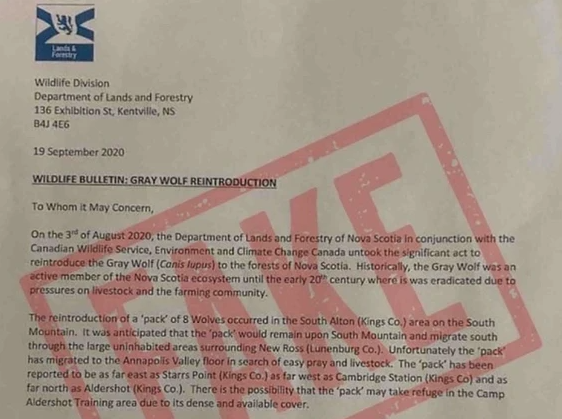
A screenshot of the fake letter from the Nova Scotia government which was sent out to residents to warn about a pack of wolves on the loose in the province. The letter was actually a forgery by Canadian military personnel as part of a propaganda training mission.
Photo by NS Lands Forestry Twitter/X /Handout

The Canadian Forces worried the public would link its previous efforts to test propaganda techniques during the pandemic to a bungled exercise in which the military spread disinformation about rampaging wolves, according to newly released records.

Military officers worried the 2020 wolves training fiasco, combined with previous coverage in this newspaper about their efforts during the COVID outbreak to test new methods to manipulate Canadians, could have “the effect of undermining our credibility and public trust”.

The October 2020 exercise involving fake letters about wolves on the loose, which caused panic in one community in Nova Scotia, was a propaganda test gone awry, generating embarrassing news coverage across Canada and in some U.S. media outlets.

Just as that incident was being reported by media outlets, a non-government group called the Organized Crime and Corruption Reporting Project released details about the Canadian Forces spending more than $1 million on training on how to modify public behaviour. That training had been used by the parent firm of Cambridge Analytica, the company that was at the centre of a scandal in which personal data of Facebook users was provided to U.S. President Donald Trump’s political campaign.

In addition, this newspaper had reported months earlier, the Canadian Forces had tested new propaganda techniques during the pandemic and had concocted a plan to influence the public’s behaviour during coronavirus outbreak.

The various reporting set off alarm bells inside the military’s public affairs branch at National Defence headquarters in Ottawa, according to documents released under the access to information law.

Col. Stephanie Godin wrote Brig.-Gen. Jay Janzen on Oct. 16, 2020 warning that since the story about the fake wolf letters broke “there has been a resurgence of media and public criticism regarding perceived nefarious IO/IA (propaganda) against the Canadian public”.

She also noted how then-army commander Lt.-Gen. Wayne Eyre contacted Laurie-Anne Kempton, then the assistant deputy minister for public affairs at National Defence. Eyre wanted to “discuss how the wolf letter issue could be removed from being conflated with” the $1 million training course on influence techniques as well as the previous articles on military pandemic propaganda plans, Godin wrote.

I mean, did they hire George Monbiot as a consultant for this idiocy?

“The traditional answer to this is to leave those inheritees be and they’ll blow it all on hookers and coke soon enough”

Filed under: Britain, Government, Media, Politics — Tags: , , , — Nicholas @ 04:00

Tim Worstall tackles the ongoing angst about “the wrong sort of people” getting their sweaty mitts on family inheritances and then backhands the ostentatiously super wealthy demanding to be taxed more heavily as “Full Of Shit. Obviously”.

This has to be one of the least sympathy inducing articles ever — rich kids worried about their inheritances. We’re about to have that grand generational shift apparently, trillions upon trillions are going to move from the people who made it to the Lucky Sperm Club.

Woes.

The traditional answer to this is to leave those inheritees be and they’ll blow it all on hookers and coke soon enough. The standard deviation of soon enough is pretty big — the folk tale is clogs to clogs in three generations but the Hervey’s managed to wait until the 7th Marquess for it all to get — quite literally in that case — blown. But, you know, it does eventually happen. There are no really old fortunes.

This isn’t, perhaps, enough for the hurry hurry of the modern world. Thus we get people like this:

    Tax, of course, could — should — play a huge part in all this. “Philanthropic donations are a drop in the ocean compared to what even quite minor tax increases on the richest in society would provide,” Lewis says. Patriotic Millionaires is calling for a hike in taxation for the super-rich — and its members aren’t limited to millennials. They include Guy Singh-Watson, founder of Riverford Organic Farmers; Graham Hobson, founder of Photobox; the Perry family, from the posh ready-meal business Cook; and Ian Gregg, whose father founded Greggs.

    “At the moment philanthropic donations amount to about £10 billion per year,” Lewis says. “A wealth tax of 1 to 2 per cent on assets over £10 million, which would affect only the wealthiest in the UK, would raise more than double that. Closing tax avoidance loopholes would raise much more than this.”

As I pointed out in the same newspaper, The Times, two decades back, this is purest bollocks. For it’s entirely easy to pay extra tax if that’s what you wish to do:

    Cheques, by the way, should be made out to “The Accountant, HM Treasury”, and sent to 1 Horse Guards Road, London SW1A 2HQ.

Job’s a good ‘un. Except, back then, near no one did. I managed to get the numbers out of The Treasury for the previous year — it took some months as they were amazed that anyone had even thought of checking this — and a whole 5 people had paid that extra tax. Four of whom were dead, leaving bequests. That is, the UK, that year, contained one whole person willing to pay higher tax than duly and justly levied upon them. Some flood of patriotic millionaires there was not.

Matters do not seem to have improved greatly:

    But something is not working. The accounts of the Debt Management Office for the year ended 31 March 2020 show that it received donations or bequests totalling just £48,957. While that’s a large percentage increase on the £11,069 received during the year ended 31 March 2019, by any standards these figures are tiny.

Not the sorts of amounts likely to make a great impact upon a lifetime’s supply of coke and hookers, is it?

One correct answer to these claims by the Patriotic Millionaires is therefore that they’re full of shit. In slightly more technical language they’re doing ethical performativity. There’s always a difference between expressed preferences — what people say — and revealed preferences, what people do. What people really believe is in what they do — but it’s entirely possible that saying the right things, even if not doing them, will get you invited to the right sorts of parties. You know, the ones where someone else pays for the hookers and coke. So, people say things they don’t do for reasons of societal enrapture. Hardly an uncommon human activity, that.

I seem to remember linking to an article of Tim’s on the old blog, but that’s long been offline. More recently, we’ve seen this exact scenario play out in Norway, the UK, the United States, and the City of Toronto.

His Majesty King Charles, in right of Canada, would also be happy to accept any unwanted sums of money above your mandatory tax rate here. Go wild, wealthy and patriotic Canadian multi-millionaires!

The WPATH to danger … for children and teens

Filed under: Bureaucracy, Health, Media, Politics, USA — Tags: , , , , , , — Nicholas @ 03:00

Andrew Doyle outlines the exposure of internal communications from the World Professional Association for Transgender Health (WPATH) showing some extremely concerning things about the organization and the political agenda of many of its members:

The ideological march through the medical institutions was rapid and unexpected. In recent years, we have seen leading paediatric specialists asserting that children who say they are “in the wrong body” must have their feelings immediately affirmed. We have been told that if a boy claims to be a girl, or vice versa, they must be believed and fast-tracked onto a pathway to medicalisation: first puberty blockers, then cross-sex hormones, and in some cases irreversible surgery.

This worldwide medical scandal has disproportionately impacted gay, autistic, and gender non-conforming children. Where clinicians should have been looking out for the interests of the vulnerable, they have been encouraging them to proceed with experimental treatments. Few people would have imagined that mutilating children to ensure they better conform to gendered stereotypes would one day be considered progressive. But here we are.

Much of the responsibility must lie in the hands of WPATH (World Professional Association for Transgender Health), a US-based organisation established in 1979 that is recognised as the leading global authority in this area. WPATH has pushed for the normalisation of the “gender-affirming” approach, and its “Standards of Care” have formed the basis of policies throughout the western world, including in the NHS.

But in an explosive series of leaked files, the credibility of WPATH might now be irreparably shattered. Whistleblowers have provided author and journalist Michael Shellenberger with videos and messages from the WPATH internal chat system which suggest that the health professionals involved in recommending “gender-affirming” healthcare are aware that it is not scientifically or medically sound. A full report has been written by journalist Mia Hughes for the Environmental Progress think-tank. The title is as chilling as its contents: The WPATH Files: Pseudoscientific Surgical and Hormonal Experiments on Children, Adolescents, and Vulnerable Adults.

Some of the leaked internal messages are astonishing in their disregard for basic medical and ethical standards. For all that paediatric gender specialists have publicly stated that there is a consensus in favour of the “affirmative” model, that it is evidence-based, and that it is safer than a psychotherapeutic alternative, their private conversations would seem to suggest otherwise.

There are messages in the WPATH Files proving that surgeons and therapists are aware that a significant proportion of young people referred to gender clinicians suffer from mental health problems. Some specialists associated with WPATH are proceeding with treatment even for those who cannot realistically consent to it. After all, how could a pre-pubescent or even adolescent child fully grasp the concepts of lifelong sterility and the loss of sexual function? As one author of the WPATH “Standards of Care” acknowledges in a leaked message:

    [It is] out of their developmental range to understand the extent to which some of these medical interventions are impacting them. They’ll say they understand, but then they’ll say something else that makes you think, oh, they didn’t really understand that they are going to have facial hair.

Or what about the endocrinologist who admits that “we’re often explaining these sorts of things to people who haven’t even had biology in high school yet”? And these are the very patients who have been approved for potentially irreversible procedures.

M60: Cold War Guardian | Tank Chats #175

Filed under: History, Military, USA — Tags: , , , — Nicholas @ 02:00

The Tank Museum
Published Dec 1, 2023

The high point of a series of American tank designs that began in WW2, the M60 stood guard in a divided Europe during the Cold War. David Willey gives us a detailed analysis of a tank that served far longer than anyone intended.
(more…)

QotD: Helmuth von Moltke’s Kabinettskriege of 1870

[The Franco-Prussian War] is generally considered the magnum opus of the titanic Prussian commander, Field Marshal Helmuth von Moltke. Exercising deft operational control and an uncanny sense of intuition, Moltke orchestrated an aggressive opening campaign which sent Prusso-German armies streaming like a mass of tentacles into France, trapping the primary French field army in the fortress of Metz in the opening weeks of the war and besieging it. When the French Emperor, Napoleon III, marched out with a relief army (comprising the rest of France’s battle-worthy formations), Moltke hunted that army down as well, encircling it at Sedan and taking the entire force (and the emperor) into captivity.

From an operational perspective, this sequence of events was (and is) considered a masterclass, and a major reason why Moltke has become revered as one of history’s truly great talents (he is on this writer’s Mount Rushmore alongside Hannibal, Napoleon, and Manstein). The Prussians had executed their platonic ideal of warfare — the encirclement of the main enemy body — not once, but twice in a matter of weeks. In the conventional narrative, these great encirclements became the archetype of the German kesselschlacht, or encirclement battle, which became the ultimate goal of all operations. In a certain sense, the German military establishment spent the next half-century dreaming of ways to replicate its victory at Sedan.

This story is true, to a certain extent. My objective here is not to “bust myths” about blitzkrieg or any such trite thing. However, not everyone in the German military establishment looked at the Franco-Prussian War as an ideal. Many were terrified by what happened after Sedan.

By all rights, Moltke’s masterpiece at Sedan should have ended the war. The French had lost both of their trained field armies and their head of state, and ought to have given in to Prussia’s demand (namely, the annexation of the Alsace-Lorraine region).

Instead, Napoleon III’s government was overthrown and a National Government was declared in Paris, which promptly declared what amounted to a total war. The new government abandoned Paris, declared a Levee en Masse — a callback to the wars of the French Revolution in which all men aged 21 to 40 were to be called to arms. Regional governments ordered the destruction of bridges, roads, railways, and telegraphs to deny their use to the Prussians.

Instead of bringing France to its knees, the Prussians found a rapidly mobilizing nation which was determined to fight to the death. The mobilization prowess of the emergency French government was astonishing: by February, 1871, they had raised and armed more than 900,000 men.

Fortunately for the Prussians, this never became a genuine military emergency. The newly raised French units suffered from poor equipment and poor training (particularly because most of France’s trained officers had been captured in the opening campaign). The new mass French armies had poor combat effectiveness, and Moltke managed to coordinate the capture of Paris alongside a campaign which saw Prussian forces marching all over France to run down and destroy the elements of the new French Army.

Big Serge, “The End of Cabinet War”, Big Serge Thought, 2023-11-30.

March 6, 2024

You had me at “Cartchy tuns, exarserdray lollipops” and “a pasadise of sweet teats”

Filed under: Britain, Media — Tags: , , , , , — Nicholas @ 04:00

Charlie Stross checks in with a Willy Wonka-adjacent story from Glasgow that utterly failed to live up to the billing:

This is no longer in the current news cycle, but definitely needs to be filed under “stuff too insane for Charlie to make up”, or maybe “promising screwball comedy plot line to explore”, or even “perils of outsourcing creative media work to generative AI”.

So. Last weekend saw insane news-generating scenes in Glasgow around a public event aimed at children: Willy’s Chocolate Experience, a blatant attempt to cash in on Roald Dahl’s cautionary children’s tale, Willy Wonka and the Chocolate Factory. Which is currently most prominently associated in the zeitgeist with a 2004 movie directed by Tim Burton, who probably needs no introduction, even to a cinematic illiterate like me. Although I gather a prequel movie (called, predictably, Wonka), came out in 2023.

(Because sooner or later the folks behind “House of Illuminati Ltd” will wise up and delete the website, here’s a handy link to how it looked on February 24th via archive.org.)

INDULGE IN A CHOCOLATE FANTASY LIKE NEVER BEFORE – CAPTURE THE ENCHANTMENT ™!

Tickets to Willys Chocolate Experience™ are on sale now!

The event was advertised with amazing, almost hallucinogenic, graphics that were clearly AI generated, and equally clearly not proofread because Stable Diffusion utterly sucks at writing English captions, as opposed to word salad offering enticements such as Catgacating • live performances • Cartchy tuns, exarserdray lollipops, a pasadise of sweet teats.* And tickets were on sale for a mere £35 per child!

Anyway, it hit the news (and not in a good way) and the event was terminated on day one after the police were called. Here’s The Guardian‘s coverage:

    The event publicity promised giant mushrooms, candy canes and chocolate fountains, along with special audio and visual effects, all narrated by dancing Oompa-Loompas — the tiny, orange men who power Wonka’s chocolate factory in the Roald Dahl book which inspired the prequel film.

    But instead, when eager families turned up to the address in Whiteinch, an industrial area of Glasgow, they discovered a sparsely decorated warehouse with a scattering of plastic props, a small bouncy castle and some backdrops pinned against the walls.

Anyway, since the near-riot and hasty shutdown of the event, things have … recomplicated? I think that’s the diplomatic way to phrase it.

Ted Gioia on escaping from the trap of Dopamine Culture

Filed under: Health, Media, Technology — Tags: , , , — Nicholas @ 03:00

Following up on this hot issue, Ted Gioia has some suggestions to get out of the habit:

My dopamine culture essay is still stirring up lots of discussion. And people have their own stories to share.

For example:

And also:

The same thing is happening everywhere — at concerts, at museums, at work, at church, while driving, or even at a funeral.

But it’s even worse when people don’t even try to multitask, instead abandoning essential life tasks—because of the compulsion to scroll.

I’ve now heard from

  • People who scroll instead of sleeping
  • People who scroll instead of engaging in physical activity
  • People who scroll instead of finding a life partner, or connecting with flesh-and-blood people
  • People who scroll instead of gaining skills, finding a job, and pursuing a vocation
  • Etc.

I originally focused on the impact on arts and creativity—because that’s the world I live in. I was worried that people had no patience for a movie or concert or book, because they can only digest stimuli in 15-second bursts.

But I now see that the problem is much, much bigger.

It’s almost quaint to worry about these screen zombies not reading books. The simple fact is that, increasingly, their entire life is suffering because of a technology shift imposed on them by Silicon Valley.

These addictive and compulsive behaviors are troubling. But even more disturbing is how the largest corporations in the world are investing billions in promoting and accelerating this compulsive use of their tech tools.

If you look at the 10 largest companies in the world, half of them are trying to create this addictive relationship to technology. The days when the dealer in addiction had to hide in the shadows are over. They now operate freely in your home, and every other sphere of your life.

A few days ago, I promised to offer concrete suggestions for dealing with this. Some of these are listed below.

Venezuelan FN49: The First FN49 Contract

Filed under: Americas, Europe, History, Military, Weapons — Tags: , , , , , — Nicholas @ 02:00

Forgotten Weapons
Published Dec 1, 2023

Venezuela was the first nation to purchase the FN-49 rifle, before even the Belgian military. In fact, the Venezuelan contract was signed in 1948, before the “FN-49” designation was even in place. Venezuela bought a total of 8,012 rifles in two batches — 4,000 rifles plus 12 cutaway training examples delivered in 1949 and a further 4,000 more rifles delivered in June 1951. All of them included the integral muzzle brake and scope mounting cuts, although no scopes were ever procured. They were all semiautomatic models.

Some of the rifles were issued and used, but some appear to have remained in depots their entire life. Venezuela was also an early adopter of the FAL, and the FN-49 was only used for a short time. In 1966, all of them (or virtually all) were sold as surplus to InterArms, and brought onto the US collector market.
(more…)

QotD: Mansa Musa’s disastrous foreign aid to Cairo

Mansa Musa’s good intentions may be the first case in history of failed foreign aid. Known as the “Lord of the Wangara Mines”, Mansa Musa I ruled the Empire of Mali between 1312 and 1337. Trade in gold, salt, copper, and ivory made Mansa Musa the richest man in world history.

As a practicing Muslim, Mansa Musa decided to visit Mecca in 1324. It is estimated that his caravan was composed of 8,000 soldiers and courtiers — others estimate a total of 60,000 — 12,000 slaves with 48,000 pounds of gold and 100 camels with 300 pounds of gold each. For greater spectacle, another 500 servants preceded the caravan, and each carried a gold staff weighing between 6 and 10.5 pounds. When totaling the estimates, he carried from side to side of the African continent approximately 38 tons of the golden metal, the equivalent today of the gold reserves in Malaysia’s central bank — more than countries like Peru, Hungary or Qatar have in their vaults.

On his way, the Mansa of Mali stayed for three months in Cairo. Every day he gave gold bars to the poor, scholars, and local officials. Mansa’s emissaries toured the bazaars paying at a premium with gold. The Arab historian Al-Makrizi (1364-1442) relates that Mansa Musa’s gifts “astonished the eye by their beauty and splendor”. But the joy was short-lived. So much was the flow of golden metal that flooded the streets of Cairo that the value of the local gold dinar fell by 20 percent and it took the city about 12 years to recover from the inflationary pressure that such a devaluation caused.

Orestes R Betancourt Ponce de León, “5 Historic Examples of Foreign Aid Efforts Gone Wrong”, FEE Stories, 2021-06-06.

March 5, 2024

Our “transnational” “elites” naturally hate anything smacking of populism

Filed under: Government, Media, Politics — Tags: , , , , , — Nicholas @ 04:00

Niccolo Soldo’s weekend post discussed some of the reasons western “elites” treat anything that can remotely be considered “populist” as if it were outright armed revolution in the streets:

For around 15 years now, the British have elected Conservatives to govern them, with anti-immigration sentiment the key driver in their choice of parties to rule. #Brexit was powered to victory by this same sentiment.

Instead of getting what they wanted, immigration in the UK has continually increased under each and every Tory Prime Minister. Last week, the ruling Conservatives managed to put out two messages on this same issue:

  1. Putin has “weaponized migration” to harm Europe, including the UK
  2. The massive spike in immigration that the UK has experienced since #Brexit was “unintentional” on the part of the Tories

Throughout the West, citizens are becoming increasingly suspicious of liberal democracy because they realize that no matter who they vote for, they always end up getting the same policies to them (yes, this is a gross generalization … please forgive me). It’s not just that people feel that their interests are not being represented by their elected representatives, but that their ruling elites are becoming increasingly distanced from the people that they purport to represent. The sentiment is growing that we are ruled by managers, and that we, the people, really do not have a say in anything.

For those of us who grew up in the West, democracy is part of our DNA. We live and work under the assumption that government rules on behalf of us, the people, and not lord over us, the peons. All of us now realize that the latter is much more true than the former, which is why you choose to read people like me. Very few of us feel that we have the ability to affect the decisions that impact us on a daily basis and that will direct our futures, and the futures of our families. We all have a stake in our respective societies, but feel powerless to do anything about our present situation.

He then linked to this article by Frank Furedi:

Since the turn of the 21st century populism has emerged as a medium through which the Western Elites recycle their worst fears. In the mainstream media populism serves as a signifier of a dark, potentially dangerous force that undermine the stable political institutions that were carefully nurtured in the post-Second World War Era. That is why terms like extreme, far-right, authoritarian, xenophobic and even fascist are often coupled with the word populist. The semantic strategy for framing populism as the antithesis of democratic and liberal norms is to create a moral distance between it and the rest of society.

The representation of populism as a moral disease is frequently communicated through a hysterical narrative about the scale of the threat it represents. Populism is sometimes medicalised as a virus. The growth of a political movement designated as populist is sometimes likened to an infection. Its growth is described as an epidemic by some of its opponents. “The next epidemic: resurgent populism” warns one analyst. “Populism, racism and xenophobia have infected Europe” asserts a writer in Euractiv. One American academic writes of “Populism as a Cultural Virus”. An essay on the Spanish political party Vox is titled, “A Political Virus? VOX’s Populist Discourse in Timed of Crisis”. A Facebook Post of the Young European Federalist stated that “The virus of populism, racism, xenophobia has affected Europe”.

Otto English, a commentator in Politico wrote hopefully that “Coronavirus’ next victim” would be “Populism”. Others were more circumspect and reported that “Covid-19 has not killed Global Populism”.

The use of a medicalised narrative that diagnosed populism as a form of moral pathology is reminiscent of the use of crowd psychology in the 19th century to de-legitimate the democratic aspiration of the people. The demonisation of the masses in the 19th century anticipates the contemporary pathologisation of populism. Crowd psychologists such as Gustave Le Bon wrote off the people as a mass of irrationality and delusion. Then and now the medicalisation of public life expressed an elite’s hatred of those members of their “social inferiors” who dared to challenge their power.

In recent years optimistic predictions about the demise of populism runs in parallel about doom laden accounts of the threat posed by this supposedly dangerous political force. “Has Europe reached peak populism?” asked Paul Taylor in Politico before hopefully noting that the “tide may have turned against nationalist right”. In recent months such hopes have turned into despair as it becomes evident to all that movements labelled as populist are in ascendant. The June elections to the European Parliament are likely to see a substantial increase in the number of parliamentarians affiliated to populist parties. It is unlikely that the dehumanising language of virology is going to do much to discredit the forward movement of populism.

Anti-populist sentiments are particularly prevalent among the oligarchy that runs the European Union. They refuse to regard populist parties as legitimate political opponents. Instead, they treat them as enemies rather than political opponents, The EU financially supports projects designed to curb the epidemic of populism. One such project titled, “Countering the populist threat: policy recommendations and educational tools” is justified on the ground that “populist sentiments and politics are spreading across Europe, dividing society into ‘Us’ and ‘Them’. It describes itself as an ‘An EU-funded project’, which ‘addresses this challenge, thereby ensuring stability of liberal democracies'”.

The National Microbiology Laboratory scandal in brief

Filed under: Cancon, China, Government, Science — Tags: , , , , , , — Nicholas @ 03:00

Tristin Hopper rounds up some of the eye-opening details of the security breach at Winnipeg’s National Microbiology Lab which certainly looks like a factor in the Wuhan Coronavirus pandemic story:

Whether or not COVID-19 started as an accidental lab leak, the pandemic just so happens to have originated in the same neighbourhood as the Wuhan Institute of Virology, home to a coronavirus laboratory with a known history of lax security protocols.

For that reason alone it’s a major scandal that Canada’s own high-security biolab was employing two scientists – married couple Xiangguo Qiu and Keding Cheng – who according to CSIS exhibited a reckless disregard of lab security and the protection of confidential information. Now, tack on the fact that both Cheng and Qiu are suspected of prolonged unauthorized contact with the Chinese government.

This week, Health Canada bowed to opposition pressure and published an illuminating package of more than 600 official documents detailing CSIS’s evidence against the couple, as well as internal emails from the Winnipeg-based National Microbiology Laboratory where they worked. The highlights are below.

The lab is surprisingly casual about shipping planet-altering pathogens

One of the main accusations against Qiu is that she sent lab samples to China, the U.S. and the U.K. without proper authorization. Around this same time, she also sent highly virulent Ebola samples to the Wuhan Institute of Virology.

[…]

Cheng was accused of breaking virtually every cyber-security law in the book

If Qiu’s signature offence was sending out lab materials without proper authorization, Cheng’s was that he routinely ignored even the most basic protocols about computer security.

[…]

Throughout, both were in constant (unauthorized) touch with China

The CSIS reports don’t necessarily frame Qiu and Cheng as traitors.

[…]

The pair kept changing their story after being presented with smoking gun evidence, according to CSIS

Some of the documents’ more cinematic passages are when CSIS agents describe lengthy interrogations in which the pair were confronted about their alleged breaches of Canadian national security.

The 1st Punic War – Corvus, Rams and Drachma

Drachinifel
Published Sep 13, 2023

Today we take a look at the strategy and shipping of the 1st Punic War with expert Bret Devereaux!
(more…)

QotD: Begging the question

Filed under: Media, Quotations — Tags: , — Nicholas @ 01:00

… I hate, hate — with a burning passion — the modern use of the phrase “begs the question”. That’s NOT what it means, damn it!! “Begs the question” is a translation of the Latin petitio principii, which is a time-hallowed description of one of the most common of mankind’s logical fallacies — an “argument” that assumes the conclusion in the premises. Please don’t ever use “begs the question” in the modern sense — the fact that we don’t know what it actually means is one of the reason it’s so depressingly common today.

Severian, “Mental Middlemen II: Sex and the City and Self-Confidence”, Rotten Chestnuts, 2021-05-06.

March 4, 2024

“Whatever his flaws, Brian Mulroney was a serious person”

Filed under: Cancon, Government, History, Politics — Tags: , , , — Nicholas @ 05:00

In the free-to-cheapskates teaser from this week’s dispatch from The Line, nice words are said in memory of the late Brian Mulroney, former Prime Minister of Canada:
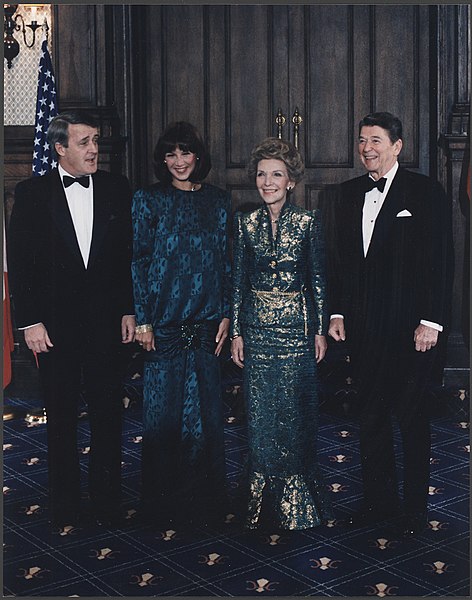
Prime Minister Brian Mulroney, Mila Mulroney, Nancy Reagan, and President Ronald Reagan at the “Shamrock Summit”, 18 March, 1985.
Photo from the Ronald Reagan Presidential Library via Wikimedia Commons.

Brian Mulroney died last week. He was 84.

The first thing you could be forgiven for taking away from the news coverage is how far we have fallen.

Brian Mulroney did big things. Negotiating Free Trade. Fighting Apartheid. Getting the Americans to crack down on acid rain. Comprehensive tax reform that saw the old Manufacturers’ Sales Tax (which taxed productivity) replaced with the GST. Sending Canadians to war in Desert Storm. Striking the Royal Commission on Aboriginal People which led to many of the legal advancements Indigenous communities were able to make through the 90s and into this century.

Even when he failed, as he did at Meech Lake, Brian Mulroney was trying to do something fundamentally transformative in Canadian politics.

And nobody who came after him had anywhere near that kind of guts. Not one of them.

There are things people will gripe about when it comes to Mulroney. Karlheinz Schreiber will be pretty close to the top of that list. Mulroney also tends to poll pretty poorly out west for any number of reasons ranging from a perceived over-emphasis on Quebec via Meech Lake and Charlottetown, to awarding the CF-18 maintenance contract to Montreal’s Canadair after (allegedly) promising it to Winnipeg-based Bristol Aerospace.

Mulroney was not beloved when he left office, to put it mildly. His party was basically annihilated in 1993, and the Canadian conservative movement shattered — it has still, in some ways, yet to fully recover. These are facts about which no one made more, or better, jokes than Mulroney himself. But that fall from esteem was almost never seen internationally. As he watched his contemporaries pre-decease him, Canadians got to see how respected the man was on the world stage. Mulroney was asked to eulogize American presidents Ronald Reagan and George H.W. Bush as well as British prime minister Margaret Thatcher. In this, Mulroney embodied one of the greatest cultural cynicisms of this country: sometimes, the only way for us to claim a Canadian as one of our own is to first watch them make it abroad.

Mulroney’s great triumph is free trade. Yes, because it meant jobs for millions of Canadians. Yes, because it locked us into an economic pact with the world’s powerhouse economy. But also because, in doing it, he went head-on at one of this country’s great cliches: the idea that reflexive, Laurentian, anti-Americanism was somehow a basis for governing instead of just the hallmark of a deeply insecure cultural elite.

Nobody is picking those fights now. Nobody is taking on the big battles to remake the country. We have been treated to almost 30 years of some of the pettiest, small-ball sniping imaginable. Various wedge issues are dusted off by either side, and hurled like stale buns at their opponents. Culture wars are imported for the purposes of giving our political class something about which they can feign moral outrage. Our leaders are afraid of big things either because they’re hard, or because they are unlikely to pay off in a single four-year election cycle. Mulroney is, arguably, the last Canadian prime minister whose vision of what Canada is, or could be, was not limited by a four-year horizon.

We are a serious country that is not led by serious people. And that is brought into focus when you lose a serious person.

Whatever his flaws, Brian Mulroney was a serious person.

The Line‘s editors say that Mulroney wasn’t well liked on leaving office, but the utter obliteration of the Progressive Conservatives in the 1993 federal election can’t be completely blamed on him. His successor as PC leader, Kim Campbell, went out of her way to alienate western conservatives and libertarians during her brief time in office and during the election campaign that followed. She became Prime Minister with a surprising level of tentative support that she jettisoned in record time, taking her party from a majority in the House of Commons to two (2) seats — only one other Canadian PM has ever been defeated in their own riding (Arthur Meighen … but he had it happen twice, first in 1921 and again in 1926).

« Newer PostsOlder Posts »

Powered by WordPress