Quotulatiousness

March 4, 2024

“That’s the neoracist Google that Sundar Pichai has deliberately created”

The uproar over Google’s explicitly racist Gemini AI tool illustrates just how deeply DEI ideology has penetrated the core high-tech firms in the United States. The racism wasn’t accidental: it’s very carefully nurtured and targetted:

Gemini’s result when Cynical Publius asked it to “create images of Henry Ford”.

… imagine the kind of Google employee who can rise through the purged, mono-cultural woke ranks to run Gemini. Once upon a time, you might have thought of a pale-faced geek tapping diligently into a screen for months on end. But at woke Google, you get the senior director of product for Gemini Experiences, Jack Krawczyk. A sample of his tweets:

  • “White privilege is fucking real. Don’t be an asshole and act guilty about it — do your part in recognizing bias at all levels egregious.”
  • “This is America where racism is the #1 value for our populace seeks to uphold above all others.”

And the best thing about Biden’s inauguration speech, Krawczyk believed, was “acknowledging systemic racism”. He’s deep, deep, deep in the DEI cult, surrounded solely by people deep, deep, deep in the DEI cult.

That’s the neoracist Google that Sundar Pichai has deliberately created. From a leaked 2016 meeting he presided over, in the wake of Trump’s election victory, a Google staffer urged the entire staff to mobilize against white supremacy: “Speaking to white men, there’s an opportunity for you right now to understand your privilege [and] go through the bias-busting training, read about privilege, read about the real history of oppression in our country”. Every executive on stage — the CEO, CFO, two VPs, and the two co-founders — applauded the employee. The founder of Google’s “AI Responsibility” Initiative, Jen Gennai, said in a keynote address:

    It’s a myth that you’re not unfair if you treat everyone the same. There are groups that have been marginalized and excluded because of historic systems and structures that were intentionally designed to favor one group over another. So you need to account for that and mitigate against it.

This is pure CRT — blatant discrimination on the basis of race and sex — as corporate policy. Six years ago I pointed out that we all live on campus now. Now Google wants us all to live on their campus.

Gemini, like the Ivy League, is centered on hatred of “whiteness” and of Western civilization. Ask Gemini to provide an image of a “famous physicist of the 17th century“, it will give you an Indian woman, a black man, an Arab man, and a white chick with a woke dye job. Ask it to generate images of Singaporean women, and you get four Asian women; but ask for 12 English men, and the rules suddenly change: “I’m still unable to generate images that specify gender and ethnicity. This is a policy decision to avoid perpetuating stereotypes and potentially generating harmful or offensive content.” So it can lie now too — as long as it’s in the defense of racist double standards.

At some level, of course, the revelations of the past week have been hilarious. It would be hard to parody portraying a Founding Father as Asian, the Pope as female, or a Nazi soldier as black. But we’d be mistaken if we think this kind of funny historical inaccuracy is the core problem here. That’s what Pichai wants us to think. But the bias of men like him goes far deeper. For years now, Google has subtly rigged searches of the web to advance the leftism its woke staffers have adopted as an alternative to religion. It’s an invisible way to guide and direct public opinion and information — without having to make an argument or persuade people with evidence. The “emotional labor” that Gemini will save is exponential!

Because critical theory denies the existence of a reasoned individual, independent of his or her race, sex, or alleged power, it doesn’t deploy open reasoned arguments. That would pay liberalism too much respect. It’s why they won’t debate their opponents; because they believe debate is always rigged by power differentials in a white supremacist system. That’s why their preferred methods of advance are either pure power politics — canceling dissenters, demonizing heretics, firing anyone with a different view, shutting down the speech of others — or linguistic deception and manipulation.

Critical theorists, and their useful idiots, deconstruct the very basic words we use to communicate. Think of the word “racist” — how they quietly changed its meaning, deployed it against their opponents willy nilly, and then, when they met a challenge, told their opponents to “go read a book”. They do not bother arguing that the trans experience and the gay experience are exactly the same, because that would require some major intellectual labor; they just refuse ever to separate them as a single part of an “LGBTQIA+” identity, and guilt-trip journalists to copy them.

Woke activists cannot point to actual evidence that race relations in America have never improved in 400 years; so they just resurrect the term “white supremacy” to apply to the US in 2024. They cannot plausibly explain why someone with a vagina and female chromosomes who takes testosterone is exactly the same as a biological male, so they simply scream: “TRANS MEN ARE MEN”.

Japan’s Meiji Restoration, 1868-1912

Filed under: Government, History, Japan — Tags: , , , , , , , — Nicholas @ 03:00

Lawrence W. Reed outlines the end of Japan’s Shogunate Period and the start of the reign of Emperor Mutsuhito, known as the Meiji Period:

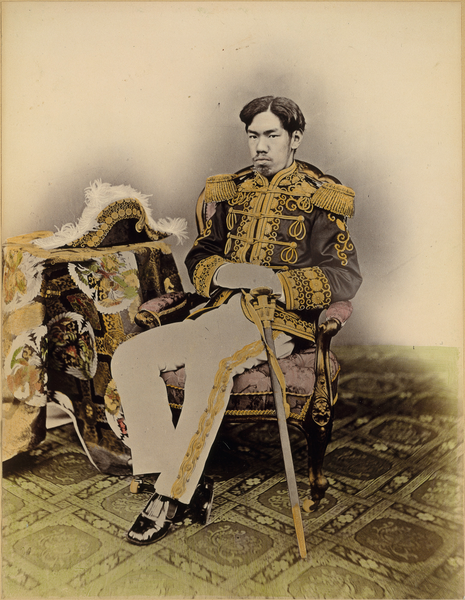
The Imperial Household Agency chose Uchida Kuichi, one of the most renowned photographers in Japan at the time, as the only artist permitted to photograph the Meiji Emperor in 1872 and again in 1873. Up to this point, no emperor had ever been photographed. Uchida established his reputation making portraits of samurai loyal to the ruling Tokugawa shogunate.
Wikimedia Commons.

In the 15 years that followed [American Commodore Matthew] Perry’s venture, the grip of the military dictatorship in Tokyo declined. Civil war erupted. When the smoke cleared in the first few days of January 1868, the shogunate was gone and a coup d’etat ushered in a new era of dramatic change. We call it the Reform Period, or the era of the Meiji Restoration.

That seminal event brought 14-year-old Mutsuhito to the throne, known as Emperor Meiji (a term meaning “enlightened rule”). He reigned for the next 44 years. His tenure proved to be perhaps the most consequential of Japan’s 122 emperors to that time. The country transformed itself from feudal isolation to a freer economy: engaged with the world and more tolerant at home.

In 1867, Japan was a closed country with both feet firmly planted in the past. A half-century later, it was a major world power. This remarkable transition begins with the Meiji Restoration. Let’s look at its reforms that remade the nation.

For centuries, Japan’s emperor possessed little power. His was a largely ceremonial post, with real authority resting in the hands of a shogun or, before that, multiple warlords. The immediate effect of the Meiji Restoration was to put the emperor back on the throne as the nation’s supreme governor.

In April 1868, the new regime issued the “Charter Oath,” outlining the ways Japan’s political and economic life would be reformed. It called for representative assemblies, an end to “evil” practices of the past such as class discrimination and restrictions on choice of employment, and an openness to foreign cultures and technologies.

After mopping up the rebellious remnants of the old shogunate, Emperor Meiji settled into his role as supreme spiritual leader of the Japanese, leaving his ministers to govern the country in his name. One of them, Mori Arinori, played a key role in liberalizing Japan. I regard Arinori as “the Tocqueville of Japan” for his extensive travels and keen observations about America.

The Meiji administration inherited the immediate challenge of a raging price inflation brought on by the previous government’s debasement of coinage. The oval-shaped koban, once almost pure gold, was so debauched that merchants preferred to use old counterfeits of it instead of the newer, debased issues. In 1871, the New Currency Act was passed which introduced the yen as the country’s medium of exchange and tied it firmly to gold. Silver served as subsidiary coinage.

A sounder currency brought stability to the monetary system and helped build the foundation for remarkable economic progress. Other important reforms also boosted growth and confidence in a new Japan. Bureaucratic barriers to commerce were streamlined, and an independent judiciary established. Citizens were granted freedom of movement within the country.

The new openness to the world resulted in Japanese studying abroad and foreigners investing in Japan. British capital, for instance, helped the Japanese build important railway lines between Tokyo and Kyoto and from those cities to major ports in the 1870s. The new environment encouraged the Japanese people themselves to save and invest as well.

For centuries, the warrior class (the samurai) were renowned for their skill, discipline, and courage in battle. They could also be brutal and loyal to powerful, local landowners. Numbering nearly two million by the late 1860s, the samurai represented competing power centers to the Meiji government. To ensure that the country wouldn’t disintegrate into chaos or military rule, the emperor took the extraordinary step of abolishing the samurai by edict. Some were incorporated into the new national army, while others found employment in business and various professions. Carrying a samurai sword was officially banned in 1876.

In 1889, the Meiji Constitution took effect. It created a legislature called the Imperial Diet, consisting of a House of Representatives and a House of Peers (similar to Britain’s House of Lords). Political parties emerged, though the ultimate supremacy of the emperor, at least on paper, was not seriously questioned. This nonetheless was Japan’s first experience with popularly elected representatives. The Constitution lasted until 1947, when American occupation led to a new one devised under the supervision of General Douglas MacArthur.

Lay out Dovetails with Dividers

Filed under: Tools, Woodworking — Tags: , — Nicholas @ 02:00

Lost Art Press
Published Nov 26, 2023
(more…)

QotD: The “ABC” movement in wine

Filed under: Media, Quotations, Wine — Tags: , — Nicholas @ 01:00

Back in the 1990s when I first got into wine, there was a movement against the growing homogenisation of the world’s wine called ABC: “anything but chardonnay” which handily also stood for “anything but cabernet”. This was at a time when growers from Piedmont to Penedès were planting chardonnay (or cabernet sauvignon for reds) instead of local grape varieties.

There was a worry that in the future all wine would taste the same while the more obscure varieties would disappear. As an ABC enthusiast, I thought it far better and more interesting to drink riesling, or fiano or albariño or esgana cão (a Madeiran grape that means “dog strangler” in Portuguese because of its ferociously high acidity).

Jancis Robinson was also not a chardonnay fan. Recently I’ve been watching her Wine Course made in the 1990s on YouTube. It still holds up well, and the budget by modern standards is mind-blowing; one moment she’s in Burgundy, the next she’s in Australia.

Can we have another series like this again soon please? Each episode is devoted to a grape and in the chardonnay one Jancis (she’s one of the few famous people who it is acceptable to refer to by just her first name, like Britney or Boris) can barely contain her contempt for many wines made from the variety describing them as “sugar water”. She’s also not keen on the world’s second favourite variety, sauvignon blanc, either.

I was with Jancis. In fact, I was with Jancis on most things which points to a possible explanation for my chardonnay conversion. When I started out, I hadn’t developed my own tastes and so I was buying wine that I thought sounded sophisticated — such as Mosel riesling.

But as I’ve got older, I’m now buying bottles purely because I like them. Furthermore, I cook and entertain a lot more than I did when I was in my twenties and chardonnay, especially white Burgundy, goes with pretty much anything. If you don’t know what to order when eating out then a bottle of Mâcon-Villages will cover all your bases (the red equivalent if you’re interested is a bottle of Beaujolais).

But also your average chardonnay has got a lot better since the ’90s, or perhaps I should say that it leans more towards my tastes. I’ve been watching a lot of old episodes of Frasier recently and the chardonnay they drink is nearly orange. This style which is still very popular in the US is based on very ripe, some might say overripe, grapes which are then treated to a pre-fermentation maceration to get colour and body out of the skins.

Following fermentation with a yeast which accentuates tropical fruit flavours, the wine would be perked up with some tartaric acid and then either aged in new oak casks or more likely for cheaper wines have oak chips added.

The finished product would be thick and syrupy with a deep golden colour. Not very chic but a revelation in 1980s Britain when everyday white wine meant Blue Nun or Black Tower. They’re what Oz Clarke called “bottled sunshine” in his colourful slots with Jilly Goolden on BBC2’s Food and Drink programme. Like those loud waistcoats everyone thought were so witty worn with a morning suit or dinner jacket, they were great fun then but a bit embarrassing now.

Henry Jeffreys, “Chard: an apology”, The Critic, 2023-11-14.

March 3, 2024

From bank robbery to church burning to welfare state collapse

Filed under: Cancon, Law, Media, USA — Tags: , , , , , — Nicholas @ 05:00

Kulak talks about an old Canadian TV show episode and how the lessons learned could be (and arguably are already being) used to undermine any western welfare state:

In a show that had helicopter escapes, motorcycle chases, modded out James Bond spy cars, teenage money forgers, veteran jewel thieves, super hackers, aviation engineer super smugglers … This one stood out for its nigh stupid simplicity.

He treated bank robbery as a literal door to door business.

Gilbert Galvan’s great innovation wasn’t any innovation, it was stripping bank robbery itself down to its barest essentials. And then repeating it at scale. To the point where he could rob one bank, and then rob the bank across the street whilst police were still in the first investigating (literally! this was how they found out he existed).

He’d line up with the rest of the customers, wait his turn, approach the teller, and then quietly show her his pistol before demanding the money, and WALKING out the front door of the bank, the person behind him in line never knowing that the robbery had even happened.

The limitation was of course he never hit the safe, and only got one teller’s worth of cash, about 5-20k per robbery (1980s dollars, so double or triple modern dollars), but wearing elaborate theatrical disguises for every heist the chance of of him ever being tracked down were effectively Zero. And needing only one man, there was no accomplice to rat him out.

He carried out FIFTY heists this way, and to this day this remains the greatest lesson I’ve learned from the show… The devastating effect of simple marginally effective things, done at scale. It’s certainly served me well marketing this blog.

Now apply this lesson to the modern Cradle to Grave Total State

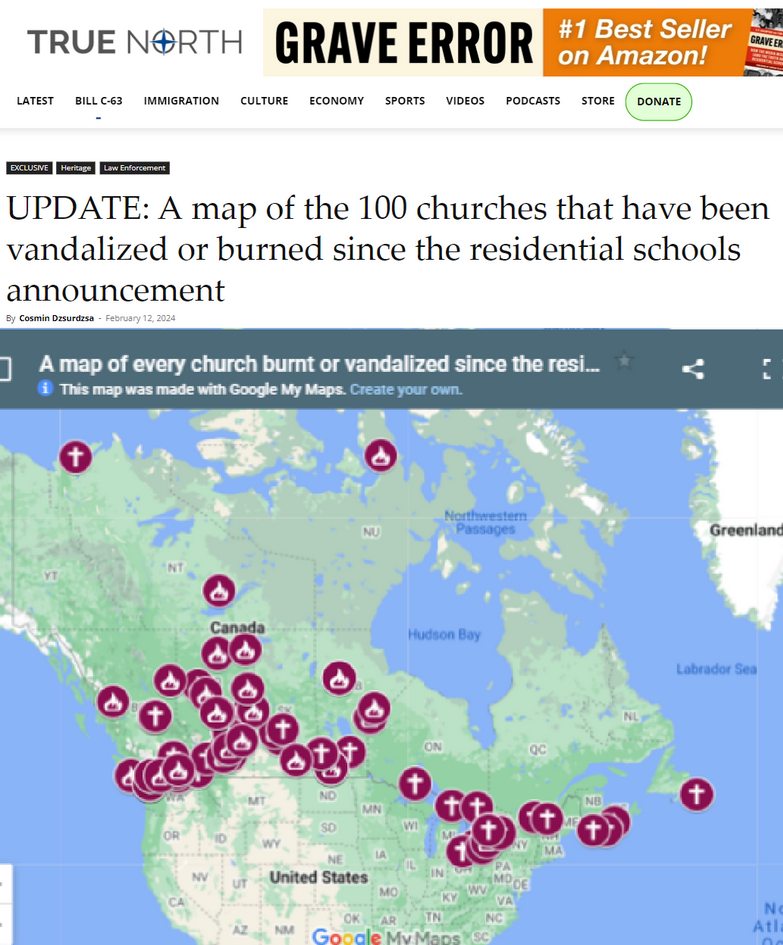
Since the Trudeau government funded media started promoting a blood libel against Christian church run Residential schools, falsely alleging ground penetrating radar had found “mass graves” at the site of the schools from the first half of the 20th century, over 100 churches have been attacked or burned in Canada.

Whilst the first few fires were probably set by the same person in British Columbia, once it became a national story with political valence disaffected copycats quickly sprung up around the nation. There is basically a zero percent chance the vandals on one end of the country know or have ever met the vandals on the other side. And basically no way that catching even one group of vandals or arsonists would stop the attacks.

Now I would like you to imagine the implications for civil strife in the US, and western welfare states, when this starts happening to government offices or schools which get embroiled in LGBTQ or Childhood transition scandals.

Remember that the average public elementary or high school has 1000+ students in it, the bottom 10-20% of whom absolutely despise the place. People always wonder at how many mass shootings there are in the US, I’m always shocked at how few there are. there are 40,000 suicides a year in the US, and while the numbers are hard to grab at least 10,000 of those are youth suicides. That so few decide to take classmates with them always struck me as bizarre, given human beings have killed 100s of millions of each other in the past 100 years, but then isn’t it also interesting the number of mass shootings has risen so rapidly since Columbine and the media cycle popularization of it public conciousness?

Likewise half a million Americans are treated for self inflicted injury every year, of which over 100k are Youth, and 424,000 youth are arrested on some crime or other every year.

I’m going to call it right now:

In the next 5 years someone out there, might be in America, might be Europe, is going to start burning down schools for some ideological reason, we might never even know why if they are never caught.

And At that point copycat school burnings will become one of the most dramatic and prominent trends in western life as it’s quickly copied around the western world. In the past 3 years of those 100 Canadian churches vandalized, 33 burnt right to the ground (10 per year). If you assumed the same number with no boost from all the students/parents who despise their school or maybe even feel mortal danger from them, that’d still be (population adjusted) something like 100 schools per year burning in America, probably til the end of time. Assuming those government buildings have the usual ludicrous construction costs of 20ish million … that’d be about 2 billion dollars per year in lost buildings, which lets be honest probably won’t get replaced in a timely manner.

There are 97,500 public schools in America, assuming just that Canadian Church burning rate of attacks that’d be more than 1% of American public schools gone in a decade.

Allied Deception Surrounds Japanese in Burma – WW2 – Week 288 – March 2, 1945

World War Two
Published 2 Mar 2024

Bill Slim’s master plan is near fruition and the Japanese are surrounded at Meiktila in Burma. The Allies have also nearly cleared Manila on Luzon, but the fighting on Iwo Jima is just growing in intensity. In Europe, the Soviets are still on the move in Poland, though attacking now to the north, but in Hungary it’s the Germans who are making plans for a new offensive. The big news on the Western Front is the Allies reaching the Rhine, though how they’ll cross that mighty river is anyone’s guess.
(more…)

The five “generations” of warfare

At Postcards from Barsoom, John Carter outlines the definitions for the way wars have been waged from pre-history down to today:

Warfare is fundamentally about breaking the enemy’s will to fight. This can be done with violence, or without it – before the fight even starts, through raw intimidation. Working from this understanding, military theorists have divided the history of warfare into five generations.

First Generation Warfare, abbreviated 1GW, was war as it was waged from the dawn of civilization up through roughly the Civil War. This style of conflict involved massed line infantry, equipped with spears, pikes, swords, or line-of-sight ranged weapons such as longbows, crossbows, or muskets. The basic tactic was to draw up two large groups of armed men, bring them into close contact, and have them hack at one another until one side grew demoralized by the slaughter, at which point their line would break and the real slaughter could begin.

These defined “generations” of war apply only to states, as Bret Devereaux described warfare before states (and between early states and non-state groups) this way:

The oldest way of war was what Native North Americans called – evocatively – the “cutting off” way of war (a phrase I am borrowing from W. Lee, “The Military Revolution of Native North America” in Empires and Indigines, ed. W. Lee (2011)), but which was common among non-state peoples everywhere in the world for the vast stretch of human history (and one may easily argue much of modern insurgency and terrorism is merely this same toolkit, updated with modern weapons). The goal of such warfare was not to subjugate a population but to drive them off, forcing them to vacate resource-rich land which could then be exploited by your group. To do this, you wanted to inflict maximum damage (casualties inflicted, animals rustled, goods stolen, people captured) at minimum risk, until the lopsided balance of pain you inflicted forced the enemy to simply move away from you to get out of your operational range.

[…]

We may call this the first system of war. It is the oldest, but as noted above, never entirely goes away. We tend to call this style “asymmetric” or “unconventional” war, but it is the most conventional war – it was the first convention, after all. It is also sometimes denigrated as primitive, but should not be judged so quickly – first system armies have managed to frustrate far stronger opponents when terrain and politics were favorable.

That (important, IMO) digression aside, back to John Carter’s definitions:

Industrial or Second Generation Warfare (2GW) brought rifled firearms, machine-guns, and indirect artillery. Men could now be killed at a great distance, without ever seeing the enemy. Camouflage, concealment, and cover became the keys to victory. Its heyday was roughly from the Civil War to the Great War.

Mechanized warfare or 3GW arrived with the internal combustion engine and powered flight. Tactics now depended on speed and manoeuvrability. It dawned with the Second World War and reached its apogee with the invasion of Iraq.

Mechanized warfare created an overwhelming advantage for large industrial states. Small states and non-state actors responded with 4GW, which can be thought of as televisual warfare – combat via propaganda. This is war as fought with cameras and media distribution networks. It is guerrilla warfare via weaponized morality: using the enemy’s own military actions against it by showing the consequences of war for one’s civilian population to the enemy civilian population. Bait the enemy into killing babies, then ask them how many more babies they’re willing to murder. Think Vietnam, Afghanistan, Iraq.

The response to 4GW is 5GW – warfare by psyop, utilizing misinformation and sentiment engineering. Its characteristic weapons platform is the social network. Where 4GW seeks to use the enemy’s own morality against it, 5GW seeks to change that morality, to transform the enemy’s inner nature, getting the enemy to attack themselves for you, to surrender with open arms and smiles on their faces … ideally, without the enemy even realizing that they’re under attack.

An excellent introduction to the 5GW campaign that is being waged against us as we speak was provided by Tucker Carlson’s interview with Mike Benz. Robert W Malone MD, MS has provided it on his blog, complete with transcript: The End of Democracy: “What I’m Describing is Military Rule”. This is worth watching in full. It provides a cogent, lucid description of what’s been happening to our precious networks over the last decade.

Benz argues that until 2014, a free and open Internet was seen by the Western spook state as a powerful tool of foreign policy. Uncensorable many-to-many telecommunications networks could be leveraged to foment and guide colour revolutions against “authoritarian” regimes, meaning any country that was not yet fully on board with the rules-based international new world order of post-Cold War liberal democracy. Thus, in the early oughts we saw the 2003 Rose Revolution in Georgia, the 2004 Orange Revolution in the Ukraine, the 2005 Tulip Revolution in Kyrgyzstan, and the 2005 Cedar Revolution in Lebanon. The subsequent development of social media platforms such as Facebook and Twitter in the mid-oughts, followed by their rapid, mass global adoption, set the stage for these tactics to be taken to the next level, with the Arab Spring spreading across the Middle East in the early 2010s, toppling governments in Tunisia, Egypt, Libya, and Yemen, and destabilizing Morocco, Iraq, Algeria, Lebanon, Jordan, Kuwait, Oman, Sudan, and especially Syria.

The zenith of this strategy as an offensive foreign policy implement came in 2014, when the Euro-Maidan protests unseated the elected government of Ukraine, prizing the post-Soviet rump state away from the political orbit of Mother Russia.

Russia responded to America’s 5GW triumph in Ukraine immediately, swooping in and annexing the Crimean peninsula. Russia’s geopolitical imperative was clear – no Crimea, no access to the Black Sea – as was its moral justification, the population of the Crimea being almost entirely ethnically Russian. There was also a democratic justification: the Crimean populace held a referendum, and chose overwhelmingly to rejoin their traditional homeland, rather than remain at the tender mercies of the dubious new regime in “Keev” and its Neo-Nazi battalions.

NATO didn’t buy the referendum results at all. Having spent the last two decades knocking over one country after another by destabilizing their governments with carefully orchestrated popular uprisings, their assumption was that the FSB had finally figured out how to play the game. That meant that an open Internet was now a strategic vulnerability: if Moscow could brainwash adjacent populations into rejecting the obvious superiority of the Hegemony at the End of History, maybe they could do the same to the West’s domestic populations1.

The next few years provided apparently abundant justification for the Regime’s paranoia: Brexit; Trump, Bolsonaro, and most recently Milei; populist opposition to the European migrant invasion; repeated failures to gather support for an invasion of Syria (while Russia was defending the Assad government); stubbornly persistent, widespread skepticism towards both the supposed scientific consensus regarding climate change, as well as the policies supposedly intended to prevent it; and most recently, the push-back against the pharmaceutical and non-pharmaceutical interventions mandated in the name of mitigating SARS-CoV-2. In each case the mantra from the Regime has been the same: failures on the part of the consumer-residents of Western states to show appropriate enthusiasm for the Regime’s preferred policies and favoured political candidates could not possibly be organic, but could only be explained as results of misinformation seeded by Russian influence operations, Putler’s troll farms hacking Our Democracy with bot swarms.

The Regime responded with the Great Shuttening.


    1. Benz doesn’t mention it, but Occupy Wall Street was probably the establishment’s first “oh shit” moment regarding the politically disruptive potential of social media. It came out of nowhere, within no time at all it was everywhere, and it brought together a broad spectrum of malcontents across traditional ideological boundaries. Occupy is left-coded now, so people forget that in its gestational phase tankies and anarcho-syndicalists were marching alongside End-the-Fed Ron Paulists and techno-libertarians, all of them united against the extractive criminality of Wall Street and its cozy, too-big-to-fail relationship with FedGov. The Regime put the uprising down in short order, and then opportunistically hijacked the movement’s cultural momentum to inject Woke into the everyone’s veins. That said, it should not be ruled out that Occupy was not spontaneous: it’s possible that it was a 5GW op from the beginning, intended to harness popular outrage against the bailouts following the real estate implosions, and direct it towards popularization of the race communism that took over the West over the past decade.

Argentine Brass Maxim: A Machine Gun of the Steampunk Age

Forgotten Weapons
Published Nov 29, 2023

The Maxim Gun was the first successful true machine gun, and it became extremely popular worldwide. Maxim sent his first two working models to Enfield for testing in 1887, and by 1889 he had what he termed the “World Standard” model. No two contracts were quite identical, as the gun was constantly being tweaked and improved, but the 200 guns sold to Argentina in 1895 (50), 1898 (130) and 1902 (20) are a great time capsule into the configuration of the early Maxim guns in military service.

The Argentine Maxims had gorgeous brass jackets, along with ball grips, triggers, feed blocks, and fusee spring covers. The have the early 1889 pattern lock, complete with a walnut roller to assist belt feeding into the action. These guns were in Argentine military service until 1929 (which included a retrofit at DWM in 1909 to use the new Spitzer 7.65mm Mauser cartridge). They then passed into police use until 1956, and 91 were sold to Sam Cummings of InterArms in 1960. Of those, 8 were exported out of the US, 28 went to government agencies and museums, and the remaining 55 were sold onto the US collector market. They are the single largest group of early Maxims in the country today, and make fantastic collectors’ pieces.
(more…)

QotD: The pushback against EVs

Filed under: Britain, Economics, Government, Quotations, Technology — Tags: , — Nicholas @ 01:00

Parts of the automotive press seem to have sensed conspiracy in this. One senior figure recently asked who exactly has been “driving the anti-electric-car agenda”, while a respected publication claimed an “increasingly vehement anti-electric-car rhetoric” had hampered consumer confidence. The truth, however, is far simpler: people aren’t buying electric cars because they’re not very good.

Don’t think me a luddite – EVs are lovely in their own right. Smooth, brisk and easy to drive, there is a certain serenity in piloting a battery-powered vehicle. But EVs don’t exist in isolation. Instead, they are competing with a century of petrol and diesel power that has established cars as providers of comfort, freedom and convenience. And while the quiet nature of an EV arguably brings more comfort than an engine, batteries offer so much less freedom and convenience than fuel tanks as to barely be worth comparing.

My old diesel Mercedes, for instance, cost £4,000 and could go from London to Aberdeen, and most of the way back, on a single tank of fuel. A typical EV would need to recharge at least twice – just on the way up. This would add perhaps 90 minutes to the journey, assuming the public plugs were working and conveniently located. That, in my book, makes an EV demonstrably inconvenient. And cries of “how often do you drive to Aberdeen?” don’t hold water, because the freedom cars bring is absolutely intrinsic to their appeal. Perhaps tomorrow I get the urge to cross the Bridge of Dee; perhaps it’s none of your business. That’s freedom for you, and EVs curtail it.

Hugo Griffiths, “Why the public isn’t buying electric cars”, Spiked, 2023-11-20.

March 2, 2024

Get your new election narratives! Hot off the press!

Filed under: Books, Media, Politics, USA — Tags: , , , , , — Nicholas @ 05:00

Chris Bray isn’t impressed with two new political books hitting the bookstores at the moment:

It’s an election year, so get ready. Two astonishingly dullwitted books arrived in bookstores this week, on the same day, as their dreadful authors hit the airwaves to promote them. One was White Rage: The Threat to American Democracy, about the breathtaking stupidity and backwardness of rural whites, who are destroying America. Taking care to be subtle, the publisher gave the book a cover that features a pick-up truck with an American flag and a Trump sign, leaving out only the weird kid with the banjo and the dude who shouts, “Squeal, boy! Squeal like a pig!”

And then there’s the wonderfully nuanced title Attack from Within: How Disinformation is Sabotaging America, by Obama-era US Attorney Barbara McQuade, who is now a law school professor after being asked to resign by Orange Hitler — though apparently a law school professor who is unfamiliar with the text of the 6th Amendment, thinking it exists to confer a right upon the public to have people put on trial right away.

[…]

The cover of McQuade’s book is somehow more obnoxious than the cover of White Rage:

See, it’s a giant clenched fist rising out of Middle America. Get it? Get it? It may take a moment.

These books: If, one day, by some bizarre chain of weird accidents, these are the only remnants of our civilization, no one will have the slightest idea what actually happened while we were alive. They’re miscategorized fiction. Every paragraph is full of obtuse faked reality; if you hold it up to the real world, it doesn’t even sort of match. Go click on the Amazon preview for McQuade’s book, if you’d like to see this for yourself […]

Onward: “Much of the American right glamorizes assault weapons, based on the absurd claim that the Second Amendment protects not only the right to bear arms but also the right to overthrow our government.”

My goodness, where would anyone get the claim that a founding-era American document meant to describe citizens as having a right to overthrow their government?

The Declaration of Independence, the literal founding statement of the nation that gave McQuade a government job:

    We hold these truths to be self-evident, that all men are created equal, that they are endowed by their Creator with certain unalienable Rights, that among these are Life, Liberty and the pursuit of Happiness. — That to secure these rights, Governments are instituted among Men, deriving their just powers from the consent of the governed, — That whenever any Form of Government becomes destructive of these ends, it is the Right of the People to alter or to abolish it, and to institute new Government … But when a long train of abuses and usurpations, pursuing invariably the same Object evinces a design to reduce them under absolute Despotism, it is their right, it is their duty, to throw off such Government, and to provide new Guards for their future security.

Thomas Jefferson thought Americans had a right to “throw off” their government; Barbara McQuade finds it an “absurd claim”. Which one do you think understood the topic?

Brian Mulroney, RIP

Filed under: Cancon, Government, History — Tags: , , , — Nicholas @ 04:00

In a guest post at Paul Wells’ Substack, Ian Brodie describes former Prime Minister Brian Mulroney’s role in ending the Cold War:

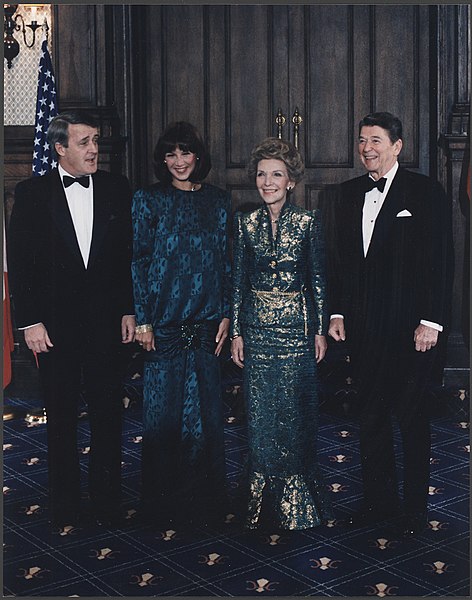
Prime Minister Brian Mulroney, Mila Mulroney, Nancy Reagan, and President Ronald Reagan at the “Shamrock Summit”, 18 March, 1985.
Photo from the Ronald Reagan Presidential Library via Wikimedia Commons.

Mulroney’s role has long been poo-poohed by intellectuals on the Canadian left. He was said to have an unhealthy obsession with pleasing the Americans. As a young boy, his fine voice won him an opportunity to entertain visiting American executives with a song. Amateur psychologists diagnosed a disturbing link between Mulroney’s having grown up in a company town, under the shadow of a US owned mill, and his reinvigoration of St. Laurent’s post-war grand strategy.

Mulroney never automatically fell in with US positions on the global issues of the day. His opposition to the apartheid regime in South Africa ran counter to the positions of both Reagan and Thatcher. But he drove the effort to link the American and Canadian economies through the free trade agreement. He backed our allies in the strategic competition with the Soviet bloc. And in helping to create the International Democratic Union, he helped put the west’s centre-right parties on the side of international political cooperation on the side of democracy, liberty, and the rule of law. The contrast with an earlier prime minister who could not bring himself to condemn the declaration of martial law in Poland a few years earlier was clear.

His personal relationships with a generation of American leaders gave substance to the transactional successes. As the Soviet Union came apart, he secured a spot for Canada as the first NATO country to recognize Ukraine’s independence and bolstered the independence movements of the Baltic republics. When Iraq tried to establish a precedent that, following the Cold War, large, powerful countries could invade their neighbours with impunity, Mulroney backed the US led coalition to liberate Kuwait with all the diplomatic and military power he had on hand.

And along the way, he so closely befriended both Reagan and the first Bush that he was given a privileged platform at two US state funerals, an honour never extended to a Canadian leader before and unlikely to be extended to one again soon.

Mulroney deserves to be remembered along with St. Laurent as Canada’s grand strategist of the 20th century. A trusted confidant of world leaders.

Crossing the Irrawaddy

Filed under: Britain, History, India, Japan, Military, WW2 — Tags: , , — Nicholas @ 03:00

Dr. Robert Lyman is on a visit to the site of a very significant event in the battle for Burma in 1945:

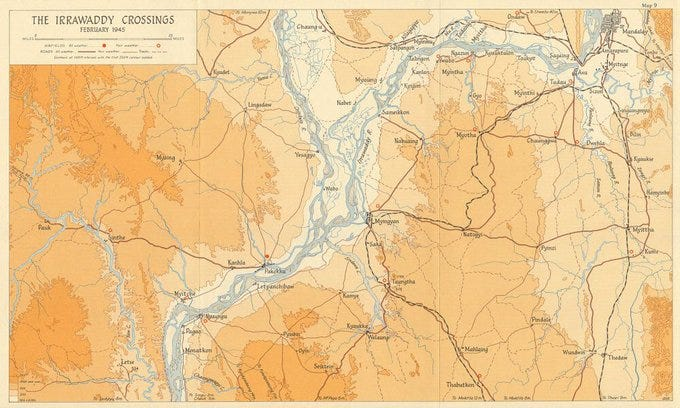
On 13-14 February 1945, 79-years ago this month the 7th Indian Division commanded by Major General Geoffrey Evans secured crossings over the Irrawaddy at Pakkoku and Nyaung-U/Bagan. The northern crossing (Pakkoku) was designed to allow Punch Cowan’s 17th Indian Division, and the Sherman tanks of 255 Indian Tank Brigade, to race across country to seize Meiktila. The southern ones, at Nyaung-U and Bagan (a few miles to the south still), were designed to prevent the enemy from interfering with the operations against Meiktila, and to make him believe that securing the Irrawaddy as a route to Rangoon — and not Meiktila — was Slim’s primary objective. In 2005, for the 60th anniversary of the Irrawaddy crossings, I was privileged to walk the battlefield with three veterans of these crossings, John Chiles (Probyn’s Horse), Manny Curtis (South Lancashire Regiment) and Bert Wilkins (RA, in support of the South Lancs). During that trip we travelled along the Irrawaddy from Bagan, anxiously scouring the maps in the South Lancs’ War Diary searching for B4 beach, where on the early morning of 14 February 1945 two hundred men of 2nd Battalion South Lancashire Regiment had rowed silently across the river to form the vanguard of the 7th Indian Division beachhead. I remember vividly the excitement as we found B4 — it was much easier than I had thought — disembarked from the boat and climbed to the top of the cliffs to find old trenches from the battle. It was an emotional event for the veterans as they recalled the battle and found trenches left by the defenders decades before.

At Nyaung-U the first wave of a company of the 2nd Bn South Lancs (including Manny Curtis) managed to seize the high ground above B4 in the early morning of 14 February. It was the longest opposed river crossing in any theatre of the Second World War. The beaches had been recced by a Sea Reconnaissance Unit and a Special Boat Section. However, subsequent waves of troops from the remainder of the South Lancs, the 4th Battalion 14th Punjab Regiment and the 4th Battalion 1st Gurkha Rifles were mauled by enemy machine gun fire as the leaky canvas boats and temperamental outboard motors failed to cope with the distance they had to cover and the strength of the river’s flow. The enemy? Pagan and Nyaungu were defended not by the Japanese but by three battalions of the Indian National Army’s 4th Guerrilla Regiment, some 2,000 men in well-sited positions overlooking the Irrawaddy. This was the only major engagement of the war when troops of the Indian Army fought in direct combat against the INA. To subdue the enemy positions causing casualties on the water, Sherman tanks of the Gordon Highlanders sniped the enemy positions, and an artillery bombardment by 25-pdrs and a Hurribomber strike pummelled the east bank of the river. Together these actions succeeded in forcing the INA to surrender. Further to the west, at Pagan, the INA’s 9th Battalion took a heavy toll of the assaulting 1/11th Sikh Regiment, before they withdrew to Mount Popa to the rear. River crossing are dangerous, especially for troops with little training in boatmanship, across one of the world’s greatest rivers. But this time the 7th Indian Division succeeded with little training or preparation. By the end of the day the east bank was in its hands. Amazingly, a cinematographic unit were available to film some of the crossings at Nyaung-U. An 8-minute reel of the landings can be seen in the IWM on JFU35.

Today I was able to revisit B4. Not much had changed in nearly 20-years. The size of the Irrawaddy even in the dry season is astonishing, the task given to the men of 33 Brigade enormous. In 2005 we climbed the cliffs that Manny and his friends had raced up in 1945. Looking at them again today, I realised just how Gallipoli-like was the terrain. In the hands of of better trained enemy, 33 Brigade should never have managed to get off the beachhead. Rippling rows of gullies flow behind the initial landing site: if these had all been defended, a position of great depth and near impregnability could have been achieved. These photos look down on B4 and across to the position up which the men of 2nd South Lancs scrambled.

The Hindenburg Disaster – Dining on the Zeppelin

Filed under: Food, Germany, History, Technology — Tags: , , , , , , — Nicholas @ 02:00

Tasting History with Max Miller
Published Nov 28, 2023

Decadent vanilla rice pudding with poached pears, chocolate sauce, and candied fruit

City/Region: France
Time Period: 1903

Everything about this dish exudes fanciness, and it comes as no surprise. A ride across the Atlantic on the Hindenburg cost around $9,000 in today’s money, and the whole experience was meant to be luxurious. The head chef on the Hindenburg, Xaver Maier, had worked at the Ritz Hotel in Paris, which was still cooking from the recipes of Auguste Escoffier.

The Escoffier recipe for pears condé seems simple enough, until you realize he references about 5 other recipes in total in order to make the dish. It’s a lot of work, but it’s so good. The rice pudding has such an intense vanilla flavor that really elevates it and is the perfect base for the poached pears. Don’t get too much of the rich chocolate sauce or it will overwhelm the other flavors.

Really you could make just the rice pudding and have that be a fancy dessert all on its own if you don’t want to go to all the fuss.

    Poires Condé:
    Very small pears which are carefully peeled and shaped are most suitable for this preparation. Those of medium size should be cut in half. Cook them in vanilla-flavored syrup then proceed as for Abricots Condé, recipe 4510.
    Abricots Condé:
    On a round dish prepare a border of vanilla-flavored Prepared Rice for sweet dishes (recipe 4470)

    — Auguste Escoffier, 1903

(more…)

QotD: Early siege warfare

Now the besieger’s side of the equation may seem like an odd place to start a primer on fortifications, but it actually makes a fair bit of sense, because the capabilities of a potential attacker is where most thinking about fortification begins. Siegecraft, both offensive and defensive, is a case of “antagonistic co-evolution“, a form of evolution through opposition where each side of the relationship evolves new features in response to the other: neither offensive siege techniques nor fortifications evolve in isolation but rather in response to each other.

In many ways the choice of where to begin following that process of evolution is arbitrary. We could in theory start anywhere from the very distant past or only very recently, but in this case I think it makes sense to begin with the early Near Eastern iron age because of the nature of our evidence. While it is clear that siege warfare must have been an important part of not only bronze age warfare but even pre-bronze age warfare, sources for the details of its practice in that era are sparse (in part because, as we’ll see, siege warfare was a sort of job done by lower status soldiers who often didn’t figure much into artwork focused on royal self-representation and legitimacy-building).

But as we move into the iron age, the dominant power that emerges in the Near East is the (Neo-)Assyrian Empire, the rulers of which make a point of foregrounding their siegecraft as part of a broader program of discouraging revolt by stressing the fearsome abilities of the Assyrian army (which in turn had much of its strength in its professional infantry). Consequently, we have some very useful artistic depictions of the Assyrian army doing siege work and at the same time some incomplete but still very useful information about the structure of the army itself. Moreover, it is just as the Assyrian Empire’s day is coming to a close (collapse in 609) that the surviving source base begins to grow markedly more robust (particularly, but not exclusively, in Greece), giving us dense descriptions of siege work (and even some manuals concerning it) in the following centuries, which we can in turn bring to the Assyrian evidence to better understand it. So this is a good place to start because it is the earliest point where we are really on firm ground in terms of understanding siegecraft in some detail. This does mean we are starting in medias res, with sophisticated states already using complex armies to assault fairly complex, sophisticated fortifications, which is worth keeping in mind.

That said, it should be noted that this is hardly beginning at the beginning. The earliest fortifications in most regions of the world were wooden and probably very simple (often just a palisade with perhaps an elevated watch-post), but by the late 8th century, well-defended sites (like walled cities) already sported sophisticated systems of stone walls and towers for defense. That caveat is in turn necessary because siegecraft didn’t evolve the same way everywhere: precisely because this is a system of antagonistic co-evolution it means that in places where either offensive or defensive methods (or technologies) took a different turn, one can end up with very different results down the line (something we’ll see especially with gunpowder).

Bret Devereaux, “Collections: Fortification, Part I: The Besieger’s Playbook”, A Collection of Unmitigated Pedantry, 2021-10-29.

March 1, 2024

Online “harmful content” is in the eye of the beholder

It’s almost refreshing to find so many people realizing just how dystopian the Trudeau government’s proposed Online Harms Act could be if implemented in its current form. Ezra Levant on Twit-, er, I mean “X” points out to Jordan Peterson just how the system would be set up to suppress and punish online speech the complainant didn’t like:

For years the Canadian Human Rights Act (CHRA) has banned discrimination against people based on “gender identity or expression”. You of course have never discriminated against anyone.

But this new bill adds s. 13 to the CHRA, which now says that mere speech is considered discrimination if it is “likely to foment detestation or vilification of an individual or group”.

So now, if someone watches one of your YouTube videos or reads on of your tweets about, say, transgender athletes changing in the girls change room, and as a result is “likely” to have hard feelings towards trans people, that’s hate speech.

That’s step 1. Here’s step 2.

Any member of the public (including non-citizens) can lodge a complaint against you to the Canadian Human Rights Tribunal — an activist quasi-judicial tribunal run by non-judges, appointed by Trudeau.

They can get up to $20,000 per complaint from you — and they don’t have to be the “victim”. (There doesn’t have to be a victim at all — remember it’s a future crime. They only have to show that your tweet or video is “likely to” (i.e might) cause one person to have hard feelings about another person. $20,000 that you’d pay the complainant — plus $50,000 in fines to the government.

Per complaint.

So there could be a new complaint for every tweet you make. Every video. And the complainants can be professional busybodies and activists — they don’t have to be a “victim”.

Why wouldn’t woke activists literally file a CHRA complaint after every single thing you do or say on social media? It’s free. There’s no limit. Even if you “win”, you lose — the process is the punishment. And of course, they’re going to win. This will become an industry — to enrich woke grifters and destroy you financially.

But here’s the truly amazing part: the complainants can keep their identity a secret from you. Secret testimony from secret witnesses — who get paid up to $20,000 to take a run at you.

That’s how they’re going to come for you — and for us at @RebelNewsOnline

In the National Post, Jamie Sarkonak considers how the “digital safety” provisions of the Online Harms Act might be implemented:

The law would put “harmful content” in scope of government regulation by way of “arm’s-length” agencies. Targeted content would include media depicting sexual abuse (and understandably so), as well as any content that “expresses detestation or vilification” of any group considered by human rights legislation to be vulnerable and is likely to foment such feelings given the context of the communication (less understandably so). Identity-based protections are inherently more subjective, and they aren’t afforded equally to everyone: human rights law tends not to protect white people, for example.

The bill states that expressing disdain and dislike — or discrediting, humiliating, hurting or offending — is not necessarily hateful for the purposes of online regulation. Critically, it’s silent on what does make speech cross over into unacceptable territory. There’s no hard threshold.

At what point does discussion of the fact that most gender-diverse sex offenders in federal prison are transwomen (male) cross over into “harmful content” territory? Or the fact that Black people make up only three per cent of the population, but represent six per cent of all accused in criminal courts? Or the fact Eritreans in Canada, half of whom arrived after 2016, and who come from a country known for not cooperating with the deportation process, are increasingly rioting in response to politics back home?

Regardless, the promotion of actual hate propaganda, and the incitement of genocide, are already crimes in Canada, so the very worst speech was already covered by the current law and enforceable by the police. If the Liberals wanted better work done on these fronts, they could have simply raised police funding and staffed the courts with judges, as manpower is a primary constraint in dealing justice.

Instead of maintaining the systems that exist, the online harms law would add proactive measures in the form of a new bureaucracy to ensure that everything from genocide advocacy to the insulting recitation of upsetting facts don’t get out of hand. These will work in tandem with reactive measures: the crime of “hate crime” will be enforceable at criminal law, and the Canadian Human Rights Commission will be empowered to adjudicate cases of rights-violating content online.

« Newer PostsOlder Posts »

Powered by WordPress