Quotulatiousness

November 5, 2021

The 1st (Failed) Paris Commune Uprising During the Franco-Prussian War 1870

Filed under: France, Germany, History, Military — Tags: , , , , , — Nicholas @ 06:00

Real Time History
Published 4 Nov 2021

Sign up for Curiosity Stream and get Nebula bundled in and SAVE 26%: https://curiositystream.com/realtimeh…

The Siege of Paris during the Franco-Prussian War 1870 and the downfall of the French Empire after the Battle of Sedan created a volatile social situation in the French capital. And in November 1870 this situation erupted in an attempt to topple the provisional government and create a self-ruling Paris Commune.

» THANK YOU TO OUR CO-PRODUCERS
John Ozment
James Darcangelo
Jacob Carter Landt
Thomas Brendan
James Giliberto
Kurt Gillies
Albert B. Knapp MD
Tobias Wildenblanck
Richard L Benkin
Scott Deederly
John Belland
Adam Smith
Taylor Allen
Jim F Barlow
Rustem Sharipov

» OUR PODCAST
https://realtimehistory.net/podcast – interviews with historians and background info for the show.

» LITERATURE
Arand, Tobias: 1870/71. Die Geschichte des Deutsch-Französischen Krieges erzählt in Einzelschicksalen. Hamburg 2018

Gouttman, Alain: La grande défaite. Paris 2015

Spiekermann, Uwe: “Die wahre Geschichte der Erbswurst”, unter: https://uwe-spiekermann.com/2018/05/1… (zuletzt besucht am 21.9.2021)

» SOURCES
Chuquet, Arthur: La Guerre 1870-71. Paris 1895

Fontane, Theodor: Der Krieg gegen Frankreich. Bd. 3. Berlin 1878

Goncourt, Edmond de: Journal des Goncourts. II.1. 1870-1871. Paris 1890

Hérisson, Maurice d’: Journal d’un officier d’ordonnance. Paris 1885

Heylli, Georges d’ (ed.): M. Thiers à Versailles: l’armistice. Paris 1871

Kürschner, Joseph (Hrsg.): Der große Krieg 1870-71 in Zeitberichten. Leipzig o.J. (1895)

Meisner, Heinrich Otto (Hrsg.): Kaiser Friedrich III. Das Kriegstagebuch von 1870/71. Leipzig 1926

N.N.: Bismarcks Briefe an seine Gattin aus dem Kriege 1870/71. Stuttgart, Berlin 1903

Schikorsky, Isa (Hrsg.): “Wenn doch dies Elend ein Ende hätte”. Ein Briefwechsel aus dem Deutsch-Französischen Krieg 1870/71. Köln, Weimar, Wien 1999

» OUR STORE
Website: https://realtimehistory.net

»CREDITS
Presented by: Jesse Alexander
Written by: Cathérine Pfauth, Prof. Dr. Tobias Arand, Jesse Alexander
Director: Toni Steller & Florian Wittig
Director of Photography: Toni Steller
Sound: Above Zero
Editing: Toni Steller
Motion Design: Philipp Appelt
Mixing, Mastering & Sound Design: http://above-zero.com
Maps: Battlefield Design
Research by: Cathérine Pfauth, Prof. Dr. Tobias Arand
Fact checking: Cathérine Pfauth, Prof. Dr. Tobias Arand

Channel Design: Battlefield Design

Contains licensed material by getty images
All rights reserved – Real Time History GmbH 2021

“There is nothing to debate anymore. The climate catastrophe is coming. Now is the time for action”

Filed under: Environment, Media, Politics, Science — Tags: , , , — Nicholas @ 05:00

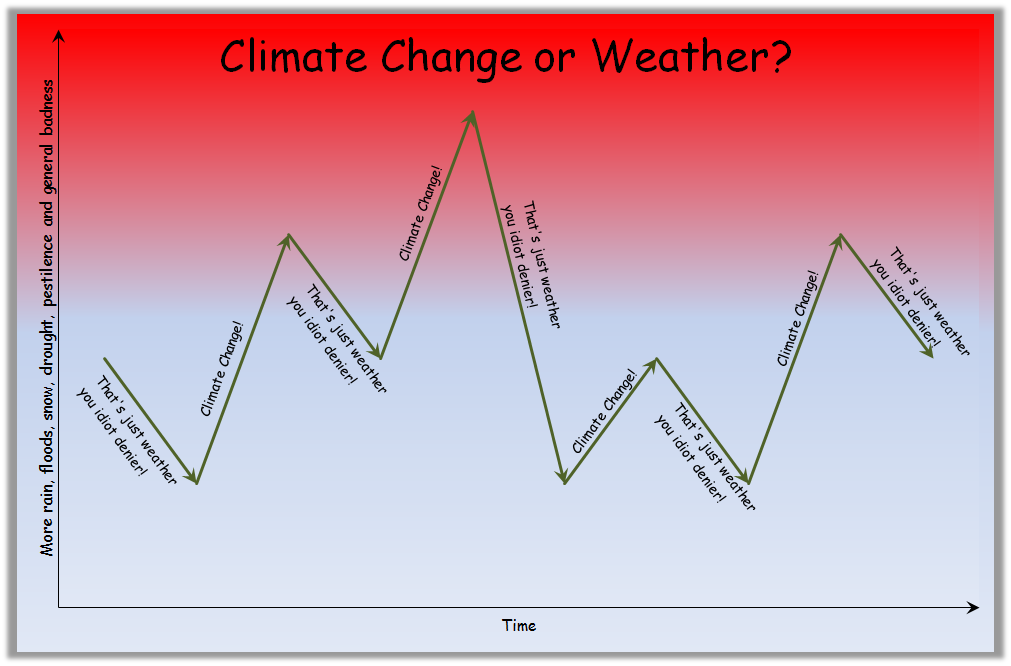
Unlike all the other (dozens? scores? hundreds?) times since the 1970s we’ve been warned about imminent climatological disaster unless we gave up on industrial civilization, heating our homes, and all the other white supremacist, racist, colonialist, transphobic, etc., exploitations we have been enjoying up to now, we’re finally out of time and we must act NOW:

COP26 is an extravaganza of ideological conformity. From the 30,000 delegates and heads of state sequestered in the “blue zone” to the NGOs, academics and green businesses exhibiting in the public “green zone”, the message is the same. There is nothing to debate anymore. The climate catastrophe is coming. Now is the time for action.

Similar sentiments abound outside COP26, where the protesters are gathered. There the likes of young eco-millenarian Greta Thunberg also claim that the end is nigh, that the time for debate is over. Or as the Swedish teenager herself put it during a protest on Sunday, there’s no need for any more of this “blah, blah, blah”.

This is essentially what all those in and around COP26 are saying. That, in effect, there is nothing to debate anymore. And so, over the next few days, Western-led policymakers, angrily cheered on by protesters, will try to decide our futures for the next few decades. They will regulate, restrict and limit. And they will be able to do so without dissent or debate.

How have we got here? How have we ended up at a point where debating climate change has become nigh-on impossible? The answer lies principally in the use and abuse of the authority of science. The standard justification for shutting down those challenging the alarmist climate-change narrative amounts, effectively, to saying “the science has spoken”.

This was clear in the run-up to COP26, when Mark Lynas, a long-time environmentalist campaigner and now a visiting fellow at Cornell University, published a widely reported-on study asserting that the scientific consensus that humans are altering the climate is now agreed upon by 99.9 per cent of scientists. That’s how certain The Science now is. Not just 97 to 98 per cent certain, as it used to be, but 99.9 per cent certain. “It is really case closed”, said Lynas. “There is nobody of significance in the scientific community who doubts human-caused climate change.”

“Case closed.” No “doubts” and no appeal. These are revealing words. Climate change has long since ceased to be an issue to be addressed, or a set of challenges to be overcome. It is now the revealed truth, the God-like judgement around which we must organise the entirety of societal life. To question this truth is tantamount to apostasy. Hence Lynas calls for any remaining heretics to be censored, urging Facebook and Twitter “to look at their algorithms and policies” to root out “climate misinformation”.

Indeed, those daring to question any aspect of the alarmist narrative are now routinely dismissed not as heretics, but as “deniers” – a term which morally equates those who question, say, certain decarbonisation policies with anti-Semites who deny that the Holocaust happened.

A United Front Against Nazi Atrocities – WAH 045 – October 1942, Pt. 2

World War Two
Published 4 Nov 2021

As the war intensifies on all fronts, the occupied world is aflame with resistance and reprisals. From Paris to Papua New Guinea, Humanity is under attack — but it is also fighting back.
(more…)

The New York Times identifies the next big threat to humanity – “Muskism”

Filed under: Books, Business, Media, Space, USA — Tags: , , , , , , — Nicholas @ 03:00

In Thursday’s NP Platformed newsletter, Colby Cosh outlines the “evidence” amassed in a recent New York Times essay blaming Elon Musk for, well, everything:

Elon Musk at the 2015 Tesla Motors annual meeting.
Photo by Steve Jurvetson via Wikimedia Commons.

Lepore commences by describing Bill Gates’s 66th birthday party, for which a bunch of rich people — including Amazon’s Jeff Bezos — were helicoptered to a private beach from a nearby yacht. Neither Elon Musk, thought to be the world’s richest person, or Mark Zuckerberg, founder of newly rebranded Facebook, were present at the party. Zuckerberg was busy illuminating plans for his “metaverse”, which Lepore describes as “a virtual reality,” wherein you wear “a headset and gear that closes out the actual world.”

Here’s where Lepore goes from this: “The metaverse is at once an illustration of and a distraction from a broader and more troubling turn in the history of capitalism. The world’s techno-billionaires are forging a new kind of capitalism: Muskism.”

In literally the next sentence, Lepore admits that the subject of her essay, Elon Musk, immediately and publicly made fun of the Facebook “metaverse” plans. We are on the third paragraph of the essay, and Lepore has already: a) blamed Elon Musk for an A-hole billionaire party he didn’t attend, because he was busy with his engineering and manufacturing projects; and b) applied the new coinage “Muskism” to a virtual reality project that actual Musk loudly criticized. Somehow this essay has severed its own hydrocephalic head twice over, within 500 words.

It gets worse from there as Lepore attempts to complete her mission of denouncing Muskism, which she describes as an “extreme extraterrestrial capitalism.” She quickly has to admit that Bill Gates, who is mostly spending a computing fortune on global philanthropy these days when he’s not lifting off from yachts in choppers, doesn’t have one single freaking thing to do with absolutely any of this. NP Platformed was an editor back in the day, so we notice that the intro of Lepore’s essay is at this point not only detached from its body, but has been left to rot several miles away. Gates-Musk-Bezos-Zuckerberg: they’re all tentacles of the same menacing Muskist octopus here, as in so much newspaper and magazine commentary, and abuse flung in their general direction will suffice to condemn all.

Lepore’s accusation against Musk turns out to be … that he likes some classic science fiction but doesn’t always concur with the politics of its authors. Musk has called himself a “utopian anarchist of the kind best described by Iain Banks,” but Banks was “an avowed socialist.” Gasp! Banks (1954-2013), the Scottish science fiction author best known for the Culture series, was a particular kind of U.K. “libertarian socialist” who believed strongly in spacefaring as a step toward post-scarcity life for sentient beings. His politics are easily misunderstood by Americans, who don’t have this particular kind of weirdo, and the interstellar “Culture” he envisioned was never intended to be admired unironically. In other words, that part of Lepore’s essay is as mangled and obtuse as the rest.

Easy Homemade Chilli Ketchup – Tastes amazing!

Filed under: Food — Tags: , — Nicholas @ 02:00

ChilliChump
Published 31 Aug 2018

In this video I show you my recipe to make your own chilli ketchup! (If you want plain ketchup without the spice then you can leave out the birds eye peppers. At the same time if you want it hotter then add more peppers … or hotter peppers!)

Making your OWN ketchup means you get to control what goes into it … so if you want to reduce the amount of sugar in your diet, but still want to enjoy ketchup, then make your own! Plus this just tastes incredible!

Smoker box: http://geni.us/bbqsmoker
Squeeze Bottles: https://amzn.to/2HOgjyb
Slow Cooker: http://geni.us/slowcook (not the exact one I have, because mine is quite old. But this is a decent one)
Hand blender: http://geni.us/handblend

Ingredients:
1.2 KG Plum Tomatoes
3 Tins plum tomatoes(or another 1.2KG of fresh plum tomatoes)
6 Jalapenos (4 red, 2 green)
25-30 Birds Eye Chillis
2x Red Onions
8 Cloves of Garlic
Piece of Ginger (a bit smaller than golf ball sized)
Piece of Fresh Fennel (about half a fennel bulb)
3x Celery sticks
1 tbsp Dried Coriander Seeds
1 tbsp Pepper Corns
1.5 tbsp Salt
150g Brown Sugar (or equivalent sweetener)
350ml Red Wine Vinegar
Handful of Fresh Basil
1 litre of water (less if you want this to cook down quicker)

————————————————————————

Any links to products or services may be affiliate links that give me a small kickback at no cost to you, and with no influence on the content. I use Geni.us to help geo-target, ensuring you are linked to the correct country’s Amazon website — As an Amazon Associate I earn from qualifying purchases.

Website – http://www.chillichump.com
Patreon – https://www.patreon.com/chillichump
Instagram – https://www.instagram.com/chillichump
Twitter – https://twitter.com/Chillichump
Reddit – https://www.reddit.com/r/chillichump/

#chillichumprecipes

Note: All information provided by ChilliChump is furnished only for educational/entertainment purposes only. You agree that use of this information is at your own risk and hold ChilliChump harmless from any and all losses, liabilities, injuries or damages resulting from any and all claims.

QotD: The Dame of Sark

Filed under: Books, Britain, History, Humour, Quotations — Tags: , , — Nicholas @ 01:00

The death at ninety of Dame Sibyl Hathaway, the Dame of Sark, removed the only person in the British Isles whom I still wanted to meet. Unfortunately, she rejected all my advances. She was a model ruler for out times, forbidding not only cars and aircraft on her island, but also trade unions, taxation, female dogs, divorce, and most of the troublesome manifestations of our age. I had always hoped to persuade this admirable lady to take England under her rule when our parliamentary system finally disintegrates. Now she is dead I think I shall leave the country for a time — probably for a very long time. I can see no hope.

Auberon Waugh, Diary, 1974-07-25.

November 4, 2021

You think software is expensive now? You wouldn’t believe how expensive 1980s software was

Filed under: Business, Gaming, Technology — Tags: , , , — Nicholas @ 05:00

A couple of years ago, Rob Griffiths looked at some computer hobbyist magazines from the 1980s and had both nostalgia for the period and sticker shock from the prices asked for computer games and business software:

A friend recently sent me a link to a large collection of 1980s computing magazines — there’s some great stuff there, well worth browsing. Perusing the list, I noticed Softline, which I remember reading in our home while growing up. (I was in high school in the early 1980s.)

We were fortunate enough to have an Apple ][ in our home, and I remember reading Softline for their game reviews and ads for currently-released games.

It was those ads that caught my eye as I browsed a few issues. Consider Missile Defense, a fun semi-clone of the arcade game Missile Command. To give you a sense of what games were like at the time, here are a few screenshots from the game (All game images in this article are courtesy of MobyGames, who graciously allow use of up to 20 images without prior permission.)

Stunning graphics, aren’t they?

Not quite state of the art, but impressive for a home computer of the day. My first computer was a PC clone, and the IBM PC software market was much more heavily oriented to business applications compared to the Apple, Atari, Commodore, or other “home computers” of the day. I think the first game I got was Broderbund’s The Ancient Art of War, which I remembered at the time as being very expensive. The Wikipedia entry says:

A screenshot from the DOS version of The Ancient Art of War.
Image via Moby Games.

In 1985 Computer Gaming World praised The Ancient Art of War as a great war game, especially the ability to create custom scenarios, stating that for pre-gunpowder warfare it “should allow you to recreate most engagements”. In 1990 the magazine gave the game three out of five stars, and in 1993 two stars. Jerry Pournelle of BYTE named The Ancient Art of War his game of the month for February 1986, reporting that his sons “say (and I confirm from my own experience) is about the best strategic computer war game they’ve encountered … Highly recommended.” PC Magazine in 1988 called the game “educational and entertaining”. […] The Ancient Art of War is generally recognized as one of the first real-time strategy or real-time tactics games, a genre which became hugely popular a decade later with Dune II and Warcraft. Those later games added an element of economic management, with mining or gathering, as well as construction and base management, to the purely military.

The Ancient Art of War is cited as a classic example of a video game that uses a rock-paper-scissors design with its three combat units, archer, knight, and barbarian, as a way to balance gameplay strategies.

Back to Rob Griffiths and the sticker shock moment:

What stood out to me as I re-read this first issue wasn’t the very basic nature of the ad layout (after all, Apple hadn’t yet revolutionized page layout with the Mac and LaserWriter). No, what really stood out was the price: $29.95. While that may not sound all that high, consider that’s the cost roughly 38 years ago.

Using the Bureau of Labor Statistics’ CPI Inflation Calculator, that $29.95 in September of 1981 is equivalent to $82.45 in today’s money (i.e. an inflation factor of 2.753). Even by today’s standards, where top-tier games will spend tens of millions on development and marketing, $82.45 would be considered a very high priced game — many top-tier Xbox, PlayStation, and Mac/PC games are priced in the $50 to $60 range.

Business software — what there was of it available to the home computer market — was also proportionally much more expensive, but I found the feature list for this word processor to be more amusing: “Gives true upper/lower case text on your screen with no additional hardware support whatsoever.” Gosh!

H/T to BoingBoing for the link.

Napoleonic Wars: Battle of Vimeiro (1808) – Peninsular War

Kings and Generals
Published 12 Aug 2018

Napoleonic Wars are back! It is 1807, and we find the Emperor of the French Napoleon Bonaparte at the height of his power, as he controls most of Europe after the War of the Fourth Coalition and the treaties of Tilsit. Napoleon decided to strangle his remaining enemy the United Kingdom economically by enacting Europe-wide Colonial Blockade, yet as Portugal defied him, he invaded it and then Spain. This was the beginning of the Peninsular War. Soon Spain and Portugal were in open rebellion. The first phase of the war ended when the British forces under Wellington landed in Portugal and fought the French General Junot at Vimeiro.

This script was researched and written by Everett Rummage. Check out his brilliant Age of Napoleon podcast – http://bit.ly/2vC3cIE In our opinion, it is the best podcast on the Napoleonic era.

Support us on Patreon: http://www.patreon.com/KingsandGenerals or Paypal: http://paypal.me/kingsandgenerals

We are grateful to our patrons and sponsors, who made this video possible: https://drive.google.com/open?id=1jjh…

This video was narrated by Officially Devin (https://www.youtube.com/user/OfficiallyDevin)

Machinimas were made on NTW3 mod for Napoleon Total War by Malay Archer (https://www.youtube.com/user/Mathemed…)

✔ Merch store ► teespring.com/stores/kingsandgenerals
✔ Twitch ► https://www.twitch.tv/nurrrik_phoenix
✔ Twitter ► https://twitter.com/KingsGenerals
✔ Instagram ► http://www.instagram.com/Kings_Generals

Production Music courtesy of Epidemic Sound: http://www.epidemicsound.com

#Documentary #Kingsandgenerals #Napoleon

Fallen Flag — the Milwaukee Road

Filed under: Business, History, Railways, USA — Tags: , , , , , — Nicholas @ 03:00

This month’s Classic Trains fallen flag feature is the Milwaukee Road (MILW) by George Drury. As with most major US railways, the Milwaukee Road was a long-term collection of different railway lines, some merged for obvious economic benefit and others taken over to reduce competition, but the first of the components that eventually evolved into the Milwaukee Road system was the 1847 Milwaukee and Waukesha Railroad. This line was incorporated to connect the Wisconsin city of Milwaukee to the river traffic along the Mississippi River, and the corporate name was changed even before construction began to the Milwaukee and Mississippi Railroad to more adequately convey the purpose of the line. The first segment opened in November 1850 connecting Milwaukee and Wauwatosa, a distance of five miles, then to Waukesha a few months later, then to Madison, but not extending all the way to the river at Prairie du Chien until 1857.

In that year, another of the frequent financial crises of the era struck and the company struggled on for two years, but eventually went into receivership in 1859. New owner the Milwaukee and Prairie du Chien Railroad took possession in 1861. After the Civil War, the company was merged with the Milwaukee and St. Paul and in 1874 the combined railroad became known as the Chicago, Milwaukee and St. Paul with the completion of a new line connecting with Chicago.

In the next few years the road built or bought lines from Racine, Wis., to Moline, Ill.; from Chicago to Savanna, Ill., and two lines west across southern Minnesota. The road reached Council Bluffs, Iowa, across the Missouri River from Omaha, in 1882, and reached Kansas City in 1887. In 1893 the CM&StP acquired the Milwaukee & Northern, which reached from Milwaukee into Michigan’s upper peninsula.

In 1900 the Chicago, Milwaukee & St. Paul was considered one of the most prosperous, progressive, and enterprising railroads in the U.S. Its lines reached from Chicago to Minneapolis, Omaha, and Kansas City. Secondary lines and branches covered most of the area between the Omaha and Minneapolis lines in Wisconsin, Iowa, and Minnesota. Lines covered much of eastern South Dakota and reached the Missouri River at three places in that state: Running Water, Chamberlain, and Evarts. Except for the last few miles into Kansas City and operation over Union Pacific rails from Council Bluffs to Omaha, the Missouri River formed the western boundary of the CM&StP. (“Milwaukee Road” as a name or nickname did not come into use until the late 1920s; “St. Paul Road” was sometimes used as a nickname, but the railroad’s advertising used the full name).
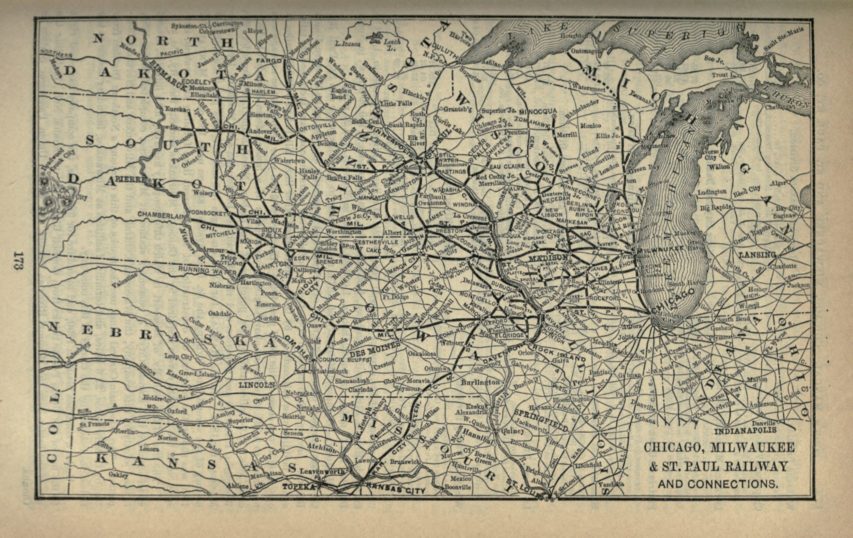
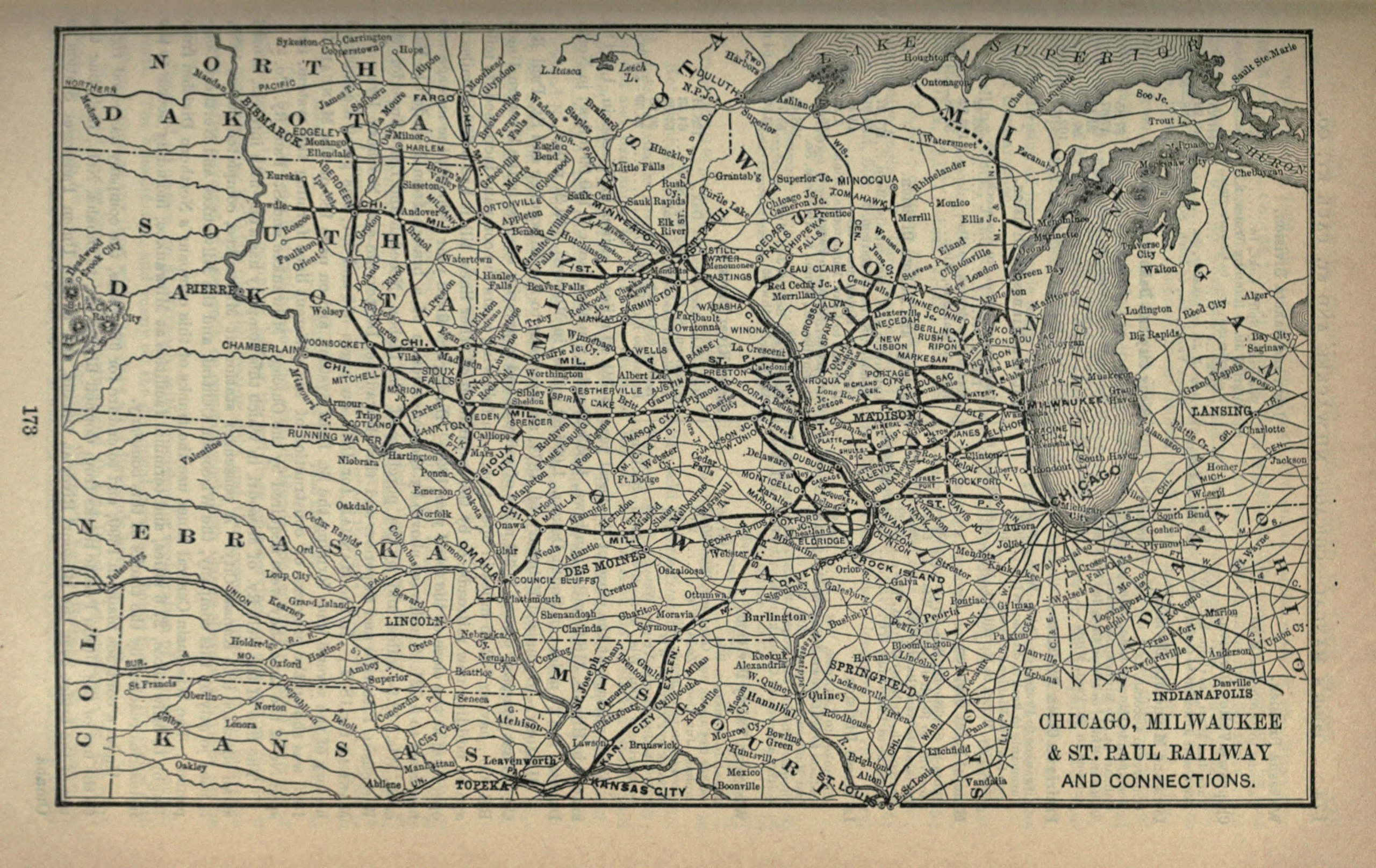
The Chicago, Milwaukee and St. Paul Railway in 1893.
Poor’s Manual of the Railroads of the United States via Wikimedia Commons.

The battle over control of the Northern Pacific and the Burlington in 1901 made the Milwaukee Road aware that without its own route to the Pacific it would be at its competitors’ mercy. At the same time the Milwaukee Road was experiencing a change in its traffic from dominance by wheat to a more balanced mix of agricultural and industrial products. Arguments against extension westward included the possibility of the construction of the Panama Canal and the presence of strong competing railroads: Union Pacific, Northern Pacific, and Great Northern. Arguments for the extension banked heavily on the growth of traffic to and from the Pacific Northwest.

In 1901 the president of the Milwaukee Road dispatched an engineer west to estimate the cost of duplicating Northern Pacific’s line. His figure was $45 million. Such an expenditure required considerable thought; not until November 1905 did Milwaukee’s board of directors authorize construction of a line west to Tacoma and Seattle.

In 1905 and ’06 the Milwaukee Road incorporated subsidiaries in South Dakota, Montana, Idaho, and Washington. The Washington company was renamed the Chicago, Milwaukee & Puget Sound Railway, and it took over the other three companies in 1908. It was absorbed by the CM&StP in 1912.

The extension began with a bridge across the Missouri River at Mobridge, 3 miles upstream from Evarts, S.D. Roadbed and rails pushed out from several points into unpopulated territory. The work went quickly, and the road was open to Butte, Mont., in August 1908.

Unfortunately for the Milwaukee, the Pacific extension was much more expensive to build than the initial estimates (it jumped from $45 million in the 1901 survey to $60 million in 1905), eventually weighing down the company books with $257 million in debt and worse, the traffic estimates for the new line turned out to be wildly optimistic. The difficulties of operating steam locomotives across the extension in winter pushed the railway toward electrification as an efficiency and cost-saving move. Beginning in 1914, sections of the line were converted to overhead catenary power until a total of 645 route-miles were being operated with electric locomotives, reportedly saving the company over a million dollars per year.

A Milwaukee “Little Joe” electric locomotive hauling a freight train along the Pacific extension in 1941. The “Little Joe” locomotives were originally built for the Soviet Union in the late 1940s but the US government cancelled the export license as relations with the Soviets deteriorated and the Cold War escalated. The Milwaukee Road bought 12 of the 20 from General Electric for $1 million during the Korean War.
Wikimedia Commons.

Despite the savings through electrification, the Pacific extension drove the company into bankruptcy in 1925, re-emerging as the Chicago, Milwaukee, St. Paul and Pacific Railroad, but the new company also had to declare bankruptcy during the Great Depression. Trustees ran the railroad for ten years until renewed civilian traffic after World War 2 allowed normal operations to resume. As with most North American railroads, the good times didn’t last and by the late 1950s, the Milwaukee’s management were looking for a merger partner to help cut costs and shed unprofitable branch lines. Unlike the rival merger of of Northern Pacific, Great Northern, Burlington Route, and the Spokane, Portland and Seattle Railway into Burlington Northern, the ICC blocked a merger between the Milwaukee Road and the Chicago and North Western. The ICC also blocked a later application for the Milwaukee to be included in the Union Pacific/Rock Island merger.

With declining business, deferred maintenance issues on most lines, and some self-induced financial issues caused by selling off rolling stock and leasing it back (which exacerbated car shortages leading to further reductions in business), the company had no funds to replace the failing “Little Joe” locomotives on the Pacific extension, so electrification was abandoned in 1974. George Drury sums up the mistakes that led to the end:

Over the decades, the road’s management had made too many wrong decisions: building the Pacific Extension, not electrifying between the two electrified portions, purchasing the line into Indiana, and in the 1960s choosing Flexivans (containers with separate wheels/bogies that required special flatcars) instead of conventional piggyback trailers.

After several money-losing years in the early 1970s, the Milwaukee voluntarily entered reorganization once again on December 19, 1977. The major result of the 1977 reorganization was the amputation of everything west of Miles City, Mont., to concentrate on what became known as the “Milwaukee II” system linking Chicago, Kansas City, Minneapolis-St. Paul, Duluth (on Burlington Northern rails from St. Paul), and Louisville (but no longer Omaha).

By 1983 the Milwaukee’s system consisted of the Chicago–Twin Cities main line; Chicago–Savanna–Kansas City; Chicago–Louisville (almost entirely on Conrail and Seaboard System rails), Milwaukee–Green Bay; New Lisbon–Tomahawk, Wis.; Savanna–La Crosse, along the west bank of the Mississippi; Marquette to Sheldon, Iowa, and Jackson, Minn.; Austin, Minn.–St. Paul; and St. Paul–Ortonville, Minn., plus a few branches.

Three roads vied for what remained of the Milwaukee: the Chicago & North Western, financially none too solid itself; Canadian National subsidiary Grand Trunk Western, with an eye toward creating a route between eastern and western Canada south of the Great Lakes; and Canadian Pacific subsidiary Soo Line.


Anti-Tank Chats #2 | Panzerbüchse 39 | The Tank Museum

Filed under: Germany, History, Military, Weapons, WW2 — Tags: , , , — Nicholas @ 02:00

The Tank Museum
Published 2 Jul 2021

Welcome to Anti-Tank Chats, a brand-new series on the history of infantry weapons used in Anti-Tank warfare. In the second episode, Archive and Supporting Collections Manager, Stuart Wheeler explores the Panzerbüchse 39 Anti-Tank Rifle.
(more…)

QotD: The “Righteousness Fallacy”, California style

… the righteousness fallacy, which Barry Brownstein noted is rampant in modern politics and a key driver of democratic socialism.

The Righteousness Fallacy (also known as the fallacy of good intentions) is described by author Dr. Bo Bennett as the idea that one is correct because their intentions are pure.

It recently occurred to me that California is a perfect example of this fallacy. Consider these three facts about the Golden State:

  1. California spends about $98.5 billion annually on welfare — the most in the US — but has the highest poverty rate in America.
  2. California has the highest income tax rate in the US, at 13.3 percent, but the fourth greatest income inequality of the 50 states.
  3. California has one of the most regulated housing markets in America, yet it has the highest homeless population in American and ranks 49th (per capita) in housing supply.

That politicians would persist with harmful policies should come as little surprise. The Nobel Prize-winning economist Milton Friedman once observed the uncanny proclivity of politicians “to judge policies and programs by their intentions rather than their results”.

In his book Capitalism and Freedom, Friedman described the danger of such thinking.

    [The threat comes] from men of good intentions and good will who wish to reform us. Impatient with the slowness of persuasion and example to achieve the great social changes they envision, they’re anxious to use the power of the state to achieve their ends and confident in their ability to do so. Yet … Concentrated power is not rendered harmless by the good intentions of those who create it.

Jon Miltimore, “Data Show California Is a Living Example of the Good Intentions Fallacy”, Foundation for Economic Education, 2019-01-09.

November 3, 2021

1915 Yorkshire Parkin for Bonfire Night

Filed under: Britain, Food, History — Tags: , , , , , , — Nicholas @ 04:00

Tasting History with Max Miller
Published 2 Nov 2021

Thank you to my Patreon Patrons – https://www.patreon.com/tastinghistory
Merch ► crowdmade.com/collections/tastinghistory
Instagram ► https://www.instagram.com/tastinghist…
Twitter ► https://twitter.com/TastingHistory1
Tiktok ► TastingHistory
Reddit ► r/TastingHistory
Discord ► https://discord.gg/d7nbEpy

Send mail to:
Tasting History
PO Box 766
Burbank, CA 91503

LINKS TO INGREDIENTS & EQUIPMENT**
Sony Alpha 7C Camera: https://amzn.to/2MQbNTK
Sigma 24-70mm f/2.8 Lens: https://amzn.to/35tjyoW
Medium Oatmeal: https://amzn.to/2ZAcpTE
Cake Flour: https://amzn.to/3brKkkl
Black Treacle: https://amzn.to/2XZdW5x
Golden Syrup: https://amzn.to/3jPzhWR

LINKS TO SOURCES**
Pot-Luck by May Byron: https://amzn.to/3ExpRHs
Parkin by Anne Fencott: https://www.fencott.com/FencottBooks/…

**Some of the links and other products that appear on this video are from companies which Tasting History will earn an affiliate commission or referral bonus. Each purchase made from these links will help to support this channel with no additional cost to you. The content in this video is accurate as of the posting date. Some of the offers mentioned may no longer be available.

Subtitles: Jose Mendoza

PHOTO CREDITS
Lewes Guy Fawkes Night: Peter Trimming
Andy Beecroft / Filey Brigg at low tide

#tastinghistory #GuyFawkes #Bonfirenight

Casablanca had a small but significant historical error

Filed under: France, History, Media, Military, WW2 — Tags: , , , , , — Nicholas @ 03:00

And it’s not Captain Renault’s throwaway line about the Americans marching into Berlin (which, of course, did not happen in 1918). The error that Michael Curtis points out is very easy to miss:

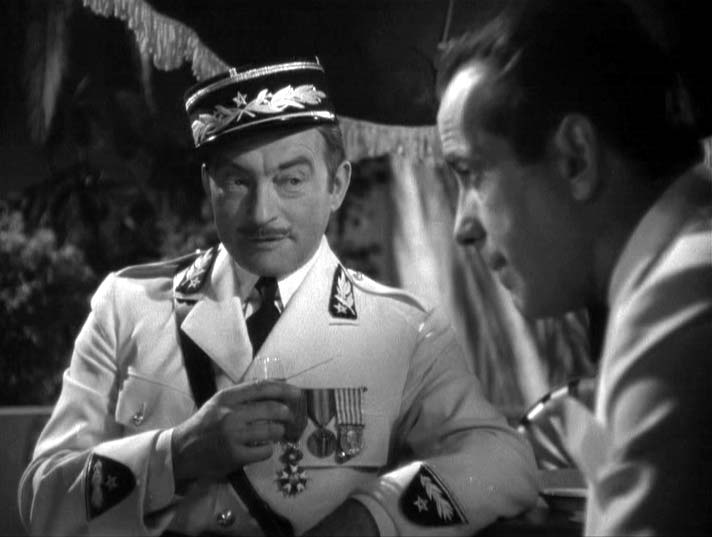
Still from Casablanca (1942), with Captain Renault (Claude Rains) asking Rick Blaine (Humphrey Bogart) why he came to Casablanca.

As time goes by, there is a consensus that Casablanca, the story of the cynical hard drinking American expatriate night club owner choosing between his love for a woman or helping her and her husband, a resistance hero escape from the town of Casablanca, a complex town controlled by the Vichy state under Nazi occupation, is one of the greatest films of all time. Its characters, dialogue, theme song, have become iconic. We’ll always have Casablanca. It is a film of moral ambiguity, that can be seen either as a theme of love and sacrifice, or as a political allegory about resistance against Nazism.

However, this brilliant film has a flaw. In one scene the camera focuses on the prefecture of the corrupt chief of police on the wall of which is the motto of the French Third Republic, “liberty, equality, fraternity”, inherited from the 1789 French revolution. But the Third Republic had been ended in May 1940, and its motto had been officially replaced by the slogan, “work, family, homeland”, of the new French State, popularly known as Vichy. The differences between the two mottos are still pertinent in French politics and culture today.

Some political and cultural problems are easy to solve, even if costly. Scotland recently spent seven months of research and $162,000 to create a new slogan that would increase tourism. It finally came up with a banal slogan, “Welcome to Scotland”. There is no easy solution for France which has been and remains a sharply divided society still confronting its history of the World War II years, the defeat of the French army by the Germans in June 1940, the end of the Third Republic and its replacement by the French State headed by 84 year old Marshall Philippe Petain, regarded as a hero of Verdun in World War I, located in Vichy, a spa in the Auvergne.

The Vichy régime participated in persecution and discrimination of the Jewish population, by aryanisation of property, propaganda, antisemitic ideology, anti-Jewish legislation, roundups, deportation to death and concentration camps. In view of this antisemitic attitude, it is a paradox that after the War, 75% of the Jewish population in France remained alive, the result of complex religious, cultural, and international factors. This can be compared to extermination of 80% of Jews in the Netherlands, and 45% in Belgium.

Nevertheless, 75,721 Jews were deported from France, and fewer than 2,000 survived. Persecution was extensive. Jews were banned from professions, civil service, journalism, business, entertainment, refugee Jews were held in concentration camps under French control, antisemitic legislation affected all Jews, and the tragedy of Vel d’Hiv occurred. French police carried out the first mass arrests of Jews in Paris in May 1941, and the first French deportation train left on March 12, 1942. The most infamous event, the roundup by French gendarmes, using batons and hoses, of 13,000 Jews took place on July 16-17, 1942 when the victims were taken to the Vel d’Hiv indoor bi-cycling stadium in Paris before being deported to Nazi camps. They included 7916 women, 1129 men and 4115 children.

By the so-called National Revolution, France would be rescued from the decadent Third Republic, and returned to purer values. The controversy continues. Was France guilty of contributing to the Holocaust, and who was responsible? First, were collaborators and sympathizers with the Nazis only a minority of the population and was Petain the “shield”, protecting France and the French people as much as it could within the country, while General de Gaulle abroad was the “sword”. A second defense was that Vichy could do little while the Germans occupiers were responsible. A third point is that Vichy tried to protect French national Jews by collaborating in the persecution, the deportation and ultimately extermination of foreign Jews in France.

Halikarnassos: The Birthplace of History

Filed under: Greece, History, Middle East — Tags: , , , , — Nicholas @ 02:00

Thersites the Historian
Published 24 Feb 2020

A Greek polis which became the capital city of a Persian satrapy, Halikarnassos is best known as the birthplace of Herodotos and the site of the Mausoleum. A monarchy in a sea of aristocratic and oligarchic governments, Halikarnassos was one of the more unique places in the wider Greek world.

Patreon link: https://www.patreon.com/thersites

PayPal link: paypal.me/thersites

https://brave.com/noa557

Twitter link: https://twitter.com/ThersitesAthens

Minds.com link: https://www.minds.com/ThersitestheHis…

Steemit/dtube link: https://steemit.com/@thersites/feed

BitChute: https://www.bitchute.com/channel/jbyg…

Backup Channel: https://www.youtube.com/channel/UCUrD…

QotD: English literature

Filed under: Books, Britain, Europe, Quotations — Tags: , , , , , — Nicholas @ 01:00

Here one comes back to two English characteristics that I pointed out, seemingly rather at random, at the beginning of the last chapter. One is the lack of artistic ability. This is perhaps another way of saying that the English are outside the European culture. For there is one art in which they have shown plenty of talent, namely literature. But this is also the only art that cannot cross frontiers. Literature, especially poetry, and lyric poetry most of all, is a kind of family joke, with little or no value outside its own language-group. Except for Shakespeare, the best English poets are barely known in Europe, even as names. The only poets who are widely read are Byron, who is admired for the wrong reasons, and Oscar Wilde, who is pitied as a victim of English hypocrisy. And linked up with this, though not very obviously, is the lack of philosophical faculty, the absence in nearly all Englishmen of any need for an ordered system of thought or even for the use of logic.

George Orwell, “The Lion And The Unicorn: Socialism and the English Genius”, 1941-02-19.

« Newer PostsOlder Posts »

Powered by WordPress