
In certain ways, Hollywood today is just like it was a half-century ago. It’s a company town, a plantation devoted to the manufacture of cultural commodities designed to please the largest possible number of people. Then as now, nearly all of the films produced there fit neatly into the pigeonholes of a limited number of highly stylized genres: gangster movies, costume dramas, romantic comedies, Westerns.
The main difference between then and now is that in the old days, such films were mass-produced on the assembly lines of the major studios. Americans of all ages went to the movies at least once a week, and they expected to see something different every time they went. Hence the studio system, which ground out product fast enough to meet the omnivorous demand. Except for the occasional Gone With the Wind, the modern Spielberg-style “event” movies that now dominate Hollywood filmmaking didn’t exist. You went to the movies not to see Spider-Man or Lord of the Rings, but simply to see a show. If the show in question was a Western or a mystery, that was good; if it starred John Wayne or Robert Mitchum, that was better. But nobody went out of his way to see a Wayne Western directed by Howard Hawks, much less a Mitchum mystery directed by Jacques Tourneur. You took what you got, and if what you got happened to be a Red River or Out of the Past, then you got lucky.
That’s why so many of the best films made in Hollywood in the Forties and Fifties were Westerns and mysteries. Precisely because they were commodities, their makers tended to be ignored by the front office. So long as your last picture turned a profit, however small, you got to make another one. If the movies in which you specialized were low-budget genre pictures for which demand was more or less constant, all that mattered was that you stay more or less within the accepted conventions of the genre, and the conventions of the Western and the mystery happened to be wonderfully well-suited to the artful telling of serious stories that were both entertaining and cheap to produce. The art, of course, was optional, and most such movies were as forgettable as a Law and Order rerun, but some of them were as good — and as serious — as a movie can be.
Terry Teachout, “What Randolph Scott Knew”, American Cowboy, 2005-12-23.
November 9, 2021
QotD: Hollywood in the late Golden Age
November 8, 2021
Look at Life — Rendered Safe (1962)
PauliosVids
Published 20 Nov 2018A look at the work of a bomb disposal squad.

QotD: The Nanny State
Jane Galt, “Suddenly, and for no apparent reason …”, Asymmetrical Information, 2005-05-16.
November 7, 2021
How to Make the World’s Best Router Plane | Paul Sellers | Episode 2
Paul Sellers
Published 5 Nov 2021In this final episode, we go all the way from creating the handles to making the cutting iron and the retainer bar, installing the components, and finishing the plane with a shellac finish.
There are detailed drawings and parts list available here: https://paulsellers.com/router-plane-…
It’s simple step-by-step for everything to take out the mysteries of metalworking, and the magic result is your very own hand-made, finished router plane.
We do hope that you will enjoy the success of making such a fine woodworking tool as your own fully adjustable hand router plane for a lifetime of use. We believe that this is the best router plane in the world. Enjoy it!
——————–Want to learn more about woodworking?
Go to Woodworking Masterclasses for weekly project episodes: http://bit.ly/2JeH3a9
Go to Common Woodworking for step-by-step beginner guides and courses: http://bit.ly/35VQV2o
http://bit.ly/2BXmuei for Paul’s latest ventures on his blog
——————–
Instagram: http://bit.ly/2oWpy7W
Twitter: http://bit.ly/33S7RFa
Pinterest: http://bit.ly/35X5uTf

Prime Minister Look-at-my-socks loves the limelight at COP26
Jen Gerson on Canada’s fundamentally unserious Prime Minister Photo-Op grandstanding at the climate love-in in Glasgow:

In a rare moment of unity, both Alberta Premier Jason Kenney and NDP opposition leader Rachel Notley objected to Trudeau’s announcements.
“I don’t know why they would make an announcement like this without consulting with the province that actually owns the overwhelming majority of Canada’s oil and gas reserve,” said Kenney.
I mean, yeah. He’s right.
When asked for actual details about this brave new plan at COP26, Environment Minister Steven Guilbeault didn’t have much to share … because the plan doesn’t exist yet. It’s a plan to make a plan.
“We will need to be developing this, and that’s exactly what we will be doing in the coming months,” Guilbeault said, according to the CBC. Both he and Natural Resources Minister Jonathan Wilkinson have asked the net-zero advisory board to help them come up with a plan. “Specifically, we seek your advice on key guiding principles to inform the development of quantitative five-year targets,” they said in a letter sent on Monday.
There’s no path, here. There’s been no discussion; no consultation, nothing. There’s not even a draft of an idea.
So why is Trudeau getting on a stage in front of the world’s leaders half-cocked with ambitious promises for an emissions cap before he’s worked out the details at home?
To quote Line co-founder Matt Gurney during our weekly meeting: “To ask that question is to answer it.”
Trudeau is signalling what he cares about and what he doesn’t. He’s more concerned with how the audience abroad perceives him than he is about the finer points of governing. It’s about getting back-pats by the Davos set, not actually running our embarrassing, open-pit G7 backwater.
It was hard to avoid the sense during the last election that Trudeau didn’t have his heart in the fight; that he’s more invested in acting the part of prime minister than being it.
I put little stock in rumours that the Liberal leader will soon leave his role — if you’re going to act a part, after all, there are few better. And what a great platform it provides for a launch to better things. But I do wonder: If someone offered him a ranking job at the UN or the WEF or something else with a suitably impressive acronym and a travel expense account, how long would he stick around?
The Allies Break Through! – WW2 – 167 – November 6, 1942
World War Two
Published 6 Nov 2021After all these months of fighting, the British 8th Army breaks through Erwin Rommel’s Axis positions in North Africa, but the Allies have even bigger plans for that theater of war — a huge invasion of Vichy French North Africa to take place next week. The Soviets also have a plan for a huge invasion to take place very soon near Stalingrad, though the fighting in the city itself sees a lull the second half of this week.
(more…)
Apparently we need to block the “Random Penguin & Schuster” merger to protect the 0.001%
In the most recent SHuSH newsletter from Kenneth Whyte, the US Department of Justice case against allowing the proposed merger of Penguin Random House and Simon & Schuster is examined in some detail:

On Tuesday, the US Justice Department (DOJ) filed suit to block Penguin Random House from purchasing its rival, Simon & Schuster, for $2.18 billion. It promises to be a fascinating case, in part because there’s so much at stake for the two firms involved, and also because of the unusual angle from which the DOJ is attacking the file.
As one of two US agencies responsible for enforcing antitrust law (the other is the Federal Trade Commission), the DOJ believes the proposed deal, struck last year, would leave Penguin Random House, already the world’s largest publisher of consumer books, “towering over its rivals”. The combined entity would have revenues more than twice its next closest competitor, and “outsized influence over who and what is published, and how much authors are paid for their work”.
Bertelsmann, owner of Penguin Random House, and Viacom, owner of Simon & Schuster, promise to fight the DOJ in court. They acknowledge that the Big Five Publishers, a grouping that also includes Hachette, HarperCollins, and Macmillan, will be a Big Four after the merger, but maintain that these firms plus new publishing entrants, such as Amazon, and an abundance of small and midsize publishers will provide sufficient competition for authors and books. “The publishing industry is, and following this transaction will remain, a vibrant and highly competitive environment,” they said in a joint statement.
So far, so ordinary corporate behaviour. Who or what do we need to protect, beyond hoping to maintain something vaguely resembling a competitive marketplace for books? A tiny sub-set of authors:
With this suit, the DOJ is taking a narrower approach. One test of whether a merger results in illegal market dominance is spelled out in the Horizontal Merger Guidelines jointly issued by the DOJ and the FTC: it asks if the combined firm would be in a position to increase its profits by imposing a price cut — a small but significant and lasting price cut — on one of its suppliers. In other words, if the new and enlarged Penguin Random House is better able than the old Penguin Random House to squeeze one supplier on one product line, the merger is illegal.
To apply this test to the deal, the DOJ needs to identify which supplier and which product line is vulnerable if the firms are allowed to merge. It has a range of options. Book publishing is a complicated marketplace, with many suppliers and product lines. Publishers sell books to retailers, and market books to consumers; they buy distribution services, printing, advertising, editorial services, and so on. The DOJ might have argued that a merged Penguin Random House-Simon & Schuster would have the muscle to make its printers or copyeditors reduce their rates. Or that it could force retailers to accept smaller cuts of sales revenue.
Instead, the DOJ put its chips on the discreet line of business in which authors supply manuscripts to publishing houses. Its complaint says that the combined firm would have the power to improve its profits by significantly and permanently lowering the advances it pays to authors for the rights to publish their books.
Advances, notes the DOJ, provide the bulk of author income at the Big Five publishing houses (few authors earn out their advances and collect further royalties). Were Penguin Random House and Simon & Schuster to combine, there would be nothing to deter it “from imposing a small, but significant, and non-transitory decrease in advances”. And if it did so, the complaint maintains, authors would have nowhere to turn. The DOJ ignores the existence of the other three members of the Big Five. It admits that the US has 3,000 small and mid-size houses but, these, according to the complaint, are economically irrelevant, mere “farm teams” for the big houses. Self-publishing, it adds, is not a serious alternative.
That may sound like the DOJ is suing to stop this merger on behalf of the writing community, a heartwarming notion, but it’s not. The lawsuit is primarily concerned with a small subset of writers: those who produce “anticipated top-selling books”. According to the complaint, there exists a small but definable market for “anticipated top-selling books”. It represents a distinct line of commerce, as required under the Clayton Act, and that is the real focus of the complaint.
The DOJ is going to war for sellers of “anticipated top-selling books”, the .001% of the publishing world.
Its lawyers foresee a time when Penguin Random House-Simon & Schuster will target John Grisham and his ilk with lower advances, and John Grisham will have no choice but to accept. So far as the DOJ is concerned, that is how this merger fails the Horizontal Merger Guidelines, and why it is illegal. The phrase “anticipated top-selling books” appears 29 times in a 26-page document.
Making 400 Year Old Buttered Beere
Tasting History with Max Miller
Published 10 Mar 2020Most people know Butterbeer from the Harry Potter books, but did you know it’s based off an actual drink from Elizabethan England?
In this episode, I show you how to make your own alcoholic (and non-alcoholic) Buttered Beere and we explore the importance of beer and ale in Medieval and Renaissance England.
Follow Tasting History with Max Miller here:
Instagram: https://www.instagram.com/tastinghist…
Twitter: https://twitter.com/TastingHistory1LINKS TO INGREDIENTS
DEMERARA SUGAR – https://amzn.to/2W0TZHSBUTTERED BEERE
ORIGINAL RECIPE – The Good Huswifes Handmaide for the Kitchin c.1594 (or 1588)
Take three pintes of Beere, put five yolkes of Egges to it, straine them together, and set it in a pewter pot to the fyre, and put to it halfe a pound of Sugar, one penniworth of Nutmegs beaten, one penniworth of Cloues beaten, and a halfepenniworth of Ginger beaten, and when it is all in, take another pewter pot and brewe them together, and set it to the fire againe, and when it is readie to boyle, take it from the fire, and put a dish of sweet butter into it, and brewe them together out of one pot into an other.INGREDIENTS
– 3 Pints (1500ml/48oz) of good quality British Ale
– 1/4 tsp ground ginger
– 1/2 tsp ground cloves
– 1/2 tsp ground nutmeg
– 1/2 lb (225g) demerara or brown sugar
– 5 egg yolks
– 1 stick (113g) unsalted butterMODERN METHOD (Based on an interpretation from https://oakden.co.uk/buttered-beere-1…)
– Take 5 yolks and beat them with the demerara or brown sugar until light and frothy. Set aside.
– Poor the ale into a saucepan. Try to not create too much foam. Stir in the spices.
– Over medium heat, bring the mixture to a boil, then turn down to low and simmer for 2 minutes. For a non-alcoholic drink, leave at medium heat and boil for 20 minutes.
– Remove the pot from the heat and stir in the egg and sugar mixture. Then return the pot to low heat until the liquid starts to thicken. Simmer for 5 minutes.
– Add in the diced butter and stir until melted. Then froth the buttered beer with a hand whisk and let simmer for 10 minutes.
– Remove the saucepan from the heat and allow buttered beer to cool to a warm but drinkable temperature. Then whisk again and serve warm.
*This can be served cold by chilling the beer, then mixing it with cold milk (1 part beer/1 part milk)SOURCE:
https://oakden.co.uk/buttered-beere-1…**Amazon offers a small commission on products sold through their affiliate links, so each purchase made from this link, whether this product or another, will help to support this channel with no additional cost to you.
#butterbeer #butteredbeere #tastinghistory #beer

QotD: Shoe manufacturing in the Soviet Union
After trying several workarounds, GOSPLAN, the state production ministry, decided to use “Gross Output Targets” to produce goods. Which probably worked ok for stuff like rebar, if you don’t care about quality (see Mao’s DIY backyard blast furnaces), but is terrible for stuff like shoes. So let’s say GOSPLAN decides that 100,000 lucky proles of Irkutsk Oblast shall receive one pair of shoes apiece. Since all materials had to be requisitioned in advance from GOSSNAB (I confess: I love Soviet acronyms), and since the production line would need to be re-tooled for each individual size and style of shoe, the factory managers — who had to hit the Gross Output Target, or go tour Siberia — did the only logical thing: They cranked out 100,000 baby shoes, all left feet. (Baby shoes use less leather; the excess can be sold or traded, see below).
Again, Commies couldn’t care less about consumer complaints, but eventually some up and comer in the Party will notice that everyone is wandering barefoot around a big pile of baby shoes. That might make him look bad, so he sends a report, and, after a long and convoluted bureaucratic process, GOSPLAN revises their order: 100,000 pairs of shoes, but in different sizes and styles, for men and women. In response to which, the factory manager does the only logical thing: 99,999 pairs of baby shoes, all left feet, plus one pump and one wingtip.
Lather, rinse, repeat. The factory manager isn’t a bad guy — in fact, let’s say he’s Wyatt. He’s just operating on an entirely different incentive structure than even his immediate boss, to say nothing of the faceless apparatchiks at GOSPLAN. Hitting any Gross Output Target is a real task, given that his workforce is a bunch of illiterate peasants who hate him and are constantly drunk. What probably seems like spectacularly inventive cruelty to the proles of Irkutsk Oblast is just Wyatt doing everything he can to keep his family out of the Gulag. And since Wyatt’s a smart guy, he can get around any target GOSPLAN sets. If they tell him to produce 100,000 pounds of shoes, his factory cranks out one enormous pair of concrete sneakers.
That’s one of Wyatt’s two overriding priorities: Staying out of the Gulag. The other one is: Using whatever he can scrimp, save, or scrounge from GOSSNAB as trade goods in the black market.
Here again, Wyatt’s not a bad guy. He’s not doing this to feather his own nest (though of course he lives a little better than others; he’s only human). In the words of the immortal Mike Tyson, everyone has a plan until he gets punched in the mouth, and even the most meticulously “scientific” management gets punched in the mouth all the time. As we’ve seen, GOSPLAN can’t even get it right with something as low-tech, as easy to mass-produce as shoes, so imagine how they do with more complex bits of equipment. The factory managers, who have to hit the Gross Output Targets, no matter what, quickly figure out that they’ll be waiting until doomsday if they try requisitioning what they need from GOSSNAB, so they form a kind of black market between themselves. Indeed there’s an entire class of quasi-criminals, whose name I forget, that exists only to facilitate such transactions.
Extend that paradigm to everything, and you’ve got life in the USSR. There’s the “official” economy, which is pure fantasy. There’s the black market economy at the factory level, where bulk materials change hands (since the official economy is pure fantasy, nobody blinks an eye when, say, 100,000 metric tons of concrete disappears off a manifest somewhere and reappears, un-manifested (as it were), somewhere else). There’s the black market at the consumer level, since of course the poor proles of Irkutsk Oblast have to have shoes and there’s no way they’re getting them from Wyatt’s factory. And finally, there’s the black market at the service level — those go-betweens arranging for 100,000 metric tons of concrete to fall off a truck in Vladivostok and appear, like magic, in Kiev (and their consumer-level equivalents — think pimps, but for everything).
Severian, “Darker Shade of Black IV: Black Market”, Rotten Chestnuts, 2021-04-02.
November 6, 2021
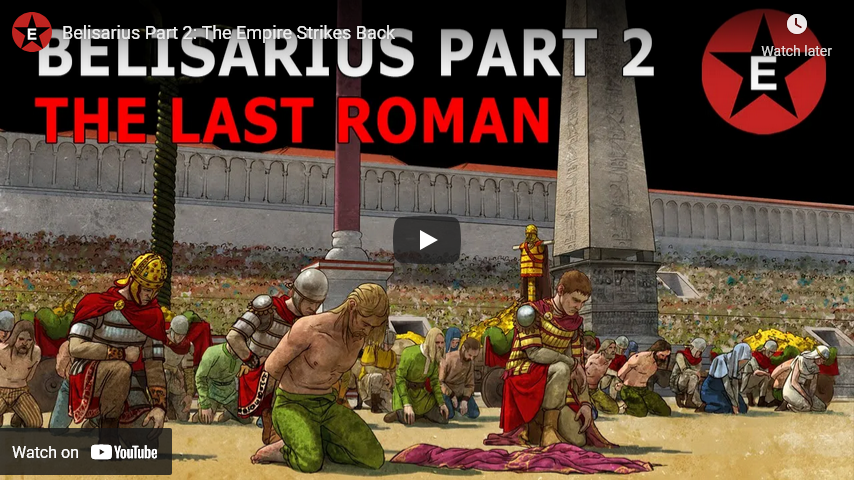
Belisarius Part 2: The Empire Strikes Back
Epic History TV
Published 5 Nov 2021Play Epic War: Thrones and enjoy the real war game experience!
Download here: http://bitly.ws/j86c
Use Gift Code ‘WAR777‘ to receive 200 beads and 200 skill points.
Real War, Real EpicBig thanks to Legendarian for Total War: Attila gameplay footage, check out his YouTube channel here: https://www.youtube.com/channel/UCOI2…
Thanks also to our Series Consultant Professor David Parnell of Indiana University Northwest, who you can follow on Twitter here: https://twitter.com/byzantineprof
Total War: Attila gameplay footage used with kind permission of Creative Assembly — buy the game here: https://geni.us/qDreR
Thanks also to the Vandalic War mod crew for modding support, find out more about their mod here: https://steamcommunity.com/sharedfile…
🎨 Original artwork by Miłek Jakubiec https://www.artstation.com/milek
📚Recommended reading (as an Amazon Associate I earn from qualifying purchases):
📖 Procopius, History of the Wars https://geni.us/L3Pgc
📖 The Wars of Justinian by Michael Whitby https://geni.us/Xxrd3
📖 Rome Resurgent by Peter Heather https://geni.us/ZFoU1
📖 The Armies of Ancient Persia: the Sassanians by Kaveh Farrokh https://geni.us/jMQo3z
📖 Late Roman Cavalryman AD 236–565 (Osprey) by Simon MacDowall https://geni.us/XMGlSupport Epic History TV on Patreon from $1 per video, and get perks including ad-free early access & votes on future topics https://www.patreon.com/EpicHistoryTV
👕 Buy EHTV t-shirts, hoodies, mugs and stickers here! teespring.com/en-GB/stores/epic-histo…
🎶Music from Filmstro: https://filmstro.com/?ref=7765
Get 20% off an annual license with this exclusive code:EPICHISTORYTV_ANN#EpicHistoryTV #RomanEmpire #EasternRomanEmpire #Justinian #Belisarius #ByzantineEmpire
#EpicWar:Thrones #Strategy #ThreeKingdoms #WarGame #RealCivilizationWar
Canadian flag shenanigans still not resolved, kinda
For non-Canadian readers (which last time I bothered to check were the absolute majority of readers), it’s perhaps not clear why flying of the Canadian national flag is an ongoing issue here in the dysfunctional Dominion. In short, Prime Minister Trudeau ordered the flag to be flown at half-staff at federal government and military sites after the publicization of unmarked graves of First Nations children who died during their stay at various residential schools across the country. (I must note that this wasn’t actually unknown beforehand … it just got enough media attention that PM Look-at-my-socks Photo-op decided it was a good idea to ostentatiously pretend that this was previously unknown and (to some) provided further evidence of the “ongoing genocide” of Canada’s problematic relations with First Nations people. The flag-lowering was ordered in May and no end date was specified to the observance. Like ritualistic “land acknowledgements” this did absolutely nothing to actually improve the living conditions of any members of First Nations bands, but was balm to the soul of virtue-signallers across the country. In Friday’s NP Platformed newsletter, Colby Cosh updates us on the state of play:

This morning the Assembly of First Nations (AFN) made its much-anticipated move in the chess game that has developed over the display of the Canadian flag on federal government buildings. As you will recall, the flags on all these buildings, including those abroad, were lowered to half-mast in May, when unmarked graves were discovered on the site of a former residential school in Kamloops, B.C., and have stayed there ever since. The prime minister said then that, although the lowering of the flags is his exclusive responsibility, he wouldn’t allow them to be flown normally again until “Indigenous communities and leadership” agreed that they could go back up.
Was this elliptical, confounding phrase intended to refer to the AFN? We wondered at the time who was capable of giving the necessary permission, if not the AFN: it appears, quite naturally, to have accepted the position, which is bound to be controversial if made explicit, that it is the exclusive political instrument for Indigenous communities.
In any case the AFN announced its solution to the stalemate this morning. Its executive committee, after consulting with elders, suggests raising the Maple Leaf on Sunday alongside an orange “Every Child Matters” banner. Both flags would go to half-mast on Monday, Nov. 8, this being Indigenous Veterans Day. The flags then go back up, and the Canadian one comes down again on Nov. 11, according to the usual tradition. From then on, both flags fly until “all of our children are recovered, named and symbolically or physically returned to their homelands with proper ceremony.”
There are Canadians who have no use for a national flag; some, no doubt, dream of carrying national self-abnegation to the point of having a fully transparent flag. But even these progressives would have to admit that it is hard to imagine a sequence of events allowing some future prime minister and some future AFN executive to get together and say, “Great job, everybody, the orange one can come down now.” This is a proposed permanent adoption of two national flags (and who is to say it won’t catch on among private citizens?). Yet it could still be argued that the AFN is letting the prime minister off the hook lightly, in exchange for a symbolic political victory of its own.
With the approach of Remembrance Day, the flag flying at half-mast was becoming a symbol, not of Canadian remorse, but of one politician’s daft impulsiveness and inability to act with even the immediate future in mind. As much as some approved of the original gesture, the prime minister should never have been allowed to treat the flag as personal property or as a subject for political negotiation.
In what other country would this be contemplated? Where else could a head of government do something like this without being warned or grimaced at or, outside the pages of the National Post, castigated very much? Indeed, how was this particular power of jerking the flag up and down on government buildings ever assigned to a prime minister in the first place? It is a little anomalous that this file doesn’t belong to the Governor General, who wrangles other flag-like symbols like medals and heraldry.
Is the Answer in Uranus? – The Soviet Plan to Win at Stalingrad – WW2 SPECIAL
World War Two
Published 4 Nov 2021Georgy Zhukov told Josef Stain in September that if the Red Army could just hold out until November, he could put together a counteroffensive that would defeat the enemy. Well, November is here, and that counteroffensive is ready to kick off, but how was it put together? Let’s find out.
(more…)
Choose your college roommates well
Scott Alexander on the unlikely rise of Victor Orbán:

Viktor Orbán at the European People’s Party Summit in Brussels, December 2018.
Wikimedia Commons.
Some are born great. Some achieve greatness. And some are Victor Orbán’s college roommates.
Orbán: Europe’s New Strongman and Orbánland, my two sources for this installment of our Dictator Book Club, tell the story of a man who spent the last eleven years taking over Hungary and distributing it to guys he knew in college. Janos Ader, President of Hungary. Laszlo Kover, Speaker of the National Assembly. Joszef Szajer, drafter of the Hungarian constitution. All of them have something in common: they were Viktor Orbán’s college chums. Gabor Fodor, former Minister of Education, and Lajos Simicska, former media baron, were both literally his roommates. The rank order of how rich and powerful you are in today’s Hungary, and the rank order of how close you sat to Viktor Orbán in the cafeteria of Istvan Bibo College, are more similar than anyone has a right to expect.
Our story begins on March 30 1988, when young Viktor Orbán founded an extra-curricular society at his college called The Alliance Of Young Democrats (Hungarian abbreviation: FiDeSz). Thirty-seven students met in a college common room and agreed to start a youth organization. Orbán’s two roommates were there, along with a couple of other guys they knew. Orbán gave the pitch: the Soviet Union was crumbling. A potential post-Soviet Hungary would need fresh blood, new politicians who could navigate the democratic environment. They could get in on the ground floor.
It must have seemed kind of far-fetched. Orbán was a hick from the very furthest reaches of Hicksville, the “tiny, wretched village of Alcsutdoboz”. He grew up so poor that he would later describe “what an unforgettable experience it had been for him as a fifteen-year-old to use a bathroom for the first time, and to have warm water simply by turning on a tap”. He was neither exceptionally bright nor exceptionally charismatic.
Still, there was something about him. To call it “a competitive streak” would be an understatement. He loved fighting. The dirtier, the better. He had been kicked out of school after school for violent behavior as a child. As a teen, he’d gone into football, and despite having little natural talent he’d worked his way up to the semi-professional leagues through sheer practice and determination. During his mandatory military service, he’d beaten up one of his commanding officers. Throughout his life, people would keep underestimating how long, how dirty, and how intensely he was willing to fight for something he wanted. In the proverb “never mud-wrestle a pig, you’ll both get dirty but the pig will like it”, the pig is Viktor Orbán.
Those thirty-six college friends must have seen something in him. They gave him his loyalty, and he gave them their marching orders. The predicted Soviet collapse arrived faster than anybody expected, and after some really fast networking (“did you know I represent the youth, who are the future of this country?”) Orban got invited to give a speech at a big ceremony marking the successful revolution, and he knocked it out of the park.
He spoke about freedom, and democracy, and the popular will. He spoke against the older generation, and the need for a rupture with the crumbling traditions of the past. And also, he spoke against the Russian troops remaining in the country — the only speaker brave enough to say what everyone else was thinking. The voters liked what they heard: in Hungary’s first free election, he and several of his college friends were elected to Parliament on the Fidesz ticket.
Unfortunately, he wasn’t a very good liberal MP.
Separated from his pomp and platform, he was just a 27 year old kid without a lot of political experience. There was a glut of liberal democrats in Hungary — the country had just had a successful liberal democratic revolution — and Orbán and Fidesz couldn’t differentiate themselves from the rest of the market. Most liberal democrats wanted cosmopolitan intellectual types; Orbán — despite his herculean efforts to lose the accent and develop some class — was still just a hick from Hicksville. During the next election, Fidesz did embarrassingly badly.
So Viktor Orbán got everyone from his liberal democratic party together and asked — what if, instead of being liberal democrats, we were all far-right nationalists?
Wait, what?
No4 MkII: The Lee Enfield’s Final Standard Upgrade
Forgotten Weapons
Published 21 Jul 2021http://www.patreon.com/ForgottenWeapons
https://www.floatplane.com/channel/Fo…
Cool Forgotten Weapons merch! http://shop.forgottenweapons.com
The final standard pattern of the venerable Lee Enfield as a standard-issue service rifle was the No4 MkII, introduced after the end of World War Two. The new pattern was adopted to resolve problems that had come about because of wartime simplifications to the rifle. Specifically, the use of kiln-dried wood for stocks. On the original No4 design, the trigger was pinned to the trigger guard, which was in turn connected to the front handguard. The sear was pinned to the receiver. If the handguard swelled, shrank, or warped (which was much more likely on the quickly kiln-dried stocks used during the war, compared to the naturally dried pre-war wood), the trigger/sear interaction could be impacted.
To solve this, the receiver was changed slightly to include a boss for attaching the trigger. This kept both the trigger and sear pinned to the (metal) receiver, and stock shifting was no longer a problem. In addition, a change was also made to remove the boss originally intended for mounting the magazine cutoff lever, so that No4 rifles would be made using No5 receiver forgings (this change did not result in a new rifle designation).
Many existing rifles were refitted to the new standard, with upgraded MkI rifles becoming Mk I/2 and upgraded MkI* rifles becoming MkI/3.
Contact:
Forgotten Weapons
6281 N. Oracle 36270
Tucson, AZ 85740

QotD: Michael Bellesisles
Bellesisles, you might recall, is the guy whose revolutionary revisionist thesis was that the Founders weren’t really all that enthusiastic about guns, and didn’t own that many, and that whole 2nd Amendment thing was just an afterthought. Yeah, right. That one was written conclusion first, and since no remotely objective look at the evidence could ever possibly support it, he resorted to making lots of “evidence” up. But the reaction of the rest of the profession was interesting: They lauded Bellesisles to the skies. He won the Bancroft Prize for his work, which is the biggest one you can get in American history. Now, I’m sure you’re saying “of course they praised him, he was telling them exactly what they wanted to hear!”, and you’re right …
… but only to a point. Because eggheads are — as you might imagine — the pettiest, most envious bunch of little bitches this side of a junior high cheerleading squad, there’s no piece of research so meticulous, no conclusion so solid, that someone isn’t going to tear into it in one of the professional journals, for base personal reasons if no other. Lest you think I’m kidding, I personally know of a woman at a big league school whose husband was seduced, and her marriage ruined, by an open, obnoxious lesbian colleague, all because she, the hetero, had dared to question some of the lesbian’s work at a conference in their mutual field.
That’s the level of pettiness we’re dealing with here. And I can’t say for absolute certain that Bellesisles received no criticism whatsoever; he doesn’t work in my field, so even though I was certain that Arming America was bullshit of the purest ray serene, it wasn’t my problem, professionally speaking. But whatever, point is, in my fairly well-informed opinion, merely “telling them what they want to hear” doesn’t account for the entire profession ignoring the huge, blinking, neon red flags surrounding Arming America. Rather, I suggest it’s more of a Pauline Kael thing.
I actually kinda pity Kael — much like John Montagu, the 4th Earl of Sandwich, she was a fairly big wheel back in her day, but if she’s known at all now, it’s for something entirely peripheral to her life’s work. In Kael’s case, it’s her declaration that it was impossible for Richard Nixon to have won in 1972, since “nobody I know voted for him” (it was one of the biggest blowouts in American electoral history). The Arming America thing is, I think, like that — nobody in academia owns a gun, or knows anyone who owns a gun, or knows anyone who knows anyone who owns a gun. So, yeah, they know all the scary statistics about how there are sixty gorillion more guns than people in America, but all of that iron belongs to the Dirt People, far away over the horizon. They’d never in a million years even be in the same zip code as someone who thinks Arming America was absurd on its face. Hence, it never occurred to them to question it.
It helped that Bellesisles was telling them what they wanted to hear, no doubt, but the main reason nobody challenged it was that they lacked the cognitive toolkit to even consider the possibility he might be wrong.
Severian, “Are They Trying to Lose?”, Rotten Chestnuts, 2021-07-15.


