Quotulatiousness

August 18, 2020

Modern art insults me

Filed under: Media — Tags: , , , — Nicholas @ 04:00

Lindybeige
Published 4 Apr 2015

Support me on Patreon: https://www.patreon.com/Lindybeige

Modern art has been shown to be a fraud many times. Again and again people fool so-called “expert” with works done by novices, toddlers, or even chimpanzees. The Baltic in Newcastle is a fine gallery, Unfortunately, they very seldom find anything to put in it worth looking at, let alone journeying any distance to see.

People appreciate effort, skill, and an attempt to please or at least be understood. Works of art that clearly have taken no skill, time, effort, or care to create are an insult to the gallery viewer.

Clearly, I am not saying that ALL modern (or “contemporary” if you prefer) art is insulting. I am just explaining why much of it is. Great art in the past was not all understood by everybody, but it didn’t insult those who didn’t understand it.

Similarly, I am not saying that any art that took ages to make is good. Boris Vallejo is an amazing draughtsman, but his works are not good art.

Lindybeige: a channel of archaeology, ancient and medieval warfare, rants, swing dance, travelogues, evolution, and whatever else occurs to me to make.

▼ Follow me…

Twitter: https://twitter.com/Lindybeige I may have some drivel to contribute to the Twittersphere, plus you get notice of uploads.

website: www.LloydianAspects.co.uk

I must admit, I’m often amused at tales of modern art “installations” being mistaken for rubbish and cleaned up by the janitorial staff after hours. In most reported cases, the cleaners have demonstrably higher artistic judgement than the curators who bring in the “art”.


Don’t worry your pretty little heads, normies, the enlightened ones are planning “The Great Reset” for 2021

Mark Steyn on how the great and the good of the world are figuring out the road ahead of us:

… most of the chaps who matter in this world are people you’ve never heard of — by which I mean they are other than the omnipresent pygmies of the political scene: In a settled democratic society such as Canada, for example, if you wind up with an electoral contest between a woke mammy singer with a banana in his pants and a hollow husk less lifelike than his CBC election-night hologram whose only core belief is that he has no core beliefs other than that party donations should pay for his kids’ schooling, you can take it as read that the real action must be elsewhere.

A lot of those chaps you’ve never heard of turn up in this video from the “World Economic Forum” — ie, the Davos set. After five months of Covid lockdown, you’ll be happy to hear that all the experts have decided that 2021 will be the year of “The Great Reset”:

I see my chums at the Heartland Institute headline this the “World Leaders’ ‘Great Reset’ Plan“. But, if by “leader” you mean an elected head of government accountable to the people, there is a total dearth. Indeed, it’s a melancholy reflection on the state of “world leadership” that the nearest to anyone accountable to the people in this video is HRH The Prince of Wales, in whom one day in the hopefully extremely far distant future the executive authority of the United Kingdom, Canada, Australia, etc will be nominally vested but which cannot be exercised without the consent of the people’s representatives. Yet even that token accountability is, as noted, in the future. So right now he’s just another guy who’s a “world leader” because he gets invited to Davos and you don’t — and, even if you were minded to show up anyway, you’d need a private jet because all the scheduled flights have been Covid-canceled and the world’s airports are ghost towns.

As is the custom among our big thinkers, the blather is very generalized. “Now is the time to think about what history would say about this crisis,” says the head of the IMF. If you say so. Personally, I was thinking that now is the time to eat a meal in a restaurant, if they weren’t closed.

But, why is it history’s job to say something about this crisis? Why, don’t you “world leaders” of the here and now say anything about it? “It is imperative that we reimagine, rebuild, redesign, re-invigorate and re-balance our world,” declares the UN Secretary-General.

That’s almost a full set, but he forgot “redefined”. “Possibilities are being redefined each and every day,” says the chief exec of British Petroleum, who as is his wont sounds like he’s in any business other than petroleum.

There is, of course, an inscrutable Oriental, who is chairman of something called the “China Green Finance Committee”. He’s there as a not so subtle reminder not even to bring up the subject of China, whose lies amplified by their sock puppet at the WHO are the sole cause of the present crisis – and whose death-grip on our future is the thing that most urgently needs to be reimagined, rebuilt, re-balanced and redefined. As I’ve mentioned many times over the spring and summer, twenty years ago we were told to forget about manufacturing — from widgets to “These Colors Don’t Run” T-shirts, that’s never coming back; from now on, we’re going to be “the knowledge economy”. Yet mysteriously, with the 5G and the Huawei and all the rest, China seems to have snaffled all that, too.

Jamestown v. Plymouth: Where is America’s Hometown?

Atun-Shei Films
Published 11 Feb 2020

With the help of the Witchfinder General, I examine the historical mythology surrounding Jamestown and Plymouth, the first two permanent English colonies in the continental United States. Can we confidently point to the founding of these two settlements as the origin of American identity and culture? No, thou knave!

Support Atun-Shei Films on Patreon ► https://www.patreon.com/atunsheifilms

#Jamestown #Plymouth #AmericanHistory

Watch our film ALIEN, BABY! free with Prime ► http://a.co/d/3QjqOWv
Reddit ► https://www.reddit.com/r/atunsheifilms
Twitter ► https://twitter.com/alienbabymovie
Instagram ► https://www.instagram.com/atunsheifilms
Merch ► https://atun-sheifilms.bandcamp.com

QotD: Stigma

Filed under: Britain, Quotations — Tags: , , , , — Nicholas @ 01:00

Anthropologists used to divide societies into shame and guilt categories. The former depended on people’s public face to keep them in order, the latter on people’s internal sense of right and wrong. No doubt no pure forms of either exist in reality, though in my darker moments I sometimes wonder whether we have succeeded in creating a new type of society, one in which neither shame nor guilt are very much in evidence.

But in fact there is almost a law of conservation of stigma that operates in human societies, such that if it does not attach to one thing, it will attach to another. No doubt there is more stigma in shame societies than in guilt societies, but even in the latter everyone, except perhaps the most psychopathic of psychopaths, is afraid of being shown up in some respect or another.

Stigma begins early in life and children are much guided or influenced in their conduct by the fear of it. A teacher told me the following story. A child of about seven or eight came crying to her one day because another child had called him names.

“What did he say?” she asked.

“He called me a virgin.”

“What is a virgin?” asked the teacher,

“I don’t know,” said the boy. “But I know it’s something horrible.”

Stigma is a kind of shorthand to indicate what we detest. Anyone who pretends that he never stigmatises is probably lying, or perhaps I should say not telling the truth, since not every untruth that emerges from the human mouth is a lie. There are people who can contradict themselves without disbelieving in the law of non-contradiction, and therefore people who can genuinely despise people who pass moral judgment on others.

What would living completely without stigma and stigmatisation mean? Surely that there was nothing that we or anyone else could do to make people think badly of us. One of the reasons — I don’t say the only one — that I don’t steal is that I don’t want to be stigmatised as a thief. One sin doesn’t define a person’s character, however, so that when we stigmatise we must be careful to be just and proportionate. If we called everyone a liar who had told a lie, then we should all be liars (quite apart from the fact that it is sometimes virtuous to tell a lie). We call a liar someone who habitually lies, so that untruthfulness is a central part of his character.

Stigma is one of those many things that is neither good nor bad in itself, and depends for its social beneficence or maleficence on what it attaches to and how strongly. In the company of rogues or scoundrels, one can be stigmatised for honesty. Many a cruel act has been performed to avoid the stigma of being too cowardly to be cruel.

Theodore Dalrymple, “The Situational Nature of Scorn and Stigma”, New English Review, 2020-04-28.

August 17, 2020

Alcibiades, the Peloponnesian War, and the Art of Intrigue

Filed under: Europe, Greece, History, Military — Tags: , , , , , , , , — Nicholas @ 04:00

The History Guy: History Deserves to Be Remembered
Published 27 Dec 2019

Intrigue has always been a part of both diplomacy and war. In ancient Greece, one enterprising politician and general took the art of switching sides to the extreme. The History Guy remembers Alcibiades, a general who had an out-sized effect on the Peloponnesian War.

This is original content based on research by The History Guy. Images in the Public Domain are carefully selected and provide illustration. As images of actual events are sometimes not available, images of similar objects and events are used for illustration.

All events are portrayed in historical context and for educational purposes. No images or content are primarily intended to shock and disgust. Those who do not learn from history are doomed to repeat it. Non censuram.

Find The History Guy at:

Patreon: https://www.patreon.com/TheHistoryGuy

The History Guy: History Deserves to Be Remembered is the place to find short snippets of forgotten history from five to fifteen minutes long. If you like history too, this is the channel for you.

Awesome The History Guy merchandise is available at:
teespring.com/stores/the-history-guy

Script by JCG

#history #thehistoryguy #ancienthistory

Dateline Ayodhya, Uttar Pradesh, 5 August 2020

Filed under: History, India, Religion — Tags: , , , , — Nicholas @ 03:00

That’s a significant date, as Tom Holland explains at UnHerd:

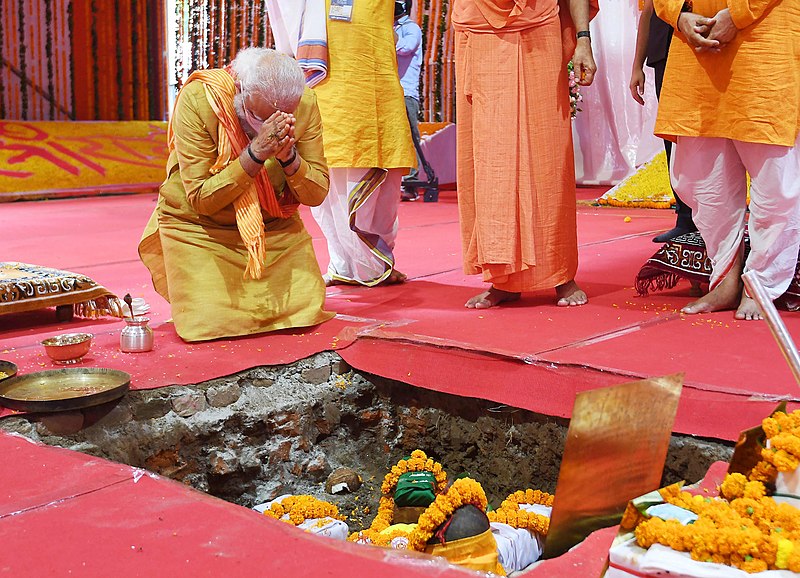
Indian Prime Minister Narendra Modi performing Bhoomi Pujan at Shree Ram Janmabhoomi Mandir, in Ayodhya, Uttar Pradesh on August 05, 2020.
Photo released by the Press Information Bureau on behalf of the Prime Minister’s Office, (ID 90071) via Wikimedia Commons.

Last week, on 5 August, the Prime Minister of India laid a foundation stone and helped bury a distinctive period in global history. Narendra Modi had travelled to Ayodhya, a city long identified by Hindus with one of their most beloved gods. Lord Rama — avatar of Vishnu and hero of the Sanskrit epic, the Ramayana — was said to have ruled within its walls as the very model of those who uphold truth and justice. Like Camelot, the court of Rama glimmers tantalisingly in the imaginings of those who fall beneath its spell: the reminder of a vanished golden age, the hope that it might come again.

In recent decades, the mingled regret and yearning that the memory of Rama’s capital can inspire among Hindus had come to be focused on one particular location in the modern city of Ayodhya: the Ram Janmabhoomi, the “birthplace of Rama”. At the moment, nothing serves to mark the sacred spot. But soon enough that will change. A great complex of buildings will rise. As Modi, officially declaring the process of construction begun, put it: “A great temple will now be built for our Lord Rama.”

A fortnight earlier, the President of Turkey had celebrated a similar reconsecration. In 1453, when the Christian capital of Constantinople fell to the Ottomans, its most stupefying building, the great cathedral of Hagia Sophia, had been converted into a mosque, and duly served for almost half a millennium as a monument to the triumph of Islam over a defeated and superceded order. Then, in 1935, a decade and more after the collapse of the Ottoman Empire and its replacement within its heartlands by a Turkish republic, the mosque of Ayasofya was turned into a museum. So, for decades, it remained. Then, this summer, the museum once again became a mosque. On 24 July, Hagia Sophia opened for Friday prayers. “It is breaking away from its chains of captivity,” President Erdogan declared rhapsodically. “It was the greatest dream of our youth. It was the yearning of our people and it has been accomplished.”

The synchronicity between Modi’s trip to Ayodhya and Erdogan’s to Hagia Sophia is striking, and only flimsily obscured by the fact that the Prime Minister of India is trampling the legacy of an Islamic empire much as the President of Turkey has trampled the legacy of a Christian one. In the early sixteenth century, shortly after the Moghul conquest of the lands that once, so Hindus believed, had constituted the Ram Rajya, the “realm of Rama”, a mosque was built in Ayodhya. By the twentieth century, large numbers of Hindus had come to believe that this same mosque, the Babri Masjid, stood directly on the site of the Ram Janmabhoomi. In the 1980s, the BJP — the party to which Modi belongs — began a campaign to demolish it. In 1992 a mob duly tore it down. Communal riots exploded. Thousands died.

Last November, even as the site was formally granted to Hindus, the Supreme Court of India condemned the demolition of the mosque as a crime. But a crime by whose standards? Not, it would seem, by Modi’s. Just as Erdogan justified the conversion of Hagia Sophia to a mosque by “right of conquest”, so the Prime Minister of India, hailing the opportunity to build a temple on the site where the Babri Masjid had stood, invoked the ancient traditions of his country. It was, he declared, “a unique gift from law-abiding India to truth, non-violence, faith and sacrifice.” History as well as justice stood on his side.

Reading Wood Grain Direction – 2 Minute Tuesday

Filed under: Tools, Woodworking — Tags: , , — Nicholas @ 02:00

Jonathan Katz-Moses
Published 5 May 2020

In this week’s 2 minute Tuesday woodworking skill builder we talk about grain direction. I give you a quick overview on grain direction and give you some real world examples on which way to cut and why. I really can’t wait to see what you create! Let me know what you’d like to see next. Thanks for watching! Please like, comment and subscribe. Cheers!
—-
*Support What We Do at The Katz-Moses Store-* http://bit.ly/KMWstore20
*Bits and Bits router bits: http://bit.ly/BitsBits USE CODE JKATZMOSES15 for 15% off*
Taytools is my favorite woodworking tool source: http://lddy.no/e90a
—-
Buy the Katz-Moses Magnetic Dovetail Jig: https://goo.gl/XzEmMa
Buy the Katz-Moses Stop Block Presale: https://goo.gl/XzEmMa
Total Boat Epoxy: http://bit.ly/2I3Q8m4 15% Discount code KATZMOSES
—-
Check me out on social media:
www.instagram.com/jkatzmoses
patreon.com/katzmoseswoodworking
youtube.com/katzmoseswoodworkingshop

QotD: Orwell and faith

Filed under: Quotations, Religion — Tags: , — Nicholas @ 01:00

I spent a day with Orwell just before he died. I sat on his sanatorium bed, tried to smoke the frightful cigarettes he insisted on making for himself. I heard him say: “The problem of the world is this: Can we get men to behave decently to each other if they no longer believe in God?”

Charles Curran, “Orwell: The man behind 1984 — and all that”, Daily Mirror, 1954-12-14.

August 16, 2020

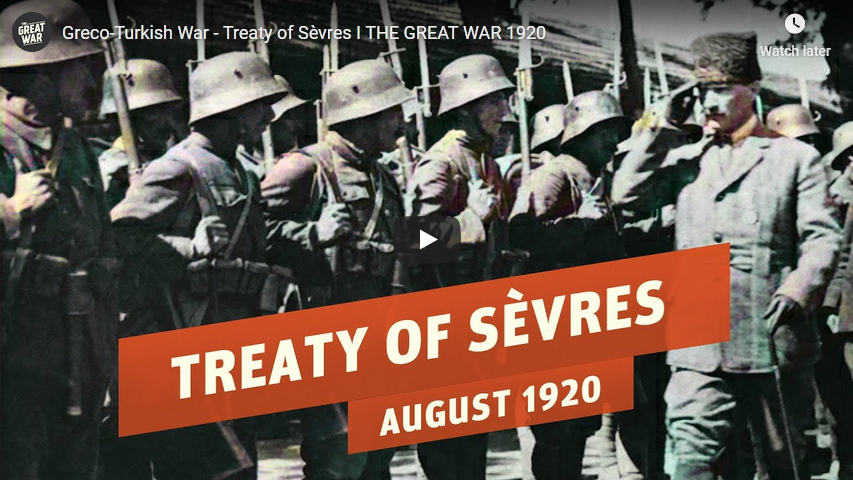
Greco-Turkish War – Treaty of Sèvres I THE GREAT WAR 1920

The Great War
Published 15 Aug 2020

Sign up for Curiosity Stream and get Nebula bundled in: https://curiositystream.com/thegreatwar

While the Greco-Turkish War was still raging, the last of the peace treaties between the Allies and the Central Powers was finalized in Paris. But the Turkish Nationalist Movement under Mustafa Kemal would not accept the terms of the Treaty of Sèvres – even though the Ottoman government had signed it.

» SUPPORT THE CHANNEL
Patreon: https://www.patreon.com/thegreatwar

» OUR PODCAST
https://realtimehistory.net/podcast – interviews with World War 1 historians and background info for the show.

» BUY OUR SOURCES IN OUR AMAZON STORES
https://realtimehistory.net/amazon *
*Buying via this link supports The Great War (Affiliate-Link)

» SOURCES
Halide Edib Adivar, The Turkish Ordeal: Being the Further Memoirs of Halidé Edib, (Piscataway: Gorgias Press, 2012)

John Darwin, Britain, Egypt and the Middle East, (London: Macmillan Press, 1981)

M.L. Dockrill and J. D. Goold, Peace Without Promise: Britain and the Peace Conferences, 1919-1923, (Connecticut: Hamden, 1981)

T G Fraser, Andrew Mango and Robert McNamara, The Makers of the Modern Middle East, (London: Gingko Library, 2015)

Phillip S Jowett, “Armies of the Greek-Turkish War: 1919-1922”, Men at Arms, no 501, (2015)

Michael Llewellyn Smith, Ionian Vision: Greece in Asia Minor 1919-1922, (London: Allen Lane, 1973)

Margaret Macmillan, Paris 1919: Six Months That Changed the World, (London: Macmillan, 2019)

A.E. Montgomery, “The Making of the Treaty of Sèvres of 10 August 1920”, The Historical Journal Vol. 15, No. 4 (December, 1972)

New York Times, “Turk Nationalists Capture Beicos” (July 6, 1920) https://timesmachine.nytimes.com/time…

George Riddell, Lord Riddell’s Intimate Diary of the Peace Conference and After: 1918-1923, (London: Victor Gollancz Ltd, 1933)

» MORE THE GREAT WAR
Website: https://realtimehistory.net
Instagram: https://instagram.com/the_great_war
Twitter: https://twitter.com/WW1_Series
Reddit: https://reddit.com/r/TheGreatWarChannel

»CREDITS
Presented by: Jesse Alexander
Written by: Jesse Alexander
Director: Toni Steller & Florian Wittig
Director of Photography: Toni Steller
Sound: Toni Steller
Editing: Toni Steller
Motion Design: Philipp Appelt
Mixing, Mastering & Sound Design: http://above-zero.com
Maps: Daniel Kogosov (https://www.patreon.com/Zalezsky)
Research by: Jesse Alexander
Fact checking: Florian Wittig

Channel Design: Yves Thimian

Contains licensed material by getty images
All rights reserved – Real Time History GmbH 2020

Surviving the surrender of Japan as allied Prisoners of War

Filed under: Cancon, History, Japan, Military, USA, WW2 — Tags: , , — Nicholas @ 05:00

Seventy-five years ago, the war in the Pacific had ended with the surrender of Japanese imperial forces after the atomic bombing attacks at Hiroshima and Nagasaki. The war may have technically ended, but there was still plenty of danger for the surviving POWs in various camps around the Japanese home islands. George MacDonnell was a Canadian soldier who had been captured in the fall of Hong Kong early in the Japanese swathe of conquest that engulfed so many areas. He had been held as a slave labourer at a prison camp in the mountains of northern Honshu in Iwate Prefecture. In Quillette, he tells how his captivity came to an end:

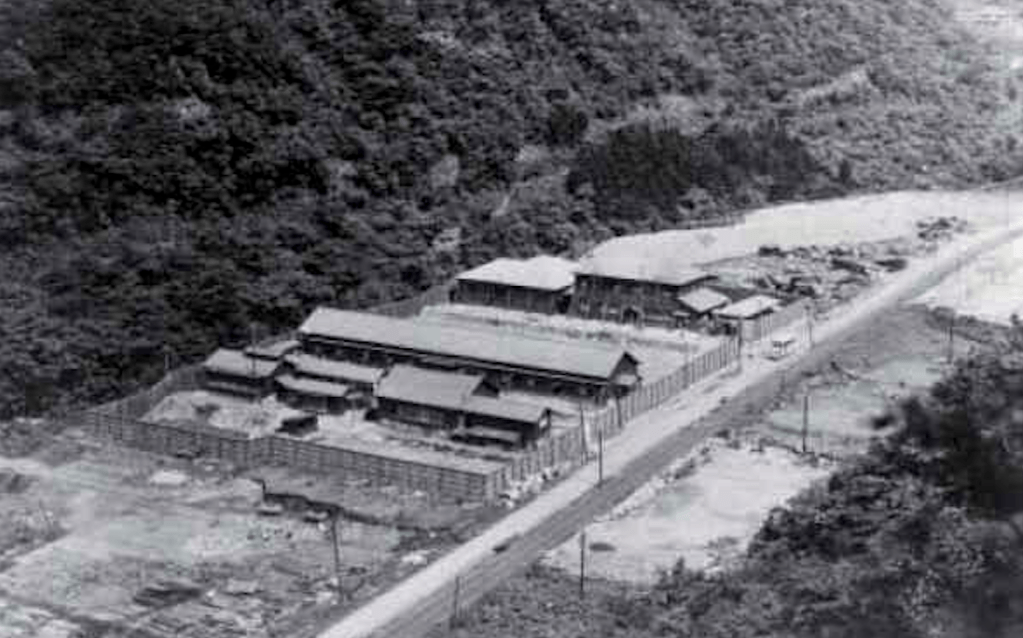
US Navy aerial photo of Ohashi prison camp in 1945.

It was noon on August 15th, 1945. The Japanese Emperor had just announced to his people that his country had surrendered unconditionally to the Allied Powers.

To those of us being held at Ohashi Prison Camp in the mountains of northern Japan, where we’d been prisoners of war performing forced labour at a local iron mine, this meant freedom. But freedom didn’t necessarily equate to safety. The camp’s 395 POWs, about half of them Canadians, were still under the effective control of Japanese troops. And so we began negotiating with them about what would happen next.

Complicating the negotiations was the Japanese military code of Bushido, which required an officer to die fighting or commit suicide (seppuku) rather than accept defeat. We also knew that the camp commander — First Lieutenant Yoshida Zenkichi — had written orders to kill his prisoners “by any means at his disposal” if their rescue seemed imminent. We also knew that we could all easily be deposited in a local mine shaft and then buried under thousands of tons of rock for all eternity without a trace.

We had no way of notifying Allied military commanders (who still hadn’t landed in Japan) as to the location of the camp (about a hundred miles north of Sendai, in a mountainous area near Honshu’s eastern coast), whose existence was then unknown. Because of the devastating American bombing, Japan’s cities had been reduced to rubble, its institutions were in chaos, and millions of Japanese were themselves close to starvation, much like us. The camp itself had food supplies, such as they were, for just three days.

Lieut. Zenkichi seemed angry, and felt humiliated by the surrender. Yet he appeared willing to negotiate our status. And after some stressful hours, we reached an agreement: The Japanese guards would be dismissed from the camp, while a detachment of Kenpeitai (the much feared Military Police) would provide security for Zenkichi, who would confine himself to his office.

To our delight, the local Japanese farmers were friendly, and agreed to give us food in exchange for some of the items we’d managed to loot from the camp’s remaining inventory — though, unfortunately, not enough to feed the camp. Meanwhile, through a secret radio we’d been operating, we learned that the Americans were going to conduct an aerial grid search of Japan’s islands for prison camps. We followed the broadcasted instructions and immediately painted “P.O.W.” in eight-foot-high white letters on the roof of the biggest hut.

Two days later, with all of our food gone, we heard a murmur from the direction of the ocean. The sound turned into the throb of a single-engine airplane flying at about 3,000 feet altitude. Then, suddenly he was above us — a little blue fighter with the white stars of the US Navy painted on its wings and fuselage. But the engine noise began to fade as he went right past us. Please, God, I thought — let him see our camp.

Churchill and Roosevelt vow to destroy all Nazis – WW2 – 103 – August 15, 1941

World War Two
Published 15 Aug 2020

Winston Churchill and Franklin Roosevelt issue a charter that lays out their thoughts for the future, the Soviets are in trouble on two fronts, and Adolf Hitler repeats his orders to those who failed to heed them the first time.

Join us on Patreon: https://www.patreon.com/TimeGhostHistory
Or join The TimeGhost Army directly at: https://timeghost.tv

Follow WW2 day by day on Instagram @World_war_two_realtime https://www.instagram.com/world_war_two_realtime
Between 2 Wars: https://www.youtube.com/playlist?list…
Source list: http://bit.ly/WW2sources

Written and Hosted by: Indy Neidell
Director: Astrid Deinhard
Producers: Astrid Deinhard and Spartacus Olsson
Executive Producers: Astrid Deinhard, Indy Neidell, Spartacus Olsson, Bodo Rittenauer
Creative Producer: Joram Appel
Post-Production Director: Wieke Kapteijns
Research by: Indy Neidell
Edited by: Iryna Dulka
Sound design: Marek Kamiński
Map animations: Eastory (https://www.youtube.com/c/eastory)

Colorizations by:
– Daniel Weiss
– Julius Jääskeläinen – https://www.facebook.com/JJcolorization/
– Cassowary Colorizations – https://www.cassowarycolor.com/
– Norman Stewart – https://oldtimesincolor.blogspot.com/
– Denis Marinov from Wikimedia

Sources:
– Bundesarchiv, CC-BY-SA 3.0: Bild_146-2005-0030, Bild_146-1971-070-61
– Imperial War Museum: E 1416, E 7014, E 3450E, E 7008, E 3438E, E 15023
– Narodowe Archiwum Cyfrowe
– Mil.ru
– egor7 from Wikimedia

Archive by Screenocean/Reuters https://www.screenocean.com.

A TimeGhost chronological documentary produced by OnLion Entertainment GmbH.

From the comments:

World War Two
3 days ago
Although the US has been steadily edging towards more and more support for the Western Allies since outbreak of war almost two years ago, it is this week that an active involvement in WW2 by the United States starts taking form. Let’s be clear though: both the US public, and the US administration are still staunchly opposed to sending in troops and becoming an active belligerent. But the tone of public and political discourse has begun to change, as it becomes increasingly obvious exactly how horrendous the threat is that humanity faces from Naziism.

This is a “hockey stick” graph you can believe

Filed under: Economics, Health, History — Tags: , , , , , — Nicholas @ 03:00

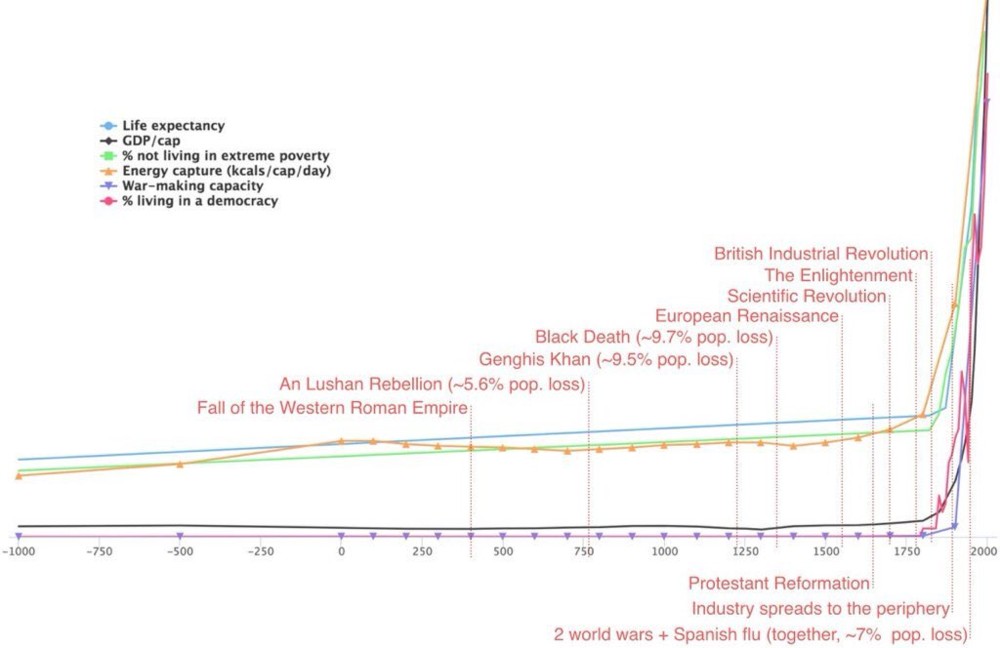
Brian Micklethwait says this graph, unlike the more famous (debunked) “hockey stick”, shows one of the most important moments in human history:

If that graph, or another like it, is not entirely familiar to you, then it damn well should be. It pinpoints the moment when our own species started seriously looking after its own creature comforts. This was, you might say, the moment when most of us stopped being treated no better than farm animals, and we began turning ourselves into each others’ pets.

Patrick Crozier and I will be speaking about this amazing moment in the history of the human animal in our next recorded conversation. That will, if the conversation happens as we hope and the recording works as we hope, find its way to here.

I’m not usually one for podcasts, in the same way that I’m not an audiobook user: I find I’m unable to do other things while listening to the spoken word, and it’s always far faster to read a text than to have it read to you. In this particular case, I might try to make an exception, and give up hope of doing anything else productive while I listen.

Collier Flintlock Revolvers

Filed under: Britain, History, Weapons — Tags: , , , , — Nicholas @ 02:00

Forgotten Weapons
Published 9 Nov 2016

Sold for:
First Pattern Musket: $51,750
Second Pattern Rifle: $46,000
Second Pattern Pistol: $63,250

Elisha Collier is probably the best-known name in flintlock revolvers — to the extent that any flintlock revolvers are well known. Because of the great cost and required skill to manufacture a functional repeating flintlock handgun without modern machine tools, these weapons were never common, but they were made by a number of gunsmiths across Europe. Collier and a fellow American gunsmith named Artemis Wheeler developed this particular type (the specific contributions of each party are not known), and Collier patented it in England in 1818. He proceeded to market the guns, which appear to have been made for him under contract by several high-end British gunsmiths (including Rigby and Nock).

Collier made three different basic types of guns. They share the main feature of a revolving cylinder which must be indexed manually between shots (seeing them while traveling in India was reportedly the inspiration for Samuel Colt’s idea to connect the mechanical functions of hammer and cylinder to invent the single action revolver). The first two patterns of Collier are flintlocks, differing in lock and cylinder design, as well as having slightly different mechanisms to self-prime. The third pattern was actually made as percussion guns, as Collier’s guns were being made right at the end of the flintlock period and the dawn of the percussion cap. In total, 350-400 guns were made, including 50-100 bought by the British military for use in India.

Cool Forgotten Weapons Merch! http://shop.bbtv.com/collections/forg…

http://www.patreon.com/ForgottenWeapons

QotD: Labour is now the “party of government” even when they’re not in power

Filed under: Britain, Bureaucracy, Government, Politics, Quotations — Tags: , — Nicholas @ 01:00

Labour, it seems to me and to many others I’m sure, has mutated from once upon a time being the party speaking for the poor, often against the government, to being the party of government, even when they aren’t the politicians in titular charge of that government. These people are now “supportive of the state”, to quote Hartley, even when they’re not personally in charge of it. It’s the process of government, whoever is doing it, whatever it is doing, that they now seem to worship. It is, as similar people in earlier times used to say, the principle of the thing, the principle being that they’re in charge. Many decades ago, Labour spoke for, well, Labour. The workers, the toiling masses. Now they represent most determinedly only those who labour away only in Civil Service offices or their allies in the media, in academia, and in the bureaucratised top end of big business.

Anyone official and highly educated sounding who challenges whatever happens to be the prevailing supposed wisdom of this governing class, on Coronavirus or on anything else, must be scolded into irrelevance and preferably silenced. The governors must be obeyed, even if they’re wrong. In fact especially if they’re wrong, just as the soldiers of the past were expected to obey their orders, no matter what they thought of the orders or of the aristocratic asses who often gave them. Whether they were good orders was an argument that those giving orders could have amongst themselves, but that orders must be obeyed was a given. “Capitalism” isn’t worth dying for, but this new dispensation is, right or wrong.

Our new class of entitled asses, together with all those who have placed their bets for life on carrying out their orders or trying to profit from them, seems now to be the limit of the Labour Party’s electoral ambition. And who knows? The awful thing is that this class and its hangers-on could be enough, in the not too distant future, to get them back into direct command of the governmental process that they so adore.

Brian Micklethwait, “Mick Hartley on the politics of the Lockdown”, Samizdata, 2020-05-15.

August 15, 2020

Miscellaneous Myths: The Book Of Invasions

Filed under: Books, Europe, History, Humour, Religion — Tags: , , , , — Nicholas @ 04:00

Overly Sarcastic Productions
Published 14 Aug 2020

The quintessential Irish mythological text, and … it’s about getting steamrolled by invaders. Now that’s what I call brand consistency!

Our content is intended for teenage audiences and up.

PATREON: https://www.Patreon.com/OSP

DISCORD: https://discord.gg/kguuvvq

MERCH LINKS: https://www.redbubble.com/people/OSPY…

OUR WEBSITE: https://www.OverlySarcasticProductions.com
Find us on Twitter https://www.Twitter.com/OSPYouTube
Find us on Reddit https://www.Reddit.com/r/OSP/

« Newer PostsOlder Posts »

Powered by WordPress