Quotulatiousness

August 6, 2020

Rhodes: A Short History

History Time
Published 2 Mar 2017

*****This was one of the first videos I ever made.
******Subscribe for much better narration on the newer videos and tons more historical awesomeness*****

Situated at a crossroads between East and West, in a strategic location between the Aegean and the Mediterranean, Rhodes has long been fought over by the surrounding powers. As a result, Rhodes is one of the most historic sites on Earth.

If you liked this video and have as little as a dollar to spare then please consider supporting me on Patreon for more and better content in the future:- http://www.patreon.com/historytimeUK

Are you a budding artist, illustrator, cartographer, or music producer? Send me a message! No matter how professional you are or even if you’re just starting out, I can always use new music and images in my videos. Get in touch! I’d love to hear from you.

I’ve also compiled a reading list of my favourite history books via the Amazon influencer program. If you do choose to purchase any of these incredible sources of information, many of which form the basis of my videos, then Amazon will send me a tiny fraction of the earnings (as long as you do it through the link) (this means more and better content in the future) I’ll keep adding to and updating the list as time goes on:-
https://www.amazon.com/shop/historytime

I try to use copyright free images at all times. However if I have used any of your artwork or maps then please don’t hesitate to contact me and I’ll be more than happy to give the appropriate credit.

—Join the History Time community on social media:-
Instagram:-
https://www.instagram.com/historytime…
Twitter:-
https://twitter.com/HistoryTimePete

Congress legislating on high tech is like your Grampa telling you how to play your favourite online game

Brad Polumbo on the notion that the politicians in Washington (or Ottawa, or London, or Canberra, …) are in any way capable of sensibly regulating the high tech sector:

While many principled small-government conservatives, such as Sen. Rand Paul, still back a free-market approach to tech policy issues, Hawley is not an outlier by any means.

Indeed, President Trump has also backed the regulation of social media companies to combat perceived anti-conservative bias. And the most popular conservative media personality in the country, Fox News host Tucker Carlson, regularly rails against Big Tech — even agreeing with progressive proposals to use the heavy hand of government antitrust regulation to break up companies such as Facebook and Google.

So, if major figures from both parties can agree on regulating Big Tech, it must be a good idea, right? Not so fast.

From left to right, the intentions behind these regulatory proposals are often good. After all, most reasonable people would likely share Democrats’ desire to see Big Tech better handle misinformation, “fake news,” and foreign election interference, while conservative Republicans’ calls for political neutrality online are no doubt appealing in the abstract.

Unfortunately, in their haphazard rush to score political points through government action, would-be regulators from both parties are forgetting the inevitable “knowledge problem” that plagues any central planners who try to dictate the minutiae of complicated industries from the halls of Washington, DC.

Economic philosopher Friedrich A. Hayek diagnosed this fatal flaw of government control in his seminal work “The Use of Knowledge in Society.”

    If we can agree that the economic problem of society is mainly one of rapid adaptation to changes in the particular circumstances of time and place,” Hayek wrote. “It would seem to follow that the ultimate decisions must be left to the people who are familiar with these circumstances, who know directly of the relevant changes and of the resources immediately available to meet them.”

    We cannot expect that this problem will be solved by first communicating all this knowledge to a central board which, after integrating all knowledge, issues its orders,” he continued. “We must solve it by some form of decentralization. But this answers only part of our problem. We need decentralization because only thus can we insure that the knowledge of the particular circumstances of time and place will be promptly used.

Fast freehand sharpening: no jigs, no guides, no sandpaper

Filed under: Tools, Woodworking — Tags: , , , — Nicholas @ 04:00

Rex Krueger
Published 5 Aug 2020

Learn to sharpen with just your hands and affordable oil-stones.

More video and exclusive content: http://www.patreon.com/rexkrueger
(more…)

Fallen flag — The Lehigh and Hudson River Railway

Filed under: History, Railways, USA — Tags: , , — Nicholas @ 03:00

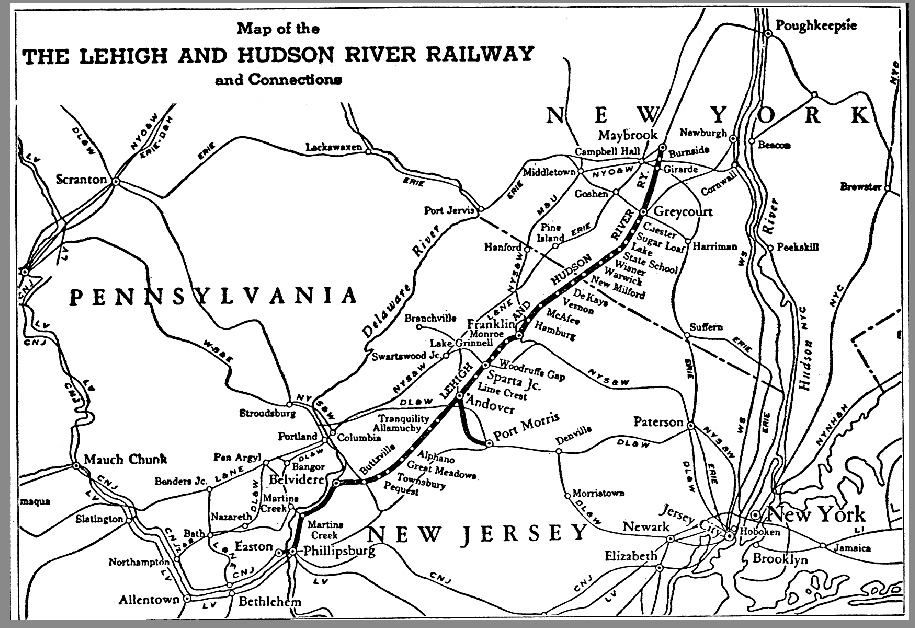
This month’s Classic Trains featured fallen flag is a northeastern railway I didn’t know much about, the Lehigh and Hudson River. If you asked me to complete the phrase “Lehigh and …”, I’d most likely have said “New England”, which was a larger operation but is perhaps only remembered now as the second major American railway to file for abandonment after the New York, Ontario & Western. The L&HR earned its keep primarily as a bridge line, with additional revenues from online anthracite coal mines. From the original founding in 1881, it operated until it was incorporated into Conrail in 1976.

L&HR’s origins date to 1860, when arrival of the New York & Erie Railroad, at Greycourt, New York, 10 miles north of Warwick, prompted construction of the Warwick Valley Railroad under the leadership of Grinnell Burt. The Warwick Valley operated as a 6-foot-gauge feeder to the same-gauge NY&E, using the big road’s equipment for two decades. Around 1880, WV assumed its own operations, was standard-gauged, and built the 11-mile Wawayanda Railroad, which tapped agricultural and mineral sources at McAfee, New Jersey. Further extension southward soon followed.

Two projected competitive lines were combined as the Lehigh & Hudson River Railroad, extending from a Pennsylvania Railroad connection at Belvidere, New Jersey, on the Delaware River, to Hamburg, New Jersey, where three miles of isolated Sussex Railroad track linked it to the Warwick Valley. In 1882 the extensions were folded into the 61-mile Lehigh & Hudson River Railway.

In addition to the New York & Erie’s mainline business at Greycourt, its Newburgh Branch provided access to Hudson River carferries crossing to the New York & New England’s Fishkill Landing. Anthracite coal, particularly from mines of affiliate Lehigh Coal & Navigation, was a major eastbound commodity. Anticipating completion of the Poughkeepsie Bridge a few miles upstream, the Orange County Railroad built north of Greycourt to connect with the New York, Ontario & Western at Burnside in 1890. Via trackage rights, this provided a first connection with the Central New England & Western at Campbell Hall, New York. Within a year, the Orange County was extended from Burnside to CNE’s new Maybrook yard.

Simultaneously, trackage rights were obtained from the Pennsy over 13 miles of its Belvidere-Delaware Division (“Bel-Del”) to Phillipsburg, New Jersey. There, disconnected subsidiaries undertook bridging the Delaware to access Easton, Pennsylvania, and the Jersey Central and Lehigh Valley. The bridge also opened in 1890, creating a three-state route of about 85 miles. The L&HR thus fulfilled the prescient vision of the line’s 1861 directors, who reported, “It was well understood by those … promoting the construction of the Warwick Valley Railroad, that in all probability it would be but a link in a great chain destined to be one of the most important thoroughfares, and to effect an important influence upon the commerce and manufacturers of an extensive section of our country …” Additional links soon extended the chain of this “important thoroughfare.”

The Lehigh and Hudson River Railway bridge over the Delaware River between Easton, Pennsylvania and Phillipsburg, New Jersey. Easton, the Lehigh River Dam feeding the Delaware Canal, and the Northampton Street Bridge are in the background.
Photo by Zeete via Wikimedia Commons.

Post WWII United Kingdom – Cold War Documentary

The Cold War
Published 11 Apr 2020

Our historical documentary series on the history of the Cold War continues with a video on the post-World War II situation in the United Kingdom

Support us on Patreon: https://www.patreon.com/thecoldwar or Paypal: http://paypal.me/TheColdWar

✔ Merch store ► https://teespring.com/stores/thecoldwar
✔ Instagram ► http://www.instagram.com/thecoldwartv

#ColdWar #UK #WorldWar

QotD: Selling booze to the immature

Filed under: Business, Quotations, USA — Tags: , , , — Nicholas @ 01:00

I’m getting really sick of manufacturers trying to extend their user base by appealing to younger people, playing on their unsophisticated and undeveloped taste buds by adding Kool-Aid flavors to grownup drinks. (Chocolate vodka? are you fucking kidding me?) This is akin to trying to get more women to shoot guns by making gunpowder smell like lilacs.

I am, by the way, fully aware of how innovation works — that most of civilization has occurred because someone, somewhere said: “Y’know, I bet if we just changed …” — but that’s confusing improvement with extension. Tinned fruity-flavored gin is not an improvement.

I know that raspberry-flavored beer may have caused more people to take to beer drinking, but that’s changed things, and not for the better. Go into any bar and look at what beers are on tap these days. Barely a drinkable one available, and worse, they’ve pushed all the decent beers into bottles (or out of stock) while hipsters and chickies are catered to with the latest fad, Strawberry IPA [pause to be sick].

Basically, booze manufacturers are changing their products to appeal to people who don’t like booze. In the old days of marketing, we used to call that pointless endeavor “catching eels” (try catching an eel in mid-air when someone tosses it in your direction and you’ll see what I’m talking about). Not only is it pointless, it’s mercurial because what’s popular today won’t be popular tomorrow as your fickle new customers chase after the next “Flavor Of The Month”, and you’ll have gone from catching one eel to catching multiple eels. That’s something they don’t teach in the Marketing section of the typical MBA course because MBAs are all about theory (“line extension”, “product enhancement”, etc.). And don’t tell me I’m talking nonsense because I’ve seen the curricula.

Kim du Toit, “Gilding the Lily #268”, Splendid Isolation, 2018-05-24.

August 5, 2020

Driver Experience @ Pecorama 2020

Filed under: Britain, Railways — Tags: — Nicholas @ 06:00

PECO
Published 4 Aug 2020

A look at the new driver experience courses on the Beer Heights Light Railway at Pecorama — summer 2020

Generalplan Ost, the Nazi plan to kill the Slavs – War Against Humanity 015 – July 1941, Part 02

Filed under: China, Europe, Germany, History, Japan, Military, Russia, WW2 — Tags: , , , , , — Nicholas @ 04:00

World War Two
Published 4 Aug 2020

In China, and the Soviet Union, all sides are causing widespread death to the local civilians. The defending forces are scorching the earth and plundering their own civilians, the attacking armed forces of Japan and Germany are executing planned genocide and mass destruction.

Join us on Patreon: https://www.patreon.com/TimeGhostHistory
Or join The TimeGhost Army directly at: https://timeghost.tv

Follow WW2 day by day on Instagram @World_war_two_realtime https://www.instagram.com/world_war_two_realtime
Between 2 Wars: https://www.youtube.com/playlist?list…
Source list: http://bit.ly/WW2sources

Written and Hosted by: Spartacus Olsson
Director: Astrid Deinhard
Producers: Astrid Deinhard and Spartacus Olsson
Executive Producers: Astrid Deinhard, Indy Neidell, Spartacus Olsson, Bodo Rittenauer
Creative Producer: Joram Appel
Post-Production Director: Wieke Kapteijns
Research by: Spartacus Olsson and Joram Appel
Edited by: Mikołaj Cackowski
Sound design: Marek Kamiński
Map animations: Eastory (https://www.youtube.com/c/eastory)

Colorizations by:
Dememorabilia – https://www.instagram.com/dememorabilia/
Jaris Almazani (Artistic Man) – https://instagram.com/artistic.man?ig…
Julius Jääskeläinen – https://www.facebook.com/JJcolorization/
Daniel Weiss
Spartacus Olsson
Klimbim – https://www.flickr.com/photos/2215569…
Mikolaj Uchman

Sources:
Eesti Kirjandusmuuseum KM EKLA, A-3:107
Yad Vashem 55AO6, 74FO7,
Consiliul National pentru Studierea Arhivelor Securitatii (CNSAS)
USHMM
IWM NA 15129, N 530
from the Noun Project: Skull by Muhamad Ulum
Picture of a victim of starvation during the siege of Leningrad, courtesy George Shuklin
Portrait of Nikolai Moskvin, courtesy goskatalog.ru

Soundtracks from the Epidemic Sound:
Johan Hynynen – “Dark Beginning”
Yi Nantiro – “Watchmen”
Yi Nantiro – “A Single Grain Of Rice”
Farell Wooten – “Blunt Object”
Reynard Seidel – “Deflection”
Andreas Jamsheree – “Guilty Shadows 4”
Philip Ayers – “Trapped in a Maze”
Skrya – “First Responders”
Philip Ayers – “Under the Dome”

Archive by Screenocean/Reuters https://www.screenocean.com.

A TimeGhost chronological documentary produced by OnLion Entertainment GmbH.

From the comments:

World War Two
3 hours ago (edited)
So here we are — it’s the end of July and the Nazi plan to ethnically cleanse Eastern Europe by genocide and forced migration is now in play, while the deliberate genocide of the Chinese has been in motion for more than three years. It’s easy to write off the massive death in both regions as collateral damage, the millions of PoWs that died as callous carelessness, the overall death toll as part of a desperate defense strategies. But that belies how planned, meticulous and specific both the genocides by Imperial Japan and by Nazi Germany were.

The sources detailing the execution and opposition to these plans in the Soviet Union are relatively easy to access. Already during the war the Allied intelligence services were intercepting most of the communication that outlined death tolls, policies, and events. After the war the comprehensive documentation by the Germans themselves was captured and compiled for the Nuremberg Trials. Although Russia under the current regime choose to obfuscate, and distort their side of the story, the decade after the collapse of the Soviet Union saw the release of enough classified material for us to know the big picture.

The sources on what happened in China are, on the other hand, harder to come by. Unlike Germany, Japan has not been forced to, and has been unwilling to reconcile with what their forefathers did. Historians unearthing these stories face massive opposition by interests that still try to maintain Japanese exceptionalism. In China, the Communist regime never collapsed, and continues to promote a propagandist historiography that distorts the events within a narrative of unilateral heroic struggle by the People’s Red Army against Imperialism. Therefore it’s all the more important that we try to see these events for what they were: a massive tragedy of human suffering caused by ideological chauvinism – there is nothing heroic here, only the sad reality of war, and the terror of hatred to the level of mass murder.

Red Toryism, limited government and other Canadian political sinkholes

Filed under: Cancon, Economics, Government, Politics — Tags: , — Nicholas @ 03:00

In his latest article in The Dominion, Ben Woodfinden talks about the political void where most Canadian conservatives keep their notions about what “conservatism” actually means in the Canadian context:

Parliament Hill in Ottawa.
Photo by S Nameirakpam via Wikimedia Commons.

This passage is from the Red Toryism essay:

    Modern Canadian conservatism champions “small government”, seemingly without having any theory of what the state is actually for. Absent such a framework, it is difficult to identify governing priorities let alone to develop a philosophically coherent blueprint for action. When Conservatives get elected, they often have no idea of how to achieve the “fiscal responsibility” they preach. A series of ad hoc actions and policies follow, and the predictable result is failure to roll back the state in any significant or lasting way.

This, predictably, did not please everyone, and in a political landscape where we often still think that the divides between left and right are really about “big” versus “small” government, this was to be expected. But a conservative theory of government needs to escape this paradigm.

While conservatism is a broad tent, one unifying feature should be a commitment to limited government. But limited government is a term that often gets conflated with ideological “small government” that sees most of the modern state as illegitimate, and would eliminate most of it and leave the state to provide just the most minimal night-watchman functions. But small government, while a valid view to hold, is not limited government, and conservative government cannot just be about small government.

Limited government means constitutional government that is accountable and constrained by the rule of law, and while there are aspects of the modern state that need to be reformed, tamed, and limited, conservative government cannot just be about trying (and failing) to shrink the state. Conservatives have too often, I think, adopted the rhetoric of small government, without actually being true believers, and in the process they find it very difficult to actually reform and shape the state because they have put little thought into what government actually ought to be about.

Let me give you an example. Recently my friend Asher Honickman and I wrote a column for the National Post calling for a “parliamentary revival.” One specific and important reform we want to see is an expanded House of Commons to 500 MPs. More MPs would make for better party, and parliamentary government. But multiple people, including well connected conservatives, privately told us that while they think this is a good idea, one reason it won’t happen is because conservatives will just look at it through the lens of more spending of tax dollars on politicians. Instead the conservative impulse is to just try and shrink the size of legislatures to save a little bit of money.

In this case small government ideology actually gets in the way of reforms that would help make government more accountable, and limited. MPs should be held accountable and have their spending and salaries heavily scrutinized, but the cost of 150 more MPs would be nothing in the grand scheme of things.

This misses the point. More MPs would make for more accountable and better parliamentary government, and allow parliament, instead of both the bureaucracy and judiciary to increasingly take over more and more of lawmaking and governing that should be done by elected officials. The choice isn’t between more government or less government, in this case it’s a choice between who you’d rather be governed by; MPs who can scrutinize the government more, legislate with more freedom, and who you can hold to account, versus unelected bureaucrats with minimal oversight and limited accountability to elected officials.

In short, a conservative theory of governance should prioritize limited government, but in some cases this might require an attempt to strengthen (and more spending) on certain parts of government to constrain other parts.

It’s a rare Canadian conservative who’s willing to be quoted as saying that any part of human life is not automatically part of the remit of the federal government … how do you carve a “limited” government philosphy out of that?


Berserkers! The facts and the fictions

Filed under: Europe, History — Tags: , , , , — Nicholas @ 02:00

Lindybeige
Published 16 Jul 2015

Support me on Patreon: https://www.patreon.com/Lindybeige

This one has been a long time coming, but now I’m glad that I’ve said it. It may disappoint many die-easy fans of unnecessary carnage, but the truth about berserkers is that they may have been a great deal more sensible and human than the rage-fuelled psychos so beloved by the world’s male teenagers.

Here’s a link to Roderick Dale’s new Viking book (although Amazon inaccurately describes it as an audiobook and abridged): http://www.amazon.co.uk/Viking-Experi…

For those wanting the full 100,000-word thesis, try here: http://eprints.nottingham.ac.uk/28819/

Lindybeige: a channel of archaeology, ancient and medieval warfare, rants, swing dance, travelogues, evolution, and whatever else occurs to me to make.

▼ Follow me…

Twitter: https://twitter.com/Lindybeige I may have some drivel to contribute to the Twittersphere, plus you get notice of uploads.

QotD: Responsibility

Filed under: Britain, Law, Liberty, Politics, Quotations — Tags: , , , — Nicholas @ 01:00

I have always been deeply suspicious of the word “responsibility”. It has again and again sounded like someone else telling me that I must do what he wants me to do rather than what I want to do. If he is paying my wages, then fair enough. But if he is explaining why I should vote for him, and support everything he does once he has got the job he is seeking, not so fair.

The sort of thing I mean is when a British Conservative Party politician says, perhaps to a room full of people who, like me, take the idea of personal liberty very seriously: Yes, I believe, passionately, in personal liberty. The politician maybe then expands upon this idea, often with regard to how commercial life works far better if people engaged in commerce are able to make their own decisions about which projects they will undertake and which risks they will walk towards and which risks they will avoid. If business is all coerced, it won’t be nearly so beneficial. We will all get poorer. Yay freedom.

But.

But … “responsibility”. We should all have freedom, yes, but we also have, or should have, “responsibility”. Sometimes there then follows a list of things that we should do or should refrain from doing, for each of which alleged responsibility there is a law which he favours and which we must obey. At other times, such a list is merely implied. So, freedom, but not freedom.

The problem with politicians talking about responsibility is that their particular concern is and should be the law, law being organised compulsion. And too often, their talk of responsibility serves only to drag into prominence yet more laws about what people must and must not do with their lives. But because the word “responsibility” sounds so virtuous, this list of anti-freedom laws becomes hard to argue against, even inside one’s own head. Am I opposed to “responsibility”? Increasingly, I have found myself saying: To hell with it. Yes.

I have often been similarly resistant to the language of Christianity, of the sort that dominates what is being said in churches around the world today. How many times in history have acts of tyranny been justified by the tyrant saying something like: We must all bear our crosses in life, and here, this cross is yours. “God is on my side. Obey my orders.” The truth about the potential of life to inflict pain becomes the excuse to inflict further pain.

Brian Micklethwait, “Jordan Peterson on responsibility – and on why it is important that he is not a politician”, Samizdata, 2018-03-30.

August 4, 2020

Nationalism DOESN’T explain WHY Austria-Hungary collapsed

Filed under: Europe, History, Military, WW1 — Tags: , , , , , , — Nicholas @ 06:00

TIK
Published 3 Aug 2020

The go-to answer is that national or ethnic divisions caused the collapse of the Austro-Hungarian Empire. But is this really the case? Using multiple sources, it’s time to provide YouTube with a narrative which doesn’t confirm nationalist beliefs. The Habsburgs survived the collapse, with Emperor Karl / Charles trying to reclaim his throne later on before being exiled. However, by about mid-November 1918, he had lost all power. The fact that there is no specific date when Austria-Hungary collapsed, and the fact that the “national revolutions” were met with relatively little opposition, speaks volumes. As does the fact that the new states were all multinational, which undermines the narrative that nationalism was the reason why Austria-Hungary collapsed. Leave your thoughts in the comments below.

⏲️ Videos EVERY Monday at 5pm GMT (depending on season, check for British Summer Time).

– – – – –

📚 BIBLIOGRAPHY / SOURCES 📚

Judson, P. The Habsburg Empire: A New History. Belknap Press, Kindle 2016.
Kiste, J. The End of the Habsburgs: The Decline and Fall of the Austrian Monarchy. Kindle 2019.
Macgregor, J. & Docherty, G. Prolonging the Agony: How the Anglo-American Establishment Deliberately Extended WW1 by Three-and-a-Half Years. Trine Day LLC, 2018.
Marx, K. Capital: A Critique of Political Economy: Volume III. PDF, English edition, 2010. (Originally written 1894)
Mises, L. Socialism: An Economic and Sociological Analysis. Liberty Fund, 1981. 1969 edition (roots back to 1922).
Oxford Dictionary of English, Oxford University Press, Third Edition 2010.
Rady, M. The Habsburgs: The Rise and Fall of a World Power. Perseus Books, Kindle 2020.
Watson, A. Ring of Steel: Germany and Austria-Hungary at War, 1914-1918. Penguin Books, 2015.

Cornwall, M. “Propaganda at Home (Austria-Hungary).” 1919. https://encyclopedia.1914-1918-online….
Online Latin-Dictionary http://www.latin-dictionary.net/defin…
Online Etymology Dictionary https://www.etymonline.com/word/public

Full list of all my sources – https://docs.google.com/spreadsheets/…

– – – – –

⭐ SUPPORT TIK ⭐

Want to ask a question? Please consider supporting me on either Patreon or SubscribeStar and help make more videos like this possible. For $5 or more you can ask questions which I will answer in future Q&A videos. Thank you to my current Patrons! You’re AWESOME! https://www.patreon.com/TIKhistory or https://www.subscribestar.com/tikhistory

– – – – –

ABOUT TIK 📝

History isn’t as boring as some people think, and my goal is to get people talking about it. I also want to dispel the myths and distortions that ruin our perception of the past by asking a simple question – “But is this really the case?” I have a 2:1 Degree in History and a passion for early 20th Century conflicts (mainly WW2). I’m therefore approaching this like I would an academic essay. Lots of sources, quotes, references and so on. Only the truth will do.

This video is discussing events or concepts that are academic, educational and historical in nature. This video is for informational purposes and was created so we may better understand the past and learn from the mistakes others have made.

Building and Gluing the Benches | The Picnic Bench Project

Filed under: Tools, Woodworking — Tags: , , — Nicholas @ 04:00

Matt Estlea
Published 3 Aug 2020

In this video, I get the benches attached to their frames and all glued up. It’s really coming together now. Let’s get to it.

#picnicbench #woodworking #buildingapicnicbench
_________________________________________________________________

Support what I do by becoming a Patron! This will help fund new tools, equipment and cover my overheads. Meaning I can continue to bring you regular, high quality, free content. Thank you so much for your support! https://www.patreon.com/mattestlea

Don’t want to commit to a monthly direct debit but still want to help out? That’s fine!
You can make a one time donation here: www.mattestlea.com/donate
You can donate us biscuits here: www.mattestlea.com/wishlist
_________________________________________________________________
BUY THE WOODWORKING BIBLE HERE:
www.mattestlea.com/the-woodworkers-manual
_________________________________________________________________

SOCIAL MEDIA
Instagram: www.instagram.com/mattestlea
Twitter: www.twitter.com/mattestlea
Patreon: www.patreon.com/mattestlea
Pinterest: www.pinterest.com/mattestlea
LinkedIn: www.linkedin.com/in/matt-estlea-b6414b11a/
_________________________________________________________________
See what tools I use here: www.mattestlea.com/equipment
My Website: www.mattestlea.com
_________________________________________________________________

My name is Matt Estlea, I’m a 24 year old Woodworker from Basingstoke in England and my aim is to make your woodworking less s***.

I come from 5 years tuition at Rycotewood Furniture Centre with a further 1 year working as an Artist in Residence at the Sylva Foundation. I now teach City and Guilds Furniture Making at Rycotewood as of September 2018.

If you’re interested in studying at Rycotewood, view their courses here:
www.mattestlea.com/rycotewood

I also had 5 years of experience working at Axminster Tools and Machinery where I helped customers with purchasing tools, demonstrated in stores and events, and gained extensive knowledge about a variety of tools and brands. I discontinued this at the start of 2019 to focus solely on video creation and teaching.

During the week, I film woodworking projects, tutorials, reviews and a viewer favourite ‘Tool Duel’ where I compare two competitive manufacturers tools against one another to find out which is best. I also have a Free Online Woodworking School which you should definitely check out!

www.mattestlea.com/school

I like to have a laugh and my videos are quite fast paced BUT you will learn a lot, I assure you.

Lets go make a mess.

Ontario’s COVID Alert app

Filed under: Cancon, Government, Health, Technology — Tags: , , , , — Nicholas @ 03:00

Michael Geist explains why he has installed the Canadian government’s COVID App on his phone, despite the privacy concerns such government tracking apps present:

The Canadian COVID Alert app is ultimately as notable for what it doesn’t do as for what it does. The voluntary app does not collect personal information nor provide the government (or anyone else) with location information. The app merely runs in the background on an Apple or Android phone using bluetooth technology to identify other devices that come within 2 metres for a period of 15 minutes or more. Obviously, the distance and timing are viewed as the minimum for a potential transmission risk. If this occurs, a unique, random identifier is stored on each person’s device for a period of 14 days. After the 14 day period, the identifier is deleted from the device.

The identifier does not identify a specific person or location information, and is not sent to any centralized database. If a person tests positive for the virus, they are given a key code to input into the app. Once the key code is inputted, anyone that was identified as being potentially exposed over the prior 14 days receives a notification that this has occurred and they should consider testing and/or self-isolating.

From a privacy perspective, this is very low risk. Indeed, the government’s position – confirmed in the Privacy Commissioner of Canada’s analysis – is that there is no collection of any personal information and therefore the Privacy Act does not apply. The Privacy Commissioner rightly points out this raises some concerns about the state of the law (arguing it should be sufficiently robust to allow for reviews of this kind), however, the use of random identifiers ensures that identification of individual is very unlikely. Moreover, the Privacy Commissioner’s review concludes that “there are very strong safeguards in place” with security of the data, commitments limiting use, independent oversight, and a pledge to de-commission the app (including deletion of all data) within 30 days of the Chief Public Health Officer of Canada declaring the pandemic over.

The Ontario Information and Privacy Commissioner was also engaged in the review process. Her recommendation letter points to commitments for potential ongoing issues, including ensuring that the app is effective, that there is monitoring of third party components such as the Google-Apple Exposure Notification System, and public transparency associated with the app and its use.

While the app passes legal muster, its introduction reinforces the problems with social inequities that COVID-19 has laid clear. Much like the connection between socio-economic status and infection risk, the app itself is only accessible to those who can afford newer Apple and Android devices. That obviously means that those with older phones or no wireless access at all are unable to use it. While I don’t think that is reason to abandon the initiative, the government should be exploring alternatives to allow all citizens to implement these safeguards.

Sturmtruppen Firepower: The Artillery Luger

Filed under: Germany, History, Military, Weapons, WW1 — Tags: , , , , , — Nicholas @ 02:00

Forgotten Weapons
Published 4 Apr 2020

https://www.instagram.com/rockislanda…

https://www.youtube.com/user/RockIsla…

This is lot #3569 in the upcoming RIA Premier Auction. It was scheduled for April, but has been postponed — check their web site for upcoming Online Only auctions every month, though!

The lP08 (Lange pistole 08) was formally adopted in 1913 to replace the Reichsrevolver for the field artillery. These were the German light artillery troops, who were specifically given a pistol caliber carbine to provide maximum firepower in a very compact package. They were made by the Erfurt Arsenal in 1914, and by DWM throughout the war, with a total of about 180,000 made.

What is most interesting to me is the evolution of the use of the “artillery Luger” throughout the course of World War One. Starting as simply a compact weapon for artillery, it was quickly recognized by aviators as an ideal weapon for aircraft before the mass introduction of aerial machine guns. The stock allowed more accurate fire, and the semiautomatic operation minimized the handling movements required to fire. More substantially, it was adopted by the German Sturmtruppen for maximizing the striking power of small and flexible units. It is for these men that the 32-round drum magazine was developed in 1916. This represents one of the very few formal military uses of a pistol-caliber semiautomatic carbine, as it was superseded by the advent of the submachine gun in 1918.

A few small batches were made in the 1920s and 1930s, but it would not see significant use in World War Two – leaving it a weapon specifically iconic to the Great War.

http://www.patreon.com/ForgottenWeapons

https://www.floatplane.com/channel/Fo…

Cool Forgotten Weapons merch! http://shop.bbtv.com/collections/forg…

Contact:
Forgotten Weapons
6281 N. Oracle #36270
Tucson, AZ 85740

« Newer PostsOlder Posts »

Powered by WordPress