Quotulatiousness

February 10, 2021

One Advantage of Swiss Neutrality: LSD! – WW2 – Reading Comments

World War Two
Published 9 Feb 2021

Another edition of Across the Airwaves, where Indy and Sparty look at interesting and unique comments from our videos. In this episode, they look at gentlemanly declarations of war, Partisan memories, and LSD.

Join us on Patreon: https://www.patreon.com/TimeGhostHistory
Or join The TimeGhost Army directly at: https://timeghost.tv

Follow WW2 day by day on Instagram @ww2_day_by_day – https://www.instagram.com/ww2_day_by_day
Between 2 Wars: https://www.youtube.com/playlist?list…
Source list: http://bit.ly/WW2sources

Hosted by: Indy Neidell & Spartacus Olsson
Director: Astrid Deinhard
Producers: Astrid Deinhard and Spartacus Olsson
Executive Producers: Astrid Deinhard, Indy Neidell, Spartacus Olsson, Bodo Rittenauer
Creative Producer: Maria Kyhle
Post-Production Director: Wieke Kapteijns
Edited by: Karolina Dołęga
Sound design: Marek Kamiński
Map animations: Eastory (https://www.youtube.com/c/eastory​)

Colorizations by:
– Daniel Weiss
– Mikołaj Uchman
– JHM Color
– Julius Jääskeläinen – https://www.facebook.com/JJcolorization/​

Sources:
– Imperial War Museums: MH 1324, CH 1533, HU111054, TR 1468, MGH 4464
– National Archives NARA
– United States Holocaust Memorial Museum
– Yad Vashem: 4360-99, 2725-5, 4788-73,
– Bundesarchiv
– Picture of Soviet Soldiers with DShK-38 gun courtesy of Leduytoan2003 from Wikimedia Commons
– Picture of 19th Army troops storming Mogile courtesy of Mil.ru

Soundtracks from Epidemic Sound:
– “The Unexplored” – Philip Ayers
– “The Inspector 4” – Johannes Bornlöf
– “London” – Howard Harper-Barnes
– “Document This 1” – Peter Sandberg
– “Dark Beginning” – Johan Hynynen
– “Rubik’s Cube” – From Now On
– “Getaway Rock” – Elliot Holmes

Archive by Screenocean/Reuters https://www.screenocean.com​.

A TimeGhost chronological documentary produced by OnLion Entertainment GmbH.

December 18, 2020

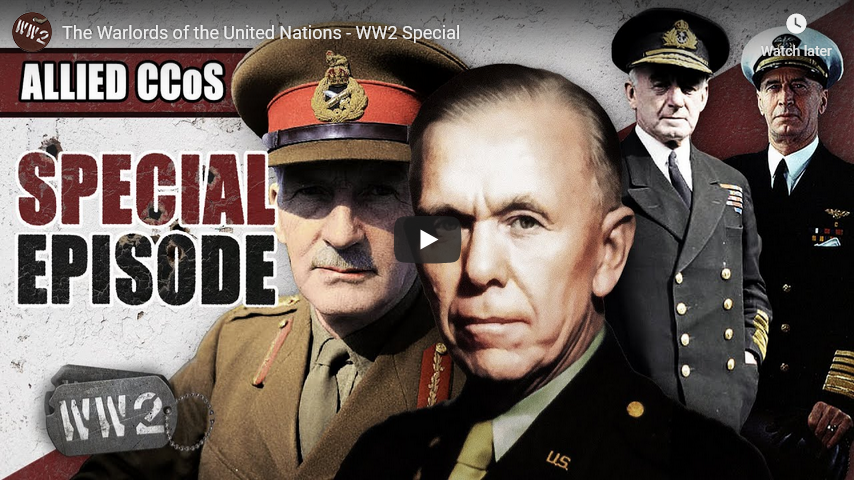
The Warlords of the United Nations – WW2 Special

Filed under: Britain, History, Military, USA, WW2 — Tags: , , , , — Nicholas @ 06:00

World War Two
Published 17 Dec 2020

Following the German declaration of war on America on the 11th of December 1941, Britain gained an invaluable ally. Securing a joint military command between the new partnership will be central to its success, the question is, how can this be achieved?

Join us on Patreon: https://www.patreon.com/TimeGhostHistory
Or join The TimeGhost Army directly at: https://timeghost.tv

Follow WW2 day by day on Instagram @ww2_day_by_day – https://www.instagram.com/ww2_day_by_day
Between 2 Wars: https://www.youtube.com/playlist?list…
Source list: http://bit.ly/WW2sources

Hosted by: Indy Neidell
Written by: Markus Linke and Indy Neidell
Director: Astrid Deinhard
Producers: Astrid Deinhard and Spartacus Olsson
Executive Producers: Astrid Deinhard, Indy Neidell, Spartacus Olsson, Bodo Rittenauer
Creative Producer: Maria Kyhle
Post-Production Director: Wieke Kapteijns
Research by: Markus Linke
Edited by: Miki Cackowski
Sound design: Marek Kamiński
Map animations: Eastory (https://www.youtube.com/c/eastory)

Colorizations by:
Norman Stewart – https://oldtimesincolor.blogspot.com/
Daniel Weiss
Adrien Fillon – https://www.instagram.com/adrien.colo…
Mikołaj Uchman

Sources:
IWM A 14040, TR153, H 10306, ME(RAF) 5052, A 16709

Soundtracks from Epidemic Sound:
Max Anson – “Ancient Saga”
Johannes Bornlof – “Magnificent March 3”
Howard Harper-Barnes – “London”
Rannar Sillard – “March Of The Brave 4”
Johannes Bornlof – “The Inspector 4”
Phoenix Tail – “At the Front”

Archive by Screenocean/Reuters https://www.screenocean.com.

A TimeGhost chronological documentary produced by OnLion Entertainment GmbH.

December 7, 2020

Churchill and the Bengal Famine of 1943

Filed under: Books, Britain, History, India, Military, WW2 — Tags: , — Nicholas @ 03:00

In The Critic, Zareer Masani debunks a recent book’s claim that British PM Winston Churchill was responsible for the Bengal famine during the Second World War:

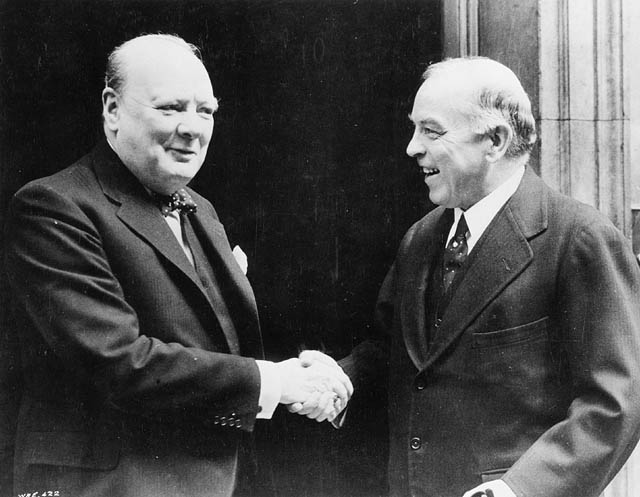
Prime Minister Winston Churchill greets Canadian PM William Lyon Mackenzie King, 1941.
Photo from Library and Archives Canada (reference number C-047565) via Wikimedia Commons.

A favourite trope of the current Black Lives Madness and its left-liberal white apologists has been the alleged infamy of Britain’s most cherished hero, Winston Churchill, charged with everything from mere racism to actual genocide. The worst accusation is that of deliberately starving four million Bengalis to death in the famine of 1943.

The famine took place at the height of World War Two, with the Japanese already occupying Burma and invading the British Indian province of Bengal, bombing its capital, Calcutta, and patrolling its coast with submarines.

The famine raged for about six months, from the summer of 1943 until the end of that year, and estimates of its victims range from half a million upwards, depending on whether one includes its indirect and long-term effects. Most famine experts agree that famines can be caused by both nature and human agency, but never by any single individual. So how has a 67-year-old British prime minister in poor health, 5,000 miles away, fighting near-annihilation in a world war, come to be charged with causing such a cataclysmic disaster?

The attempt to lay this at Churchill’s door stems from a sensationalist book by a Bengali-American journalist called Madhusree Mukerjee. As its title, Churchill’s Secret War, indicates, it was a largely conspiracist attempt to pin responsibility on distant Churchill for undoubted mistakes on the ground in Bengal.

The actual evidence shows that Churchill believed, based on the information he had been getting, that there was no food supply shortage in Bengal, but a demand problem caused by local mismanagement of the distribution system. Ironically, his view found unexpected support in a 2010 exchange between Mukerjee and the Nobel Prize-winning economist Amartya Sen, the world’s foremost expert on famine in India.

Commenting in the New York Times, Sen said of Mukerjee, that “she seems satisfied with little information” and that her data came from only two rice research stations, and those in only two out of 27 districts in Bengal. “The analysis I made,” countered Sen, “using data from all districts … indicated that food availability in 1943 (the famine year) was significantly higher than in 1941 (when there was no famine) … There was indeed a substantial shortfall compared with demand, hugely enhanced in a war economy … but that is quite different from a shortfall of supply compared with supply in previous years … Mukerjee seems to miss this crucial distinction, and in her single-minded … attempt to nail down Churchill, she ends up absolving British imperial policy of confusion and callousness.”

November 24, 2020

Is the day of the orator over?

In The Critic, Nigel Jones considers some of the great orators of history:

Prime Minister Winston Churchill greets Canadian PM William Lyon Mackenzie King, 1941. Churchill was certainly one of the great orators of history … Mackenzie King, on the other hand, certainly was not.
Photo from Library and Archives Canada (reference number C-047565) via Wikimedia Commons.

On 19 November 1863, President Abraham Lincoln rose to speak at Gettysburg, Pennsylvania, the battlefield which four and a half months before had seen the decisive turning point of the American Civil War. Lincoln was not even the principal speaker at the ceremony to dedicate a cemetery for those who had fallen in the battle.

Before he spoke, the President had to sit through a two-hour address by a pompous official orator, a windbag called Edward Everett. But when he finally got to his feet Lincoln entered political immortality. He spoke for only two minutes, but the few words he uttered about “Government of the people, by the people, and for the people” have echoed down the years – even Mrs Thatcher made a recording of them – inspiring and rousing generations to value and defend democracy.

Winston Churchill’s iconic status as Britain’s greatest Prime Minister largely rests on the handful of radio speeches he growled out to the nation in the darkest days of World War Two: “… fight them on the beaches … so much owed by so many to so few … this was their finest hour …” and so on.

Ever since Roman statesmen such as Cato and Cicero delivered their speeches on the Capitol, oratory like that spoken by Lincoln and Churchill has been a mainstay of western civilisation and governance. A carefully constructed argument or a few ringing phrases having the power to change minds, stiffen sinews, and bring down leaders.

Churchill himself was brought to supreme political power in 1940 by the power of the spoken word. Those words were spoken by one politician – his friend and schoolmate Leo Amery – quoting another, when Amery repeated Oliver Cromwell’s words dismissing the Long Parliament in calling for the end of Neville Chamberlain’s feeble administration: “You have sat here too long for any good you have been doing. Depart, I say, and let us have done with you: in the name of God, go!” Chamberlain, albeit reluctantly, went.

November 22, 2020

QotD: Winston Churchill

Filed under: Britain, History, Military, Quotations, WW2 — Tags: , , — Nicholas @ 01:00

I wonder whether any historian of the future will ever be able to paint Winston in his true colours. It is a wonderful character — the most marvellous qualities and superhuman genius mixed with an astonishing lack of vision at times, and an impetuosity which if not guided must inevitably bring him into trouble again and again. Perhaps the most remarkable failing of his is that he can never see a whole strategical problem at once. His gaze always settles on some definite part of the canvas and the rest of the picture is lost. It is difficult to make him realize the influence of one theatre on another. The general handling of the German reserves in Europe can never be fully grasped by him. This failing is accentuated by the fact that often he does not want to see the whole picture, especially if this wider vision should in any way interfere with the operation he may have temporarily set his heart on. He is quite the most difficult man to work with that I have ever struck, but I should not have missed the chance of working with him for anything on earth!

Footnote by Field Marshal Lord Alanbrooke, War Diaries, 1939-1945, 1957.

November 13, 2020

QotD: Military allies

Filed under: Britain, Cancon, History, Military, Quotations, USA, WW2 — Tags: , , , — Nicholas @ 01:00

Partnership implies the burden is shared more or less equally. If I bought twenty quid’s worth of shares in The Spectator and started swanning about bitching that Conrad Black didn’t treat me as a partner, he’d rightly think I’d gone nuts. The British in their time were at least as ruthless about such realities as the Americans are today. For example, in September 1944, in one of the lesser-known conferences to prepare for the post-war world, Churchill and Roosevelt met in Quebec City. They had no compunction about excluding from their deliberations the Canadian Prime Minister, Mackenzie King, even though he was the nominal host. There’s a cartoon of the time showing King peering through a keyhole as the top dogs settled the fate of the world without him.

And guess what? Militarily speaking, Canada was a far bigger player back then than Britain is today: the Royal Canadian Navy was the world’s third-biggest surface fleet, the Canucks got the worst beach at Normandy — but hey, why bore you with details? In those days that still wasn’t enough to get you a seat at the table.

Mark Steyn, “The Brutal Cuban Winter”, The Spectator, 2002-01-26.

September 23, 2020

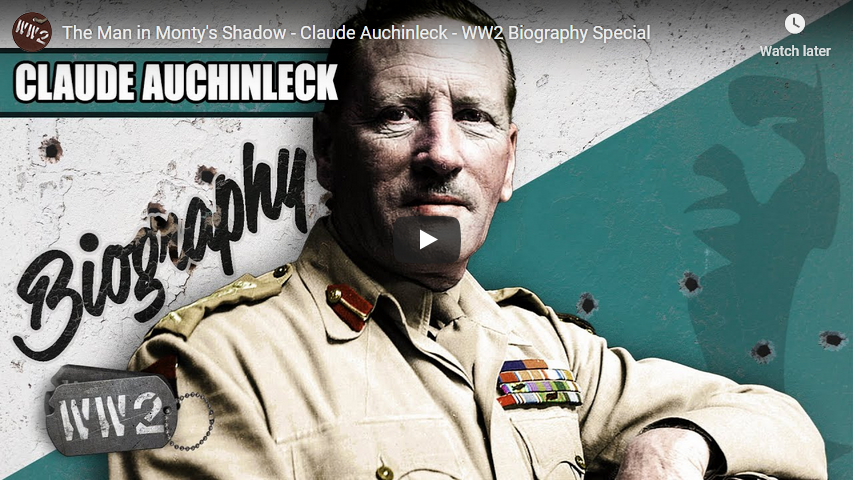
The Man in Monty’s Shadow – Claude Auchinleck – WW2 Biography Special

World War Two
Published 22 Sep 2020

Claude Auchinleck put military matters over that of politics. Although this angered some, mainly Churchill, Auchinleck still found himself in India, and later facing down Rommel in North Africa.

Join us on Patreon: https://www.patreon.com/TimeGhostHistory
Or join The TimeGhost Army directly at: https://timeghost.tv

Check out our TimeGhost History YouTube Channel: https://www.youtube.com/c/timeghost?s…

Follow WW2 day by day on Instagram @ww2_day_by_day – https://www.instagram.com/ww2_day_by_day
Between 2 Wars: https://www.youtube.com/playlist?list…
Source list: http://bit.ly/WW2sources

Hosted by: Indy Neidell
Written by: Francis van Berkel
Director: Astrid Deinhard
Producers: Astrid Deinhard and Spartacus Olsson
Executive Producers: Astrid Deinhard, Indy Neidell, Spartacus Olsson, Bodo Rittenauer
Creative Producer: Maria Kyle
Post-Production Director: Wieke Kapteijns
Research by: Lennart Visser
Edited by: Monika Worona
Sound design: Marek Kamiński

Colorizations by:
Norman Stewart

Sources:
National Portrait Gallery
USHMM

Archive by Screenocean/Reuters https://www.screenocean.com.

A TimeGhost chronological documentary produced by OnLion Entertainment GmbH.

August 16, 2020

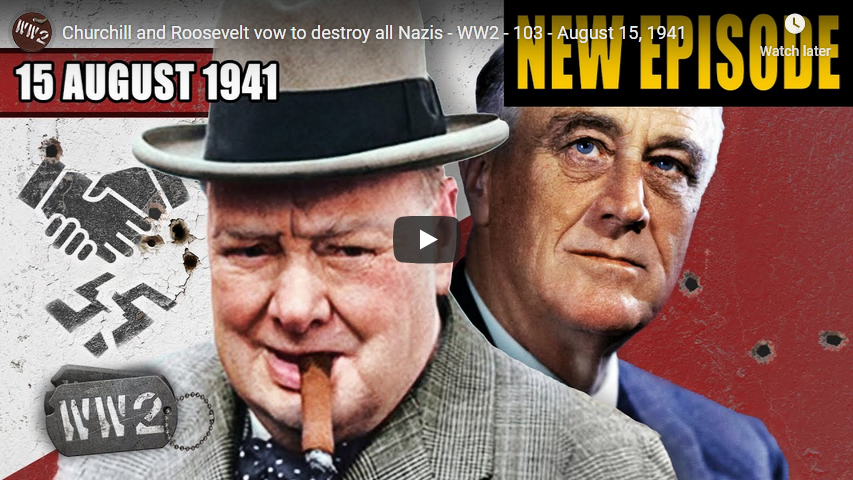
Churchill and Roosevelt vow to destroy all Nazis – WW2 – 103 – August 15, 1941

World War Two
Published 15 Aug 2020

Winston Churchill and Franklin Roosevelt issue a charter that lays out their thoughts for the future, the Soviets are in trouble on two fronts, and Adolf Hitler repeats his orders to those who failed to heed them the first time.

Join us on Patreon: https://www.patreon.com/TimeGhostHistory
Or join The TimeGhost Army directly at: https://timeghost.tv

Follow WW2 day by day on Instagram @World_war_two_realtime https://www.instagram.com/world_war_two_realtime
Between 2 Wars: https://www.youtube.com/playlist?list…
Source list: http://bit.ly/WW2sources

Written and Hosted by: Indy Neidell
Director: Astrid Deinhard
Producers: Astrid Deinhard and Spartacus Olsson
Executive Producers: Astrid Deinhard, Indy Neidell, Spartacus Olsson, Bodo Rittenauer
Creative Producer: Joram Appel
Post-Production Director: Wieke Kapteijns
Research by: Indy Neidell
Edited by: Iryna Dulka
Sound design: Marek Kamiński
Map animations: Eastory (https://www.youtube.com/c/eastory)

Colorizations by:
– Daniel Weiss
– Julius Jääskeläinen – https://www.facebook.com/JJcolorization/
– Cassowary Colorizations – https://www.cassowarycolor.com/
– Norman Stewart – https://oldtimesincolor.blogspot.com/
– Denis Marinov from Wikimedia

Sources:
– Bundesarchiv, CC-BY-SA 3.0: Bild_146-2005-0030, Bild_146-1971-070-61
– Imperial War Museum: E 1416, E 7014, E 3450E, E 7008, E 3438E, E 15023
– Narodowe Archiwum Cyfrowe
– Mil.ru
– egor7 from Wikimedia

Archive by Screenocean/Reuters https://www.screenocean.com.

A TimeGhost chronological documentary produced by OnLion Entertainment GmbH.

From the comments:

World War Two
3 days ago
Although the US has been steadily edging towards more and more support for the Western Allies since outbreak of war almost two years ago, it is this week that an active involvement in WW2 by the United States starts taking form. Let’s be clear though: both the US public, and the US administration are still staunchly opposed to sending in troops and becoming an active belligerent. But the tone of public and political discourse has begun to change, as it becomes increasingly obvious exactly how horrendous the threat is that humanity faces from Naziism.

August 14, 2020

QotD: Eisenhower and Churchill

Filed under: Britain, History, Humour, Military, Quotations, WW2 — Tags: , — Nicholas @ 01:00

From the outset the neophyte American commander understood perfectly well that he was being thoroughly scrutinized, and that to permit himself to be overpowered by the prime minister’s aggressive personality and charm would be disastrous. During 1942 Eisenhower won over Churchill and a warm and enduring friendship developed between the two men that survived some bruising encounters.

Their common love of history became a bond. Churchill was happiest when discussing history and its lessons, and in Eisenhower he found not only a worthy companion but also one of the few who could match him. Once while dining at Chequers, Churchill “remarked to Eisenhower that he had studied every campaisgn since the Punic Wars,” leading Commander Thompson to whisper to his neighbour, “And he’s taken part in most of them!”

Carlo d’Este, Warlord: A life of Winston Churchill at war, 1874-1945, 2008.

August 6, 2020

Post WWII United Kingdom – Cold War Documentary

The Cold War
Published 11 Apr 2020

Our historical documentary series on the history of the Cold War continues with a video on the post-World War II situation in the United Kingdom

Support us on Patreon: https://www.patreon.com/thecoldwar or Paypal: http://paypal.me/TheColdWar

✔ Merch store ► https://teespring.com/stores/thecoldwar
✔ Instagram ► http://www.instagram.com/thecoldwartv

#ColdWar #UK #WorldWar

August 1, 2020

QotD: Voluntary self-censorship

Obviously it is not desirable that a Government department should have any power of censorship (except security censorship, which no one objects to in wartime) over books which are not officially sponsored. But the chief danger to freedom of thought and speech at this moment is not the direct interference of the M.O.I. [Ministry of Information] or any official body. If publishers and editors exert themselves to keep certain topics out of print, it is not because they are frightened of prosecution but because they are frightened of public opinion. In this country, intellectual cowardice is the worst enemy a writer or journalist has to face, and that fact does not seem to me to have had the discussion it deserves.

Any fair‐minded person with journalistic experience will admit that during this war official censorship has not been particularly irksome. We have not been subjected to the kind of totalitarian “co-ordination” that it might have been reasonable to expect. The press has some justified grievances, but on the whole the Government has behaved well and and has been surprisingly tolerant of minority opinions. The sinister fact about literary censorship in England is that it is largely voluntary. Unpopular ideas can be silenced, and inconvenient facts kept dark, without the need for any official ban. Anyone who has lived long in a foreign country will know of instances of sensational items of news — things which on their own merits would get the big headlines — being kept right out of the British press, not because the Government intervened but because of a general tacit agreement that “it wouldn’t do” to mention that particular fact. So far as the daily newspapers go, this is easy to understand. The British press is extremely centralized, and most of it is owned by wealthy men who have every motive to be dishonest on certain important topics. But the same kind of veiled censorship also operates in books and periodicals, as well as in plays, films and radio. At any given moment there is an orthodoxy, a body of ideas which it is assumed that all right thinking people will accept without question. It not exactly forbidden to say this, that or the other but it is “not done” to say it, just as in mid‐Victorian times it was “not done” to mention trousers in the presence of a lady. Anyone who challenges the prevailing orthodoxy finds himself silenced with surprising effectiveness. A genuinely unfashionable opinion is almost never given a fair hearing, either in the popular press or in the highbrow periodicals.

At this moment what is demanded by the prevailing orthodoxy is an uncritical admiration of Soviet Russia. Everyone knows this, nearly everyone acts on it. Any serious criticism of the Soviet regime, any disclosure of facts which the Soviet Government would prefer to keep hidden, is next door to unprintable. And this nation-wide conspiracy to flatter our ally takes place, curiously enough, against a background of genuine intellectual tolerance. For though you are not allowed to criticize the Soviet Government, at least you are reasonably free to criticize our own. Hardly anyone will print an attack on Stalin, but it is quite safe to attack Churchill, at any rate in books and periodicals. And throughout five years of war, during two or three of which we were fighting for national survival, countless books, pamphlets and articles advocating a compromise peace have been published without interference. More, they have been published without exciting much disapproval. So long as the prestige of the U.S.S.R. is not involved, the principle of free speech has been reasonably well upheld. There are other forbidden topics […] but the prevailing attitude toward the U.S.S.R is much the most serious symptom. It is, as it were, spontaneous, and is not due to the action of any pressure group.

The servility with which the greater part of the English intelligentsia have swallowed and repeated Russian propaganda from 1941 onward would be quite astounding if it were not that they have behaved similarly on several earlier occasions. On one controversial issue after another the Russian viewpoint has been accepted without examination and then publicized with complete disregard to historical truth or intellectual decency. To name only one instance, the B.B.C. celebrated the twenty-fifth anniversary of the Red Army without mentioning Trotsky. This was about as accurate as commemorating the battle of Trafalgar with out mentioning Nelson, but evoked no protest from the English intelligentsia. In the internal struggles in the various occupied countries, the British press has in almost all cases sided with the faction favored by the Russians and libeled the opposing faction, sometimes suppressing material evidence in order to do so. A particularly glaring case was that of Colonel Mihailovich, the Jugoslav Chetnik leader. The Russians, who had their own Jugoslav protégé in Marshal Tito, accused Mihailovich of collaborating with the Germans. This accusation was promptly taken up by the British press: Mihailovich’s supporters were given no chance of answering it, and facts contradicting it were kept out of print. In July, 1943, the Germans offered a reward of 100,000 gold crowns for the capture of Tito, and a similar reward for the capture of Mihailovich. The British press “splashed” the reward for Tito, but only one paper mentioned (in small print) the reward for Mihailovich; and the charges of collaborating with the Germans continued. Very similar things happened during the Spanish civil war. Then, too, the factions on the Republican side which the Russians were determined to crush were recklessly libeled in the English leftwing press, and any statement in their defense, even in letter form, was refused publication. At present, not only is serious criticism of the U.S.S.R. considered reprehensible, but even the fact of the existence of such criticism is kept secret in some cases. For example, shortly before his death Trotsky had written a biography of Stalin. One may assume that it was not an altogether unbiased book, but obviously it was saleable. An American publisher had arranged to issue it and the book was in print — I believe the review copies had been sent out — when the U.S.S.R. entered the war. The book was immediately withdrawn. Not word about this has ever appeared in the British press, though clearly the existence of such a book, and its suppression, was a news item worth a few paragraphs.

George Orwell “The Freedom of the Press”, 1945 (written as the introduction to Animal Farm, but not published in Orwell’s lifetime).

July 24, 2020

Winston Churchill and the 1943 Bengal famine

Filed under: Britain, Economics, History, India, Japan, WW2 — Tags: , , , , — Nicholas @ 05:00

Christopher Howarth on a recent BBC production that threw facts out the window in a rush to condemn British Prime Minister Winston Churchill for the famine in Bengal during 1943:

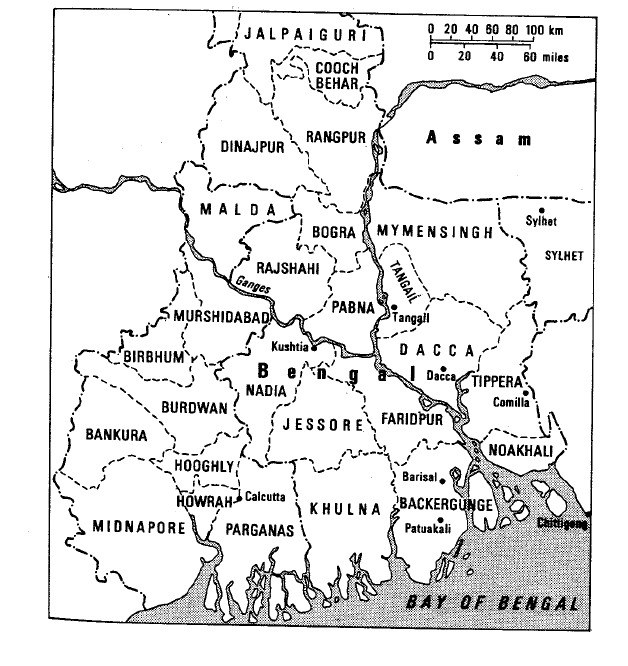
A 1945 map of Bengali districts as of 1943.
Famine Inquiry Commission (1945): Report on Bengal via Wikimedia Commons.

This argument was put forward by the BBC’s own Yogita Limaye, an Indian engineer and reporter on Women’s safety, based on the book Inglorious Empire by Shashi Tharoor, who was interviewed to give his opinion that Churchill was an “odious figure of reprehensible views and racist attitudes.”

No doubt the narrative of British evil and oppression is believed in India and elsewhere, but that does not make it true or worthy of the BBC reporting it as fact without any semblance of balance. The BBC failed its licence fee paying audience in two main regards, namely, conceptually and factually.

The British ruled India, one of the largest populations on earth, for well over two centuries. Good and bad things happened, just like everywhere else ever. You can join the dots to create whatever picture you like – Dr Tharoor chose the picture he wished to create. Why is the Bengal famine uniquely interesting to a BBC audience in 2020 over say a mini-series on British Railways and development in India? BBC presenters are demonstrably more interested in the first narrative: this is a major conceptual failing on their part. Being equal mixtures primitivism and solipsism. Always the borderline racist Western assumption is that “we” did things to “them”: we had agency, they were passive brutes. They are boring, we are endlessly interesting. Let’s talk about us. However even the slightest knowledge of the British-in-India teaches one that “we” did nothing without them. How on earth could we? There were famously few of us.

Yet it’s the second great BBC failing – over accuracy – which is so especially galling. On the actual allegation the BBC is plain wrong. Churchill was not responsible for the Bengal famine as any actual delving into the facts would have shown. Note well that they didn’t even try.

In 1943 Britain was at war with Japan, who were at the gates of India having occupied Burma, a major supplier of grain to Bengal. Important facts. Bengal was in the grips of a famine, nobody disputes that. But Churchill was not responsible, neither for the weather nor the agriculture nor the Japanese aggression.

Even the BBC did not allege that Churchill instigated the famine, the charge sheet is that he refused to help when he could. There were “stockpiles [of food] in the UK” and shipping which was retained in the northern hemisphere, prioritised for use there. Stockpiles of food in the UK in 1943? Even if there was the food and shipping, transporting US corned beef to Bengal would have been ludicrous. If there was shipping and protection from Japanese naval assault the food would have come from the rest of India. So why was food not transported from other parts of India to Bengal?

Prime Minister Winston Churchill greets Canadian PM William Lyon Mackenzie King, 1941.
Photo from Library and Archives Canada (reference number C-047565) via Wikimedia Commons.

April 1, 2020

Curator’s Tank Museum Tour: Tank Story Hall – WW1 | The Tank Museum

Filed under: Britain, Europe, France, Germany, History, Military, WW1 — Tags: , , , , , — Nicholas @ 05:00

The Tank Museum
Published 31 Mar 2020

Join Curator David Willey as he takes you on a tour of The Tank Museum’s Tank Story Hall, which houses over 30 key vehicles from Little Willie to Challenger 2. In this section he looks at the First World War vehicles and gives you a potted history of WW1.

Support the work of The Tank Museum on Patreon: ► https://www.patreon.com/tankmuseum
Visit The Tank Museum SHOP & become a Friend: ► https://tankmuseumshop.org/

Twitter: ► https://twitter.com/TankMuseum
Instagram: ► https://www.instagram.com/tankmuseum/
Tiger Tank Blog: ► http://blog.tiger-tank.com/
Tank 100 First World War Centenary Blog: ► http://tank100.com/
#tankmuseum #tanks

March 24, 2020

QotD: “Desacralizing the State”

Filed under: Government, History, Politics, Quotations — Tags: , , , , — Nicholas @ 01:00

Winston Churchill famously proclaimed democracy to be the least-worst government. Alas, quotability is not the same thing as wisdom. Worst at what, Sir Winston?

Speaking of quotable-yet-loony folks, Aristotle defined Man as “the political animal,” and as such had an answer to our question: The State’s purpose, Aristotle said, is to promote virtue.

Let’s leave the contentious topic of “virtue” aside, and step back to the definition of “Man.” Man isn’t a political animal. Man is a purpose-finding animal, an explaining animal. We simply can’t resist the siren song of teleology. We all live under some kind of State; therefore, we assume that “The State” must have a purpose. It’s in our DNA; we can’t do otherwise, but … we might be wrong. Perhaps “self-organization into some kind of government” is just one of Humanity’s givens, like “sexual dimorphism*” or “requires oxygen.” Maybe “government” just IS.

A dangerous thought, that. If it’s true, it desacralizes the State — the worship of which, I think we all agree, has driven all the major political events in the West since at least 1789. Historian Herbert Butterfield called the 20th century’s great mass movements “giant organized forms of self-righteousness,” but he could’ve taken that a step further — “popular” government of any sort invariably becomes a giant organized form of self-righteousness. People being people — that is, teleology-addled monkeys — it can’t be any other way. The State, since it exists, must exist to do something. What better something to do than to promote virtue?

So we’re back to Aristotle. But it looks like Aristotle stole a base. As a rule, people aren’t virtuous. Why else would they need the State to promote virtue? And yet, the State is made up of nothing but people. Aristotle also said that a cause can’t give something to an effect that it, the cause, doesn’t already have. So how, then, can the State — which, like Soylent Green, is made of people — itself make people virtuous?

See what I mean about this teleology stuff? The mind rebels. The State is a human thing. Humans made it, and every human act, we’re hardwired to believe, has a purpose behind it. That hardwiring may lead us into incoherence in under three steps, but so far as I know, I’m the only guy in the history of Political Science ever to suggest that government just … kinda … IS. That it evolved with us, and thus all our airy-fairy noodling about Divine Right and We the People and the Vanguard of the Proletariat and whatnot are just foolish blather about what’s basically still a monkey troop.

[…]

All this would be just philosophy-wank, better suited to a dorm room bull session after a few bong rips, if not for the fact that “desacralizing the State” has to be the #1 project of any viable Dissident movement. The State, as a human production, has only such “goals” as we give it … and, being made up of nothing but humans, is going to be as good at achieving those goals as we humans generally are at achieving any of our goals …

Severian, “The Least-Worst Government?”, Rotten Chestnuts, 2019-12-21.

March 23, 2020

Naval strategy versus naval tactics in the Battle of the Atlantic

Ted Campbell outlines how the Battle of the Atlantic was fought between the Kriegsmarine and the Royal Navy (and the Royal Canadian Navy and, eventually, the United States Navy) in World War 2:

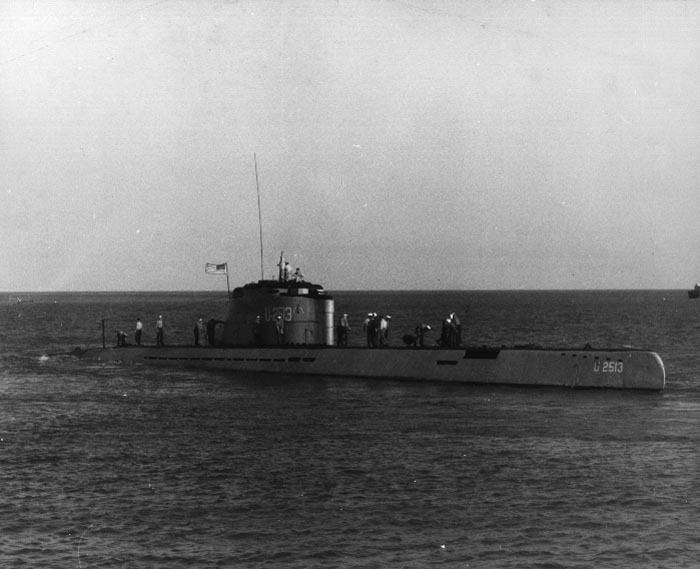
U-2513 in US Navy control off Key West, Florida – 30 October 1946

… there is a rather thick, and quite blurry line between naval strategy and naval tactics. One Army.ca member used the Battle of the Atlantic to distinguish between two doctrines:

  • Sea control ~ which was practised by the 2nd World War allies ~ mostly British Admirals Percy Noble and Max Horton in Britain and Canadian Rear Admiral Leonard Murray in St John’s and Halifax; and
  • Sea denial ~ which was practised by German Admiral Karl Dönitz.

The difference between the two tactical doctrines was very clear. The strategic aims were equally clear:

  • Admiral Dönitz wanted to knock Britain out of the war ~ something that he (and Churchill) understood could be done by starving Britain into submission by preventing food, fuel and ammunition from reaching Britain from North America. (We can be eternally grateful that Adolph Hitler did not share Dönitz’ strategic vision and listened, instead, to lesser men and his own, inept, instincts); and
  • Prime Minister Churchill, who really did say that “the only thing that ever really frightened me during the war was the U-boat peril“, who wanted to keep Britain fighting, at the very least resisting, until the Americans could, finally, be persuaded to come to the rescue.
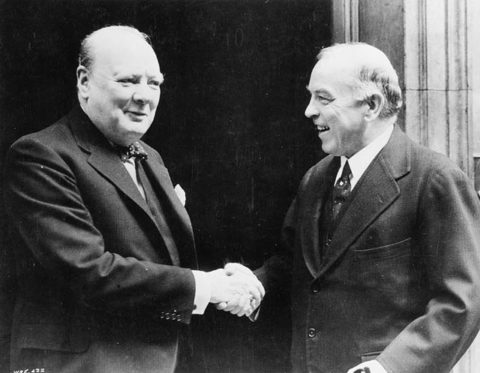
Prime Minister Winston Churchill greets Canadian PM William Lyon Mackenzie King, 1941.
Photo from Library and Archives Canada (reference number C-047565) via Wikimedia Commons.

Canada’s Prime Minister Mackenzie King did have a grand strategy of his own. It was to do as much as possible while operating with the lowest possible risk of casualties ~ the conscription crisis of 1917 was, always, uppermost in his mind and he was, therefore, terrified of casualties. He mightily approved of the Navy doing a HUGE share in the Battle of the Atlantic ~ especially by building ships in Canadian yards and escorting convoys which he hoped would be a low-risk affair.

Churchill’s grand strategy was based on Britain surviving … there was, I believe, a “worst case” scenario in which the British Isles were occupied and the King and his government went to Canada or even India. But that has always seemed to me to be a sort of fantasy. The United Kingdom, without the British Isles, made no sense.

    (While I believe that Rudolph Hess was, as they say, a few fries short of a happy meal, I think that he and several people in Germany believed that it might be possible to negotiate a peace with Britain which many felt was a necessary precursor to a successful campaign against Russia. The Battle of Britain (die Luftschlacht um England, September 1940 to June 1941) was, clearly, not going in Germany’s favour. Late in 1940, the Nazi high command had been forced to send a German Army formation to Libya to prevent a complete rout of the Italians. Malta still held out, meaning that Britain had air cover throughout the Mediterranean. In short, Britain was not going to go down unless it could be starved into submission ~ and in the spring of 1941, the Battle of the Atlantic was going in Germany’s favour. There was, in other words, some reason for Germans to believe that an armistice might be possible ~ freeing up all of Germany’s power to be used against the USSR.)

    (But things were changing for the Allies, too. At just about the same time as Hess was flying to Scotland, then Commodore Leonard Murray of the Royal Canadian Navy, who had been in England on other duties, had met with and persuaded Admiral Sir Percy Noble, who liked Murray and had been his commander in earlier years, that a new convoy escort force should be established in Newfoundland and that it should be a largely Canadian force (with British, Dutch, Norwegian and Polish ships under command, too) and that it should be commanded by a Canadian officer. Admiral Noble insisted, to Canada, that Murray, who he liked, personally, and who had written, extensively, on convoy operations in the 1920s and ’30s, must be that commander. The establishment of the Newfoundland Escort Force, which would be more appropriately renamed the Mid Ocean Escort Force in 1942, was a key decision at the much-debated operational level of war which put an expert tactician (Murray) in command of a major force and allowed him (and Noble) to move closer to achieving Churchill’s strategic aim. The Battle of the Atlantic was not won in 1941, but it seemed to Churchill, Noble and Murray that they were a lot less likely to lose it, even without the Americans.)
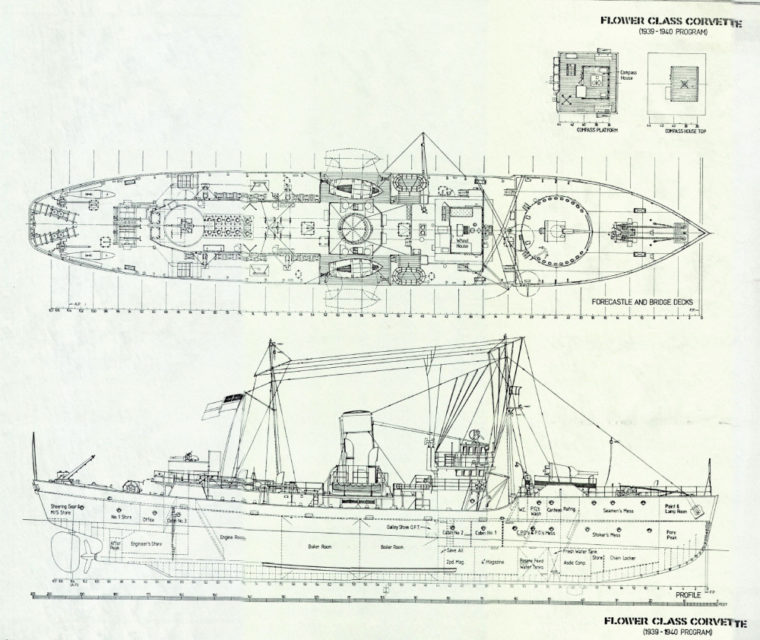
Diagram of the early Flower-class corvettes, via Lt. Mike Dunbar (https://visualfix.wordpress.com/2017/04/12/dreadful-wale-4/)

Anyway, the boundaries of strategy vs. the operational art vs. tactics were as thick and blurry in 1941 as they are today. The decision, taken in 1939, for example, to build little corvettes in the many British and Canadian yards that could not build a real warship was, in retrospect, a key strategic choice, but it was, at the time, totally materialist: just a commonsense, engineer solution to an operational problem ~ lack of ships. Ditto for the eventual decision, which had to be made by Churchill, himself, to reassign some of the big, long-range, Lancaster heavy bombers to Coastal Command. It was, once again, with the benefit of hindsight, a key strategic move, but at the time it would likely have seemed, to Capt(N) Hugues Canuel, the author of that Canadian Naval Review essay, to be materialistic, more concerned with how to use the resources available than with deciding what is needed.

I agree with Capt(N) Canuel that, by and large, Canadians have left strategic and even operational level thinking to first, the British and more recently the American admirals ~ Rear Admiral Murray being known, in the 1930s and early 1940s as a notable exception.

« Newer PostsOlder Posts »

Powered by WordPress