
The other strategic aim nomads might fight over is for the acquisition of some kind of movable good, which is to say raiding for stuff. Because all of the warriors (which is generally to say all of the free adult males) of these societies are mounted and because they have a subsistence system which allows rapid, relatively along distance movements (often concealed; remember that Mongols need not light any camp fires), nomads make fearsome raiders, able to strike, grab the things they are looking for and quickly retreat before a counterattack can be mobilized. That goes just as well for raiding each other as it does for raiding the farmers at the edges of the grasslands.
But what are the things here that they are aiming to get? It depends on the targets; nomadic raids into the settled zone generally aim to capture the goods that agrarian societies produce which nomadic societies do not: stocks of cereal crops, metal goods and luxury goods. But most nomadic raiding was directed against other nomads, seeking to acquire either people or animals.
On the Great Plains, the animals in question were invariably horses; the act of stealing, or “cutting out” a horse gives McGinnis part of the title of his book (Counting Coup and Cutting Horses) and raids for horses dominate both McGinnis and Secoy’s discussion of Plains Native American warfare. Horses were, after all, a scarce commodity which only percolated into the Great Plains from the South (and which could only be raised in quantity in its southern reaches), but which all tribes required both to hunt and fight effectively. Stealing enemy horses thus both strengthened your tribe while weakening your enemies, both in military and subsistence terms. The Mongols also engaged in quite a lot of raiding for horses, but also – in a pastoral subsistence system – a lot of simple cattle rustling as well (e.g. Ratchnevsky, op. cit., 28-31).
Raiding for people is more complex, but undeniably part of this system of warfare. But crucially this raiding was generally not for slave-trading (though there are exceptions which I discussed last time), but instead incorporative raiding. What I mean by that is that the intent in gaining captives in the raid was to incorporate those captives, either as full or subordinate members, into the nomadic community doing the raiding. Remember: the big tribe is the safe tribe, so incorporating new members is a good way to improve security in the long run.
On the Eurasian Steppe, incorporated captives became the ötögus bo’ol “bonded serfs” that we mentioned previously (Ratchnevsky, op. cit., 12-4). Unlike warfare on the Great Plains, it seems possible for the bo’ol to include adult men, either captured or sold (by destitute parents) as children or else taken as prisoners when their tribe or clan was essentially dissolved by being conquered in war. Indeed, in his own conquests, Chinggis only decreed the annihilation of one tribe, the Mongols’ traditional enemies, the Tatars – there he ordered the death of any Tatar male taller than the linchpin of an oxcart (May, Mongols, 12). In other cases, it is clear that the incorporation of defeated nomad warriors into the successful tribe was fairly normal, though raids to capture women and children (also for incorporation) were just as common. Bride abduction in particular was very common on the Steppe, as Ratchnevsky notes (op. cit., 34-5).
The incorporation of males was far less common in Great Plains Native American warfare, but the capture of women and children to enhance tribal strength in the long term was a core objective in raiding. McGinnis (op. cit., 42-3) notes how the Crow, after suffering a massive defeat in the early 1820s which resulted in the deaths of many warriors and the capture of perhaps several hundred women and children, steadily built their tribe back up over the following decades with an intentional strategy of capturing women and children from their enemies. As McGinnis (op. cit., 24) notes, women captured in this way might be married into the capturing tribe, adopted into it, or sometimes kept as an enslaved laborer (under quite bad conditions). Adult males, by contrast, were almost always killed; unlike on the Steppe, the incorporation of formerly hostile warriors doesn’t seem to have been considered possible (though one wonders if this would have become cultural practice given enough time; both McGinnis and Secoy note how the increasing lethality of warfare post-gun/horse led to slow population decline overall, which may, had the system run without outside interference long enough, led to the emergence of norms more closely resembling the Eurasian Steppe. We should keep in mind that the Eurasian horse-system had many centuries to sort itself out, whereas the North American horse-system was essentially strangled in its crib).
Of course, taken together with the previous discussion of territorial warfare, we can see that all of these raids have a double purpose: they both aim to acquire resources (horses, sheep, humans) and at the same time inflict damage on an opponent with the long-term goal of forcing that enemy to move further away, opening their pastures or hunting grounds for exploitation by the victorious tribe. Thus in the long-term, each successful raid is intended to build a sense of threat which eventually results in territorial gains (though in cases of real power asymmetry, the long term could come very rapidly; people aren’t stupid and if you are being raided by a clearly superior opponent, you are likely to move on before you lose everything of value).
Squaring the ugly reality of nomadic raiding with [George R.R.] Martin’s depiction [of his nomadic Dothraki] is tricky. On the one hand, a raid in which exceptional victory results in enemy women and children taken captive and fit adult males slain fits within either the Great Plains Native American or Steppe nomad military tradition. On the other hand, the immediate declaration by Drogo’s men that female captives taken this way are not marriageable (AGoT, 559; the idea is treated as laughable) and the killing of all of the very valuable livestock (which, even if the Dothraki are not herdsmen, these animals could be eaten, or quite easily driven to a place where they could be sold or traded for other resources, like metalwork) suggests that Martin has not understood why those raids happened. Instead, it seems like his imagination is only able to view these raids from the perspective of the settled people on the receiving end.
Instead, Martin’s understanding of Native American warfare seems not conditioned by any actual Native Americans, but rather by Hollywood depictions of Native Americans during the Hollywood “Golden Age” which were in turn conditioned by sensational accounts of Western settlers who themselves didn’t understand how Native American warfare worked on the Great Plains. As we will see, the Game of Thrones showrunners took that unfortunate subtext when making the show itself, and turned it into actual text.
Bret Devereaux, “Collections: That Dothraki Horde, Part IV: Screamers and Howlers”, A Collection of Unmitigated Pedantry, 2021-01-08.
June 24, 2024
QotD: Raid warfare on the Eurasian Steppes and on the Great Plains
June 23, 2024
The amazing range of things Britain’s Ofcom gets its tentacles into
Earlier this week, Mark Steyn discussed the British government’s Office of Communications (Ofcom) and the way it rigs regulates who can say what during British election campaigns:

Why do I think the UK state censor Ofcom should be put out of business? Because there are very few areas of British life that this strange, secretive body does not “regulate”. Take, for example, this current UK election campaign, which the media are keen to keep as a torpid Potemkin struggle between TweedleLeft and TweedleRight. So, on Thursday night, BBC bigshot Fiona Bruce will host a debate between the four party leaders – that’s to say, the head honchos of the Conservatives, Labour, the Liberal Democrats and the Greens.
Wait a minute: what about Nigel Farage, leader of the Reform party? Since the beginning of the year, Reform has been third-placed in the polls, ahead of the LibDems and Greens, and last week they rose to second place ahead of the unlovely Tories.
So why wouldn’t the second-place party get a spot in the leaders’ telly debate?
Ah, well, you’re looking at it all wrong, you hick. Here’s how the Beeb explain it:
The Ofcom guidance gives “greater weight on the actual performance of a political party in elections over opinion poll data” taking into account the “greater uncertainty associated with support in opinion polls”.
The “actual performance of a political party” refers to their results in the two previous elections — 2019 and 2015 — when Reform didn’t exist. A lot of other things didn’t exist in 2015: Brexit, Covid, lockdown, the Ukraine war, legions of vaccine victims, the massed ranks of Albanian males occupying English country-house hotels …
But, per “Ofcom guidance”, Campaign 2024 has to be conducted on the basis of how things stood a decade ago.
You know who would also be ineligible to participate under Ofcom’s rules? Everyone’s favourite Lana Turner sweater-girl in Kiev, Volodymyr Zelenskyyyyy. He only formed his Servant of the People party in late 2017, so no election debates for you, sweater-girl. And don’t try blaming it on Putin, because it’s “Ofcom guidance” so we all know it’s on the up-and-up.Because, as their barrister assured the High Court, Ofcom are “expert regulators”. Lord Grade and Dame Melanie Dawes probably did a module in regulation at Rotherham Polytechnic or whatever.
I can see why the likes of Naomi Wolf’s creepy stalker-boy Matthew Sweet like this system: it’s a club and they get to decide who’s admitted. It’s less obvious why the generality of the citizenry put up with it. At any rate, get set for another thrilling BBC election debate in which all four “opponents” agree on Covid, climate, Ukraine, the joys of mass Muslim immigration and the inviolability of the NHS … but ever more furiously denounce each other for not tossing enough money that doesn’t exist into the sinkhole.
Don’t get me wrong, I quite like that pixie Green leader who describes herself as a “pansexual vegan”, and I certainly don’t have the personal baggage with her that I have with Nige. But under what rational conception of media “regulation” does the six per cent basement-dweller get guaranteed a seat at the table but not Reform?
And you wonder why nothing changes?
June 22, 2024
“We can learn a lot about our betters from looking at each exception to their rules”
Julie Burchill isn’t a soccer fan, but she points out that the “exceptions” to the usual “rules” that the kakistocrats allow during international soccer tournaments tell us a lot about them:

Patriotism is not the only “bad” thing we’re suddenly “allowed” to do in the weeks when the national team plays on the world stage. The BBC in particular reminds men that they can disregard the finger-wagging for a few brief weeks. In EastEnders, male characters cringingly ask their mates to “get the beers in for the game”. Alcohol would generally be condemned as a public-health menace by Auntie, but during “The Game”, one more “cheeky” tipple apparently won’t hurt you.
We can learn a lot about our betters from looking at each exception to their rules. Don’t be racist – except against Jews. Believe all women about sexual assault – unless they’re Israeli. Oh, and be careful not to “culturally appropriate” the slightest thing from any other nationality, even to the point of never wearing a sombrero in a Mexican restaurant – but it’s fine to be a cross-dressing man culturally appropriating my sex. Meanwhile, if you’re a woman, be a good little Transmaid and stand by smiling, even if you call yourself a feminist.
Like most other places in the West in these dog days of civilisation, England feels like a nation devoid of hope and pride. Even so, being allowed to take pride in some overpaid ball-kickers, but not in the fact that this country contributed massively to ending slavery – lest we be called out as White Saviours – is a somewhat surreal situation to find ourselves in, after all those centuries of blood, sweat and struggle.
Flying the flag for the duration of the Euros is like being a eunuch who’s permitted to have his nuts back for a couple of weeks – for old times’ sake – and wear them as earrings. But those who indulge must be sure to tear their St George’s down sharpish once the festivities are over, lest they be fingered as a fascist for liking their own flag more than others. Remember, the only flag that can be flown constantly now is the Pride flag. This must be saluted respectfully wherever it pops up – failure to do so may identify you as an unworthy citizen of Soft Play Pit Nation.
June 11, 2024
We’ve descended into some sort of bizarre hellworld where Jeremy Clarkson can be described as an “unlikely national treasure”
In The Critic, Kara Kennedy considers the possibility that Jeremy Clarkson, the petrolhead’s petrolhead, might actually have a soul:

Screencap from Jeremy Clarkson’s banned Hawkstone Lager ad
The last truly poignant thing I watched on television was a show about a grumpy farmer raising piglets. He’s a city gentleman new to farming, but what may have started out as a gimmick has, over three growing seasons, transformed into a real calling. Or a passion, even. And one that, in some moments, sees him battle with life and death. Unfortunately, for a lot of the little piglets, it was death. After watching their births — their first moments and last, after their delinquent pig mothers smothered them without a care in the world — I cried. My husband cried. The friends who we harangued to watch the season again with us cried. And Jeremy Clarkson cried.
Yes, I am talking about Jeremy Clarkson on Clarkson’s Farm, streaming on Amazon Prime Video. Clarkson, over the last few decades, has made a career for himself in part by being easy to hate. It is uncomfortable for everybody, himself included, that the miserable boomer has turned into an unlikely national treasure, and all it took was some honest work.
Clarkson is cultural marmite. After 35 years on the BBC’s Top Gear, he is revered in the petrolhead community as a god. Newspapers love him because he’s impolite and will sell some prime “you can’t say anything anymore” content. Meghan Markle hates him after he once wrote he was “dreaming of the day” that British crowds threw lumps of shit at her. Feminists hate him for mostly that same reason. Leftists hate him for writing once that striking workers should be “shot in front of their families”. As for the denizens of the countryside, he has maintained a multi-decade fight in his newspaper column with ramblers.
Basically, the answer to whether you like Clarkson relies really on whether you take what a funny old guy says seriously. But there are some legitimate grievances towards the presenter too. When he was finally bounced from the Beeb, it was because he punched a producer. And as annoying as the people who had long had it in for Clarkson had always been, it is not some new Gen Z norm or innovation of “cancel culture” to say you can’t physically assault your colleague. That said, the producer in question did sue him for racial injury, which is a bit closer. (He called him Irish, for God’s sake!) The crux of it, anyway, is that Clarkson is badly behaved and probably too inconsistent to be trusted by any major TV network. He wound up on Amazon Prime’s The Grand Tour, a just-changed-enough-to-be-legal Top Gear clone, once again drawing a massive and mostly male audience that loves to memorise the 0-60 times of cars only oligarchs can ever afford.
But, once The Grand Tour began winding down — it now returns just for the occasional travel special — the old presenters went off to make spinoffs for Amazon. And Clarkson decided to make his, and to rejigger his Times column, around his 1000 acre country farm in the Cotswolds. And that is where, through epiphany, necessity, human nature, act of God, or sheer growing up, Clarkson was reborn as someone who not just the lovers of edgy humour and high horsepower figures can admire.
June 5, 2024
Hollywood has been here before … and they learned nothing
Ted Gioia illustrates the mind-blowing dominance of westerns on TV and in the theatre in the 1950s and how quickly the boom was over and has never come close to recovering:
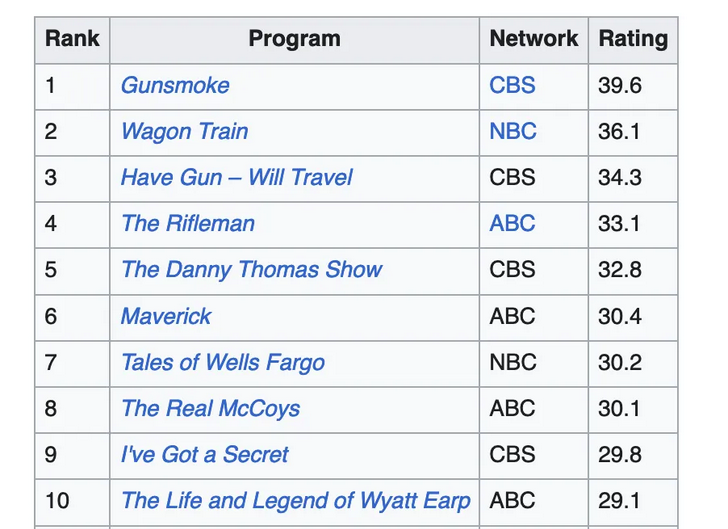
Source – https://en.wikipedia.org/wiki/Top-rated_United_States_television_programs_of_1958%E2%80%9359
Eight of the top ten shows during the 1958-59 season were westerns.
Spaceships were in the news every day back then, but on TV it was just horses — and occasionally a covered wagon. Each of the three networks was caught up in a time warp, partying like it was 1899.
Any fool could see that they were saturating the market. Yet the studios kept launching new westerns with regularity, although with less confidence, for another decade, more or less.
Back in 1955, the three US TV networks had introduced three new western-themed series — Gunsmoke, Cheyenne, and Wyatt Earp. But two years later, the networks ramped up their investment in cowboys, launching nine new westerns that fall.
And it got worse.
In 1958, these three networks introduced ten more western series. On some nights, you could watch cowboys for two hours straight on ABC. CBS and NBC also started scheduling back-to-back Wild West shows.
I need to stress that the western was already an exhausted genre long before 1960. Movie theaters had relied on cowboys as an audience draw going back at least to Broncho Billy Anderson and The Great Train Robbery (1903).
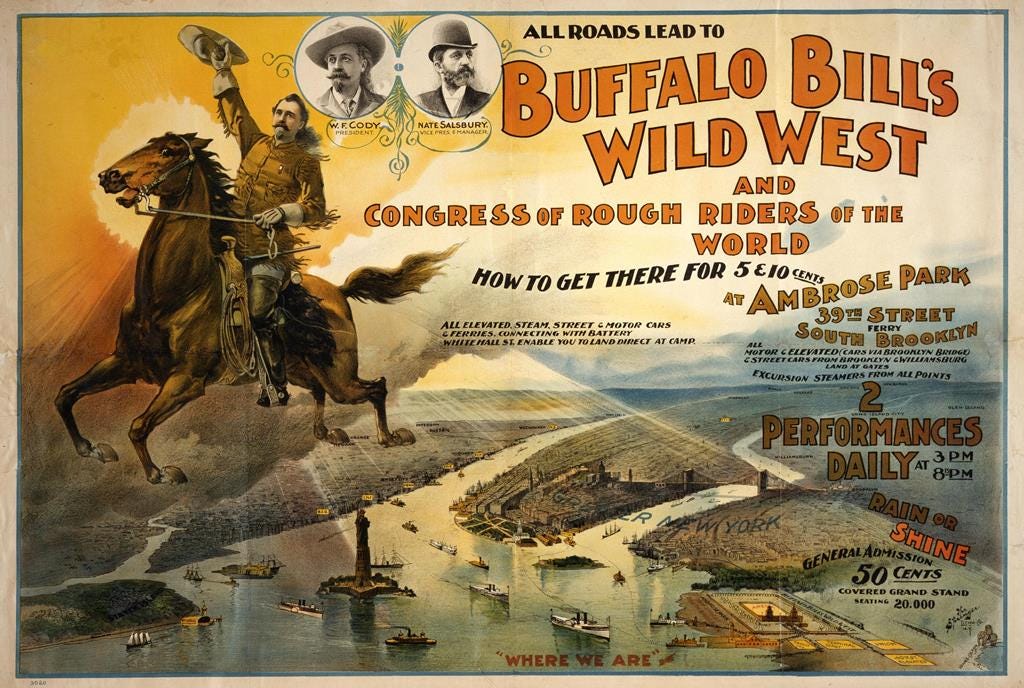
And cheap books and magazines with stories of the Wild West had already been around for decades at that point. By my measure, nostalgia for the old West dates back to the launch of Buffalo Bill’s Wild West show on May 19, 1883 in Omaha, Nebraska — four years after the invention of the gasoline engine.
Poster for Buffalo Bill’s Wild West Show — the first major cowboy nostalgia business
[…]
Younger viewers were the first to abandon the western — a telling sign, especially when you consider that, back in the 1930s, children and teens had been the core audience for the genre.
By the time Gunsmoke went off the air in 1975, the few remaining fans were old-timers — maybe the same ones who had gone to movie theaters to cheer for Roy Rogers in the 1930s. That show had been the most popular TV series in the US for four seasons in the late 1950s. But a cowboy series would never do that again.
Youngsters lost interest in westerns despite a proliferation of merchandise. During my childhood, I paid no attention to the cowboy genre — nor did any of my friends. But brand merchandise was everywhere. We could buy Gunsmoke comic books, trading cards, lunchboxes, and — of course! — toy guns, among other paraphernalia.
With the benefit of hindsight, we can see that these products did not develop the market — they merely saturated it.
June 2, 2024
A definite sign of the end-times – “South Park is going into its 27th season”
I’d pretty much given up on watching anything on television around the time that South Park went on the air, so I never “stopped watching it” because I wasn’t watching anything on TV by that time (although I did see Team America: World Police in the theatre). Andrew Sullivan says I’ve been missing something quite worthwhile for all this time:
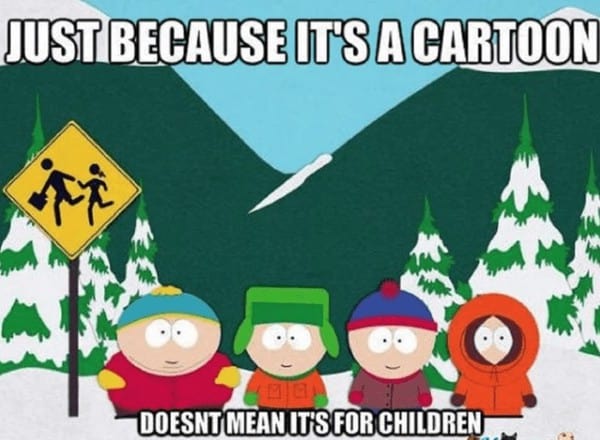
South Park is going into its 27th season. And it has rarely been better. (I simply can’t believe so many people I meet say they haven’t watched in years. You’ve been missing out!) The new special on obesity — a deft masterclass of social commentary — has a brutal takedown of suburban white women jonesing for doses of Ozempic like meth-heads; a definitive — and musical! — digression into the insanity of the American healthcare system; pure, character-driven humor in a figure like Randy Marsh — a far subtler parody of the average American male than Homer Simpson; and, of course, Eric Cartman — the “big-boned” fat-ass kid whose capacity for pure evil was first truly captured in the epic “Scott Tenorman Must Die“.
You can read books on Ozempic, scan op-eds, absorb TikToks, and even listen to the Dishcast! — but nothing out there captures every single possible social and medical and psychological wrinkle of this new drug than this hour of crude cartoons. Yes, there are fart jokes. There are always fart jokes. But fart jokes amid a sophisticated and deeply informed parody of insurance companies? Or, in other episodes, toilet humor guiding us through the cowardice of Disney, the dopey vanity of Kanye, the wokification of Hollywood, the exploitation of black college athletes, the evil of cable companies, the hollowness of hate-crime laws, the creepiness of Christian rock, or the money-making behind legal weed? Only South Park pulls this off. Only South Park gets away with all of it.
It’s a 1990s high-low formula at root, sophisticated cultural and political knowingness married to crude cartoons, silly accents, m’kay, and a talking Christmas turd, Mr Hankey. Generationally, it really marked a moment when merging these two worlds seemed the most creative option — not an abandonment of seriousness, but the attachment of a humane levity to it. South Park can be brutal, but it is never cruel. Unless you’re Barbra Streisand or Bono. And virtually every character (even Eric) is redeemable. Except Meghan Markle.
Yes, Matt and Trey have tried other things. To wit: just one of the best and most successful musicals of the 21st century, The Book of Mormon. They’ve pioneered deep-fakes. They also just renovated and relaunched a huge Denver restaurant they loved as kids, Casa Bonita, memorialized in a classic Cartman-is-evil episode. Twenty years ago, they actually created an entirely puppet-acted movie with epic sex and vomit scenes as a commentary on the war on terror, Team America; and are now teaming up with Kendrick Lamar to shoot a live-action comedy about a biracial couple where the black boyfriend interns as a slave re-enactor only to discover that his ancestors were owned by his girlfriend’s. No landmines there.
But they always return to South Park and evince no desire to transcend it — partly because it has become an entire world that can expand and contract at will: a world where Mel Gibson tweaks his nipples and smears his feces, Mickey Mouse acts like a mafia don, Michael Jackson’s nose falls off, Meghan Markle is a literal empty vessel, Christopher Reeve eats fetuses for their stem-cells, and Tom Cruise works in a fudge factory where, yes, he does a lot of the packing.
And in two decades of an acutely polarized and politicized culture, what team is South Park on? Precisely. You can’t tell, can you? — which is a staggering achievement in its own right. And it’s not about risk-aversion: the duo was targeted by Islamist terror and didn’t blink. They also took on the censors at the MPAA — savor this memo — and obliterated one of George Carlin’s “Seven Words You Can Never Say on TV” by saying “shit” 162 times in one episode.
They’ve shown Martha Stewart putting a whole turkey up her back-hole, Paris Hilton putting a whole pineapple up her front-hole, Caitlyn Jenner running over innocent pedestrians, and Jesse Jackson demanding that his big black ass be ceremoniously kissed. They’ve tackled Scientology and Mormonism; they’ve shown intergalactic Catholic priests astonished at the idea they have to stop raping young boys; and they beat Dave Chappelle by two decades with “Mr. Garrison’s Fancy New Vagina” — their take on sex reassignment.
They have done all this, taken no prisoners, and remain uncancellable. Why? Because their mockery is genuinely universal (including themselves), their courage is real, and because they remain humane.
By humane, I mean they show how you can skewer and yet still love. As a young gay man, I often winced at the careful, all-too-sensitive depictions of gay men in most movies and television, the elaborate ways in which the subculture was homogenized and prettified for straight audiences. But in South Park, I could see the gay reality as I had already witnessed it in all its bewildering variety: the right-wing, elementary school teacher Mr Garrison … dating Mr Slave — a leather-daddy with a gerbil called Lemmiwinks living in his upper colon; I could see Big Gay Al get expelled from the Boy Scouts — and defend their right to do so; I could see Butters’ dad on the DL at the White Swallow bathhouse; in time, I could see Satan having a gay love affair with Saddam Hussein, because his other boyfriend was so lame. They even made AIDS funny. The offense worked because it always conveyed an actual truth about gay men, while also obviously mocking us with love. (Mr Slave was portrayed as a moral paragon next to Paris Hilton, for example, and Mr Garrison eventually ends up with Rick, a total normie.) South Park‘s role in helping America grow up on the topic of homosexuality, especially the young male demographic who followed them, is deeply under-rated.
May 20, 2024
If King Crimson Played the Batman TV Theme
JB Anderton
Published Jan 8, 2024Batman TV Theme written by Neil Hefti
Arrangement by JB Anderton
Bass, guitar, keyboards and drum loop programming – JB AndertonBatman ’66 is a registered trademark of Greenway Productions/20th Century Fox. No infringement is intended.
#KingCrimson #Batman66
May 14, 2024
The Eurovision non-binary song contest
Unless you’re very tuned in to all things Euro, you might not have known that the gala Eurovision Song Contest has again come and gone (I only noticed after the fact myself). It wouldn’t be a televised pan-European event if there wasn’t at least a tiddly bit of controversy, so that role appears to have been eagerly filled by the Irish contestant, in whom Brendan O’Neill is unimpressed:

What a thing of beauty that Israel beat Ireland in Saturday’s Eurovision Song Contest. That Israel’s serene songstress, Eden Golan, got more points than Ireland’s warbling, gurning, pseudo-Satanic they / them, Bambie Thug. That an actually decent song trumped the caterwauling of a fake punk who mistakes having tattoos, identifying as “nonbinary” and saying “I’m queer!” for a personality. More importantly, that a singer who was harangued by baying mobs of Hamas fanboys did better than the “singer” who helped to whip up this orgy of cruelty by saying she cried when she heard Israel had made it to the final. Boo-fucking-hoo. I bet you’re crying even more now, Ms Thug.
This is the news – the beautiful news – that Israel came fifth and Ireland sixth in the Eurovision Song Contest. Of course – because they are racist and mentally unstable – Israel haters on social media are saying the Zionist octopus helped to bump up Israel’s points. One pictures Mossad agents taking a break from hunting down the anti-Semites who slaughtered a thousand of their compatriots to post memes on Facebook saying “Screw Bambie, Vote Eden!”. In truth, the reason Israel did so well in the public vote – getting the maximum “douze points” from no fewer than 14 of the 37 nations eligible to vote in Eurovision – is because normal people don’t share the Euro-bourgeoisie’s feverish loathing for the Jewish State. It wasn’t only the emotionally incontinent Israelophobe Bambie Thug who took a beating last night – so did the entire anti-Israel middle class whose cries for a boycott of Eurovision clearly fell on deaf ears.
We shouldn’t get ahead of ourselves, of course, given it’s only Eurovision, and given that some people (me, for example) were highly motivated to vote for Israel in order to wind up the wankers of Europe. But it is undeniably delicious that, despite the pompous pleas of drag queens and other paragons of morality for everyone to switch off Eurovision this year, millions watched. Around 7.6million Brits tuned in. Yes, that’s lower than last year – when we were the hosts – but it’s higher than every year between 2015 and 2021. It will be a source of mirth for me for some time that while the LGBTQ lobby was self-importantly putting away the glitter, locking the drinks cabinet and doing their very best not to check X for Eurovision updates, the general public were watching and enjoying the daftness of it all. Rarely has the moral gulf between us and our preening cultural overlords been so starkly exposed.
Then there were the votes for Israel. It felt like a tiny rebellion against the hysteria of the elites. Brits gave Israel 12 points. So did France, Germany, Belgium, Italy and others. This was people saying “We don’t agree with your bullying of a young woman and your obsessive hatred for her homeland”. Even the good people of Ireland gave Israel 10 points. As someone who knows and loves Ireland, it would not surprise me one iota to discover that people there are as yawningly vexed by Bambie Thug as everyone else in Europe who enjoys the sense of hearing. The land that gifted Eurovision Dana, Johnny Logan and Riverdance now finds itself represented by a self-styled “goth gremlin goblin witch” who does “primordial screaming” (shorter version: she can’t sing). What a mess. I’ve been listening to Logan’s “Hold Me Now” (winner in 1987) to try to liberate my brain from Thug’s narcissistic howling.
Andrew Doyle also commented on the “non binary” emphasis of many participants:
This year the trophy went to Switzerland’s Nemo, a man in a skirt who identifies as “non-binary”. The UK entry, Olly Alexander, calls himself “gay and queer and non-binary” but magnanimously accepts the pronouns “he” and “him”. And then there is the “queer” and “non-binary” Irish entry Bambie Thug, a woman who came sixth in the competition but first in the award for the sorest of losers. Having being beaten by Israel, whose very presence in the competition was a source of outrage for Thug, she had the following to say:
I’m so proud of Nemo winning. I’m so proud that all of us are in the top ten that have been fighting for this shit behind the scenes because it has been so hard and it’s been so horrible for us. And I’m so proud of us. And I just want to say, we are what the Eurovision is. The EBU [European Broadcasting Union] is not what the Eurovision is. Fuck the EBU. I don’t even care anymore. Fuck them. The thing that makes this is the contestants, the community behind it, the love and the power and the support of all of us is what is making change. And the world has spoken. The queers are coming. Non-binaries for the fucking win.
One might argue that all of this is simply an extension of the high-campery of old. Thug certainly looks pantomimic, with her Christmas-cracker devil horns, and the layers of makeup piled on to what used to be a face. But what were once the glittery fripperies of gay culture have been hijacked by the acolytes of gender identity ideology, a movement that has appropriated this whimsical sheen to advance its authoritarian and sinister goals. It is this same movement that has successfully lobbied governments to introduce draconian speech laws, has hounded people out of their jobs for wrongthink, and has normalised bullying and threats of violence in the name of “social justice”.
The very notion of “non-binary” is a reactionary concept dressed up in the guise of progressivism. Most of those who identify as non-binary are embracing, rather than rejecting, sex stereotypes. They claim to feel neither sufficiently masculine nor feminine, which is simply another way of reinforcing what it means to be male or female.
The same ambiguity goes for “queer”. Many gay people see this as a anti-gay slur, associating the term with the practice of “queer-bashing”. But now, many young heterosexuals are identifying themselves into this category as a means to claim the high status that now accompanies victimhood. Dannii Minogue, a lifelong heterosexual, recently “came out” as “queer”. To those who have been the victims of homophobic abuse and violence, it’s galling to see straights embracing the term as a fashion accessory. Minogue may as well have come out as a “faggot” or a “dyke”.
May 11, 2024
The second time as farce – “we’re living through a performative version of the seventies”
Sarah Hoyt posted this a few days back, but I only noticed it now:
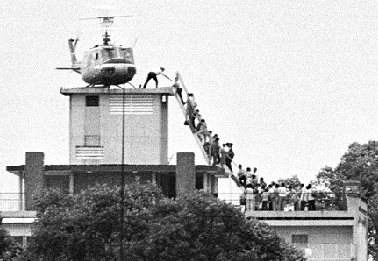
A member of the CIA helps evacuees up a ladder onto an Air America helicopter on the roof of 22 Gia Long Street April 29, 1975, shortly before Saigon fell to advancing North Vietnamese troops.
Hubert van Es photo via Wikimedia Commons.
Yesterday talking to a friend, he said that it seems like we’re living through a shoddy version of the seventies.
But that’s not QUITE it. It’s more complicated. It’s more like we’re living through a performative version of the seventies.
It’s like all the recasting and re-doing of classic movies and series, at this point even those that weren’t particularly successful: it feels like Hollywood is just redoing these things out of some sort of dinosaur brain memory that they were successful. However, the people in charge no longer have any idea why these things were successful or why they resonated or achieved the results they did.
So the re-casts/re-dos sound hollow and strange, and would even if they didn’t use them to push their weird personal current obsessions. (All heroes must be women and black and increasingly of some odd sexual identity! Only villains can be white!) Because the car is there, but the engine is gone metaphorically speaking.
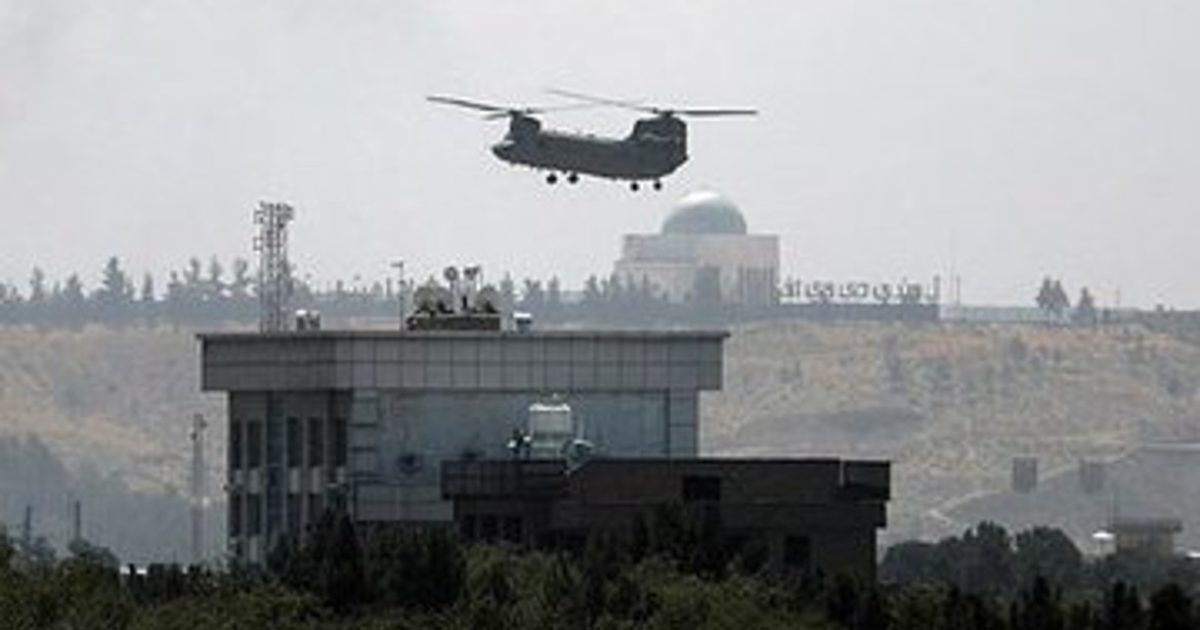
A Boeing CH-47 Chinook transport helicopter appears over the U.S. embassy compound in Kabul, 15 Aug 2021. Image from Twitter via libertyunyielding.com
All these redos and recastings and all are just shells of what the original was. And imbuing them with current wokeness doesn’t make them massively popular, because it doesn’t have that kind of purchase amid the public.
The left and current “Cultural gatekeeping elite” doesn’t seem to be aware of this, or aware of why they fail. In fact, each failure baffles them.
I could be snide, here, and say that it’s because this entire administration, and in fact, the entire upper-crust/controlling layer of our institutions are profoundly untalented theater kiddies, who have no creativity but love the style, and so are trying to do performance of what they think should be there, in the hopes it will work. And are forever baffled it doesn’t.
The truth is not quite that mean, but it rhymes. They are people of a certain frame of mind. In most places and most times, this would make them profoundly “conservative.” Frankly they are, because 100 years into the “progressive” project, those who support it are conservatives. But it’s a weird sort of “conservatism” because what they’re conserving is the cult that tells them if they tear Western civ apart paradise ensues. The whole just-so cult of Marx as filtered through their parents, grandparents and great grandparents.
Part of the whole Marxian philosophy is that it’s a self-contained system, congruent within itself, and with no basis in reality. This makes a certain type of mind susceptible to it. In other centuries they’d be religious fanatics, missionaries to the heathens and zeal-burned puritans.
That type of mind tends to think of things in terms of pre-ordained and fixed narrative, not wildly creative and innovative. That THEY think of themselves as creatives is the insanity of the current system and the Marxian corruption of institutions. They are not actually capable of creativity, only of passing on the received word.
And so we get to the other side of the rerun of the seventies: These kids, by and large, grew up with everything from schools, to TV to even their parents (for the children and grandchildren of boomers) being sold a version of the sixties and seventies in which protesting on the street, behaving badly and destroying property was being passionate and fighting for the voiceless and by itself meant IMPROVING SOCIETY and MAKING THE WORLD A BETTER PLACE.
So the most gullible of this generation are rebels without a clue. They must perform the hit the streets and protest, but they lack the immediacy of the draft to make it personal, and they lack anything like civil rights to make it righteous.
Instead they attach to any stupid cause they can find or which is handed to them by manipulative SOBs. So, you know, it might be saving the endangered Prebles Jumping Mouse, or perhaps saving old buildings, or even well … Lately Occupy Wall Street, BLM, antifidiots and of course pro-Hamass.
May 10, 2024
QotD: The artificially induced public interest in women’s football
For example, quite recently there has been a concerted attempt to persuade the European public that women’s football (soccer) is interesting and exciting. The newspapers and online publications suddenly carry stories about it, with pictures, reports, profiles, and the like, whereas, shortly before, most people were only vaguely aware that women even played football.
No one can object to their doing so, of course, but the fact remains that they are not very good at it, at least not by comparison with men. They may be good — but with for women always appended. It is not the fault of women that they are not very good at football, any more than it is the fault of fish that they are illiterate, but the fact that everyone pretends not to notice it and dares not say it, at least in public, is surely a little sinister. A man of seventy may still play a good game of tennis, but it is always for his age: one wouldn’t expect him to win Wimbledon, nor would one expect excited, breathless reports on an over-seventies’ tennis tournament. The sudden interest in women’s football thus has a bogus feel about it, like the simulated enthusiasm of a crowd for the dictator in a communist state.
Theodore Dalrymple, “Propaganda & uglification”, New English Review, 2023-12-21.
May 7, 2024
But Carbon Dioxide is scary, m’kay?
Last week, Chris Morrison shared some charts that show atmospheric carbon dioxide to be nowhere near high enough to be a concern … in fact, compared to ancient atmospheric conditions, CO2 may be at a potentially concerning low point:
Last year, Chris Packham hosted a five-part series on the BBC called Earth, which compared a mass extinction event 252 million years ago to the small rise in atmospheric carbon dioxide seen in the last 150 years. He said he hoped the “terror factor” generated by his programme would “spur us to do something about the environment crisis”. But as we shall see, the only terror factor is having to sit through an hour-long film consisting of cherry-picked science data and unproven assertions in the hope of persuading us that the increase in global temperatures in the last 150 years or so is comparable to the rise in temperatures over a considerable swath of geological time. Great play was made of a 12°C rise in average global temperatures 252 million years ago as CO2 levels started to rise, although Packham fails to report that CO2 levels were already at least four times higher back then than in modern times. The “science” that Packham cloaks himself with on every occasion is hardly served by terrorising the viewer with what is little more than a highly personal political message.
Think of all that suffering and wastage, he says about the fourth great mass extinction. I don’t think we want a comparable extinction to the one that happened 252 million years ago on our conscience, he adds. Of course, Packham is not the first person to politicise the end-Permian extinction when most plant and animal life disappeared to be replaced eventually with what became known as the age of the dinosaurs. As we can see from the graph below, even though that extinction event coincided with an uptick in CO2 levels, the general trend over a 600-million-year period was downwards ending in the near denudation currently experienced today. But scientists note that the rise started some time before the extinction event, with most of the Permian characterised by very low levels of CO2.
It is obvious why the three other great extinctions are of little interest to modern day climate alarmists. The Ordovician extinction 445 million years ago occurred when CO2 levels were 12 times higher than today, the Devonian wipe-out happen 372 millions ago when CO2 levels were falling, while the later Triassic/Jurassic event 201 million years ago occurred at a time of stable CO2. Hard to see a pattern there suggesting rising CO2 levels equals a mass extinction event. The disappearance of the dinosaurs 66 million years ago is generally attributed to the impact of a giant meteorite, while the current sixth mass extinction exists only inside the head of the Swedish doom goblin, and need not detain us at this point.
Since Packham was essentially making a BBC political film promoting Net Zero, he inevitably started with the fixed view that all our current environmental problems are the fault of CO2. An intense period of volcanic eruptions that led to huge coal deposits catching fire increased CO2 levels and almost instantly sent temperatures soaring at the end of the Permian period. About 20 million years of rain subsequently followed, he observed, taking some of the CO2 out of the atmosphere and order it seems was restored. Certainly, CO2 resumed a small descent but levels remained almost as high, or for some periods higher, as those at the end of the Permian period for another 120 million years. Packham does not provide an explanation of what happened to the average global temperature at this time.
The graph above shows why he avoided the subject. Temperatures did rise at the end of the Permian period after a long decline, but only as far as previous highs recorded 200 million years earlier. They then stayed at those levels for most of the next 200 million years, throughout the age of the dinosaurs. Helped by the increased levels of CO2, this is considered one of the most verdant periods in Earth’s history.


April 25, 2024
“… good Lord, is [Chrystia Freeland] ever terrible at politics”
In The Line, Matt Gurney recounts Deputy Prime Minister Chrystia Freeland’s terrible response to a topical question from a reporter:
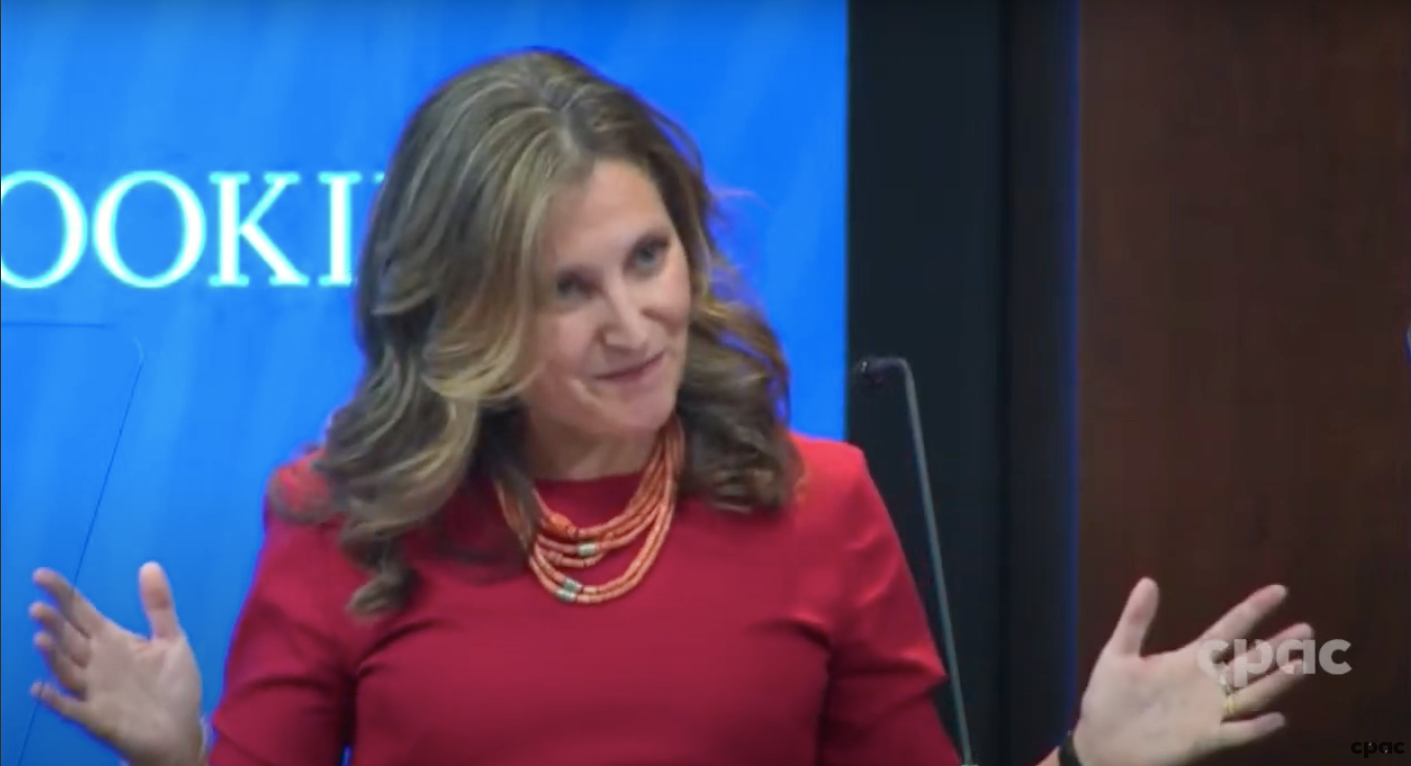
Screencap from a CPAC video of Chrystia Freeland speaking in October, 2022.
In fairness, noting that Freeland, she of the infamous Disney+ flop, is bad at politics is not an original observation. I confess that. But, still. Yikes! What the hell was that?!
I’m referring to Monday’s unfortunate gaffe. Freeland was in Montreal doing post-budget stuff with the small business minister, and after touring a business, took questions from reporters. Sarah Leavitt from the CBC asked a question related to a particularly vile eruption of overt antisemitism at a protest in Ottawa last weekend. A man leading the crowd in chants said “Our resistance attacks are proof that we are almost free … Oct. 7 is proof that we are almost free. Long live Oct. 7, long live the resistance, long live the intifada, long live every form of resistance.”
Oct. 7, of course, means the Hamas rape-and-murder pogrom of Oct. 7.
By the time Leavitt quizzed Freeland, the comments in Ottawa had already been widely disseminated and, critically, condemned. Among the condemners: Freeland’s boss, Prime Minister Justin Trudeau. He’d commented via Twitter a day before Freeland faced Leavitt’s question. This ought to have been an extremely easy exchange for Freeland.
As it turns out, though, not so much, actually.
In the interests of transparency, let’s simply see in full both what Leavitt asked, and how Freeland replied.
The question was clear enough: “Over the weekend, protesters in Ottawa were heard chanting, among other things, ‘Long live October 7’ and ‘October 7 is proof that we are almost free’. Is this hate speech?”
[…]
Let’s walk through her answer, putting her reply into the discrete points she’s been trained to hit.
Phase One: Ass covering. “I wasn’t in Ottawa over the weekend. And I’m not aware of those specific reports. And so it would be just wrong of me to comment on something that I am not specifically aware of.”
Phase Two: Banal statement that favours no group in particular but mentions the key stakeholders. “What I will say is, today is a time in Canada, when antisemitism and Islamophobia are on the rise. When we have a lot … there are a lot of Canadians who are not feeling safe. In my own riding of University-Rosedale, the JCC, a really important centre for Jewish Canadians but also for all Canadians, has faced a lot of pressure. And I’ve been there to meet with people there. There’s also a mosque in my riding that faced pressure and attacks and I’ve met with the leaders there.”
Phase Three: Attempt to sound like you’re engaging with the actual question, even though you are not. “Hate speech is absolutely not acceptable. Glorifying … I mean, I can’t even say the word because it’s … you shouldn’t. It’s too terrible. And what happened on October 7 was a heinous terrorist attack. People were killed. People were raped. Women, men, children … totally unprovoked attack on civilians. That is not acceptable.”
Phase Four: Pivot back to approved talking points. “Canada recognizes Hamas as a terrorist entity and our government is very, very clear on that. We have also been really clear that there needs to be a ceasefire, that a humanitarian catastrophe is happening right now in Gaza, and Canada and Canadians are there to support the people, the suffering people, there, too.”
This is how the PM answers questions, too. It’s a pattern that, once seen, will never been unseen. The problem for Freeland is that the PM is better at it. He’s smoother and quicker on his feet. His evasive non-answers sound more natural, but have begun to get old in recent years, as foreign journalists are generally better at pointing out than Canadian ones. Freeland has never been comfortable doing talking-point politics, and has always sounded extremely unconvincing when she tries.
March 4, 2024
QotD: The “ABC” movement in wine
There was a worry that in the future all wine would taste the same while the more obscure varieties would disappear. As an ABC enthusiast, I thought it far better and more interesting to drink riesling, or fiano or albariño or esgana cão (a Madeiran grape that means “dog strangler” in Portuguese because of its ferociously high acidity).
Jancis Robinson was also not a chardonnay fan. Recently I’ve been watching her Wine Course made in the 1990s on YouTube. It still holds up well, and the budget by modern standards is mind-blowing; one moment she’s in Burgundy, the next she’s in Australia.
Can we have another series like this again soon please? Each episode is devoted to a grape and in the chardonnay one Jancis (she’s one of the few famous people who it is acceptable to refer to by just her first name, like Britney or Boris) can barely contain her contempt for many wines made from the variety describing them as “sugar water”. She’s also not keen on the world’s second favourite variety, sauvignon blanc, either.
I was with Jancis. In fact, I was with Jancis on most things which points to a possible explanation for my chardonnay conversion. When I started out, I hadn’t developed my own tastes and so I was buying wine that I thought sounded sophisticated — such as Mosel riesling.
But as I’ve got older, I’m now buying bottles purely because I like them. Furthermore, I cook and entertain a lot more than I did when I was in my twenties and chardonnay, especially white Burgundy, goes with pretty much anything. If you don’t know what to order when eating out then a bottle of Mâcon-Villages will cover all your bases (the red equivalent if you’re interested is a bottle of Beaujolais).
But also your average chardonnay has got a lot better since the ’90s, or perhaps I should say that it leans more towards my tastes. I’ve been watching a lot of old episodes of Frasier recently and the chardonnay they drink is nearly orange. This style which is still very popular in the US is based on very ripe, some might say overripe, grapes which are then treated to a pre-fermentation maceration to get colour and body out of the skins.
Following fermentation with a yeast which accentuates tropical fruit flavours, the wine would be perked up with some tartaric acid and then either aged in new oak casks or more likely for cheaper wines have oak chips added.
The finished product would be thick and syrupy with a deep golden colour. Not very chic but a revelation in 1980s Britain when everyday white wine meant Blue Nun or Black Tower. They’re what Oz Clarke called “bottled sunshine” in his colourful slots with Jilly Goolden on BBC2’s Food and Drink programme. Like those loud waistcoats everyone thought were so witty worn with a morning suit or dinner jacket, they were great fun then but a bit embarrassing now.
Henry Jeffreys, “Chard: an apology”, The Critic, 2023-11-14.
March 3, 2024
From bank robbery to church burning to welfare state collapse
Kulak talks about an old Canadian TV show episode and how the lessons learned could be (and arguably are already being) used to undermine any western welfare state:
In a show that had helicopter escapes, motorcycle chases, modded out James Bond spy cars, teenage money forgers, veteran jewel thieves, super hackers, aviation engineer super smugglers … This one stood out for its nigh stupid simplicity.
He treated bank robbery as a literal door to door business.
Gilbert Galvan’s great innovation wasn’t any innovation, it was stripping bank robbery itself down to its barest essentials. And then repeating it at scale. To the point where he could rob one bank, and then rob the bank across the street whilst police were still in the first investigating (literally! this was how they found out he existed).
He’d line up with the rest of the customers, wait his turn, approach the teller, and then quietly show her his pistol before demanding the money, and WALKING out the front door of the bank, the person behind him in line never knowing that the robbery had even happened.
The limitation was of course he never hit the safe, and only got one teller’s worth of cash, about 5-20k per robbery (1980s dollars, so double or triple modern dollars), but wearing elaborate theatrical disguises for every heist the chance of of him ever being tracked down were effectively Zero. And needing only one man, there was no accomplice to rat him out.
He carried out FIFTY heists this way, and to this day this remains the greatest lesson I’ve learned from the show… The devastating effect of simple marginally effective things, done at scale. It’s certainly served me well marketing this blog.
Now apply this lesson to the modern Cradle to Grave Total State
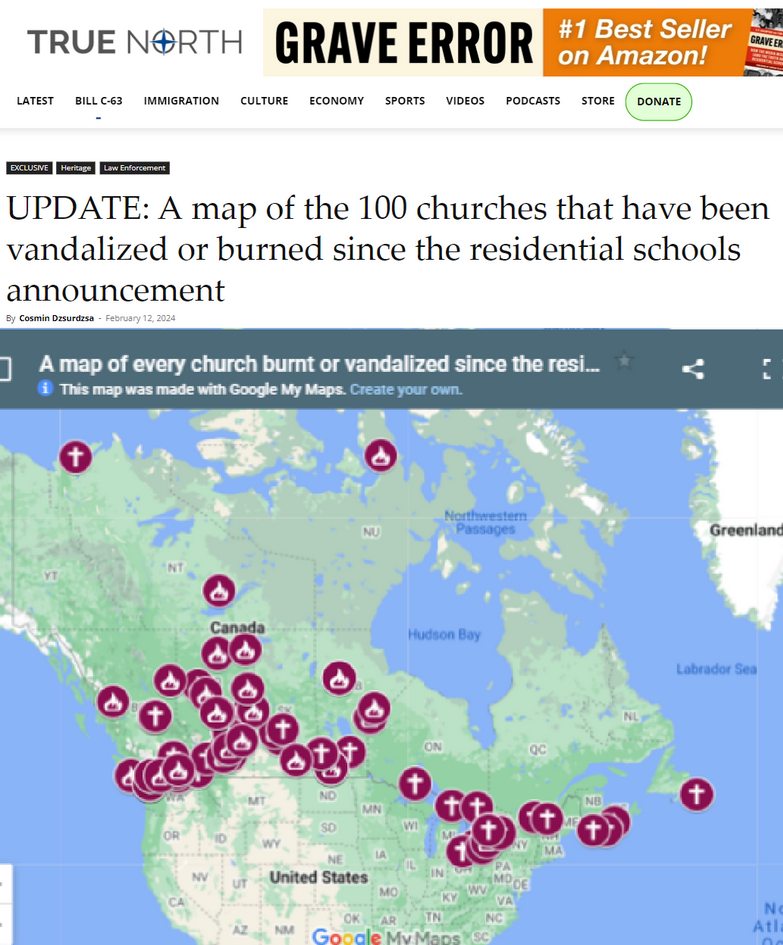
Since the Trudeau government funded media started promoting a blood libel against Christian church run Residential schools, falsely alleging ground penetrating radar had found “mass graves” at the site of the schools from the first half of the 20th century, over 100 churches have been attacked or burned in Canada.
Whilst the first few fires were probably set by the same person in British Columbia, once it became a national story with political valence disaffected copycats quickly sprung up around the nation. There is basically a zero percent chance the vandals on one end of the country know or have ever met the vandals on the other side. And basically no way that catching even one group of vandals or arsonists would stop the attacks.
Now I would like you to imagine the implications for civil strife in the US, and western welfare states, when this starts happening to government offices or schools which get embroiled in LGBTQ or Childhood transition scandals.
Remember that the average public elementary or high school has 1000+ students in it, the bottom 10-20% of whom absolutely despise the place. People always wonder at how many mass shootings there are in the US, I’m always shocked at how few there are. there are 40,000 suicides a year in the US, and while the numbers are hard to grab at least 10,000 of those are youth suicides. That so few decide to take classmates with them always struck me as bizarre, given human beings have killed 100s of millions of each other in the past 100 years, but then isn’t it also interesting the number of mass shootings has risen so rapidly since Columbine and the media cycle popularization of it public conciousness?
Likewise half a million Americans are treated for self inflicted injury every year, of which over 100k are Youth, and 424,000 youth are arrested on some crime or other every year.
I’m going to call it right now:
In the next 5 years someone out there, might be in America, might be Europe, is going to start burning down schools for some ideological reason, we might never even know why if they are never caught.
And At that point copycat school burnings will become one of the most dramatic and prominent trends in western life as it’s quickly copied around the western world. In the past 3 years of those 100 Canadian churches vandalized, 33 burnt right to the ground (10 per year). If you assumed the same number with no boost from all the students/parents who despise their school or maybe even feel mortal danger from them, that’d still be (population adjusted) something like 100 schools per year burning in America, probably til the end of time. Assuming those government buildings have the usual ludicrous construction costs of 20ish million … that’d be about 2 billion dollars per year in lost buildings, which lets be honest probably won’t get replaced in a timely manner.
There are 97,500 public schools in America, assuming just that Canadian Church burning rate of attacks that’d be more than 1% of American public schools gone in a decade.


March 1, 2024
Understanding the modern media
It’s hard for Baby Boomers and even some older Gen X folks to grasp just how much the mainstream media has changed since the 1960s and 70s. Helpfully, Severian provides the context to properly understand what drives them and why they do the things they do:

Proposed coat of arms for Founding Questions by “urbando”.
The Latin motto translates to “We are so irrevocably fucked”.
There is no local news, because all “news” is Apparat audition tape. Back when — back when they were called “reporters” — news people had a clear career progression within a specific industry. A hungry young reporter for the Toad Suck, Nebraska, Times-Picayune might end his days as a reporter for the New York Times or Washington Post, but that was as high as he could reasonably expect to go. Same with the television division — the bobblehead at WSUX in Toad Suck might end up, at most, on CNN or Fox.
These days, though, they call themselves “journalists”, and “journalist” is just an entry-level Apparat post. They’re not just auditioning for the NYT or CNN, of course. A hungry young “journalist” might end xzhyr career at either, of course, but also as a corporate communications director, a political campaign consultant, a professor of “journalism”, a Diversity Outreach Coordinator, any one of a million “Media strategies” and “Media consulting” gigs … or, of course, as an outright lobbyist, because all of those are just euphemisms for “lobbying” anyway.
And that’s before you consider that all the “independent” papers and stations have been bought up by huge conglomerates, and depend on advertising revenue. Noam Chomsky was right — the Media does dance to the tune its corporate paymasters’ call. He was just wrong on those paymasters’ political orientation. Combine all that, and even the most straight-up, just-the-facts-ma’am local “news” story will find some way to insert The Sermon. If you don’t see The Sermon, you’ve either found an incompetent journalist (which happens) … or you might be looking at something subtle.
[…]
The Media, like Skynet, is self-aware. This significantly complicates the stoyachnik‘s task, as The Media understands its own power, and it increasingly wants to drive Narratives itself, especially as its power is on the verge of… well, not collapse exactly, but certainly a sea change. Because The Media is not monolithic, and that’s part of its self-awareness. So many “journalists” do nothing but hit refresh on Twitter all day, and Twitter knows this — that makes Twitter the real power broker. Google, too, obviously is more self-aware than traditional Media. That ludicrous AI image generator represents years of effort; they expended enormous resources to get precisely that result. They understand how utterly dependent the lower layers of The Media are on them; they are more self-aware.
Let us […] use Google’s own AI “summarizer” to refamiliarize ourselves with the tale of Comrade Ogilvy:
Comrade Ogilvy is an imaginary character in the novel 1984, created by Winston Smith to replace Comrade Withers, an Inner Party member who has fallen into disgrace and been vaporized. Comrade Ogilvy supposedly lived a patriotic and virtuous life, supported the party as a child, designed a highly effective hand grenade as an adult, and died in action at the age of 23 while protecting important dispatches for his country. He did not drink or smoke, was celibate, and only conversed about Party philosophy, Ingsoc. Comrade Ogilvy displays how easy it is for a member of The Party to be pulled from thin air, and how determined The Party is to keep unpersons from the media.
The Apparatchiks at Google are more self-aware than the Apparatchiks at, say, the New York Times. That is, they understand their place in the Apparat better, and see the networks more clearly. They know how mal-educated “journalists” are, far better than the “journalists” themselves do. Google, like Winston Smith, knows full well that there’s no Comrade Ogilvy. But the “journalists” at the New York Times who are utterly reliant on Google for their “facts” do NOT know this. How could they?
And thus, the only White people in all of human history were Nazis. At least according to Google’s AI image generator, and therefore — soon enough — it’s what “everybody knows”. (And it’s necessarily recursive. The second generation of Google engineers will not know there’s no Comrade Ogilvy, any more than the current generation of “journalists” does).


