Quotulatiousness

April 27, 2014

Gerrymandering

Filed under: Books, Politics, USA — Tags: , , , , — Nicholas @ 09:49

Former US Supreme Court Justice John Paul Stevens has published a book in which he calls for certain amendments to the constitution, one of which is quite appealing:

1. Requiring that congressional and state legislative districts be “compact and composed of contiguous territory” to stop both parties from carving out safe seats.

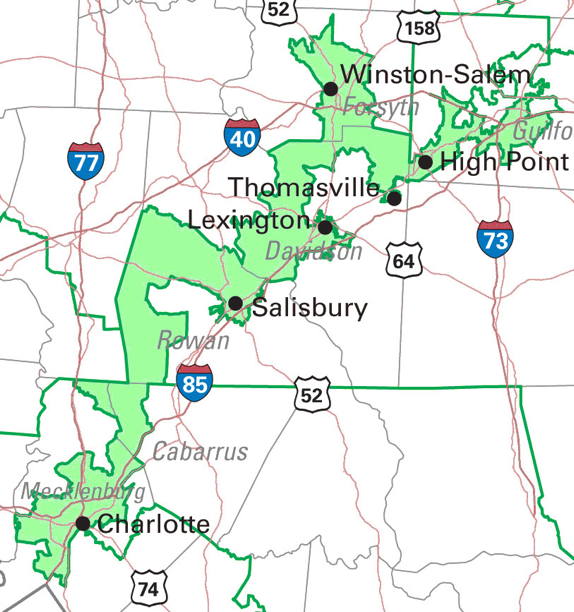
US electoral districts can be particularly odd creatures. In a post from 2010, Zombie looks at the “top ten” gerrymandered districts … and they’re hard to believe. Here’s North Carolina-12, number 10 on the list:

This is what most people imagine when they think of a gerrymandered district — what I call “Gerrymander Classic.” NC-12 looks very much like the gerrymandered districts of the 19th century, but taken to extremes. As bad as it is, NC-12 at least looks like a congressional district, with meandering lines, consistent width, and hand-drawn appearance. As we’ll soon see, modern gerrymandering is often another animal altogether, with jarring shapes and artificial boundaries that are not just offensive to the eye but somehow feel like an insult to rationality.

This is what most people imagine when they think of a gerrymandered district — what I call “Gerrymander Classic.” NC-12 looks very much like the gerrymandered districts of the 19th century, but taken to extremes. As bad as it is, NC-12 at least looks like a congressional district, with meandering lines, consistent width, and hand-drawn appearance. As we’ll soon see, modern gerrymandering is often another animal altogether, with jarring shapes and artificial boundaries that are not just offensive to the eye but somehow feel like an insult to rationality.

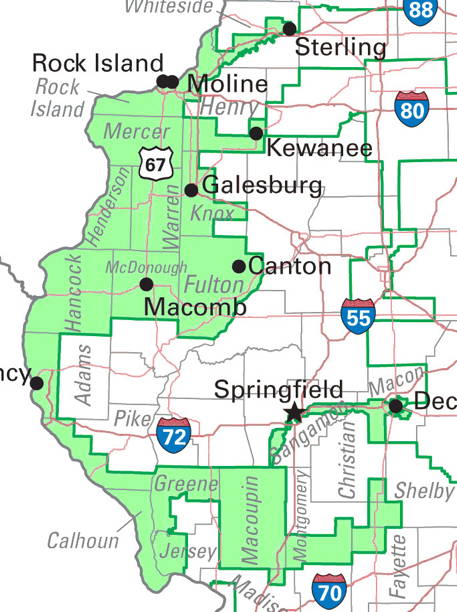
Coming in at number 5, it’s Illinois-17:

Political scientists love to cite IL-17 as the prototypical gerrymandered district, and you are likely to see IL-17 used as the illustration in many academic treatises about redistricting. And we can see why here. Its shape has often been described as “a rabbit on a skateboard,” though to me it looks more like an embryonic ichneumon wasp with a pancreatic cyst. We saw above how PA-12 was a gerrymandering blunder by the Republicans; IL-17 is the opposite, a gerrymandered district created by Democrats to ensure themselves a seat in western Illinois — but which this year was snatched from their grasp by Tea Party candidate and now congressman-elect Bobby Schilling. Ooops! The Democrats went out on a limb when drawing IL-17 — several limbs, by the looks of it — but the wave election of 2010 changed the electoral landscape. Let me repeat my warning to over-confident redistricters next year: THINGS CHANGE. Gerrymander at your own risk.

Political scientists love to cite IL-17 as the prototypical gerrymandered district, and you are likely to see IL-17 used as the illustration in many academic treatises about redistricting. And we can see why here. Its shape has often been described as “a rabbit on a skateboard,” though to me it looks more like an embryonic ichneumon wasp with a pancreatic cyst. We saw above how PA-12 was a gerrymandering blunder by the Republicans; IL-17 is the opposite, a gerrymandered district created by Democrats to ensure themselves a seat in western Illinois — but which this year was snatched from their grasp by Tea Party candidate and now congressman-elect Bobby Schilling. Ooops! The Democrats went out on a limb when drawing IL-17 — several limbs, by the looks of it — but the wave election of 2010 changed the electoral landscape. Let me repeat my warning to over-confident redistricters next year: THINGS CHANGE. Gerrymander at your own risk.

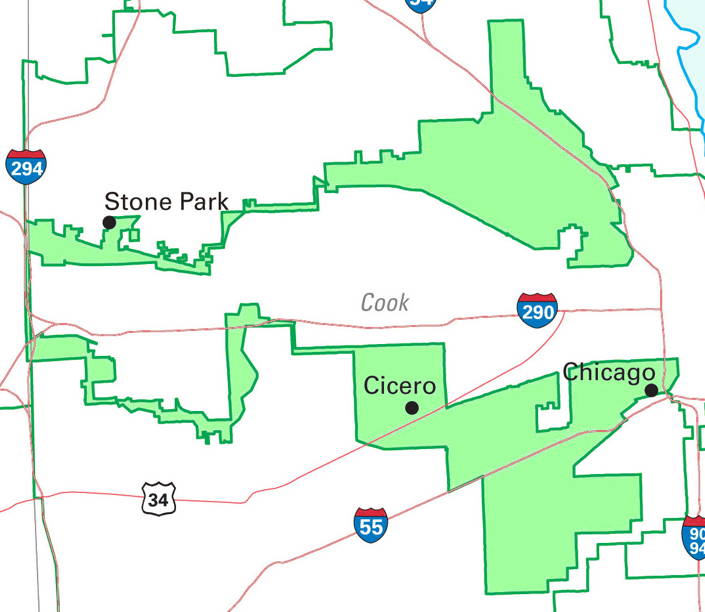
And finally, the circa 2010 winner of the most gerrymandered district in the United States award, Illinois-4:

Here it is: The most ridiculous congressional district in the entire country. No, you’re not looking at two districts; IL-4 has two absurdly gerrymandered halves held together by a thin strip of land at its western edge that is nothing more than the median strip along Interstate Highway 294. The end result is a gerrymandered gerrymander, a complete mockery of what congressional representation is even supposed to be. As with AZ-2, the intention behind IL-4 was to create an ethnic enclave, in this case an Hispanic-majority district within an otherwise overwhelmingly non-Hispanic Chicago. Problem is, Chicago has two completely distinct and geographically separate Hispanic neighborhoods — one Puerto Rican, the other Mexican — but neither is large enough to constitute a district majority on its own. Solution? Lump all Hispanics together into a supposedly coherent cultural grouping, and then carefully draw a line surrounding every single Hispanic household in Chicago, linking the two distant neighborhoods by means of an uninhabited highway margin. Voila! One Hispanic congressperson, by design. And as a side-effect, the most preposterous congressional district in the United States.

Here it is: The most ridiculous congressional district in the entire country. No, you’re not looking at two districts; IL-4 has two absurdly gerrymandered halves held together by a thin strip of land at its western edge that is nothing more than the median strip along Interstate Highway 294. The end result is a gerrymandered gerrymander, a complete mockery of what congressional representation is even supposed to be. As with AZ-2, the intention behind IL-4 was to create an ethnic enclave, in this case an Hispanic-majority district within an otherwise overwhelmingly non-Hispanic Chicago. Problem is, Chicago has two completely distinct and geographically separate Hispanic neighborhoods — one Puerto Rican, the other Mexican — but neither is large enough to constitute a district majority on its own. Solution? Lump all Hispanics together into a supposedly coherent cultural grouping, and then carefully draw a line surrounding every single Hispanic household in Chicago, linking the two distant neighborhoods by means of an uninhabited highway margin. Voila! One Hispanic congressperson, by design. And as a side-effect, the most preposterous congressional district in the United States.

The kicker? Those ten are at least legal in that they’re contiguous. Zombie goes on to show some even more outrageous examples where that requirement is blatantly ignored.

The state of the US judicial system

Filed under: Law, Liberty, USA — Tags: , , , , — Nicholas @ 00:01

In a column about Mark Steyn’s legal battles with Michael Mann, Conrad Black takes time out to revisit the overall state of the US court system:

… American justice is in a shocking condition. Too many judges in the U.S. are elected; too many are ex-prosecutors; the battle over capital punishment has taken all the air out of the room in which the infamous severity of American sentences and the unspeakable lopsidedness of prosecutorial success should be debated. This is a country that inspired the world with a vision of freedom and democracy (though Great Britain, Switzerland, much of the Netherlands, and Scandinavia were just as democratic at the time of the American Revolution). Yet the entire legal apparatus has sat like a gigantic suet pudding and the Supreme Court, in between its four-month vacations, has drunk the Kool-Aid of its own bathwater. The Fifth, Sixth, and Eighth Amendment guaranties of due process, just compensation for seizure of property, grand jury deliberations as assurance against capricious prosecution, prompt justice, access to counsel (of choice), impartial jury, and reasonable bail have been put to the shredder. The United States has six to twelve times the number of incarcerated people per capita as Australia, Canada, France, Germany, Japan, and the United Kingdom, the nearest comparable countries. Even after removing from the totals all those with unstigmatizing records irrelevant to their hireability today (DUI or disorderly conduct decades ago, for example), about 15 percent of adult males are felons.

Prosecutors win 99.5 percent of their cases, 97 percent of them without trial, because of the plea bargain system, which has often been reduced to a sleazy extortion or subornation of confected and rehearsed inculpatory testimony in exchange for immunities, including from the perjury sponsored and approved by the prosecutors. This is far from what was intended by the authors of the Bill of Rights and the original propagators of the tenuous theory that American independence was a new order of the ages and the dawn of government of, by, and for the people, vested with inalienable rights, according to self-evident truths.

Beyond all that, the American legal profession is a suffocating cartel that saps 10 percent of American GDP and through its members in legislatures and regulatory authorities adds 4,000 statutes and regulations a year to the law books, steadily tightening its strangulation of American life, all and always in the name of a society of laws and the ever more equitable refinement of civilization. It would have been impossible and unreasonable to anticipate that so perceptive and spontaneous and fearless an observer as Steyn would not steadily broaden his range of fire, as he has. At one point Steyn began filing motions on his own behalf—the best written court documents you may ever read—that drip with disdain for the judicial process. He quotes Lady MacBeth and describes various pieces of the case using phrases such as “multi-car pileup,” “zombie-like,” “Potemkin hearing” and “meretricious folderol.” It would have been equally unreasonable not to foresee that the authorities upon whom his withering fire descended would not resent this deserved if unaccustomed hostility, and whatever one may think of Mann, he cannot be faulted tactically for trying to tuck himself under the wing of an affronted legal establishment. That does not justify Mann’s infliction of the hockey stick upon the world (like the great Montreal Canadiens point-man Bernard “Boom Boom” Geoffrion lowering — with considerable but probably not sufficient provocation — the real article onto the cranium of a New York Ranger forward sixty years ago) any more than it whitewashes Mann’s own insults. He has dismissed the immensely respected Danish scientist and intellectual Bjorn Lomborg as “a career fossil fuel industry apologist”; Judith Curry, co-editor of the Encyclopedia of Atmospheric Sciences and an honored member of the National Research Council’s climate research committee, as a “serial climate disinformer”; Australian journalist Andrew Bolt as a “villainous” threat to the planet who is paid by Rupert Murdoch “to lie to the public” (Mann apologized for this one after Bolt—in solidarity with Steyn—threatened a lawsuit); and the rest of us as mere “climate change deniers.”

April 23, 2014

Desegregation

Filed under: Education, History, USA — Tags: , , — Nicholas @ 08:04

An interesting article in the New Yorker by Jelani Cobb discusses some of the aspects of the struggle to desegregate American schools that I hadn’t heard of:

The architects of Jim Crow were fixated by notions of white racial purity, but black people subjected to that dictatorship of pigment were concerned with a different question: In a hostile society, is it better to be isolated from those who view you with contempt or in close proximity to them? In retrospect, it is easy to see segregation as a moral evil unanimously despised by black people, but even its fiercest critics betrayed ambivalence about what its end would mean. In the thirties, W. E. B. Du Bois inspired rancorous debates within the N.A.A.C.P. by arguing, in his writing, that there were important economic benefits — the built-in market for black businesses, for instance — that came with segregation. James Nabrit, Jr., an attorney who handled a school-desegregation suit in Washington, D.C., that became one of the cases grouped with Brown, went on to become president of Howard University, a job that entailed the seemingly paradoxical task of preserving and furthering an all-black educational institution. Three of the other attorneys who worked on Brown, including Thurgood Marshall, had, in fact, met as students at Howard’s law school, and they began their desegregation work under the tutelage of Charles Hamilton Houston, the school’s dean. Black teachers in South Carolina, where another of the desegregation suits had been filed, worried, with some cause, that integration would end a state of affairs in which black children, though deprived of equal resources, at least benefitted from teachers who did not calibrate their expectations according to the color of their students’ skin.

The Supreme Court decision on Brown, in 1954, marked a moral high point in American history, but the practice that it dispatched to the graveyard had already begun to mutate into something less tangible and far more durable. What would, in the end, preserve the principle of “separate inequality” was not protests like the one staged by Orval Faubus, the governor of Arkansas, who deployed the National Guard to Little Rock’s Central High School, in 1957, in order to keep black students out. Instead, it was policies like the Interstate Highway Act, whose passage one year earlier helped spawn American suburbia. In the wake of Brown, private schools, whose implicit mission was to educate white children, cropped up throughout the South. The persistent legacies of redlining, housing discrimination, and wage disparity conspired to produce segregation without Jim Crow — maintaining all the familiar elements of the past in an updated operating system.

To the extent that the word “desegregation” remains in our vocabulary, it describes an antique principle, not a current priority. Today, we are more likely to talk of diversity — but diversification and desegregation are not the same undertaking. To speak of diversity, in light of this country’s history of racial recidivism, is to focus on bringing ethnic variety to largely white institutions, rather than dismantling the structures that made them so white to begin with.

And so, sixty years after Brown, it is clear that the notion of segregation as a discrete phenomenon, an evil that could be flipped, like a switch, from on to off, by judicial edict, was deeply naïve. The intervening decades have shown, in large measure, the limits of what political efforts directed at desegregation alone could achieve, and the crumbling of both elements of “separate but equal” has left us at an ambivalent juncture. To the extent that desegregation becomes, once again, a pressing concern — and even that may be too grand a hope — it will have to involve the tax code, the minimum wage, and other efforts to redress income inequality. For the tragedy of this moment is not that black students still go to overwhelmingly black schools, long after segregation was banished by law, but that they do so for so many of the same reasons as in the days before Brown.

H/T to ESR for the link.

April 3, 2014

Big money in US politics gets bigger

Filed under: Media, Politics, USA — Tags: , — Nicholas @ 07:48

Jonathan Rauch looks at the implications of the McCutcheon decision of the US Supreme Court this week:

The 5-4 ruling along the usual conservative-liberal lines, while not unexpected, has broad implications. Like it or not — and assuredly, progressives do not like it — the era of effective limits on contributions to federal politicians is drawing to a close. Want to write a million-dollar check to support a candidate? Chances are that now, or someday soon, you can.

For four decades, since the campaign finance reforms of the 1970s, limits on big-dollar, direct gifts to politicians have been the beating heart of the progressive paradigm. Before McCutcheon, donors could give only $2,600 to an individual candidate in any one election cycle — and they could only give an aggregate of $48,600 to all campaigns. (Here’s the whole list of contribution limits.) In McCutcheon, the court struck down the aggregate limit, reversing its own prior holding in the seminal 1976 case Buckley v. Valeo.

[…]

A calamity for the 1970s paradigm? Yes. A calamity for progressives? Maybe not. There is a way forward, a potential win for both freedom and political accountability, though it requires progressives to hold their nose and swallow hard: raise contribution limits. A lot. A whole lot. Like, allow contributions of up to $1 million for presidential campaigns and up to $200,000 and $50,000, respectively, for Senate and House campaigns. (In 2012, an average winning Senate campaign spent $10.4 million, and a winning House campaign spent $1.6 million, according to Vital Statistics on Congress.) At the same time, as part of the deal, close the wide gaps in today’s rules requiring the disclosure of donations.

Wait. Allow Senate candidates to hit up victims — sorry, donors — for $200,000 at a time? Legitimize contributions of a size that virtually guarantees special attention from office-holders? Why should progressives conceivably support that? Because the old means no longer serve the desired ends. As of now, the case for low contribution limits has all but evaporated — even if you believe, as I do, that the limits once made sense and that the Buckley court was correct in upholding them.

One of the reasons those of us north of the border are often shocked at US political spending is that Canadian election campaign limits are a tiny fraction of the US numbers. You could run a national political campaign and candidates in every riding (308 in the last election) for less than the cost of seven average US senate races. This may explain the limited success of US campaign tactics (and tacticians) periodically imported from the US.

March 30, 2014

“[E]very Ohio political candidate has escaped from a lunatic asylum and all Ohio ballot initiatives are the work of Satan”

Filed under: Humour, Liberty, Politics, USA — Tags: , , — Nicholas @ 10:11

P.J. O’Rourke finally made his mom proud by filing a brief of Amici Curiae to the US Supreme Court:

Ilya Shapiro, with a J.D. from the University of Chicago Law School, is Senior Fellow in Constitutional Studies at Cato and editor-in-chief of the Cato Supreme Court Review. He often files amicus briefs, especially in cases where constitutionally guaranteed rights are imperiled. But these briefs are serious in tone even though Ilya is funny in person.

He’s also self-effacing, saying, “There are people who know more about Constitutional law than I do, and there are people who are funnier than I am, but I do occupy the very small area of overlap in that Venn diagram.”

The Venn diagram seemed like the only proper approach to a law that would make you a criminal in Ohio for saying that Buckeye president William Howard Taft was so fat his wife had to grease the doorframe and tell him there was a banana cream pie in the Blue Room to get him into the White House.

The fight-a-laugh-with-a-laugh brief was Cato Legal Associate Gabriel Latner’s idea. He wrote the first draft. Cato Research Fellow Trevor Burrus added research. And more jokes. Then Ilya Shapiro took over. I was asked to read it and give it my endorsement because I am an expert on being run out of Ohio. Ask my mother.

Politico posted a condensed version of the brief, and I shared the byline with Ilya. On the Above the Law blog David Lat called it the “Best Amicus Brief Ever.” (Albeit that’s a low “bar” — notice how I casually toss in legal jokes now that I’m arguing a case before the Supreme Court.) And a lawyer friend of mine congratulated me on what he said was the first legal brief in history to go viral.

March 5, 2014

QotD: “Truthiness” and the First Amendment

Filed under: Humour, Law, Liberty, Quotations, USA — Tags: , — Nicholas @ 10:22

In modern times, “truthiness” — a “truth” asserted “from the gut” or because “it feels right,” without regard to evidence or logic5 — is also a key part of political discourse. It is difficult to imagine life without it, and our political discourse is weakened by Orwellian laws that try to prohibit it.

After all, where would we be without the knowledge that Democrats are pinko-communist flag-burners who want to tax churches and use the money to fund abortions so they can use the fetal stem cells to create pot-smoking lesbian ATF agents who will steal all the guns and invite the UN to take over America? Voters have to decide whether we’d be better off electing Republicans, those hateful, assault-weapon-wielding maniacs who believe that George Washington and Jesus Christ incorporated the nation after a Gettysburg reenactment and that the only thing wrong with the death penalty is that it isn’t administered quickly enough to secular-humanist professors of Chicano studies.

Everybody knows that the economy is better off under [Republican/Democratic]6 presidents — who control it directly with big levers in the Oval Office — and that:

    President Obama is a Muslim.
    President Obama is a Communist.
    President Obama was born in Kenya.
    Nearly half of Americans pay no taxes.7
    One percent of Americans control 99 percent of the world’s wealth.
    Obamacare will create death panels.
    Republicans oppose immigration reform because they’re racists.
    The Supreme Court is a purely political body that is evangelically [liberal/conservative].8

All of the above statements could be considered “truthy,” yet all contribute to our political discourse.

5. Wikipedia.com, Truthiness, http://en.wikipedia.org/wiki/Truthiness (last visited Feb. 28, 2014) (describing the term’s coinage by Stephen Colbert during the pilot of his show in October 2005). See also Dictionary.com, Truthiness, http://dictionary.reference.com/browse/truthiness (last visited Feb. 28, 2014).
6. Circle as appropriate.
7. 47 percent to be exact, though it may be higher by now.
8. Again, pick your truth.

Ilya Shapiro and P.J. O’Rourke, BRIEF OF AMICI CURIAE CATO INSTITUTE AND P.J. O’ROURKE IN SUPPORT OF PETITIONERS, Susan B. Anthony List v. Driehaus [PDF], 2014-02-28

December 13, 2013

Australian territory’s gay marriage law struck down by High Court

Filed under: Australia, Law, Liberty — Tags: , , , — Nicholas @ 08:01

The Australian Capital Territory attempted to make gay marriage legal within its borders despite federal law prohibiting same-sex marriages being recognized. The Australian High Court decided yesterday that the territory cannot override federal law on this issue:

The ACT legislation had allowed gay couples to marry inside the ACT, which includes the Australian capital, Canberra — regardless of which state they live in.

Federal law, however, specified in 2004 that marriage was between a man and a woman.

Civil unions are allowed in some states in Australia.

The High Court in Canberra ruled unanimously against the ACT legislation on Thursday, saying that it could not stand alongside national-level laws.

“Whether same sex marriage should be provided for by law is a matter for the federal parliament,” it said in a statement.

“The Marriage Act does not now provide for the formation or recognition of marriage between same-sex couples. The Marriage Act provides that a marriage can be solemnised in Australia only between a man and a woman,” it added.

Attorney-General George Brandis had previously warned that the local law would face a legal challenge, because it was inconsistent with the country’s Marriage Act.

September 28, 2013

This is what democracy looks like – Indian voters can now vote “None of the above”

Filed under: Government, India — Tags: , , , — Nicholas @ 11:40

Alex Tabarrok links to a Wall Street Journal article (paywalled, unfortunately) about the Indian court decision that will allow Indian voters to cast their ballots against all the candidates on offer:

Excellent news. Bear in mind:

    Nearly a third of the members of the lower house of Parliament are facing criminal charges, according to the Association for Democratic Reforms, a New Delhi-based advocacy group for transparency in governance.

Even if that were not the case, however, one of the problems of democracy is that there is too little feedback and information transmission, due both to rational ignorance and the bundle nature of politics. Allowing for “none of the above” provides, not a panacea, but a little bit more feedback. Many people vote but have to hold their noses to do so. Many others don’t vote but do they not vote because they are satisfied or dissatisfied? None of the above gives the dissatisfied a chance to reveal their views and in so doing it may encourage more and better candidates.

At present, voting none of the above is just informational, i.e. none of the above is never “elected” even if it gets a majority, although the option to vote NOTA may change the outcome of the election. In the future a NOTA majority might signal a new election.

There have been a few elections here in Ontario I’d love to have had the option of voting “None of the above”.

July 13, 2013

Same Sex Marriage in America: What Now?

Filed under: Law, Liberty, USA — Tags: , , , , — Nicholas @ 09:20

The Supreme Court’s decisions on same sex marriage are just the beginning of a long process of determining what roles marriage will play in the legal environment of states and the country. Walter Olson and Ilya Shapiro detail some of the implications of the rulings.

July 1, 2013

Positive developments in Canadian government digital policy

Filed under: Cancon, Law, Technology — Tags: , , , , — Nicholas @ 11:59

Micheal Geist rounds up some good news for Canada Day:

As Canadians grapple with news of widespread secret surveillance, trade agreements that could upend intellectual property policy, and the frustrations of a failed wireless policy, there are plenty of digital policy concerns. Yet on Canada Day, my weekly technology law column argues that it is worth celebrating the many positive developments that dot the Canadian digital policy landscape. Eight of the best include:

1. The Supreme Court of Canada’s strong affirmation of user rights and technological neutrality in copyright. [. . .]

2. The Canadian Radio-television and Telecommunications Commission’s policy on network neutrality. [. . .]

3. The defeat of the government’s lawful access legislation. [. . .]

4. Canada’s promotion of user generated content. [. . .]

5. The CRTC’s pro-consumer agenda. [. . .]

6. The Privacy Commissioner of Canada’s aggressive investigations of top Internet companies. [. . .]

7. Canada’s notice-and-notice system for Internet providers. [. . .]

8. Canada’s balanced patent law standards. [. . .]

June 26, 2013

Buh-bye, DOMA

Filed under: Law, Liberty, USA — Tags: , , , , — Nicholas @ 12:59

I was away from my computer for about an hour this morning and when I came back online, my Twitter feed had exploded with news and opinion links about the US Supreme Court striking down the Defence of Marriage Act. While I’m delighted with the result (check my posts tagged Same Sex Marriage if you’re curious), it’s interesting to watch the reactions on all sides of the issue.

June 20, 2013

Supreme Court refuses to hear appeal of Rob Ford’s conflict-of-interest case

Filed under: Cancon, Law, Media, Politics — Tags: , , , , , — Nicholas @ 11:07

The Toronto Star must be feeling devastated by this:

The Supreme Court of Canada says it will not hear an appeal in a conflict-of-interest case against Toronto Mayor Rob Ford.

The court dismissed it with costs, but did not give reasons for the ruling.

Lawyer Clayton Ruby was trying to restore a lower court decision from November 2012, in which Superior Court Justice Charles Hackland ruled Ford be removed from office.

However, as part of Ford’s appeal, the decision was overturned by an Ontario Divisional Court panel in January 2013.

Deputy mayor Doug Holyday said this was all about antagonizing the mayor.

“There was no reason to take this to the Supreme Court; there was very little likelihood of it every getting put before the Supreme Court,” Holyday said.

Update: The CBC reports that Ford feels vindicated by the decision:

Toronto Mayor Rob Ford expressed relief Thursday that a conflict challenge that previously threatened to oust him from office won’t be revived in the country’s top court.

“I’m so happy this is finally over. I’ve been vindicated and we can move on,” Ford told reporters in Toronto, about two hours after the Supreme Court of Canada rejected an application to hear a final appeal in the much-publicized conflict case that began last year.

As is customary, the Supreme Court gave no reasons for dismissing the appeal, but legal experts — including the lawyer who filed the application himself — had acknowledged the odds of reviving the conflict of interest case were a long shot.

The court only accepted 12 per cent of appeal requests made last year.

Toronto resident Paul Magder filed an application in an Ontario court last year, alleging that Ford had violated conflict of interest legislation when he participated in a council vote that absolved his need to pay back funds donated to his private football foundation.

June 18, 2013

A brief history of Habeas Corpus

Filed under: History, Law, Liberty, USA — Tags: , , , , — Nicholas @ 10:09

In Reason, Jonathan Hafetz reviews a new book by Anthony Gregory called The Power of Habeas Corpus in America: From the King’s Prerogative to the War on Terror:

This tension between the ideal and the reality of habeas corpus is central to Anthony Gregory’s excellent new book, The Power of Habeas Corpus in America. Gregory, a research fellow at the Independent Institute, provides a valuable contribution to the literature on habeas corpus, one with broader implications for civil liberties, state power, and justice in a liberal democracy. The book does not attempt to capture all of the complex doctrinal shifts in habeas over the centuries. Instead, it synthesizes these developments to underscore a paradox: the way habeas serves as “both as an engine and a curb on state power.” In the process, Gregory charts how power dynamics have historically shaped struggles over habeas and its role in American society.

Gregory situates this paradox early in habeas‘ history. During the 15th and 16th centuries, habeas served mainly as a mechanism for England’s central courts to assert control over ecclesiastical courts and other rival tribunals. By demanding that reason be given why any of the king’s subjects was imprisoned, habeas helped increase the crown’s authority and legitimacy.

By the late 17th century, on the other hand, habeas had become a means of challenging royal authority itself, eventually taking on its modern incarnation as the Great Writ of Liberty. Yet even here, the story is more complex. Building on the pioneering work of historian Paul Halliday, Gregory points out that, contrary to popular interpretations, habeas‘ potential as a judicial constraint on state power was threatened by legislation. Gregory notes, for instance, how the famous Habeas Corpus Act of 1679, labeled by William Blackstone as a “second Magna Carta and stable bulwark of our liberties,” ultimately diluted the writ’s potency and flexibility by tying it down to statute. Increasingly, habeas‘ efficacy would be seen to depend on legislative action — an understanding perhaps best illustrated by U.S. Supreme Court Chief Justice John Marshall’s statement that a federal court’s power to award the writ “must be given by written law.”

[. . .]

The contradictions within habeas were manifested during antebellum America, where the writ was used both to bolster slavery and to undermine it. Slave owners employed habeas to apprehend runaways — for example, by petitioning state courts in the North to assist in apprehending their “property.” Other state courts in the North, by contrast, sometimes used habeas to free slaves or block their return to the South. Ultimately, the ability of state courts to wield habeas in defense of individual liberty was limited by Supreme Court rulings barring state interference with the enforcement of federal fugitive slave laws and, eventually, with federal detentions generally — an example of what Gregory describes as the dangers of centralization.

A significant counter to Gregory’s thesis is the role federal habeas corpus played during the 20th century in helping enforce civil rights in the South and in advancing the criminal procedure revolution undertaken by the Supreme Court to protect the rights of defendants. Gregory’s account here runs against the traditional narrative in which habeas‘ centralization was critical to its continuing role in protecting liberty. In response, Gregory cites the declining utility of federal habeas corpus following several decades of Supreme Court decisions and congressional restrictions that have made it more difficult for prisoners not merely to obtain relief but even to have their claims heard by a judge. Federal habeas, Gregory writes, has become a “shell of what it promised to be.”

May 30, 2013

The real reason we’re getting wall-to-wall senate scandal coverage

Filed under: Cancon, Government, Media — Tags: , , , , , , — Nicholas @ 08:41

Colby Cosh suspects we may be on the receiving end of a massive distraction attempt:

I’m starting to half-believe the theory that the Senate expense scandal was cooked up to cover other problems for the Conservative Party of Canada. The broad main effect of the Senate fracas so far has been to exasperate the hell out of everybody. Mike Duffy’s bad behaviour presents the public with the frustrating conundrum that only the Senate can make rules for or punish errant senators, and that the major features of the Constitution (including that one) are probably immune from formal amendment for the next hundred years or so. Stephen Harper’s statutory end-run proposals for permitting Senate elections and tightening term limits are currently awaiting scrutiny by the Supreme Court; if the court rejects his measures, he can argue that they represented at least a fillip of attainable accountability, which they do, and that it is not his fault they were bounced.

In modern history, providing convenient excuses for inaction by elected politicians is about 45 per cent of the court’s function. And, at that, maybe it is okay to notice that the court, now crowded with Harper appointees, is as much an audience for Duffy’s antics as the rest of us. On top of all this, the whole mess invited Justin Trudeau, following cues like a good drama teacher, to plunge headlong into the trap of not only defending the Senate, but defending it on the specific grounds that Quebec is beneficially overrepresented therein.

If people are pulling faces at the Senate, that’s a win for the Conservative party. But perhaps more importantly, it’s a boost for the New Democrats, who have a clear “dynamite it” position on the Senate that they have advocated pretty consistently for half a century. Keeping the seat counts of the NDP and the Liberals roughly level with each other is the paramount strategic axiom for the Tories from now until (at least) 2015.

Most Canadians over the age of 40 would rather do almost anything other than watch another attempt at constitutional wrangling … we saw what happened the last couple of times the feds and the provinces tried re-rigging things to their preference.

May 10, 2013

Colby Cosh on “gendercide”

Filed under: Cancon, Health, Law, Liberty, Religion — Tags: , , , , — Nicholas @ 10:53

Despite the federal government’s efforts to keep this debate from happening, we apparently are going to be having a big national debate about abortion. (For those following from outside the borders of Former Soviet Canuckistan, Canada doesn’t actually have any abortion law on the books at the moment, and Stephen Harper’s government of “bitter-clinging, right-wing, Bible-thumping, fundamentalist Christian” Conservatives is desperate not to have to bring one in.) Colby Cosh explains why the efforts by some back-bench MPs to use “gendercide” as a way to force the government’s hand won’t work:

Here, then, is my contribution to the big conversation.

(1) “Gendercide” is incoherent religious militancy in cheap drag. (Editors certainly shouldn’t be taking sides by putting it in headlines as if it were an actual thing.)

(2) However you feel about personal eugenics, which is an accurate name for “mothers choosing babies that are likely to be better in some respect they deem relevant”, the Era Of It is arriving now and will not be wished away.

(3) Sex-selective abortion perpetrated for reasons of religious superstition is, upon all evidence, a marginal phenomenon in this country, probably a fading one, and quite likely to be an inherently self-correcting one. It makes a shabby excuse for blowing up the political truce our country clings to when it comes to the topic of abortion. (It seems remotely possible that Stephen Harper has perceived this and concurs with it.)

(4) In particular, no statute is likely to be effective against sex selection by mothers. We had one, you know, and it actually made a hypothetical exception for parents at risk of X-linked gene disease. A Liberal government devoted to “reproductive choice” criminalized sex-selective embryo implantation by means of the Assisted Human Reproduction Act; a Supreme Court found that law offensive to the Constitution; and a Conservative government closed the agency that was supposed to enforce it because it had accomplished the sum total of jack squat ever.

(5) People who wish to police sex-selective abortion had better figure out what exactly kinds they don’t like. And why. And what other reasons for a woman to have an abortion don’t cut their brand of mustard. And whether they really want their wives, girlfriends, daughters or nieces to end up as a future Case 6 running afoul of the law.

(6) Fellow-travellers of Mark Warawa who think he makes an awesome test case for parliamentary purity should consider looking for one that, pardon the metaphor, doesn’t have quite so many oopsies in its DNA.

« Newer PostsOlder Posts »

Powered by WordPress