Quotulatiousness

March 14, 2020

QotD: Apartheid

Filed under: Africa, History, Law, Quotations — Tags: , , , — Nicholas @ 01:00

To anyone who was exposed to its machinations — let alone directly affected by it, as most South African Blacks were — apartheid was truly evil: only the absence of extermination camps differentiated it from the Nazism of the 1940s. In actuality, Blacks couldn’t live or work in “White” areas except by permit, couldn’t own businesses in White areas, couldn’t be promoted past a certain point when they did work outside the “Black” areas, and were forcibly resettled into Black “homelands” without legal redress or the ability to resist. Social intercourse between Blacks and Whites were restricted, by law, to business interactions only — any kind of interracial sexual activity was legally classified as “immorality” and summarily banned, carrying appallingly-high penalties in the breach thereof. Crimes by Whites against Blacks carried penalties far more lenient — to the extent of semi-official toleration — than those by Blacks against Whites, which were severely punished. The education system favored White children over Black children and continued throughout life — to where “White” universities were ubiquitous but “Black” universities could be counted on one hand, with a couple fingers left over. (Lest anyone is offended by the comparison to Nazism, simply substitute “Jews” for “Blacks” and “Aryans” for “Whites”. That would have been Germany, from 1933 to 1945.)

So the disappearance of apartheid cannot be seen as anything other than a Good Thing.

Kim du Toit, “Tough Question, Simple Answer”, Splendid Isolation, 2019-12-05.

March 10, 2020

The Birth of a Nation | Based on a True Story

Filed under: History, Media, USA — Tags: , , , , , , — Nicholas @ 02:00

The Cynical Historian
Published 7 Oct 2016

The Birth of a Nation was the first major motion picture success, and because of its historical inaccuracy, the Ku Klux Klan was revived for another round of terror. This is the worst case of a “Based on a True Story” film. So today is a prime time to go into why it was so bad, and get some President Wilson bashing in.

Through YouTube’s cowardice, this video has been demonetized.
————————————————————
references:
Blee, Kathleen M. Women of the Klan: Racism and Gender in the 1920s. Berkeley: University of California Press, 1991. https://amzn.to/2NzeHbl

http://www.npr.org/sections/codeswitc…

https://en.wikipedia.org/wiki/The_Bir…
https://en.wikipedia.org/wiki/The_Cla…
https://en.wikipedia.org/wiki/Ku_Klux…
https://en.wikipedia.org/wiki/Reconst…
https://en.wikipedia.org/wiki/Woodrow…
https://en.wikipedia.org/wiki/1804_Ha…
https://en.wikipedia.org/wiki/Nat_Tur…
————————————————————
contribute to my Patreon:
https://www.patreon.com/CynicalHistorian

LET’S CONNECT:
https://twitter.com/Cynical_History
—————————————–
Wiki:
The Birth of a Nation (originally called The Clansman) is a 1915 American silent epic drama film directed and co-produced by D. W. Griffith and starring Lillian Gish. The screenplay is adapted from the novel and play The Clansman, both by Thomas Dixon Jr. Griffith co-wrote the screenplay (with Frank E. Woods), and co-produced the film (with Harry Aitken). It was released on February 8, 1915.

Three hours long, the film was originally presented in two parts separated by an intermission; it was the first 12-reel film in America. The film chronicles the relationship of two families in the American Civil War and Reconstruction era over the course of several years: the pro-Union Northern Stonemans and the pro-Confederacy Southern Camerons. The assassination of President Abraham Lincoln by John Wilkes Booth is dramatized.

The film was a commercial success, though it was highly controversial for its portrayal of black men (many played by white actors in blackface) as unintelligent and sexually aggressive towards white women, and the portrayal of the Ku Klux Klan (KKK) (whose original founding is dramatized) as a heroic force. There were widespread African-American protests against The Birth of a Nation, such as in Boston, while thousands of white Bostonians flocked to see the film. The NAACP spearheaded an unsuccessful campaign to ban the film. Griffith’s indignation at efforts to censor or ban the film motivated him to produce Intolerance the following year.

The film’s release is also credited as being one of the events that inspired the formation of the “second era” Ku Klux Klan at Stone Mountain, Georgia, in the same year. The Birth of a Nation, along with the trial and lynching of Leo Frank for the 1913 murder of Mary Phagan in Atlanta, was used as a recruiting tool for the KKK. Under President Woodrow Wilson, it was the first American motion picture to be screened at the White House.

Griffith’s innovative techniques and storytelling power have made The Birth of a Nation one of the landmarks of film history. In 1992, the United States Library of Congress deemed the film “culturally, historically, or aesthetically significant” and selected it for preservation in the National Film Registry.
————————————————————
Hashtags: #History #BirthOfANation #KKK #Review #BasedOnATrueStory #WoodrowWilson #DWGriffith

March 7, 2020

QotD: “Jim Crow” laws

Filed under: History, Law, Liberty, Quotations, USA — Tags: , , — Nicholas @ 01:00

Everyone raised in the Unites States over the last fifty years has been required to memorize the official dogma regarding Jim Crow laws. These were state and local laws that enforced racial segregation in the Southern United States. The official version preached to this day is that they were draconian restrictions on blacks preventing them from having a normal life. Modern blacks are told that their condition is the direct result of white discrimination against blacks via these laws.

Now, there is a debate as to the intent and the effect of these laws, mostly because the Left has re-imagined that period in American history. The official version of the Civil Rights era is a fantasy with little connection to reality. What is not under dispute is that these laws existed and they had a negative impact on blacks. Black institutions did not receive public support. Blacks were denied access to the legal system, which often denied them justice when the victims of white malfeasance.

The best argument against these sorts of laws is that they created a second class of citizens, as a legal construct. You cannot have democracy if you have second class citizens, as democracy assumes all men being equal before the law. If the effect of Jim Crow was separate and equal, then maybe they would fit into democracy. In reality, they were separate and unequal, even accounting for the differences in the races. Therefore, as a legal construct, they violated the ideal of equality before the law.

The Z Man, “The Jim Snow Laws”, The Z Blog, 2019-12-01.

February 19, 2020

Enoch Powell

Filed under: Books, Britain, History, Politics — Tags: , , , , , — Nicholas @ 05:00

Theodore Dalrymple reviews a recent book by Paul Corthorn on Powell’s career and the concerns that animated him:

Enoch Powell in a 1987 portrait by Allan Warren.
Wikimedia Commons.

It does not pretend to be a biography, or even an intellectual biography. Rather, it chronicles, scrupulously but somewhat drily, Powell’s varying attitudes toward the main subjects of his political concerns: international relations, economics, immigration, Britain’s relations with Europe, and the status of Northern Ireland in the United Kingdom. Powell’s wider intellectual interests and religious views are scarcely touched upon, though it is mentioned that he went from being a believer to being (under the influence of Nietzsche) an atheist, to then returning to Christian belief. There is no description of his character in this book, not even by implication, and with this book as a guide, one would not recognise him if one met him. It is not possible to tell whether the author admires or detests his subject. This neutrality creates confidence in the accuracy of his scholarship, but also makes his book less than a pleasurable or exciting read. Perhaps it is the sign of a frivolous mind, but I prefer even histories of ideas to be spiced with a little biography (or, more truthfully, gossip).

The author does, however, offer a unifying interpretation of Powell’s various political concerns, namely that they were all responses to Britain’s precipitous national decline, the steepest part of which occurred in his lifetime, but which is continuing apace to the extent that Britain might even cease to be a nation at all. Powell was born in a great power and died in an enfeebled country with no industrial or military might, with precious little patriotism, and with no sense either of grandeur or collective purpose.

That this decline – relative rather than absolute, except in such fields as the maintenance of law and order — was inevitable given the conjunctures of the age, was evident to Powell (though not at first). This relative decline was already implicit in Disraeli’s dictum that “the Continent [of Europe] will not suffer England to be the workshop of the world.”

Powell’s concerns, then, were how to manage Britain’s decline and how to find it a new place in the world. He had not always been perceptive about the scale of its decline. He clung, for example, to the illusion that the Empire might still count for something even after the Second World War. Thereafter, however, he became a devotee of a kind of Realpolitik, to the extent of wanting a rapprochement or even alliance with the Soviet Union to balance the power of the United States, whose aims he had long distrusted. He discounted ideology, including communism, as a force in international politics, which is odd in a man who was by far the most intellectual and intellectually accomplished of all British politicians of the 20th century, being both a classical scholar and a brilliant linguist. He seemed to think that Soviet ambition was merely that of any large power in the great game. Those countries that fell into its grip knew otherwise.

On economics, Powell was an early devotee of the superiority of the market over state planning at a time when the intellectual tide was running the other way. There was one important subject, however, on which he was a confirmed statist, namely that of health care. He was for a time Minister of Health in the British government, during which he fiercely defended the NHS. He believed that the government had an ethical duty to provide health care for its citizenry, and it never seemed to occur to him that the centralised NHS was not the only possible way of doing so. He was often highly suspicious of international comparison, but it is difficult to see how judgment of the merits of a system could be made without it. It was clear, moreover, that in this, as in other fields, Britain was at best very mediocre. Perhaps Powell was blind to the NHS’s mediocre performance because of the benevolence of its stated intentions (an occupational hazard among intellectuals, even — or perhaps especially — among brilliant ones). At any rate, he never satisfactorily explained why health care should be different from other spheres of service provision in the superiority of private over public organization.

Christopher Hitchens – Why Orwell Matters

Filed under: Books, Britain, History, Liberty, Politics — Tags: , , , , — Nicholas @ 04:00

TheHitchensArchive
Published 24 Apr 2013

October 21, 2002. Christopher Hitchens giving a speech based on his book about George Orwell at The Commonwealth Club.

February 16, 2020

Diamonds vs. Self Determination – South West Africa and the League of Nations I THE GREAT WAR 1920

The Great War
Published 15 Feb 2020

Sign up for Curiosity Stream and Nebula: https://curiositystream.com/thegreatwar

Woodrow Wilson’s 14 Points and their idea of self-determination didn’t go unnoticed in the former German colonies like German Southwest Africa. But especially South Africa had other ideas at the Paris Peace Conference and lobbied to take control over future Namibia and its lucrative diamond mines.

» SUPPORT THE CHANNEL
Patreon: https://www.patreon.com/thegreatwar
Merchandise: https://shop.spreadshirt.de/thegreatwar/

» SOURCES

Emmett, Tony. 1999. Popular Resistance and the Roots of Nationalism in Namibia, 1915-1966. Basel, Switzerland: P. Schlettwein Publishing.
Olusoga, David, and Casper W. Erichsen. 2011. The Kaiser’s Holocaust: Germany’s Forgotten Genocide and the Colonial Roots of Nazism. London, UK: Faber and Faber.
Onselen, Charles van. 1980. Chibaro: African mine labour in Southern Rhodesia 1900-1933. London, UK: Pluto Pr.
Pirio, Gregory. 1988. “The Role of Garveyism in the Making of Namibian Nationalism.” In Namibia 1884-1984: Readings on Namibia’s History and Society: Selected Papers and Proceedings of the International Conference on “Namibia 1884-1984: 100 Years of Foreign Occupation; 100 Years of Struggle”, London 10-13 September, 1984, Organised by the Namibia Support Committee in Co-Operation with the SWAPO Department of Information and Publicity, edited by International Conference on “Namibia 1884-1984: 100 Years of Foreign Occupation; 100 Years of Struggle,” Brian Wood, Namibia Support Committee, United Nations Institute for Namibia, SWAPO, and Department of Information and Publicity. London: The Committee in cooperation with United Nations Institute for Namibia.
“Report on the Natives of South-West Africa and Their Treatment by Germany.” 1918. 1918. https://ufdc.ufl.edu/UF00072665/00001/1j.
Silvester, Jeremy, and Jan-Bart Gewald, eds. 2003. Words Cannot Be Found: German Colonial Rule in Namibia: An Annotated Reprint of the 1918 Blue Book. Sources for African History, v. 1. Leiden, NL ; Boston, USA: Brill.
Smith, Iain R. 1999. “Jan Smuts and the South African War.” South African Historical Journal 41 (1): 172–95. https://doi.org/10.1080/0258247990867….
Vinson, Robert Trent. 2012. Americans Are Coming! Dreams of African American Liberation in Segregationist South Africa. Athens: Ohio University Press. http://public.eblib.com/choice/public….
Wallace, Marion, and John Kinahan. 2013. A History of Namibia from the Beginning to 1990. Oxford, UK: Oxford University Press.
William Blakemore Lyon. 2015. “The South West Africa Company and Anglo-German Relations, 1892-1914.” Master’s thesis, Cambridge University.
Zimmerer, Jürgen, and Joachim Zeller. 2008. Genocide in German South-West Africa. Monmouth, UK: Merlin Press.
Michell, Lewis (1910). The Life and Times of the Right Honourable Cecil John Rhodes 1853-1902, Volume 2. New York and London: Mitchell Kennerly
Rhodes, Cecil, (1902) “The Last Will and Testament of Cecil John Rhodes: With Elucidatory Notes to Which Are Added Some Chapters Describing the Political and Religious Ideas of the Testator”, London: “Review of Reviews” Office
Cecil Rhodes, “Confession of Faith”, 1877 https://pages.uoregon.edu/kimball/Rho…

» SOCIAL MEDIA
Instagram: https://instagram.com/the_great_war
Twitter: https://twitter.com/WW1_Series
Reddit: https://reddit.com/r/TheGreatWarChannel

»CREDITS
Presented by: Jesse Alexander
Written by: Jesse Alexander
Director: Toni Steller & Florian Wittig
Director of Photography: Toni Steller
Sound: Toni Steller
Editing: Toni Steller
Mixing, Mastering & Sound Design: http://above-zero.com
Maps: Daniel Kogosov (https://www.patreon.com/Zalezsky)
Research by: Jesse Alexander
Fact checking: Florian Wittig

Channel Design: Alexander Clark
Original Logo: David van Stephold

A Mediakraft Networks Original Channel

Contains licensed material by getty images
All rights reserved – Real Time History GmbH 2020

February 15, 2020

QotD: Architecture’s lingering racism

Filed under: Architecture, History, Quotations, USA — Tags: , , , , , — Nicholas @ 01:00

Many leading 20th-century architects, including Philip Johnson and Mies van der Rohe, were openly disdainful of the public’s preferences. On occasion they evinced subtle and overt racism. In 1913, in one of the most influential essays in the history of Modernist architecture, “Ornament and Crime,” the Austrian architect Adolf Loos declared that modern man (read: white northern Europeans) must go beyond what “any Negro” could achieve in design, and strip away all that is superfluous, all that is morally and spiritually polluted. It is Papuans and other primitives who, like innocent children, ornament themselves with tattoos. Loos’ race has superseded them: “the modern man who tattoos himself is either a criminal or a degenerate.” The same held for ornament in architecture. (To this day, architects — who continue to believe they are the vanguard of civilization’s progress — find ornament retrograde. Yet ordinary people stubbornly continue to adorn themselves with cosmetics, jewelry, and, yes, tattoos.)

In the 1920s, during the time he was a member of the French Fascist party, the seminal architect Le Corbusier said he was disgusted by the “zone of odours, [a] terrible and suffocating zone comparable to a field of gypsies crammed in their caravans amidst disorder and improvisation.” He also chimed in with Loos: “Decoration is of a sensorial and elementary order, as is color, and is suited to simple races, peasants, and savages … The peasant loves ornament and decorates his walls.”

More recently, indicative of architecture’s current race problem, in 2006 the aforementioned highly influential dean of Tulane’s architecture school, Reed Kroloff, wrote the embarrassingly tone-deaf, flat-footed essay “Black Like Me.” (As I discuss below, he collaborated with Betsky on a post-Katrina project.) Kroloff — the privileged, self-described gay white Jew from Waco, Texas — announced that he was now black, that the Hurricane Katrina disaster had made him feel first-hand the African-American predicament. His piece was subject to much ridicule. No wonder the Mods have chosen to insulate themselves from the un(brain)washed masses. Architecture has become a gated community.

Betsky, to his credit, doesn’t pretend that architects should even try to make outreach. Showing little sympathy for democracy, he says that appeals to the public are “mystical.” The people — the 99% — do not deserve a seat at the table. Yet Betsky would have us believe that he and the architecture he supports are “progressive.”

Justin Shubow, “Architecture Continues To Implode: More Insiders Admit The Profession Is Failing”, Forbes, 2015-01-06.

February 5, 2020

Free speech and social media

In Spiked, Brendan O’Neill says that even people who say racist things should not be censored on social media:

Katie Hopkins is a racist. Anyone who hadn’t already gleaned that from her dalliances with the vile race-baiters of Generation Identity types or her use of the word “cockroaches” in a column about immigrants will surely see it now following the speech she made at a phoney awards ceremony in Prague. Internet pranksters invited Hopkins to accept the Campaign to Unite the Nation Trophy (CUNT), during which Hopkins made a speech filled with racist epithets. She mocked Pakistani speech patterns. She compared Asians to epileptics. She described Muslims as retards who rape their mothers. She said that if you shout “Mohammed” in a British playground, thousands of “fucking” kids will come running, and “you don’t want any of them”. Vile, hateful stuff.

And yet Hopkins should not be banned. She should not be thrown off social media. Censorship is not the right solution to any problem, including prejudicial or hateful commentary. Last week, Hopkins, to the delight of the illiberal liberals who make up the commentariat and cultural elite in the UK, had her Twitter account suspended. Reportedly at the behest of Countdown host and campaigner against anti-Semitism Rachel Riley, and the chief exec of the Centre for Countering Digital Hate, Imran Ahmed, Twitter erased all of Hopkins’ tweets and prevented her from accessing her account. People are celebrating this as a victory of decency over hatred; in truth, it is a victory of corporate power over freedom of speech.

[…]

That’s the thing: once you empower Twitter and other capitalist-founded platforms to decree who may speak and who may not, you are green-lighting a sweeping, global system of censorship. Both right-wing libertarians and left-wing radicals, ironically, say the same thing in response to this concern. They say, “Well, Twitter and the rest are private companies, so surely they have the right to say who can and cannot use their services”. It is predictable that the myopic libertarian right would so cavalierly elevate powerful corporations’ property rights over the free-speech rights of individuals – but to hear leftists do that is alarming. Clearly, their woke intolerance, their urge to censor everyone they disagree with, has now gone so far that they will happily empower unaccountable capitalists over ordinary people and give a nod of approval to the corporate control of public discussion.

And then there is the more difficult part of this discussion. Even if Hopkins had said genuinely racist things on Twitter – as she did in her Prague speech and has also done elsewhere – still she should not be censored. One of the many great things about freedom of speech is that it allows us to see what people really think. And that is empowering. It means that the rest of us – the potential audience to an individual’s speech – can use our intelligence and our principle to counter that speech, to criticise it, to ridicule it, to prove it wrong. Freedom of speech doesn’t only empower the speaker. It also empowers the audience. It allows us to exercise our moral judgement. Censorship, in contrast – whether it’s state censorship or corporate censorship – is fundamentally infantilising. It insults us and demeans us by blocking words and images on our behalf, as if we were children. It weakens our moral muscles and intellectual savvy by discouraging us from ever thinking for ourselves. Well, why should we, when wise people in government or Silicon Valley will think for us?

Katie Hopkins should be reinstated on Twitter. Not because she has anything of value to say, but for these three reasons. 1) Everyone, even objectionable people, must have the right to express themselves. That is the entire nature of freedom of speech. If we limit free speech, for any reason whatsoever, then it isn’t free speech at all. It is licensed speech, something gifted to us by officialdom or capitalism so long as we say things they find acceptable. 2) We, the audience, must have the right to hear all ideas and to decide for ourselves if they are good or bad. Anything else is just pure, foul paternalism that turns us from thinking citizens into overgrown children who must be protected from difficult ideas. 3) Corporate censorship is as bad as state censorship. Calling on powerful people or rich people to police the parameters of acceptable thought, and to expel anyone who says something bad, is a catastrophically erroneous thing to do. Trust people, not power; prefer freedom over control.

February 4, 2020

Andrew Sullivan – “Our fate was almost certainly cast as long ago as 1964 and 1965”

Filed under: Books, History, Politics, USA — Tags: , , , , , , — Nicholas @ 05:00

In his most recent New York magazine column, Andrew Sullivan reviews two new books on the same issues from different perspectives: Ezra Klein’s Why We’re Polarized and Christopher Caldwell’s The Age of Entitlement.

… both books agree on one central thing: Our fate was almost certainly cast as long ago as 1964 and 1965. Those years, in the wake of the Kennedy assassination, saw the Civil Rights Act upend the Constitution of a uniquely liberal country in order to tackle the legacy of slavery and racism, and the Immigration and Nationality Act set in motion the creation of a far more racially and ethnically diverse and integrated society than anyone in human history had previously thought possible. Still, at the time, few believed that either shift would have huge, deep consequences in the long term. They were merely a modernization of American ideals: inclusivity, expansiveness, hope.

As someone who was born just before these two changes were instigated, I regarded those tectonic shifts as simply part of the landscape — something that seemed always to have been here. And what could be questioned about either? One was reversing a profound moral evil; the other was banishing racism from the immigration laws. No-brainers. The strongest resistance to civil rights came from former segregationists or obvious racists, and there was little resistance to the Immigration Act, because most in the congressional debate seemed to think it wouldn’t change anything much at all. (The House sponsor of the Immigration Act, as Caldwell notes, promised that “quota immigration under the bill is likely to be more than 80 percent European,” while Ted Kennedy insisted: “The ethnic mix of this country will not be upset.”) There were a few dissenters to the 1964 Act, such as Robert Bork, who identified a significant erosion in the freedom of association. And there were southern senators who worried about immigrants from the developing world. But the resisters were easily dismissed on both counts, in the wake of LBJ’s 1964 landslide.

In fact, as Klein shows, a pivotal moment had arrived. The civil-rights movement quickly broke apart the old Democratic party, which had for decades combined the interests of blacks and southern whites into a single multiracial coalition. The result was a sorting of the two political parties into much purer vessels for their diverging ideologies, and into groupings that were also increasingly racially distinct. The GOP became whiter and whiter; the Democrats more and more became the party of the marginalized nonwhites as the years rolled by. Blacks and southern whites ceased to communicate directly within a single party, where compromises could be hammered out through internal wrangling. In the aggregate this was, as Klein emphasizes, a good thing — because blacks kept coming out the losers in those intraparty conversations, and with civil rights, they had a chance of winning in a clearer, less rigged, debate.

But it was also problematic because human beings are tribal, psychologically primed to recognize in-group and out-group before the frontal cortex gets a look-in. And so the whiter the GOP became, the whiter it got, and the more diverse the Democrats got. Simultaneously, the economy took a brutal toll on the very whites who were alienated by the culture’s shift toward racial equality, and then racial equity. Klein recognizes that this racial polarization, is, objectively, a problem for liberal democracy: “Our brains reflect deep evolutionary time, while our lives, for better and worse, are lived right now, in this moment.” So he can see the depth of the problem of tribalism — and its merging with partisanship, which goes on to create a megatribalism.

If humans simply cannot help their tribal instincts, then a truly multicultural democracy has a big challenge ahead of it. The emotions triggered are so primal, that conflict, rather than any form of common ground, can spiral into a grinding cold civil war. And you can’t legislate or educate this away. One fascinating study Klein quotes found that “priming white college students to think about the concept of white privilege led them to express more racial resentment in subsequent surveys.” Anti-racist indoctrination actually feeds racism. So tribalism deepens.

Klein sees this spiral more clearly than most on the left. He acknowledges the truth that in a period of extraordinary demographic and racial change — the U.S. is the first majority-white nation that will become majority nonwhite in human history — every group begins to feel like an oppressed minority. Including whites: “To the extent that it’s true that a loss of privilege feels like oppression, that feeling needs to be taken seriously, both because it’s real, and because, left to fester, it can be weaponized by demagogues and reactionaries.” And the truth is: It was left to fester. Whenever whites resisted ever-expanding concepts of civil rights or mass illegal and legal immigration, they were cast outside the arena of permissible disagreement, deemed racists, and stigmatized. Even the GOP scorned them. Eventually, Hillary Clinton named them: the deplorables. By 2016, plenty of Americans decided to embrace the label, and voted for Trump.

January 22, 2020

You – yes, you – and your “White Supremacy” issues

Filed under: Randomness — Tags: , , , , — Nicholas @ 06:00

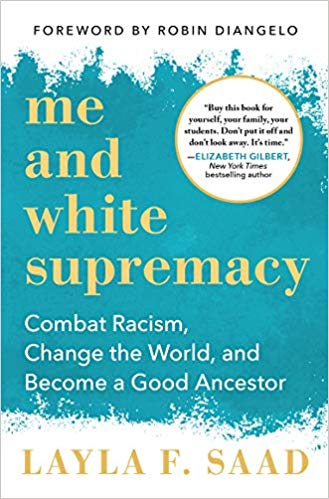
Antonia Senior is shocked, shocked to discover that she’s struggling with a whole bunch of internalized issues, according to a new book by Layla F. Saad:

I am a white supremacist. Who knew? I didn’t. I have, however, just read Me and White Supremacy by Layla F Saad, published next month by Quercus, which has made clear to me that I am white, therefore I am a racist. In fact, Ms Saad told me in the introduction to prepare to “become overwhelmed when you begin to discover the depths of your internalised white supremacy”.

On a similar note, a friend recently told me that my failure to recognise a vast malevolent patriarchy was as a result of “internalising your own oppression”. There seems to be a lot of internalised weirdness going on: gender victim battling it out with racist in my gut. I thought it was wind.

The publisher is pretty sure that the ranks of underpaid, bookish folk who work for them are also all white supremacists. It is distributing the tome to all the British employees of its parent company Hachette, and telling them to spend 28 days “reflecting on manifestations of white supremacy, including white privilege”.

The self-flagellation of all the white supremacists at Hachette is yet another example of how much the Woke borrow from the Church. Identity politics has become a secular religion, and “white privilege” is one of its shibboleths. Indeed Ms Saad makes the point clearly in her book, stating that “I strongly believe that anti-racism practice and social justice work are also spiritual work.”

To be woke demands faith in certain creeds, with the twins Equality and Diversity as unassailable deities. It demands a knowledge of the right language. You must believe in certain disprovable evils — like the existence of a malevolent patriarchy — and like many strict sects, it punishes its apostates most severely. The Twitter storms are fierce for those who express a non-woke view but should have known better than for those outside of the faith altogether.

Tom Holland, in his book Dominion, The making of the Western Mind, identifies the “trace elements” of Christianity in the woke world. The example he used was the intersectional feminists in the #MeToo movement offering white feminists the chance to “acknowledge their own entitlement, to confess their sins and to be granted absolution”.

December 27, 2019

A Christmas 2.0? – Kwanzaa – December 26th – TimeGhost of Christmas Past – DAY 3

Filed under: Africa, History, Politics, USA — Tags: , , , , , — Nicholas @ 04:00

TimeGhost History
Published 26 Dec 2019

It is in the Civil Rights Movement of the 1960s, that a young doctor of African studies decides to create his own holiday in California. Half a century later and this holiday has now become the nation-wide Kwanzaa.

Join us on Patreon: https://www.patreon.com/TimeGhostHistory

Hosted by: Indy Neidell
Written by: Rune Væver Hartvig and Spartacus Olsson
Directed by: Spartacus Olsson and Astrid Deinhard
Executive Producers: Bodo Rittenauer, Astrid Deinhard, Indy Neidell, Spartacus Olsson
Creative Producer: Joram Appel
Post-Production Director: Wieke Kapteijns
Research by: Rune Væver Hartvig
Edited by: Mikołaj Cackowski
Sound design: Marek Kamiński

Colorization by:
Julius Jääskeläinen – https://www.facebook.com/JJcolorization/

Sources:
valphotography https://flic.kr/p/6yoUEF
Emilio Labrador https://flic.kr/p/65sBT1
Robert Couse-Baker https://flic.kr/p/b2oyrr
Boston City Archives
From the Noun Project:
umoja by Travis Avery
kinara by Travis Avery
Human by Angelina

Soundtracks from Epidemic Sound:
Howard Harper-Barnes – “A Sleigh Ride Into Town”
Zauana – “Encountering the Unknown”
Sahara Skylight – “Streams of Africa”
Sahara Skylight – “Arriving in Ghana”
Sight of Wonders – “Wildlife Sunrise”

A TimeGhost chronological documentary produced by OnLion Entertainment GmbH.

From the comments:

TimeGhost History
17 minutes ago
Today, December 26, our TimeGhost of Christmas Past looks back in the not-too-distant history – in fact into a time in history when some of us here were alive. See, in 1966, Dr. Maulana Karenga decides to create his own holiday in the midst of the holiday season, and, as you’ll see, the rest is history. Now, before some of you become all judgemental and begin shouting in the comment section, remember what Indy says in the video. Think twice before you write something, and please adhere to our community guidelines. And even if you have something controversial to say or not, we’d still like you to share some holiday cheer with us by supporting us on Patreon. It is because of our Patreons that we can fly back into the past and their contributions are vital. See you tomorrow!

December 10, 2019

Warren Kinsella, the PPC, and “Operation Cactus”

Filed under: Cancon, Media, Politics — Tags: , , , — Nicholas @ 05:00

Kate at SDA linked to this interesting article by James Di Fiore on the Conservative Party’s contract with Warren Kinsella to smear Maxime Bernier and the PPC in the run-up to the Fall election:

If you were new to this country, or part of our sect of apathetic voters, there was a good chance you walked away from the election believing Bernier and his party were nothing but a bunch of racists who thought they finally found a home. From there, being branded the racist party in Canada, all the media had to do was either ignore the PPC, or only run negative stories, not wanting to be seen as an outlet giving positive coverage to what was deemed as obvious bigotry.

Enter Warren Kinsella.

I sometimes wonder how well-known Kinsella really is. Everyone in the Ottawa and Toronto bubble knows him. The media and party members know him. But he’s not exactly a household name, until now maybe. Kinsella, a throwback operative going back to the Chretien years, still manages to convince people to hire him, despite having a reputation of being hopelessly unsavoury, where the ends always justifies the means as long as you remind everyone along the way how great of a person you are.

Kinsella was hired by the Conservative Party of Canada to execute a campaign painting The People’s Party of Canada as a haven for bigotry and white nationalism. Secretly recorded by an employee, Kinsella was heard giving his team a pep talk on how to effectively destroy Bernier. He even tried to reinforce his motivational speech by bragging about falsely smearing three prominent politicians as racists when he knew they were not. He tries to catch himself by saying how easy it is to smear Bernier as a racist because, as Kinsella put it, “this guy actually is a racist.”

When a strong federal party hires a notoriously unethical operative to smear a new party as a gang of racists and bigots, it can be difficult to define your own brand. I asked Bernier if he thought there was a reason some racists did seem drawn to his party’s platform.

“It happened when Preston Manning started the Reform Party more than 25 years ago. People were saying that party was a racist party. The Conservative Party and Kinsella tried to do the same thing with us. That’s why I am looking at all my options to look at the legal procedures that we can do.”

Bernier might have a very strong case, especially now that Kinsella’s mask has been taken off by his own hand.

“The Conservative Party of Canada is morally and intellectually corrupt, and they proved that with their contract with Kinsella.”

It is still unknown how much the CPC and Kinsella impacted Bernier’s party, but it is reasonable to believe Kinsella was ultimately successful. On September 29th, at an event in Hamilton, several protestors accosted event attendees as they tried to get into the building at Mohawk College. The aggressiveness of the demonstrators was palpable as they screamed at seniors, calling them Nazis and preventing them from entering the building. Instances like this make Kinsella’s contract all the more mysterious. After all, his job, according to his own admission, was to activate Canadians against Bernier by stoking the flames of racial intolerance.

There are questions as to whether Kinsella’s fingerprints are on several other party missteps and controversies, including a rash of resignations earlier this year when former loyalists mysteriously began trashing the party publicly.

Operatives normally do not get caught bragging about having a track history of how their lies about other people’s bigotry have been successfully used to disrupt campaigns. In Bernier’s case, Kinsella, a self-proclaimed, lifelong fighter for racial justice, actually spent a career monetizing racial divisions he helped to stoke. When his shtick was exposed through his own accidental confessions, the hindsight view of Maxime Bernier became less blurry.

November 27, 2019

The “Gentrification” debate

Filed under: Economics, Politics, USA — Tags: , , , — Nicholas @ 05:00

In Quillette, Coleman Hughes explains the furor over gentrification in many big American cities:

The word “gentrification” was coined in 1964 to describe the influx of wealthy newcomers into low-income inner-city neighborhoods, resulting in rising property values, changes in neighborhood culture, and displacement of original residents. Though gentrification predates the modern era, it has only become the target of criticism in recent decades, as cities like Washington, D.C., Atlanta, and Boston have witnessed rapid transformations. Opponents of gentrification have ranged from residents directly affected by it to wealthy college students directly responsible for it, as well as prominent Democrats such as Bernie Sanders, Cory Booker, and Alexandria Ocasio-Cortez.

Critics of gentrification give two main reasons for their opposition: (1) wealthy newcomers drive up monthly rents, thereby displacing original residents; and (2) rapid change to neighborhood culture represents an injustice to original residents. Both critiques are magnified by the presumed skin color of the gentrifiers and the gentrified, who tend to be white and black or Hispanic, respectively.

Though such critiques may seem reasonable at first glance, neither of them survive scrutiny. Not only is gentrification harmless, it’s actually beneficial. Indeed, for reasons I will lay out, it’s exactly the kind of thing that progressives should support.

Let’s begin with the charge that gentrification displaces original residents. Two economists used data from the 2000 U.S. Census and the 2010-2014 American Community Survey to track individual outcomes for all residents of “gentrifiable” — or low-income inner-city — neighborhoods in America’s one hundred largest metropolitan areas. The largest study of its kind, it divided residents of gentrifiable neighborhoods into two categories based on educational attainment. Their findings refute the displacement narrative conclusively.

[…]

On the whole, progressives ought to love gentrification. It makes black inner-city homeowners wealthier. Among less-educated homeowners — who are majority non-white and comprise over a quarter of the total population in gentrifiable neighborhoods — those who remained in gentrified neighborhoods saw a $15,000 increase in the value of their homes due to gentrification. Among more-educated homeowners — who are also majority non-white — those who remained saw a $20,000 increase in property value.

What’s more, gentrification breaks up concentrated poverty and reduces residential segregation. Progressives have frequently observed that poor blacks are more likely to live in concentrated poverty than poor whites. As a result, they lose out on the advantages that come with living in a mixed-income neighborhood. Gentrification helps solve this problem. Moreover, progressives often observe that residential segregation remains pervasive half a century after the 1968 Fair Housing Act. Gentrification helps solve that problem too.

November 1, 2019

The “Wokescreen” protecting the Prime Racist

Filed under: Cancon, Politics — Tags: , , , — Nicholas @ 03:00

Justin “Blackface” Trudeau has been completely exonerated for any racist acts he committed, thanks to what Julie Burchill calls “the Wokescreen”:

Justin Trudeau with dark makeup on his face, neck and hands at a 2001 “Arabian Nights”-themed party at the West Point Grey Academy, the private school where he taught.
Photo from the West Point Grey Academy yearbook, via Time

Justin Trudeau seems as compulsively drawn to blacking up as his mother was to hanging around pop groups; after the third example of him doing so was revealed this year, he admitted that he had actually lost count of the number of times he’d done it. Nevertheless, he was defended by minority spokesmen and liberal commentators. This contrasts strikingly with the fate of Atlantic Records UK president Ben Cook, who was forced to resign earlier this month after old photographs of him in blackface emerged. As Cook is responsible for launching the career of Ed Sheeran, some might say he had it coming. But it’s weird how Trudeau, an ostentatiously woke politician, has survived and thrived, while Cook has limped away in disgrace. You’d think the former had betrayed both his beliefs and his followers far more.

[…]

So how come Trudeau got away with it? It’s part of a broader dodge – what the commentator Daniel Norris calls the Wokescreen. From behind this magical canopy, cliques can rob women of their hard-won private spaces (transgender activists) and enjoy the brutish thrill of racism (Corbynite anti-Semites) and because they’ve ticked the box which says Brotherhood Of Man it doesn’t make them bad people! Those people over there are the bad ones – like Jacob Rees-Mogg’s 12-year-old son.

It’s a mystery. But an even bigger one is why blackface is quite rightly unacceptable while drag gets bigger by the day. You’d have to be living in an Amish community not to have heard of RuPaul’s Drag Race, while Channel 5’s Drag Kids follows a process which we squares call “grooming”. Yet no one turns a hair. I’ve said it before and I’ll say it again: if the Black and White Minstrels are insulting and reactionary, why aren’t drag queens? If someone can explain to me why race-based parody is bad and sex-based parody “a bit of fun”, I’d love to know. Woke me up and tell me why!

October 30, 2019

In case it wasn’t already obvious – “Extinction Rebellion isn’t about the climate”

One of the self-described founders of Extinction Rebellion takes to Medium to explain what the organization’s real goals are:

I’ve been with Extinction Rebellion (XR) from the start. I was one of the 15 people in April 2018 who came together and made the collective decision to try to create the conditions that would initiate a rebellion. I was a coordinator of one of the original five working groups, and I’ve been organising with XR day-and-night since then (frugally living off my savings so I don’t have to work, having quit an industry that paid me £1000/week). And I’ve been in RisingUp (the organisation from which XR has emerged) since the first RisingUp action in November 2016. I’m a RisingUp Holding Group member, and a member of the XR Guardianship Team.

And for the sake of transparency: that previous paragraph is all about me “pulling rank” — I’m trying to convince you to listen to what I have to say …

And I’m here to say that XR isn’t about the climate. You see, the climate’s breakdown is a symptom of a toxic system of that has infected the ways we relate to each other as humans and to all life. This was exacerbated when European “civilisation” was spread around the globe through cruelty and violence (especially) over the last 600 years of colonialism, although the roots of the infections go much further back.

[…]

So Extinction Rebellion isn’t about the climate. It’s not even about “climate justice”, although that is also important. If we only talk about the climate, we’re missing the deeper problems plaguing our culture. And if we don’t excise the cause of the infection, we can never hope to heal from it.

This article is calling to all of those who are involved in XR who sometimes slip into saying it’s a climate movement. It’s a call to the American rebels who made a banner saying “CLIMATE extinction rebellion”. It’s a call to the XR Media & Messaging teams to never get sloppy with the messaging and “reduce” it to climate issues. It’s a call to the XR community to never say we’re a climate movement. Because we’re not. We’re a Rebellion. And we’re rebelling to highlight and heal from the insanity that is leading to our extinction. Now tell the truth and act like it.

« Newer PostsOlder Posts »

Powered by WordPress