
Vault of Lost Tales
Published 5 Apr 2025Delve into the razor-sharp world of Saki in this engaging author talk exploring his chillingly clever short story, “The Open Window”. Discover the man behind the pen name — H.H. Munro — and uncover how his biting satire, Edwardian upbringing, and darkly humorous worldview shaped this unforgettable tale. Perfect for fans of classic literature, Oscar Wilde-style wit, and unsettling plot twists, this literary deep dive offers historical context, thematic insights, and just enough spookiness to keep you on edge. Whether you’re a student, a short story lover, or just curious about the mind that created one of literature’s most deviously satisfying endings, this talk is your open invitation.
“Saki”, the wickedly sharp pen name of Hector Hugh Munro, masked a man whose wit could slice through Edwardian society like a silver butter knife through scandal.
Born in 1870 in British Burma and raised in England, Munro brought an acerbic wit to the drawing rooms of empire, crafting tales that balanced dry humor, social critique, and sudden, often shocking twists. Writing under the name “Saki”, he produced short stories that mocked the pretensions of the upper class, exposed the darkness beneath genteel facades, and made readers laugh — sometimes uncomfortably. His life, marked by loss, repressed identity, and service in World War I, ended tragically in 1916 on the battlefield, but his stories continue to delight and disturb to this day.
(more…)
August 25, 2025
The Sharpest Pen of the Edwardian Age | Who Was Saki?
August 24, 2025
Much of our prosperity is based on trust, and we’re rapidly losing it
Ted Gioia foresees a precipitous fall in trust coming at us very soon, and I’m afraid he might be being too optimistic:
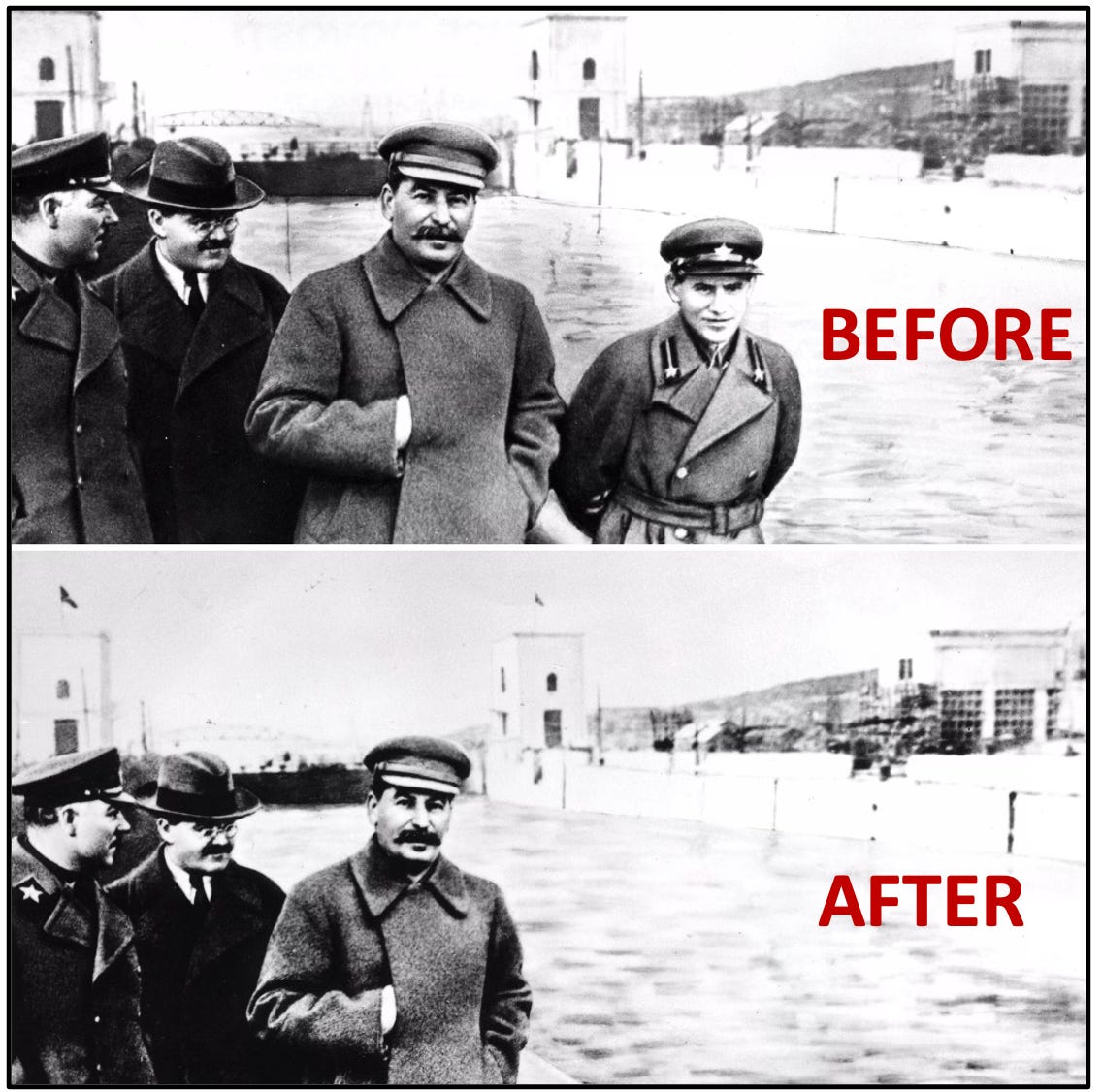
During the great purges of the 1930s, Stalin ordered the execution of a million people, including some of his closest associates. But it wasn’t enough to kill these victims — they also had to disappear from photographs.
In a famous case, Nikolai Yezhov got removed from his position next to Stalin in a photo taken by the Moscow Canal. This erasure alarmed many party elites because Yezhov, head of the secret police, had been one of the most feared men in the Soviet Union.
And now he got totally deleted.
Well, not totally. In those days of print media, original photos survived, and a paper trail made it difficult to erase history.
So this photo was later used to mock Stalin, and the pretensions of dictators. They can try to change reality, but that’s not possible.
Or is it? Maybe dictators now get the last laugh. Because in the last few months, reality has been defeated — totally, completely, unquestionably.
It is now possible to alter reality and every kind of historical record — and perhaps irrevocably. The technology for creating fake audio, video, and text has improved enormously in just the last few months. We will soon reach — or may have already reached — a tipping point where it’s impossible to tell the difference between truth and deception.
- Can I tell the difference between a fake AI video and a real video? A few months ago, I would have said yes. But now I’m not so sure.
- Can I tell the difference between fake AI music and human music? I still think I can discern a difference in complex genres, but this is a lot harder than it was just a few months ago.
- Can I tell the difference between a fake AI book and a real book by a human author? I’m fairly confident I can do this for a book on a subject I know well, but if I’m operating outside my core expertise, I might fail.
At the current rate of technological advance, all reliable ways of validating truth will soon be gone. My best guess is that we have another 12 months to enjoy some degree of confidence in our shared sense of reality.
But what happens when it’s gone?
Back in 2023, I asserted that trust is the most scarce thing in society. But that was before all these tech deceptions came online. Trust will soon get even more scarce — or perhaps disappear completely from the public sphere.
This is not a small matter.
Most discussions of this issue focus on the technology. I believe that’s a mistake. The real turmoil will take place in social cohesion and individual psychology. They will both fracture in a world where our shared benchmarks of truth and actuality disappear.
We will be — already are — in desperate need of Robert Heinlein’s Fair Witnesses:
A Fair Witness is an individual trained to observe events and report exactly what is seen and heard, making no extrapolations or assumptions. While wearing the Fair Witness uniform of a white robe, they are presumed to be observing and opining in their professional capacity. Works that refer to the Fair Witness emphasize the profession’s impartiality, integrity, objectivity, and reliability.
An example from the book [Stranger in a Strange Land] illustrates the role of Fair Witness when Anne is asked what color a house is. She answers, “It’s white on this side.” The character Jubal then explains, “You see? It doesn’t occur to Anne to infer that the other side is white, too. All the King’s horses couldn’t force her to commit herself … unless she went there and looked – and even then she wouldn’t assume that it stayed white after she left.”
August 17, 2025
To replace a people, first you need to induce guilt and self-hate
On his Substack, Frank Furedi discusses just how negatively the British establishment views the national flag and those uncultured boors who display it:

“Union Jacks and crosses of St George” by Ben Sutherland is licensed under CC BY 2.0 
 .
.
First a confession. I am not a serial flag-waver. In fact, one of the features of British history that I always appreciate is that its people possessed so much confidence about itself that it did not see the need for ostentatious displays of patriotism and flag waving. However, today matters are different. The nation’s cultural and political elites regard the Union Jack and the St George’s Cross — the flag of England — with embarrassment and studied contempt. Today many British institutions would rather fly the Palestinian flag or the LGBTQ+ or of Ukraine than flags that bear the nation’s symbols. Outwardly pride in Britain is in danger of being displaced by the sentiment of self-loathing.
Foreign observers are often surprised by the relative absence of Britain’s flag in public spaces. As one such observer noted recently, in Oxford Pride flags are outnumbered the Union Jack “by at least fifty to one”. He noted that the “next day in London, I saw Pride flags all about, with the Union Jack reserved for tourist sites like the Tower of London, which also sported Pride flags”.
In fact, the British Establishment’s reaction towards England’s flag is often communicated through the sentiment of ridicule and hatred. This sentiment has been embraced by local councils, particularly ones that are under the influence of Labour and the Lib Dems. Many of them feel entitled to prevent these flags from being displayed. Most recently the Birmingham’s Labour dominated council has ordered the removal of Union and St George’s flags from lamp posts in this city. The Council announced its decision to remove the flag on the ground that they put the lives of pedestrians and motorists “at risk” despite being up to 25ft off the ground! Needless to say, the Council applies a different standard of judgment when it comes flying the Palestinian flag, which are flown all over the City. Presumably this flag does not constitute a danger to motorists and pedestrians.
In Birmingham, Britain’s second largest city flying the flag of the nation is regarded by local officialdom as a risk to safety.
The British Establishment feels contempt towards not only Britain’s flags but also towards the people who enthusiastically identify with them with patriotic pride. An incident involving Emily Thornberry, Labour MP for Islington South, in November 2014 captures well the contempt that significant sections of the British political class have towards the symbolic displays of patriotism. During a by-election campaign in Rochester, she posted a photo of a house displaying three St George’s flags, with a white van parked outside, and accompanied it with the arch caption, “Image from #Rochester”. The implication of her post was that those who decorated their house with the flags of England were a legitimate target of disdain. Since they were obviously morally inferior to her superior kind there was no need for a caption explaining this on her post.
Millennial Woes discusses how the contempt of the elites for the British people is leading to increasing possibility of civil unrest … or worse:
The short answer as to “why?” is that, even in mid 2025 when many people are sensing a mood developing, the government is still doing all the things that are bringing that mood about. They have no reverse gear. Despite their rhetoric, they are not reducing immigration and are certainly not doing mass deportation. In addition we have learned that, for years, they have been covertly propagandising us. Meantime the hate speech laws which muzzle us are still in force and being strengthened. Recently, the Online Safety Act came into force and the very next day numerous internet platforms had to start censoring content. We can literally see our oppression increasing in real-time. And even now, they want more. Always, we feel the government trying to stop us talking about its abuse of us. (Even as I type these words, I am aware that they could get the police raiding my home and seizing my devices.)
Image from Millennial Woes
The same is true in the media. This morning I heard that the BBC are making a high-profile drama about 11th Century Britain in which a key historical figure will be played by a Black actor. Our news media is still biased in favour of mass immigration at any cost. Adverts are still full of black-man-white-woman couples. It is relentless.
In business, White people are handicapped by preferential treatment for non-whites in employment, business loans and career opportunities. A few days ago I got an advert on YouTube featuring a business consultant woman who defiantly said “at the end of the day, diversity is the key to success”. Middle-class White people habitually work against each other and their group interests, causing personal failure and burning resentment for many of their ethnic kin.
It doesn’t actually matter whether the people who perpetuate all of this truly “believe” in it. What matters is that they are prepared to behave as if they do. The incentives have taken on a life of their own, become self-perpetuating, making alternatives almost illegal and certainly a guarantor of “social death” and “professional death”. Even with all the evidence that diversity is bad, nobody in the professional class will dare to speak against it because, even now, that would be the end of their career. And so the poisoning continues.
In short, I feel that my country’s mainstream is working constantly against my ethnic group surviving. Furthermore I see no end in sight for this ethnic sabotage.
And many other people think the same – more and more all the time, in fact. This is why they are getting ever more angry.
Among young people there are more reasons still, economic pressures which mean they can’t get on the property ladder and build the security to start a family. That is immensely frustrating for a lot of energetic young adults, and they haven’t got (haven’t been able to get) much to lose. When a society doesn’t facilitate this most basic desire in people, it should expect upheaval.
However, against this backdrop of oppression, dysfunction and madness, the main catalyst for civil unrest will be something much more concrete: refugees sexually assaulting White women and children. Such crimes are now occurring every day. Unfortunately, there is no reason why they will lessen in frequency. (I will not endanger myself further by explaining why. Everyone knows.)
And it is the fact that, indeed, “everyone knows” which makes civil unrest inevitable. It isn’t just spergs, theorycels, doomers, basement-dwellers and politics or race science obsessives any more; it’s the apolitical working-class who just want a decent chance at life. When they believe their own government is denying them that, it is inevitable that they will “rise up”. It is only a question of when, where, how and how many.
It has been pointed out that, during covid, the public didn’t “rise up”. But I say this was because, despite the restrictions and the perversity of that situation, throughout it people were still comfortable. Most importantly, they didn’t feel their children were in danger. That is the key thing. Dangers that never attended raising a child in Britain thirty years ago are now ubiquitous, even if you live in a nice middle-class town.

Update, 18 August: Welcome, visitors from Instapundit. Please do have a look around at other posts you may find of interest. I send out a daily summary of posts here through my Substack – https://substack.com/@nicholasrusson that you can subscribe to if you’d like to be informed of new posts in the future.
August 13, 2025
The Dispossessed: State Happens
Feral Historian
Published 21 Mar 2025Ursula K. le Guin’s The Dispossessed is one of the most in-depth examinations of how a large anarchist society might function, addressing both the problems it solves and those it creates for itself. It’s a must-read for anyone interested in the communist-leaning variants of anarchism in particular.
00:00 Intro
01:58 Anarres is not an Island
04:45 Shevek goes to Urras
07:00 Abolition of Property
08:30 Social Pressures and Pravic
12:30 Necessity and Ossification
14:45 Necessity of Conflict
15:45 Shevek’s Wild RideThis video is in part a companion to this one — Cloak of Anarchy : Gradations of Stat… from a few weeks ago. The original cut of that one had a brief mention of a couple details from The Dispossessed, but it really needed its own video.
August 11, 2025
The problem with the theory that local government is more responsive is … people
Poor Chris Bray is having a moment of deep cognitive dissonance over the vast chasm between his prior belief that local government is more sensible, more grounded, more responsive to the electorate than huge, distant, impersonal big government:
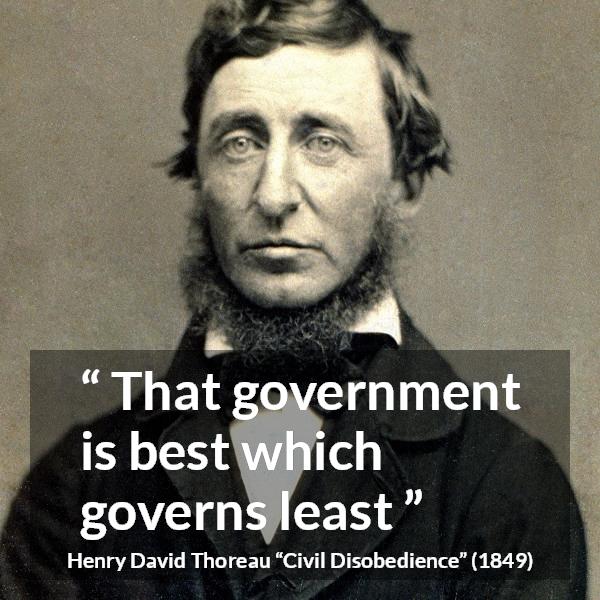
The more you deal with government, the more you are likely to agree with Thoreau
The problem of underlying principles and structural assumptions in a moment of profound cultural decay.
Like my old friend James Madison, the core of my understanding of political power is that authority becomes more rational and balanced as it gets closer to the people who are governed. Starting from home in my list of ideological priors, centralized power is usually going to be a steamroller, managed on top-down premises by people you’ve never met; local government, government by neighbors, is usually going to be more adept at listening and adapting. Your mayor is down the block, mowing his lawn. You can wave to him. When I worked at small town newspapers, I’d have breakfast with the city manager and the police chief — mostly so they could threaten to call my editor and have me fired, but still. They were here, right in front of me. I could talk to them. In the town where I’ve lived for a few years, now, I’ve waited at Trader Joe’s for a city councilman in cargo shorts and an old t-shirt to move over so I could get to the ground beef. They aren’t distant autocrats.
Sadly, though, a good few of them turn out to be proximate autocrats, and almost miraculously stupid. The problem with the theory of relatively well-balanced local authority is that some of the biggest goobers I’ve ever met have served on small town city councils and school boards, and your HOA board of literal neighbors makes Mussolini look like a hippie.
[Deleted a video here of an HOA officer being arrested, because it was staged.]
I wrote a quite carefully reported newspaper story about wasted money at a suburban school district, decades ago, that was critical but fair and elaborately sourced. The subsequent conversations I had with the members of the school board made me wonder if they had actual brain damage. No one on earth is more susceptible to psychotic conspiracy theories than small town elected officials, who respond to mild criticism by demanding to know WHO PUT YOU UP TO THIS, WHO ARE YOU REALLY WORKING FOR!?!?!?! WHAT’S YOUR TRUE AGENDA!?!?!?! WHO SENT YOU!?!?!?!? If you ask me for a list of the top ten people I’ve known personally and can’t stand at all, roughly eight of them were elected to local government positions in towns with low-five-figure populations, and I start grinding my teeth at the sound of their names. Wait, no: nine.
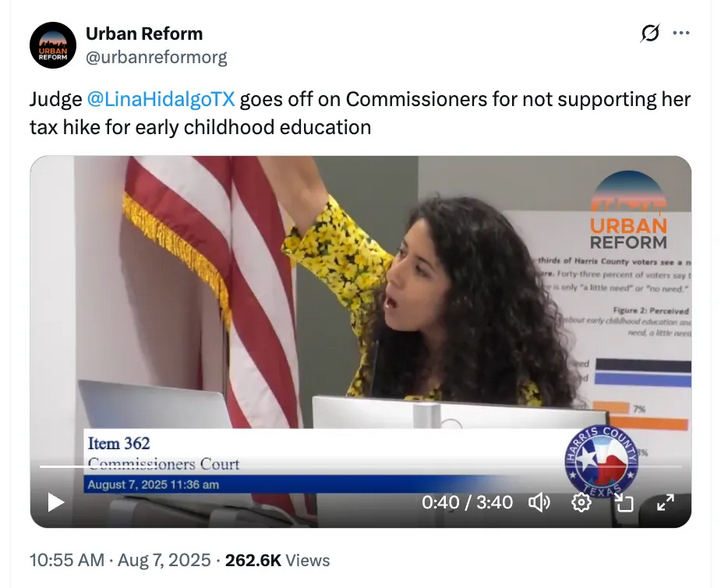
This topic is back on my mind this week because of Lina Hidalgo, though a county of five million people may be a bad example of real localism and neighborhood authority. Hidalgo is the county judge — in Texas, the chief executive officer — of Harris County. And she’s mad as a hatter. Click on the link to watch the video, but a tax increase is “not about politics, it’s about kids.” Never heard that one before.
[…]
Making appalling decisions at the head of broken institutions, they respond to criticism by hiring men with guns as a shield against ordinary human contact. Like I said, the mayor is down the block, mowing his lawn, so you can wave to hi—STOP RIGHT THERE, GET ON THE GROUND.
The spirit of the NSBA letter lives on in a thousand local offices, where the problem with running schools is that parents exist, and the problem with running cities is that they have people in them.

August 8, 2025
QotD: Accelerating back towards bicamerality
Bicamerality [Wiki] is the human ground state; we always “want” to return to it; in the absence of the actual gods, the blinking smartphone screen is the next best thing.
This hypothesis seems to explain a few huge, otherwise perplexing facts of Leftist behavior. First: The further Left a person is, the more desperate xzhey are to put everyone else into one, and only one, category. Starting, of course, with themselves — I often joke that they’re trying to get their own bespoke “sexuality” so refined that no one else in the world could possibly share it. That would relieve them from the burden of ever actually having to be intimate — sexually or otherwise — with anyone. They can sit in the dark in their masks, eating bugs and watching Netflix, totally alone, forever.
I’m joking, but I’m not kidding. They really do seem to want that. And bicamerality explains it. I’ve also frequently likened them to the “zooanthrops” from The Book of the New Sun, from whence my stupid nom de blog comes. In that book, the literal end of the world was just around the corner — the sun, long expanded into a cool red giant, was about to go out, possibly within the current generation’s lifetime. Because of that, some people decided to “lay the burden of consciousness down” — they had themselves lobotomized and dumped in the woods.
Again, I’m joking, but I’m not kidding: Doesn’t that seem to be what so many on the Left really want? To be relieved of the burden of thought?
It applies even more so when they’re forced to interact with the world. We’ve all seen how desperate they are to shove people into one, and only one, box. Actually “desperate” is too mild a word — nothing frightens them more than the fact that a person can look one way, but actually be another way. It’s why they’re such slaves to fashion — literal fashion, not just fads trending on Twitter. Even before Der Hamsterkauf you could tell a Leftist just by looking at them, pretty much 100% of the time. Afterwards … well, we’ve all advanced a lot of explanations for why they’re so bizarrely insistent on the mask, especially for children: It’s their new purity ritual. They’re all chicks, and that’s the ultimate chick herd behavior. They’re just sadists. And so on.
But what if it’s as simple as The Mask relieves them, as nothing else can, from a significant source of interpersonal stress? “Interpersonal” again is too mild a word. They don’t want to “get to know you”. They don’t even want to talk to you. Hell, they don’t even want to share the same air with you, and do you see what I mean? Their “lives” would be so much better if we all had to wear colored patches on our jumpsuits, Dachau-style, telling everyone exactly what we are (exactly and only). Barring that, they’d love to reimpose some of the old medieval sumptuary laws — again, you will eat the bugs, because that’s what you deserve, peasant! But it’s not just that. It’s also a huge stress relief for them, to be able to tell a person’s social status at a glance.
Consider further (just briefly) how much a non-victim Victim fries their circuits. A gay conservative, say, or a pro-life woman, or a black “acting White” (your average liberal makes your average rapper look like a paragon of tolerance when it comes to that particular sin, though of course the liberal dresses it up in a thousand syllables of fugly jargon). Even though “the sex you’re attracted to” has no possible relationship to “your stance on the tax code”, the Left has made it so — first as a cynical political maneuver, but now because it minimizes their “interpersonal” (again, for lack of a better word) stress.
The tl;dr here is that your typical Leftist seems to spend all xzheir time in xzheir own head — always labeling, cataloging, frantically shoving everyone and everything into its own little box. But they do this, I think, because they know subconsciously that once they’ve got everything shoved into one and only box, forever, they’ll never have to think again … and that’s what they really want. A life of perfect unconscious bliss, where any “decision” that needs to get made comes from the blinking box.
Severian, “Striving Towards Bicamerality”, Founding Questions, 2022-03-20.
August 3, 2025
20th century advertising alchemy rediscovered
Much sound and fury has been devoted to the ritual denunciations of American Eagle and their new ad campaign featuring blatant Nazi ideology and imagery, er, I mean Sydney Sweeney:

Whenever I endure a sentence which trespasses into a jibe about whiteness or men or some other illusory bugbear, I stop reading and launch the laptop through the window. This week, I’ve cleaned out eBay. As one delivery driver lugs a fresh laptop to my front door, another scoops up the last to fall from the sky.
Those all-too-common laments about skin colour or genitalia are the scarlet letter imprinted on the chest of the thoughtless bore. It’s a mind virus without antidote. Screeching “whiteness!” upon snapping one’s shoelace betrays sound psychological health.
Take Sydney Sweeney, an American actress blessed with a merciless, unfair genetic inheritance. This week, Sydney broke the internet. Her crime? She’s rather attractive. Worse yet, Sydney flaunts her icy, Scandinavian beauty.
In an advert for American Eagle, the dewy, lissom blonde squeezes her gymnastic body into a pair of denim jeans. Smouldering before the camera, Sydney flutters her “great genes”.
Those great genes sashay around a classic Mustang — 400 horses of unapologetic masculine energy. Sydney pats her hypnotic behind. She fires up that climate-melting engine. The infernal marriage of masculine-feminine consummates as she roars off into the distance.
Advertisers know what they did. Diana, Roman goddess and huntress of men. Her chariot, the male appendage made steel and exploding gasoline. A combination to light our monkey brains on fire. The symbolism hijacks our amygdala: buy these jeans, and she’s yours. Or, for the other sex, buy these and manipulate them.
I’m sorry to be so blunt, reader. Those claims, as primitive as they may appear, are the animating spirit of advertising. Back in the 1920s, Freud’s nephew, Edward Bernays, transplanted Uncle Siggy’s theories into the advertising business. Out went staid adverts praising a product’s utility. In went adverts selling visions of your unconscious, insatiable self. Bernays transformed the public relations and advertising worlds. He sold products that stirred the galloping herds of the subconscious mind.
Take cigarettes. Before Bernays, smoking was a decidedly male pursuit. Tobacco giants, keen to double their potential customer pool, turned to him. Bernays transformed smoking from a vulgar, unladylike pastime into a symbol of freedom and female empowerment. Men buy Patek Phillipe watches for the same reason. As Dave Chappelle put it: “If a man could fuck a woman in a cardboard box, he wouldn’t buy a house”.
In just a few moments, Sweeney’s serpentine hips lulled advertising away from overt wokeness to its subliminal witchcraft. It worked. American Eagle’s stock surged fifteen percent.
For research, I studied the ad twenty-seven times. Your humble narrator bought thirty-seven pairs of jeans and then signed over his entire inheritance to Ms Sweeney.
The reaction on the identitarian left authored five additional chapters to the upcoming edition of the Diagnostic and Statistical Manual of Mental Disorders.
By teasing the words “genes” and “jeans”, Sweeney called for the annexation of Poland and the Sudetenland. MSNBC excelled itself, even birthing a new pidgin English indecipherable to 97 percent of native speakers:
“Sydney Sweeney’s ad shows an unbridled cultural shift towards whiteness”.
Well, that’s one way to think about it.
August 2, 2025
QotD: The path to salvation
The following is not a theological argument, it’s an observation about human nature: Both faith and works are necessary, because by their fruits ye shall know them. If one has faith, then the works will follow — naturally, as it were. But works without faith are mere mumbo-jumbo, no different than the crudest magic spell. The kind of guy who does what David French does — performs the works solely to be seen performing the works — is what Jesus called a “whited sepulcher”, which indeed appear beautiful outward, but are within full of dead men’s bones, and of all uncleanness.
Again, you don’t have to be a Biblical scholar to observe that Jesus commanded what the parlance our times calls “tough love”. Just as you can’t save a sinner by taking away all his opportunities to sin — we are ALL guilty; we are ALL fallen; that alone is sufficient to damn us — so you can’t “save” a drunk, or an illegal alien, or a criminal, or whatever by enabling his lifestyle. The reason I’m not in church today is because the church is exactly like that gaggle of Karens in Starbucks — they talk a good game about renouncing the wiles of this world, but they bend over backwards to enable every possible social dysfunction.
No, Jesus did NOT command us to patch up the gutter addict every time he OD’s, so that he can go out and OD again. He did NOT command us to provide all kinds of food and shelter and medical care to every Squatemalan who broke the very first American law he had the opportunity to break by coming here. No, He did NOT command us to tolerate deviance — there are two clauses in “love the sinner, hate the sin”, and we must obey both.
The only route to salvation starts by admitting that everyone is fallen. You can take that in whatever sense you like, because it’s not theology, it’s just an obvious fact about human nature. Alas, it’s one you have to learn by age 12, or you’ll never learn it at all. That’s the greatest trick the Devil ever pulled.
Severian, “On Being Bad”, Founding Questions, 2021-12-12.
July 30, 2025
“The worst thing that can happen to a good cause is, not to be skilfully attacked, but to be ineptly defended”
On Substack, Johann Kurtz provides a great example of Bastiat’s insight (quoted in the title), as debaters ineptly defend the whole notion of masculinity, particularly how boys are victimized for being boys:

“End Toxic Masculinity” by labnusantara is licensed under CC BY-NC-ND 2.0


We’re failing our boys.
Two-thirds of young men feel that “no one really knows” them. Their real wages have been falling since the 1970s. They’re dropping out of education and the workforce in growing numbers. They die deaths of despair at almost three times the rate of women. Even their physical strength is collapsing.
Terrible solutions are proposed. No matter how much traditional masculinity is undermined, powerful voices continue to insist that the real problem is that it hasn’t been destroyed altogether. “Only then will boys be happy”.
My thesis for this series is that there is a need to defend true masculinity on its own terms, not on the implicit terms of progressives who either don’t understand it or actively hate it.
Take, for example, this debate at the Oxford Union on traditional masculinity. The opening argument of the opposition — who are supposed to be defending traditional masculinity — starts with asserting the need for a “contemporary and inclusive” masculinity which is accessible to anyone “of any race, sexuality, or other identity“.
The best defence that this speaker can mount on this anaemic foundation is an argument that masculinity is useful for activism and community building like the “Movember Foundation”. After this slightly pathetic case she goes back to conceding “being forced to conform to a set of expectations is uncomfortable and even dangerous. We should allow people to access the gender expressions that make them feel like their truest self.”
The next speaker for the defence of traditional masculinity continues the grovelling: “In 2019, you know, we should not be honouring and obeying men — those times have gone.” This talk is a little better — you get the sense that he actually likes men, and notes that it’s overwhelmingly men who die in wars and dangerous jobs — before collapsing back at the end: “We should look at new ways of being a man. I would love to get more men involved in teaching, in nursing — make it ‘cool to care’. I’ve been around Scandinavia talking to stay-at-home dads … These are progressive, beautiful men.”
The final speaker — who, again, is supposed to be defending traditional masculinity — takes the stage and begins: “Some of the most beautiful moments I’ve watched in young men’s lives are when we’re alone in a room — and maybe a brother who’s been struggling with his sexuality comes out in front of a hundred other brothers, and he’s crying, and his other brothers are crying with him“. You can imagine the rest.
None of this has anything to do with traditional masculinity. In this series I will advocate for the cultivation in boys of all of the aspects of masculinity that these “advocates” were afraid to defend: strength, aggression, dominance, stoicism, and risk-taking.
July 26, 2025
The desperate narcissism of the “Cool Professor”
Freddie deBoer on the pathetic academic specimen sometimes known as “Bob” or “Biff” or “Lizzie” — the dreaded self-imagined “cool professor”:

“heh, probably never expected to have a professor with full sleeve tattoos, huh? well, that’s not the last time your mind’s gonna be blown this semester …”
Image and caption from Freddie deBoer’s Substack
Let me tell you about the saddest figures in the American university. They wear black jeans and Chuck Taylors to class, except maybe on the first day, when they stroll in wearing semi-ironic suits designed to contrast with their ample tattoos. Their syllabuses are printed in Helvetica. They mention Chappell Roan in the first fifteen minutes of the first day of class. They tell their students, with a wink, that they don’t believe in grades — why, who are they to judge their students! They encourage everyone in class to call them by their first names, or perhaps a contrived nickname. They hope to blow everyone’s minds when they theatrically announce that in their classes, students pick the readings, because the students are the ones who really know what’s worthy of their time. They describe themselves as “friends” or “guides” or “partners”, not as teachers or professors. They disdainfully invoke the words “rigor” and “standards” only with ironic scare quotes and want you to know that they don’t believe in deadlines. They subtweet the provost on BlueSky. They are the Cool Professors. And they are frauds.
The Cool Professor fundamentally does not want to teach, as teaching requires the teacher to sometimes be the bad guy. The Cool Professor can’t stand to be the bad guy, chafes at the very idea. That’s the core of all of this. The posture, the cultivated aesthetic of rejection, the performance of cool — none of it’s about students, even though Cool Professors will not shut the fuck up about how they run a “student-centered classroom”. Their affect isn’t about pedagogy. It’s about insecurity and narcissism, their desperate need to be perceived as the rare exception, the rogue academic, the anti-institutional rebel. Cool Professors aren’t trying to liberate students. They’re trying to be loved, and in being loved by students stave off their horror about growing old. And if that means letting students drift intellectually, if that means mistaking chaos for creativity, if that means failing to ever give anyone a hard but necessary lesson, then so be it. Because the thing the Cool Professor wants to avoid at all costs is being perceived as an authority figure, and that is precisely what students most need them to be.
It’s a common misunderstanding, particularly among faculty who feel alienated from the bureaucracy of the university or who fancy themselves transgressive thinkers, that teaching should never be hierarchical. The idea is that it’s somehow oppressive to know more than your students or to presume to evaluate their performance; that knowing more than your students and evaluating their performance are publicly understood to be core parts of being a teacher typically goes ignored. Many who consider themselves modern or progressive in the academy insist that education should be horizontal, an equal exchange between learner and guide, that the classroom is a site of resistance or liberation. But these ideas, while maybe flattering to the professor’s ego and superficially appealing to a certain kind of idealist, are incoherent. They’re built on a fundamental category error: mistaking the classroom for a club meeting, or a dinner party, or a DSA breakout session. The classroom is none of those things. It’s a site of instruction, and in a site of instruction one party knows more than the other; one party evaluates the other; one party is, necessarily, in charge.
(And, for the record, the fundamental dictate of critical pedagogy is always and forever self-defeating: if you inspire your students to rebel against your authority in your own classroom, they’re still following your lead and thus not rebelling at all. The ubiquitous goal of prompting students to resist top-down education, whatever that means, is unachievable, because if you do prompt them to resist, they’re actually complying with your desires, not resisting them. It’s a good old fashioned paradox and not one you can bluff your way out of with abstruse academic vocabulary.)
The plain fact that a teacher must necessarily have some sort of control over the classroom space that the students do not makes people uncomfortable. Authority always does. But then, the job of a teacher is not to minimize discomfort; indeed, a good teacher will necessarily make their students uncomfortable, on occasion, as it’s often only in the space of genuine discomfort that we’re inspired to achieve our deepest growth. The professor’s job to be responsible for the intellectual development of students, which inevitably involves making judgments: what is true, what is false, what is well argued, what is sloppy, what is insightful, what is clichéd. If you aren’t willing to say those things, if you shrink from judgment, you’re abandoning the role you signed up for, you’re copping out. You’re indulging yourself, and your own flattering self-mythology, at the expense of the people you’re supposed to be teaching.
July 25, 2025
Autism, then and now
At Psychobabble, Hannah Spier traces the rise of autism from its first formal definition to something that 1 in 36 kids is diagnosed with:
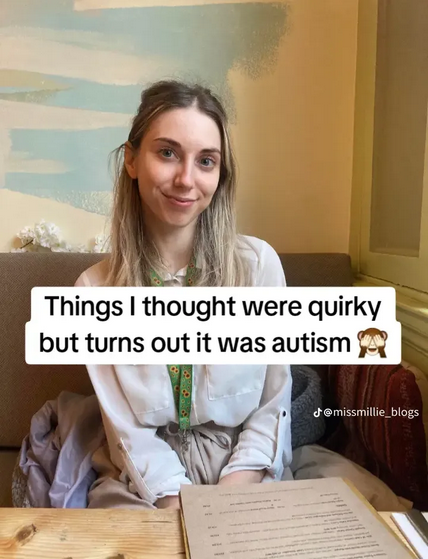
When Leo Kanner first defined autism in 1943, it was estimated that 4 to 5 children per 10,000 were affected. Today, the CDC puts that number at 1 in 36, almost one child in every classroom. If any other medical condition, blindness, epilepsy or paralysis showed a spike like this, it would trigger a pandemic-level outcry. But with autism, we see at best a curious murmuring as to what this is, and at worst, a growing chorus of people insisting, they too, belong in the group.
From experts, instead of raised alarms or calls for serious public health investigation (as would be expected for any other childhood disorder) we get calls for inclusivity and a self-congratulatory attitude toward their advancement in diagnostic understanding and tools. Another example of ideological capture of psychiatry by cultural sentiment.
Characters like Sheldon Cooper and Sherlock Holmes have helped turn the image of autism into a badge of honour. It means you’re socially odd, intellectually superior, and emotionally detached in an edgy and endearing way. For many, especially mothers with narcissistic tendencies hungry for a narrative of exceptionalism, this offered a seductive reframing of their child’s misbehaviour and non-conformity as evidence of giftedness. She could thus become the one who gave birth to the quirky but special genius. She alone saw the hidden brilliance beneath the “weird” behaviour. She became the martyr and the insider to an elite subculture. It’s Munchausen by proxy, 2025 edition.
People with narcissism and psychopathic traits exploit wherever they can, we know this. And yet again, psychiatry, the ones who should be the best at recognizing these, made it easy pickings by flinging the diagnostic gates wide open. Longtime readers will recognize the pattern: I’ve written before about the diagnostic creep in trauma, expanding definitions that blur the line between disorder and ordinary variation. The same diagnostic creep has unfolded here. Autism, once narrowly defined, was steadily loosened through each revision of the DSM.
The Great Diagnostic Expansion
Originally, Kanner’s autism was unmistakable: nonverbal children, socially disconnected, cognitively impaired, often with seizures. These were not quirky introverts. These were children who required full-time care and specialized schooling. In the DSM-III of the 1980s, it was called infantile autism. The criteria required clear onset before 30 months, marked language delays, gross deficits in social interaction, and repetitive behaviours. These were developmental dysfunctions, not misunderstood personalities. And neither clinicians nor parents had a problem naming them as such.
Then came the DSM-III-R in 1987, which introduced pervasive developmental disorder not otherwise specified (PDD-NOS) and broadened the field significantly. Suddenly, language delay and intellectual disability were no longer central. Subclinical cases were included. Asperger’s Syndrome followed in the DSM-IV in 1994, adding high-IQ individuals with no language delays but poor social functioning. A child who spoke on time but didn’t understand jokes, had poor eye contact, and rigid routines was now also autistic.
But the most dramatic change came with DSM-5 in 2013. The subtypes were eliminated. Autism became one spectrum. The criteria were thinned down to two domains: social communication difficulties and restrictive, repetitive behaviours. A person needed to meet just six out of twelve traits, spread across these two clusters. Language and cognitive delay? Optional. Even the requirement for early onset was removed. A diagnosis could now be given based on historical symptoms. Questionnaires like the Autism Spectrum Quotient (AQ) are so broad and subjective they can be easily gamed. This made it possible for 30-year-olds to recall feeling “socially overwhelmed” in school and not liking itchy clothing to receive the same diagnosis as a nonverbal child requiring lifelong care.
The diagnostic category has become a black hole, pulling in people with no clinical resemblance, collapsing distinction into sameness. From what I’ve observed, three distinct autism “patients” now account for much of the increased prevalence, none of whom would have qualified under the original criteria.
July 22, 2025
Bitter reality is coming for the laptop class
Spaceman Spiff foretells the end of the managed paradise of the “unsophisticated sophisticates” of the privileged laptop class who have been able to keep their dream alive at the expense of everyone outside their rarefied and protected bubbles:
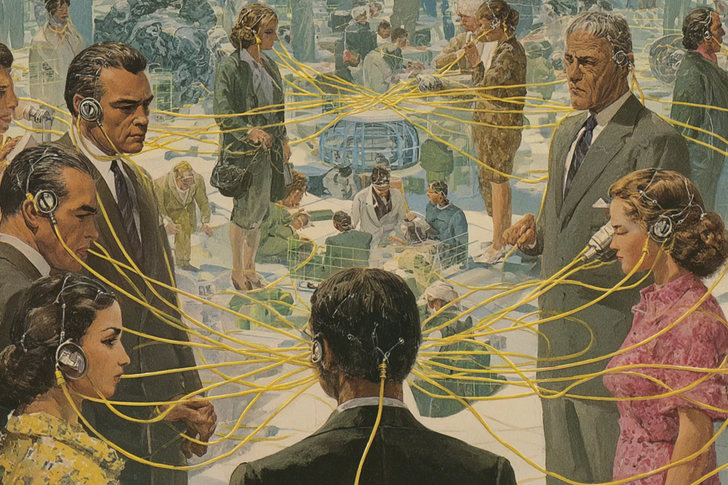
There seems to be a section of society populated with gullible conformists who believe many of the manufactured narratives designed to manage society.
Most are the credentialed products of universities. The laptop class of professionals who operate the corporations, institutions and key organizations.
Their worldview is comprised of stories which are downloaded and stored as mental models. Adhering to these narratives can then devolve into belief systems that are placed beyond criticism. This in turn can easily degenerate into a kind of fanaticism.
Ideas like mass migration and the destruction of reliable energy sources are crazy and yet they are primarily in existence thanks to the efforts of this layer of society, the professionals who implement policies desired by the ruling class.
While some among them are cynically exploiting today’s fads for their own ends, many seem to be true believers.
How can they believe these things so completely? What is going on?
Rebels searching for causes
Most of today’s great crusades seem to have the same characteristics. They are easily downloaded and consumed, they are socially rewarded within some circles, and they are not immediately obvious as issues at all.
The most popular are pre-prepared to an almost comical degree and thoroughly focus-grouped to ensure minimal friction among their consumers.
Many even come with slogans attached. Diversity is our strength is every bit as artificial as two weeks to flatten the curve, but it goes down easily with no thought required, which is the point.
The ideas that stick are the ones most useful to demonstrate virtue. Showing off to your peers you are non-sexist, non-racist and non-homophobic helps secure your place in many professional hierarchies where visible in-group membership matters.
The most prized causes appear to be non-obvious where the conclusions are not reachable with the evidence available.
This confusing aspect makes many question some new idea or policy, but in the laptop class often triggers a sense of smugness that they see beyond the obvious to the obscure thanks to their impressive intellects. Criticism can then be dismissed as simplistic providing a rewarding sense of superiority.
Much of the above is evident in the belief systems of today’s professional classes.
[…]
What to make of all this?
Does any of this matter? Yes it does. It is this section of society that ultimately puts in place the ruinous ideas of the ruling class.
They are in the corporate offices, the local councils and the schools. They are running the television stations and the publishing houses. They are captured by groupthink. Everyone they know thinks as they do. All criticism is easily dismissed.
Very little can penetrate this bubble. Except one thing.
Over time reality intrudes. Models should be updated to accommodate new findings and observations, but that is challenging when they have been uncritically downloaded to satisfy psychological needs.
Contrary evidence threatens one’s sense of self so scrutiny is avoided. When these avoidances ultimately fail some dig even deeper. Magical thinking seems to be everywhere.
The ultimate effect is either a reassessment of one’s worldview, or a psychotic break from reality. We see examples of the latter; Trump Derangement Syndrome is one well known borderline psychosis but there are others.
July 21, 2025
“Normal”? Dude, that’s extremist right-wing hate speech!
The Bone Writer on the huge increase in young people “identifying” as something other than what unreconstructed cavemen used to call “normal”:
Walk through any high school, scroll through TikTok, or attend a freshman orientation, and you’ll see the new hierarchy of modern identity:
- Straight white male? Bottom rung.
- Bisexual nonbinary neurodivergent? Stunning and brave.
- Confused, anxious, fluid? You’re seen. You’re valid.
- Rooted, stable, and clear? YOU must be dangerous.
It’s not just a cultural shift anymore. It’s a cultural mutation. A slow but total dislocation from reality.
We are no longer celebrating the diversity of life. We are celebrating the diversity of escape routes from it.
Identity as a Compass? No … It’s Identity as Camouflage
There was a time when “identity” meant something integrated, a clear expression of who you are, shaped by your values, your upbringing, your nature.
Now, identity is:
- A product
- A protest
- A mask
It’s often less about expressing truth and more about shielding from judgment.
And nowhere is that clearer than in the explosion of LGBT+ self-identification, especially among the young.
The Numbers Don’t Lie but No One Wants to Look at Them
In 2012, Gallup found ~3.5% of Americans identified as LGBT.
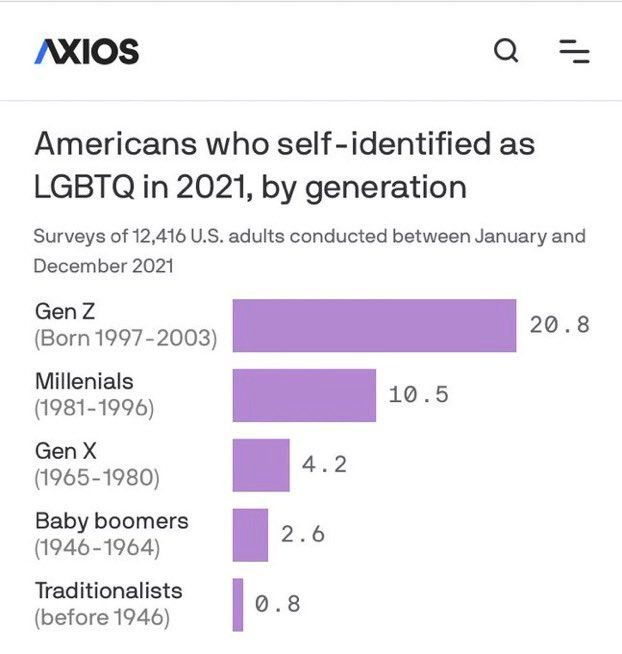
By 2021? Over 20% of Gen Z now identify somewhere on the spectrum.
Among Gen Z women, bisexual identity has grown by over 400%.
Do you really believe this is all “just visibility”? Do you really think the human genome changed this much in 10 years?
Of course not.
What changed was the culture. And culture now rewards deviation and punishes normativity.
Reported by Axios in 2021

July 20, 2025
Generational differences about … ugh … talking on the telephone
As a late boomer — and unlike most of my cohort — I’ve always hated talking on the telephone to someone. I’m sure part of it is my innate shyness and social awkwardness: if I can’t see how the other person reacts to my verbal blundering, how can I correct myself in time to salvage something from the call? As a result, I’m rather more sympathetic to younger Millennials and Gen Z’ers who have a common generational aversion to telephone calls:

“Candle-stick phone with courtesy pay box” by CodeName47km is licensed under CC BY-SA 4.0  .
.
I’ve been working to wean myself off the phone. I try to use it only when it feels necessary: we require an answer now, things are too complex to lay out in an email, or I want to be sure what I’m saying is received as I intend it. Sometimes these calls are spontaneous. Increasingly, I schedule them, or ask permission first.
I’ve done this because it’s how business communications work today, and I don’t like to remind people that I’m getting on. I also do it in deference to my colleagues, all of whom are much younger than me. They prefer email, texts, or the group chat.
The landline decision was forced by our acquisition of Fitzhenry & Whiteside, which has had the same telephone number for decades. F&W has many more authors than does Sutherland House, and a good number of them are over sixty. We’re trying to make the transition to new ownership seamless. We didn’t want people calling up to hear “this number is no longer in service”. So the newly installed phone sits on a stand beside the desk I share with Shalomi. I call it Shalomi’s phone and make her answer it when she’s around. Mostly it goes to voicemail and tells people how to contact us by email.
Accustomed as I’ve become to phone-free work, I was taken aback this week when I asked one of our interns to call a printer — we needed a quick quote — and she responded, “I don’t do telephones”. She looked at me bewildered. I responded in kind.
My mind was racing to figure out if I’d mishandled the matter. I’d just read that story in the New York Times about the “Gen Z stare”, the blank look given by a young person (usually in a service job) where a verbal response would be common. It is often interpreted as a freeze on the part of the starer, an inability or reluctance to engage, perhaps rooted in anxiety, perhaps a remnant of the pandemic’s social dislocations, although some insist the starer is telling their interlocutor “you’re in my space and you ought to back off”.
I heard from a number of people about that article this week, and while the Times had not mentioned phone usage and etiquette, my conversations did. Apparently there are a lot of young people who don’t know how to answer their phones. They see a call pop up on their screen and they stare at it, waiting for it to go away. Or they press answer and listen without saying anything. Some, I’m told, answer even scheduled calls from people they know with silence.
I’ve heard parents say they didn’t expect they’d have to teach their children to answer a phone. A university lecturer explained that journalism professors now demonstrate use of a telephone before instructing students on how to conduct an interview over it. Apparently, the same goes for rookie salespeople.
Poking around online, I found a BBC article reporting that a quarter of people aged eighteen to thirty-four never answer their phones, more than half of them interpret any unexpected call as bad news. CBS reports 90 per cent of Gen-Z are anxious about phone calls.
In fairness, a lot of adults are similarly leery of their phones. They don’t want to engage with spam dialers or scammers — they answer and listen for the brief pause that betrays a call centre. Some let every unrecognized call go to voicemail. The savvier ones have figured out that your iPhone, properly configured, will send calls from people not in your contacts directly to voicemail.
Back to our intern. Eventually, I recovered myself. This wasn’t an instance of Gen-Z awkwardness or anxiety around real-time conversations. She is bright, confident, and as socially adept as anyone in the office. I asked if she had a phone. She did. I asked if she used it for calls. She said only to speak to her mom, who pays for her phone. Perfectly reasonable. And it was her personal phone, not a company phone, so she was under no obligation to use it at work. So we suggested she make the call on the company phone, which she cheerfully did.
We spoke later about generational differences with regard to communications technology. She likes the control one has over email communication as compared to the unpredictable nature of phone calls. I told her about life when no one had phones, yet we could all somehow manage to show up at the same place and the same hour. I can hardly believe I lived in such times. Hearing this must have hit her like I was once hit by the reporter Ray Stannard Baker’s account of how he used to walk up to the White House, knock on the front door, and ask to speak with the president.
QotD: Above all else, helicopter parents hate … helicopter parenting
If the kid gets anything less than an A-triple-plus in Zoom School, Karen is immediately on the horn to the teacher … and since all schools these days, even the rare physical ones, are all wired up with “classroom management software”, they can bombard their kids’ teachers with emails and text messages 24 hours a day, 7 days a week.
Helmets, knee pads … kids these days wear more safety gear than a mountain climber just to ride their bikes, and I wouldn’t be at all surprised to see them kitted out like hockey goalies if recess ever becomes a thing again. Can the day be far off when every kid is trailed by xzheyr own personal injury lawyer, and parents are forced to sign waivers to let their kids use the bathroom?
Everyone knows how bad this is for childhood development, but if I told some kid with a scraped knee to rub some dirt on it, you’ll be fine, I’d probably get hauled up on child endangerment charges.
How can kids advance past age twelve, mentally and emotionally, if they’re never allowed to get hurt? To fail? To suffer the consequences of their own bad decisions?
I’m no developmental psychologist, but it seems obvious that such learning is time-limited. If you haven’t learned that X brings pain — and WHY — by the time you hit twelve years old, then on some fundamental level you’re never going to learn it.
Severian, “On Being Bad”, Founding Questions, 2021-12-12.


