Quotulatiousness

July 11, 2018

Environmentalists against science

At Catallaxy Files, Jeff Stier looks at situations when activists who normally fetishize their devotion to science will go out of their way to fight against scientific findings that don’t co-incide with their preferences:

The debate over regulation often devolves into a debate about “too little” versus “too much” regulation, split along the ideological divide. Too little regulation, goes the argument, and we are exposed to too much risk. Too little, and we don’t advance.

This binary approach, however, represents the dark-ages of regulatory policy. It was more frequently relevant when our tools to measure risk were primitive, but today’s technology allows much more precise ways to evaluate real-world risks. With less uncertainty, there’s less of a need to cast a broad regulatory net.

Regulation not warranted by countervailing risk just doesn’t make sense. That’s why a pseudoscientific approach, dubbed the “precautionary principle,” behind much of today’s regulation is so pernicious. This dogma dictates that it’s always better to be safe than to ever be sorry. The approach is politically effective not only because it’s something your mother says, but because it’s easier to envision potential dangers, remote as they may be, than potential benefits. Uncertainty, it turns out, is a powerful tool for those who seek to live in a world without risk.

But what happens when regulators can get a reasonably good handle on benefits and risks? Some potential risks have been eliminated simply because the basis for the concern has proven to be unwarranted. For more than two decades, the artificial sweetener, saccharin, came with a cancer warning label in the U.S.But it turned out that the animal experiment which led to the warning was later found to be irrelevant to humans, and the warning was eventually removed.

Warning about a product when risks are not well-understood is prudent. But it would be absurd to continue to warn after the science tells us there’s nothing to worry about.

Today, an analogous situation is playing out in the EU, where activists are using outmoded tests not just to place warning labels on silicones, a building block of our technological world, but to ban them outright.

The playbook is predictable: as the scientific basis for a product’s safety grows, opponents go to increasingly great lengths to manufacture uncertainty, move the goalposts and capitalize on scientific illiteracy to gain the political upper-hand.

We’ve seen these tactics employed in opposition to everything from growing human tissue in a lab, to harm-reducing alternatives to smoking, such as e-cigarettes. Now, the effort to manufacture uncertainty is playing out in the debate over the environmental impact of silicones, which are used to in a wide range of consumer, medical, and industrial products.

Fortunately, in the case of silicones, regulators in a number of countries, including Australia, have put politics aside and adhere to appropriate scientific methods to inform their decision-making.

June 24, 2018

Berlin protest planned against EU’s proposed copyright changes

Filed under: Europe, Law, Liberty, Media, Technology — Tags: , , , , — Nicholas @ 03:00

If you’re a regular internet user and you’re anywhere near Berlin, you might want to consider supporting this protest:

On Wednesday, the Legislative Committee of the European Union narrowly voted to keep the two most controversial internet censorship and surveillance proposals in European history in the upcoming revision to the Copyright Directive — as soon as July Fourth, the whole European Parliament could vote to make this the law of 28 EU member-states.

The two proposals were Article 11 (the link tax), which bans linking to news articles without paying for a license from each news-site you want to link to; and Article 13 (the copyright filters), requiring that everything that Europeans post be checked first for potential copyright infringements and censored if an algorithm decides that your expression might breach someone’s copyright.

These proposals were voted through even though experts agree that they will be catastrophic for free speech and competition, raising the table-stakes for new internet companies by hundreds of millions of euros, meaning that the US-based Big Tech giants will enjoy permanent rule over the European internet. Not only did the UN’s special rapporteur on freedom of expression publicly condemn the proposal; so did more than 70 of the internet’s leading luminaries, including the co-creators of the World Wide Web, Wikipedia, and TCP.

We have mere days to head this off: the German Pirate Party has called for protests in Berlin this Sunday, June 24 at 11:45h outside European House Unter den Linden 78, 10117 Berlin. They’ll march on the headquarters of Axel-Springer, a publisher that lobbied relentlessly for these proposals.

If you use the Internet to communicate, organize, and educate it’s time to speak out. Show up, stand up, because the Internet needs you!

Original post, with embedded links, at BoingBoing.

June 23, 2018

Ian Explains the French Mutinies of 1917

Filed under: France, History, Military, WW1 — Tags: , , — Nicholas @ 02:00

Forgotten Weapons
Published on 24 May 2018

http://www.patreon.com/ForgottenWeapons

Check out my new series of WW1 shirts!
https://shop.bbtv.com/collections/forgotten-weapons

While on the road with Military Historical Tours visiting American battlefields of World War One, I was asked to explain the French mutinies of 1917. This was an extemporaneous lecture, so please forgive any factual errors I may have made (and such errors are entirely my fault, not that of MHT). Please not that I am not a regular tour guide or anything for MHT; I’m on this tour as a participant. Want to take one of their tours yourself? They go all over Europe and Asia, covering sites form WW1, WW2, Korean, and Vietnam:

https://www.miltours.com

March 25, 2018

Conscientious Objectors – Water – “Wastage” I OUT OF THE TRENCHES

Filed under: Cancon, Europe, History, Military, WW1 — Tags: , , , — Nicholas @ 04:00

The Great War
Published on 24 Mar 2018

Chair of Wisdom Time!

QotD: America’s “read-only” activists

Outside, unbeknownst to those of us on the panel, the individuals who left said things like, “even the women in there have been brainwashed!” and “Nazis are not welcome in civil society.”

When banal observations like “men and women are different heights” prompts the accusation that I’m both brainwashed and a Nazi, it’s clear that this was not good faith protest.

It is true that the authoritarian-left is denying biology, but the deeper truth of the situation is perhaps even more concerning. The incoherence of the protesters’ responses and the fact that the walkout was scheduled in advance suggests something darker: the protesters are “read-only,” like a computer file that cannot be altered. They will not engage ideas — they will not even hear ideas — because their minds are already made up. They have been led to believe that exposure to information is in and of itself dangerous.

Scientists, philosophers, and scholars of all sorts have effectively been accused of thoughtcrimes before it is even known what we’re going to say. The very concept of thoughtcrime, as Orwell himself well understood, is the death knell to discourse, to discovery, to democracy.

Heather Heying, “On the dangers of read-only activism”, Medium.com, 2018-03-02.

March 1, 2018

Penn & Teller – The Right Not to be Offended

DeadJ0ker27
Published on 19 Feb 2010

I’m personally offended by people who get offended.

February 28, 2018

China: Triumph and Turmoil, Episode 1 – Emperors

Filed under: China, Economics, History — Tags: , , , , — Nicholas @ 04:00

Niall Ferguson
Published on Jan 31, 2018

Niall Ferguson shows how the vast apparatus of the Chinese state has always been called on to subjugate individual freedom to the higher goal of unity. Ferguson also examines how, on the other hand, centralized control produces tensions that threaten to destroy the country.

February 2, 2018

Strikes and Mutiny I THE GREAT WAR Week 184

Filed under: Europe, Germany, Greece, History, Military, Russia, WW1 — Tags: , , , — Nicholas @ 04:00

The Great War
Published on 1 Feb 2018

Public opinion is turning against the war for the Central Powers but not only that, mutinies are also happening more frequently. Winning the war will be a race against time for Ludendorff and Germany’s allies. Within the month, the biggest German offensive of the war is to be unleashed.

January 7, 2018

QotD: The Whiskey Rebellion

Filed under: History, Liberty, Quotations, USA — Tags: , , , , , , — Nicholas @ 01:00

Ninescore and fifteen years ago, with the ink only just sanded on the United States Constitution, President George Washington and Treasury Secretary Alexander Hamilton decided it was time to try out their shiny brand-new powers of taxation.

Their first victims would be certain western Pennsylvania agricultural types long accustomed to converting their crops into a less perishable, more profitable high-octane liquid form. Unfortunately for the President and the Secretary, many of these rustics, especially near the frontier municipality of Pittsburgh, placed a slightly different emphasis than high school teachers do today on the Revolutionary slogan regarding “taxation without representation”. In their view, they’d fought the British in 1776 to abolish taxes and they weren’t interested in having representation imposed on them by that gaggle of fops in Philadelphia, the nation’s capital. They made this manifestly clear by tarring-and-feathering tax collectors, burning their homes to the ground, and filling the stills of those who willingly paid the hated tribute with large-caliber bullet holes.

Feeling their authority challenged, George and Alex dispatched westward a body of armed conscripts equal to half the population of America’s largest city (Philadelphia once again, later famous for air-dropping explosives on miscreants charged with disturbing the peace). Four hundred whiskey rebels, duly impressed by this army of fifteen thousand, subsided. The miraculous process by which the private act of thievery is transubstantiated into public virtue was firmly established in history. The results — chronic poverty and unemployment, endless foreign wars, and reruns on television — are with us even today.

L. Neil Smith, “Introduction: A Brief History of the North American Confederacy”, The Spirit of Exmas Sideways: a “novelito” by L. Neil Smith.

December 24, 2017

Hilarious History: That Time Cadets at West Point Rioted Over Eggnog

Filed under: Education, History, Military, USA — Tags: , , , — Nicholas @ 02:00

Today I Found Out
Published on 6 Dec 2017

In this video:

From the beginning, heavy drinking was fairly commonplace among the cadets at the United States Military Academy at West Point (founded in 1802). In an attempt to stem this in 1826, the academy’s strict superintendent and the “Father of West Point,” General Sylvanus Thayer, began a crackdown by prohibiting alcohol on campus. As Christmas approached and the cadets realized that the prohibition would put a damper on their traditional Christmas Eve festivities that included consumption of a fair amount of eggnog, a bold few began to plan away around the problem.

Want the text version?: http://www.todayifoundout.com/index.p…

December 14, 2017

Cognitive dissonance in action – Net Neutrality partisans want TRUMP to control the internet

Jon Gabriel on the weird position Net Neutrality fans find themselves in … demanding that Il Donalduce himself, the most hated politician in Liberal America since Richard Nixon be the one to dictate how the internet is run:

If President Trump is some kind of digital facist, he sure has a funny way of going about it.

His FCC chairman is trying to remove government from the Internet, returning it to those dark, authoritarian days of 30 months ago — you know, when pretty much every website, app and online service we use was created.

Bizarrely, these net neutrality alarmists are demanding that Trump maintain control of the Internet, planting his administration firmly between citizens and whatever content they want to view or create.

Even if Democrats were running the show in Washington, how could federal meddling improve the Internet? Do they want the Web run by the bureaucrats who spent $2 billion to build a health care website that didn’t work? Do they want our privacy assured by those behind the National Security Agency?

Nevertheless, progressives insist that Trump regulate the Internet in the name of free speech. Perhaps he can do this between his tweets bashing the press.

[…]

If the FCC approves this new proposal, the worst of federal meddling online will be retired. Instead, the commission will simply require Internet service providers to be transparent about their service offerings. That way, tech innovators will have the information they need and consumers will know which plan works best for them.

In other words, Web users and creators will be back in control of the Internet instead of lawyers and bureaucrats. Just as they were for all but the past couple of years.

To ensure transparency, Pai made all his proposals public before the FCC vote Thursday. A big departure from the Obama administration’s methods, which kept its net neutrality rules secret until after they were approved.

Before the FCC’s heavy-handed intervention, we saw the creation of Amazon, Google and Twitter. If Washington removes these unnecessary regulations as expected, we’ll see the Internet continue to blossom.

And my daughters will get to watch their favorite YouTube celebrities complain about net neutrality for years to come.

November 1, 2017

Spain versus Catalonia

Filed under: Europe, History, Politics — Tags: , , , , — Nicholas @ 03:00

Tim Black on the situation in Catalonia after the abortive declaration of independence:

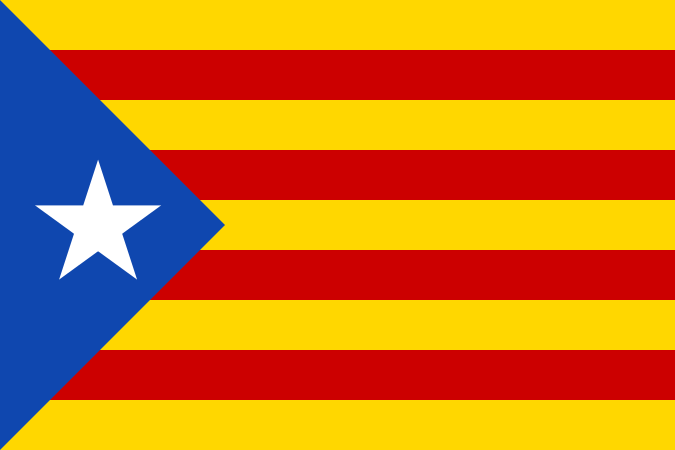
L’Estelada Blava, the “blue-starred flag” of the Catalonian independence movement
(Via Wikimedia)

An excessive focus on history can obscure the real dynamic informing the Catalonia autonomous community’s push for independence from Spain. It makes it look as if what we’re seeing now is a revival of a longstanding strain of Catalan nationalism, drawing on its 12th-century legacy as a principality, fired up by the divided union of Aragon and Catalonia during the early modern era, and burnished with the left-wing romance of Catalonia’s stand-alone, red-and-black resistance to General Franco during the 1930s. It makes it look, ultimately, as if Catalonia is not only an entity distinct from the rest of Spain, it is also a victim of, if not Spain, than certainly the Spanish state.

Not that matters have been helped by the Spanish government’s brutal, anti-democratic response to Catalonia’s independence referendum, as unconstitutional and therefore illegal as it was. It merely reinforced the impression that this is a conflict between an oppressive state and an oppressed people. After all, such is the defensiveness and weakness of the Spanish political class, we saw armed units of Guardia Civil assaulting Catalan voters, forcibly shutting polling stations and confiscating ballot boxes, and now we see charges of rebellion and sedition being laid at the doors of the leading pro-independence Catalan politicians, which has even prompted the Catalan president Carles Puigdemont to flee to Brussels. This really does look like a conflict rooted in some longstanding desire of the Spanish state to bend the Catalans to its will.

But to think that misses the real catalyst for the Spanish crisis, which lies less in Madrid or Barcelona, than in the European Union’s HQ in Brussels. That’s because, in the EU’s flight, manned by Western Europe’s political classes, from the democratic accountability of national peoples, in its demonisation of the very idea of national sovereignty as a species of 1930s-style nationalism, indeed in its essential anti-national elitism, it has created a transnational, technocratic set of institutions that necessarily weakens national state structures, depriving nations of numerous lawmaking powers, border controls and economic independence. Admittedly, the Spanish nation state has never been particularly strong. In common with the rest of Europe, its party-political system is in disarray, with its two traditional behemoths, the Socialist and Popular parties, hollowed out, and populist rivals exploding on to the scene. And, specific to Spain, the state has failed properly to cohere itself as a state, with suppressed regional antagonisms re-emerging in the post-Franco era. But the EU has not only exacerbated the internal weaknesses of the Spanish state; it has also fundamentally undermined even the possibility of a functioning nation state.

[…]

Yes, the cultural distinction between Catalonia and the rest of Spain has come to the fore in recent decades, with the red-yellow-and-blue Estelada a familiar sight hanging from buildings, and Catalan a familiar sound on the streets. But it’s clear that the driving force is less cultural difference, no matter how divisive, than the experience of EU-driven austerity as an unnecessary drain on an economically rich region. This is why support for Catalan independence has only risen dramatically since the economic crisis. As the Financial Times puts it: ‘After decades during which Catalan support for independence hovered between 15 and 20 per cent, secessionist sentiment started climbing rapidly in 2009. By 2011, according to the closely followed survey by the Catalan Centre for Opinion Studies (CEO), support for independence was above 30 per cent. Two years later, it reached an all-time high of 48.5 per cent.’

This is not a uniquely Spanish phenomenon, either. In other EU member states, the same dynamic is at work, with richer regions or areas with a sufficiently distinct cultural identity seeking to unfasten themselves from the rest of their respective nations. You can see it in the desire for greater economic autonomy of the rich Lombardy and Veneto regions in northern Italy. And you can see it again in Belgium, with the wealthy northern region of Flanders continually seeking to decouple itself from the de-industrialised, relatively impoverished southern region of Wallonia.

October 14, 2017

Brexit hangover – a proposed deal for the “Remoaners”

Filed under: Britain, Europe, Politics — Tags: , , , , — Nicholas @ 04:00

In Spiked, Brendan O’Neill offers an olive branch to the Remoaners:

I propose a deal with Remoaners: Leavers will stop calling you enemies of democracy when you stop behaving like enemies of democracy. Sound good?

By Remoaners, I don’t mean the 16.1million who voted Remain, the vast majority of whom are not part of any elite, and a huge chunk of whom now accept Brexit must happen. I don’t even mean those sad people who traipse through the streets shouting ‘Brex-shit!’ and who agitate, or at least tweet, for Britain to stay in the EU: the rights to protest and speak are essential to democracy and these people must be free to fulminate for as long as they like against the democratic will. No, I mean those sections of the elite who have sworn their financial, political and institutional clout to the cause of preventing or diluting Brexit. You guys: we’ll stop calling you destroyers of democracy when you stop trying to destroy democracy, cool?

The war on Brexit – which is a war on the largest democratic mandate in British history, on the very right of the masses to decide the fate of their nation – is getting serious. For too long Leavers have had a tendency to chortle at the myriad spittle-producing haters of Brexit in business, politics, the law. But it’s not funny anymore, because they’re in the ascendancy. Not courtesy of democracy; the people have rejected their preference for oligarchy over democracy, for technocracy over debate, for expertise over the public’s opinions and beliefs. No, their rise, their influence, is built on their economic supremacy and behind-closed-doors influence, on the fact that they are wealthier, better connected and – let’s be frank – more ruthless than us, the demos.

The seriousness of this bloodless coup d’etat against Brexit has been perfectly and brutally summed up this week in the elitists’ suggestion that we revoke Article 50. Not content with seeking to wound Brexit – by, for example, suggesting we stay under the jurisdiction of the European Court of Justice, or institute a second referendum even before Brexit has become a reality – now they’re openly calling for the whole thing to be reversed. The Observer revealed on Sunday that, contrary to what some ministers have intimated, Article 50 is revocable. This is all the proof we needed, said a QC in the Guardian, that it is ‘not too late to step back from the Brexit brink’. Translation: the plebs, the unwashed throng, took us to a political cliff edge with their strange, prejudiced passions, and now it falls to the clever, the legally minded, the rational, to put Britain back on course.

September 1, 2017

“Antifa looks increasingly like the militant wing of Safe Space fanaticism”

Brendan O’Neill posting to Facebook a few days back:

People are shocked by images of antifa activists beating up normal, peaceful right-wing protesters in Berkeley or physically shoving right-wing people off Boston Common. Why? This is what happens when you tell an entire generation that other people’s ideas are dangerous, that their speech is toxic, that their words can wound you and traumatise you: you invite that generation to shut people down, to use any means necessary to ensure “dangerous” ideas are not expressed and do not cause injury to people’s self-esteem or sense of safety. We are starting to see what happens when speech is talked about as a form of violence: it green-lights actual violence against certain forms of speech. If speech is violence, shouldn’t it be met with violence? Antifa looks increasingly like the militant wing of Safe Space fanaticism, the bastard offspring of a culture that elevates mental safety over intellectual liberty, and people’s feelings over public freedom.

August 4, 2017

Short memories and willing self-deception over Venezuela

Filed under: Americas, Economics, Media, Politics — Tags: , , , , , — Nicholas @ 03:00

In the Los Angeles Times, James Kirchick took the pundits to task for their adulation of Venezuela’s government as it plunged deliberately into a humanitarian disaster:

Shaded relief map of Venezuela, 1993 (via Wikimedia)

On Sunday, Venezuelan President Nicolas Maduro claimed victory in a referendum designed to rewrite the country’s constitution and confer on him dictatorial powers. The sham vote, boycotted by the opposition, was but the latest stage in the “Bolivarian Revolution” launched by Maduro’s predecessor, the late Hugo Chavez. First elected in 1998 on a wave of popular goodwill, Chavez’s legacy is one of utter devastation.

Thanks to Chavismo’s vast social welfare schemes (initially buoyed by high oil prices), cronyism and corruption, a country that once boasted massive budget surpluses is today the world’s most indebted. Contraction in per capita GDP is so severe that “Venezuela’s economic catastrophe dwarfs any in the history of the U.S., Western Europe or the rest of Latin America” according to Ricardo Hausmann, former chief economist of the Inter-American Development Bank. Transparency International lists Venezuela as the only country in the Americas among the world’s 10 most corrupt.

Socialist economic policies — price controls, factory nationalizations, government takeovers of food distribution and the like — have real human costs. Eighty percent of Venezuelan bakeries don’t have flour. Eleven percent of children under 5 are malnourished, infant mortality has increased by 30% and maternal mortality is up 66%. The Maduro regime has met protests against its misrule with violence. More than 100 people have died in anti-government demonstrations and thousands have been arrested. Loyal police officers are rewarded with rolls of toilet paper.

The list of Western leftists who once sang the Venezuelan government’s praises is long, and Naomi Klein figures near the top.

In 2004, she signed a petition headlined, “We would vote for Hugo Chavez.” Three years later, she lauded Venezuela as a place where “citizens had renewed their faith in the power of democracy to improve their lives.” In her 2007 book, The Shock Doctrine, she portrayed capitalism as a sort of global conspiracy that instigates financial crises and exploits poor countries in the wake of natural disasters. But Klein declared that Venezuela had been rendered immune to the “shocks” administered by free market fundamentalists thanks to Chavez’s “21st Century Socialism,” which had created “a zone of relative economic calm and predictability.”

Chavez’s untimely death from cancer in 2013 saw an outpouring of grief from the global left. The caudillo “demonstrated that it is possible to resist the neo-liberal dogma that holds sway over much of humanity,” wrote British journalist Owen Jones. “I mourn a great hero to the majority of his people,” said Oliver Stone, who would go on to replace Chavez with Vladimir Putin as the object of his twisted affection.

« Newer PostsOlder Posts »

Powered by WordPress