Quotulatiousness

October 25, 2019

Civil servants tend to be of the left … this should be no surprise to anyone

Filed under: Bureaucracy, Government, Politics, USA — Tags: , — Nicholas @ 03:00

Arthur Chrenkoff on the political tendencies of people who work for the government:
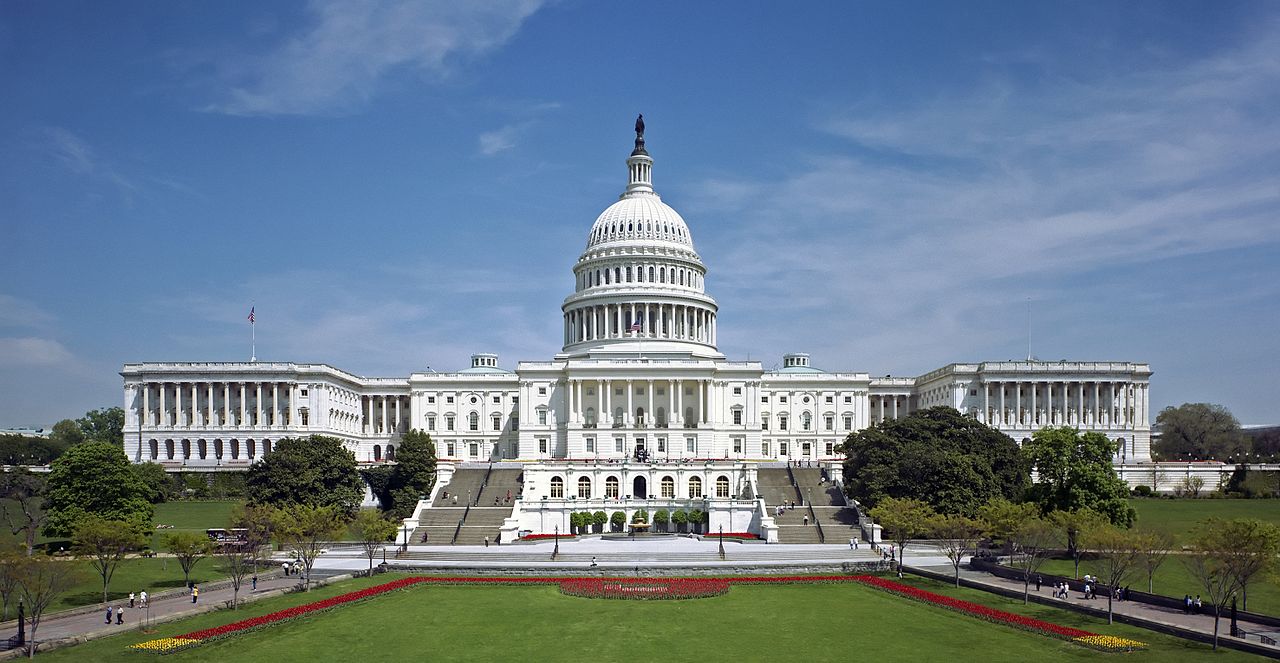
The western front of the United States Capitol.
Photo via Wikimedia Commons.

You could believe the whole “protect[ing] the interests… of the American people” shtick if after all this time and the incalculable amount of energy and effort expended on bringing down the President, all those patriotic public servants have been able to show something – anything – for it. So instead of disinterested paragons of civic virtue, it increasingly looks like the federal bureaucracy is full of hard core progressives and liberals who can’t stomach a non-Democrat usurper who doesn’t share their values, ideas and objectives.

It’s not a shocking revelation that public service is overwhelmingly staffed by left-of-centre people. Government work attracts the left the same way that private sector and military attract the right. The left believes in the power of government to affect change and implement its vision. Even the spooks are no different. A couple of years ago I wrote briefly about the myth that the intelligence community is a hive of shady right-wing types. In reality, the CIA – just like the Department of Education – has always been a liberal institution. That so many people believe that the intelligence community is some sort of a vast-right wing conspiracy instead of another part of the liberal establishment, is a testament to the narrative power of the far-left, for whom indeed anyone to the right of selves is right wing, including everyone from John F Kennedy to Hillary Clinton.

Most public servants can be professional enough to work under any government, even if they would clearly prefer that government to be of the left – forever. But others can’t stomach working for people whom they believe not merely wrong but positively evil. The honourable thing to do in such circumstances, of course, is to resign; if you can’t in good conscience work to implement policies you strenuously object to, you should make room for someone who can. But why quit your often lucrative job and watch from the sidelines as the country is in your opinion going to hell in a hand basket, when you can stay on and try to sabotage the government and save the world? Thus you can convince yourself you are protecting the people, even if in reality it’s the people who voted in your new, unsavoury masters. It’s easy if you try; like so many others in the recent past you can argue that the people did not in fact elect the government, which is therefore illegitimate, or you can default to the standard left-wing position that the people don’t know what’s good for them, so their democratic choice as expressed at the ballot box has no decisive meaning. We know what’s best for everyone, hence taking a different position is equated to “the war on… expertise”.

It’s an interesting, if of course also self-serving theory, that public servants don’t work for the government of the day, but for “the people”. As Cottle’s logic demonstrates, it gives you a licence to essentially do whatever you want instead of what your political bosses tell you. The problem, as I mentioned above, is that “the people” don’t vote for bureaucrats, they vote for their elected representatives, based on which policy program they like best – or hate least. Seeing that we – still – live in a democracy, the people are given the opportunity to judge their politicians every few years. If they consider that their interests have been negatively affected by the executive’s excesses, they will vote somebody else in. The problem is that the progressives only like the people if the people agree with them. By and large, however, the people can’t be trusted; like children or mentally handicapped they need someone – like the government, or if the government is in hostile hands, the public service – to look after them. It’s the unspoken technocratic mantra and it justifies the existence of an in loco parentis state, deep or otherwise.


October 21, 2019

“On Monday Canadians will have a choice between five left-of-centre social-democratic parties”

Except for Maxime Bernier’s invisible-to-the-mainstream-media PPC, the other parties contesting today’s election are all remarkably similar except for the colour of their signs and the mediocrity of their leaders:

As Mrs Thatcher used to say, first you win the argument, then you win the vote. So not engaging in any serious argument has certain consequences. John Robson puts it this way:

    As Canada’s worst election ever staggers toward the finish line, a theme has finally emerged. Despite the best efforts of the party leaders to say nothing coherent or true at any point, we know what it’s about. Everyone is running against the Tories. Including the Tories. Makes you wonder what they’re so afraid of.

On Monday Canadians will have a choice between five left-of-centre social-democratic parties: the crony left (Liberals), the hard left (NDP), the eco-left (Greens), the secessionist left (Bloc) and the squish left (Conservatives). The only alternative to the crony-hard-eco-secessionist-squish social-justice statism on offer is a disaffected Tory, Maxime Bernier. John Robson again:

    Bernier may be an imperfect human being and a flawed politician. It happens. But whatever his blemishes, his party exists because the Tories abandoned their beliefs and their base long before 2017 on every important conservative issue from free markets to traditional social values to strong national defence.

A billboard in Toronto, showing Maxime Bernier and an official-looking PPC message.
Photo from The Province – https://theprovince.com/opinion/columnists/gunter-berniers-legitimate-position-on-immigration-taken-down-by-spineless-billboard-company/wcm/ecab071c-b57d-4d93-b78c-274de524434c

M Bernier would like to rethink immigration policy, but that makes him a racist so he shouldn’t be allowed in the debates because, per John Tory, while he’s free to rent the Scotiabank Arena, public buildings such as the CBC studios have a “higher responsibility”.

It’s a good thing for the other guys that Bernier was snuck in to a couple of debates because otherwise they’d be running against an entirely mythical beast — a red-meat conservative behemoth stomping the land for which there’s less corroborating evidence than of Justin in blackface but which is nevertheless mysteriously threatening to steamroller your social-justice utopia into the asphalt. Ah, if only that were true: I hope voters in the Beauce will return Max, and I hope our small band of readers in Longueuil-Saint Hubert will persuade their neighbours to turn out for our pal Ellen Comeau; but this is not shaping up as a breakthrough night for the People’s Party.

Nevertheless, sans Max, what’s left? Virtue-Dancing With The Stars: Elizabeth May says Trudeau wants to eliminate CO2 completely, but not until 2030! Justin Trudeau says that Scheer didn’t believe in gay marriage before 2005! Jagmeet Singh says that May’s selling out to the billionaires by promising to balance the budget by 2047, whereas he won’t balance the budget ever! Yves-François Blanchet says Singh’s ten-point plan to eliminate bovine flatulence by last Tuesday is too little too late compared to the Bloc’s plan to reduce Canada’s carbon footprint by declaring Quebec independent … oh, wait, sorry, that was almost an intrusion of something real: I meant “by declaring Quebec fully sovereign when it comes to jurisdiction over selecting its own pronouns for the door of the transgender bathroom: je, moi, mon …”

And at that point in the debate Lisa LaFlamme moves on to the next urgent concern of Canadian voters: Are politicians’ aboriginal land acknowledgments too perfunctory? Should they take up more time at the beginning of each debate? Say, the first hour or two?

John Robson argues that all five candidates are running against proposals that no one’s proposing because deep down inside they know that lurking somewhere out there is not a mythical right-wing Bigfoot but mere prosaic Reality, which sooner or later will assert itself. I’m not so sure. I think it’s more an enforcing of the ground rules, a true land acknowledgment that public debate can only take place within the bounds of this ever shriveling bit of barren sod. Those who want to fight on broader turf – such as M Bernier – cannot be permitted to do so.

October 18, 2019

QotD: England has become the Mother Hive

In 1908, Rudyard Kipling published a short story called “The Mother Hive”. In this, the bees in a hive decide to drop all outmoded ideas of hierarchy and to make everyone equal. This includes the right of workers to eat royal jelly and to mate with the drones. In the spreading chaos that results, traditionalist dissidents are first shunned and then murdered. Eventually, the bee keeper looks into the hive, and sees the empty honeycombs and the horribly deformed offspring of the workers. His response is to poison all the bees.

Now, something like this has happened in England. In the past few generations, the whole of national life has been taken over by the cultural Marxists. They run government and the administration, and the law, and education and the media, and business too. They have imposed on us a nasty hegemonic discourse. Cultural Marxism is ultimately to be traced to European thinkers like Antonio Gramsci and Louis Althusser and the Frankfurt School. But this has come to England in American clothing. It has prestige because it was taken up by the American universities.

In America, however, the progress of cultural Marxism has been resisted, or slowed, by a strong religious right and by a written constitution that it is taking a long time to subvert. Here, we have no religious right, nor an entrenched constitutional law. In the past, freedom and common sense were safeguarded by an hereditary land-owing aristocracy and gentry. These ran the country, and did much to determine its moral tone. During the twentieth century, they were marginalised and then eliminated from government. They remain as a class — still very rich — but the tacit deal since at least the 1940s has been that they will be left alone, so long as they keep out of politics. Government has been left to middle class lefties. The effect followed the cause only after several generations. But here it is.

It may be interesting for you, as foreigners, to learn an answer to the implied question in the title of this speech. But it is essential for the English to think about the question and its answers. You see, like both the Germans and the Russians, we have had a revolution. Unlike them, we have had no obviously revolutionary event. The Russians had the storming of the Winter Palace and the murder of their Royal Family. The Germans were utterly defeated in 1945. Their cities were bombed flat. Their country was occupied and divided. Every German knows either that German history came to an end in 1945, or at least that a new chapter in German history had begun.

We do not have that awareness, and it would be useful for us to understand, even so, that we are living in a state of revolution. England has become the Mother Hive.

Sean Gabb, “A Nation of Sheep: Understanding England and the English”, Libertarian Enterprise, 2017-09-23.

October 17, 2019

QotD: IKEA humans

Filed under: Education, Politics, Quotations, USA — Tags: , , — Nicholas @ 01:00

Therefore, to be precise, the class of people of whom I am speaking are “cosmopolitan” neither in the idealized nor in the demonized sense of the word. They neither bridge deep social differences in search of the best in human experience, nor debase themselves with exotic foreign pleasures. Rather, they have no concept of foreignness at all, because they have no native traditions against which to compare. Indeed, the very idea of a life shaped by inherited custom is alien to our young couple. When Jennifer and Jason try to choose a restaurant for dinner, one of them invariably complains, “I don’t want Italian, because I had Italian last night.” It does not occur to them that in Italy, most people have Italian every night. For Jennifer and Jason, cuisines, musical styles, meditative practices, and other long-developed customs are not threads in a comprehensive or enduring way of life, but accessories like cheap sunglasses, to be casually picked up and discarded from day to day. Unmoored, undefined, and unaware of any other way of being, Jennifer and Jason are no one. They are the living equivalents of the particle board that makes up the IKEA dressers and IKEA nightstands next to their IKEA beds. In short, they are IKEA humans.

Samuel Biagetti, “The IKEA Humans: The Social Base of Contemporary Liberalism”, Jacobite, 2017-09-13.

October 12, 2019

QotD: Giving the vote to children

Filed under: Politics, Quotations — Tags: , , , — Nicholas @ 01:00

The irony being that children and teenagers tend to be quite selfish and self-absorbed, to a degree unbecoming in adults, and are accustomed to free stuff, all paid for out of sight by someone else, much to the youngsters’ indifference. It would therefore hardly be surprising if voting children tended to favour policies that pile up unsustainable debt, all left for whatever generations follow them.

Apparently, this constitutes “planning for the future.”

David Thompson, commenting on “”, David Thompson, 2018-12-08.

October 8, 2019

Extinction Rebellion – “an upper-middle-class death cult”

Filed under: Britain, Environment, Politics — Tags: , , , , , — Nicholas @ 05:00

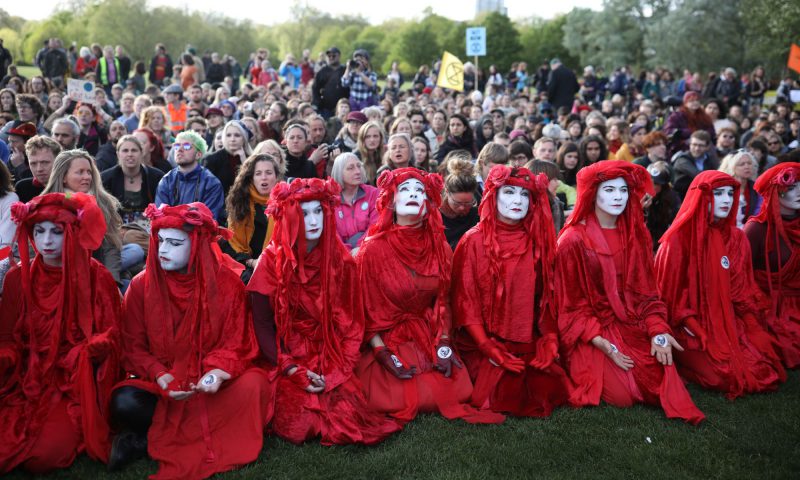
Brendan O’Neill watched a death cult hold one of their ceremonies in public on the streets of London the other day:

This was, of course, Extinction Rebellion. Let us no longer beat around the bush about these people. This is an upper-middle-class death cult.

This is a millenarian movement that might speak of science, but which is driven by sheer irrationalism. By fear, moral exhaustion and misanthropy. This is the deflated, self-loathing bourgeoisie coming together to project their own psycho-social hang-ups on to society at large. They must be criticised and ridiculed out of existence.

Yesterday’s gathering, like so many other Extinction Rebellion gatherings, was middle-aged and middle-class. The commuters heading in and out of King’s Cross looked upon them with bemusement. “Oh, it’s those Extinction freaks”, I heard one young man say. It had the feel of Hampstead and the Home Counties descending on a busy London spot to proselytise the cult of eco-alarmism to the brainwashed, commuting plebs.

It was a gathering to mark Extinction Rebellion’s week of disruption. The group is asking people in London and other cities around the world to “take two weeks off work” and join the revolt against the “climate and ecological crisis”. You can tell who they’re trying to appeal to. Working-class people and the poor of New Delhi, Mumbai and Cape Town – some of the cities in which Extinction Rebellion will be causing disruption – of course cannot afford to take two weeks off work. But then, these protests aren’t for those people. In fact, they’re against those people.

Extinction Rebellion is a reactionary, regressive and elitist movement whose aim is to impose the most disturbing form of austerity imaginable on people across the world. One of the great ironies of “progressive” politics today is that people of a leftist persuasion will say it is borderline fascism if the Tory government closes down a library in Wolverhampton, but then they will cheer this eco-death cult when it demands a virtual halt to economic growth with not a single thought for the devastating, immiserating and outright lethal impact such a course of action would have on the working and struggling peoples of the world.

Extinction Rebellion says mankind is doomed if we do not cut carbon emissions to Net Zero by 2025. That’s six years’ time. Think about it: they want us to halt a vast array of human activity that produces carbon. All that Australian digging for coal; all those Chinese factories employing millions of people and producing billions of things used by people around the world; all those jobs in the UK in the fossil-fuel industries; all those coal-fired power stations; all that flying; all that driving … cut it all back, rein it in, stop it. And the people who rely on these things for their work and their food and their warmth? Screw them. They’re only humans. Horrible, destructive, stupid humans.

The Toronto chapter of the death cult shut down one of the major bridges across the Don Valley on Monday morning:

Just in time for rush hour on Monday morning, hundreds of climate change activists have barricaded themselves across a major four-lane bridge in the heart of Canada’s largest city.

Extinction Rebellion (XR) Toronto, the local arm of an environmental protest group with demonstrations taking place across the world today, shut down traffic on the Prince Edward Viaduct between Bloor Street and Danforth Avenue around 8 a.m. on Monday morning.

Members of the group formed blockages on both sides of the truss bridge with their bodies and props, including a larger-than-life set of letters reading “ACT NOW.”

October 6, 2019

QotD: Modern middle-class “cosmopolitans”

Filed under: Education, Politics, Quotations, USA — Tags: , , — Nicholas @ 01:00

We must not sneer at Jennifer and Jason, many readers are sure to point out, for choosing IKEA. Their incomes, though high in the global scale, are likely to be lower than their parents’ were, and they often have to move in order to climb the employment ladder. It is only reasonable for them to buy something inexpensive, transportable, and replaceable. IKEA fulfills an important niche in the middle-class market — for cheap furniture that still retains a semblance of respectability. The company has exploited this market to become the global empire that Sweden never had, a kind of Viking revenge on the modern age.

Still, there is a good chance that Jennifer and Jason actually like their IKEA dressers, and prefer them to the old oak chest that their grandparents tried to foist on them. Indeed, the extraordinary popularity of IKEA testifies not only to its convenience but to its ability to appeal to the middle-class self-image. Jennifer and Jason are drawn to IKEA because it reflects who they are: they too are modern, movable, and interchangeable, their wants satisfiable in any neighborhood with a food co-op and a coffee shop. More fundamentally, Jennifer and Jason are untraceable, a “composite material” made from numberless scraps and pieces. They have a long catalog of home towns, and their accents are NPR neutral. They can probably rattle off the various nationalities in their family trees — Dutch, Norwegian, Greek, and Jewish, maybe some Venezuelan or Honduran for a little color. From these backgrounds they retain no more than a humorous word or phrase, a recipe, or an Ellis Island anecdote, if that. They grew up amidst a scramble of white-collar professionals and went to college with a scramble of white-collar professionals’ kids. Their values are defined mainly by mass media, their tastes adorably quirky but never straying too far from their peers’, and like the IKEA furniture that they buy in boxes, they too cut themselves into manageable, packaged pieces and market themselves online. They are probably “spiritual but not religious.” They have no pattern or model of life that bears any relation to the past before the internet. For all intents and purposes, they sprang up de novo in the modern city. Whereas the Veneerings’ high fashion covered over an essential vulgarity, Jennifer’s and Jason’s urbane style masks a hollowness.

It may be tempting to call Jennifer and Jason, and the the group of people whom they represent, “cosmopolitans.” (And indeed, IKEA, with its vaguely exotic Swedish names, provides a dash of cosmopolitanism on the cheap.) However, Jennifer and Jason are something newer and more bizarre than cosmopolitans: as Ross Douthat aptly pointed out in the wake of the Trump election, the increasingly insulated college-educated classes of the coastal cities do not grapple with real, substantive differences in beliefs and values, associating instead with cliques of like-minded classmates. In addition, classic cosmopolitans seek out what is best in others’ traditions while showing a fierce pride in their own — a Jordanian extolling the majesty of Petra, a Mexican diplomat breaking into lines of Octavio Paz, etc. Westerners like Jennifer and Jason show no such pride or attachment, instead leaping at opportunities to mock the foibles of their native lands.

Conversely, we must also avoid cheap epithets. The word “cosmopolitan” is a double-edged sword – long a shibboleth for worldly sophistication, it has lately turned upon its makers, serving as a political weapon against urban liberals; it is not surprising that a Trump spokesman recently attacked the “cosmopolitan bias” of a journalist who questioned the White House’s immigration policies. There is nothing particularly new or insightful about attacking urbanites tainted by association with the foreign, like the Judean exiles railing against the silken whores of Babylon. Still, as shallow and hackneyed as this rhetorical strategy might be, it packs a populist punch because the very concept of “cosmopolitan” is purely relative: since no one, legally speaking, is a citizen of the world, one can be “cosmopolitan” only in contrast to someone else – a “provincial” in the Victorian terminology, or a “xenophobe” in contemporary talk. In other words, the idea of cosmopolitanism carries an unavoidable subtext of class superiority.

Samuel Biagetti, “The IKEA Humans: The Social Base of Contemporary Liberalism”, Jacobite, 2017-09-13.

September 25, 2019

The Children’s Crusade against Carbon

Filed under: Environment, Politics — Tags: , , , , — Nicholas @ 03:00

Arthur Chrenkoff explains why political movements treasure and actively seek out the youth:

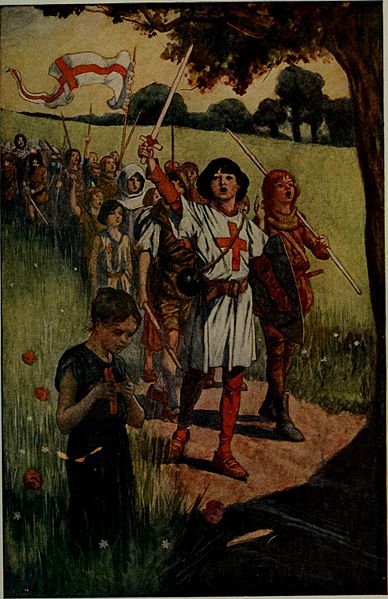
Illustration of the Children’s Crusade from Tales from far and near : history stories of other lands (1915).
York University Libraries via Wikimedia Commons.

It’s really a no-brainer. Revolutionary movements like communism and Nazism, which sought to overthrow the status quo and create a new society, have always placed huge importance on cultivating young following. I consider the green movement, particularly those sections of it that can be described as the Green religion, as a revolutionary movement too, because its main aim is to implement socialism under the pretense of saving the world from an environmental catastrophe.

There are several reasons why children and teenagers are so valued by utopian authoritarians:

1. As the cliché goes, children are the future. Invest in indoctrinating them now and your investment will last a lifetime, certainly outliving the less enthusiastic elders.

2. Children’s minds are more malleable and they are more impressionable, making them more receptive and accepting of your propaganda.

3. Peer group pressure helps to reinforce what the adults instill.

4. Children are (sorry children) ignorant and naive, having neither the sufficient education nor life experience that make adults more difficult to scare, persuade or bullshit into submission and belief.

5. Children have the energy and enthusiasm, which older people often lack.

6. Teenagers go through the proverbial rebellious stage, where they question their parents and other conventional sources of authority. This makes them very useful for the said revolutionary movements, whether fascist or socialist, which need to destroy the old, more conservative way of life so as to create a new social order according to their design.

September 24, 2019

More on the demands from the “climate strike” protests

Filed under: Environment, Politics — Tags: , , , — Nicholas @ 03:00

Arthur Chrenkoff on the far beyond pie-in-the-sky demands coming discordantly from the amorphous climate protest groups coalescing around poor Greta Thunberg and her “climate strike”:

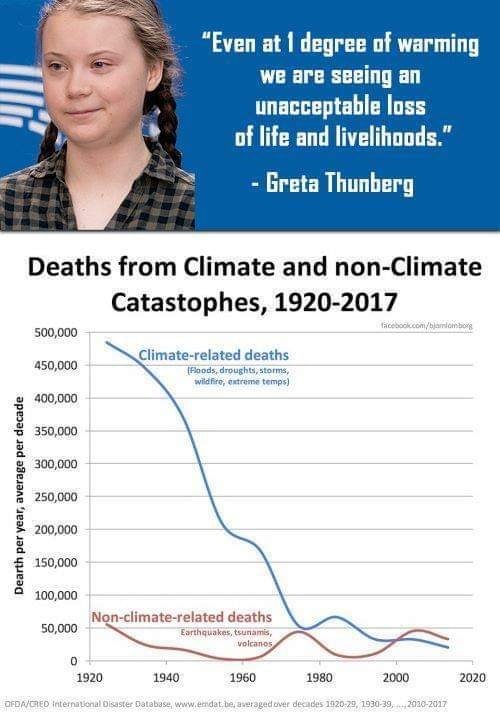
Greta Thunberg at the EU Parliament, 16 April, 2019.
European Parliament photo via Wikimedia Commons.

Fighting “climate change” is a very broad umbrella. What does the Global Climate Strike actually stand for? Greta Thunberg’s (I jokingly referred to her as St Joan of Arc of the Children’s Crusade against Carbon, but the marchers in Paris did carry a poster of Thunberg as a saint) initiative does not offer any extensive manifestos or programs on its website, perhaps not unexpectedly for a child-centric project, but it does provide a brief answer to the question “What are you [as a participant asking for?”:

    The climate crisis is an emergency – we want everyone to start acting like it. We demand climate justice for everyone. Our hotter planet is already hurting millions of people. If we don’t act now to transition fairly and swiftly away from fossil fuels to 100% renewable energy for all, the injustice of the climate crisis will only get worse. We need to act right now to stop burning fossil fuels and ensure a rapid energy revolution with equity, reparations and climate justice at its heart [emphasis in the original].

It’s not much, but already more than a great majority of those taking part are probably aware of they were striking for.

It doesn’t help that some of the more outrageous claims are clearly not true:

What of the other aspects of the Global Climate Strike’s five-sentence program? What exactly is “climate justice”? And what the hell are the “reparations” in this context?

The Strike site doesn’t provide answers, but “climate justice” in the last sentence hyperlinks to the website for The People’s Demands for Climate Justice, which explains itself as “Collectively shaped by people’s movements around the world, these demands are an international statement rooted in southern movements, and with input from numerous climate justice organizations and people’s movements around the world. The People’s Demands lays out a vision for a truly just international climate policy. We must ensure the demands of people, not the fossil fuel industry and other Big Polluters, is what is centered in the lead up to and during COP24 in Poland this December, 2018.” (a case here for updating your website.) While the Global Climate Strike is neither a “convening” nor an “endorsing” organisation among the 403 groups who are, by linking it clearly subscribes to the People’s Demands’ vision. Some of which includes:

    Support global efforts for a just and equitable transition that enables energy democracy, creates new job opportunities, encourages distributed renewable energy, and protects workers and communities most affected by extractive economies …

    Adopt a technology framework that recognizes the importance of endogenous and indigenous technologies and innovations in addressing climate change, and enables developing countries and communities to develop, access, and transfer environmentally sound, socially acceptable, gender responsive and equitable climate technologies.

    Respect and enable non-corporate, community-led climate solutions that recognize the traditional knowledge, practices, wisdom, and resilience of indigenous peoples and local communities, and protect rights over their lands and territories …

    Developed countries must make new concrete pledges of public climate finance accompanied by a definite timeline for delivery.

    Commit to climate reparations to those most affected but least responsible for climate change.

In addition to fossil fuels, the People’s Demands are also against any market mechanisms to reduce emissions (like emission trading schemes), carbon offsets, carbon sequestration technologies, geoengineering and other “techno-fixes”, nuclear power, biofuels and use of biomass to generate energy, and large scale hydro projects – i.e. most of the potential solutions accepted by the serious mainstream climate change political-scientific consensus. This pretty much leaves only solar and wind, geothermal in a few lucky places (like Iceland, which is sitting on top of volcanoes) and small scale hydro to power the entire world post 2030. In other words, a complete fantasy world of green Luddites.

September 23, 2019

The “Global Climate Strike”

The big “let’s all play hooky from school” event’s Toronto organizers have been getting positive coverage from some of the local media, because of course they have. Here’s Tanya Mok for BlogTO, listing the totally reasonable and not in any way unrealistic “demands” of the movement:

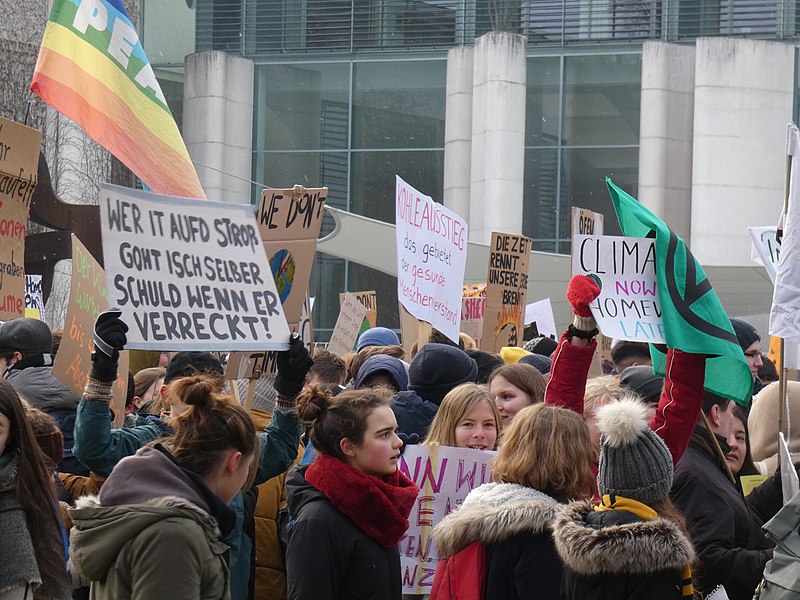
FridaysForFuture Demonstration, 25 January 2018 in Berlin.
Photo by C. Suthorn via Wikimedia Commons.

The coalition has made a list of seven demands, which “reflect the rallying cries of the intersectional movements” they belong to. Some of those demands include:

  • Indigenous rights and sovereignty.
  • The protection of forests, land, and water sources.
  • A shift to publicly-owned renewable energy, and reducing national carbon emission by 65% by 203, reaching zero emissions by 2040.
  • A $15 minimum wage for all, and higher taxation on the rich.
  • Universal public services like health care and dental care, free university and college, housing as a human right, and free public transit.
  • Justice for migrants and refugees, allowing status for all. That includes putting an end to deportations and allowing for the full access to public services.

There will be a concert at Queen’s Park after the rally, as well as a follow-up benefit concert at the Tranzac Club in the evening. A giant street mural project run by Greenpeace will also be taking place prior to the rally, around 10 a.m., at the southern point of Queen’s Park.

September 18, 2019

QotD: Debunking the notion of “peaceful” Vikings

Filed under: Europe, History, Quotations — Tags: , , , , — Nicholas @ 01:00

Going through the Viking exhibit, for instance, we kept being told time after time how powerful women had been among the Vikings, and also there were things like treasure troves, which in one case they said “was a woman’s treasure trove, probably to honor women in her ancestry.” At which point I looked at the case enquiringly, because these idiots don’t seem to understand someone’s unearthed treasure trove is someone else’s panicked burial.

[…]

Which brings us to the next part. All through the exhibit, people told us over and over again that the Vikings were — contrary to legend — peaceful, peaceful I tell you. Most of the Vikings were, after all, farmers and householders.

I wasn’t buying it. Yeah, sure, most Vikings, if you count women, children, and people to old to go aViking, just stayed put. But no civilization where dying in bed gets you sent to Hel (which was cold rather than hot but much like our Hell) is a peaceful one. In the same way I didn’t buy the continuous reassurances there were as many women as men aboard those ships. Cooeeeeee! Really? The men saddled themselves with a liability likely to get pregnant, give birth, etc AND be weaker in battle? That’s … amazing. Oh, I forget. The idiots writing these cards think women are naturally as strong and physically as fast as men and that the “patriarchy” is a six-thousand-year-old conspiracy to hide this. Sure, there probably was the occasional female in a male role. Contrary to much bleating on the left, the patriarchy didn’t enforce strict gender roles, life generally did, and there are always outliers, and Helga the Ugly who could lift a pig under each arm, probably was allowed to join the guys in their expeditions. For one, who was going to tell her no? For another, no guy ever got drunk enough for her to be at risk.

Other than that, sure, there were as many women as men aboard Viking ships. Coming back from a raid. They called those women “slaves.”

[…]

But no, like the beliefs in powerful women Vikings, (who apparently can ONLY be powerful by pillaging and plundering. Being mistress of a farm is not enough), and in peaceful Vikings too they’re simply an upending of long-held beliefs about something. I.e. if Western culture has long believed something, progressives will believe the opposite, because that’s about as hard as any of them can reason, and congruent with their initial mission to topple civilization so perfect communism will emerge.

Sarah Hoyt, “I Aten’t Dead”, According to Hoyt, 2017-07-27.

September 5, 2019

Phony Trudeaumania has bitten the dust

Filed under: Cancon, History, Media, Politics — Tags: , , , , , — Nicholas @ 03:00

Nico Johnson discusses the dangers of family dynasties in democratic countries:

When future political historians look back at the 21st century, Justin Trudeau’s election as a Liberal leader may be regarded as a bland footnote. Despite all the hope Trudeau brought Canadians in his once seemingly eternal, post-election honeymoon, his leadership inevitably toppled into a swamp of sticky scandals and hurried apologies.

Justin Trudeau may still be re-elected. However, the Conservatives can rest easy in the knowledge that Trudeaumania, at least for this current Trudeau, is well and truly dead.

What is noteworthy, however, is the atmosphere of surprise and confusion that has clouded commentators’ judgements surrounding the downfall of Trudeau. In the corridors of Ottawa’s broadcasters, it may have appeared absurd that natural political decline should apply to their darling Prime Minister; the leader of the “woke world.”

Trudeau’s appearance of invincibility, which still makes these commentators swoon (note the SNC-Lavalin coverage) was first created in those blue-skied months following his leadership election in 2013.

Perhaps Justin, with his charisma and handsomeness, seemed like a breath of fresh air to Canadian progressives. Gone were those days of Ignatieff, the drooling philosopher, who rather spectacularly (considering his semi-illiterate predecessor) lost 43 seats forcing the Liberals into third-party status.

With Trudeau’s leadership, the Liberal party would have a candidate who seemed so perfect for Canadian political life that even a eugenicist would struggle to replicate it. With his status as an Anglophone-Quebecois, which managed to pacify the sensibilities of English Canada, whilst having his Quebecois heritage to maintain seat-rich Quebec—Trudeau must have seemed like a divine gift.

Yet even in those early days, Trudeau lacked noticeably in the fundamental requirements that statesmanship should necessitate. He had no political experience after being almost casually elected to the House of Commons. Nor did he possess any working experience, and had been entirely unknown to the Canadian public until the eulogy at his father’s funeral. To put it quite simply, Justin Trudeau would have never become Prime Minister of Canada if his father, Pierre, had not been one too.

August 30, 2019

Communist Revolution in America? – The Red Scare 1919 I THE GREAT WAR 1919

Filed under: History, Politics, USA — Tags: , , , , , , — Nicholas @ 06:00

The Great War
Published on 29 Aug 2019

Get a free audiobook and 2 Audible Originals with a 30-day trial: http://audible.com/greatwar or text greatwar to 500 500.

The American intervention in the Russian Civil War, the economic hardships of workers and returning veterans and the strikes all over the US in 1919 created a hysteria that we know as Red Scare today. But how realistic was the idea of a Bolshevist revolution in America really?

» SUPPORT THE CHANNEL
Patreon: https://www.patreon.com/thegreatwar
Merchandise: https://shop.spreadshirt.de/thegreatwar/

» SOURCES
US Congress. Senate. Bolshevik Propaganda: Hearings before a Subcommittee of the Committee on the Judiciary. 65th Cong., 3rd sess., February 11, 1919, to March 10, 1919
Brecher, Jeremy. Strike! Revised edition. South End Press, 1997.
Hanson, Ole. Americanism versus Bolshevism. New York and London: Doubleday, Page, & Co., 1920.
United States Department of Justice. Red Radicalism as Described by Its Own Leaders, Exhibits Collected by A. Mitchell Palmer, Including Various Communist Manifestos, Constitutions, Plans, and Purposes of the Proletariat Revolution, and Its Seditious Propaganda. Washington: Government Printing Office, 1920.
Cocks, Catherine, Peter C. Holloran, Alan Lessloff. The A to Z of the Progressive Era. Maryland: Scarecrow Press, Inc., 2009.
Dick, William M. Labor and Socialism in America. New York: Kennikat Press, 1972.
Gould, Lewis L. The Progressive Era. New York: Syracuse University Press, 1974.
Hagedorn, Ann. Hope and Fear in America: 1919. New York: Simon & Schuster, 2007.
Jaffe, Julian F. Crusade Against Radicalism: New York During the Red Scare, 1914-1924. New York: Kennikat Press, 1972.
Kornweibel, Jr., Theodore. “Seeing Red”: Federal Campaigns Against Black Militancy, 1919-1925. Indianapolis: Indiana Press University, 1998.
Hawley, Ellis W. The Great War and the Search for a Modern Order: A History of the American People and Their Institutions, 1917-1933. New York St Martin’s Press, 1979.
Murray, Robert K. Red Scare: A Study of National Hysteria, 1919-1920. New York: McGraw-Hill Book Company, 1964.
Powers, Richard Gid. Not Without Honor: The History of American Anticommunism. Yale University Press, 1998.

»CREDITS
Presented by: Jesse Alexander
Written by: Jesse Alexander
Director: Toni Steller & Florian Wittig
Director of Photography: Toni Steller
Sound: Toni Steller
Editing: Toni Steller
Mixing, Mastering & Sound Design: http://above-zero.com
Motion Design: Christian Graef – GRAEFX
Maps: Daniel Kogosov (https://www.patreon.com/Zalezsky)
Research by: Jesse Alexander and Jonathan Dunning
Fact checking: Florian Wittig

Channel Design: Alexander Clark
Original Logo: David van Stephold

A Mediakraft Networks Original Channel

Contains licensed material by getty images
All rights reserved – Real Time History GmbH 2019

August 27, 2019

So much for nil nisi bonum

Filed under: Liberty, Media, Politics, USA — Tags: , , , , , — Nicholas @ 03:00

The old Latin phrase De mortuis nihil nisi bonum encourages us to only speak well of the dead. The recent death of libertarian billionaire David Koch has brought forth a torrent of vituperation from many people in media and politics, as James Piereson and Naomi Schafer Riley record:

David Koch speaking at the Defending the American Dream Summit in Columbus, Ohio, 21 August 2015.
Photo by Gage Skidmore via Wikimedia Commons.

“Yesterday David Koch of the zillionaire Koch brothers died … of prostate cancer. I guess I’m going to have to reevaluate my low opinion of prostate cancer.” That was Bill Maher last Friday night, joking before his approving audience. Maher went on to say, “The Amazon is burning up. I’m glad he’s dead.” Maher is not known for his kindness toward those with whom he disagrees. In that sense, he reflects the thinking of a growing number of progressives and leftists who openly despise conservatives and libertarians. David Koch, along with his brother Charles, have for decades been targets of harsh rhetoric from the far Left.

What is it about David Koch that inspired such hatred? “We live in the world that he helped build, and it is on fire,” wrote Sarah Jones in New York, denouncing Koch’s “monstrous legacy.” In Esquire, Charles Pierce writes: “Except for his surviving brother, Charles, no man had a worse effect on American politics since the death of John C. Calhoun. Every malignancy currently afflicting us can be traced in one way or another into their wallets, and that’s not even to mention the lasting damage they’ve done to the planet as a whole.”

This is the kind of language that religious cults reserve for heretics and apostates — and in many ways, David and Charles Koch were blasphemers to the liberal orthodoxy. They believed in smaller government and thus criticized the welfare state, excessive taxation, and a great deal of government regulation. At the same time, they criticized America’s wars abroad, along with high levels of defense spending, and were sympathetic to the causes of gay rights and gay marriage. They were consistent in their views across a range of issues, antagonizing liberals but also vexing conservatives. The claim that David Koch was a reflexive right-winger is a caricature of his beliefs.

The Kochs believed in smaller government. Whether it was gay marriage or land wars in Asia, they consistently argued that less government intervention would produce freer and happier people. Their support for drug legalization and abortion rights irked plenty of conservatives, but it drove few over the edge as their support for lower taxes and greater school choice did for liberals. Perhaps nothing irked liberals more, though, than the Kochs’ fight for less environmental regulation. Blaming Charles and David Koch for singlehandedly destroying the rainforests or raising the temperature of the earth seems to be a common theme among critics — an attribution of immense power beyond the capacity of any man or family or company.

August 23, 2019

Reasons to expect an even weirder (and scarier) US election in 2020 than in 2016

Filed under: Media, Politics, USA — Tags: , , , , , , — Nicholas @ 05:00

At Rotten Chestnuts, Severian explains why the First World War was inevitable (because of the fecklessness of all the world leaders at the time) and then points out that the same sort of inevitability seems to be playing out in the run-up to the 2020 US elections:

Donald Trump addresses a rally in Nashville, TN in March 2017.
Photo released by the Office of the President of the United States via Wikimedia Commons.

In short, World War 1 was a massive, indescribably bloody dick-measuring contest between a few inbred yokels. To anyone who has met the Sons of Privilege,* or who is passingly familiar with the Peter Principle, this comes as no surprise. Hell, Lenin saw it, and a guy with his egg head further up his own ass you’ll never find.** All you have to do is look at the people, not the paper.

That’s where the modern political landscape gets so terrifying. Looking at the paper from the establishment Democrats’ point of view, their course of action seems obvious. And credit where it’s due, even Slow Joe Biden and Fauxcahontas are smart enough (or, more likely, have hired people who are smart enough) to see the obvious once it gets rubbed in their faces a few dozen times — Slow Joe is playing the above-it-all unifier, while Dances with Socialism has gone on a Hillary-esque “listening tour” for The Media’s benefit. Should they choose, The Media can now memory hole all the “fake Indian” stuff, and yell “racist!” at anyone who tries to dredge it back up …

… but I don’t think they’ll choose to. The human factor always wins, and the humans (using the term in its strictest biological sense) in The Media are fed up close to bursting. The mask is completely off “The Squad,” and The Media couldn’t be happier. I’m sure that, in their heart of hearts, Nancy Pelosi et al don’t have a problem with BDS, or the Green New Deal, or any of the rest of it. But flying to Israel on the taxpayer’s dime to support Palestinian terrorism just doesn’t play in Peoria, and the Establishment Dems know it. The Media, however, do not — just look at the coverage.

I’m also quite confident that Nancy et al are even, in their heart of hearts, ok with “Antifa” shooting at cops and firebombing ICE offices. Nancy, after all, came up in the heyday of Jim Jones’s San Francisco, so she’s no stranger to political violence. But The Media absolutely cream themselves over “revolutionaries.” They’ve kept this stuff under wraps so far — Nancy et al have convinced them it’ll hurt Donald Trump more than it will hurt them if they keep it bottled up — but every single person in The Media had xhzhyr first wet dream about Che Guevara. I doubt they can keep it in their pants too much longer, especially if — as seems all but certain — “Antifa” commits some gaudy, gross atrocity in the 2020 campaign season.

Nor can we discount the human factor regarding Normals. Every day brings a new insult — Twitter colluding with China to suppress democratic protests in Hong Kong while all-but-openly banning anyone to the right of Mao; gender-and-race-swapping comic book characters; anything and everything to throw sand in Normals’ faces. If Trump’s victory in 2016 was The Great Fuck You, I can’t even imagine what it’ll look like in 2020, after four more years of this stuff ramped up way past 11.

It’s not looking good, but since the idiots in charge have never even thought about looking up from the paper, the whole thing is going to catch them completely unprepared. Forget “that’s how you got Trump;” this is how you get the Somme.

* they’re like the Sons of Anarchy, but effete and usually gay.
** though he basically just stole the idea from Hobson, who, though a goofy love-the-worlder, was actually a pretty smart guy.

« Newer PostsOlder Posts »

Powered by WordPress