Quotulatiousness

February 17, 2021

Sarah Hoyt on why Progressives think Gina Carano’s tweet was antisemitic

Filed under: History, Media, Politics, USA — Tags: , , , , , — Nicholas @ 03:00

I’m a few days behind, so I didn’t see this post by Sarah Hoyt until Tuesday morning:

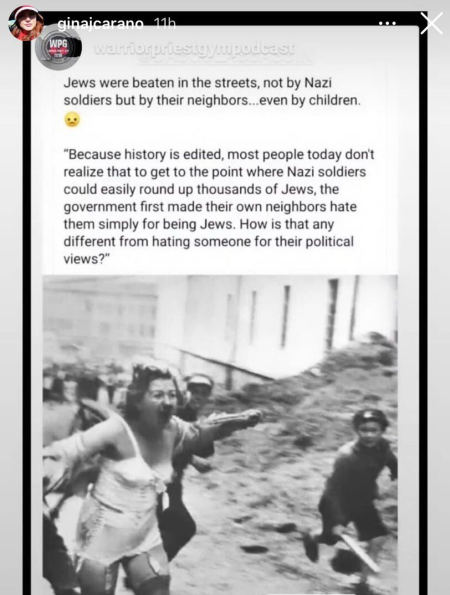
My first reaction was “Oh. Actress said something, and … they cancelled her.” Which is not only “day ending in y” right now, but also has been for a long time. Part of the reason I came out of the political closet is because I’d gotten tired of watching every word I said, and every expression I made in public. Because even a slight slip would have caused my career to be completely dead. […] So, I was going “Yeah, only innocents who don’t realize what life is like in a completely taken-over industry would think this is surprising. All power to the lady, but I’m sure she knew what would hit her for stepping out of line.”

And then I came across a screen capture of what she said. And someone asking “how is this anti-semitic.”

Which is when I panicked.

[…]

The only way, remotely, no matter how much you stretch it, that what she said can be considered “anti-semitic” is this:

    The left believes the Jews were innocent. (This is correct, btw.) That what happened to them was shameful and terrible, and a dishonor on those who attacked them.

    BUT they also believe it’s an insult to compare them to the people the left hates FOR THEIR POLITICAL VIEWS.

Because they think the people they hate for their political views — us — are really that bad, and really deserve everything the left intends to do to them. Which is more or less—in rough outlines — what the Nazis did to the Jews.

I mean, they have already talked of reeducating us, taking our children away, and they do in fact do think of us as not fully human.

Mind you, they have absolutely no idea who we are and what we believe, but they know we don’t agree with them, and since their hearts are pure, and utopia is their objective, we must be the very devil, and terrible on principle.

They’ve been exquisitely propagandized to the point they think the only American president with Jewish grandchildren was “anti-semitic.” They think that black people who don’t want to careen into ruinous and deadly socialism are “white supremacists” (the poor things swallowed Gramsci without chewing); they think other races aren’t hetero-normative; they think America is the most racissss, sexissss, homophobic nation on Earth … and they will not listen to corrections of their appalling and atrocious ignorance of true history or foreign anthropology or … really anything. Because anything opposing the indoctrination has been trained into them is an attack on their psyche.

So, they’re ignorant. They live in a political/social universe where if you oppose the completely insane leftist version of the world, you must be evil and “a nazi” which is to say the devil. They are so completely saturated in utter inanity that they call Israel “fascist.”

BUT one thing they know, and they know it at gut level: everyone to the right of Lenin — or perhaps Mao — are untermensch who will have to be utterly destroyed, so that the final promised utopia that they were promised since elementary school will come to be.

So, in their eyes comparing innocent Jews to their political opponents is experienced as an insult to the Jews.

Because in leftist eyes, we are evil, cockroaches and sub-humans whom they have to eradicate from society.

And they will not look in the mirror, or admit that what they’re engaging in is exactly what the nazis did, only with political beliefs instead of race. And it’s complicated. These idiots have simply decided that the real master race are black people. And that all evil comes from white males. But to be fair, it shades to people like me who have “internalized oppression” and are therefore “male.”

QotD: Protectionists, left and right

Filed under: Economics, Politics, Quotations — Tags: , , , — Nicholas @ 01:00

Conservatives who embrace protectionism thereby embrace both the fear that businesses, entrepreneurs, and workers in their country are simply not up to the task of competing against foreign rivals, and the belief that among the steps in making their country “great” is for their own government to restrict the freedom consumers in their country.

“Progressives” who embrace protectionism share conservatives’ low opinion of their country’s businesses, entrepreneurs, and workers, but also mistakenly believe that protectionism “sticks it to” corporate oligarchs when, in fact, it creates corporate oligarchs.

Don Boudreaux, “Quotation of the Day…”, Café Hayek, 2018-09-10.

February 10, 2021

“Did you know that seventy years ago, our grandparents were having an underpolarization crisis?”

Filed under: Books, History, Politics, USA — Tags: , , , , , , — Nicholas @ 05:00

Scott Alexander reviews Why We’re Polarized by Ezra Klein, beginning with the underpolarization crisis of the mid-20th century:

In 1950, the American Political Science Association “released a call to arms … pleading for a more polarized political system”. The report argued that “the parties contain too much diversity of opinion and work together too easily, leaving voters confused about who to vote for and why”. Everyone agreed with each other so much, and compromised so readily, that supporting one party over the other seemed almost pointless.

In 1976, three years after Roe v. Wade, Democrats and Republicans were about equally likely to support abortion restrictions. That same year, a poll found that “only 54% of the electorate believed that the Republican Party was more conservative than the Democratic Party”; 30% thought there was no difference. As late as 2004, about equal numbers (within 5 pp) of Democrats and Republicans agreed with statements like “government is almost always wasteful and inefficient” and “immigrants are a burden on our country”. Between the late 60s and early 90s, Democratic presidents deregulated the airlines and passed welfare reform; Republican presidents pushed immigration amnesties and founded the EPA.

What happened between then and now? Klein has two answers: a historical answer, and a structural answer.

The historical answer is: the Dixiecrats switched from Democrat to Republican.

When the North won the Civil War, it had grand plans to remake the South into a paradise of racial equality and universal love. After Lincoln’s death, his successor Andrew Johnson decided this sounded hard and gave up. Within a few decades, the South was back to being a racist, paramilitary-violence-prone one-party dictatorship. That one party called itself “Democrat”, but had few similiarites to the Democrats in the North. The Southern Democrats (“Dixiecrats”) and northern Democrats disagreed on lots of issues, but the South hated the Republicans so much after their experience with Lincoln that they caucused with the northern Democrats anyway. This turned into a stable coalition, with northern Democrats agreeing to support the South against civil rights for blacks, and the Dixiecrats supporting the northern Democrats whenever they needed something.

But since the Democratic party contained both northern Democrats (relatively liberal) and Dixiecrats (relatively conservative), it didn’t want to take a coherent party-wide stance on liberalism vs. conservatism. And by the median voter theorem, that meant the Republicans also didn’t want to take a coherent stance on liberalism vs. conservatism. So both parties ended out centrist and identical.

In 1964, the Civil Rights Act threatened the Dixiecrats’ key issue. It wasn’t quite as simple as “Democrats were for it, Republicans were against it” – in fact, 80% of Republicans and 60% of Democrats supported it. But that year’s presidential election pitted heavily pro-CRA Democrat Lyndon Johnson against anti-CRA Republican Barry Goldwater, beginning Southerners’ defection to the Republican Party.

Klein says this successfully got all the conservatives on one side of the aisle and all the liberals on the other, allowing polarization to begin. Essentially, he believes polarization is a natural process, which the odd coalitions of the early 20th century temporarily prevented. Once the coalitions were broken, it could begin to do its work. He spends the rest of the book talking about why exactly polarization is so natural, what aspects of modernization have made it worse, and what sort of feedback loops make it keep going

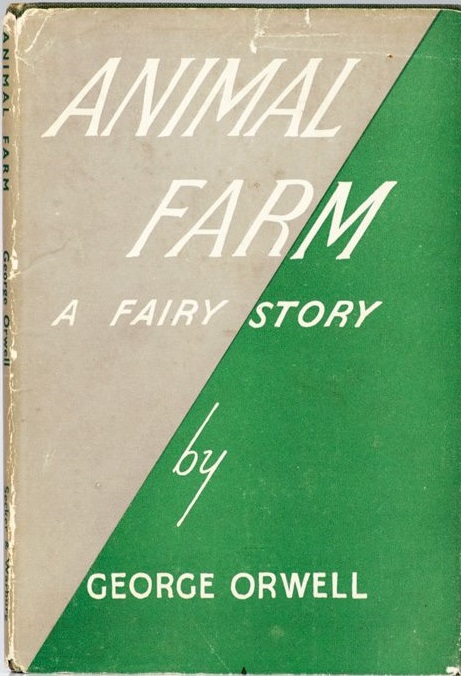
Victor Davis Hanson on Animal Farm, America’s nightmare 2021 version

Filed under: Books, Liberty, Politics, USA — Tags: , , , , , , — Nicholas @ 03:00

Victor Davis Hanson outlines the original George Orwell novel and then contrasts today’s situation with what progressives demanded back in the 1960s and 70s:

Yes, the downtrodden pigs, the exploited horses, and the victimized sheep finally did expel Farmer Jones from America’s Animal Farm.

But in his place, as Orwell predicted, revolutionary pigs began walking on two feet and absorbed all the levers of American cultural influence and power: the media, the bureaucracies, Wall Street, Silicon Valley, publishing, the academy, K-12 education, professional sports, and entertainment. And to them all, the revolutionaries added their past coarseness and 1960s-era by-any-means-necessary absolutism.

We are now finally witnessing the logical fruition of their radical utopia: Censorship, electronic surveillance, internal spying, monopolies, cartels, conspiracy theories, weaponization of the intelligence agencies, pouring billions of dollars into campaigns, changing voting laws by fiat, a woke revolutionary military, book banning, bleeding the First Amendment, canceling careers, blacklisting, separate-but-equal racial segregation and separatism.

Conspiracies? Now they brag of them in Time. Read their hubristic confessionals in “The Secret History of the Shadow Campaign That Saved the 2020 Election.” Once upon a Time, radicals used to talk of a “secret history” in terms of the Pentagon Papers, or a “shadow campaign” in detailing Hollywood blacklisting. They are exactly what they once despised, with one key qualifier: Sixties crudity and venom are central to their metamorphosis.

Our left-wing American revolutionary cycle from the barricades to the boardroom was pretty quick — in the manner that the ideology of the Battleship Potemkin soon led to Stalin’s show trials, or Mao’s “long march” logically resulted in the Cultural Revolution. The credo, again, is that the noble ends of forced “equity” require any means necessary to achieve them.

The Left censors books in our schools, whether To Kill a Mockingbird or Tom Sawyer. It is the Left who organizes efforts to shout down campus speakers or even allows them to be roughed up.

The Left demands not free-speech areas anymore, but no-speech “safe spaces” and “theme houses” — euphemisms for racially segregated, “separate-but-equal” zones. “Microaggressions” are tantamount to thought crimes. The mere way we look, smile, or blink can indict us as counterrevolutionaries. Stalin’s Trotskyization of all incorrect names, statues, and commemoratives is the Left’s ideal, as they seek to relabel Old America in one fell swoop. No one is spared from the new racists, not Honest Abe, not Tom Jefferson, not you, not me.

For “teach-ins,” we now have indoctrination sessions. But the handlers are no longer long-haired 1960’s dreamy, sloppy, and incoherent mentors. They are disciplined, no-nonsense brain-washers.

The Left’s Russia is our new old bogeyman. Putin is the new “We will bury you” Khrushchev.

February 6, 2021

QotD: Political virtue signalling in everyday conversation

Filed under: Politics, Quotations — Tags: , , — Nicholas @ 01:00

At the time, I was struck by the presumption — the belief that everyone present would naturally agree — that opposition to Brexit and a disdain of Trump were things we, the customers, would without doubt have in common. That the poem’s sentiment of friendship and community was being soured by divisive smugness escaped our local academic, whose need to let us know how leftwing he is was apparently paramount. The subtext was hard to miss: “This is a fashionable restaurant and its customers, being fashionable, will obviously hold left-of-centre views, especially regarding Brexit and Trump, both of which they should disdain and wish to be seen disdaining by their left-of-centre peers.” And when you’re out to enjoy a fancy meal with friends and family, this is an odd sentiment to encounter from someone you don’t know and whose ostensible job is to make you feel welcome.

It wouldn’t generally occur to me to shoehorn politics into an otherwise routine exchange, or into a gathering with strangers, or to presume the emphatic political agreement of random restaurant customers. It seems … rude. By which I mean parochial, selfish and an imposition — insofar as others may feel obliged to quietly endure irritating sermons, insults and condescension in order to avoid causing a scene and derailing the entire evening. The analogy that comes to mind is of inviting the new neighbours round for coffee and then, just before you hand over the cups to these people you’ve only just met, issuing a lengthy, self-satisfied proclamation on the merits of mass immigration, high taxes and lenient sentencing. And then expecting nodding and applause, rather than polite bewilderment.

David Thompson, “The Blurting”, David Thompson, 2019-09-04.

February 4, 2021

Ace reads the upper middle class out of the conservative movement

Filed under: Politics, USA — Tags: , , , , , , , — Nicholas @ 03:00

At Ace of Spades H.Q., Ace himself explains why he doesn’t consider anyone who evinces loyalty to “the mores of the upper middle class” to be in any way, shape, or form “conservative”:

Never once do these bougie “cons” notice that the class whose class markers they are so eagerly collecting like Cub Scout merit badges are entirely created by progressives.

I’m going to say this more straightforwardly than I’ve ever said it. I’ve hinted around it, I’ve never said it straight up.

But here goes:

People loyal to the mores of the upper middle class are left-liberal. Period.

They should have no place in the leadership and “thought” leadership of any “conservative” movement. They are not conservative.

They are all pro-gay marriage.

They are all pro-abortion.

They are all in favor of shipping out every single working-class job to China, and, for those few remaining jobs which must be performed in America, shipping in workers from the third world to displace Americans.

They are all supporters of a soft version of the SJW progressive stack. They all believe in “White Privilege,” for an obvious reason — as the rich children of the prosperous upper-middle class, they’re actually the ones born to privilege, but they wish to obscure that fact. So they buy into the left’s claims about the “White Privilege” of 63% of the country, instead of focusing on the wealth privilege of 10%.

Jake Tapper will entertain he shares a kind of privilege with two thirds of the country but he will never acknowledge his real privilege, one shared by only 10% of the country.

And the social-climbing “conservative” media class is almost entirely born from the same prosperous class. They too do not want to talk about real privilege.

I always want to ask these guys, so desperate to peonize the working class: How far back in time do you have to go to find an ancestor who had a job which caused callouses to form on his hands?

Was it two generations ago? Three? It’s obvious the “conservative” media class has never had to work a shovel in their lives. The toughest job they’ve ever held was working in their dad’s law office, or valet parking Beemers at the country club.

And yes, they support the leftwing SJW claims about race. Bullshit like “minorities can’t be racist,” or at least not racist in a way that should be held against them.

That’s why they all rushed to defend notorious, swaggering racist Sarah Jeong, and refuse to even acknowledge the eyebrow-singing anti-white racism seen every single day in the media.

To acknowledge there’s such a thing as “anti-white racism,” and that it ought to be condemned, is, they’ve decided, an “alt-right” idea, and the alt-right is a lower class phenomenon, and, as I’ve noted, they really, really really need you to know they are not lower class.

The only way in which they are arguably “conservative” is that … they are in favor of oligarchical fascism directed by the billionaires signing their paychecks.

Which is of course not “conservative” at all. But that’s the one category in which they can make an arguable case for their “conservatism” — in always championing the Ruling Class’ right to rule over the downscale Dirties.

Is that the “conservatism” we want? A gonzo left-liberalism which is also thoroughly anti-republican, anti-egalitarian?

Also at Ace of Spades H.Q., OregonMuse quoted this rather timely Barry Goldwater statement:

I have little interest in streamlining government or in making it more efficient, for I mean to reduce its size. I do not undertake to promote welfare, for I propose to extend freedom. My aim is not to pass laws, but to repeal them. It is not to inaugurate new programs, but to cancel old ones that do violence to the Constitution or that have failed their purpose, or that impose on the people an unwarranted financial burden. I will not attempt to discover whether legislation is “needed” before I have first determined whether it is constitutionally permissible. And if I should later be attacked for neglecting my constituents’ “interests”, I shall reply that I was informed that their main interest is liberty and that in that cause I am doing the very best I can.

February 2, 2021

Well, it is a very, very cunning plan …

Filed under: Government, History, Media, Politics, USA — Tags: , , , , , , — Nicholas @ 03:00

In the latest Libertarian Enterprise, Sarah Hoyt explains why the progressives’ cunningest of cunning plans may not be cunning enough:

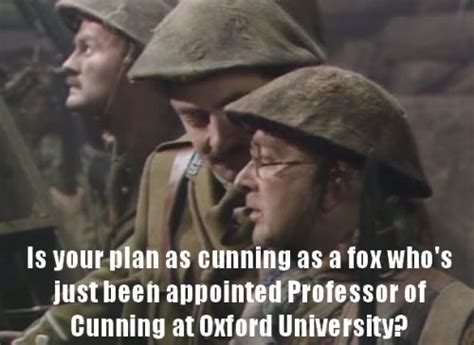
The left has a plan so cunning that if it were a person, it would be teaching cunningology at Oxford. And the ones who get the reference will also know that their plan is about to go pear shaped in all sorts of interesting ways, and at the end of it there might very well be a turnip or two involved, but not as the only item available in the shelves of the grocery store.

Look, someone pointed out in the comments the left are trying to follow the “plan” for other communist revolutions round the world.

He’s right. They’re trying to follow it to the letter. Partly because it’s worked before, and partly, because to be fair, they’re a cult, and cults don’t know the reason for the ritual, they just follow it.

… but it’s already going wrong. And it’s only going to get worse.

You see, part of the problem is that the cult of communism and the procedures for “the revolution” were set in the early twentieth century. And it’s designed for the early twentieth century. To the extent they worked in places like Venezuela, it is because the underlying structures of the society were still very much “early twentieth century.”

The US? Well, not so much. In fact we never were much like the early twentieth century in Europe, which is why they’ve had a hell of a time getting a foothold here.

The communist revolution is designed to work in a country that is mostly urban, with a vast urban underclass that can’t rise above for reasons both internal and external despite working unreasonable hours. It’s designed for a country with a firm aristocracy of the hereditary sort (even if that aristocracy is often from trade), it is designed for a country with a conscript army where the plum assignments go to the “good families” as a matter of course, it is designed to work — most of all and very importantly — in a country where they ABSOLUTELY control all the means of mass communication and do so without the vast majority of the people being aware of it.

The last time they could have pulled that off in the US was in the mid seventies. And my guess, honestly, is that they tried. I don’t know for sure, since the news of the time were all reported by biased sources, and besides I’m too lazy and too busy […] to spend my day chasing down hints. I bet they did try, though. I bet they gave it a sporting try. And I bet part of the issue back then — as now, btw — is that they were pinning their hopes on a race war, having both not realized how much of a minority people of African descent are in the US (last estimate is what? 14%? Sizeable, sure, but not a large minority and certainly not a majority. Also, and seriously, a lot of that minority is middle class and whatever they voice from the mouth-out as uninterested as the rest of us in having the apple cart overturned. Apples are tasty. Genocide not so much.) Mostly because that sh*t was so successful in Africa, and again the left doesn’t think. It ritualistically applies “what worked” without being able to account for changed conditions.

Anyway, that was the last time they could have MAYBE credibly have followed their little red map to revolution and have it work. And even then Americans were just too darn contrarian. Why everyone and their parents were telling us that Republicans were so dangerous, that they were going to start the nuclear war, that — And we went and voted Reagan in. (Well, not me. I only worked towards it. I didn’t vote. I wasn’t a citizen and I’m not a democrat.)

In fact, America could have engraved on its door lintel “authorities can go f*ck themselves.” The left keeps forgetting that. And sometimes justifiably. Take their Covid-psy-ops. It worked. And it was all run on the “experts” and how important it was.

Uh uh. So, they think their control is back! They’re golden again, baby!

February 1, 2021

QotD: “Useless things … do not further The Revolution”

Filed under: Politics, Quotations — Tags: , , , — Nicholas @ 01:00

“Fat acceptance,” slutwalks, and all the rest of it follow naturally from Bolshie beliefs. If you accept — as a good little Dialectical Materialist must — that there’s nothing to human happiness but bread, shoes, and shit, ugliness — physical, moral, mental — becomes a good in itself. How could it be otherwise? Only truly useless things can be beautiful, and useless things, by definition, do not further The Revolution.

Too bad for the Bolshies that it’s in our nature to confuse the messenger with the message. I like to think of myself as an open-minded, tolerant man who takes things as they come, but holy jeeebus, I don’t care what Emma Goldman’s deal is — if she’s for it, I’m against it. I need bleach for my eyes.

We need to use that. It’s no coincidence that Ashley Judd and now Taylor Swift are spouting off about Progtard politics — they used to be cute; now they’re not. See what Social Justice does to you, ladies?

Severian, “The Face You Deserve”, Rotten Chestnuts, 2018-10-11.

January 29, 2021

QotD: Banishing racism

Filed under: Liberty, Politics, Quotations, USA — Tags: , , , — Nicholas @ 01:00

The simple, powerful truth that banishes racist prejudice is this: the individual is not the mass. Statistical distributions do not predict the traits of individuals. It’s OK to acknowledge that (for example) Ashkenazic Jews average significantly brighter than gentile whites, because the difference in the means of those bell curves tells us nothing about where any single Jew or gentile falls on them.

We can – we must, in fact – learn to judge individuals as individuals, not as members of racial or other ascriptive groups. This has always been the right thing to do; as knowledge about genetic group differences becomes more detailed and widespread, we will need to learn how to focus rigorously on individuals with the same discipline (and the same justified fear of failure) that we now apply to averting our eyes from genetic group differences.

Part of the reason this evolution won’t be easy is that so much of our politics has been distorted by racial grievance-mongering. It’s not only the obvious bad guys like neo-Nazis, Black separatists like Louis Farrakhan, and Bharatiya Janata who are invested in racialist categorization as a lever to power. The political Left has fallen into a lazy habit of screaming “racist!” at anyone who disagrees with them, won’t readily relinquish that rhetorical club, and have a lot invested in the present system of taboo, resentment, “disparate impact” legislation, and racial identity politics; expect them, too, to be part of the problem rather than part of the solution.

Still, the right strategy is clear. Actual knowledge makes both prejudice and repression unsustainable. “Know thyself!” said the oracle, and behavioral genetics will allow – actually, force us – to know ourselves in ways we never have before. That way lies the pain of revelation, but also the path of redemption.

Eric S. Raymond, “A Specter is Haunting Genetics”, Armed and Dangerous, 2010-06-19.

January 10, 2021

Has the United States reached the same tipping point Canada reached in 1982?

David Warren considers the 1982 tipping point in Canada to have been the implementation of Pierre Trudeau’s Constitution:

Queen Elizabeth II signs Canada’s constitutional proclamation in Ottawa on April 17, 1982 as Prime Minister Pierre Trudeau looks on.

There are two principal political parties in modern America (in which I include up here). In the Natted States, the population is divided roughly equally between those of “progressive” and “regressive” habits of mind; in the Canadas, the former have come to dominate.

The tipping point was reached much earlier up here, and the new “metapower” (Foucault’s term) was seized, politically, from within the Liberal Party. The strategy was to disenfranchise the “conservative” half of the electorate, by undermining all national institutions, and hosing down Canada’s previous identity. I’d count, say, 1982, as the point of no return. That identity was replaced, definitively, under a revised Trudeau constitution, with a new “multicultural” identity, in which citizens were themselves redefined, from free persons whose rights were inalienable, to interchangeable clients of an omnipotent State, which could dispense rights whenever it was in the mood — and withdraw them whenever the mood changed; however frequently.

This is the Democrat strategy in the larger, and still less amenable, country next door. As Andrew Breitbart and Antonio Gramsci might agree, this is an essentially cultural process. Politics are visible at the tip of the iceberg, but “progress” requires a more thorough “cleansing,” of old cultural norms. The cancer metastasized more from Hollywood, than from Washington DC. The takeover of the Democratic Party as the vanguard “agent of change” was only part of the institutional takeover of America. As important was the takeover of the mass media, and even corporate boardrooms. Those who weren’t “progressive” would now be “cancelled”: must cease to be.

All cultural change has a religious dimension. The Democrat representatives of the “powers and principalities” mentioned by Saint Paul, are characteristically godless, themselves. But they depend on a massive, core constituency of low-information, low-intelligence, easily manipulated urban voters.

Those who can still see the stars at night tend to remain in the ancient, God-fearing default. In the cities, where the masses may not grasp that milk comes from cows, let alone that someone must milk them, the belief that the economy is based on government cheques is more common. That is the god of the populous cities, and for most city-dwellers, not voting for their “godless god” of progress, seems a kind of heresy.

The idea that such heretics should be deprived of their freedom, starting with freedom of speech, does not appeal to the “rural” voter, including people like me — a “country hick” type who paradoxically lives in the city. The idea that laws and constitutions should be flexible, to accommodate the latest schemes of a progressive technocratic élite, doesn’t flourish among us country bumpkins. But to the efficiency experts in the city, what is our problem?

January 5, 2021

Lockdowns are inducing a kind of cultural autism (but especially among our self-imagined “betters”)

Last month, Douglas Murray looked at how the various shades and degrees of lockdown in most western nations have disrupted normal socialization patterns and created odd and unusual social feedback to various stimuli:

A building burning in Minneapolis following the death of George Floyd.
Photo by Hungryogrephotos via Wikipedia.

This year has seen a series of extraordinary events. First and foremost are the unprecedented lockdowns, which have removed from almost all our societies not just our ability to congregate, but also almost all of our social antennae. It is not just actors, comedians or public speakers who have lost that mechanism: we all have to some extent.

“Will this statement/opinion/joke go down well or badly?” is a fine judgement call. In public and relative private we all try things out and experiment all of the time. Take away all audiences beyond your immediate household and we must all subject ourselves to some other way of testing which way the wind is blowing. The only such device left is the online world, which — as should be obvious to all by now — has its own problems.

And so, during the middle of the oddest mass psychological experiment in history, came the death of George Floyd in May and the rapid escalation of the Black Lives Matter movement. A movement that attempted to push, inveigle and eventually intimidate itself into almost every walk of life inside America and beyond.

In Britain, institutions as far away from the scene of the crime as the British Library and Cambridge University seemed to think that the death of an unarmed black man at the hands of a Minnesota police officer (currently awaiting trial on a charge of murder) demanded some kind of response, lest they be accused of being insufficiently devout.

In ordinary times, people might have been able to get a sense of where other people stood on such a matter. Did users of the British Library really feel any culpability for events in Minnesota? Were things so bad in the state of race relations in America and across the western world (only the western world, naturally) that a stance was required — indeed demanded — of everyone? For a time, it seemed so. Almost every major British institution, including all its universities, issued statements about the death of a man in police custody on another continent, in a jurisdiction over which we have precisely zero control, and similar levels of influence.

“Taking the knee” became one of the emblems of obedience, or subservience, to the cause. Soon, even questioning the reverence of that hallowed, brand new tradition was cause to be pummelled online. And when all gatherings of more than six were banned by law, what other world mattered?

January 3, 2021

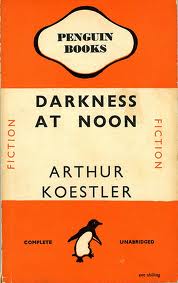
Arthur Koestler’s Darkness at Noon ranks with Orwell’s Nineteen Eighty-Four

Filed under: Books, History, Politics, Russia — Tags: , , , , — Nicholas @ 03:00

James E. Hartley on why Koestler’s 1941 novel should be seen as a prescient guide to modern-day “wokeness”:

The puzzling thing about wokeness is not that it is fashionable among a small subset of the Campus Left. One should never be surprised by what is fashionable among college faculty and students. The curious question is how these ideas broke out of the academic asylum and met acquiescence among a large group of people who should have known better.

The answer is found in a book which should have never fallen off the radar: Arthur Koestler’s Darkness at Noon. First published in 1941, it was — along with 1984 — one of the great books about totalitarianism written in the 1940s. Widely praised when it was published, the book was enormously influential in fostering the consensus view of post-war anti-communism. In 1998, Modern Library published a list of the 100 best English novels of the 20th century; Darkness at Noon was ranked eighth, five places above 1984.

The plot of the novel itself is fairly simple. The story begins with the imprisonment of Nicholas Rubashov, one of the heroes of the communist revolution in a country which is clearly the Soviet Union. Decades after the revolution, Number 1 (read: Stalin) has assumed power. Rubashov is imprisoned on the absurdly false charges of plotting to kill Number 1. The entire novel takes place in prison, as Rubashov is interrogated and eventually comes to voluntarily confess at a public trial to crimes he did not commit. He is then shot.

The novel explores the philosophical puzzle of why Rubashov would join with what has obviously become a murderous cult run by a totalitarian who is solely interested in amassing enough power to stamp his will upon the whole country. Rubashov, a devoted communist to the end, abandons his principles and bit by bit comes to accede to demands of the new generation who are seeking scapegoats and ritualistic confessions of guilt.

What is the nature of the new generation? One of the Party officials interrogating Rubashov explains:

    There are only two conceptions of human ethics, and they are at opposite poles. One of them is Christian and humane, declares the individual to be sacrosanct, and asserts that the rules of arithmetic are not to be applied to human units. The other starts from the basic principle that a collective aim justifies all means, and not only allows, but demands, that the individual should in every way be subordinated and sacrificed to the community — which may dispose of it as an experimentation rabbit or a sacrificial lamb.

The individual does not matter. The group matters. What is good for the group is by definition good, regardless of whether it is good for the individual. As the interrogators make abundantly clear, no individual has the right to stand in the way of the group. The Party represents the group, and thus no individual has the right to oppose the Party.

January 2, 2021

QotD: The Opposite Rule of Progressives

Filed under: Politics, Quotations, USA — Tags: , , — Nicholas @ 01:00

At various times, I’ve rolled out my rule about how to interpret statements by liberals regarding non-liberals […] it goes like this. Take whatever they say, assume the opposite and you will get close to the truth. When liberals said the Tea Party was “AstroTurf” and liberal groups were genuine grassroots, you could flip it around to mean their gang was a rent-a-mob and the weirdos in the 17th century outfits were just regular folks pissed off and making some noise.

That was in fact the case. The Left has well funded “volunteer” operations to bus in protesters when needed. Often they are paid by their union, like we saw in Wisconsin with the teacher unions. It is a form of projection, for the most part, but in politics it is a way to shift the focus away from whatever crooked stuff they’re doing. One of the oldest tricks in politics is to falsely accuse your opponent of something, so the story is about the other guy denying it, not about whatever you are doing. […] For as long as I’ve been alive, there have been theories about why there is a Left and Right in American politics. All of these theories claim the mantel of science and all of them come from the Left. The reason for this is, at some level, the Left knows they are not working from facts and reason, but rather a set of beliefs. Rather than confront that, they accuse everyone that opposes them of holding irrational beliefs and acting from emotion.

The formula goes like this. They assign to themselves qualities they wish they possessed, but don’t. “Open minded” always makes the list along with “smart” and “unconventional.” Who would not want to be a smart, open minded guy, who is a little off-beat? Gosh that sounds just like the protagonist of every cool TV show and movie! Then they usually assign some bad qualities to the mythical right-winger or conservative. Then they produce a “study” that confirms all of this as science!

I’ll note that liberals have a long list of words for the people on the other side of the hive walls. You never hear liberals talk about the differences between libertarians and paleo-cons or neocons and paleos. To the liberal, they are part of the undifferentiated other on the other side of the wall. Often they avoid this and rely on their cartoon version of the conservative, which is usually a blend of the 1950’s sitcom dad and a prison guard. It’s Ward Cleaver with a closet full of Nazi uniforms.

The Z Man, “The Opposite Rule of Liberalism”, The Z Blog, 2013-11-15.

December 31, 2020

QotD: The “noble savage” belief system

… the whole weeks-long saga, which featured urban protestors appearing alongside their Indigenous counterparts at road and rail barricades throughout Canada, tapped into a strongly held noble-savage belief system within progressive circles. Various formulations of this mythology have become encoded in public land acknowledgments, college courses, and even journalism. The overall theme is that Indigenous peoples traditionally lived their lives in harmony with the land and its creatures, and so their land-use demands transcend the realm of politics, and represent quasi-oracular revealed truths. As has been pointed out by others, this mythology now has a severe, and likely negative, distorting effect on public policy, one that hurts Indigenous peoples themselves. In recent years, Indigenous groups have finally gotten a fair cut of the proceeds of industrial-development and commodity-extraction revenues originating on their lands. And increasingly, they are telling white policy makers to stop listening to those activists who seek to portray them as perpetual children of the forest. It is for their benefit, as much as anyone else’s, to explore the truth about the myth of harmonious Indigenous conservationism.

***

When the ancestors of North America’s Indigenous peoples entered the New World some 16,000 years ago via Siberia, they hunted many of the mammals, reptiles, and birds, from the Arctic down to Tierra del Fuego. Mammoths, mastodons, and enormous ground-dwelling sloths, as well as giant bears, giant tortoises, and enormous teratorn birds with 16-foot wingspans — animals that had never had a chance to evolve in the presence of humans — were among the many species that disappeared from the Americas. Some medium-sized animals — such as horse, peccary, and antelope species — were also wiped out. But others survived: Bison and deer species, tree sloths, tapirs, jaguars, bear species, alligators, and big birds such as rheas and condors are, at least for the time being, still with us. The existence of these survivors, along with the relatively unspoiled forests, grasslands, and rivers seen by the first Europeans to enter the Americas, served to support the illusion that America’s first peoples had been maintaining what popular environmentalist David Suzuki calls a “sacred balance” with the natural world. Throughout history, however, humans killed animals that were tasty, numerous, and huntable. For kin-groups, staying alive meant making life-and-death cost-benefit calculations about where to send your berry-pickers and hunters. “Sacredness” had nothing to do with it.

This is not to say that the Indigenous peoples who migrated from Asia to the Americas were especially bloodthirsty (though Europeans typically reported that their hunting and fishing skills were excellent). In every known case where humans entered continents formerly uninhabited by our species, the bigger animals tended to disappear, since they provided the most sustenance per kill. The first humans to enter Australia some 70,000 years ago wiped out giant kangaroo species, rhino-sized marsupial herbivores, jaguar-sized marsupial carnivores, big flightless birds, and many other megafauna. The same thing would happen in Europe: After sapiens completed its occupation of that sub-continent some 30,000 years ago, the mammoths, woolly rhinos, giant deer, and lions they recorded in their cave paintings and carvings also disappeared.

Baz Edmeades, “The Myth of Harmonious Indigenous Conservationism”, Quillette, 2020-09-06.

December 30, 2020

This is why the word “unexpectedly” gets such a workout in media these days

David Warren on “unexpectedly” negative results from policies born of virtue-signalling “good intentions” by self-styled progressives:

The expression, “unintended consequences,” is a charitable dodge. It is what old-fashioned, polite, civic-minded people say about the fallout from progressive social policies. It implies that their authors have overlooked something, or made some innocent mistake. For unfortunately, the policies do the exact opposite of what was promised. Surely the “reformers” didn’t mean to force decent, reasonable people to do things that any decent, reasonable person would consider to be satanic. Yet somehow, that was the result.

By contrast, these reformers despise the tactics of the bourgeois. Rather than argue, they prefer to drown out their opponents with slogans. Rather than coherently reply, they characterize any asking questions as “fascist,” “misogynist,” “racist,” “hate criminals,” &c. Those who have exposed scandals are personally smeared, slandered, doxxed. This isn’t new. It is the way the Left has always “debated,” going back long before Lenin. Once they have the police working for them, opponents get the knock in the middle of the night.

There are, incidentally, two kinds of “reform,” corresponding to the two political persuasions. One happens without planning, and is an organic response to things no longer working properly. Try, in good faith, to make the old system work, and it will subtly change. The “problems” fix themselves, when they are allowed to. The other kind is “reform” according to a theory. A huge, mostly imaginary “problem” is created, so a “solution” may be imposed. Every tool must be applied, to get everyone onside for the task: fake news, fake science, fake history, and miscellaneous fakery. For as every godless person knows, “the end justifies the means.”

Luckier than most, raised in “liberal” environments, I was able to discern this from an early age. By chance I acquired many friends who were refugees from Communist (especially Soviet-occupied) countries. But it was not just that. Having been trained counter-culturally, by non-conformist “classically liberal” teachers, and also having learnt to read for myself, I was already fairly alert. The clincher for me was a native disposition, not only to think independently, but to resist being a putz. It was not in my nature to assume that the enemies of real liberalism (which requires honesty) had good intentions. Reason, and experiment, demonstrated that they had not.

For instance, I early realized that leftwing factions formed a Party of Privilege. Every policy they advanced favoured individuals with relatively more wealth and power, against individuals with less. Unions were a good example. They represented the better-paid. The labour laws they advocated were designed to exclude the young and the poor from labour-market competition. They secured the allegiance of thuggish union members through crassly self-interested schemes. They opposed legitimate rewards for labour; for skill and hard work. Instead they enforced universal mediocrity, and punished intelligent enterprise. Legitimate labour interests, once represented by cooperative and self-managing guilds, were replaced by the interests of (untalented) union organizers.

« Newer PostsOlder Posts »

Powered by WordPress