Quotulatiousness

February 21, 2025

“… a sea change in American foreign policy priorities”

Theophilus Chilton on how the markedly changed US foreign policies under Donald Trump are roiling the old certainties of so many western “transnational” elites:

Last Friday, an event occurred which represents a sea change in American foreign policy priorities, but the importance of which may have been missed by many. Vice-President Vance gave a speech at the Munich Security Conference. In this speech, he basically pulled no punches, calling out the various Western European governments for their support for mass immigration, their opposition to free speech, and the erosion of democratic functions within their governments. The speech itself presented a stark contrast between the new American administration and the “leadership” that currently exists in most European countries. It represents a decisive rupture between an American executive which is in the process of refuting the influence of a globalist transnational “elite” over its country and European governments which are still firmly ensconced in that elite’s thrall.

The thing is, Vance was pretty much right about everything he said. Mass immigration, especially that part of it coming from Africa and the Muslim world, is absolutely destroying the social fabric of every European nation as well as dragging down their standards of living toward third world levels. Euro governments, in fact, do absolutely hate freedom of speech and apply strictures that medieval monarchies would never have dreamed of instituting. For all their talk about the importance of democracy and the “threat” to it represented by Trump and his administration, Euro countries make an absolute mockery out of the entire concept. Those European slaves of the globalists can grumble and sit there aghast at Vance’s words, but the simple fact of the matter is that he was right in every way in the criticisms he leveled against them.

After all, these are the people who overturn Romanian elections because actual Romanians voted for the wrong person — all to “defend democracy”. These are the people who ban political parties to “defend democracy”. These are the people who let “migrants” stab little girls to death to “defend democracy”. These are the people who arrest Christians for singing hymns on a public street to “defend democracy”. These are the people who do armed midnight raids and throw people into prison for sharing memes on social media to “defend democracy”. You get the picture. Populism and popular sovereignty are such a threat to these regimes because their democracy is a sham, a foil used to give a pretended legitimacy to globalist policies which are destroying the actual people of these various countries.

For all the breathless hyperventilating about Russia “invading Europe” (which it is in no position to do, LOL), the fact is that there is nothing that the Russians could do to the people of Europe that would be worse than what their own governments already subject them to.

What makes this all the more amusing is the excited “nationalism” we’ve been seeing from the lefties and globalists in several of the countries that have been in the Trump/Vance crosshairs over the past month. A good example would be in Canada, in response to the tariff threats that Trump made to try to push the Canadian government into being a little more proactive about securing their side of the border from the fentanyl and illegal aliens that enter the USA. Watching the Canadian government fall all over itself trying to fake an exuberant pride in their Canadian-ness, even as they continue to turn their country into an Indian colony and treat their own White Canadian population like a bunch of expendable paypigs has been enlightening, to say the least. Obviously, what’s driving the reaction is not a genuine love of country or people, but loyalty to the transnational elite that is piqued at recently being disempowered in the USA.

In all of this, it’s important to remember that the enemies here, the people who deserve our ire and derision, are not the peoples of Canada, the UK, the European countries. It is the transnational clique and their progressive Left hangers-on, the same people who were until very recently doing the exact same things to the American people, too. We need to be very clear that regular, everyday Americans and regular, everyday Frenchmen, Germans, Canadians, Italians, and all the rest are on the same side here. We have the same enemy. The European and other peoples are victims of their own governments, first and foremost. I mean, their own governments are now formally making them eat the bugs as part of their anti-human green agenda, just to give one example.

February 18, 2025

Canadian academic life now entails mandatory indoctrination about “settler colonialism”

In Quillette, Jon Kay talks about the pervasive indoctrination of Canadian university students in that invasive intellectual weed from Australia, “settler colonialism”:

Last month, I received a tip from a nursing student at University of Alberta who’d been required to take a course called Indigenous Health in Canada. It’s a “worthwhile subject”, my correspondent (correctly) noted, “but it won’t surprise you to learn [that the course consists of] four months of self-flagellation led by a white woman. One of our assignments, worth 30%, is a land acknowledgement, and instructions include to ‘commit to concrete actions to disrupt settler colonialism’ … This feels like a religious ritual to me.”

Canadian universities are now full of courses like this — which are supposed to teach students about Indigenous issues, but instead consist of little more than ideologically programmed call-and-response sessions. As I wrote on social media, this University of Alberta course offers a particularly appalling specimen of the genre, especially in regard to the instructor’s use of repetitive academic jargon, and the explicit blurring of boundaries between legitimate academic instruction and cultish struggle session.

Students are instructed, for instance, to “commit to concrete actions that disrupt the perpetuation of settler colonialism and articulate pathways that embrace decolonial futures”, and are asked to probe their consciences for actions that “perpetuate settler colonial futurity”. In the land-acknowledgement exercise, students pledge to engage in the act of “reclaiming history” through “nurturing … relationships within the living realities of Indigenous sovereignties”.

My source had no idea what any of this nonsense meant. It seems unlikely the professor knew either. And University of Alberta is not an outlier: For years now, whole legions of Canadian university students across the country have been required to robotically mumble similarly fatuous platitudes as a condition of graduation. It’s effectively become Canada’s national liturgy.

After my tweet went viral, I was contacted by a US-based publication called The College Fix, which covers post-secondary education from a (typically) conservative perspective. Like many observers from outside Canada, reporter Samantha Swenson couldn’t understand why Canadian students were being subjected to this kind of indoctrination session. “I hope you can answer,” she wrote: “Why do schools make mandatory classes like these?”

I sent Swenson a long 13-paragraph answer — which, at the time, felt like a waste of my time: I assumed the reporter would pluck a sentence or two from my lengthy ramble, and the rest of my words would fall down a memory hole.

So when her article did come out — under the title, Mandatory ‘Indigenous Health’ class for U. Alberta nursing students teaches ‘systemic racism’ — I was pleased to see that I’d been quoted at length. I especially appreciated the fact that Swenson had kept in my point that educating Canadians (especially students in the medical field) about Indigenous issues is important work; and that courses such as Indigenous Health in Canada would provide value if they actually served up useful facts and information, instead of self-parodic faculty-lounge gibberish about “decolonized futurities”.

February 13, 2025

Australia’s most toxic export (so far) – “Settler-colonial ideology”

Filed under: Australia, Books, Cancon, Education, History, Media, Politics, USA — Tags: , , , , — Nicholas @ 05:00

Helen Dale explains how a lunatic fringe Australian notion has grown to be a major ideology in most of the Anglosphere and even as far afield as Israel:

Despite a great efflorescence of literature and especially film about the mafia, it’s a truism to say that it isn’t very good for Sicily. It also hasn’t been very good when exported to other countries, either, spreading violence, corruption, and lawlessness. Well, Australia is to settler-colonial ideology as Sicily is to mafia, and our poisonous gift to the world is, like Sicily’s mafia, one of those things about us that really isn’t for export.

“Settler-colonial ideology” seems a mouthful, but if I describe bits of it to you, you’ll recognise it. Heard Australia Day called “Invasion Day”? You’ve encountered settler-colonial ideology. Been called racist for voting NO in the 2023 Voice Referendum? You’ve encountered settler-colonial ideology. Noticed Aboriginal academics get hired with obviously inadequate qualifications? You’ve encountered settler-colonial ideology.

Many Australians — including me — first encountered settler-colonial ideology at university. Back then, it was a theoretical and foreign concern, and largely in languages other than English (mainly French and Arabic). I do remember one of the “post-colonial literatures” (note the s, the s is important) obsessives trying to convince me that Alan Paton’s Cry the Beloved Country wasn’t a “legitimate book” because its author was white, but back then, this was still a niche view.

Like other Australians confronted with daft academic ideas, I blamed the US or France and ignored my own country’s contribution. Australians aren’t noted for their theoretical acumen, which made this easier. Critical race theory and affirmative action are all-American, while US academics have often executed hostile takeovers of French nonsense like postmodernism or queer theory early on in proceedings. It gets easy to blame America and France.

Easy, but unfair.

I realised how mistaken I’d been when, in October last year, I returned to Australia for a stint. While I was there, I read Adam Kirsch’s On Settler Colonialism: Ideology, Violence and Justice. I did so in part because October 2024 was the one-year anniversary of two important events. Both concerned what Kirsch calls “the ideology of settler-colonialism”.

Kirsch documents a process whereby the French- and Arabic-speaking theorists of post WWII decolonial conflicts — particularly Frantz Fanon — had their ideas grafted (very, very awkwardly) onto dissimilar Australian history and conditions by Australian intellectuals. These were then exported throughout the English-speaking world, likely through academic conferences. This explains how cringeworthy Australian nonsense like land acknowledgments managed to spread first to Canada and then the US in a reversal of the usual process whereby America sneezes and so gives its Hat a cold.

Fanon was a Marxist and a Freudian. His writing seethes with angry bloodthirstiness and pseudoscientific psychodrama, but he was responding to a vicious war of independence and incipient civil conflict. Kirsch notices a pattern where Australian scholars borrow bits of Fanon to give a sanguinary rhetorical garnish to their writing. “Fanon’s praise of violence is a large part of his appeal for Western intellectuals,” he notes. “Many of the sentiments expressed in The Wretched of the Earth, coming from a European or American writer, would immediately be identified as fascistic.”

Australia’s intervention changed the ideology, in some ways making it more destructive. Fanon is shorn of most of his Marxism, for example (can’t have that, won’t be able to recruit rich minorities to the boss class otherwise). The key Australian shift coalesces around an oft-quoted aphorism from historian Patrick Wolfe: “invasion is a structure, not an event”. That is, colonisation trauma is constantly renewed because “settler” is a heritable identity. “Every inhabitant of a settler colonial society who is not descended from the original indigenous population,” Kirsch points out, “is, and always will be, a settler”.

“Settler” here includes people transported to both America and Australia in chains — slaves and convicts. Once it became acceptable to construe one group of people conveyed against their will across thousands of miles of ocean in dreadful conditions as providentially lucky (and genocidal) settlers, it became possible to extend the reasoning to other, similar groups. After all, the only difference between a convict and a slave is the presence or absence of a criminal conviction.

Kirsch’s attempt to explain how Australia was analogised with Fanon’s Algeria and then how Israel was analogised with Wolfe’s Australia is heroic, in part because the casuistry he seeks to unpick is so convoluted. Filtering Fanon through Australian academia and its claim that “settler” is a heritable identity did have the effect of making Jewish Israelis look more like non-indigenous Australians or Americans, however, especially when attention was focussed on European Jewish immigrants to Israel.

The downfall of the “theatre kid occupied government”

Filed under: Bureaucracy, Government, Media, Politics, USA — Tags: , , , , — Nicholas @ 03:00

Theophilus Chilton says that one of the biggest weaknesses of the Biden administration was their addiction to the idea that appearances mattered far more than reality:

For the previous four years, one of the constant refrains from the Left that we kept hearing over and over was “the adults are back in charge”. Trump is “childish” while Biden was “the adult in the room,” or so the media-driven narrative kept telling us. Trump just hung out on social media and made fun of people during his first term while Democrats did the serious business of guiding the ship of state through the rocky shoals of the modern world when Biden was in office, and all that. The whole point was to mask the serious deficiencies in the previous administration and its underlying ideational premises, deficiencies that existed at both the structural and personnel levels because of the fundamental ideological puerility of the Left.

It’s become common for observers to (only partially jokingly) note that until very recently we had a “theatre kid occupied government”. What’s that mean? Well, everything we saw from the past four years (and really, a lot longer than that) was performative — it was about giving appearances rather than getting anything useful done. All the way back to the terminally midwit show The West Wing, the belief among up-and-coming leftie PMCers was that government could essentially be conducted by stagecraft. All you have to do is write the script, teach the actors their lines, and create whatever you want out of the production. More generally, the theatre kids in government thought that they could rule the world merely by wishcasting things into reality, which explains a lot of the “questionable” spending to and through USAID and various NGO organisations. They have the very juvenile tendency to think that wanting something to be a certain way can make it so, regardless of intervening realities.

Fundamentally, that is the whole character of modern Western and American progressivism. Modern leftists display a whole suite of childlike behavioural patterns that, as it turns out, are not conducive to good government. Really, progressivism is essentially based on wishful thinking and daddy issues. Once you understand this, you understand about 90% of where the Left’s thought process comes from.

One good example of this is the whole transgender push. While there is obviously an element of grooming/recruiting involved with it all, the main point to it is that it’s a means of social conditioning and control. They pretend — and demand that others pretend — that boys can become girls and that girls can become boys. Until recently, they were able to punish normal people who didn’t at least pay lip service to this. Even without this power, there is still a good deal of attempting to emotionally manipulate people about the matter (you don’t want to commit TRANS GENOCIDE do you???), which is itself a means of trying to exercise power, though in a juvenile manner.

Of course, the fact that the whole trans agenda rests of wishful thinking, on the attempt to stage manage reality into accepting something blatantly at odds with it, should go without saying. There has been a concerted effort to build a Baudrillardian hyperreality around this issue, to create a “consensus reality” that muddies the distinction between fact and fiction. Baudrillard himself defined hyperreality as “… the generation by models of a real without origin or reality”. The entire process is essentially semiotic, which explains the obsession of the modern Left (not just now, they tried this in Weimar Germany in the 1920s as well) with transgenderism — it’s a spearhead which, once successfully pierced through the veil of classical reality in this one area, can justify the same exact process being carried out in any other so that any symbolic-yet-unreal consensus can be built, even if by fraud or force.

There are real world consequences to this sort of theatre kid performativism. It leads to them impeding traffic on busy highways to protest whatever their idiotic cause du jour happens to be (physics isn’t real bro!). It’s also why (ostensibly adult) Democratic elected officials think they can impede federal immigration enforcement efforts. For so long, progressives in our TKOG were able to force everyone else to go along with their delusions or face punishment. Even though they’re now not able to do this (at least here in the USA, other places in the West aren’t so lucky), they still think they can obstruct and counteract the implementation of policy simply because they don’t want these things to happen. Like little kids who can’t accept that they lost at a game, these folks believe they can roll back the results of the latest election by throwing tantrums and trying to get in the way. Hopefully, a few arrests will clear up this misconception.

February 11, 2025

Many young white men are choosing to “own the insult” when accused of being a fascist

Filed under: Media, Politics, USA — Tags: , , , , , — Nicholas @ 05:00

Lorenzo Warby points out that some — even many — young white men are reacting to repeatedly being called “Nazi” or “fascist” by embracing the slur:

Still from Pink Floyd: The Wall

For the fuel of the contemporary networked authoritarians are angry young men. Angry young men who have a great deal to be angry about.

In so many modern schools, universities, and much of social media, if you are a low melanin count, heterosexual male you are absolutely at the bottom of the “woke” oppression-bingo hierarchy. You will be implicitly, or explicitly, held to be somehow tarred with every bad thing any person “like” you has done in history, no matter how long — even how many generations — before you were born that it happened, nor how dubious an historical characterisation it might be. There is no identity open to you that you can celebrate, or feel positively attached to, without potential or actual denigration.

If you do any reading, you can quickly work out that this is a ludicrously one-sided — and deeply unfair — way to look at history. Even in its own terms, it is nonsense, as “folk like you” — i.e., low melanin count heterosexual males — voted for every single legal advance any of the celebrated-as-oppressed groups made. “Folk like you” built the Scientific Revolution, Parliamentary Government, mass prosperity.

Of course, this was a matter of culture, institutions, the happenstance of history, not melanin content. The trouble with the racialisation of history and identity is that it is, indeed, the racialisation of history and identity. As Jews are currently (re)discovering.

Nor can many of these angry young men take much refuge in the good life, work or entertainment. Online dating has turned into a hypergamous nightmare that excludes most guys, in-person connections are fraying and migration-plus-restrictive-land-regulation has shot rents up and made home-owning unattainable.

In entertainment, masculine heroes are being replaced and degraded. Online games are being systematically “wokified”. There are systematic attacks on their heritage. Sport and advertising is also being wokified, is “bending the knee”. Where to go?

If folk systematically tar or denigrate someone’s identity, a natural response is to say “no, my identity is great, it is wonderful”. There will be certainly a market for such a response. The natural response to systematic denigration is some form of “fuck you!” and the politics of “fuck you!“.

In the contemporary world, what is the most dramatic way of saying “fuck you!“? To take the racist!, fascist! abuse and go “right on!“. Even more so if you take the ideas they invoke and turn them back against them.

Of course, if you just reverse what left-progressivism — in its “woke” iteration — stands for, you are still dancing to their tune. But rage can easily work like that.

So, these angry young men look at the folk who treat them with such continual, institutionalised, contempt — who stack everything they can against them — and decide “we hate you”. If you are going to abuse us anyway no matter what we do — the seductive logic goes — then why not simply embrace the identity you impose on us if we put our heads up? There is, after all, no more in-your-face way to shriek their anger and rejection back at those who are abusing, denigrating and excluding them than to embrace racism and fascism.

They look at ordinary conservatives, at ordinary liberals, they look at Boomers, and think “you did not stop it, you did nothing to protect people like me”, so they — and their politics — get no respect.

Instead, they go to the politics of using the operational tactics used against them — the operational politics of “wokery” — in support of politics that most completely expresses their rage. This is the updated version of what happened with 1920s Fascism in Italy and 1930s Nazism in Germany. Like the original versions, they are using — and so helping to legitimate — the operational methods of the left-progressivism.

Not that left-progressives, the “woke”, will see it. They are way too full of the stupidity of arrogance, of the blindness of moral narcissism, to pick what is happening, still less take any responsibility for it. They utterly fail to see themselves; to understand how much they come across as smug, arrogant, condescending, self-righteous, shits whose politics again and again ends up favouring people like them and whose recurrent response to disagreement is to de-legitimise, denounce and censor. Their entire view of themselves is they are the oh-so-clever, oh-so-moral people. Nothing they do is ever seriously counter-productive or fundamentally mistaken.

Faced with the rise of actual racism and actual fascism, they will shriek racist! and fascist! even harder. But they are in the situation of the boy who cried wolf! Except worse, as the boy in the story neither created, nor trained, the wolf.

They have so debased that currency, so debased historical analogy, that fascism has lost its rhetorical, or even its warning, power.

Besides, how many people will say: these folk against whom you are shrieking the same terms of abuse you have shrieked at people for decades. Are they making excuses for the mass sexual predation on young girls by migrants we did not want? Are they supporting the hormonal and surgical mutilation and sterilisation of minors? Are they teaching folk to despise their own countries and heritage? Are they pushing the narrative lies of the moment? Have they proved to be incompetent at elementary things, such as fighting crime and managing fire risk?

No? Then they sound good to me.

Left-progressives: so good at finding new ways to make the same mistakes. It is almost as if they have a pathological relationship with information. Oh, wait, they do.

“As it turns out, you can just cut things”

Filed under: Bureaucracy, Government, Media, Politics, USA — Tags: , , , , — Nicholas @ 03:00

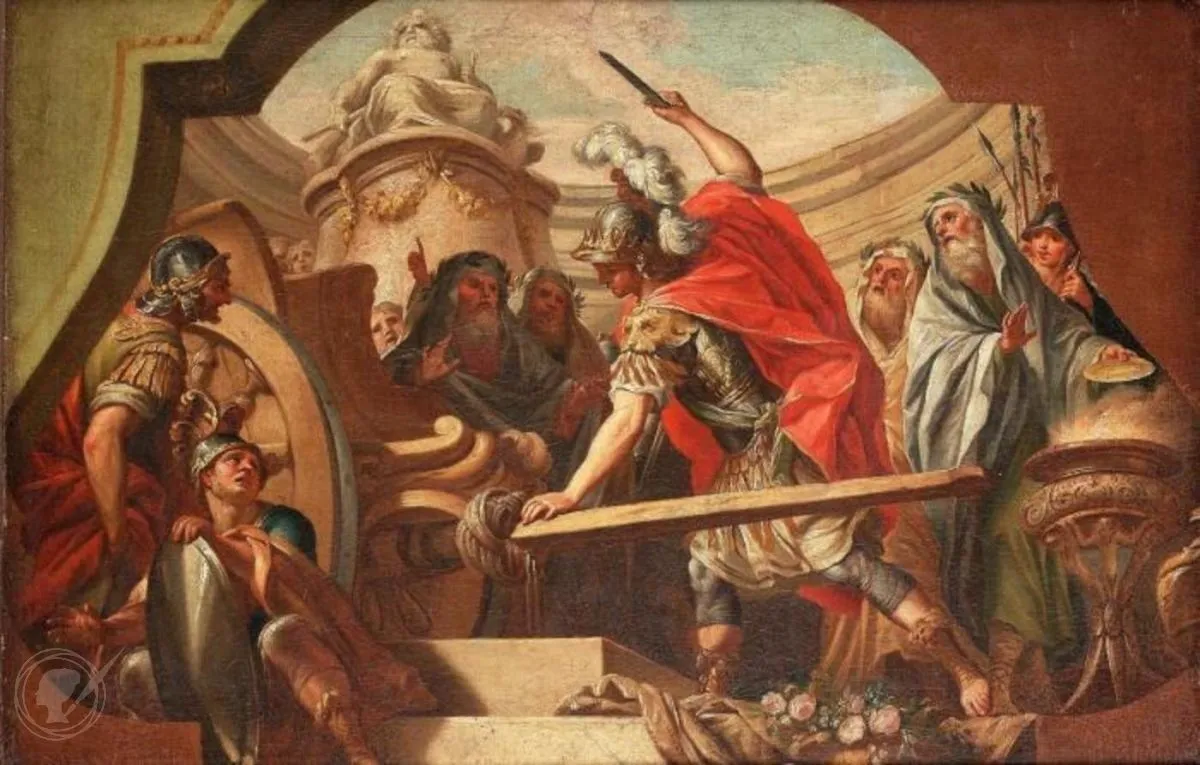
John Carter outlines the left’s long march through the institutions and explains why a conservative counter-operation of the same kind would utterly fail. Instead, Donald Trump (of all people) launched a political blitzkrieg that used none of the strategies of the long march — because the establishment knew intimately how those worked, as they’d used them for generations to become the establishment:

Alexander Cutting the Gordian Knot
Fedele Fischetti, 18th century.

But a counter-revolutionary long march through the institutions was always a doomed project.

The left understands the method quite well, having perfected it themselves, and its defences against counter-infiltration were well advanced. It was never enough merely to say the right things, and not say the wrong things – the left knows how easily such signals are faked, as these are mere words, and words have no meaning to an egregore which sees in discourse nothing but the currents and tokens of power. Much of the seeming insanity of the Cancelled Years is best understood as the imposition of elaborate, difficult to fake displays of loyalty: offering your child’s genitals to the hungry gender gorgon, opening your veins for the gene therapy injection. Then of course there is DEI, whose explicit intent was to simply deny opportunity to those most likely, on a demographic basis, to oppose the left. There is very little point, as a young white man, in keeping your mouth shut if you will be locked out simply because you are white, no matter what you say.

The psychological demands of stealthy infiltration are spiritually toxic. Anyone attempting this path finds himself embedded in a social context in which all of his friends and colleagues adhere to values which he privately despises, and moreover, he knows that the instant they discover his true beliefs he will be not only fired, but ostracized and isolated. Worse, he’s constantly placed in the position of betraying his own convictions, of going along with and even actively supporting things he knows are wrong, because failing to do so would be immediately suspicious. Since the left is a hive mind, he must “pretend” to give up his agency … and insofar as you are what you do, there is very little difference between pretending to give up your agency, and actually doing giving it up. Living like this is miserable. It requires iron discipline, and there is very little reward. Some of you doubtless have direct experience of this.

The most important reason that a long march was never viable, however, was that there was not enough time.

The West is in crisis. Public debt has broken up through the exosphere, its rise ever more vertical as the deficits fuelling it continue to expand, and we can all see in its meteoric rise that its inevitable descent will hit the land like rods from God. Third world invaders pour into our countries by their millions at the open invitation of seditious governments whose open aim is to reduce native white populations to second-class minorities in their own homelands within the space of a generation. These two crises of the Great Inflation and the Great Replacement could never be solved by the tactics the left used to bring them about. Even if such a long march could have succeeded in the face of the barriers the left so astutely erected, by the time it came to fruition the victors would preside over wreckage.

The left’s tactics were those of a chronic disease, gradually wasting the patient, leaching the strength from his limbs. You cannot cure a patient by becoming an opportunistic infection in your own right.

So what to do? Many, despairing, looked to civil war. A coup d’état, likely followed by blue states separating from the Union. Battle lines would be drawn, brother would be set against brother, cities would be ruined, vast pits would be excavated and filled with the stinking dead. Such a war would never have been limited to continental United States. It would have dissolved the Pax Americana, with brushfire wars springing up across the globe as great powers sought to expand their territories by grabbing resources or strategic trade corridors. Those powers would have gotten involved in the Civil War themselves, backing one side or another, prolonging the conflict in order to ensure the Union remained shattered forever.

On J6, the American government teetered on a precipice. Had Trump applied so much as the gentlest pressure with his baby finger, it would have toppled over. The other side would then have screamed that he was a tyrant who had seized power by force; his own supporters would have rallied to the cause that the election had been stolen; America, and the world, would have been bathed in blood. So Trump pulled back, allowed the heroes of J6 to be imprisoned, and permitted the sclerocracy to impose four years of malevolent mismanagement on the American people.

Many were furious with Trump. He’d lost his nerve; he was a coward.

As it turned out, they were all wrong. It was a strategic withdrawal.

And now, instead of a Long March, we are getting a blitzkrieg.

I’ve been silent for the last month partly for personal reasons that deprived me of the time and energy to write, which I won’t elaborate upon here save to note that it’s nothing anyone has to worry about. But I’ve also been silent because I haven’t been sure what to say. The last weeks have been one of those ‘weeks when decades happen’ periods, and that pace of change doesn’t appear to be letting up. Executive Orders flying off of the big man’s desk, birthright citizenship being struck down, entire government departments getting defunded, the J6 heroes being pardoned, trade wars starting and then stopping before they start, the military heading to the border, DOGE siccing broccoli-headed zoomers armed with large language models to rip through the sprawling financial records of acronym agencies like a cyclone of destruction.

As it turns out, you can just cut things.

These are all great, wonderful things. We are winning, and the pace of winning is dizzying. It’s like we’ve spent the last several years slamming again and again against a seemingly immovable wall, bashing our brains out upon it like an enraged tiger, only for that wall to suddenly turn to sand upon our final desperate push, leaving us sprawled and disoriented on the ground.

That is at least what it has felt like to me. The people on the inside of the Trump administration are not disoriented. Far from it. They are executing a detailed, thorough plan. They’ve identified the enemy nerve centres and are neutralizing them precisely, rapidly, and ruthlessly. Handpicked squads of very competent young men have been turned loose inside the Beltway. It is clear that they are not being micromanaged, but are being left to develop their own action plans on the fly as the tactical situation evolves. This is manoeuvre warfare, with small, nimble, lethal teams dropped into the heart of enemy territory and being given maximum latitude to pursue the campaign’s strategic objectives.

February 6, 2025

QotD: Wokeness as substitute religion

Filed under: Media, Politics, Quotations, Religion — Tags: , , — Nicholas @ 01:00

[In Tom Holland’s Dominion, he] makes that point that in the absence of Christianity, there’s something instinctive about finding these belief systems. And it does have the same hallmarks: it has the aspect of original sin, the Augustinian concept of original sin which now comes in through whiteness, or being heterosexual — having these immutable characteristics that make you a sinner. And then you’ve got the heresy concept, the idea that anyone who doesn’t think the right things is a heretic who needs to be cancelled, and then you get the metaphor of cancel culture, which is a lot like witch hunting, and burning people at the stake as the Inquisition might have done.

And of course so much of the theorizing behind woke ideas is based on entirely unsubstantiated, faith-based positions. They believe in unconscious bias, and institutional power structures — things that you can’t quantify or put your finger on that just sort of exist in the ether like spirits. And to ask them to prove any of these positions is to simply get the response that well, they do exist because we know they do. Which is what a religious zealot would say.

So I think that certainly the best way to understand the social justice movement is to see it as a cult. Because then it all makes sense, and it also makes sense why they’re able to behave so barbarically toward those who don’t subscribe to their belief system. Because the hallmark of many religions is tolerance to a degree. And then where things start going wrong, where witches start getting burned at the stake and heretics start getting executed is where that tolerance runs out. And I think that’s what happened here: the social justice movement is a fundamentally intolerant movement. And fundamentally illiberal. There’s nothing liberal about it.

Andrew Doyle, talking to Spencer Klavan, “Titania McGrath and the Politics of Wokeness: An Interview with Andrew Doyle”, The American Mind, 2020-01-30.

February 4, 2025

QotD: The American political spectrum

I tend to think of the American political spectrum as broadly dividing into six major groups (political “tribes” we might say), arranged very roughly from left to right, though I must note that there are serious differences within tribes as much as between them. Going left-to-right, there is first (1) The Left, who are the sort of left-leaning folks who get upset if you call them liberals and are committed to more aggressive forms of socialism that envision and end to or massive curtailment of things like markets. Your actual Marxists go here. Then moving right there are (2) Progressives, who are generally committed to liberalism as a philosophy, but favor large-scale government intervention inside that framework to reshape society (“progressivism”), which they believe can be reshaped for the better. Bernie Sanders, Elizabeth Warren and AOC go here; some of these folks will call themselves social democrats, evoking the form of this ideology in Europe. Then you have (3) Left-Liberals (“Social Liberals”), who have the same ideological components as the progressives (progressivism+liberalism), but with an inversion of the emphasis, where the individual liberty claim of liberalism is the dominant strain over the society-reshaping goals of progressivism. This is where the mainstream and especially moderate wings of the Democratic party sits.

Then on the right you have (4) Right-liberals (“Classical liberals”), who share liberalism with groups (2) and (3) but reject (or at least substantially challenge) the idea that society can be “engineered” with positive results. This group largely left the Republican party between 2016 and the present (though some were already libertarians). Notably, (3) and (4) in the United States tend to share hawkish anti-authoritarian, anti-communist foreign policy views; this is where the foreign policy “blob” lives. To their right are (5) Traditionalist Conservatives. Because the United States was founded as a liberal country, they tend to still hold some liberal views (and respond well to liberal, “freedom-centered” framing) but their main ideological commitment is generally conservative in its literal meaning of being traditionalist, desiring things to not change or to recover that which has changed and there is a willingness to compromise on liberalism in the pursuit of that. This, I’d argue, is where the core of the Republican Party currently exists. Finally, you have (6) Right-Authoritarians, who come in various forms based on the authority they believe ought to structure society, e.g. populist authoritarians are fascists, whereas Catholic religious authoritarians are integralists and so on. But the core idea here is that there exists an authority, be it the “national will” (invariably channeled by an individual charismatic leader and often herrenvolk in nature) or tradition or the church or whatever else, which has a right to structure society which supersedes individual liberties. For our purposes, they key is they generally despise liberalism because it places limits on that authority. They tend to insist that liberalism makes societies weak even as liberal societies pound their favorite dictators into dust over and over again.

To put the spectrum another way, we might think in terms of publications: Jacobin (1) <-> Vox (2) <-> The Atlantic (3) <-> The Bulwark/Dispatch (4) <-> National Review (5); few major publications openly identify as being in (6) in the United States, but you can see editors at The Federalist or First Things platform political visions that [derive] from it. To the degree to which “horse-shoe theory” works it is because the thing that The Left and the Right-Authoritarians have in common is that they believe in an effectively unlimited claim on the individual by the community, whereas the core of liberal ideology is that the social claim on the individual is and must be limited.

Bret Devereaux, In a footnote to “Collections: The Philosophy of Liberty – On Liberalism”, A Collection of Unmitigated Pedantry, 2024-07-05.

January 30, 2025

The MAGA movement as “America’s Thermidorian Reaction”

Filed under: Cancon, Media, Politics, USA — Tags: , , , , — Nicholas @ 03:00

Fortissax lays out the case for Canada remaining separate from the United States, in what he says is the longest single article he’s written. It is indeed a long piece, from which I’ve selected a small portion that helps identify the US MAGA movement as something other than just pro-Trump activism:

“Canada’s national identity is rooted in Order, as expressed in its national motto, Peace, Order, and Good Government, conceived by Sir John A. Macdonald. This stands in contrast to the United States, whose core value is Liberty, reflecting its liberal and individualist foundations in the pursuit of life, liberty, and the pursuit of happiness.”

The MAGA movement, as explored in my colleague and fellow Canadian Endeavour’s article, can be understood not as a counter-revolutionary or genuinely reactionary force, but as America’s Thermidorian Reaction — a movement within the post-WWII liberal order to purge its own radical excesses. Endeavour draws parallels to the French Revolution, where the Thermidorian Reaction was not a restoration of the monarchy but a moderation of the Reign of Terror’s extremism, and to the Soviet Union’s Destalinization, which sought to distance the regime from Stalin’s radical policies without abandoning communism.

Similarly, MAGA does not aim to dismantle the liberal framework established during the cultural revolution of the 1960s, marked by the Civil Rights Act and Hart-Celler Act, but instead seeks to address the instability caused by the radicalization of this framework during the “Great Awokening” of the 2010s. Its faith in “colourblind meritocracy” is rock solid. Just as the Thermidorians and Khrushchev’s regime sought to preserve their respective systems by eliminating destabilizing elements, MAGA represents an attempt to recalibrate the liberal order by challenging excessive ideological commitments like open borders, identity politics, and globalist policies.

While MAGA appeals to traditionalist sentiments, it ultimately operates within the boundaries of the same liberal system it critiques, lacking the philosophical depth to present a true alternative. Trump’s 2016 campaign was fueled by widespread dissatisfaction with the establishment and a sense of cultural alienation among, working-class European-Americans. As an outsider candidate, Trump faced opposition from both political parties and the media but managed to channel populist anger into an unexpected victory. However, his presidency revealed that he posed less of a threat to the system than many anticipated. Trump’s administration implemented some reforms but fell short of disrupting the liberal order, leading many elites to reframe him as a tolerable alternative to the increasing instability caused by radical left-wing movements. The 2024 campaign differs significantly from Trump’s earlier runs because he has garnered support from influential elite factions. Figures in Big Tech, such as Elon Musk and Peter Thiel, and segments of the Zionist lobby, see Trump as a tool to stabilize the system without fundamentally altering it. While Trump continues to appeal to his populist base, his elite backers are likely to exert more influence over his presidency than grassroots supporters.

The Four Agendas of America’s Elite

Endeavour outlines four major agendas driving the U.S. political landscape, which often overlap but also compete for dominance:

  1. The Anti-White Agenda (Wokeism)
  2. This agenda promotes diversity, equity, and inclusion (DEI) as core principles, advocating for identity politics, demographic transformation, and the demonization of traditional Western cultural norms. Organizations like the NAACP, SPLC, and Open Society Foundations champion this cause.

  3. Managerialism
  4. Focused on centralized control, managerialism, coined by James Burnham, expands bureaucratic oversight in both public and private sectors. The COVID-19 pandemic epitomized managerial overreach, as policies enforced compliance on an unprecedented scale. Key proponents include BlackRock, the World Economic Forum (WEF), and the Bill & Melinda Gates Foundation.

  5. The Zionist Lobby
  6. Primarily concerned with ensuring unwavering U.S. support for Israel, the Zionist agenda overlaps with wokeism in promoting leftist social causes but diverges when these causes conflict with Israeli interests. Organizations like AIPAC and the ADL straddle this divide.

  7. Big Tech
  8. Initially aligned with wokeism, Big Tech has begun to push back against its most radical elements due to its impact on innovation and competence. Elon Musk’s purchase of Twitter (now X) symbolizes this shift, as does growing discontent with DEI mandates within the tech sector.

While these agendas are not inherently unified, they collectively uphold the liberal framework established in the 1960s, even as they compete for dominance within it. I’ve defined these forces in the past as left-liberalism vs right-liberalism, which I covered here: MAGA & Wokism

Parallels to Historical Thermidorian Reactions

MAGA’s role is likened to historical Thermidorian Reactions, where moderates sought to rein in revolutionary excesses to stabilize their regimes. For example:

  • The Thermidorians ended Robespierre’s radical Reign of Terror, easing persecution and executions while maintaining the republic.
  • Khrushchev’s Destalinization moderated Stalin’s authoritarian rule but preserved the communist system.

Similarly, MAGA seeks to temper the radicalism of woke managerialism without challenging the core tenets of the liberal order. The “Great Awokening,” characterized by intensified DEI policies, identity politics, and cancel culture, parallels the Reign of Terror and Stalinist purges in its ideological zeal. Trump’s 2024 campaign represents an attempt to dial back these excesses and restore a degree of moderation.

Challenges Facing the Thermidorians

Despite its goals, MAGA faces significant hurdles in moderating the system:

  • Demographic Shifts: The growing influence of progressive, non-white voting blocs entrenches leftist policies.
  • Institutional Entrenchment: Managerial bureaucracies are staffed with ideologues deeply committed to woke principles, making reform difficult.
  • Superficial Reforms: Even if MAGA eases censorship and curbs DEI mandates, it is unlikely to reverse structural changes such as demographic transformation or the Civil Rights Act.

Endeavour contends that MAGA’s moderation of woke managerialism may improve short-term conditions but will not address deeper contradictions in the liberal order. For example:

  • The Zionist lobby’s support for both Israeli ethno-nationalism and woke policies in the U.S. creates unsustainable contradictions.
  • Universalist egalitarianism remains fundamentally flawed, and attempts to reform it, like Gorbachev’s Perestroika in the USSR, may inadvertently accelerate systemic collapse.

While MAGA may temporarily stabilize the United States, it will not fundamentally alter the trajectory set in motion during the cultural revolution of the 1960s. The deeper issues of demographic change, cultural alienation, and institutional decay remain unresolved. Trump’s vision—and likely that of most within the MAGA movement—is rooted in nostalgia for the 1980s and 1990s, a romanticized era cherished by many baby boomers. This idealized vision imagines a time when race was purportedly invisible, the black middle class thrived, and patriotism unified Americans across racial lines. This narrative conveniently ignores the darker realities of that period, including the L.A. race riots and the rise of militant groups like the Black Panther Party. At the same time, this Thermidorian Reaction is being leveraged to solidify control over America’s imperial vassals, with the Anglosphere serving as its primary appendages and European nation-states as key dependencies. Populist movements across Europe echo rhetoric nearly identical to that of MAGA, with many receiving direct or indirect support from individuals and entities affiliated with the movement. Figures like Elon Musk have actively amplified some of these efforts, like promoting the Alternative für Deutschland party and bolstering independent actors aligned with MAGA’s agenda, thereby expanding its influence across the Western world. Not ideal, but a means to an end for sure.

QotD: Michael Moore

Filed under: Media, Politics, Quotations, USA — Tags: , , , — Nicholas @ 01:00

Bowling for Columbine is the latest documentary from Michael Moore, the leftwing multi-millionaire provocateur in his usual cunning disguise as an all-American lardbutt loser — baseball cap, unkempt hair, untucked shirt. This time, the nominal subject is American violence, but, by now, connoisseurs of Roger and Me and Moore’s TV work know that, whatever the subject, the routine never varies: he turns up at company headquarters unannounced and demands to see the chairman. The receptionist says he’s not available, and Moore merrily films the stand-off before moving on to some other target. If he showed up to see me without making an appointment, I’d tell him to piss off and then fire a warning shot. If I showed up to see him unannounced and accompanied by a camera crew, his people would do the same to me.

But most folks are nicer than that.

And so you can’t help noticing that, for a champion of the little guy, he goes to an awful lot of time and effort to make the little guy look like a chump. Moore has no interest in digging deep into his subjects when all the fun’s to be had on the surface of American life — the squeaky receptionists, the bored security guards, the bland PR women, the squaresville company guy in the suit, the State Police trooper with the infelicitous phrasing, the bozo in the pool hall … His vision of America as a wasteland of gun kooks, conspiracy theorists and perky brain-fried mall clerks will doubtless have them rolling in the aisles in Paris this weekend. In my corner of New Hampshire, there were only four other moviegoers in the theater. But Moore, a great favorite with the BBC, now does his shtick with an eye to the non-American market.

Mark Steyn, “Bowling for Columbine”, Steyn Online, 2002-11-30.

January 28, 2025

“Like Sulla, [Trump]’s been taking names, and he has a list”

Filed under: Government, History, Media, Politics, USA — Tags: , , , , — Nicholas @ 04:00

So-called “Sulla” (probably from the time of Augustus) after a portrait of an important Roman from the 2nd century BC.
From the Glyptothek collection via Wikimedia Commons.

The comparison of Trump to the man who prefigured Julius Caesar in the final years of the Roman Republic is, we should all passionately hope, more rhetorical than realistic. Sulla came to power in Rome after being, in his view, illegally removed from his rightful position, and he came wading through the blood of his enemies. He then created a brand new position for himself, using the old and disused title of “dictator”, but piling on far more power than any earlier dictator had held (the irregular election was held in hearing distance of where Sulla’s army was busy executing many of his captured enemies). He used his power to reconfigure and codify the rules by which the Republic was run, to “restore the Republic” to what he imagined was a purer, better nation. He set a precedent that would be followed a generation later by Julius Caesar and the end of the Republic was clearly in sight.

Trump has come again to power, from which he believes he was illegally removed, although he has not been wading through the blood of his enemies. He has been using the powers of his position very actively, but thus far seems to be staying within the bounds of the Constitution (mostly). On his Substack, Glenn Reynolds says that the second Trump presidency will be much worse for his political opponents than if he’d won his second term in 2020, and I think that’s the right analysis:

Well, if you follow me here, you probably don’t need to be told how fast Trump is moving. But I have a few other thoughts here that didn’t fit the column. The main point is that the Democrats’ over-the-top rule-breaking, norm-busting attacks on Trump have backfired bigly. I like to use the Tolkien quote, “oft evil will shall evil mar”, and that happened here for sure.

A second consecutive Trump term would have been better, from my perspective, than Biden’s sham administration, obviously. But it certainly would have been better for the Democrats than this second non-consecutive term. Trump spent the past four years not only planning his comeback, but planning what he would do after his comeback.

In his first term he was too busy running to plan, and he was naïve about how Washington and the federal government – and the Republican Party – actually work. Not so much anymore. I’ve seen people – to continue the Tolkien reference – compare him to Gandalf the White coming back after battling the Balrog, and that’s not a bad analogy.

Then there’s this one, which pretty much sums up what I’m saying here. Like Sulla, he’s been taking names, and he has a list.

And there’s this:

It really is. Trump could get carried away with this stuff at some point, but at present he seems to be settling all family business in a very measured way. Where the opening months of the first Trump Administration were confused – Omarosa in the White House? – this time around he’s realized that personnel is policy, and he’s clearly done a lot of thinking about who his personnel will be. And it’s no coincidence that he’s put a lot of people who were victims of various government agencies in charge of those same agencies. Not much danger of them going native, I think.

A second consecutive Trump term would have delayed the advance of the left/Democrat agenda, and pushed it back in some minor ways, but would probably have ultimately been no more than a bump in the road for that agenda. This Trump term will likely burn it down.

January 27, 2025

QotD: The bureaucratization of university administration

Filed under: Britain, Bureaucracy, Education, Quotations — Tags: , , , , — Nicholas @ 01:00

On the consolidation of power within the administrative bureaucracy:

    The character of the college as a micro-community of academics is being doubly subverted: from within, by the rapid growth of bureaucratic roles taken up by professional administrators, and from without, by a university seeking to centralise control and elide differences among the colleges. The more uniform the overall environment becomes, the more rapidly it will suffer from the bad decisions inevitably yet to be made.

On the metastasis of overpaid, officious administrators:

    The content of this letter is extremely important, so please read it carefully.” It isn’t often that the university speaks to its employees in this way. This was a follow-up email from the former pro-vice-chancellor for strategy and planning, David Cardwell. He wanted academics to complete his Time Allocation Survey by tabulating how many hours were spent across a vast suite of possible activities. It is characteristic of contemporary Cambridge that the strongest rhetoric it can muster is directed toward this self-serving bureaucratic exercise. Cardwell rubbed shoulders with four other pro-vice-chancellors, all enjoying a salary that is several multiples of the typical university academic, and surpasses the Prime Minister’s.

This administrative overgrowth is, by the way, a historical novelty:

    All of this is new: until 1992, the role of vice-chancellor was covered in short stints by the Heads of House, who paused their college governance while the rest of Cambridge got on with what they were here to do. Now we have not only career administrators at the helm, but their five deputies, for an annual cost of around £1.5 million. All the while, the university fails to find the money to keep important subjects alive, such as the centuries-old study of millennia-old Sanskrit.

I’ve been pointing this out for years. Until very recently, administrative functions in universities were largely filled by senior academics: you got bullied into shouldering the unwelcome burden because somebody had to do it, and you drew the short straw. There is nothing that a serious person despises more than paperwork, especially a scholar, who would much rather be happily buried in whatever esoterica he has made his field of study. Forcing academics into administrative roles ensured that the people filling those offices were incentivized to keep the paperwork to an absolute minimum; the last thing they wanted was to create more of the hateful stuff.

Enter, some decades ago, the professional administrators. Initially, these usually had some sort of academic qualification, and still largely do – albeit typically in fake non-disciplines, “public administration” or what have you – but they were not in any sense scholars. They were managers. Give us your burden, they said; we’ll do all the annoying paperwork for you, and you can concentrate on your very important research, you very important scholars, you. Thus the professoriate, like gullible fools, handed over the keys to the kingdom.

Unlike professors, managers are incentivized to create as much administrative complexity as they can: the more administration there is to perform, the more administrators the institution needs, and the larger the fiefdoms senior administrators can command. Since admin typically has control of the budget, they were easily able to appropriate the necessary funds. The result has been the explosive proliferation of useless eaters with lavish salaries and ridiculous titles like Senior Vice Assistant Dean for Excellence or Junior Associate Student Life Provost. At many universities, administrators now exist in a 1:1 ratio with the student body.

Admin have sucked shrinking university budgets dry, with real intellectual consequences: they aren’t going to fire themselves, and they sure aren’t taking a salary cut, so to make up budget shortfalls academic programs with low enrolment get the axe. Butterfield’s reference to the closure of the Sanskrit program is an example of this; there are many such examples, and they are increasingly common. To brains built out of buzzwords and spreadsheets, everything is either a marketing technique or a revenue stream, and if a program isn’t popular enough to subsidize their summer vacations in Provence or social-justicey enough for them to brag to their beach friends about how progressive they are, it serves no purpose.

This ability of university administrations to close down programs illustrates something else, which is that they are the real power on campus. The academics are mere employees: they will teach whichever students the admin decides to admit, will teach those students whatever the admin says to teach them, will not teach what the admin tell them not to teach, will teach in whatever manner admin decides is best, and will evaluate the results of that instruction in whatever fashion admin mandates they be evaluated.

As members of the managerial class, university administrators are drones of the global managerial hive mind, and instinctively exert a homogenizing influence. Old, parochial practices must be jettisoned in favour of standardizing the institutions they manage.

    As for our age-old titles – of lecturer, senior lecturer, reader and professor – these were replaced with American titles so as to be “more intelligible” to a global audience. … To conjure up a world of “assistant professors” and “associate professors”, who in fact have no supporting relationship to “the professors”, makes a mockery of that venerable system.

Administrators dislike horizontal social relationships amongst faculty. Peer-to-peer network architectures are hard to control; they prefer a server-terminal model, with management as the server through which all communications pass, and professors as the terminals, who can be regulated through systems of permissions. Thus, they set about dissolving those institutions that facilitate conviviality amongst the faculty:

    It was telling that a few years ago the authorities silently closed down the University Combination Room, the 14th-century hall in which academics could freely convene outside their individual colleges.

Administration is also sneaky, adopting governance practices that minimize whatever legacy powers the professoriate still possesses:

    Although in theory Cambridge academics are self-governing, the move to online voting, with minimal announcement, allows for many university policies to be driven through by those who want them enacted.

Butterfield understands full well that the problems are hardly unique to Cambridge:

    All this I say of Cambridge. But these issues go right across the university sector … The public need to trust and respect the elite academic institutions they fund; but that respect is waning, as stories continue to reveal politicised teaching, grade inflation, authoritarian campus policies and lurid, even laughable, research grants. The ambitions of our whole education system are ultimately pegged to the achievements at the very pinnacle of academia. If Cambridge can’t resist decline, who can?

The obvious answer is: no one can resist this. Not Cambridge, not Oxford, not University College London, not Harvard, not Princeton, not MIT, and not Whittier College. The problem is too systemic; the rot too deep. Decades of administrative consolidation of power has subsumed the ivory tower into an appendage of the global asset management system. Generations of ideological infection by the mind virus of cultural Marxism, wokeism, critical social justice, gay race communism, whatever you want to call it, has poisoned the minds of too many of the faculty. Generations of steadily declining standards, an inevitable consequence of massively increased enrolment which of unavoidable necessity heavily sampled the fat middle of the IQ distribution, has thinned out the influence of the bell curve’s rarefied tail to statistical irrelevance. After all of this, the only way to save the university is to purge it, of the great mass of low-performing affirmative action students, of the diversity hire academics who substitute clumsy sermonizing for the scholarship they can neither understand nor perform, and most especially of the great tumorous mass of useless administrators.

Such a purge, to be effective, would need to be thorough. To be thorough, it would remove almost everyone in the system. This would be the same as destroying the system. To save the patient, one would have to kill the patient.

Therefore no such purge will take place.

Instead, the system will crumble, buckle under its own weight, and eventually collapse.

As, in fact, it is doing.

John Carter, “Crumbling DIEvory Towers”, Postcards From Barsoom, 2024-10-25.

January 25, 2025

“How can an active program of ending censorship; of lauding colour blind appointment on merit; … be Fascism redux?”

Filed under: Government, Liberty, Media, Politics, USA — Tags: , , , — Nicholas @ 04:00

As discussed yesterday, one of the many “hitting the ground running” acts of Donald Trump at the beginning of his second term in office has been to issue executive orders to dismantle a lot of progressives’ favourite policies, and many of them are calling it “fascism”:

Trump-the-Presidency 2.0 has already proved to be rather different from the 1.0 version. It is not merely that this time around he won the US popular vote. It is that he has “hit the ground running” with a whole stack of executive orders.

Watching the reaction to this has become — to put it mildly — a somewhat bifurcated experience. Lots of people, who were relieved at his victory, applaud what they see as a return to common sense; a rejection of censorship; a rejection of a politics intrusive into any and all aspects of life.

Conversely, there are also lots of — typically very online — people who see it as Fascism redux, as the equivalent of the end of Weimar Germany being live-streamed. How can an active program of ending censorship; of lauding colour blind appointment on merit; of removing DEI commissars from the US Federal Government; that includes appointment of women and persons of colour to senior positions; be Fascism redux?

The short answer is: it isn’t. The question then becomes, how can it be seen as such? This is where the long-run consequences of anti-discrimination law kicks in.

Anti-discrimination law creates a legal-bureaucratic structure that operates on the basis that the general citizenry is continually hovering on the edge of wrong think (racism) and wrong act (discrimination). The presumption becomes — without all this active effort — racism and discrimination will be unleashed.

This is nonsense. Anglosphere countries have low levels of racism and anti-discrimination norms have become widely accepted. Where there are discrimination issues, they are mostly problems of cultural distance that have a significant element of practicality from differing expectations between groups.

Nevertheless, it is very much in the interests of the legal-bureaucratic structure that anti-discrimination law sets up that propensities to wrong act and wrong think be seen as real, and endemic. Even better, is if the problem is seen as even larger than originally conceived.

So, we get a double expansion. The first expansion is in the range of protected groups. This provides a broadening of the social ambit of the potential wrong thinking (racism, misogyny, homophobia, Islamophobia, transphobia …) and of the potential wrong acting (who might be discriminated against).

As this moral dimension becomes so elevated—not least because there are so much employment involved, but also as considerable social leverage is created by for those who can set what is, or is not, legitimate action and speech—there is expansion of what constitutes wrong think and wrong act. There is large, indeed expanding, ambit for intellectual and other entrepreneurs to identify new sins of discrimination, new sins of unequal consideration, new ways wrong think propagates, and new ways of signalling one’s rejection of such sins.

It is better still if uttering true things becomes a wrong act, expressing wrong think, for people are prone to do that, to notice things. Of course, if you start trying to shun, shame and punish folk for expressing true things, for noticing things, you are likely to generate quite a lot of resentment. This is useful, for such pushback just further “establishes” the propensity to wrong think and wrong act. Hence Transphobia and Islamophobia becoming such markers of wrong think—there are so many true things to not notice.

There is even a term for someone who notices inconvenient patterns — far right. A term that has become the classic thought-terminating cliché in the service of not noticing.

QotD: “Big budget cuts!”

Filed under: Bureaucracy, Government, Media, Politics, Quotations, USA — Tags: , , , — Nicholas @ 01:00

So why is there such a big disconnect in the media? Why are there headlines about cutting and slashing when government is growing by every possible measure?

For the simple reason that the budget process in Washington is pervasively dishonest, as I’ve explained in interviews with John Stossel and Judge Napolitano. Here are the three things you need to know.

  1. The politicians created a system that automatically assumes big increases in annual spending, called a baseline.
  2. When there’s a proposal to have spending grow slower than the baseline, the gap between the proposal and the baseline is called a cut.
  3. It’s like being on a diet and claiming progress because you’re gaining two pounds each month rather than five pounds.

Defenders of this system argue that programs should get built-in increases because of things such as inflation, or because of more old people, which leads to more spending for programs such as Social Security and Medicare.

It’s certainly reasonable for them to argue that budgets should increase for these reasons.

But they should be honest. Be forthright and assert that “Spending should climb X percent because …”

Needless to say, that won’t happen. The pro-spending politicians and interest groups like the current approach because it allows them to scare voters by warning about “savage” and “draconian” spending cuts.

Daniel J. Mitchell, “The Media’s Pervasively Dishonest Coverage of Trump’s New Budget”, International Liberty, 2020-02-10.

January 24, 2025

When the law schools went woke

Filed under: Education, Law, Liberty, Media, Politics, USA — Tags: , , , , , — Nicholas @ 03:00

In the New English Review, Bruce Bawer reviews Ilya Shapiro’s book Lawless: The Miseducation of America’s Elites:

As Donald Trump begins his second term as president with a mandate to undo the damage done to the country by leftist ideology, incompetence, and corruption, one of the many stables that most need cleaning up is academia – which is, of course, the source of virtually all of the most misbegotten ideas that have sent America astray.

To be sure, some parts of academia are more desperately in need of reform than others. As a rule, the elite universities, especially those in the Ivy League, are more poisoned by the new progressivism than most state schools, especially those in the heartland. Humanities and social science departments are worse off than STEM departments. And as Ilya Shapiro points out in his important new book, Lawless: The Miseducation of America’s Elite, the introduction of woke thinking into law schools is singularly damaging.

Yes, writes Shapiro, it’s unfortunate enough if, say, a sociology faculty is selling ideology rather than fact, for it represents “a loss to the richness of life and the accumulation of human knowledge”. But for a law school to head down the same road is far more perilous. For these schools turn out the lawyers, politicians, and judges who will serve as “the gatekeepers of our institutions and of the rules of the game on which American prosperity, liberty, and equality sit”.

And the sad fact, alas, is that in too many American law schools today, a preponderance of students are the products of classrooms in which, as Shapiro puts it, “the classical pedagogical model of legal education” has been abandoned in favor of “the postmodern activist one” – a process that has been underway for decades but that was greatly accelerated during the Covid pandemic and in the wake of the irrational nationwide hysteria over the killing of George Floyd. Hence those students swallow such dangerous notions as critical race theory and its corollary, critical legal theory, and therefore believe that colorblind justice, due process, and freedom of speech aren’t desiderata but tools of white supremacy.

Lawless has its roots in Shapiro’s own hellish encounter with this ideological leviathan. It happened like this: on January 26, 2022, the day that Supreme Court Justice Stephen Breyer announced his retirement, Shapiro tweeted that the “best pick” for a replacement was Sri Srinivasan, who, if appointed by President Biden, would be the “first Asian (Indian) American” on the Court. Yet because Biden had promised to name a black woman, lamented Shapiro, “we’ll get [a] lesser black woman”. After sending off the tweet, Shapiro went to bed – and awoke in the morning to discover that his comment had caused pandemonium in the legal community, where he was being viciously attacked as a racist and a sexist. Shapiro immediately deleted the tweet and issued an apology for expressing his opinion in such an “inartful” manner.

But that wasn’t the end of it. As it happened, Shapiro, who had just left the Cato Institute, was scheduled to take up a new position at Georgetown University’s school of law in five days. And unluckily for him, the dean of the law school, William M. Treanor, was a wimp of the first order, the kind of craven academic administrator who’s quick to cave to the noisiest and most radical elements. On January 27, Treanor issued a statement in which he represented Shapiro as believing that “the best Supreme Court nominee could not be a Black woman”.

This was the height of disingenuity: it was clear that Shapiro simply meant that Biden shouldn’t limit the pool of possible nominees on the basis of sex or race – a view shared by three-quarters of the American public. But as Shapiro would soon discover, under the current dispensation at woke law schools “what matters is not the objective meaning of a given statement or even its intent but its effect – not the facts but the feelings”.

So it was that Treanor ordered an elaborate and expensive “investigation” by a top-dollar law firm into Shapiro’s tweet – yes, an investigation into a tweet. Ludicrously, it took more than four months – during which Shapiro’s new job was put on hold. In the end, the “investigators” concluded that Shapiro had indeed expressed an offensive opinion but permitted him to start work at Georgetown. Wisely, Shapiro decided that, given everything that had happened, Georgetown would not be a comfortable fit for him – at least not with Treanor at the helm – and chose instead to accept a job offer from the Manhattan Institute, where he works today.

« Newer PostsOlder Posts »

Powered by WordPress