
The Korean War by Indy Neidell
Published 20 Jan 2026There’s discussion — and disagreement — in UN Command and Washington about whether or not to poll all the POWs the UN side holds to see where they would like to go should they be released. There are arguments for and against this, and it brings up a couple different interpretations of the Geneva Convention. This week we also talk a lot about recent medical advances in field medicine in Korea, and the development of the “Medics’ War”.
00:00 Intro
00:44 Recap
01:14 Poll the POWS
04:52 UN Decleration
08:19 52nd Medical Battalion
10:56 Cho-Do Island
11:45 Summary
12:06 Conclusion
12:49 Memorial
(more…)
January 21, 2026
The Korean War Week 83: The Medics’ War! – January 20, 1952
Comments Off on The Korean War Week 83: The Medics’ War! – January 20, 1952
January 14, 2026
The Korean War Week 82: Ridgway’s Nuclear Warning! – January 13, 1952
The Korean War by Indy Neidell
Published Jan 13, 2026Operation Strangle, to destroy enemy logistical capability with air power, has been in progress for months now, and yet the enemy is still able to bring up men and supplies, and even slowly stockpile them for possible future offensives. The UN position now is that should there be an armistice, and should the other side break its terms, retaliation would be broader and would include actions against Communist China, but will the UN have the force to do such retaliation? That is the question.
00:00 Intro
00:44 Recap
01:09 POW Issues
03:30 The Airfields
08:29 UN Declaration
10:15 Operation Strangle
14:13 Summary
14:35 Conclusion
15:25 Call To Action
(more…)
Comments Off on The Korean War Week 82: Ridgway’s Nuclear Warning! – January 13, 1952
January 7, 2026
The Korean War Week 81: Ridgway Admits the UN is Little Threat! – January 6, 1952
The Korean War by Indy Neidell
Published 6 Jan 2026The year may have changed, familiar faces come and go, but some things remain the same. The POW issue continues to dominate and frustrate armistice talks, the fear of an expanded war in Asia re-emerges, and the snow remains cold. The war found no end and no pause in either 1950 or 1951, but third time’s the charm, surely?
00:00 Intro
00:29 Recap
01:24 Britain and the US
06:49 The US Proposal
10:57 The Slave Trade?
12:12 Summary
13:35 Conclusion
(more…)
Comments Off on The Korean War Week 81: Ridgway Admits the UN is Little Threat! – January 6, 1952
December 31, 2025
The Korean War Week 80: Empty Lines and Guerrillas: X-mas ’51 in Korea! – December 30, 1951
The Korean War by Indy Neidell
Published 30 Dec 2025It’s Christmas, 1951, and though peace on earth and goodwill to all men might have a general appeal, peace seems as far away as ever in Korea. There are, though, no large scale offensives being planned at the moment, as the frozen winter grips Korea and the peace talks drag on and on. However, just because the war between armies is quiet, doesn’t mean Korea is; anti-guerrilla operations claim lives by the thousands, and the general drudgery of the war also takes thousands of lives on both sides each and every month. Christmas in Korea is grim.
00:00 Intro
00:27 Recap
00:49 POW Lists
02:25 New Offensive
05:29 Fighting the Guerrillas
07:20 Casualty Numbers
09:04 Boatner and the 23rd
11:54 Inspections and China
13:27 Summary
13:59 Conclusion
(more…)
Comments Off on The Korean War Week 80: Empty Lines and Guerrillas: X-mas ’51 in Korea! – December 30, 1951
December 24, 2025
The Korean War Week 79: Soviet Technology Surpasses the USA – December 23, 1951
The Korean War by Indy Neidell
Published 23 Dec 2025Both sides finally release POW information to each other, as required by the Geneva Convention, but neither side is happy with the information, charging it either wildly incomplete or grossly mischaracterized. The Communists also refuse to allow the Red Cross in and the UN doesn’t want compulsory repatriation of POWs, but both are required under Geneva. And away from the truce tables, the Communist air power menace continues to grow, but should there be an armistice will they be allowed to rebuild air bases in North Korea?
00:00 Intro
00:38 Recap
00:58 POW Lists
05:02 Repatriation
07:52 Geoje-Do
09:01 Ambush Program
09:54 Airfields or Armistice
12:00 Communist Air Power
13:23 Summary
13:32 Conclusion
14:50 Call to Action
(more…)
Comments Off on The Korean War Week 79: Soviet Technology Surpasses the USA – December 23, 1951
December 17, 2025
The Korean War Week 78: Communists See 100% Success in the Skies! – December 16, 1951
The Korean War by Indy Neidell
Published 16 Dec 2025The Communist forces’ air power grows and grows, to the point where the UN wonders if they will lose aerial supremacy. This colors the Peace Talks, because should infrastructure be allowed to be rebuilt and rehabilitated during an eventual armistice, what airfields might the Communist side soon have in North Korea? Not just as a threat should an armistice fail, but to Japan as well.
Chapters
00:00 Intro
00:49 Recap
01:23 General Hsieh Probes
06:22 Communist Air Power
12:06 POW Issues
14:54 Summary
15:14 Conclusion
15:51 Call to Action
(more…)
Comments Off on The Korean War Week 78: Communists See 100% Success in the Skies! – December 16, 1951
November 19, 2025
The Korean War Week 74: The US Wants To Prolong The War – November 18, 1951
The Korean War by Indy Neidell
Published 18 Nov 2025UN Commander Matt Ridgway has everyone in Washington worried because of his refusal to play ball with the Communist side at the peace talks. The Communist side aren’t exactly playing nice either, lobbing insults at the UN delegates, but the newspapers of the world wonder if the US actually even wants a truce, since bloody headlines implying impending vengeance come out in American papers timed suspiciously with possible breakthroughs at the talks.
Chapters
00:00 Intro
00:43 Recap
01:12 Ridgway Disagrees
04:29 Insults at Panmunjom
06:50 What The Troops Think
09:05 Ridgway’s Statement
10:11 POW Repatriation
12:50 Summary
13:06 Conclusion
(more…)
Comments Off on The Korean War Week 74: The US Wants To Prolong The War – November 18, 1951
November 13, 2025
The Korean War Week 73: Fractures within the UN! – November 11, 1951
The Korean War by Indy Neidell
Published 11 Nov 2025The fighting continues for Maryang-san, though in general everyone is getting ready for the freezing Korea winter. The big news this week is the seeming breaking of the deadlocked peace talks as the Communist side makes what looks to be a major concession. The UN rejects the communist proposal because there’s more to this then meets the eye. What does Washington really want? Because even the Soviets are now speaking out against the war. Meanwhile in the background, the POW situation in the overcrowded camps grows ever more tense and deadly.
Chapters
00:00 Intro
00:50 Recap
01:06 Maryang-San
01:40 Communist Concessions
07:40 The Soviets Speak
09:08 Geoje Island POWS
13:22 Notes
13:51 Summary
14:08 Conclusion
15:11 CTA
(more…)
Comments Off on The Korean War Week 73: Fractures within the UN! – November 11, 1951
November 5, 2025
The Korean War Week 72: UN Censors as Communists Speak! – November 4, 1951
The Korean War by Indy Neidell
Published 4 Nov 2025The Panmunjom peace talks continue, but a real sticking point is Kaesong- both sides insist that they must have control of it. Frustration mounts among the Allied journalists, though, as they are allowed less access to what’s going on than their Communist counterparts. Despite the talks, there’s new action in the field this week, as the Chinese attack in force to try and retake Maryang-san, a commanding strategic position.
Chapters
00:00 Intro
00:40 Recap
00:59 The Kaesong Issue
03:24 Voluntary Repatriation
07:14 US Command’s Position
09:15 All For All Repatriation
10:35 UN Censorship
12:29 Maryang-San
13:35 Summary
13:37 Conclusion
14:39 CTA
(more…)
Comments Off on The Korean War Week 72: UN Censors as Communists Speak! – November 4, 1951
June 7, 2025
The 12th SS Massacre of the Canadians in Normandy | History Traveler Episode 195
The History Underground
Published 9 Feb 2022In the days after D-Day, the Canadians of the 3rd Infantry Division found themselves up against the German 12th SS Panzer Division as they were making their way south through Normandy. Tragically, some of these men would find themselves as the victims of one the battle’s worst atrocities at a place called Abbey Ardenne. In this episode, we’re joining Paul Woodadge of @WW2TV as we retrace the final steps of these men as they made their way to a tragic fate at the hands of Kurt Meyer and a division of the most fanatical fighters that Germany threw into the Battle of Normandy.
(more…)
Comments Off on The 12th SS Massacre of the Canadians in Normandy | History Traveler Episode 195
May 23, 2025
Yasukuni-jinja, Japan’s most controversial historical site
Nigel Biggar on the Yasukuni-jinja in the Imperial Gardens in Toyko, where the Japanese shrine to their war dead also celebrates fourteen convicted WW2 war criminals:
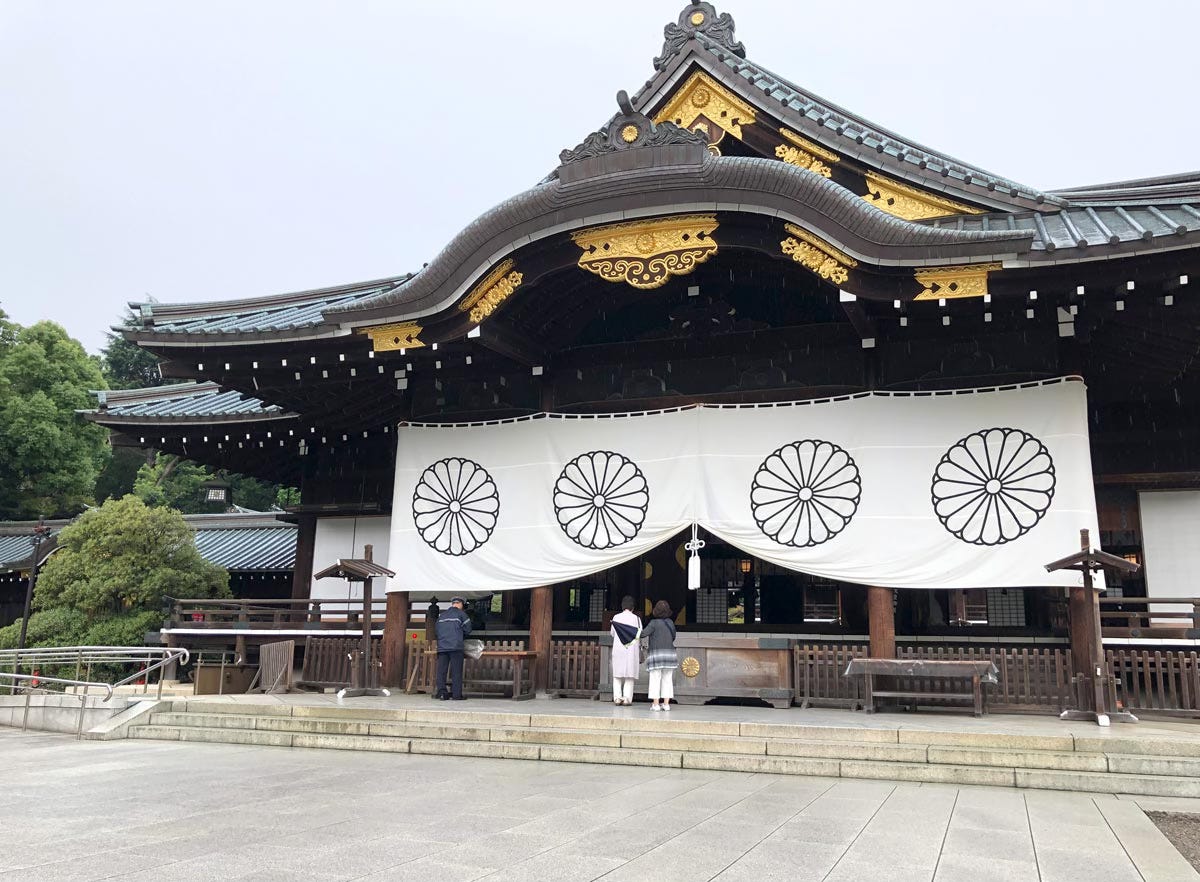
The Yasukuni Shrine in the Imperial Gardens, Tokyo.
Photo by Pierre Hazan
If ever you find yourself in the centre of Tokyo, make your way to the north-west corner of the Imperial Gardens, and turn left. A few minutes will bring you to the Yasukuni-jinja, Japan’s most controversial site. This is the national shrine to the war-dead, whose two and half million resident “glorious souls” include fourteen Class A war criminals.
A hundred yards to the right of the main shrine stands a museum, the Yushukan. Upon entering it, a visitor finds himself immediately face to face with a locomotive.
Now, when an Anglo-Saxon puts together Japan, Second World War, and locomotive, he arrives at one thing only: the “Burma Railway”. This is the railway that was hacked through the Burmese jungle partly by Allied prisoners-of-war, who were treated as slave labour and perished in their thousands. Over 12,000 Westerners died — about one in five — alongside perhaps 90,000 Asians.
So our Anglo-Saxon visitor beholds the locomotive with a mixture of disbelief, rising horror, and curiosity. He approaches the machine, looking for an explanatory text. Finding it, he learns that this locomotive is one of ninety that ran along the Burma Railway. He also learns the name of the military unit responsible for the railway’s construction. But of the Allied prisoners, the slave-labour, and the number of their deaths he learns nothing at all.
The Burma Railway wasn’t Auschwitz, either in genocidal intent or in murderous scale. But it was similar in its cruel contempt for human life. So the experience of confronting this Tokyo locomotive is analogous to stepping into a museum in Berlin and being confronted by one of the trains that shipped Jews to Auschwitz, and then reading an explanation that omits any mention of its cargo or the nature of its destination. If there were such a museum in Berlin, I’d have found it.
When our Anglo-Saxon ventures deeper into the Yushukan, he eventually discovers the exhibition on the 1930s and World War Two in the Far East. And here he learns that Japan’s imperial expansion was in fact a war of liberation, waged on behalf of subjugated Asian peoples, against Western colonial domination. And he learns that, even though Japan lost the war militarily, she won it politically, since the example of her early victories over the French in Vietnam, the Americans at Pearl Harbor, and the British at Singapore helped to inspire anti-colonial movements worldwide and so succeeded in ridding the world of European empires.
He also learns that what is known outside Japan as “the Rape of Nanking” (1937-8) is referred to demurely in the museum as “the Chinese incident”. And that whereas the “Rape of Nanking” is reckoned to have involved the indiscriminate massacre by Japanese troops of about 300,000 Chinese civilians, “the Chinese incident” only involved the severe treatment of Chinese troops who had violated the laws of war by disguising themselves in civilian clothes.
Comments Off on Yasukuni-jinja, Japan’s most controversial historical site
May 21, 2025
The Butt Report – Nadir of the RAF – The Bomber War Episode 3
HardThrasher
Published 15 Dec 2023As the powers that be on YT have decided that this video is Evil and naughty they’ve removed the ads — which, like, is great from your point of view but a bit shite from mine. So if you wanted to it’d be awesome if you’d consider either hitting the Super Thanks button or consider becoming a super cool kid and joining my Pateron.
If you’d like to email me send a message to lordhardthrasher@gmail.com
In this episode, the Butt Report, what happened next and the arrival of Bomber Harris. Despite this being more than 50 minutes, I’ve skipped some detail e.g. The Singleton Report which basically said “eh – bit difficult this bombing thing” nor Tizard’s rubbishing of Cherwell’s Memorandum, nor really the detail of the Cherwell Memorandum. You’ll live. However if you want more on the subject then I recommend the Official History of Bomber Command to get more into the civil service fire fights.
(more…)
Comments Off on The Butt Report – Nadir of the RAF – The Bomber War Episode 3
May 18, 2025
Why it Sucked to be an Italian Prisoner in North Africa – WW2 Fireside Chat
World War Two
Published 17 May 2025Today, Indy and Sparty tackle some questions on the North African theatre. Why did the Italians think invading was a good idea in the first place? Was Allied treatment of Axis POWs a war crime? How did Italian and Allied tanks stack up?
(more…)
Comments Off on Why it Sucked to be an Italian Prisoner in North Africa – WW2 Fireside Chat
May 8, 2025
Aftermath
I’ve read a few books on what happened in Europe after the surrender of Nazi Germany in May of 1945, but there is always more to learn about a continent-wide struggle to recover from a disaster of the magnitude of World War Two:
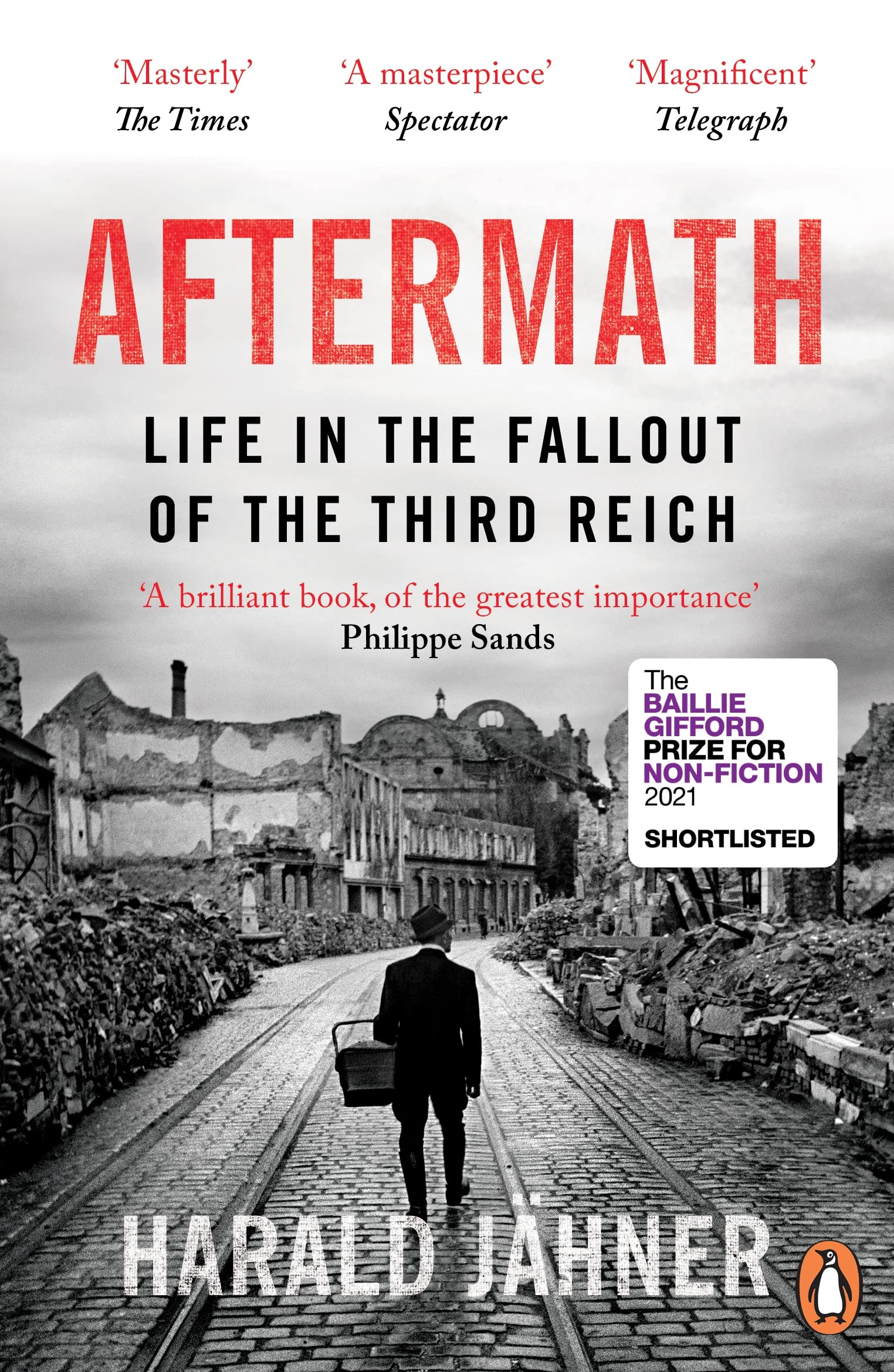
On a train journey earlier this year between Cologne and Berlin, I began to read Harald Jähner’s Aftermath, a fascinating account of the years when Germany emerged from the destruction and shame of the Third Reich.
The war ended 80 years ago today, and in the defeated nation the scenes were primeval and apocalyptic. In Berlin, journalist Ruth Andreas-Friedrich, along with a doctor, actor and musical conductor, discovered a white ox wandering through the streets and, after finding a Russian soldier to shoot it, found themselves suddenly surrounded by a ravenous mob. She recalled: “Suddenly, as if the underworld had been spying on them, a noisy crowd gathered around the dead ox. They crept from a hundred basements. Women, men, children. Were they lured by the smell of blood? Within minutes they were scrambling for meat.” The bourgeois of Middle Europe reduced to an animal state.
Germany was a pile of rubble; the ruins in the Reich‘s capital amounted to 55 million cubic metres, enough for a wall 30 metres wide and 5 metres high stretching all the way to Cologne. In West Berlin, for the next 22 years, up to 800 lorries a day unloaded so much rubble on the former Factory of Armaments Technology that it became known as Teufelsberg, or Devil’s Mountain. The last “rubble brigade” in Dresden only finished work in 1977.
Although Nazi party members were made to clear rubble as a punishment, the Germans hardly needed encouragement; on 23 April, the war not yet over, the municipal building of Mannheim had already declared WE ARE REBUILDING.
The communal process of clearing away seemed to serve a psychological function for a hungry, defeated people, and was encouraged by the new authorities — all the “heroic cinematic rhetoric” employed by the UFA film company of the Nazi regime now used to get the country clearing up. There was even a cinema genre called Trümmerfilm, rubble films, one — And The Heavens Above Us — ending with the Lord’s Prayer being recited among the ruins of Germany.
German POWs, “dispirited, disciplined and dutiful to the point of submissiveness”, made life easy for occupying soldiers while their former victims were far more troublesome. (Russian POWs in France caused such anarchy that they called in a Soviet liaison officer who selected ten at random and shot them, bringing the mob under control.) This led to a bizarre alliance between Allied and German law enforcement working hand-in-hand from the early days of the occupation, with joint raids and weapons searches on displaced persons from Poland and the Soviet Union, which the Poles and Russians “of course saw as an intolerable provocation”.
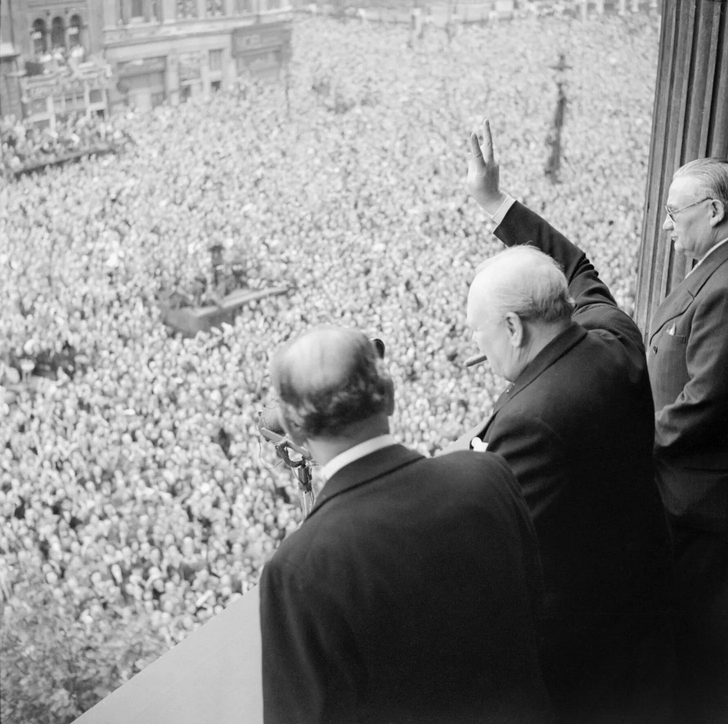
London cheered on May 8, 1945. In Berlin they searched for food and cleared rubble
In a strange irony, there was now a large-scale migration of Jews from Poland to Germany, fleeing fresh persecution despite the horror they had endured. Even here in a camp system under Allied control, there were anti-Semitic attacks from other survivors, so that Jews were eventually separated altogether following the conclusions of the Harrison Report. The Americans, in a likely first in European history, now made Jews an explicitly privileged group, with superior camp conditions.
The Polish Jews set up their own camp in the Munich district of Bogenhausen where locals were confused and disorientated by the new arrivals. These eastern Jews actually looked like the alien caricatures Nazi propaganda had bombarded them with, dressed in oriental clothes from the shtetl, totally unlike the assimilated German Jews they had grown up with. One local complained that “the Jews from the old days were really, how can I put it, very intelligent, polite and unusually friendly and elegant people. And of course the ones who turned up after the war included all sorts.” The Jews “from the old days” were “the good Jews”, he lamented.
Holocaust guilt was in the distant future for most, and newly re-established newspapers weren’t remotely shy about publishing anti-Semitic content. One printed a resident’s complaint about Polish Jews that “these were not people who had been persecuted” but “the sputum, the yeast and the scum of elements who were never deported but, to avoid regular work, came here from the eastern states, in many cases completely illegally, and are now spreading themselves raggedly about the place.”
Comments Off on Aftermath
May 5, 2025
The Bloody Battle of Agincourt | Animated Episode
The Rest Is History
Published 30 Nov 2024“We few, we happy few, we band of brothers”.
The Battle of Agincourt in 1415 endures as perhaps the most totemic battle in the whole of English history. Thanks in part to Shakespeare’s masterful Henry V, the myths and legends of that bloody day echo across time, forever enshrining the young Henry as the greatest warrior king England had ever known. So too the enduring idea of the English as plucky underdogs, facing down unfavourable odds with brazen grit. And though the exact numbers of men who fought in the two armies is hotly contested, the prospect was certainly intimidating for the English host looking down upon the vast French force amassed below them the day before the battle. Hungry and weary after an unexpectedly long march, and demoralised by the number of French that would be taking to the field, the situation certainly seemed dire for the English. One man amongst them, however, held true to his belief that the day could still be won: Henry V. An undeniably brilliant military commander, he infused his men with a sense of patriotic mission, convincing them that theirs was truly a divinely ordained task, and therefore in this — and his careful strategic planning the night before the battle — he proves a striking case of one individual changing the course of history. However, the French too had plans in place for the day ahead: total warfare. In other words, to overwhelm the English in a single devastating moment of impact, sweeping the lethal Welsh archers aside. So it was that dawn broke on the 25th of October to the site of King Henry wearing a helmet surmounted by a glittering crown and bearing the emblems of both France and England, astride his little grey horse, and riding up and down his lines of weathered silver clad men, preparing them to stride into legend … then, as the French cavalry began their charge, the sky went black as 75,000 arrows blocked out the sun. What else would that apocalyptic day hold in store?
Join Tom and Dominic as they describe the epochal Battle of Agincourt. From the days building up to it, to the moment that the two armies shattered together in the rain and mud of France. It is a story of courage and cowardice, kings and peasants, blood and bowels, tragedy and triumph.
00:00 What is to come …
00:50 Shakespeare and Henry V
02:53 Agincourt is exceptional
04:15 The battle is a test of God’s favour
05:27 The English see the French forces …
09:30 The French aren’t offering battle
10:40 Why the French delay
11:13 The French think they’re going to win
11:35 An ominous silence
12:35 Henry’s plan
20:50 The French plan
24:28 How big were the armies
28:49 The lay of the land
34:50 Henry makes the first move
37:00 The French charge into darkness
38:57 The French army advances
45:50 Reaction to the slaughter
(more…)
Comments Off on The Bloody Battle of Agincourt | Animated Episode


