Quotulatiousness

October 9, 2019

Theodore Dalrymple on Justin Trudeau and David Cameron

He doesn’t hate either of them, he just thinks they are either fools or knaves. As the Instapundit often says, it might be time to “embrace the healing power of ‘and'”:

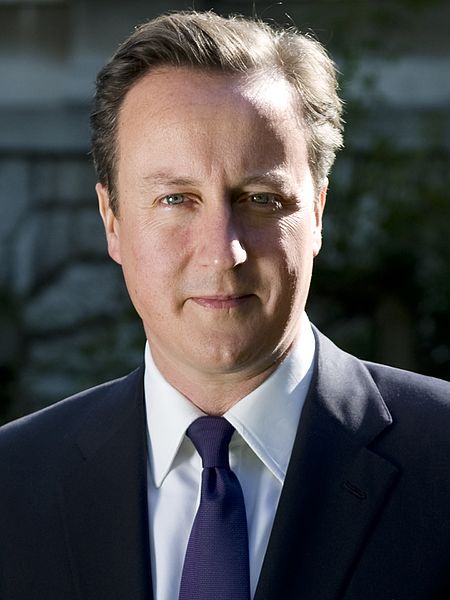
No doubt it is the mark of bad character to rejoice, as I do, in the spectacle of a man being hoist with his own petard, and as the Canadian Prime Minster, Justin Trudeau, has recently been hoist. And while I am at it, I confess also that, though I know that there is no art to find a mind’s construction in the face, I cannot help also but judge people, at least to an extent, by their physiognomy. And the fact is that Mr Trudeau has a face as characterless as that of the former British Prime Minister, David Cameron. They are of the same ilk. You look at them and think “What nullities!” The main character discernible in their faces is lack of character.

David Cameron’s official portrait from the 10 Downing Street website, 3 August 2010.
Open Government Licensed image via Wikimedia Commons.

It is not their fault, perhaps; besides which I, or you, might be mistaken in our assessment of them and actually they have backbones (or what my teachers use to call moral fibre) of enormous strength. In any case, there are worse things to be, especially in the field of politics, than a nullity: an evil monster, for example, would be far worse, and no one could seriously claim that either of Messrs Trudeau and Cameron are, or were, evil monsters, however little they inspire admiration.

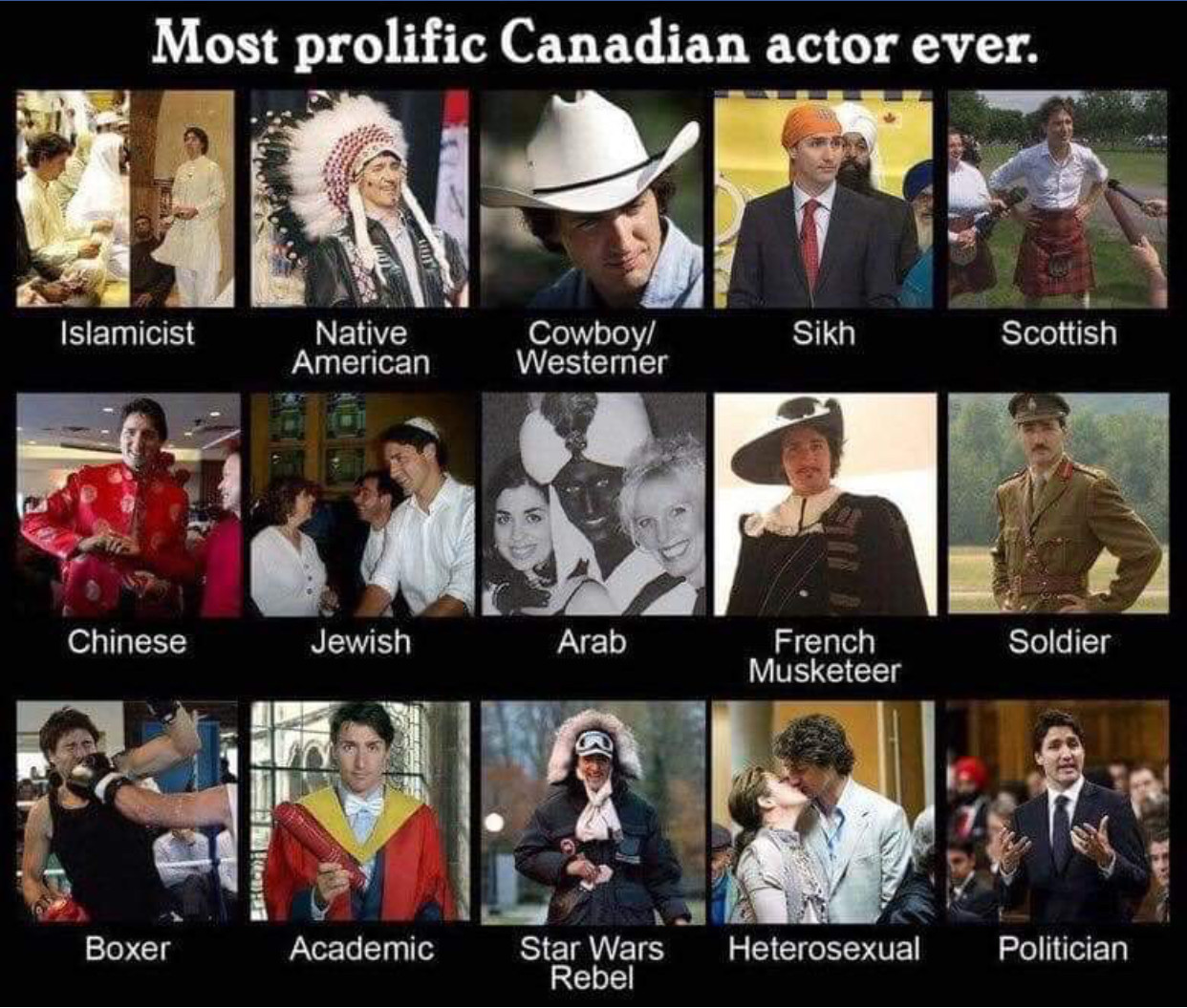
No one, then, could accuse me of partiality for Mr Trudeau, and the abjectness of his apology for his behaviour when he was a very young man did nothing to increase my liking for him. But it seems to me that sins as a young man were venial at worst, a callow disregard of the sensibilities of others which I common in youth. I very much doubt that he was a deep-dyed racist in any dangerous way, more a silly boy having a bit of fun.

There is a serious side to this imbroglio, of course. If the political leader of an important country can be overthrown or not re-elected on so relatively trivial a ground, while at the same town no one cares in the least about his shallow but dangerous moral posturing and obviously weak-minded pandering to the ayatollahs of an absurd and ill-founded political morality, then a new nadir of decadence and cowardice has been reached. It is a difficult question of moral philosophy as to whether it would be worse if Mr Trudeau actually believed his own political correctness or merely made use of it as a means to power. If the former, he is a fool; if the latter a knave. I leave it to others to decide which is better in a politician, or indeed in any other human being, foolishness or a knavery.

Political correctness is dangerous because when fools or knaves get into power, they may try to implement its dictates. And since many people are much more concerned to appear good than to do good, and since they are unlikely to suffer the consequences of their own actions (except when hoist on their own petard), the implementation may continue for a long time after the negative effects of its dictates have become clear. When implemented, those dictates create a clientele dependent upon their continuation, which turns any attempt to undo the harm into a nasty social conflict.

August 17, 2019

The British Empire in retrospect

Filed under: Books, Britain, History, India — Tags: , , , — Nicholas @ 03:00

It’s been fashionable to dismiss the British Empire as a positive force in history for about 100 years (partly in reaction to the losses during the First World War), but Casey Chalk reviews a recent book that counter-cherry-picks the facts to show it wasn’t all an authoritarian dystopia and cultural wasteland:

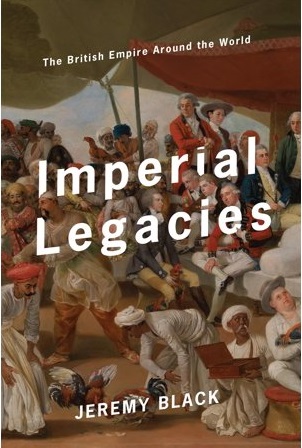
… the central argument of University of Exeter professor of history Jeremy Black’s new book Imperial Legacies: The British Empire Around the World, which, according to the book jacket, is a “wide-ranging and vigorous assault on political correctness, its language, misuse of the past, and grasping of both present and future.” The imperial legacy of Great Britain is also, in a way, an instructional lesson for the United States, which, much like the British Empire of the early to mid-20th century, is experiencing a slow decline in influence.
As a former history teacher who has visited many former British colonies in Africa and Asia, I’ve been well catechized in how British imperialism is interpreted. The British, so we are told, were violent aggressors and expert political manipulators. Using their technological superiority and command of the seas, they subjugated cultures across the globe, applied the “divide and rule” policy to set ethnic and linguistic groups against one another, extracted resources for profit, and stole cultural artifacts that now collect dust in their museums. Thus, so the story goes, blame for many of the world’s current problems lies squarely at the feet of the British Empire, for which she should still be paying reparations.

Yet, Black notes, “there is sometimes a failure to appreciate the extent to which Britain generally was not the conqueror of native peoples ruling themselves in a democratic fashion, but, instead, overcame other imperial systems, and that the latter themselves rested on conquest.” Take, for example, the Indian subcontinent, which was a disparate collection of kingdoms and competing empires — including Mughals, Sikhs, Afghan Durranis — during the early centuries of British intervention. All of these were plenty brutal and intolerant towards those they subjugated. Moreover, Hinduism promoted not only the oppressive caste system, but also sati, or the ritual of widow burning, in which widows were either volitionally or forcibly placed upon the funeral pyres of their deceased husbands. It was the British who stopped this practice, and others, with such legislation as the Hindu Widows’ Remarriage Act of 1856, the Female Infanticide Prevention Act of 1870, and the Age of Consent Act of 1891.

Nor has India been able to escape the same imperialist tendencies as the British. Just ask the Sikhs, whose demands to “free Khalistan” have gone unheeded by New Delhi, and who in 1984 suffered great atrocities at the hands of the Indian military and civilian mobs. Or ask Indian Muslims, of whom more than 1,000 died in the 2002 Gujarat riots and who suffer increasing persecution under the ruling Hindu nationalist party BJP. There’s also not a few folks in Kashmir who happen to call the Indians imperialists. One might note here that many of the problems in former European colonies are not solely, or even largely the result of European imperialism, but can be attributed to many other causes, population increase, modernization, and globalization among them. Corruption in some former colonies, including India, is almost certainly higher than it was during British rule.

India is only one such example where the modern narrative ignores both historical and contemporary realities, including, one might add, the fact that India as it now exists is largely a creation of British colonial efforts. It was Britain that united a disparate group of people into a single cohesive unit with a national identity. Indeed, as Black rightly notes, “modern concepts of nationality have generally been employed misleadingly to interpret the policies and politics of the past.”

This is further complicated by the fact that in many places, especially India, “alongside hostility, opposition and conflict,” between the imperialists and the colonized, “there was inter-marriage, intermixing, compromise, co-existence, and the process of negotiation that is sometimes referred to as the ‘middle-ground.'” One need look no further than the First and Second World Wars, in which more than 1.5 million and approximately 2.5 million Indians, respectively, fought willingly and bravely in the service of the British crown.


July 29, 2019

Erasing the past, statue by statue, plaque by plaque

Alexander Adams on the deliberate sabotage of historical monuments in pursuit of a more perfect (i.e., imaginary) past:

End of the Trail by James Earle Fraser, located in Waupun, Wisconsin.
Photo by Shawn Conrad via Wikimedia Commons.

In the wake of recent attempts – some successful – to have Confederate statues removed from the US south, what is the future of colonialist statues in the US west? In Pioneer Mother Monuments: Constructing Cultural Memory, Cynthia Culver Prescott, a professor of history at the University of North Dakota, senses a reluctance to apply to pioneer monuments the ideological zeal that was turned on Confederate memorials. “We resist applying the insights of settler colonial studies to American pioneer narratives because to do so would call into question foundational myths of Jeffersonian agrarianism and American exceptionalism, and lay bare white conquest of native lands and peoples.” She outlines the cases against statues of colonialists, and particularly against female settlers, who took part in the drive to colonise the American west in the 19th century.

Statues depicting women have been criticised by academics and campaigners for being idealising, inaccurate, generalising and stereotypical. There is a sense that campaigners direct such ire at statues of women settlers not just because they embody sexism and colonialism but because they show women as complicit in the act of dispossessing native peoples. There is a residual resentment that – in intersectional terms – a political minority took part in a project to oppress another minority.

The creation of monuments honouring white settlers of the west began in earnest in the 1890s. As the American western frontier was closed and territories became part of the United States, a chapter of national history had been definitively closed, too. Just under 190 monuments have been erected in the US since the 1880s marking pioneer achievements. It was a way of fixing in collective memory the achievements of forebears just at the moment their stories were becoming history. The western territories had been spared the scourge of the Civil War, and its new states had a history that involved war with Mexico, the persecution and flight of the Mormons and the Indian Wars.

In the statuary, common types emerged. Women were the prairie Madonna, the protective mother, the Indian guide leading the way, the nuclear family. Men were resolute fathers, the epitome of bravery and stoic defiance. Competitions, touring exhibitions, newspaper features and book publications circulated them, encouraging other communities to commission similar statues. Alexander Phimister Proctor’s statue of a male pioneer was an acceptable manifestation of the conquering of the west. Bearded and dressed in buckskin clothing, the pioneer wears European boots and carries a rifle. He straddles the wisdom of the natives and the technological superiority of settlers, explaining how the west was won through a combination of old knowledge and new materials.

Culver Prescott notes the example of James Earle Fraser’s sculpture The End of the Trail (1890s), which depicted an exhausted American Indian on a tired pony. Fraser had apparently developed a deep sympathy for native peoples after witnessing an army eviction. It seems the sculptor intended to elicit sympathy for evicted Indians, yet it was interpreted by contemporary observers as a scene of the sad but necessary extinction of a primitive indigenous people, conforming to the social Darwinist reading of history, in which advanced people defeat and displace inferior peoples. This is an object lesson in the variety of interpretations an artwork can elicit, regardless of artistic intent. It should alert today’s social-justice warriors to the dangers of misinterpreting public art and the risk of suppressing art on the basis of misapprehension.

May 11, 2019

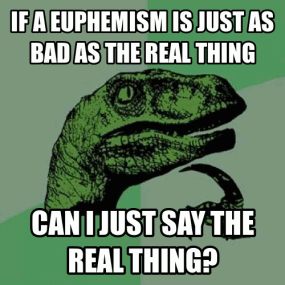
The “Euphemism Treadmill”

Filed under: Media, Politics — Tags: , , , , — Nicholas @ 03:00

An older post by Stan Hingston on the urgent need of many people to demand others use their chosen euphemisms, especially when the word objected to is itself already a euphemism:

Stephen Pinker in his 2003 book The Blank Slate coined the name euphemism treadmill for the process whereby words introduced to replace an offensive word, over time become offensive themselves. A current example of this is mental retardation.

The word itself comes from the Latin retardare meaning “to make slow, delay or hinder”.

Retardation was first used in the psychiatric sense in 1895, and eventually replaced older terms – once neutral themselves – like moron, imbecile, idiot, feeble-minded and cretin. Each of these terms had a specific meaning as to severity and age of development (cretinism for example referred to severe congenital hypothyroidism) but these meanings often differed between countries. The new term was subdivided into degrees of mild, moderate and severe mental retardation. These new technical terms were no doubt welcomed by those affected, as the previous names were being used as derogatory insults (as indeed they still are).

By the 1960s when I was in grade school, the same process had occurred with retardation. “Retard” was a common playground insult, as in “Look where yer goin’, ya retard!” To us at the time it was considered harmless fun (although I now recognize the potential to really hurt someone who did have an intellectual disability). In Grade 7 my buddy Doug and I did impersonations of “retarded chipmunks” in which we tucked our lower lip inside our upper front teeth and crossed our eyes.

Since that time retardation has been gradually replaced by a variety of more acceptable (at least for now) terms including mentally handicapped, mentally impaired, mentally challenged, intellectually challenged, intellectually disabled, learning disabled, and developmentally disabled. The last two of course are broader terms that include other conditions not covered by the meaning of mental retardation.

The problem of technically defined terms being appropriated by “the masses” and misused is not soluble by professional bodies, and given the flexibility of the English language, probably not even by a French-style “official language commission” empowered with all the majesty of law: it would be a massive waste of time and effort. Of course, “massive waste of time and effort” is pretty much baked into the bones of government agencies…

May 10, 2019

Microsoft can’t get worse than old Clippy? “Hold my non-alcoholic beer”

Filed under: Technology — Tags: , , , , — Nicholas @ 05:00

Libby Emmons reports on a new Microsoft Word plugin that puts Clippy into the history books:

Coming soon to a word processing app you probably already subscribe to is Microsoft’s new Ideas plugin. This leap forward in the predictive text trend will endeavor to help you be less offensive. Worried you might be a little bit racist? A little gender confused? Not sure about the difference between disabled persons and persons who are disabled? Never fear, Microsoft will fix your language for you.

Using machine learning and AI, Microsoft’s Ideas in Word will help writers be their least offensive, most milquetoast selves. Just like spell check and grammar check function, Ideas will make suggestions as to how to improve your text to be more inclusive. On the surface, this seems like a terrible idea, but when we dig further beneath the impulse, and the functionality of the program, it gets even worse. What’s happening is that AI and machine learning are going to be the background of pretty much every application, learning from our behaviours not only how we’d like to format our PowerPoint presentations, but learning, across platforms, how best to construct language so that we say what we are wanted to say as opposed to what we really mean.

There is an essential component of honest communication, namely that a person express themselves using their own words. When children are learning to talk and to articulate themselves, they are told to “use your words.” Microsoft will give writers the option of using someone else’s words, some amalgamation of users’ words across the platform, and the result will be that the ideas exhibited will not be the writer’s own.

March 15, 2019

QotD: Gender correctness

Filed under: Liberty, Media, Politics, Quotations — Tags: , , , , , — Nicholas @ 01:00

Five years ago, if someone had told you it would soon become tantamount to a speechcrime to say ‘There are two genders’, you would have thought them mad.

Sure, we live in unforgivably politically correct times. Ours is an era in which the offence-taking mob regularly slams comedians for telling off-colour jokes, demands the expulsion from campus of speakers who might offend students’ sensibilities, and hollers ‘Islamophobe’, ‘homophobe’ or ‘transphobe’ at anyone who transgresses their moral code on anything from same-sex marriage to respecting Islam. (A phobia, we should always remind ourselves, is a mental malaise, a disturbance of the mind. How very Soviet Union to depict your opponents essentially as mentally diseased.)

And yet for all that, surely it would never become a risky business to utter the opinion: ‘There are men and women and that’s all.’ Well, that has now happened. It is now looked upon as hateful, sinful and phobic, of course, to express a view that has guided humanity for millennia: that humankind is divided into two sexes, and they are distinctive, and one cannot become the other.

Say that today in a university lecture room packed with right-on millennials and watch their faces contort with fury. Write it in a newspaper column or blog post and witness the swift formation of a virtual mob yelling for you to be fired. Say it on TV and there will be protests against you, petitions, demands that you and your foul, outdated ideology be denied the oxygen of televisual publicity.

Brendan O’Neill, “It isn’t TERFs who are bigoted – it’s their persecutors”, Spiked, 2019-01-28.

March 8, 2019

Education schools and the bloat of university administration

Filed under: Bureaucracy, Education, Politics, USA — Tags: , , , — Nicholas @ 03:00

Remember the old joke:

    Those who can, do.
    Those who can’t, teach.
    Those who can’t teach, teach gym educational studies.

As far as higher education is concerned, the joke is on us:

Though I didn’t realize it at the time, those were my first encounters with an alternate curriculum that was being promoted on many campuses, a curriculum whose guiding principles seemed to be: 1) anything that could be construed as bigotry and hatred should be construed as bigotry and hatred; and 2) any such instance of bigotry and hatred should be considered part of an epidemic. These principles were being advanced primarily, though not exclusively, by college administrators, whose ranks had grown so remarkably since the early 1990s.

Everyone knows about the kudzu-like growth of the administrative bureaucracy in higher education over the past three decades. What most don’t know is that at many colleges, the majority of administrators directly involved in the lives of students — in dorms, conduct hearings, bias-response teams, freshmen “orientation” programs, and the like — got their graduate degrees from education schools.

Ed schools, such as Teachers College at Columbia, or Penn’s Graduate School of Education, have trained and certified most of the nation’s public-school teachers and administrators for the past half-century. But in the past 20 years especially, ed schools have been offering advanced degrees in things like “educational leadership,” “higher education management,” and just “higher education” to aspiring college administrators. And this influx of ed school trained bureaucrats has played a decisive role in pushing an already left-leaning academy so far in the direction of ideological fundamentalism that even liberal progressives are sounding the alarm.

To anyone acquainted with the history and quality of American ed schools, this should come as no surprise. Education schools have long been notorious for two mutually reinforcing characteristics: ideological orthodoxy and low academic standards. As early as 1969, Theodore Sizer and Walter Powell hoped that “ruthless honesty” would do some good when they complained that at far too many ed schools, the prevailing climate was “hardly conducive to open inquiry.” “Study, reflection, debate, careful reading, even, yes, serious thinking, is often conspicuous by its absence,” they continued. “Un-intellectualism — not anti-intellectualism, as this assumes malice — is all too prevalent.” Sizer and Powell ought to have known: At the time they were dean and associate dean, respectively, of the Harvard Graduate School of Education.

More than three decades later, a comprehensive, four-year study of ed schools headed by a former president of Teachers College, Arthur Levine, found that the majority of educational-administration programs “range from inadequate to appalling, even at some of the country’s leading universities.” Though there were notable exceptions, programs for teaching were described as being, in the main, weak and mediocre. Education researchers seemed unable to achieve even “minimum agreement” about “acceptable research practice,” with the result that there are “no base standards and no quality floor.” Even among ed school faculty members and deans, the study found a broad and despairing recognition that ed school training was frequently “subjective, obscure, faddish, … inbred, and politically correct.”

March 7, 2019

QotD: Marxist absolutism

Filed under: Politics, Quotations — Tags: , , — Nicholas @ 01:00

Do you know why Marxists like absolutism so much? Why even a 99.9% success rate is not good enough for them? Because it gives them an excuse to continue to exist. No human society will ever reach 100% of anything. There will always be people who are poor, people who don’t get the care they need, people who die senselessly, idiots who get drunk and wreck someone’s life. Always.

Reducing the incidence of those things is a good and noble pursuit. But they can never be stopped completely. By saying that nothing is good enough unless it has a 100% success rate, the Marxist is giving himself power for life, and his organization power forever. Because so long as one person slips through the cracks, he can say “my work is not done yet.”

But the single-minded focus of Marxists on power politics is a good tell. Absolutism can tell you if someone is a Marxist, but so can an over-reliance on the language of political power. Normal people might talk politics for a while, even rant about it as I do here, but there are also times when they just don’t care about politics at all.

Marxists want to bring politics into everything. Are you eating a plate of Chinese takeout? Cultural Appropriation. Do you drive a nice car? Privilege! Do you like your hair a certain way? Racism! Everything must involve politics with them. They cannot stop thinking about their obsession for even the briefest of moments. At some point, a normie is likely to talk about his dog, or his kid, or how much he likes beer, or something totally unrelated to politics. The Marxist, on the other hand, will find a way to steer that back.

Dystopic, “Marxism: The bug wearing an Edgar suit”, The Declination, 2017-03-10.

February 27, 2019

QotD: When progressives took over SF publishing

Filed under: Books, Business, Politics, Quotations — Tags: , , , , — Nicholas @ 01:00

When I sold my first novel in the late 90s. Most Americans might not be that sensitive to the “climate” but I was. I had after all grown up in a socialist (at best, during the better times) country where to graduate you had to present the proper progressive front. I knew the signs and the hints and social positioning of “further left than thou.” For instance, my first SF cons, as an author, in the green room, I became aware that “a conservative” was a suitable, laughter inducing punchline for any joke; that all of them believed the Reagan years had set us on course to total dystopia; that the US was less enlightened/capable/free than anywhere else; that your average Republican or even non-Democrat voter was the equivalent of the Taliban.

As for Libertarians, I will to my dying day cherish the dinner I had with my then editor to whom I was describing a funny incident at MileHi where for reasons known only to Bob, I found myself in an argument with someone who wanted to ban the internal combustion engine. My editor perked up and (I swear I’m not making this up) said “Oh, a Libertarian.” At which point my husband squeezed my thigh hard enough to stop me answering. But yeah. That was a not uncommon idea of a libertarian. If it was completely insane and involved banning something, then it was a libertarian.

I once overheard the same editor talking to a colleague and saying that if she got submissions across her desk and they were – dropped and horrified voice – somewhat conservative she recommended they try Baen.

Which the other editor (from a different house) agreed with, because after all, they weren’t in the business of publishing conservative works.

This immediately put me on notice that in the field if you were a conservative (I presume libertarians were worse, or at least they seemed to induce more mouth foaming. And though I was solidly libertarian and – at the time – might have qualified as a Libertarian, I suspect if faced with my real positions they would have classed me as conservative, because my positions were self-obviously not left and that’s all it took.) there was only one house that would take you, and if what you wrote/wanted to write wasn’t accepted by then, then you were out of luck.

After that I lived in a state of fear

I imagine it was similar to living in one of the more unsavory periods of the Soviet Union. You saw these purges happen. Whisper-purges. You got the word that someone was “not quite the thing” or that they associated with so and so who associated with so and so who was a – dropped voice – conservative. Suddenly that person’s books weren’t being bought and somehow people would clear a circle around them, because, well, you know, if you’re seen with a – dropped voice – conservative they might think you’re one too. And then it’s off to Never-Never with you.

I found a few other conservatives/libertarians (frankly, mostly libertarians) in the field, all living in the same state of gut clenching fear.

We did such a dance to test both the reliability and discretion of the other before revealing ourselves that we might as well have developed a hanky code. [Blue for true blue Conservative, white for pure Libertarian, red for the blood of our heroes, brown for OWL (older, wiser libertarian), purple for squishy conservative, powder blue for Brad Torgersen. (The powder blue care bear, with the bleeding heart… and the flame thrower.)]

Conventions were nerve wracking because I watched myself ALL the TIME. And you never knew how much you had to watch yourself. Suddenly, out of the blue, at a World Fantasy the speaker, a well known SF/F writer went on about Dean Howard, our next president. The room erupted in applause, some people stood to clap, and I sat there, frozen, unable to actually fake it to that point but too shocked to even put a complaisant expression on my face.

Sarah Hoyt, “Say Goodbye To The State Of Fear”, According to Hoyt, 2017-03-11.

February 19, 2019

QotD: Internal contradictions of political correctness

… there was an article in the magazine arguing, on what might loosely be called philosophical grounds, for an end to the separation of men and women in sports. Women tennis players, for example, should compete against men, even if this means (as it does) that no woman could ever again make a living as a tennis player. In the name of equality of the sexes, one sex should be eliminated from a whole field of endeavor. Presumably, also, there should be no concessions for the handicapped, who would be forced to compete not against those similarly handicapped but against the fully fit.

Though this be madness, yet there is method in it: For the greater political correctness’ violation of common sense, the better — at least if its goal is power over men’s minds and conduct. In this sense it is like Communist propaganda of old: The greater the disparity between the claims of that propaganda and the everyday experience of those at whom it was directed, the greater the humiliation suffered by the latter, especially when they were obliged to repeat it, thus destroying their ability to resist, even in the secret corners of their heart. That is why the politically correct insist that everyone uses their language: Unlike what the press is supposed to do, the politically correct speak power to truth.

One of the strange things about the politically correct is that they never seem to become bored with their own thoughts. And this leads to a dilemma for those who oppose political correctness, for to be constantly arguing against bores is to become a bore oneself. On the other hand, not to argue against them is to let them win by default. To argue against rubbish is to immerse oneself in rubbish; not to argue against rubbish is to allow it to triumph. All that is necessary for humbug to triumph is for honest men to say nothing.

Theodore Dalrymple, “Two Forms of Mass Hysteria”, Taki’s Magazine, 2017-03-11.

January 10, 2019

Patreon’s changing role

At Quillette, Uri Harris outlines how Patreon has changed over the last year or so and what those changes mean for both content creators and financial supporters:

On December 6, crowdfunding service Patreon removed the account of popular YouTuber Carl Benjamin, who is better known by his YouTube moniker Sargon of Akkad. In a statement, Patreon explained that Benjamin was removed for exposing hate speech under its community guidelines, which prohibit: “serious attacks, or even negative generalizations, of people based on their race [and] sexual orientation.” The incident in question was an appearance on another YouTube channel where Benjamin used racial and homosexual slurs during an emotional outburst. (The outburst was transcribed and included for reference as part of Patreon’s statement.)

Patreon’s reaction sparked immediate accusations of political bias from many centrists and conservatives, as Benjamin—who identifies as a classical liberal—is a frequent and outspoken critic of contemporary progressivism, receiving hundreds of thousands of views on many of his videos. The fact that Benjamin was removed from Patreon for an outburst on another YouTube channel almost a year ago, when he produces hours of content every week on his own channels and appears regularly on many others, suggested that this was a targeted attempt to remove him due to his politics, either by Patreon employees themselves or as a response to outside pressure.

This belief was bolstered by the fact that Patreon’s CEO Jack Conte had appeared on popular YouTube talk show “The Rubin Report” last year to explain the removal of conservative YouTube personality Lauren Southern, where he seemed to suggest that Patreon’s content policy had three sections and that hate speech was in the first section, meaning that it only applied to content uploaded to Patreon’s own platform. (Southern was removed for off-platform activity because she had “crossed the line between speech and action,” Conte maintained, which he implied was covered by the more severe second and third sections of their content policy.)

There’s nothing unusual about a company revising its content policy, of course, but it seemed suspicious that Benjamin was being removed for a different set of rules than those Patreon’s CEO had previously articulated. In fact, several people pointed out the prevalence of similar slurs on Patreon’s own platform as further indication that Benjamin was specifically targeted for his political views.

December 27, 2018

QotD: The deep state

The deep state is no myth but a sodden, intertwined mass of bloated, self-replicating bureaucracy that constitutes the real power in Washington and that stubbornly outlasts every administration. As government programs have incrementally multiplied, so has their regulatory apparatus, with its intrusive byzantine minutiae. Recently tagged as a source of anti-Trump conspiracy among embedded Democrats, the deep state is probably equally populated by Republicans and apolitical functionaries of Bartleby the Scrivener blandness. Its spreading sclerotic mass is wasteful, redundant, and ultimately tyrannical.

I have been trying for decades to get my fellow Democrats to realize how unchecked bureaucracy, in government or academe, is inherently authoritarian and illiberal. A persistent characteristic of civilizations in decline throughout history has been their self-strangling by slow, swollen, and stupid bureaucracies. The current atrocity of crippling student debt in the US is a direct product of an unholy alliance between college administrations and federal bureaucrats — a scandal that ballooned over two decades with barely a word of protest from our putative academic leftists, lost in their post-structuralist fantasies. Political correctness was not created by administrators, but it is ever-expanding campus bureaucracies that have constructed and currently enforce the oppressively rule-ridden regime of college life.

In the modern world, so wondrously but perilously interconnected, a principle of periodic reduction of bureaucracy should be built into every social organism. Freedom cannot survive otherwise.

Camille Paglia, “Hillary wants Trump to win again”, Spectator USA, 2018-12-04.

December 23, 2018

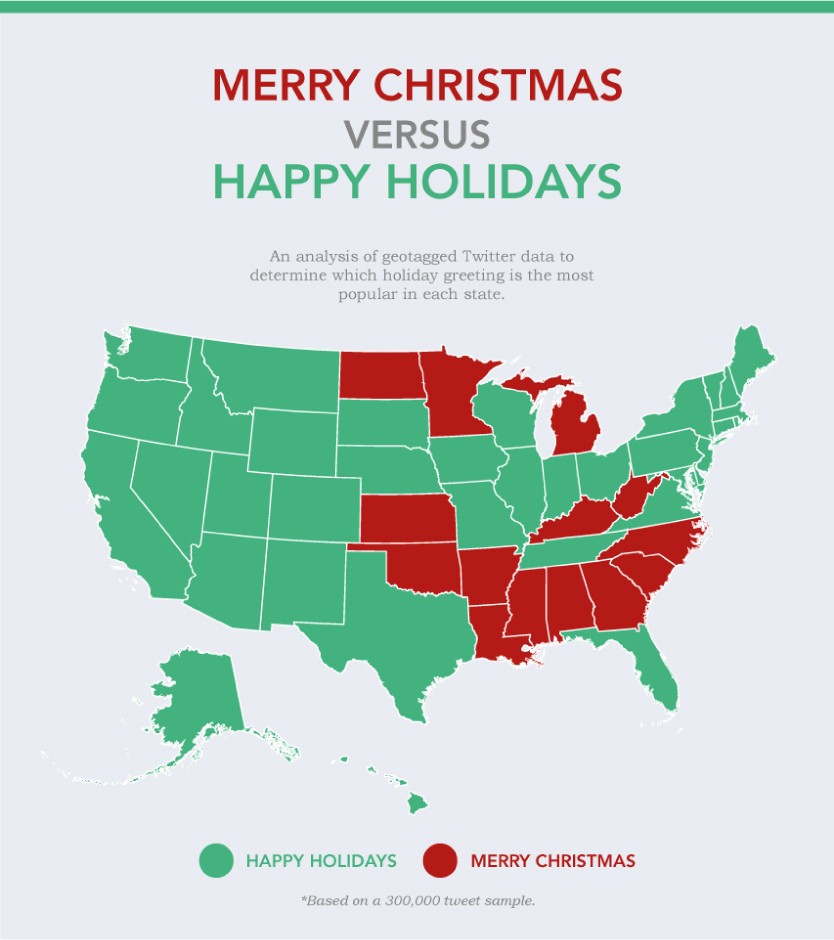
Repost – “Merry Christmas” versus “Happy Holidays” versus “Happy Midwinter Break”

L. Neil Smith on the joy-sucking use of terms like “Happy Midwinter Break” to avoid antagonizing the non-religious among us at this time of year:

Conservatives have long whimpered about corporate and government policies forbidding employees who make contact with the public to wish said members “Merry Christmas!” at the appropriate time of the year, out of a moronic and purely irrational fear of offending members of the public who don’t happen to be Christian, but are Jewish, Muslim, Hindu, Buddhist, Sikh, Jain, Rastafarian, Ba’hai, Cthuluites, Wiccans, worshippers of the Flying Spaghetti Monster, or None of the Above. The politically correct benediction, these employees are instructed, is “Happy Holidays”.

Feh.

As a lifelong atheist, I never take “Merry Christmas” as anything but a cheerful and sincere desire to share the spirit of the happiest time of the year. I enjoy Christmas as the ultimate capitalist celebration. It’s a multiple-usage occasion and has been so since the dawn of history. I wish them “Merry Christmas” right back, and I mean it.

Unless I wish them a “Happy Zagmuk”, sharing the oldest midwinter festival in our culture I can find any trace of. It’s Babylonian, and celebrates the victory of the god-king Marduk over the forces of Chaos.

But as anybody with the merest understanding of history and human nature could have predicted, if you give the Political Correctness Zombies (Good King Marduk needs to get back to work again) an Angstrom unit, they’ll demand a parsec. It now appears that for the past couple of years, as soon as the Merry Christmases and Happy Holidayses start getting slung around, a certain professor (not of Liberal Arts, so he should know better) at a nearby university (to remain unnamed) sends out what he hopes are intimidating e-mails, scolding careless well-wishers, and asserting that these are not holidays (“holy days”) to everyone, and that the only politically acceptable greeting is “Happy Midwinter Break”. He signs this exercise in stupidity “A Jewish Faculty Member”.

Double feh.

Two responses come immediately to mind, both of them derived from good, basic Anglo-Saxon, which is not originally a Christian language. As soon as the almost overwhelming temptation to use them has been successfully resisted, there are some other matters for profound consideration…

December 9, 2018

Everyone please update your Newspeak dictionaries…

Filed under: Asia, Media, Middle East — Tags: , , , — Nicholas @ 03:00

Mark Steyn suggests we’ll soon be unable to use compass directions in spoken or written work, for fear of causing offence:

Things you can no longer say:

I was in the big city earlier this week, and so saw for the first time in ages a physical copy of The New York Times. It contained an interview with James Dyson, the brilliant re-inventor of vacuum cleaners and much else. The Times felt obliged to preface Sir James’ words with a health warning for the easily triggered:

    In this interview, Mr. Dyson expressed antiquated and at times offensive views on “racial differences” and Japanese culture. He also referred to growth markets in Asia as the “Far East.”

He used the term “Far East”!!! What the hell was he thinking?????? Good thing he has no plans to run for public office or host a cable show. The old British Foreign Office joke about the “Near East” (which is more generally referred to as the Middle East) is that they call it the Near East because it’s always nearer than you think. But start referring to the Far East and the instant vaporization of your entire career is a lot nearer than you think.

“Far East” is, I suppose, literally Eurocentric. But then so is “Midwest”. Perhaps the Times now finds any point of view or perspective “offensive”. Perhaps it is time to ban such “antiquated” concepts as north, south, east and west – and indeed the very compass. The abolition of instruments of navigation would seem a necessary condition for the future we’re sailing to.

November 2, 2018

Operation Choke Point

Filed under: Bureaucracy, Business, Government, USA — Tags: , , — Nicholas @ 03:00

In Forbes, John Berlau details how expansive regulatory powers and vindictive bureaucrats make doing business in the United States less “free enterprise” and more “shame if something were to happen to it”:

Every Halloween, there exists the temptation for bloggers, pundits, and commentators to describe routine events in the news with adjectives like “scary” and “frightening.” Sensitive to sounding clichéd or inflammatory, I try usually to avoid using such terminology in my descriptions of the policy process.

Yet after reading through new documents introduced into a lawsuit stemming from the Obama administration’s “Operation Choke Point,” I find that “scary” and “frightening” actually fit. These documents show that powerful bank regulatory agencies engaged in an effort of intimidation and threats to put legal industries they dislike out of business by denying them access to the banking system.

While I am often outraged about things the government does, now I am truly scared and frightened about the ability of government bureaucrats to shut down arbitrarily whole classes of businesses they deem to be “politically incorrect.” As one who champions the FinTech sector and the benefits it can bring, I also worry that such powers may be uses to shut down innovative new industries, such as cryptocurrency, that carry some perceived or real risks.

Choke Point was a multi-agency operation in which several entities engaged in a campaign of threats and intimidation to get the banks that they regulate cut off financial services – from providing credit to maintaining deposit accounts — to certain industries regulators deemed harmful a bank’s “reputation management.” The newly released documents – introduced in two court filings in a lawsuit against Choke Point — show that the genesis of Choke Point actually predated Barack Obama’s presidency, and began when President George W. Bush was in power.

[…]

When the Obama administration came into power, the FDIC would expand the definition of “reputation risk” even further, and other federal agencies, bureaus, and departments would soon jump on the proverbial bandwagon. Much of Operation Choke point would again be accomplished by “guidance documents,” which my Competitive Enterprise Institute colleague Wayne Crews refers to as “regulatory dark matter,” since they have legal force but allow regulators to bypass the sunlight of the notice-and-comment process of a formal rule.

In 2011, an FDIC guidance document featured a chart of business categories engaged in what it called “high-risk activity.” These included “dating services,” “escort services,” “drug paraphernalia,” “Ponzi schemes,” “racist materials,” “coin dealers,” “firearm sales,” and “payday loans.” The FDIC would post this and similar lists in other guidance documents and on its web site.

A staff report of the House Government Reform and Oversight Committee puzzled over many of these categories. “FDIC provided no explanation or warrant for the designation of particular merchants as ‘high-risk,’” the report observed. “Furthermore, there is no explanation for the implicit equation of legitimate activities such as coin dealers and firearm sales with such patently illegal or offensive activities as Ponzi schemes, racist materials, and drug paraphernalia.”

« Newer PostsOlder Posts »

Powered by WordPress