Quotulatiousness

December 11, 2020

“Politically correct language … seemed like a nice, polite, and Canadian sort of thing to do”

Filed under: Cancon, Politics — Tags: , , , , , , — Nicholas @ 03:00

Meaghie Champion discusses politically correct language in The Line:

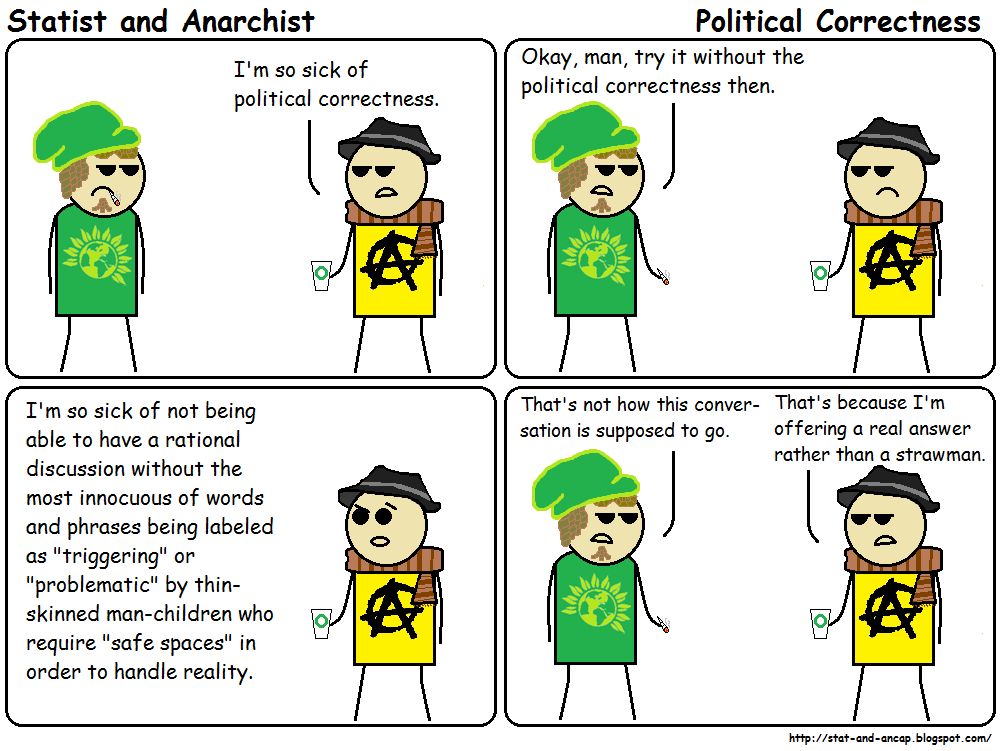
Source: https://www.deviantart.com/blamethe1st/art/Statist-And-Anarchist-063-Political-Correctness-589944623

I grew up in the 1970s and ’80s. I have never lived in a world without what we now call “political correctness” — typically understood to mean using a kind of stilted and artificial language in order to atone for the disadvantages and slights suffered by marginalized groups and avoid inflicting new ones. Politically correct language required more effort to communicate, but it seemed like that effort was worth it to not offend people. It seemed like a nice, polite, and Canadian sort of thing to do.

I went along with political correctness out of a sincere desire to be accommodating to disadvantaged and dis-enfranchised groups. This became especially true after I learned about the “Sapir Whorf theory of psycho neurolinguistics.” The theory suggests that language shapes our perception of reality; that by altering the way we talk, we can shift the way we think — and, thus, collectively, we can shape reality itself. From this, it seemed logical to “de-gender” language or stop using stereotypes. It seemed like a small ask. Maybe I personally couldn’t solve big problems that concerned me as a good liberal … i.e. things like poverty or world hunger, but I could be nice in how I expressed myself and try to use language that everybody was using to be equitable and more fair.

What I didn’t understand, then, was that this precedent set a trap in which many good, well-intentioned liberals are finding themselves stuck. It’s no longer about ameliorating past sins: there is a project afoot to re-make the English language. The purpose of this project is to re-engineer how people think about certain subjects like gender, sex, and race, while skipping the necessary prerequisites of persuasion and logic. Conservative positions are declared off limits, even bigoted, simply by shaping the way we are allowed to talk about them.

Right now, even as I type this, there is a veritable army of academics hard at work on what they call “de-colonizing” and “de-gendering” language at many universities and colleges. There are tens of thousands of activists and academics in universities and online organizing and pushing for ever-changing rules to be enforced as it relates to the English language. It’s a multi-million-dollar industry in academia and woke corporatism. And it’s already starting to spill over into government regulations and enforcement.

I love the English language. I have been a voracious reader since childhood. I thrill at well-spoken and written prose and poetry. A finely turned witticism or fantastic mot juste can break my heart with its perfection. Further, I’m First Nations, and that love of the English language has also carried me into a love of the study of my tribal cradle tongue “Hul’qumi’num.” Shouldn’t I, as a First Nations person, be in favour of de-colonizing the English language? No. No, I do not think so. I have little patience or regard for any effort that makes language a less workable and functional tool of human endeavour. I identify strongly as a writer, and I take this assault upon the tool with which I conduct my craft very personally.

November 18, 2020

QotD: Feminism and gender equality

Filed under: Politics, Quotations, USA — Tags: , , , , — Nicholas @ 01:00

It takes one’s breath away to watch feminist women at work. At the same time that they denounce traditional stereotypes they conform to them. If at the back of your sexist mind you think that women are emotional, you listen agape as professor Nancy Hopkins of MIT comes out with the threat that she will be sick if she has to hear too much of what she doesn’t agree with. If you think women are suggestible, you hear it said that the mere suggestion of an innate inequality in women will keep them from stirring themselves to excel. While denouncing the feminine mystique, feminists behave as if they were devoted to it. They are women who assert their independence but still depend on men to keep women secure and comfortable while admiring their independence. Even in the gender-neutral society, men are expected by feminists to open doors for women. If men do not, they are intimidating women.

Thus the issue of Summers’s supposedly intimidating style of governance is really the issue of the political correctness by which Summers has been intimidated. Political correctness is the leading form of intimidation in all of American education today, and this incident at Harvard is a pure case of it. The phrase has been around since the 1980s, and the media have become bored with it. But the fact of political correctness is before us in the refusal of feminist women professors even to consider the possibility that women might be at any natural disadvantage in mathematics as compared with men. No, more than that: They refuse to allow that possibility to be entertained even in a private meeting. And still more: They are not ashamed to be seen as suppressing any inquiry into such a possibility. For the demand that Summers be more “responsible” in what he says applies to any inquiry that he or anyone else might cite.

Harvey Mansfield, “Fear and Intimidation at Harvard”, Weekly Standard, 2005-03-07.

September 18, 2020

QotD: Heinlein’s “Crazy Years”

It’s become a thing among Heinlein fans, writers and readers alike. We get together for a good talk, and a glass of wine, and one of us will mention something nuts and the others will go “Well, these are the crazy years.”

Things like the girl who had to remove a decoration from her purse before boarding a plane because the decoration was in the shape of a revolver, though about finger sized and evidently cut in half lengthwise. The TSA thought the ban on guns applied to this too. (Of course, she’d flown with it before, so it was just this TSA station, but nonetheless its rulings were absolute.)

Things like the little deaf boy who can’t sign his name because one of the letters looks like a gun.

Things like kids getting in trouble because of a fictional story they wrote. Things like my younger son – it’s a theme, yes. The boy is lightning rod on his mother’s side. More on that later – getting sent to the school psychiatrist because he used the following sentence in an essay “Some people think I’m crazy.”

[…]

There’s half (half?) of our literature and movies, which glorify behaviors that in real life get you killed or make you a bum. There’s the fact that being thrifty, hard working and honoring your contracts makes you “uncool.” There the fact our women are taught to hate all men and men are finally learning to avoid women. There’s …

You say it in groups of Heinlein fans, and people go “Well, these ARE the crazy years.” And you move on.

Sarah Hoyt, “These Are The Crazy Years”, According to Hoyt, 2013-07-17.

August 2, 2020

Words are verbal tools, but tools can be weaponized

In this week’s newsletter, Andrew Sullivan analyzes the roots of wokeness:

In the mid-2010s, a curious new vocabulary began to unspool itself in our media. A data site, storywrangling.org, which measures the frequency of words in news stories, revealed some remarkable shifts. Terms that had previously been almost entirely obscure suddenly became ubiquitous — and an analysis of the New York Times, using these tools, is a useful example. Looking at stories from 1970 to 2018, several terms came out of nowhere in the past few years to reach sudden new heights of repetition and frequency. Here’s a list of the most successful neologisms: non-binary, toxic masculinity, white supremacy, traumatizing, queer, transphobia, whiteness, mansplaining. And here are a few that were rising in frequency in the last decade but only took off in the last few years: triggering, hurtful, gender, stereotypes.

Language changes, and we shouldn’t worry about that. Maybe some of these terms will stick around. But the linguistic changes have occurred so rapidly, and touched so many topics, that it has all the appearance of a top-down re-ordering of language, rather than a slow, organic evolution from below. While the New York Times once had a reputation for being a bit stodgy on linguistic matters, pedantic, precise and slow-to-change, as any paper of record might be, in the last few years, its pages have been flushed with so many neologisms that a reader from, say, a decade ago would have a hard time understanding large swathes of it. And for many of us regular readers, we’ve just gotten used to brand new words popping up suddenly to re-describe something we thought we knew already. We notice a new word, make a brief mental check, and move on with our lives.

But we need to do more than that. We need to understand that all these words have one thing in common: they are products of an esoteric, academic discipline called critical theory, which has gained extraordinary popularity in elite education in the past few decades, and appears to have reached a cultural tipping point in the middle of the 2010s. Most normal people have never heard of this theory — or rather an interlocking web of theories — that is nonetheless changing the very words we speak and write and the very rationale of the institutions integral to liberal democracy.

What we have long needed is an intelligible, intelligent description of this theory which most people can grasp. And we’ve just gotten one: Cynical Theories: How Activist Scholarship Made Everything About Race, Gender and Identity, by former math prof James Lindsay and British academic, Helen Pluckrose. It’s as deep a dive into this often impenetrable philosophy as anyone would want to attempt. But it’s well worth grappling with.

What the book helps the layperson to understand is the evolution of postmodern thought since the 1960s until it became the doctrine of Social Justice today. Beginning as a critique of all grand theories of meaning — from Christianity to Marxism — postmodernism is a project to subvert the intellectual foundations of western culture. The entire concept of reason — whether the Enlightenment version or even the ancient Socratic understanding — is a myth designed to serve the interests of those in power, and therefore deserves to be undermined and “problematized” reason whenever possible. Postmodern theory does so mischievously and irreverently — even as it leaves nothing in reason’s place. The idea of objective truth — even if it is viewed as always somewhat beyond our reach — is abandoned. All we have are narratives, stories, whose meaning is entirely provisional, and can in turn be subverted or problematized.

During the 1980s and 1990s, this somewhat aimless critique of everything hardened into a plan for action. Analyzing how truth was a mere function of power, and then seeing that power used against distinct and oppressed identity groups, led to an understandable desire to do something about it, and to turn this critique into a form of activism. Lindsay and Pluckrose call this “applied postmodernism”, which, in turn, hardened into what we now know as Social Justice.

June 17, 2020

“We don’t need no stinkin’ badges!”

Theodore Dalrymple on the use of badges within the NHS to virtue signal and compel compliance in the unwilling:

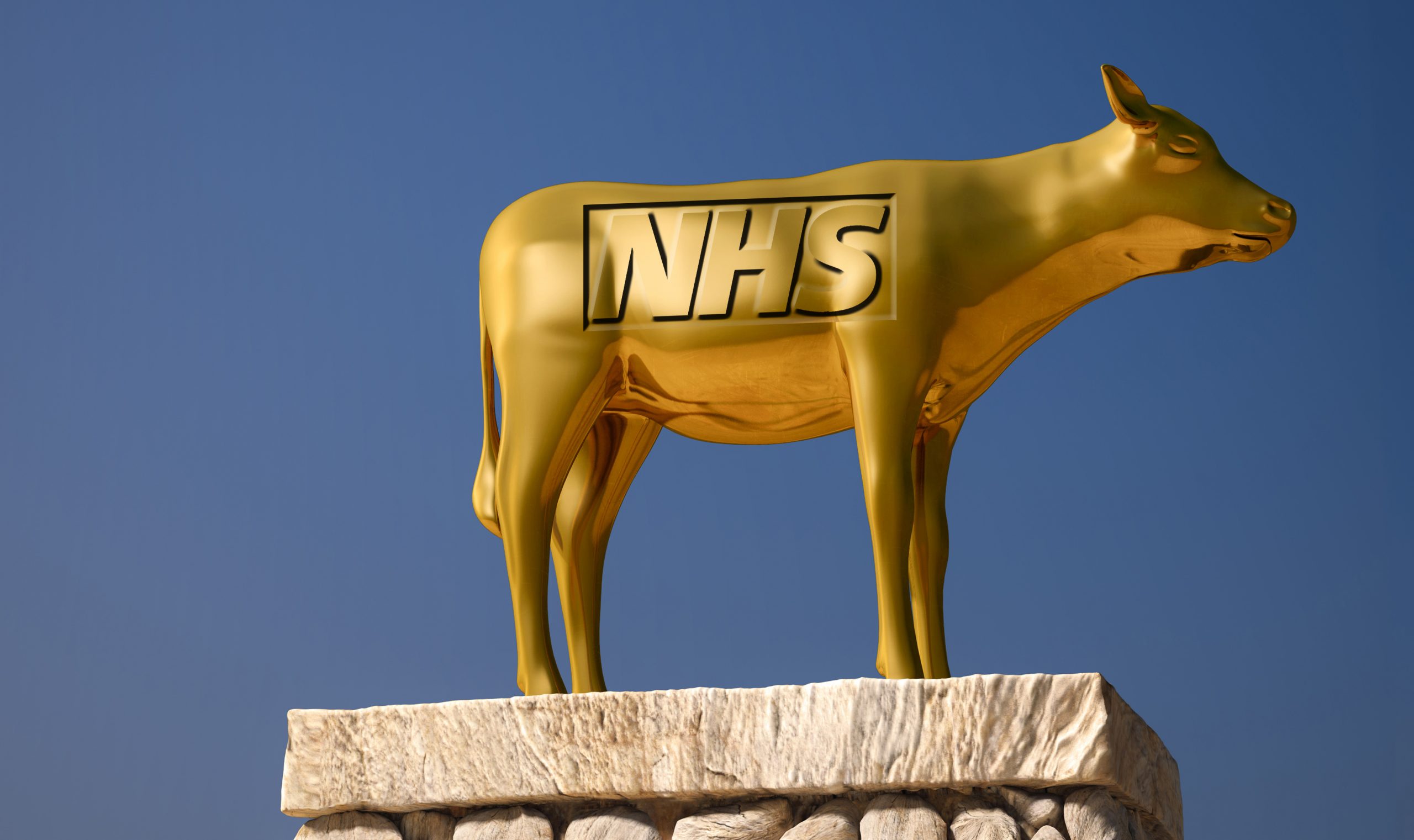
Not actually the official symbol of Britain’s National Health Services … probably.

In Britain’s highly-centralized, almost Soviet-style healthcare system, the National Health Service, staff are being encouraged all over the country to wear little rainbow-coloured metal badges to show that they are homosexual, bisexual, and transsexual-friendly, and do not discriminate against them. The wearing of these badges is voluntary, but about 3,000 of the staff of Guy’s and St Thomas’ Hospitals, for example, now wear them. The self-congratulatory website of those ancient hospitals — St. Thomas’ is over 800 years old and Guy’s was founded in 1721, now combined into one administrative unit — says:

    The badges are just one way to show that Guy’s and St Thomas’ is an open, non-judgmental and inclusive place for people that identify as LGBT+ [which] stands for lesbian, gay, bisexual and transgender). The + simply means we are inclusive of all identities, regardless of how people identify themselves.

This language, which combines the unctuous with the bureaucratic, is typical of the way British hospital administrators express themselves nowadays. And if, as Buffon said, the style is the man himself, we may justly fear for a semi-totalitarian future.

By implication, the badges bully the staff, for if any of them refuse to wear one, their refusal is likely to be taken to mean that their minds are closed, judgmental (in the sense of being censorious, for even the attempt to avoid making judgments is itself based on a judgment), and exclusionary. It is to imply that they would deliberately treat any patients in the above mentioned categories differently and worse from all other patients. Wear the badge or declare yourself to be a bigot.

This is an insult to all those people who worked before the advent of the badges (or who now refuse to wear them) who strove and continue to strive always to treat patients to the best of their ability, irrespective of the many categories into which any individual patient falls. In my experience, the great majority of doctors have always tried to do this.

Let me give an example. Working as I did as a doctor in prison, I met many men who had done terrible things. I treated them, as a matter of course, to the best of my ability. I remember, for example, a man who had strangled three children and then impaled them on railings. Though I did not think he was a good man, and in that sense passed a judgment on him within the privacy of my mind, I treated him for his bronchitis exactly as I would have treated anyone else with bronchitis. I did not find this difficult in the least and do not claim any special merit for having done so, for it is only what all my colleagues in the profession did — as a matter not only of course, but of principle.

A couple of years ago, I read the diary of one of Marshal Pétain’s doctors during the latter’s imprisonment after World War II. The doctor had been a member of the Resistance and had no reason to love Pétain, to say the least: Pétain’s supporters would have had not a second thought about killing him if he had fallen into their power. Yet, as the diary makes clear, the doctor treated Pétain, who by then was demented, with the greatest humanity. Moreover, the doctor refused to publish his diary, despite the financial advantage of doing so, because he thought that publishing it would be to break patient confidentiality. It was only after his death, and more than half a century after Pétain’s, that the diary was published. The doctor’s adherence to his medical ethics was impressive, and he needed no badge to proclaim his virtue.

April 10, 2020

QotD: Ketman

I got into the higher ed biz fully intending to practice what Milosz calls “aesthetic ketman.” [“paying lip service to official ideology while secretly subverting it”] I loved my subject, but my subject was recondite enough, I figured, that I could keep the SJW bullshit to a bare minimum. I don’t remember what they called “intersectionality” back then, but whatever it was, I’d just make a few brief nods to it, then get on with my work in relative peace. Throw a few quotes from Foucault, Judith Butler, Gayatri Spivak, and the like in my dissertation intro, and that was that.

The problem, though, is that the sour pleasure of ketman is addictive, and like any addiction, you need to keep upping the dose to feel the same effect.

My first few years in grad school, anyone who cared to look could’ve easily spotted me as a secret shitlord. For one thing, I was the only guy in the whole damn town who actually looked happy. For one thing, professing is a 24/7 job — that’s “24 hours a week, 7 months a year,” and don’t let anyone tell you otherwise. All that free time is lovely, especially in a college town with 24-hour everything and scads of scantily clad undergraduate eye candy.

But more importantly, there’s the pleasure of ketman. So long as I make a few radical noises, I can get you sheep to believe anything I say. I used to tell people I studied transgendered potato farmers in the Kenyan uplands. I told this obnoxious girl from the Gender Studies department my dissertation was on resistance strategies of Eskimos in the Waffen-SS. I cited Alan Sokal’s hoax paper on the social construction of gravity in every seminar taught by a radical feminist, and no one ever called me on it. Anyone who thinks I’m kidding obviously hasn’t been on campus in the last 20 years or so. It was fucking hilarious

… for a time. And then it got sad, then nauseating, because I eventually realized I was no different from the fools who swallowed my bullshit. It doesn’t matter if you’re being exquisitely ironic when you tell a room full of freshmen that “gender is a social construction.” They can’t recognize irony anyway, and even if they could, parroting the phrase “gender is a social construction” is still required to pass the class. More importantly, what if they did recognize it? I’m up there thinking I’m a shitlord, speaking truth to power to anyone smart enough to figure it out, but all they see is another fat, middle-aged sellout parroting nonsense. If I were serious about my shitlordery, they think, then I’d quit. But I don’t quit, which must mean my so-called “principles” are worth … what? We’ve already established you’re a whore, madam; now we’re just haggling over the price.

Severian, “The Pleasures of Ketman”, Rotten Chestnuts, 2020-01-09.

March 30, 2020

QotD: Free speech is the safety valve we must not eliminate

[W]hen you’re a peddler of Utopia, you can’t admit you’re wrong or that your methods are crazy. After all, your cult of Marx (a college-professor friend recently shocked his students by pointing out Marx is a 19th century western idea — born of the mechanical age and the idea you can make everything just so — and that imposing this interpretation on non-Western systems is colonialist) promises eventual paradise and world domination. You can’t be wrong. It would mean your whole life has been in vain, and everything you’ve been taught is a lie.

The system might have moved the downtrodden from those “exploited” by the industrial revolution, to “minorities” “third world people” and people with interesting colorations — mostly because the “exploited” workers kept rising up in the world and spitting in the eye of Marx, the ungrateful bastages — but it’s totally still true and the way of the future. Even if it requires conceptualizing a future where no one works and everything is free, since they’ve now tossed the “workers” out of their ideal society. (Again, ungrateful bastages who don’t know how “good” the intellectuals are for them.) But it is totally the future!

So all those people who say that it’s still spinach and to hell with it? They’re just trying to destroy the train of happiness leading to the station of utopia.

Which means they must be silenced. If they’re just silenced, then the system will work fine, and everyone will be happy and joyful.

So the latest attack is on free speech. Because free speech can be hurty and say things the left doesn’t want to hear. Bad bad free speech must be stopped.

They already have laws against “hate speech” or “harassment”, which according to a comment here is “saying something I don’t like more than once” in most of the world.

The US is holding fast in our unreasonable devotion to the first amendment which irks the left as much as our devotion to the second. Don’t we understand that bad speech hurts people? And leads to bad think?

In any institution they control, from companies code of conduct to deplatforming people on twitter, to Google strangling hits to dissenting blogs, etc, they are already silencing that nasty, evil feedback.

Because if only they don’t hear the whistles of rising steam, the engine will never explode.

Cotton stuffed in their ears, they keep feeding more coal to the engine of public opinion and stopping up the steam vents.

The end of this is what happened to Ceausescu and his repulsive wife: “Beloved leader of the morning, pile of cooling, bullet riddled meat in the afternoon.”

But they don’t see it. They’re convinced if they just stop the feedback, the machine will work fine.

And they’re going to take all of us into the explosion. Mind you, in the end we win, they lose, but it’s going to get very rough there for a while.

Unfortunately when dealing with true believers, there’s nothing you can do but let them utterly prove their system wrong, before sane people can build again.

Sarah Hoyt, “Breaking the Gears”, According to Hoyt, 2018-01-03.

February 27, 2020

Toby Young’s Free Speech Union (FSU)

Brendan O’Neill explains why Toby Young’s FSU is so important right now:

The beautiful thing about the mad reaction to Toby Young’s Free Speech Union (FSU) is that it proves why the union is so necessary. No sooner had Young unveiled his censorship-busting union than the illiberal liberals were out in force to mock it and ridicule it and to insist that, actually, there is no free-speech crisis in the UK. It’s a right-wing myth, they claim. There is no widespread censorship. People aren’t being shipped off to gulags for expressing an opinion. Apparently, the free-speech “grift” – God, I hate the word “grift” – is just a bunch of pale, male and stale blokes pissed off that they can no longer say the N-word or talk openly about women’s boobs. Freedom of speech is not under threat, the Young-bashers claim, and anyone who says it is is probably just an Islamophobe, transphobe or some other breed of phobe itching to spout bile with “no consequences”.

This rank denialism, this blinkered insistence that free speech is not in danger in 21st-century Britain, is exactly why we need the FSU and as broad a discussion as possible about the importance of the liberty to express oneself. Because the fact that so many inhabitants of the chattering-class bubble can’t even see that free speech is dying right now confirms how naturalised and uncontroversial the new censorship has become. They don’t even see it as censorship. They see it as perfectly normal, and good, in fact, that certain views cannot be expressed in public life or on social media. That’s how cavalier the new war on heretical opinion has become. At least in the past, from Torquemada to the McCarthyites, authoritarians were honest about being censors. Today’s self-elected moral guardians of correct opinion are so hubristic, so taken with their own mortal rectitude, that they don’t even see themselves as enemies of freedom, but rather as decent, unimpeachable maintainers of a natural intellectual order.

Things have come to such a pass that these people will literally seek to censor you in one breath and then express alarm at being called censors in the next breath. Hence the Guardian could publish a piece last week claiming that the idea that there is a culture of censorship in British universities is a “right-wing myth” while simultaneously defending censorship on campus. In an act of extraordinary moral contortionism, Evan Smith mocked the “idea that there is a free-speech crisis at British universities” and then, without missing a beat, he defended the policy of No Platform and the creation of safe spaces because “the university cannot be a place where racism and fascism – as well as sexism, homophobia and transphobia – are allowed to be expressed”. The Orwellianism is staggering. “There is no censorship on campus. Except the censorship I approve of. Which is not really censorship.” That is what is being said here. The intellectual dishonesty is almost impressive.

This Orwellian denialism of the existence of censorship by people who actually support and enact censorship cuts to the heart of the free-speech crisis in the UK. The reason the illiberal liberals and woke McCarthyites and Twittermobs don’t consider themselves to be censors – even as they gleefully agitate for the censorship of feminists, secularists worried about Islamist extremism, and right-wing people opposed to mass immigration – is because they have convinced themselves that certain forms of speech are not free speech. That certain beliefs should not be afforded the liberty of expression. You hear it in their telling, baleful mantra that “Hate speech is not free speech”. And if “hate speech” is not free speech, but rather some kind of toxin, a pox on public life, then crushing it is not censorship. It is more like an act of public health: cleansing the public realm of diseased thoughts that are liable to harm certain groups. These people see themselves not as censors, but as public-health activists delousing the community of germs spread by evil men and women.

February 13, 2020

“Titania McGrath thinks you’re scum. That is because of how tolerant she is.”

Spencer Klavan interviews the mind behind the Twitter legend that is Titania McGrath:

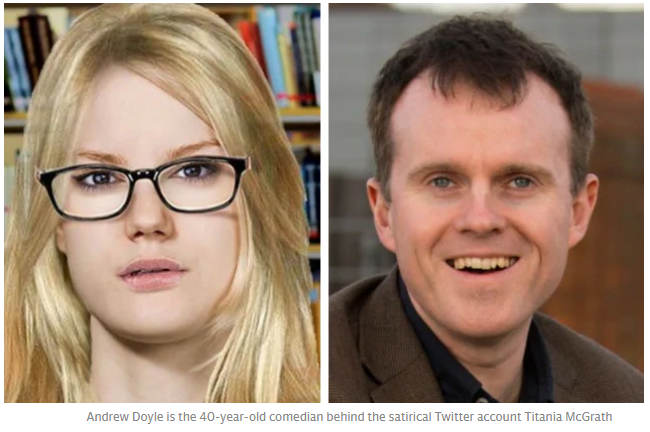
In April 2018, Oxford-educated comedian and journalist Andrew Doyle created a satirical Twitter persona, an “activist,” “healer,” and “radical intersectionalist poet” who self-identifies as “selfless and brave.” Titania, an imaginary amalgam of all the worst excesses in the modern social justice movement, fancies herself a voice for minorities of all kinds (whether they know they agree with her or not). What she lacks in self-awareness, she makes up for in conviction.

There are other parody accounts in a vein similar to Titania’s: Jarvis Dupont of the Spectator USA, for example, or Wrightly Willowleaf (who moved to Williamsburg before it was cool). But none of them has achieved Titania’s notoriety, or her reach (418.4K followers). Doyle attributes some of this success to a much-publicized Twitter ban. But that’s perhaps too modest: Titania is a note-perfect creation, as frighteningly accurate as she is screamingly funny. “[Y]ou need to understand that which you are critiquing,” Doyle told me: more than anything, his tweets as Titania demonstrate an incisive grasp of how radical progressivism functions and why woke politics commands such hypnotic power over the 21st-century Western psyche.

Doyle is among a growing number of classical liberals who have simply had enough: witty, thoughtful, and profoundly humane, he is the kind of eloquent sophisticate who would have been quite uncontroversial as a cultural critic and public intellectual in a less turbulent era. But that wasn’t his fate. Comedy and culture have been so strangled by political correctness that he is “at that point where I feel that it would be morally wrong to be silent” about the crisis of free public discourse in the West. Still, there is much more to Doyle than politics and polemic. I spoke to him at some length about his philosophical outlook, his academic interests, and his career beyond Titania.

[…]

S.K. Yes, something you capture really well with Titania is the complete lack of self-awareness, the oblivion of people to their own racism even as they criticize racism in others.

Let’s talk about that moment when Titania got banned: you’ve written elsewhere that “those in power cannot tolerate being ridiculed.” That was a theme when we interviewed Kyle Mann of the Babylon Bee as well: why do you think ridicule gets woke people so angry?

A.D. Because it’s an effective way to expose their folly. There’s something very instinctive that we all have as human beings: we don’t like being laughed at. And that makes sense: it feels like a form of humiliation. But I also think that’s why it’s a good way to puncture and deflate those kinds of pretensions. And they absolutely don’t like it — I mean, tyrants throughout history have locked up and killed satirists. We had the Bishop’s Ban on any satirical work in Great Britain, and that was in 1599. You’ve got president Erdogan in Turkey who will lock up satirists and call for their arrest — so it’s a pretty standard feature of history.

Of course, with Titania, the misinterpretation of what she’s doing is that she’s punching down, she’s attacking minorities. That’s not the point at all: it’s attacking the social justice movement, which is very very powerful but doesn’t perceive itself to be powerful. That’s why they claim victimhood: so that they can say mocking social justice is mocking the weak. It’s not, of course. It’s mocking those who are in power.

S.K. You’re absolutely right that persecution of satire by the powerful is as old as satire itself — goes back to the court of Ptolemy II, probably further. So let’s talk about power.

Based on what you’ve written it seems as if you feel that wokeness wields a kind of soft power — a cultural power more than a legal or a political power. I’m reminded a bit of Shelley’s argument that poets are the “unacknowledged legislators of the world.” How is it that you think the woke and the social justice movement came to acquire the overwhelming degree of cultural power they now have?

A.D. I think it’s because the woke movement is largely driven by people who are independently wealthy and privately educated. Just to give you an example from the U.K.: 7% of our country is educated privately. So those are the richest people, but those 7% dominate the arts, and the media, and journalism, and the law, and education, and the government. So what you have is a very small coterie of very powerful people who disproportionately control the direction of culture.

The BBC is a good example of an institution that is overly dominated by privately educated people, and it’s very very woke. So there seems to be a correlation. And similarly, the universities where they have the most woke students, and the most people wanting to de-platform and censor — which comes hand-in-hand, obviously, with woke culture — there is a clear correlation between the economic privilege of students and how woke they are. So the worst examples you’ll find are in places like Oxford University, Cambridge University, Yale, and Harvard. Those will be the ones where you get the most egregious examples of censorial wokeness. And of course those are the kids who come from the most privileged backgrounds.

It is no surprise to me that those with the most would like to claim to have the least and to be the most oppressed. There was a survey in the Atlantic about political correctness, and by a long way, the people who resent political correctness the most are the ones whom it purports to defend: the ethnic minorities and the sexual minorities and so on. And the people who support political correctness the most tend to be rich white liberals, by a long way. I think there’s something quite strategic about holding on to power by claiming to be oppressed or claiming to stand up for the oppressed. It’s something which I think is unprecedented in history: those who claim to be the victims also seize the power. It’s very unusual.

February 12, 2020

Jeeves & Windsor (Prince Andrew Edition) – Will Franken

Filed under: Britain, Humour, Politics — Tags: , , , — Nicholas @ 04:00

Comedy Unleashed
Published 8 Feb 2020

An imagined Prince Andrew receives advice from Jeeves about Jeffrey Epstein.

Live at London’s little home of free-thinking comedy.
Gigs every month https://comedyunleashed.co.uk/whatson

H/T to Hector Drummond for the link.

January 22, 2020

The general unpleasantness of life in the “groves of academe”

Filed under: Education — Tags: , , , , — Nicholas @ 03:00

David Warren on the state of play on the intellectual and political battlefronts of academia:

University College, University of Toronto, 31 July, 2008.
Photo by “SurlyDuff” via Wikimedia Commons.

As the latest reports from our universities confirm, we live in an age of juvenile anachronism. So far as the past is acknowledged at all, it is to be judged, by the incredibly narrow standards of “social justice,” itself two words of a lie. Anyone who tries to resist this — even tenured professors — will be demoted, fired, or “placed on probation.” As in Soviet universities, this was enough to keep most dissenters secret. There is, after all, at least one mouth to feed, and not everyone is equipped to become a martyr. Among the better academics, some particles of truth can be snuck into lectures, past the inquiring minds of ignorant thugs.

But as technology has now blessed us with portable, and easily concealed recording devices, they must stay constantly on guard. A slight ideological slip could end the most promising career, apart from surrounding the speaker with shrieking Antifa who, if they manage to injure him, will not be prosecuted by campus or municipal sensitivity police.

It’s actually no better for (most of) the students than it is for the professors:

… after family breakdowns and the re-education of a generation of public school teachers, the crop of new students are so dull and docile that, unless they are radicalized, they will sit there aloof, like zombies. There are “conservative” students, whose complacency can serve any mission. Many have “common sense” enough to play along. They are only there to acquire the minimum credentials for paid work on the outside. It is a prison term. Once graduated, they will then adopt the customs and tone in their workplace environment which, except for “professions” like journalism, are unlikely to be radical. The feigned “social justice warrior” is transformed into a feigned enthusiast for capitalism, by self-interest, almost overnight.

January 8, 2020

QotD: Diversity in academia

Filed under: Bureaucracy, Education, Quotations — Tags: , , — Nicholas @ 01:00

Academia is simultaneously both the part of America that is most obsessed with diversity, and the least diverse part of the country. On the one hand, colleges bend over backwards to hire minority professors and recruit minority students, aided by an ever-burgeoning bureaucracy of “diversity officers”. Yet, when it comes to politics, they are not just indifferent to diversity, but downright allergic to it.

“America’s one-party state”, The Economist, 2004-12-02.

January 3, 2020

Magical thinking in names

Theodore Dalrymple relates the rather odd story of a young girl’s media-publicized objection to a math problem in school and then considers the girl’s given name in the larger context:

Popular first names in the United States, 2010.
Image from Behind the Name.

My attention was also caught by the first name of the politically-correct child: Rhythm. This is not a traditional name, though not actually ugly; but her parents have evidently accepted the increasing convention of giving a child an unconventional, and sometimes previously unheard of, name. This is a worldwide, or at least occident-wide, phenomenon. In Brazil, for example, parents in any year give their children one of 150,000 names, most of them completely new, made up like fake news, and in France, 55,000 children are born every year who are given names that are shared by three or fewer children born the same year. This latter is all the more startling because, until 1993, there was an old Napoleonic law (admittedly not rigidly enforced) that constrained parents to choose among 2000 names, mainly those of either saints or classical heroes.

What does the phenomenon of giving children previously unheard-of names signify — assuming that it signifies something? I think it is symptomatic of an egoistic individualism without true individuality, of self-expression without anything to express, which is perhaps one of the consequences of celebrity culture.

I performed an internet search on the words Rhythm as a given name. I soon found the website of a group called the Kabalarians, who believe that the name given to a child determines, or at least contributes greatly, to its path through life, especially in conjunction with the date of birth:

    When language is used to attach a name to someone this creates the basis of mind, from which all thoughts and experiences flow. By representing the conscious forces combined in your name as a mathematical formula, one’s specific mental characteristics, strengths and weaknesses can be measured.

It invited readers to inquire about the psychological characteristics and problems of people with various given names. I invented a child called Rhythm of the same age, more or less, as Rhythm Pacheco. This was the result:

    The name of Rhythm causes this child to be extremely idealistic and sensitive. She will find it difficult to overcome self-consciousness and to express her deeper thoughts and feelings in a free, natural way. She is too easily hurt and offended, and will often depreciate her own abilities. Because of her lack of confidence and her sensitivity, she will go to great lengths to avoid an issue. True affection, understanding, and love mean a great deal to her, as she is a romantic and emotional youngster. Often she will resort to a dream world when her feelings are hurt. She could be very easily influenced by others, for she will find it difficult to maintain her individuality. This problem could become more predominant during the teenage years. Although there is much that is refined and beautiful about her, the lack of emotional control could bring much unhappiness, repression, misunderstanding and loneliness later in life. Tension could also create fluid and respiratory problems. Because of the sensitivity created by this name, she will find it difficult to cope with the challenges of life.

There is, in fact, a semi-serious theory of nominative determinism, according to which a name may influence a person’s choice of career: two of the most prominent British neurologists of the first half of the twentieth century, for example, were Henry Head and Russell Brain. A recent Lord Chief Justice of England was called Igor Judge. And surely it must work in a negative direction too: no poet could be called Albert Postlethwaite. However rational one believes oneself, one might also experience a frisson of fear on consulting a doctor called Slaughter — as was called the doctor and popular novelist Frank G. Slaughter.

When I first went to Africa, I encountered patients whose first names were Clever, Sixpence or Mussolini. The first of these names was presumably an instance of magical thinking, while the second two were chosen merely because the naming parents liked the sound of them. Years later, during the civil war in Liberia, I met a constitutional lawyer called Hitler Coleman, who presumably desired to live his name down by concerning himself with the rule of law.

December 23, 2019

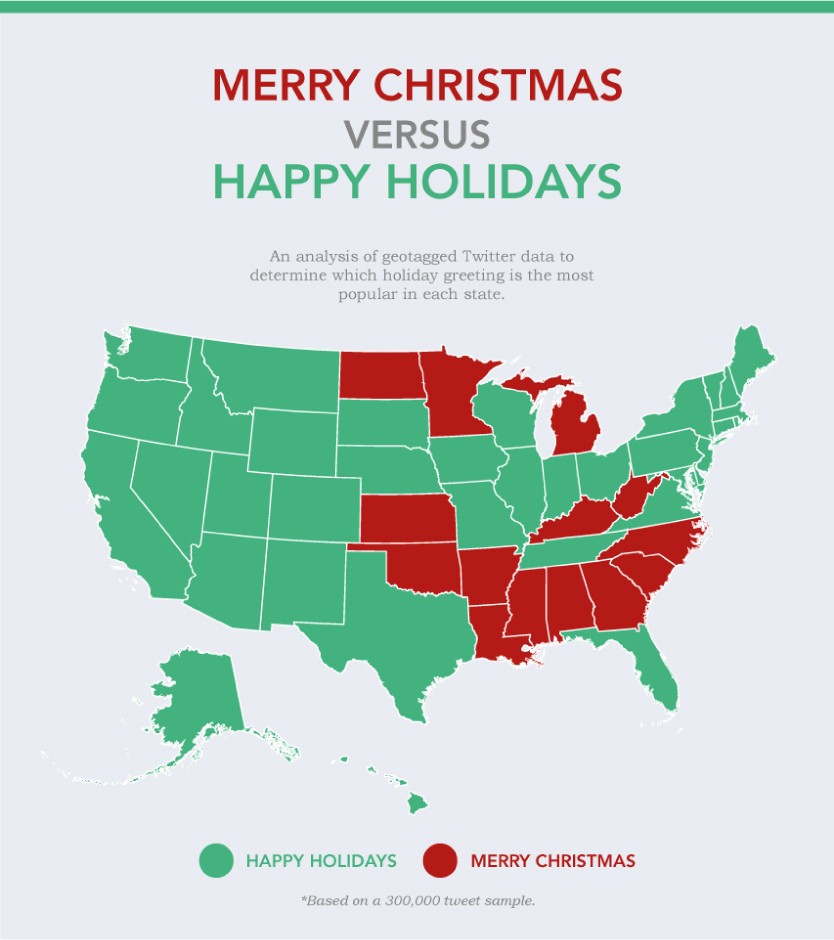
Repost – “Merry Christmas” versus “Happy Holidays” versus “Happy Midwinter Break”

L. Neil Smith on the joy-sucking use of terms like “Happy Midwinter Break” to avoid antagonizing the non-religious among us at this time of year:

Conservatives have long whimpered about corporate and government policies forbidding employees who make contact with the public to wish said members “Merry Christmas!” at the appropriate time of the year, out of a moronic and purely irrational fear of offending members of the public who don’t happen to be Christian, but are Jewish, Muslim, Hindu, Buddhist, Sikh, Jain, Rastafarian, Ba’hai, Cthuluites, Wiccans, worshippers of the Flying Spaghetti Monster, or None of the Above. The politically correct benediction, these employees are instructed, is “Happy Holidays”.

Feh.

As a lifelong atheist, I never take “Merry Christmas” as anything but a cheerful and sincere desire to share the spirit of the happiest time of the year. I enjoy Christmas as the ultimate capitalist celebration. It’s a multiple-usage occasion and has been so since the dawn of history. I wish them “Merry Christmas” right back, and I mean it.

Unless I wish them a “Happy Zagmuk”, sharing the oldest midwinter festival in our culture I can find any trace of. It’s Babylonian, and celebrates the victory of the god-king Marduk over the forces of Chaos.

But as anybody with the merest understanding of history and human nature could have predicted, if you give the Political Correctness Zombies (Good King Marduk needs to get back to work again) an Angstrom unit, they’ll demand a parsec. It now appears that for the past couple of years, as soon as the Merry Christmases and Happy Holidayses start getting slung around, a certain professor (not of Liberal Arts, so he should know better) at a nearby university (to remain unnamed) sends out what he hopes are intimidating e-mails, scolding careless well-wishers, and asserting that these are not holidays (“holy days”) to everyone, and that the only politically acceptable greeting is “Happy Midwinter Break”. He signs this exercise in stupidity “A Jewish Faculty Member”.

Double feh.

Two responses come immediately to mind, both of them derived from good, basic Anglo-Saxon, which is not originally a Christian language. As soon as the almost overwhelming temptation to use them has been successfully resisted, there are some other matters for profound consideration…

Original infographic from Treetopia – https://www.treetopia.com/Merry-Christmas-vs-Happy-Holidays-a/304.htm

October 18, 2019

Colonel Daniel Stepaniuk’s one-man campaign to wipe out (some) religious observance in the Militia

Filed under: Cancon, Military, Religion — Tags: , , , , — Nicholas @ 03:00

Christie Blatchford on the oddly partial actions of the officer in charge of more than a dozen Ontario militia regiments as far as religion is concerned:

The Lorne Scots (Peel, Dufferin and Halton Regiment) on parade in Brampton, Ontario on 24 September, 2016.
Photo by Nicholas Russon.

An army brigade commander has told the 14 Ontario reserve regiments under his charge that they must cancel any “church parade” they have planned.

Despite a lack of complaints about the parades, which see soldiers march to their regimental church, Col. Daniel Stepaniuk urged his commanding officers to stop participating in “any event where the primary purpose is liturgical, spiritual or religious … even if the service is non-denominational.”

A custom in the Canadian Army since the time of Confederation, the parades aren’t as common as they once were, though many units still have at least one a year, often tied to Remembrance Day ceremonies.

[…]

First of all, there is the glaring contradiction with Stepaniuk’s harsh stand on church parades and a parade that happened in Toronto last April.

A group of soldiers — I counted between 15 and 20 — were issued weapons, allowed to march in their military uniforms and were escorted by an armoured vehicle in the annual Khalsa parade for Canada’s Sikh community. It is considered a holy day.

The soldiers were from the Lorne Scots, one of Stepaniuk’s reserve units based in Brampton. The CO of the unit said at the time that he signed off on the weapons only after his commander (that would presumably be Stepaniuk, or perhaps the brigadier-general above him) approved the soldiers’ participation.

So weapons worn at a Khalsa Day parade good, though against the rules (The Canadian Armed Forces Manual of Drill and Ceremonial), according to army spokeswoman Karla Gimby.

But soldiers going anywhere near a church, bad, and against rules five years old that no one cared to enforce until now.

But most of all, in such small incremental strikes, does Canadian history and tradition lose strength.

« Newer PostsOlder Posts »

Powered by WordPress