
… an accurate and intelligent account of Nietzsche’s ideas, by one who has studied them and understands them, is, as Mawruss Perlmutter would say, yet another thing again. Seek in What Nietzsche Taught, by Willard H. Wright, and you will find it. Here in the midst of the current obfuscation, are the plain facts, set down by one who knows them. Wright has simply taken the eighteen volumes of the Nietzsche canon and reduced each of them to a chapter. All of the steps in Nietzsche’s arguments are jumped; there is no report of his frequent disputing with himself; one gets only his conclusions. But Wright has arranged these conclusions so artfully and with so keen a comprehension of all that stands behind them that they fall into logical and ordered chains, and are thus easily intelligible, not only in themselves, but also in their interrelations. The book is incomparably more useful than any other Nietzsche summary that I know. It does not, of course, exhaust Nietzsche, for some of the philosopher’s most interesting work appears in his arguments rather than in his conclusions, but it at least gives a straightforward and coherent account of his principal ideas, and the reader who has gone through it carefully will be quite ready for the Nietzsche books themselves.
These principal ideas all go back to two, the which may be stated as follows:
- Every system of morality has its origin in an experience of utility. A race, finding that a certain action works for its security and betterment, calls that action good; and, finding that a certain other action works to its peril, it calls that other action bad. Once it has arrived at these valuations it seeks to make them permanent and inviolable by crediting them to its gods.
- The menace of every moral system lies in the fact that, by reason of the supernatural authority thus put behind it, it tends to remain substantially unchanged long after the conditions which gave rise to it have been supplanted by different, and often diametrically antagonistic conditions.
In other words, systems of morality almost always outlive their usefulness, simply because the gods upon whose authority they are grounded are hard to get rid of. Among gods, as among office-holders, few die and none resign. Thus it happens that the Jews of today, if they remain true to the faith of their fathers, are oppressed by a code of dietary and other sumptuary laws — i.e., a system of domestic morality — which has long since ceased to be of any appreciable value, or even of any appreciable meaning, to them. It was, perhaps, an actual as well as a statutory immorality for a Jew of ancient Palestine to eat shell-fish, for the shell-fish of the region he lived in were scarecly fit for human food, and so he endangered his own life and worked damage to the community of which he was a part when he ate them. But these considerations do not appear in the United Sates of today. It is no more imprudent for an American Jew to eat shell-fish than it is for him to eat süaut;ss-und-sauer. His law, however, remains unchanged, and his immemorial God of Hosts stands behind it, and so, if he would be counted a faithful Jew, he must obey it. It is not until he definitely abandons his old god for some modern and intelligible god that he ventures upon disobedience. Find me a Jew eating oyster fritters and I will show you a Jew who has begun to doubt very seriously that the Creator actually held the conversation with Moses described in the ninteenth and subsequent chapters of the Book of Exodus.
H.L. Mencken, “Transvaluation of Morals”, The Smart Set, 1915-03.
April 16, 2020
QotD: Nietzsche’s ideas
April 4, 2020
QotD: The danger of studying philosophy
I knew my analysis of Wallace Stevens would please my professor, but I was bothered by a nagging thought that I really didn’t understand Wallace Stevens. I wondered if my graduate school training just amounted to a parlor trick. Last year, at my high school, the students enjoyed arguing if a hotdog is a sandwich, the millennial equivalent of asking how many angels can dance on the head of a pin. The hotdog question made its way to the whiteboard in our staff lounge. By the time I arrived, my colleagues had written their responses. Some argued that a hot dog is not a sandwich because a sandwich requires two pieces of bread and a hotdog bun isn’t supposed to separate. Others averred that it most definitely is a sandwich: Meat between bread is a sandwich, end of story. I saw these responses and thought, “Simpletons!” before putting my graduate education to work: “In order to determine if a ‘hotdog is a sandwich,’ we must first determine the proper understanding of ‘is’ for if we do not grasp the ontological necessity of being itself, we fall into an abyss wherein ‘being’ is and is not itself and thus a hotdog is and is not a sandwich for it is and is not its very self.” I was quite amused by the whole situation until a colleague told me that a student had seen the whiteboard and said he wanted to study philosophy so that he could write like me.
S. A. Dance, “Incomprehension 501: Intro to Graduate School”, Quillette, 2018-03-06.
March 24, 2020
QotD: “Desacralizing the State”
Speaking of quotable-yet-loony folks, Aristotle defined Man as “the political animal,” and as such had an answer to our question: The State’s purpose, Aristotle said, is to promote virtue.
Let’s leave the contentious topic of “virtue” aside, and step back to the definition of “Man.” Man isn’t a political animal. Man is a purpose-finding animal, an explaining animal. We simply can’t resist the siren song of teleology. We all live under some kind of State; therefore, we assume that “The State” must have a purpose. It’s in our DNA; we can’t do otherwise, but … we might be wrong. Perhaps “self-organization into some kind of government” is just one of Humanity’s givens, like “sexual dimorphism*” or “requires oxygen.” Maybe “government” just IS.
A dangerous thought, that. If it’s true, it desacralizes the State — the worship of which, I think we all agree, has driven all the major political events in the West since at least 1789. Historian Herbert Butterfield called the 20th century’s great mass movements “giant organized forms of self-righteousness,” but he could’ve taken that a step further — “popular” government of any sort invariably becomes a giant organized form of self-righteousness. People being people — that is, teleology-addled monkeys — it can’t be any other way. The State, since it exists, must exist to do something. What better something to do than to promote virtue?
So we’re back to Aristotle. But it looks like Aristotle stole a base. As a rule, people aren’t virtuous. Why else would they need the State to promote virtue? And yet, the State is made up of nothing but people. Aristotle also said that a cause can’t give something to an effect that it, the cause, doesn’t already have. So how, then, can the State — which, like Soylent Green, is made of people — itself make people virtuous?
See what I mean about this teleology stuff? The mind rebels. The State is a human thing. Humans made it, and every human act, we’re hardwired to believe, has a purpose behind it. That hardwiring may lead us into incoherence in under three steps, but so far as I know, I’m the only guy in the history of Political Science ever to suggest that government just … kinda … IS. That it evolved with us, and thus all our airy-fairy noodling about Divine Right and We the People and the Vanguard of the Proletariat and whatnot are just foolish blather about what’s basically still a monkey troop.
[…]
All this would be just philosophy-wank, better suited to a dorm room bull session after a few bong rips, if not for the fact that “desacralizing the State” has to be the #1 project of any viable Dissident movement. The State, as a human production, has only such “goals” as we give it … and, being made up of nothing but humans, is going to be as good at achieving those goals as we humans generally are at achieving any of our goals …
Severian, “The Least-Worst Government?”, Rotten Chestnuts, 2019-12-21.
February 11, 2020
Animal “rights”
In the latest Libertarian Enterprise, L. Neil Smith republished a short essay he wrote for the March 1996 edition which is still fully relevant today:

An olive ridley sea turtle, a species of the sea turtle superfamily.
NASA image via Wikimedia Commons.
Last Friday I watched an episode of X-Files in which innocent zoo animals were being abducted — apparently by benign, superior UFOsies (the ones who mutilate cattle and stick needles in women’s bellies) — to save them from a despicable mankind responsible for the erasure of thousands of species every year.
Or every week, I forget which.
I was reminded of a debate I’d found myself involved in about sea turtles; I’d suggested that laws prohibiting international trade in certain animal products be repealed so the turtles might be privately farmed and thereby kept from extinction. After all, who ever heard of chickens being an endangered species? From the hysteria I provoked — by breathing the sacred phrase “animal rights” and the vile epithet “profit” in one sentence — you’d have thought I’d demanded that the Virgin be depicted henceforth in mesh stockings and a merry widow like Frank N. Furter in The Rocky Horror Picture Show.
That debate convinced me of two things. First: I wasn’t dealing with politics, here, or even philosophy, but with a religion, one that would irrationally sacrifice its highest value — the survival of a species — if the only way to assure it was to let the moneylenders back into the temple. Its adherents abominate free enterprise more than they adore sea turtles.
Second (on evidence indirect but undeniable): those who cynically constructed this religion have no interest in the true believers at its gullible grassroots, but see it simply as a new way to pursue the same old sinister objective. A friend of mine used to refer to “watermelons” — green on the outside, red on the inside — who use environmental advocacy to abuse individualism and capitalism. Even the impenetrable Rush Limbaugh understands that animal rights and related issues are just another way socialism pursues its obsolete, discredited agenda.
In my experience, those who profess to believe in animal rights usually don’t believe in human rights. That’s the point, after all.
January 14, 2020
Sir Roger Scruton, RIP
Douglas Murray on the life and work of the British philosopher:
Doubtless there will be some talk in the coming days of “controversy”. Some score settling may even go on. So it is worth stressing that on the big questions of his time Roger Scruton was right. During the Cold War he faced an academic and cultural establishment that was either neutral or actively anti-Western on the big question of the day. Roger not only thought right, but acted right. Not many philosophers become men of action. But with the “underground university” that he and others set up, he did just that. During the ’70s and ’80s at considerable risk to himself he would go behind the Iron Curtain and teach philosophy to groups of knowledge-starved students. If Roger and his colleagues had been largely leftist thinkers infiltrating far-right regimes to teach Plato and Aristotle there have been multiple Hollywood movies about them by now. But none of that mattered. Public notice didn’t matter. All that mattered was to do the right thing and to keep the flame of philosophical truth burning in societies where officialdom was busily trying to snuff it out.
Sir Roger Scruton
Photo by Pete Helme via Wikimedia Commons.Having received numerous awards and accolades abroad, in 2016 he was finally given the recognition he deserved at home with the award of a Knighthood. Yet still there remained a sense that he was under-valued in his own country. It was a sense that you couldn’t help but get when you travelled abroad. I lost count of the number of countries where I might in passing mention the dire state of thought and politics in my country only to hear the response “But you have Roger Scruton”. As though that alone ought to be enough to right the tiller of any society. And in a way they were right of course. But the point did always highlight the strange disconnect between his reputation at home and abroad. Britain has never been very good with philosophers of course, a fact that Roger thought partly correct, but his own country’s treatment of him was often outrageous. As events of the last year reiterated, he might be invited onto a television or radio programme or invited to a print interview only for the interviewer to play the game of “expose the right-wing monster”. The last interview he did on the Today Programme was exactly such a moment. The BBC might have asked him about anything. They might have asked him about Immanuel Kant, or Hegel, or the correct attitude in which to approach questions of our day like the environment. But they didn’t. They wanted cheap gotchas. That is the shame of this country’s media and intellectual culture, not his.
But if there was a reason why such attempts at “gotchas” consistently failed it was because nobody could reveal a person that did not exist. course Roger could on occasion flash his ideological teeth, but he was also one of the kindest, most encouraging, thoughtful, and generous people you could ever have known. From the moment that we first met – as I was just starting out in my career – he was a constant guide as well as friend. And not just in the big things, but in the small things that often matter more when you’re setting out. Over the years I lost count of the number of people who I discovered that he had helped in a similar way without wanting anyone to notice and expecting no reward for himself.

Theodore Dalrymple describes him as “swimming always against the tide”:
He showed great moral courage throughout his career, swimming against the intellectual tide of his time regardless of the deprecation, insult, denunciation, and even hatred directed at him. For a long time, his very name among much of the British intelligentsia was a byword for political atavism or evil, as if he had been a radical advocate of tyranny and pogroms rather than a defender of freedom and civilized values. At the time of his coming to public notice, much of the intelligentsia refused to believe that a highly gifted and knowledgeable man could also be a conservative. Their own rejection of all that was traditional seemed so self-evidently right to them that they thought that the only possible explanation for someone who valued tradition was obtuseness, moral turpitude — or both.
Scruton’s work was so broad-ranging that the term Renaissance Man seems hardly inappropriate. He published books on Kant and Spinoza, on Wagner’s Tristan and Isolde, on the aesthetics of music and architecture, on animal rights, on wine, on hunting, on the importance of culture, on the nature of God, on man’s relations with animals, and on many other subjects. He wrote novels and short stories of distinction, and two operas. The words of Dr. Johnson’s epitaph for Oliver Goldsmith come to mind: he left scarcely any style of writing untouched, and touched nothing that he did not adorn.
This is not to say that many people, or indeed anyone, would agree with all that he wrote, scarcely to be expected in view of his immense output. He accepted disagreement with equanimity, as the natural and laudable condition and consequence of freedom. Unlike many of his detractors, who affixed labels to him and then believed in their veracity, he was fair-minded to those with whom he disagreed and whose ideas he believed had had a disastrous effect on Western society. In the two editions of his book about thinkers of the New Left, for example, he praised them generously for whatever he considered praiseworthy in them. He paid them the honor of reading their work with attention, trying hard to decipher what it meant (by no means easy, given their frequent resort to high-sounding, multisyllabic verbiage), and refuting what was sufficiently intelligible to be refutable.
December 12, 2019
QotD: Economic sophistication in ancient Greece
There is the anecdote of Thales the Milesian and his financial device, which involves a principle of universal application, but is attributed to him on account of his reputation for wisdom. He was reproached for his poverty, which was supposed to show that philosophy was of no use. According to the story, he knew by his skill in the stars while it was yet winter that there would be a great harvest of olives in the coming year; so, having a little money, he gave deposits for the use of all the olive-presses in Chios and Miletus, which he hired at a low price because no one bid against him. When the harvest-time came, and many were wanted all at once and of a sudden, he let them out at any rate which he pleased, and made a quantity of money.
Whether this is a true story about Thales, or even of market conditions in Miletus, is of no importance. What is important is the unvoiced background to the story. It cannot easily be taken as an instance of the predatory capitalism that Polanyi and Finley are willing to grant to the ancient world. Thales decided that there would be a good olive crop. He did not buy olive presses. Instead, he took out options on them. He and those who dealt with him, seem to have understood the nature of the deal made. When it turned out that Thales had predicted right, he seems to have had no trouble enforcing his contracts. This assumes a familiarity of the courts with such contracts, and a commercial state of mind either among the peoples of Chios and Miletus, or — assuming the story is apocryphal — among Aristotle’s Athenian audience.
Many of the Greek city states were considerable trading centres. They lack any detailed commercial histories. Certainly, no ancient writer thought it consistent with the dignity of history to describe their economic structure and the causes of their commercial greatness. But this casual anecdote must stand in place of the unwritten histories as evidence for thriving and sophisticated financial economies.
Sean Gabb, “Market Behaviour in the Ancient World: An Overview of the Debate”, 2008-05.
December 1, 2019
QotD: Religious belief
James Lileks, The Bleat, 2004-10-18.
November 25, 2019
How to Be an Epicurean
In City Journal, Michael Gibson reviews a recent book on Epicureanism by Catherine Wilson:
The Atomic Age had its anxieties, but Hugh Hefner believed he had a good diversion. “We aren’t a family magazine,” he announced in the first issue of Playboy in 1953. “We enjoy mixing up cocktails, an hors d’oeuvres or two, putting a little mood music on the phonograph, and inviting in a female acquaintance for a quiet discussion on Picasso, Nietzsche, jazz, sex.” By the 1960s, the music had grown louder, the colors more lurid, the conversations steamier. When Hefner died in 2017, he was considered either a hero of hedonism or an object lesson in the period’s squalid obsessions. Run a Google search today on Hefner, and you’ll often find the word “Epicurean” to describe him. Is this fair to Epicurus, the man who set forth the philosophy starting in 306 BC?
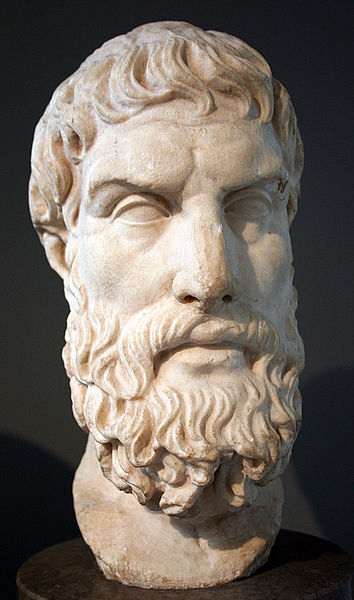
Marble bust of Epicurus. Roman copy of Greek original, 3rd century BC/2nd century BC. On display in the British Museum, London.
Photo by ChrisO via Wikimedia Commons.For 23 centuries now, Epicureans have struggled mightily against variations of the Hefner caricature. If pleasure is the highest good, the goal of the best life, must we all strive to live in pajamas, smoking a pipe in a decadent Hollywood Hills estate? Though he didn’t live in a mansion off Sunset Boulevard, at the end of the fourth century BC, at the age of 32, the philosopher Epicurus founded the Garden, a school removed from Athens’s monuments of power and politics. An inscription at the entrance read: “Stranger, here you will do well to stay; here our highest good is pleasure.” (In Chicago, Hefner’s door bore an inscription: Si Non Oscillas, Noli Tintinnare, or “If you don’t swing, don’t ring.”)
Leading life in a modern Garden is the subject of Catherine Wilson’s latest book, How to Be an Epicurean: The Ancient Art of Living Well. There was always an air of Peter Pan-like anarchy at the Playboy Mansion, but as Wilson shows us, life in the Garden was quite different. Her book is a spirited tour and defense of Epicurean philosophy, as reconstructed by the fragments Epicurus left behind in tattered papyrus and as set forth in the epic poem De Rerum Natura, “On the Nature of Things,” by the Roman poet Lucretius.
What did these pleasure-seekers believe? They start with the elementary particles, atoms — tiny, colorless, without smell, shaped this way and that, indestructible, reshuffling themselves infinitely into all the marvelous forms we see, including ourselves. Their forms get swept away by time, only to recombine again into something new — possibly another universe. Blurred in this haze of metaphysics, most atoms fall straight downward into the void, but a few swerve, and from these deviations arise our free will and all that we see. At the California Institute of Technology, physicist Richard Feynman began his lectures by wondering what single sentence would be passed on to future generations, if, in a cataclysm, all scientific knowledge was destroyed. His answer: “The atomic hypothesis that all things are made of atoms.”
With the Epicureans, we have a historical test of Feynman’s thought. The world is made of nothing more than atoms in the void, but where did that take the ancient Greeks and Romans who believed it? Wilson begins with these basic building blocks because she asserts that mistaken beliefs about nature are the source of our deepest fears and hang-ups: death, punishment in an afterlife, failure in this one, lust for power, greed, jealousy, unrequited love, and status-jockeying. “Epicurean philosophy might be said to be based on the notion of the limit,” Wilson writes. By understanding the atom and the void, by knowing that the soul is mortal and the gods indifferent, that all things pass and are forgotten, we might then liberate ourselves from the grinding weight of superstition and the vanity of ambition and pursue pleasure without guilt.
October 28, 2019
QotD: Latin versus English
Winston Churchill, My Early Life, 1930.
October 12, 2019
History Summarized: Ancient India
Overly Sarcastic Productions
Published 11 Oct 2019Go to http://www.audible.com/overlysarcastic or text
overlysarcasticto 500500 to get a free audiobook, 2 free Audible Originals, and 30-day free trial.In the first of what is sure to be a multi-part series, let’s take a look at the history of Ancient India, from the earliest civilization through the development of Sanskrit literature and all the way to the great Maurya Empire!
FURTHER READING: The Discovery of India, by Jawaharlal Nehru (https://en.wikipedia.org/wiki/The_Discovery_of_India)
PATREON: https://www.Patreon.com/OSP
DISCORD: https://discord.gg/sS5K4R3
MERCH LINKS: https://www.redbubble.com/people/OSPY…
OUR WEBSITE: https://www.OverlySarcasticProductions.com
Find us on Twitter https://www.Twitter.com/OSPYouTube
Find us on Reddit https://www.Reddit.com/r/OSP/

October 5, 2019
QotD: Individual liberty
John Stuart Mill, On Liberty, 1859.
October 4, 2019
Rise of Evil – From Populism to Fascism | BETWEEN 2 WARS I 1932 Part 4 of 4
TimeGhost History
Published 3 Oct 2019Democracy finds itself in a crisis as the 1930s take off. On a global scale, Fascist or otherwise authoritarian and repressive movements and governments seek to destroy the pillars of liberal society.
Join us on Patreon: https://www.patreon.com/TimeGhostHistory
Subscribe to our World War Two series: https://www.youtube.com/c/worldwartwo…
Hosted by: Indy Neidell
Written by: Spartacus Olsson and Joram Appel
Directed by: Spartacus Olsson and Astrid Deinhard
Executive Producers: Bodo Rittenauer, Astrid Deinhard, Indy Neidell, Spartacus Olsson
Creative Producer: Joram Appel
Post-Production Director: Wieke Kapteijns
Research by: Joram Appel and Spartacus Olsson
Edited by: Wieke Kapteijns
Sound design: Marek KamińskiSources icons: Graphic Enginer, Luis Prado
Colorizations: Daniel Weiss, Cassowary Colorizations, KlimbimA TimeGhost chronological documentary produced by OnLion Entertainment GmbH.
From the comments:
TimeGhost History
1 hour ago (edited)
This episode might be a little more academic than our other episodes, but we wanted to cover the global Fascist surge AND that it’s just too simple to refer to all totalitarian states and authoritarian and repressive movements as “Fascist”. Fascism is a very complicated concept that is still today being debated by political scientists and historians, as well as politicians and journalists. We try to give some insight to what Fascism is, what it isn’t and what all those movements and countries were, if not Fascist. We appreciate that you might have a different opinion as to what Fascism was or is, and we’re interested to hear your opinion. Just keep it civil and try to stay away from modern political debates, as that is not what we’re here for. EDIT: As for comments claiming that Fascism was left-wing/socialist, watch the video again. Don’t bother commenting if you can’t bring a proper argument to the table.
Cheers,
Joram

September 24, 2019
QotD: Conditions for the rise of tyrants in the Greek city states
Force can only ever be part of the answer. The poor have always been the majority, and sometimes the great majority. Armies of mercenaries to protect the rich have not always been available, and they have never by themselves been sufficient to compel obedience on all occasions in every respect.
Force, therefore, has always been joined by religious terrors. In Egypt, the king was a god, and the privileged system of which he was the head was part of a divine order that the common people were enjoined never to challenge. In the other monarchies of the near east, the king might not actually be a god. But all the priests taught that he was part of a divinely ordained order that it was blasphemy to challenge.
In the Greek city states until about a century before the birth of Epicurus, securing the obedience of the poor had not been a serious problem. There had been some class conflict, even in Athens. But most land was occupied by smallholders, and excess population could be decanted into the colonies of Italy and the western Mediterranean. There were rich citizens, but they were usually placed under heavy obligations to contribute to the defence and ornament of their cities.
Then a combination of commercial progress and the disruptions of the war between Athens and Sparta created a steadily widening gulf between rich and poor. There was also a growing problem of how to maintain large but unknown numbers of slaves in peaceful subjection.
The result was a class war that destabilised every Greek state. The sort of democracy seen in Athens could survive in a society where citizens were broadly equal. Once a small class of rich and a much larger class of the poor had emerged, there was a continual tendency for democratic assemblies to be led by demagogues into policies of levelling that could be ended only by the rise of a tyrant, who would secure the wealth of the majority — but who could secure it only so long as the poor could be terrified into submission. Once they could not be terrified by the threat of overwhelming force, they would rise up and dispossess the rich, until a new tyrant could emerge to subdue them again.
Unlike in the monarchies of the near east, no settled order could be maintained in Greece by religious terrors. During the sixth and fifth centuries, the Greek mind had experienced the first enlightenment of which we have record. There had been a growth of philosophy and science that revealed a world governed by laws that could be uncovered and understood by the unaided reason.
Now, enlightenments are always dangerous to an established religion. And the Greek religion was unusually weak as a counterweight to reason. The Greeks had no conception of a single, omnipotent God the Creator. Instead, they had a pantheon of supernatural beings who had not created the world, but were subject to many of its limitations. These were frequently at war with each other, and so they could be set against each other by their human worshippers with timely sacrifices and other bribes. They did not watch continually over human actions, and beyond the occasional punishment and reward to the living, they had no means of compelling observance of any code of human conduct.
And so, when the intellectual disturbance of philosophy and science spilled over into demands for a reconstruction of society in which property would be equalised, there was no religious establishment with the authority to stand by the side of the rich.
Sean Gabb, “Epicurus: Father of the Englightenment”, speaking to the 6/20 Club in London, 2007-09-06.
August 13, 2019
QotD: Karl Popper on the paradox of tolerance
In note 4 of volume 1, chapter 7, of Popper’s The Open Society and Its Enemies, he clarifies his position on how best to deal with intolerant philosophies:
… I do not imply, for instance, that we should always suppress the utterance of intolerant philosophies; as long as we can counter them by rational argument and keep them in check by public opinion, suppression would certainly be unwise. But we should claim the right to suppress them if necessary even by force; for it may easily turn out that they are not prepared to meet us on the level of rational argument, but begin by denouncing all argument; they may forbid their followers to listen to rational argument, because it is deceptive, and teach them to answer arguments by the use of their fists or pistols. We should therefore claim, in the name of tolerance, the right not to tolerate the intolerant.
It is clear from Popper’s writing that it would be unwise to resort to violence against an intolerant group that is willing to discuss and debate their ideas. So long as the intolerant group is tolerant enough to agree to debate and discuss their intolerant ideas rather than resort to violence, it is better to handle them with words.
The problem is, some groups, like Antifa, respond to arguments with violence. And it is these sorts of groups that Popper claims must not be tolerated. If a group is so intolerant that they are unwilling to discuss ideas and instead rely entirely on violence, then they must be met with violence. In other words, Popper is simply saying that a nonviolent society must, at the very least, believe in a right to use violence as a form of self-defense.
Nathan Kreider, “Misconceptions of the Paradox of Tolerance”, Being Libertarian, 2019-05-31.
July 23, 2019
QotD: Science of the ancient Greeks
The problem with all this is not just that the scholars of the Mouseion were rather more interested in the textual variants of Pindar’s paianes than studying physics, but also a common modern misunderstanding about the nature of Greek “science”. Many modern people, including modern scientists, hear about the Greeks discussing motion or “atoms” or doing geometry to measure the circumference of the Earth or the distance to the Sun and assume that they were doing “science” in the modern sense of the word. Historians also sometimes refer to Greek natural philosophy as “science” and popularisations of the history of science draw simplistic direct lines between things like Greek discussions of “atoms” and modern atomic theory. But this obscures the fact that Greek proto-science was, while a distant lineal ancestor of the modern sciences, very unlike them in many important respects. At best, it was a highly rational attempt at understanding fundamental precepts of the physical and natural world. But it used induction and common sense more than measurement and experiment. There were exceptions (mainly in geometry and its related field, astronomy), but the Greeks were usually not interested in empirical measurement and so were usually even less interested in genuine experiments. Most Greek proto-science was a highly abstract and philosophical affair, based on some observations, but without modern ideas of carefully designed and repeatable experiments with calibrated measurement and attendant mathematics. Most of their “science” was done by sitting around, thinking and talking about concepts, not by actually dropping weights from towers – though they did do thought experiments which sometimes led to correct conclusions and sometimes did not. Their “science” was not our science.
This means that a Greek conversation about “atoms” was largely an abstract and metaphysical exercise about the philosophical nature of a thing and how many times it could be divided conceptually and what this may mean; the word comes from the Greek ἄτομος meaning “unhewn, uncut, indivisible”. No Greek philosopher walked away from such a conversation and decided to try to build some equipment to explore the physical nature of atomic structure and would probably have considered such an idea absurd. Nor would they have taken the step of considering that different forms of matter, liquid or gas were made up of different combinations of atoms and so decide to experiment with these substances to understand this better, since this was completely contrary to their (erroneous) conception of the “Four Elements” of Earth, Air, Water and Fire. The nature of Greek thought did allow them to draw useful and often correct conclusions about the physical universe, but it also set up barriers to the true scientific method that they simply did not and could not cross.
This was one of the reasons there was no direct link between their proto-scientific “science” and technology. Natural philosophy was, as the term would suggest, the preserve of philosophers. In a world where most of the population had to be devoted to agricultural production and most of the rest often barely got by, sitting around and talking about abstractions like “atoms” was a rich man’s luxury. Most philosophers either came from the upper class (though maybe its lower echelons in many cases) or had rich patrons or both, which meant most philosophers had little interest in making or inventing things: that was generally the preserve of lowly mechanics and slaves. Again, there were exceptions to this – Archimedes seems to have had some interest in the engineering applications of his ideas, even if most of the inventions attributed to him are probably legends. On the whole, however, lofty Greek philosophers didn’t think to soil their hands with something as lowly as inventing and making things.
Tim O’Neill, “The Great Myths 5: The Destruction Of The Great Library Of Alexandria”, History for Atheists, 2017-07-02.


