
Invicta
Published on 4 Sep 2017Alexander the Great is one of the most famous historical figures of all time. Yet many are unaware of the 9 times he cheated death over the course of his epic campaigns into the east!
Support future documentaries: https://www.patreon.com/InvictaHistory
Twitter: https://twitter.com/InvictaHistoryVideo Credits:
Research – Invicta
Script: Invicta
Narration – Invicta
Artwork – Robbie McSweeney (https://www.artstation.com/artist/rob…)Bibliography:
Alexander the Great by Phillips Freeman
The Campaigns of Alexander by ArrianMusic: “Rome: Total War OST” by Jeff van Dyck
“Total War: Rome II OST” by Richard Beddow
April 7, 2019
Epic Moments in History – The 9 Lives of Alexander the Great
Comments Off on Epic Moments in History – The 9 Lives of Alexander the Great
February 20, 2019
History Summarized: Ancient Greece
Overly Sarcastic Productions
Published on 26 Jun 2017What’s that? Blue already did a video on the Athenian empire? Uh… well… um… LOOK, OVER THERE, A DISTRACTION!
For more Greek goodness, check out the following:
History Summarized: Alcibiades: https://youtu.be/kRLkjBUgB2o
History Summarized: Thebes: https://youtu.be/L1x9np5fys8
History Summarized: Athenian Empire: https://youtu.be/cNWDkFkcuP4This video was produced with assistance from the Boston University Undergraduate Research Opportunities Program.
PATREON: http://www.patreon.com/user?u=4664797
Find us on Twitter @OSPYouTube!
Comments Off on History Summarized: Ancient Greece
January 23, 2019
A new beginning for the Middle East: The Cyrus Cylinder and Ancient Persia
The British Museum
Published on 18 Jul 2014The Cyrus Cylinder is one of the most famous objects to have survived from the ancient world. It was inscribed in Babylonian cuneiform on the orders of Persian King Cyrus the Great (559-530 BC) after he captured Babylon in 539 BC.
The cylinder is often referred to as the first bill of human rights as it appears to encourage freedom of worship throughout the Persian Empire and to allow deported people to return to their homelands. It was found in Babylon in modern Iraq in 1879 during a British Museum excavation.
Comments Off on A new beginning for the Middle East: The Cyrus Cylinder and Ancient Persia
January 18, 2019
Xenophon’s Anabasis, Memorabilia, and Symposium
I’ve read an English translation of Xenophon’s Anabasis, but I only know a little bit about the Memorabilia, so Eve Browning‘s essay at Aeon was quite interesting:
The Anabasis is the first military memoir in the history of Western literature, and it recounts Xenophon’s experiences in the Persian campaign of Cyrus against his brother King Artaxerxes, and the long march ‘up country’. Since Xenophon waited several decades to commit these memories to writing, some have argued that they cannot be accurate. But as anyone who has listened to combat veterans will know, there’s a lot about the remembrance of past tours of duty that time cannot soften nor the years wear away.
Xenophon also wrote histories, portraits of leaders, practical treatises on horse training, hunting and running a household, among other things. An enduring theme that runs through much of his writing, and which has received scholarly attention in recent years, is that of leadership. What makes a good leader? What kind of leader can induce humans to endure hardships and expend effort toward a common goal? What exemplary traits mark out a leader and allow him or her to execute the requisite tasks with skill, induce a harmonious fellowship among those for whom he is responsible, maintain loyalty and mission clarity among the ‘troops’, whomever they might be? It is not difficult to see the formative roots of these questions, and of Xenophon’s answers to them, in that literally death-defying, embattled 2,000-mile march up-country to the sea.
Xenophon also wrote down his remembrances of a local philosopher named Socrates. Those who know Socrates mainly through the writings of Plato – Xenophon’s near-exact contemporary – will find Xenophon’s Socrates something of a surprise. Plato’s Socrates claims to know nothing, and flamboyantly refutes the knowledge claims of others. In the pages of Xenophon’s Memorabilia, however, Socrates actually answers philosophical questions, dispenses practical life advice, provides arguments proving the existence of benevolent gods, converses as if peer-to-peer with a courtesan, and even proposes a domestic economy scheme whereby indigent female relatives can become productive through the establishment of a textile business at home.
Socrates’ conversation, according to Xenophon, ‘was ever of human things’. This engaged, intensely practical, human Socrates can be refreshing to encounter. Anyone who has felt discomfort at how the opponents of Plato’s Socrates suffer relentless public refutations and reductions to absurdity can take some comfort in Xenophon’s Socrates who ‘tries to cure the perplexities of his friends’.
For instance, what could be more enchanting than a Socrates who solo-dances for joy and exercise, so unlike the Socrates we know from Plato? In Xenophon’s Symposium, Socrates asks the Phoenician dance-master to show him some dance moves. Everyone laughs: what will you do with dance moves, Socrates? He replies: ‘I’ll dance, by God!’ A friend of Socrates then tells the group that he had stopped by his house early in the morning, and found him dancing alone. When questioned about it, Socrates happily confesses to solo-dancing often. It’s great exercise, it moves the body in symmetry, it can be done indoors or outdoors with no equipment, and it freshens the appetite.
Another surprising side of Xenophon’s Socrates is shown through his encounter with a person who not only doesn’t honour the gods, but makes fun of people who do. To this irreligious person, Socrates presents a careful and persuasive line of reasoning about the designed usefulness of all elements of creation. For humans and many other animals, there are ‘eyes so that they can see what can be seen, and ears so that they can hear what can be heard’, eyelids, eyelashes, molars and incisors, erotic desire to aid procreation; all these are ‘the contrivance of some wise craftsman who loves animals’. And what about the cosmos as a whole? ‘Are you, then, of the opinion that … those surpassingly large and infinitely numerous things are in such an orderly condition through some senselessness?’ Human beings even have the spiritual capacity to perceive the existence of gods, ‘who put in order the greatest and noblest things’, and ‘they worry about you!’
H/T to Never Yet Melted for the link.
Comments Off on Xenophon’s Anabasis, Memorabilia, and Symposium
October 15, 2018
German Afghanistan Mission I OUT OF THE ETHER
The Great War
Published on 13 Oct 2018Thank you again Jack Sharpe!
Comments Off on German Afghanistan Mission I OUT OF THE ETHER
September 16, 2018
Early Arab Conquests | 3 Minute History
Jabzy
Published on 13 Dec 2015Covering the conquests during the Rashidun Caliphate. I will probably do a separate video on the First Fitna.
Thanks for the 15,000 subs. And thanks to Xios, Alan Haskayne, Lachlan Lindenmayer, Derpvic, Seth Reeves and all my other Patrons. If you want to help out – https://www.patreon.com/Jabzy?ty=h
Comments Off on Early Arab Conquests | 3 Minute History
August 31, 2018
How did Britain Conquer India? | Animated History
The Armchair Historian
Published on 10 Aug 2018Check out History With Hilbert: https://www.youtube.com/watch?v=Hs1sw…
Our Patreon: https://www.patreon.com/armchairhistory
Our Twitter: https://twitter.com/ArmchairHist
Sources:
https://dailyhistory.org/Why_was_Brit…
1857 Indian War of Independence: 1857 Indian Sepoys’ Mutiny, Shahid Hussain Raja
The East India Company, Brian Gardner
The Corporation that Changed the World: How the East India Company Shaped the Modern Multinational, Nick Robins
A History of India, Peter Robb
Comments Off on How did Britain Conquer India? | Animated History
July 30, 2018
Pour Le Merite – Persia – Polish Legions I OUT OF THE TRENCHES
The Great War
Published on 28 Jul 2018Chair of Wisdom Time!
Comments Off on Pour Le Merite – Persia – Polish Legions I OUT OF THE TRENCHES
July 15, 2018
Alcibiades, the Athenian Byron
Not for poetry, but for the Byronian swathe he cut through a large portion of Classical Greece:
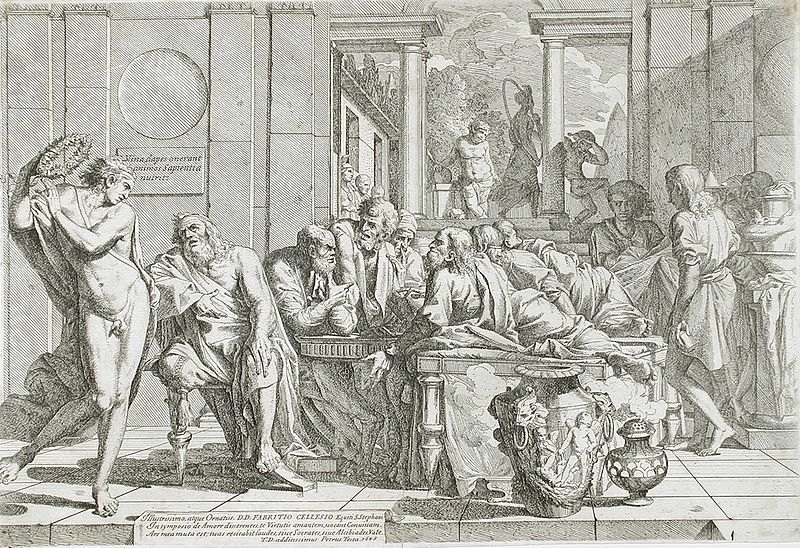
“Drunken Alcibiades interrupting the Symposium”, an engraving from 1648 by Pietro Testa (1611-1650)
Via Wikimedia Commons.
Of all personality traits, charisma is the hardest to appreciate at second hand. We read Cicero’s letters and can instantly tell that he was vain, insecure and ferociously clever; we read scraps of Samuel Johnson’s conversation in Boswell’s biography and know at once that he was magnificent, lovable and desperately unhappy. But as to what it was like to have Lord Byron turn the full force of his attention onto you – well, we have no conceivable way of knowing. We just have to trust his contemporaries that it felt like ‘the opening of the gate of heaven’.
This causes problems for a biographer of Alcibiades. On the face of it, the man was utterly insufferable. Born in around 450 BC into one of the oldest and richest families of ancient Athens, Alcibiades was the only Old Etonian (as it were) to play a leading role in the late-fifth-century radical democracy. The account of his childhood in Plutarch’s Life of Alcibiades suggests a bad case of antisocial personality disorder: biting during wrestling, mutilating dogs, punching his future father-in-law in the face for a dare. His later political career makes Boris Johnson seem like a man of firm and unbending principle. Exiled from Athens in 415 BC over some particularly odious Bullingdon Club antics, Alcibiades promptly sold his services to Sparta (where he seduced the king’s wife) before double-crossing both sides and wheedling his way into the court of a Persian satrap.
But Alcibiades, like Byron, clearly had that indefinable something. One catches a glimpse of it in the unforgettable last scene of Plato’s Symposium, when he crashes into the room, blind drunk, flirting with everything on legs, shouting about his love for Socrates. Thucydides captures it in his report of Alcibiades’s speech whipping up the Athenian assembly to vote for the disastrous Sicilian expedition of 415 BC – an extraordinary stew of egotistic bragging (about how successful his racehorses are), mendacious demagoguery and brilliantly acute strategic thinking. The unwashed Athenian masses, not usually prone to atavistic toff-grovelling, absolutely adored him: when Alcibiades finally returned to Athens in 407 BC after eight years of exile, sailing coolly into Piraeus on a ship with purple sails, they welcomed him back with paroxysms of joy.
Behind the Peloponnese-sized ego, Alcibiades was a general of spectacular genius – when he could be bothered. In 410 BC, shortly after his controversial reinstatement as admiral of the Athenian navy (on the back of a bogus promise of Persian support), he wiped out the entire Spartan fleet at the Battle of Cyzicus; two years later, through sheer chutzpah, he captured the city of Selymbria near Byzantium with only fifty soldiers, and without striking a blow. When things went wrong – as in 406 BC, after a disastrous campaigning season in the eastern Aegean – he showed an infuriating ability to wriggle out of trouble. His final years (406–404 BC) were spent once again in exile from Athens, holed up in a private castle on the Gallipoli peninsula. The circumstances of his death are still shrouded in mystery. One story tells that he died in the remote mountains of central Turkey at the hands of the brothers of a Phrygian noblewoman whom he had decided to seduce. This is, I fear, all too believable.
This is the introduction to a review by Peter Thonemann of a new biography of Alcibiades by David Stuttard in the Literary Review for July, 2018. H/T to Never Yet Melted for the link.
Comments Off on Alcibiades, the Athenian Byron
June 16, 2018
Thermopylae – East vs. West – Extra History – #2
Extra Credits
Published on 14 Jun 2018Brought to you by Total War: Arena! Use the code HOPLITE for extra goodies: https://totalwararena.net/join/4064_EN1…
Why does everyone know the Greek defeat at Thermopylae, but victories like Salamis and Plataea remain obscure? Because it helped define Greek, and thus “western” culture. And that’s thanks to one man: Herodotus.
The oracle said that a Spartan king must fall in battle or Sparta would burn. So when Persia said “hand over your weapons” Leonidas said “come and take them.”
Comments Off on Thermopylae – East vs. West – Extra History – #2
June 9, 2018
Thermopylae – The Hellenic Alliance – Extra History – #1
Extra Credits
Published on 7 Jun 2018A small handful of Grecian city-states have come together to stand off against the invading Persians at Thermopylae. At this fateful mountain pass, Greece will discover its identity as a nation.
The Battle of Thermopylae is one of the most significant events in the ancient world — and also one of the least understood.
Brought to you by Total War: Arena! Use the code HOPLITE for extra goodies:
https://totalwararena.net/join/4064_EN1…
Comments Off on Thermopylae – The Hellenic Alliance – Extra History – #1
May 27, 2018
Middle East: Odenathus – Ghosts of the Desert – Extra History
Extra Credits
Published on 31 Oct 2015Watch the afterword about Palmyra Today: http://bit.ly/1kiAKTN
Support us on Patreon: http://bit.ly/EHPatreon
____________In 260 CE, the Roman Empire was falling apart on all sides. Emperor Valerian gathered the legions to push back on the worst incursions from the Sassanid Empire in the east. They not only lost – they were massacred, and the emperor was taken captive. This left the empire in disarray. Into this desperate moment stepped Odenathus from the city-state of Palmyra. Palmyra was a vassal state that owed fealty to Rome and had been decorated with many honors and recognition in the past. If Rome fell, the Sassanid Empire would certainly look to conquer and annex Palmyra, so Odenathus rode to the rescue. He gathered all the soldiers he could find and took the Sassanid army by surprise on their way back from the battle with Valerian. He destroyed them. From there, he rode north to protect the emperor’s son, and the next heir to Rome, then south again where he pushed the Sassanids all the way back to their capitol twice. Despite his success and undeniable military power, he never took power for himself or declared himself an emperor. Rome showered him with appreciation and titles. Sadly, he was murdered by his nephew in 267 CE, but his loyalty had bought the Roman Empire enough time to recover and survive for another 200 years.
Comments Off on Middle East: Odenathus – Ghosts of the Desert – Extra History
February 4, 2018
Khosrau Anushirawan – Lies – Extra History
Extra Credits
Published on 3 Feb 2018Why did we refer to Khosrau’s empire as Iran, not Persia? Did Mazdak really exist, or was his proto-communist movement pure propaganda? Dan (narrator) and Soraya (writer) tackle these questions and address the large issue of how perspective can shape one’s idea of the truth.
Comments Off on Khosrau Anushirawan – Lies – Extra History
January 22, 2018
Khosrau Anushirawan: On Top of the World – Extra History – #5
Extra Credits
Published on 20 Jan 2018Plague had brought an end to Khosrau’s war against Justinian, but Justinian’s nephew soon reignited the rivalry. Khosrau was at the peak of his political power and eager to crush this young upstart personally… but old age had also crept up on him.
Comments Off on Khosrau Anushirawan: On Top of the World – Extra History – #5
January 15, 2018
Khosrau Anushirawan: Trolling Justinian – Extra History – #4
Extra Credits
Published on 13 Jan 2018Iran and Rome had agreed to an Eternal Peace, but tensions between them proved too great and Khosrau decided to invade while Justinian’s guard was down. His army swept into Rome practically unopposed, and he made a mockery of Justinian at every opportunity while treating himself to a grand old time pillaging and parading across the Roman border.
Comments Off on Khosrau Anushirawan: Trolling Justinian – Extra History – #4


