
Unpopular ideas can be silenced, and inconvenient facts kept dark, without the need for any official ban. Anyone who has lived long in a foreign country will know of instances of sensational items of news — things which on their own merits would get the big headlines — being kept right out of the British press, not because the Government intervened but because of a general tacit agreement that “it wouldn’t do” to mention that particular fact. So far as the daily newspapers go, this is easy to understand. The British press is extremely centralised, and most of it is owned by wealthy men who have every motive to be dishonest on certain important topics. But the same kind of veiled censorship also operates in books and periodicals, as well as in plays, films and radio. At any given moment there is an orthodoxy, a body of ideas which it is assumed that all right-thinking people will accept without question. It is not exactly forbidden to say this, that or the other, but it is “not done” to say it, just as in mid-Victorian times it was “not done” to mention trousers in the presence of a lady. Anyone who challenges the prevailing orthodoxy finds himself silenced with surprising effectiveness. A genuinely unfashionable opinion is almost never given a fair hearing, either in the popular press or in the highbrow periodicals.
At this moment what is demanded by the prevailing orthodoxy is an uncritical admiration of Soviet Russia. Everyone knows this, nearly everyone acts on it. Any serious criticism of the Soviet régime, any disclosure of facts which the Soviet government would prefer to keep hidden, is next door to unprintable. And this nation-wide conspiracy to flatter our ally takes place, curiously enough, against a background of genuine intellectual tolerance. For though you are not allowed to criticise the Soviet government, at least you are reasonably free to criticise our own. Hardly anyone will print an attack on Stalin, but it is quite safe to attack Churchill, at any rate in books and periodicals. And throughout five years of war, during two or three of which we were fighting for national survival, countless books, pamphlets and articles advocating a compromise peace have been published without interference. More, they have been published without exciting much disapproval. So long as the prestige of the USSR is not involved, the principle of free speech has been reasonably well upheld. There are other forbidden topics, and I shall mention some of them presently, but the prevailing attitude towards the USSR is much the most serious symptom. It is, as it were, spontaneous, and is not due to the action of any pressure group.
George Orwell, Unpublished Preface to Animal Farm, 1945.
June 5, 2021
QotD: British wartime censorship
May 29, 2021
Justin Trudeau is clearly not concerned about China or Chinese involvement in Canadian affairs
In The Line, Jen Gerson outlines the PM’s latest display of insouciance in regard to anything involving China, their ruling Communist party, or the Chinese military:
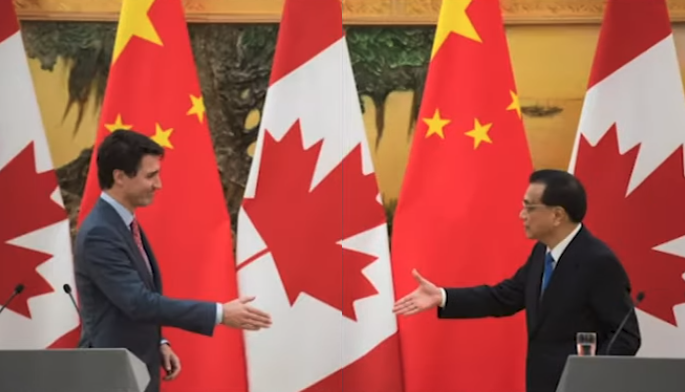
The Globe and Mail reported last week that Canada’s top infectious disease research centre, the National Microbiology Laboratory in Winnipeg, had hosted and otherwise collaborated with guest researchers and scientists from China — including some with links to that country’s military or government. O’Toole asked about this in the House, and Trudeau gave a very routine Trudeauvian non-answer. O’Toole and other Tories kept up the questioning, Trudeau eventually responded with this (as per Hansard): “Mr. Speaker, we have always and will always take this threat seriously. Public safety officials have met with more than 34 universities to help them keep their research safe. In 2020, CSIS engaged more than 225 different organizations, including universities, to ensure that they were aware of foreign threats. I also want to mention that we are seeing a disturbing rise in anti-Asian racism. I hope that my Conservative Party colleagues are not raising fears about Asian Canadians.”
Sigh. Where do we begin?
First of all, though this may shock our readers, the Sun papers, and its columnists, have been known to exaggerate their criticisms of the PM. The PM gave a more substantive answer than Lilley gave him credit for. You can disagree with the PM — see below! — without getting cute with what he actually said. The racism line was dumb, and shitty. It was beneath the PM and unfair to the legitimate questions that were being asked. Trudeau shouldn’t have said it, and he was right to get called out for it.
So yes, a dick move by the PM — in a hundred years, maybe one of his descendants can apologize for it. But let’s not take our eye off the ball.
Trudeau’s answers were more than Lilley suggested, but they’re still not good enough. O’Toole and the Conservatives are onto something. China’s ruling regime is aggressive, brutal, and thuggish. They’re a threat to security abroad, they’re committing outright crimes against humanity against their own religious minorities, they’ve crushed Hong Kong underfoot, and they’re actively hostile to Canada. None of this is racist to note.
And yet our federal Liberals remain alarmingly unable to admit any of this. We don’t buy that it’s just a matter of political expediency, an awkward but necessary consequence of the ongoing detention of the two Michaels. Hell, we wish that the Liberals were just being publicly cautious with their real views on Beijing while remaining clear-eyed about the threat behind closed doors. The evidence continues to suggest that the federal Liberals, from Trudeau on down, remain hopelessly naïve about the nature of Beijing’s rulers, even as more and more of our allies are getting real about what the next generation or two of geopolitics is gonna look like for the Western alliance. (Which Canada remains a part of, whether Trudeau likes it or not.)
The growing tensions with a rising China are a big deal. It is only going to become a bigger deal. The Liberals need to get with the program. We hope to see more on this across the Canadian media — and hopefully it’s a bit more useful and productive than what the Sun ran with this week. The Liberals look terrible on this file already for entirely legitimate, serious reasons. We don’t need to pop our aging joints as we stretch and contort ourselves to make it seem so.
May 13, 2021
QotD: Blogging
I’d say it’s a throwback to the old newspapers, the days when partisan slants covered everything from the play story to the radio listings, but this is different. The link changes everything. When someone derides or exalts a piece, the link lets you examine the thing itself without interference. TV can’t do that. Radio can’t do that. Newspapers and magazines don’t have the space. My time on the internet resembles eight hours at a coffee shop stocked with every periodical in the world — if someone says “I read something stupid” or “there was this wonderful piece in the Atlantic” then conversation stops while you read the piece and make up your own mind.
James Lileks, The Bleat, 2002-10-10.
May 1, 2021
The more we ask governments to do, the less well they do … everything
Matt Gurney’s latest Code 47 post reflects on the good and bad of Canadian governance right now (and yes, I agree with his basic take that despite buffoonery and incompetence at all levels of government, Canadians still generally have it good):

Parliament Hill in Ottawa.
Photo by S Nameirakpam via Wikimedia Commons.
In some ways, absolutely. Canada’s relative awesomeness is not an accident. We rest on the accomplishments of prior generations and some of what we do today contributes directly to the common prosperity. A ton of stuff happens behind the scenes, every day, that contribute enormously to our way of life — really, make it possible. But in other ways, the pandemic has revealed just how incompetent and inept our governments have become meeting new challenges. It’s like every last bit of bandwidth our governments have is used up just keeping the status quo running along, and if we ask it to do anything new, it’s like hitting a computer with one process too many for its CPU. It just locks up.
Real-life example: I was watching today as the Ontario and federal governments continued bickering about the proper border controls we should have during what will probably be the last phase of this crisis. And what struck me was the sheer insanity of not having settled this a long time ago. I’m not even saying what I think the answer should have been. There’s a lot of genuinely competing interests there. I have my opinion, you can have yours. But can we at least agree that what to do about the goddamn borders ought not to still be under active decision 14 frickin’ months after this all began?

The federal government, in particular, seems to have fallen into a trap of its own making in that it corporately seems to believe that saying they’ll do something is exactly the same as actually doing something. Often enough, I’m pleased and relieved to find that Trudeau Jr.’s latest brain fart never got further than the press release and obligatory photo op, but it has become a constant in federal affairs. Optics matter far more than achievements, as long as the tame Canadian media play along — and they always played along with their boyfriend PM even before he bought them off with real money — nothing really changes. And everyone seems generally okay with this … except that real problems are not being addressed (ask any First Nations representative about how well the feds are helping with long-standing, known issues, for instance).
Certain provinces have done better than others. It’s tempting to point at them and go, ah ha, there’s what we should have done. And I think this is in large part fair and true. But it’s hard to make direct comparisons. Nova Scotia is not Ontario, and what worked in Nova Scotia wouldn’t necessarily have worked here. Believe me, if I could have swapped in their leaders for ours, I would have. It would have been an upgrade for sure. But the right solution, and personalities, for one crisis, in one time and place, aren’t necessarily the right solution for even that same crisis, at the same time, in a different place. I suspect we’ll spend a long time arguing about this once it’s all over, but I think that’s more or less where I’ve landed. Most of us would have been better off trying to be more like the Atlantic, but that doesn’t mean it would have recreated Atlantic-like successes everywhere.
But all that being said, there have been enormous basic failures, both in leadership and execution. You’ve all heard the joke about how someone new to government is shocked and dispirited to finally seize the levers of power, only to discover they’re not connected to anything. You can push and pull the levers all day long. But they don’t do anything. In Canada, both federally and in some of the provinces, we’ve been shockingly slow, again and again, to pull those levers. And sometimes, even after they’re pulled, nothing happens.
I don’t know if I have this thought through yet in a meaningful, useful way. This is a big, big idea that I’m starting at from different angles, trying to even conceive of its dimensions and scope. But if there is one problem we have — we have more, but if there is a meta-problem — I think it is that Canadian governments have lost the ability to execute new policy agendas. What we already have will generally work, more or less. But new things, or updates to old things? We routinely accept that failure is an option, or that even our successes will be late and overbudget — beyond acceptable real-world margins. (Life is always more complicated than theory.) There are things in my life that I just take for granted will work. If I get into my car and it doesn’t start, that surprises me, even though I am intellectually aware that that’s a possibility every time I try. But too often, with government, there is an entirely justified skepticism that it’ll succeed at all, let alone as intended, and yet, we shrug, because, hey. It’s Canada. Things are still good. How upset can I get about another program failure when I can just go fire up the barbecue and watch some hockey or something.
Governments are generally not very good at solving problems, especially novel problems that don’t already have a template to follow for success in similar circumstances. Set up a bureaucracy, establish processes and procedures, and set it in motion and it’ll carry on until the final Trump, but don’t ask it to cope with a crisis or even just an unexpected event or six. That’s not what they’re good at and they generally lack the organizational flexibility to adapt on the fly. Or at all.
QotD: “WOLF! Film at 11”
Natalie Solent, “Why do Americans think the media might be hiding things from them? Let’s try asking Tony Bobulinski on Twitter”, Samizdata, 2021-01-13.
April 9, 2021
QotD: Instant expertise
One of the effects of the COVID-19 epidemic has been to reveal to a very large percentage of the population the joys of instant expertise. The world now has hundreds of millions, if not several billions, of epidemiologists, virologists, and clinicians, all of whom know best how to deal with the pandemic. The only problem is that their solutions are at variance with one another.
It sometimes seems as if the certainty with which views are held is inversely proportional to the solidity of the factual basis on which they are founded. If commentary on the internet is anything to go by (it might not be, of course, for those who avail themselves of this means of self-expression are a self-selected rather than a representative sample), people often take a religious attitude toward their own doctrine and condemn as heretics all those who express doubts about it. I don’t want to sound like a psychoanalyst, that class of person who believes that he unfailingly knows the real meaning of what is said rather than its merely apparent meaning, but stridency of views is often indicative of unacknowledged uncertainties. Zinc supplementarians and others of the type cling to their beliefs with a fervor that evidence does not merit.
Theodore Dalrymple, “Everyone’s an Expert”, Taki’s Magazine, 2020-10-16.
March 17, 2021
The long-gone economic framework of print newspapers
In The Line, Peter Menzies explains the economic underpinnings of the newspaper world back in the “good old days” before first radio, then TV, and finally the internet took all the profits out of their model:
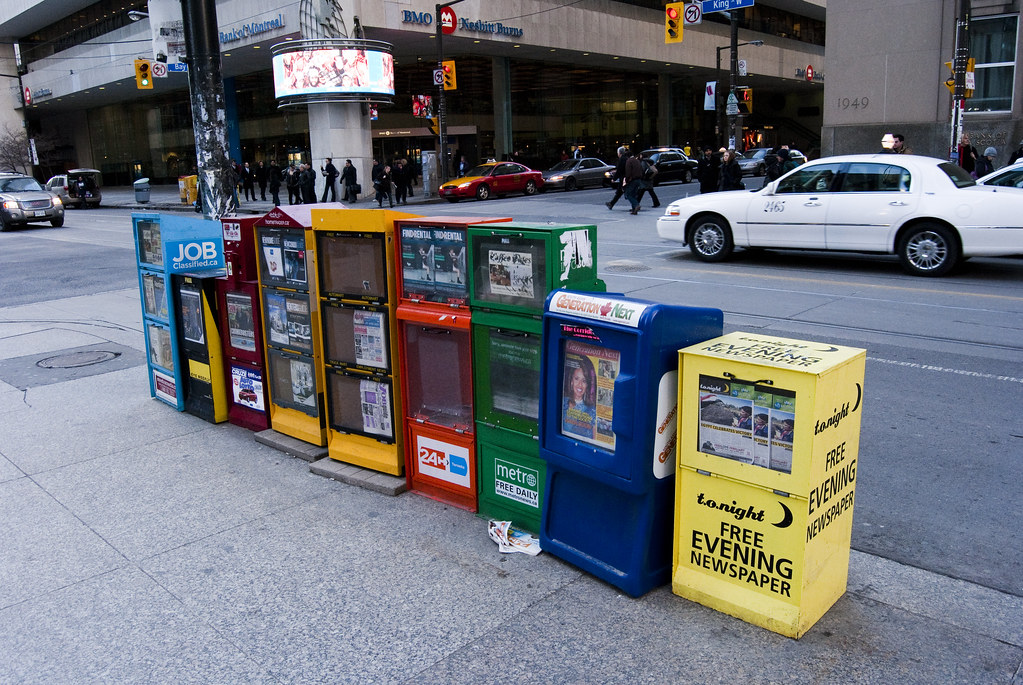
“Newspaper Boxes” by Randy Landicho is licensed under CC BY 2.0

We will hear a lot in the months ahead about who’s making money from news, so let’s get something straight: Even in the profit-soaked heyday of Canadian newspapers, no one made money from news.
That all ended about 100 years ago when radio — and then television — began delivering it for free.
Oh sure, the occasional ongoing news story would inspire people to buy more newspapers. But in my 30 years in that business the only event that did so in any significant way was the death and funeral of Princess Diana. Even then, after the extra cost of newsprint and distribution, the financial return was insignificant.
But mythologies die hard. People in newsrooms believed news made money — and apparently some still do — even when year after year, surveys of readers showed that there were lots of other things that sold and sustained newspapers.
Some people bought them because they were looking for a job. For others, it was a house, a plumber, a companion, a pet, a car or, really, almost anything else you can think of that might be needed. Classified pages were every town and city’s marketplace. That’s where you found stuff you had to get and bought an ad when you had something to sell or tell people about. It was where you announced the births of your babies, the graduations, engagements and weddings of your children and the deaths of your parents. The lives of communities were recorded in the classified pages of their newspapers.
After a glance at the headlines, many other readers’ first and sometimes only stops were the horoscope, comics, crossword (an error there generated far more calls than a rogue columnist ever could) and other pleasant distractions. For still more, it was the stocks listings, sports scores or recipes to which they were primarily drawn.
There were movie and entertainment listings — even a TV guide so you’d know where and when to find Seinfeld. On Thursdays, you might buy a paper just for the Canadian Tire flyer. On weekends, specialty sections discussed books and told tales of travel adventures well-supported by the latest deals advertised by travel agencies. Housing developers pitched their latest home designs in special real estate sections. And there were magazines. Honestly, there were.
It’s been literal decades since we last subscribed to a print newspaper, and nearly as long since I picked one up from a news stand. My mother is the last person I recall still depending on buying a physical newspaper — she only stopped buying a Saturday Toronto Star in the last year or so — but that was mainly for the TV listings. Back when I still occasionally travelled on business (also more than a decade ago, now), it was a nostalgic treat to find a copy of USA Today at the door of my hotel room in the morning.
March 11, 2021
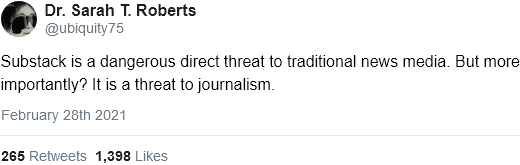
Substack is “‘incredibly dangerous and damaging’ to ‘one of the few failsafes against anti-democratic maneuvers'”
At The Line, Matt Gurney discusses Substack in the light of extreme criticism by, among others, UCLA professor of information studies Dr. Sarah T. Roberts:

It wasn’t long ago that Jen Gerson and I wrote damn similar columns within days of each other. She was writing here, at The Line, and I was writing at my personal blog, Code 47. We both discussed Substack, the digital publishing company you’re reading at this very moment — The Line is currently hosted on Substack.
Or, if you prefer, Substack is a “a dangerous direct threat to traditional news media” and “a threat to journalism.”
That is the view of Dr. Sarah T. Roberts, a professor of information studies at UCLA, who unloaded on Substack (and some of those who use it) in a recent Twitter thread. You can read it here, and should, but for our purposes, Roberts argues that Substack is bad because it lets journalists who have come up through the traditional newsroom system bail on it, stop bothering with the trouble of an editor, “cash out” on the reputation they earned in newsrooms, and transform themselves from a “journalist” to that vastly lower order of life, “an opinion writer, at best.” Ouch!
Roberts makes an explicit appeal to her Twitter followers: do not pay for Substack content. Do not write for Substack. (She does carve out exceptions for purely personal blogs on trivial topics.) But Substack as a journalism venture is, in her view, “incredibly dangerous and damaging” to “one of the few failsafes against anti-democratic maneuvers … We really can’t afford to lose [journalism] right now.”
This is my summary of what she said — perhaps she’d quibble with it, which is why I’m encouraging you, all of you, to go read her original thread. Get it in her own words and judge for yourself if I’ve been fair.
Assuming I’ve passed your muster, like, yikes. Where to start?
Roberts is, of course, as entitled to her views as any one, and if she hates Substack with a fiery passion, that’s totally fine. And I think there is some truth to her argument, as Jen and I both noted in our earlier pieces: there no doubt are some people with big profiles, who built those profiles working for traditional newsrooms, who will bail on that job to go make money — maybe lots of money! — on Substack. This is a threat to legacy media organizations, who are more reliant than ever on a few key contributors, who serve not only as click magnets, but also human avatars of an outlet’s brand. Roberts’ argument is on the money here.
But the sum of what she left out of her argument is so gigantic that it practically warrants a Substack of its own.
March 6, 2021
QotD: Why “the rich” benefit more from tax cuts
There is that objectionable idea that not taxing something is a giveaway. The root presumption there is that everything belongs to the State and we’re lucky it allows us to keep anything to deploy as we desire and not as those who stay awake in committee do. This is not an assumption that leads to a free country nor populace, nor a liberal society.
But it’s also to miss that logical point, that if income tax is to be reduced then it must be those currently paying income tax who benefit from not doing so in the future under the new rates. […] The low paid cough up hardly anything in income tax. Therefore the low paid gain hardly anything from income tax being reduced. This should be obvious.
Tim Worstall, “Budget Revelation – Those Who Pay Income Tax Benefit From Income Tax Cuts”, Continental Telegraph, 2018-10-30.
February 23, 2021
The danger period is when “the coherence of the news breaks” … and it appears to be breaking before our eyes
In the latest Libertarian Enterprise, Sarah Hoyt remembers the breakdown of the Soviet Union and the disturbing parallels we can see today:

[Click to see full-size flowchart]
Our likelihood of coming out of this a constitutional republic is still high. Why? Well, because societies under stress become more themselves.
I remember when the USSR fell. And out of the ashes Tzar Putin emerged, who is despicable, but not particularly out of keeping with Russian monarchy.
So, yeah, the pull of our culture will be towards the reestablishment of who and what we are and were: a constitutional republic.
But on the way …
Look, I remember when the USSR fell.
The people in the USSR knew they were being treated like mushrooms: kept in the dark and fed on crap. They knew there was truth in Pravda. But they were used to having certain information, and interpreting it.
And there is something worse than reading the news in totalitarianism. You can get used to interpreting the news, and knowing the shape of the hole of what they’re not reporting.
But once you realize it’s all nonsense, once the coherence of the news breaks — and it’s doing so now, earlier than I expected, with the Times article, with the New York Times admitting the protesters at the capitol didn’t kill the police officer — once there are holes, but they’re not consistent, or they’re consistent, but then contradicted; once the narrative changes almost by the week, to the point it can’t be ignored, that’s the dangerous period.
I know I joke that by the end of this year I’ll have to apologize to the lizard-people conspiracy theorists. But the problem is that the lizard people conspiracy theorists can acquire respectability and a strange new respect. Or something even crazier. Heck, a lot of crazier things.
To an extent the 9/11 troofer conspiracies, which yes, are crazy and also anti-scientific were our warning shot. That they flourished and that to this day a lot of people believe them means that there was already a sense that the news made no sense, that there were other things going on behind the scenes that we weren’t aware of.
It’s going to get far, far worse than that, as the actual elites, the top of various fields fall like struck trees in a thunder storm. There is a good chance that authorities you rely on for your profession, or just for your knowledge have been compromised. A lot of our research is tainted by China paying to get the results it wants, for instance. And there’s probably worse. You already know most research can’t be reproduced, and that’s not even recent.
As all this stuff comes out, the problem is that people won’t stop believing. Instead they’ll believe in all and everything.
I don’t know how much was reported here, as the USSR collapsed. but I remember what I read in European magazines and journals. All of a sudden it was all new age mysticism and spoon bending and only the good Lord knew what else.
And that’s what we’re going to head into. So, when you find yourself in the middle of an elaborate explanation that someone constructed, well …
First find the facts. Pace Heinlein: Again, and again what are the facts. Never mind if your ideology demands they be something else. Establish the facts to the extent you can. Facts and math don’t lie. (Statistics do. So be aware you can lie with them. And any metrics that involve intangibles, like intelligence or performance much less sociability or micro anything? forget about it.)
From the facts, deploy Occam’s razor. What is the simplest explanation?
Then remember that humans run at the mouth, and the more humans in the conspiracy, the more facts are likely to leak out somewhere.
And while we’ve seen a lot of Omerta among leftists, note that they’re all afflicted by evil villain syndrome. Sooner or later, they brag about how clever they were in deceiving us. So, if your conspiracy theory requires perfect silence forever, it’s probably not true.
February 21, 2021
QotD: Journalism
Hunter S. Thompson, Fear and Loathing in Las Vegas, 1972.
February 15, 2021
The current (and future) rash of newsroom purges
Some thoughts from The Line on why people like former New York Times science reporter Donald McNeil are being given the show trial treatment and why it’s not going to stop quickly:

The New York Times Building in New York City, 1 January, 2008.
Photo by Frieder Blickle via Wikimedia Commons.
The first issue, of course, is a steady weaponization of HR processes and unions. Vehicles intended to fix problems like unfair pay structures, workplace misconduct and lack of due process are being re-deployed as tools of ideological conformity — fuelled by healthy doses of personal dislike and professional resentment.
Make no mistake: there are bad people in journalism, as there are in any profession. Abusers should be rooted out, and there should always be clear processes in place to handle toxic personalities fairly, decisively and effectively. (“Fairly” isn’t a buzzword here — the accused must have rights, too.)
But there has also been a steady lowering of the bar as to what evils warrant an HR intervention. Every newsroom should be a safe place from abuse, harassment and violence — but not from ideas that are offensive. We recognize the entirely legitimate concerns of employees who are from marginalized groups about historic injustices, microaggressions and systemic power imbalances. But being in the world sometimes involves working with people who are simply insensitive assholes. Drawing the line between the merely difficult and the truly dysfunctional isn’t always easy.
Further, many of the complaints now being bandied about are strategic. They are being used to pummel terrified HR staffs and weak, ineffectual managers into compliance with ideological agendas. A staff at war with itself and ever-fearful of the axe is easier to silence and control. Owners have long understood this; it’s a grim irony that our peers have now decided to take up the hood and the blade.
These workplace revolts always boil down to an internal struggle for control. The very concept of where power rests is being challenged by those who think the traditional way of running newsrooms is as obsolete as a classifieds page. Uprisings are about who decides institutional values, and who gets to enforce those values. An entire class of leaders needs to wake up to the fact that they’re three campaigns deep into a battle for their own legitimacy. And they’re losing.
That brings us to the third issue: management. We’ve said this before, but managers need to show some spine. The most consistent theme in all these newsroom eruptions is management either lacking the confidence to assert its authority, or hesitating to do so just long enough to make things worse. Too many leaders have been selected for their affability rather than their toughness. We at The Line suspect this is no accident. Powerful editors, necessary for effective management of staff, are inconvenient for owners intent on slashing said newsrooms. The kind of people who’d be most effective at crushing the odd staff rebellion also annoy the suits. So instead, we get nice people — truly nice people — who know the right folks and subscribe to the right politics, and shy away from embarrassment, conflict, and loss of status. They’re marks.
February 8, 2021
The quality of medical information available to journalists
Scott Alexander shows the conflicting agendas of journalists and the medical professionals they depend on for their background information in writing about medical issues:
I heard from a journalist yesterday after writing yesterday’s post on WebMD. They’ve been trying to write a coronavirus article worthy of Zvi or any of the other illegibly smart people writing on the pandemic. Apparently the bottleneck is sources.
In most journalistic settings, you can’t just write “here’s what I think”. You have to write “here’s what my source, a recognized expert, said when I interviewed them”. And the experts are pretty sparing with their interviews for contrarian stories.
The way my correspondent described it: sources don’t usually get to approve the way they’re quoted in an article, or to see it before it gets published. So they’re really cagey about saying anything that might get misinterpreted. Maybe their real opinion is that X is a hard question, there are good points on both sides, but overall they think it probably isn’t true. But if a reporter wants to write “X Is Dumb And All Epidemiologists Are Idiots For Believing It”, they can slice and dice your interview until your cautiously-skeptical-of-X statement sounds like you’re backing them up. So experts end up paranoid about saying potentially-controversial-sounding things to reporters. And since reporters can’t write without sources, it’s hard for them to write anything controversial about epidemiology.
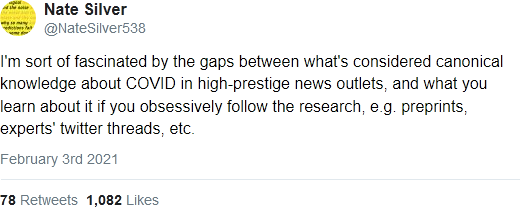
The incentives for the journalist and their editor is to find a sensational angle to get as many people to read the piece as possible (“clickbait” works). The incentives for the “expert sources” are to avoid saying anything substantive that might provide such an angle (“don’t become a headline”). It’s no wonder that journalists with no specialized training in the experts’ area are unable to produce fully informative articles for public consumption.
February 2, 2021
Well, it is a very, very cunning plan …
In the latest Libertarian Enterprise, Sarah Hoyt explains why the progressives’ cunningest of cunning plans may not be cunning enough:
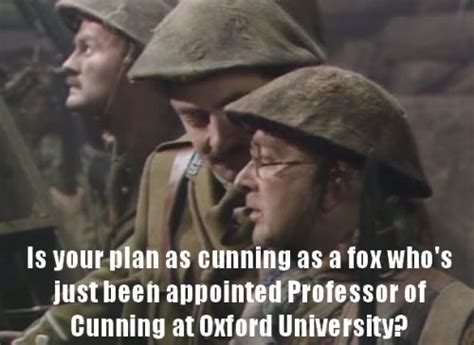
The left has a plan so cunning that if it were a person, it would be teaching cunningology at Oxford. And the ones who get the reference will also know that their plan is about to go pear shaped in all sorts of interesting ways, and at the end of it there might very well be a turnip or two involved, but not as the only item available in the shelves of the grocery store.
Look, someone pointed out in the comments the left are trying to follow the “plan” for other communist revolutions round the world.
He’s right. They’re trying to follow it to the letter. Partly because it’s worked before, and partly, because to be fair, they’re a cult, and cults don’t know the reason for the ritual, they just follow it.
… but it’s already going wrong. And it’s only going to get worse.
You see, part of the problem is that the cult of communism and the procedures for “the revolution” were set in the early twentieth century. And it’s designed for the early twentieth century. To the extent they worked in places like Venezuela, it is because the underlying structures of the society were still very much “early twentieth century.”
The US? Well, not so much. In fact we never were much like the early twentieth century in Europe, which is why they’ve had a hell of a time getting a foothold here.
The communist revolution is designed to work in a country that is mostly urban, with a vast urban underclass that can’t rise above for reasons both internal and external despite working unreasonable hours. It’s designed for a country with a firm aristocracy of the hereditary sort (even if that aristocracy is often from trade), it is designed for a country with a conscript army where the plum assignments go to the “good families” as a matter of course, it is designed to work — most of all and very importantly — in a country where they ABSOLUTELY control all the means of mass communication and do so without the vast majority of the people being aware of it.
The last time they could have pulled that off in the US was in the mid seventies. And my guess, honestly, is that they tried. I don’t know for sure, since the news of the time were all reported by biased sources, and besides I’m too lazy and too busy […] to spend my day chasing down hints. I bet they did try, though. I bet they gave it a sporting try. And I bet part of the issue back then — as now, btw — is that they were pinning their hopes on a race war, having both not realized how much of a minority people of African descent are in the US (last estimate is what? 14%? Sizeable, sure, but not a large minority and certainly not a majority. Also, and seriously, a lot of that minority is middle class and whatever they voice from the mouth-out as uninterested as the rest of us in having the apple cart overturned. Apples are tasty. Genocide not so much.) Mostly because that sh*t was so successful in Africa, and again the left doesn’t think. It ritualistically applies “what worked” without being able to account for changed conditions.
Anyway, that was the last time they could have MAYBE credibly have followed their little red map to revolution and have it work. And even then Americans were just too darn contrarian. Why everyone and their parents were telling us that Republicans were so dangerous, that they were going to start the nuclear war, that — And we went and voted Reagan in. (Well, not me. I only worked towards it. I didn’t vote. I wasn’t a citizen and I’m not a democrat.)
In fact, America could have engraved on its door lintel “authorities can go f*ck themselves.” The left keeps forgetting that. And sometimes justifiably. Take their Covid-psy-ops. It worked. And it was all run on the “experts” and how important it was.
Uh uh. So, they think their control is back! They’re golden again, baby!
January 24, 2021
The dangers of depending on “experts”
David Warren considers the vastly expanded role of “experts” in our public discourse:

Having no degree in either field, I try not to write what will be contradicted by an expert. On the other hand, “expert” has become a murky concept. Once we had to distinguish only between demonstrated credible experts, and villains. Common sense could usually tell them apart. But with the growth of our “sophistication,” the category of villainy has been much expanded. We have a category of institutionally credentialled experts who aren’t exactly liars, but more like what Harry G. Frankfurt defined as “bullshitters.” They struggle to remain plausible, but are using their expertise to advance interested views. And, having such motives — in opposition to the plain pursuit of truth — they seek publicity, and angle to obtain it.
As Dr Frankfurt hinted, in his short philosophical treatise on this topic (On Bullshit, 2005), these can be, and usually are, more trouble than old-fashioned liars. For a real liar knows he is lying, and can be caught out. By comparison, the modern media expert avoids what is strictly checkable, not only to protect himself, but from indifference for truth. He is, according to me, the intellectual descendant of the mediæval Nominalists, adumbrating words, not realities. While less intelligent than his predecessors, he carries on the tradition of saying that something is true because he says so.
“Consensus science” is of this nature. In it, truth can be negotiated, or imposed. While the weather next Saturday will be known to the living, a prediction for much later in the century has no meaning. From the number of variables in play, I can tell you with certainty, that woke “climatologists” are talking bosh; and every signature on their consensus I may add to my list of persons to ignore. This is elementary stuff: and I do try to stick to what is elementary, and foreseeable.
The success rate, for elaborate predictions, remains, at this point in our history, zero-point-zero. But it is becoming so also for the present, and past. The Batflu, here, is current primary example. Owing to obvious manipulation, we cannot know much about its effects. In rough terms, we can know that they are exaggerated, because almost every expert has a vested interest in getting the numbers up, and those who disagree will be punished. The same is true for all the popular remedies, including such nonsense as mangle-wearing, and obsessive social distancing. No legitimate research lies behind either, so we must assume the purposes for various lockdown orders are not actually the Batflu.


