
Quotulatiousness

December 22, 2011

Britain, Argentina, and the Falkland Islands

Filed under: Americas, Britain, History, Military — Tags: , , , , , — Nicholas @ 15:39

Yesterday, I sent a Twitter update linking an article about rising tensions between Argentina and the United Kingdom over the Falkland Islands:

The South American trade group Mercosur, wrapping up a two-day summit in Uruguay, has sided with Argentina in its ongoing dispute about the Falkland Islands, which it calls the Malvinas, announcing it will ban boats with Falkland Islands flags from their ports.

[. . .]

Note the flurry of activity since 2010. The dispute has become heightened over resources, as British firms explore for oil in the waters surrounding the islands.
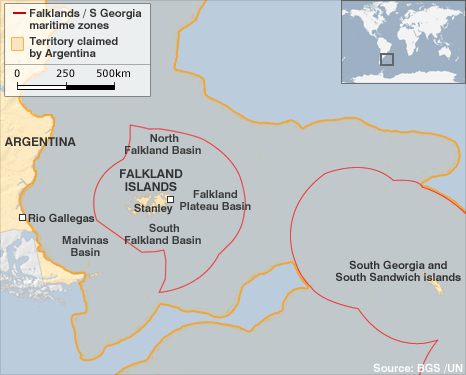
I described the article at the link as “early moves in the next Falklands War”. I then followed up with a another Tweet: “Of course, if Argentina decides to take the Falkland Islands, Britain no longer has the navy to stop them. No carriers = no force projection”

This struck Craig Chandler as seriously misunderstanding the risks: “War can still happen. Do not delude yourself.” I responded that I was “Not deluded about risk of war. Just realistic about outcome.” That is, I didn’t think Britain had any chance of pulling off a victory if Argentina resorted to the military option (again).

Craig had a remarkably positive view of British military power: “Britain would crush them. Missiles, Jets etc… Lot’s of ways to fight a modern war” and “Britain allies would join with them. An attack on one of us is an attack on all of us. Thus, victory would be 100% for Britain”. I responded “Even Reagan had to be cajoled into supporting Thatcher in 82. Obama? Doubt he feels any strong attachment to the UK.” “The UK would have to lodge protest in UN, impose trade sanctions, sit back and accept facts on the ground.”

I was starting to struggle with Twitter’s 140 character limit, as there was much I wanted to say that couldn’t easily be condensed into Twitter-friendly lengths. I’ve said on the blog that Britain’s scrapping of the Harriers and decommissioning/scrapping the remaining aircraft carriers was an open invitation to Argentina to try the Falklands issue again. Argentina’s President Cristina Kirchner wouldn’t be using words like “arrogant” (describing the British government) and characterizing the Prime Minister’s comments as an “expression of mediocrity and almost of stupidity” without good reason.
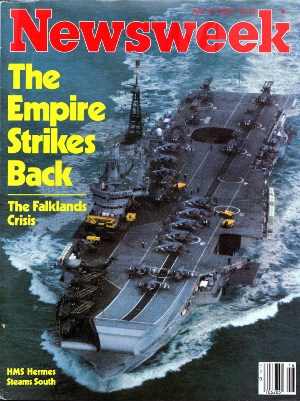
Britain was lucky in 1982, as the government of the day was desperately seeking economies in the budget and (as there was no war with anyone on the horizon), scrapping their aircraft carriers looked like a great way of reducing costs. They’d reduced their military presence in the South Atlantic in an attempt to both save money and appease Argentinian feelings. The announced reductions prompted Argentina’s military rulers to use an external war for internal political benefit. Argentina struck before the intended “economizing” took place. Had they waited six months, Britain would not have had the means to launch the counter-attack that retook the Falklands.
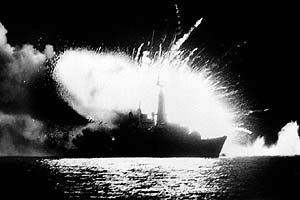
Even with the aircraft carriers HMS Hermes and HMS Invincible each operating several extra Harriers, the British were just barely able to keep enough aircraft going to fend off the majority of Argentinian attacks (losing two destroyers, two frigates, and several support ships sunk or severely damaged). With the Argentinian navy almost entirely confined to base after the sinking of the ARA Belgrano, the British could concentrate on air defence.

Having fought the fleet into position for the invasion, it was possible to pull the more vulnerable ships further out of range for Argentinian air strikes (as even at this stage, losing one of the carriers would endanger the entire mission). While it was much more than a “mere matter of marching”, the smaller but much better trained British forces (primarily Royal Marines, paratroops, Guards, and Gurkhas) were able to defeat the Argentinian troops and bring the military campaign to a close.

Anyway, Craig had an even more positive view of Britain’s likely political and military support today: “The USA owes the UK much for Iraq and Afghanistan there is also the entire Common Wealth. Argentina would be invaded.” “It would be all out war. No acceptance. The Common Wealth and other UK allies would come to support.” I think there’d be some forms of support short of military action: in 1982, for example, New Zealand sent a frigate to the Indian Ocean to replace a Royal Navy ship that was needed to support the Task Force. The rest of the Commonwealth gave verbal and diplomatic support, but no significant military assistance. Today’s Commonwealth is hardly a significant military player — Canada, Australia, and New Zealand combined could not even provide a full division of troops, and none of them would be willing to get involved in a land war in South America on Britain’s behalf.

As far as the islands themselves, there have been some significant changes since 1982, the most significant being a new Royal Air Force base with permanently stationed modern Typhoon fighters (although only four of them at last report). The island transportation net has vastly improved since 1982 — when the only permanent roads were within Port Stanley proper — with all-weather roads now linking all mainland settlements. In addition to the RAF base personnel, there is a British garrison force of a reinforced infantry company and supporting troops, and the Falkland Islands Defence Force which is a company-sized unit of part-time troops.

Argentina’s armed forces have also changed significantly since the war. Two of the most significant changes were post-war fall of the military Junta and the elimination of conscription (creating a more modern, better-trained professional army, navy and air force). The Argentinian navy no longer has a purpose-built landing ship (the ARA Cabo San Antonio was retired shortly after the war and replaced with a modified cargo vessel). They have three submarines in service (replacing the one sub active in 1982), and have replaced all their WW2-vintage ships with more modern designs from France and Germany. The marines, who were the best of the Argentinian troops in 1982, are organized in five battalions of infantry, with supporting artillery, anti-aircraft, engineering and special forces detachments.

Anyway, back to the Twitter exchange that started this. After I’d responded to Craig’s last comment, Colby Cosh joined the discussion: “Sign me up for a bet on 2 PARA if it comes to that, will you?”. I’ll just reproduce the rest of the exchange in approximately correct order below:

NR: “Admire the Paras, but you can’t drop from that far away.”
CC: “I guess they must have teleported onto Goose Green last time.”
NR: “They certainly didn’t fly in from Heathrow!”
CC: “I’m guessing they’ll use the Bay-class ships they built for pretty much that exact mission?”
NR: “Not without air cover.”
CC: “I’m no admiral, but somehow I did get the memo about the fetish for “capital ships” being obsolete.”
NR: “Carriers still relevant.”
CC: “Meanwhile, the Argie navy has not exactly thrived under civilian rule. Not sure if that’s relevant?”
NR: “For a short-haul invasion, you don’t need a massive navy. Air cover is the key. UK only has 1 sub in region normally.”
NR: “No way at all to prevent an invasion, but in 82 UK still had (barely enough) carrier air to cover counter-attack. No longer true”
CC: “Air cover *less* important for Bay class now with close-in antimissile guns. And RN is still operating two carriers, you know.”
NR: “UK paid off Ark Royal and Invincible. Replacement ships still years from launching.”
CC: “The RN just tried out HMS Ocean (I think it was Ocean) as a platform for Apache in the Gadhafi raids.”
CC: “Replacements for fixed-wing capability, yes. Ocean & Illustrious are configured for choppers now.”
NR: “Chopper-equipped force versus missile-armed fighters? Outcome not good for choppers without lots of luck.”
CC: “Helicopters are the name of the game in an amphib op anyway; hence the reconfig.”
NR: “For amphibious work, choppers are great support. Not designed to fight against fixed-wing fighters.”
CC: “We’re forgetting that the islands themselves are garrisoned much more heavily than in ’82.”
NR: “Still indefensible vs Arg”
CC: “The Typhoons that are there are certainly at the sharp end until RN’s Harriers are replaced.”
NR: “Not enough of them to matter.”
CC: “You’ve convinced me to worry about this a little more than I would’ve”
NR: “I’ll post a “Mission Accomplished” banner. ;-)”

Colby did point out some weaknesses in my original contention: for example, I’d forgotten about the construction of the new RAF base, but it isn’t equipped to fight a war: it’s an expensive trip-wire. Four aircraft aren’t going to be enough (especially as Britain had, as of the Libya campaign, only 69 qualified Typhoon pilots). I’ll admit I’m a bit less sanguine about Argentina just waltzing in to Port Stanley this time, but I still think if they can pull off a quick disabling strike followed by a landing, Britain will not be able to reverse the outcome like they did in 1982.
December 15, 2011

China’s first aircraft carrier at sea

Filed under: China, Military, Pacific — Tags: , , , — Nicholas @ 12:17

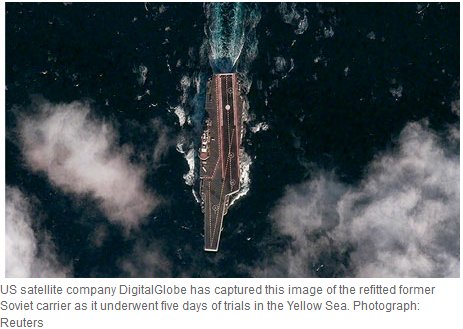
From the Guardian, including this satellite image:

A US satellite company says it has taken a photograph of China’s first aircraft carrier during trials in the Yellow Sea.



It is believed to be the first time the 300-metre ship, a refitted former Soviet carrier, has been photographed at sea since it was launched in August.

DigitalGlobe said one of its satellites took the picture on 8 December and an analyst at the firm spotted the ship this week while searching through images.

Stephen Wood, director of DigitalGlobe’s analysis centre, said he was confident the ship was the Chinese carrier because of the location and date of the image. The carrier has generated intense international interest because of what it might portend about China’s intentions as a military power.

The former Soviet Union started building the carrier, which it called the Varyag, but never finished it. When the USSR collapsed, the ship ended up in Ukraine.

December 7, 2011

Reason.TV: How Pearl Harbour made America a global power

Filed under: History, Japan, Military, Pacific, USA, WW2 — Tags: — Nicholas @ 13:05

A minor quibble: though Craig Shirley asserts that the only way Americans could fight overseas before Pearl Harbour was with the Chinese air force, at least 16,000 Americans were serving in the Canadian Army, the Royal Canadian Navy, or the Royal Canadian Air Force:

Long before Pearl Harbor, a steady stream of Americans had started moving northward across the border to join the Canadian armed forces. By the beginning of 1941 some 1,200 Americans comprised about 10 percent of RCAF officer strength and 3 percent of the other ranks. A U.S. influx totaling about 10 percent of RCAF recruitment continued until, at the time of Pearl Harbor, over 6,000 U.S. citizens were serving in the RCAF, of whom 600 were instructors in the British Commonwealth Air Training Plan. By the same time nearly 10,000 Americans were serving in the Canadian Army. After Pearl Harbor a reverse movement resulted in the absorption of over 26,000 Canadians into the U.S. armed forces during World War II.

From Military Relations Between the U.S. & Canada by Stanley W. Dzuiban.

Greek army reduces from 30 to 19 brigades

Filed under: Europe, Greece, Military — Tags: , , , , , — Nicholas @ 09:15

Strategy Page lists the initial impact on the Greek armed forces due to the financial squeeze:

The current financial crisis in Greece has led to enormous cutbacks in government spending. The military has not been exempt. This year alone, the defense budget will be cut about a third. Over the next two years, the reduced budget will be cut another 15 percent. The army will lose 11 of its 30 brigades, but the air force has disbanded one of 16 squadrons, but kept the aircraft in service by moving them to surviving squadrons. The navy has retired some older patrol boats.

The army is apparently coping by disbanding many reserve units and retiring older tanks and equipment. There won’t be much new equipment purchased for the next few years, at least. Training will also be cut, because operating vehicles, aircraft and ships for these exercises is expensive. The reduction of training will decrease the combat capabilities of the troops. But the government does not want to dismiss lots of the 156.000 active duty troops. That will just increase the already high (approaching 20 percent) unemployment rate. It’s never a good idea to have a lot of professional soldiers among the unemployed.

December 6, 2011

Argentina puts more pressure on Britain to negotiate over the Falkland Islands

Filed under: Americas, Britain, Military — Tags: , , , — Nicholas @ 13:07

The Argentinian navy has been boarding fishing vessels for “illegal” operations in Argentinian waters (that happen to be the seas around the Falklands, South Georgia, and the South Sandwich Islands — all British territories):

Argentine patrol vessels have boarded 12 Spanish boats, operating under fishing licences issued by the Falkland Islands, for operating “illegally” in disputed waters in recent weeks.

Argentine patrol commanders carrying out interceptions near the South American coast told Spanish captains they were in violation of Argentina’s “legal” blockade of sea channels to the Falklands.

[. . .]

President Cristina Kirchner has adopted a steadily more beligerent stance towards Britain’s South Atlantic possessions.

A newly formed gathering of South American nations meeting in Venezeula backed Argentina’s sovereignty demands at the weekend.

Argentina’s claim over the Falklands was backed by a newly formed block of South American and Caribbean countries, CELAC, on Saturday with unanimous approval. Mrs Kirchner used the last UN General Assembly meeting to put Argentina’s claims of sovereignty over the Falklands on a par with Palestinian claims to statehood.

As predicted, now that Britain’s Royal Navy no longer has any aircraft carriers, there’s literally no way that Britain can prevent Argentina from another invasion (the one nuclear submarine on patrol in the area could cause damage, but not repel Argentinian forces). Back in the last war between Britain and Argentina, the United States had to be cajoled into supporting Britain: I very much doubt that Barack Obama would be as willing to provide support to a country he clearly disdains.

Royal Navy to pay double purchase price to keep warship in drydock for five years

Filed under: Britain, History, Military — Tags: — Nicholas @ 10:05

Sounds insane (unless you usually pay attention to the cost of military equipment), but — for a change — it’s a valid use of funds:

A contract has been awarded to keep a Royal Navy warship stored and unready for sea in dock for five years. The amount to be paid is approximately double what the ship cost to purchase in the first place.

The vessel in question is HMS Victory, Nelson’s famous flagship at the Battle of Trafalgar, which remains in commission as a Royal Naval warship, though her seagoing days are long behind her. It has just been announced that a deal for her next five years’ maintenance has been struck for £16m.

Historical records indicate that Victory — in her time one of the most powerful warships afloat — cost £63,176 to build, which according to the Bank of England is equivalent to just over £8m in today’s money. The five-year maintenance deal will thus cost twice what it cost to build the ship in real terms.

November 18, 2011

An antidote to the “OMG! China will eat our lunches” meme

Filed under: Americas, China, Economics — Tags: , , — Nicholas @ 12:02

For those inclined to worry overmuch about the rise of China as a world power (as opposed to merely as an economic competitor):

The real importance of this story does not, however, have much to do with Brazil’s jittery nerves about Chinese investment. It is to remind us about a key Chinese vulnerability that is often overlooked by pundits: China’s growing dependence on natural resources located far from its frontiers.

Beijing’s chosen national strategy — to achieve great power status by becoming the industrial workshop of the world — locks it into a complex and difficult set of dependencies and relationships with countries and markets all over the world. Access to those resources traps China in complicated geopolitical tradeoffs that can blow up in unexpected ways — as when China had to scramble to protect its citizens in Libya. Chinese companies become the object of public anger if they are seen to be economically exploitative, unwelcoming to local labor, or environmentally destructive. And, of course, in the event of a confrontation with the United States, China’s entire supply chain and overseas investments are helpless hostages.

Strategically, the only way out of this trap would be to build a blue water navy and air force that could threaten US command of the seas. But a build up of that kind would not only trigger a massive US response; other countries like Japan, India and Australia would join together to ensure that China did not overturn a maritime status quo that is well trusted by other world powers.

H/T to Jon, my former virtual landlord, for the link.

November 15, 2011

Idiotic British defence decision is USMC’s gain

Filed under: Britain, Military, USA — Tags: , , , — Nicholas @ 12:44

Lewis Page explains why the USMC is getting a lovely windfall from Britain’s crack-brained decision to get out of the aircraft carrier business:

Blighty’s famous force of Harrier jump-jets, controversially disposed of during last year’s defence review along with the Royal Navy’s aircraft carriers, have been reprieved: the radical vectored-thrust jets, believed by many to have been the best strike planes in Britain’s arsenal, will fly (and almost certainly, fight) again.

However they won’t do so with British roundels on their sides or British pilots in their cockpits. The mothballed fleet of 74 Harriers, plus the UK’s inventory of spare parts, is being bought up lock, stock and barrel by the US Marines.

The US Marines possess a substantial air arm of their own and operate a large fleet of Harriers, with slightly different equipment but structurally the same. They anticipate that the British planes, engines and spares, many of which are in nearly-new condition and have been recently upgraded at significant expense, will allow them to keep flying Harriers into the mid-2020s without difficulty.

“We’re taking advantage of all the money the Brits have spent on them. It’s like we’re buying a car with maybe 15,000 miles on it,” Harrier expert Lon Nordeen tells the Navy Times.

November 14, 2011

“We feel completely and utterly betrayed”

Filed under: Britain, History, Military, WW2 — Tags: , , — Nicholas @ 09:37

More on the campaign to grant a specific medal to the veterans of the WW2 Arctic convoys:

They risked their lives again and again on what Churchill described as ‘the worst journey in the world’.

The heroes of the Arctic Convoys ran the gauntlet of German warplanes and U-boats to keep the Soviet Union supplied on the Eastern Front.

Even Russia has awarded commemorative medals to acknowledge its gratitude to the surviving sailors, more than 3,000 of whose comrades were killed.

Yet David Cameron has refused to do the same. Yesterday, as the nation paid tribute to its war dead on Remembrance Sunday, disgusted veterans expressed anger that the Prime Minister had seemingly reneged on a pledge to introduce a specific Arctic Medal.

‘We feel completely and utterly betrayed,’ said Commander Eddie Grenfell, 91, the leader of the Arctic Medal campaign. ‘How can Cameron stand up and support us in public but privately say we don’t deserve a medal? It’s two-faced and wrong.’

In opposition, the Tories pledged to introduce an Arctic Medal if they won power.

Footage from a Russian TV drama series “Konvoi PQ-17”.

November 12, 2011

Renewed call for Britain to issue a medal for WWII Arctic convoy veterans

Filed under: Britain, History, Military — Tags: , , — Nicholas @ 11:36

A video report at the BBC website (no embedding allowed, unfortunately) looks at the campaign on the part of Arctic convoy veterans for a specific medal to recognize their amazing story.

There are calls for recognition for the sailors on the WWII Arctic Convoys who risked their lives to transport crucial supplies and munitions from Scotland to Russia.

Although the bravery of the crews is not disputed, the men who served on the ships have never been officially recognised with a British campaign medal.

The BBC’s Robert Hall reports.

November 11, 2011

In memorium

Filed under: Britain, History, Military, WW1, WW2 — Tags: , , — Nicholas @ 11:00

A simple recognition of some of our family members who served in the First and Second World Wars:

The Great War

  • Private William Penman, Scots Guards, died 1915 at Le Touret, age 25
    (Elizabeth’s great uncle)
  • Private David Buller, Highland Light Infantry, died 1915 at Loos, age 35
    (Elizabeth’s great grandfather)
  • Private Walter Porteous, Northumberland Fusiliers, died 1917 at Passchendaele, age 18
    (my great uncle)
  • Corporal John Mulholland, Royal Tank Corps, died 1918 at Harbonnieres, age 24
    (Elizabeth’s great uncle)

The Second World War

  • Flying Officer Richard Porteous, RAF, survived the defeat in Malaya and lived through the war
    (my uncle)
  • Able Seaman John Penman, RN, served in the Defensively Equipped Merchant fleet on the Murmansk Run (and other convoy routes), lived through the war
    (Elizabeth’s father)
  • Private Archie Black (commissioned after the war and retired as a Major), Gordon Highlanders, captured at Singapore (aged 15) and survived a Japanese POW camp
    (Elizabeth’s uncle)

In Flanders fields the poppies blow
Between the crosses row on row,
That mark our place; and in the sky
The larks, still bravely singing, fly
Scarce heard amid the guns below.

We are the Dead. Short days ago
We lived, felt dawn, saw sunset glow,
Loved and were loved, and now we lie
In Flanders fields.

Take up our quarrel with the foe:
To you from failing hands we throw
The torch; be yours to hold it high.
If ye break faith with us who die
We shall not sleep, though poppies grow
In Flanders fields.

Lieutenant Colonel John McCrae, MD (1872-1918)

November 7, 2011

The likely result of a strike against Iran’s nuclear facilities

Filed under: Middle East, Military, USA — Tags: , , , , — Nicholas @ 08:48

Ralph Peters paints a grim picture of the immediate results of any US or Israeli attack on the Iranian nuclear weapon program:

How would Iran respond to strikes on its nuke facilities? Inevitably missiles would be launched toward Israeli cities — some with chemical warheads — but these tit-for-tat attacks would be the least part of Tehran’s counterattack strategy. The Iranians would “do what’s doable,” and that means hitting Arab oil-production infrastructure on the other side of the narrow Persian Gulf. Employing it mid-range missiles, aircraft and naval forces, Tehran would launch both conventional and suicide attacks on Arab oil fields, refineries, storage areas, ports and loading facilities, on tankers in transit, and on the Straits of Hormuz, the great chokepoint for the world’s core oil supplies. The price of a barrel of crude would soar geometrically on world exchanges, paralyzing economies — exactly as Iran’s leaders intend. Ten-dollar-a-gallon gas would be a brief bargain on the way to truly prohibitive prices. And, in the way of the world, Tehran would not get the blame. We would.

And we would be in one hell of a war, with the Middle East literally aflame and our Navy able to conduct only limited operations (if any) within the Persian Gulf, given that the body of water would become a shooting gallery: Even our finest surface-warfare ships can’t fight or maneuver effectively in a bathtub. The flow of oil would not resume, and we would have no idea how to end the war (not least, since we’re unwilling to inflict serious pain on our enemies anymore).

So . . . if we are forced to attack Iran’s nuclear-weapons facilities at some point, what would it take to do it right and limit Tehran’s ability to respond with such devastating asymmetrical attacks?

H/T to Doug Mataconis for the link.

October 31, 2011

Shipwrecks: salvage or preserve?

Filed under: Environment, History, Law — Tags: , , , — Nicholas @ 08:26

An article at the BBC website looks at some of the issues involving shipwrecks in international waters:

When a ship sinks and lives are lost, it is a tragedy for the families involved.

For the relatives of the dead, the ship becomes an underwater grave but as the years pass the wreck can become a site of archaeological interest.

In recent years technological innovations have allowed commercial archaeologists, decried by some as “treasure hunters”, to reach wrecks far below the surface.

[. . .]

In November 2001, the Unesco Convention on the Protection of Underwater Cultural Heritage was finally adopted.

But 10 years on, it still has not been ratified by the UK, France, Russia, China or the US, and commercial archaeologists continue to locate wrecks, remove their cargoes and sell them off.

“The convention has not been ratified yet because of the issues it throws up about the cost of implementing and policing it,” a spokesman for the UK Department for Culture, Media and Sport, says. “Discussions continue within government, but ratification is not currently seen as a priority.”

It’s telling that the convention has not been ratified by five of the nations most likely to have both the technology and the interest to take on major underwater archaeological or salvage projects.

Robert Yorke, chairman of the Joint Nautical Archaeology Policy Committee, argues the real reason the government, and the Ministry of Defence in particular, are not ratifying the convention was becayse of a misplaced fear about the implications for British warships around the world.

The internationally recognised concept of “sovereign immunity” means nations should not interfere with foreign warships.

Under the Military Remains Act 1986, a number of British warships around the world are protected, including several ships sunk during the Falklands conflict. Also covered are several German U-boats in UK waters.

October 20, 2011

Timer now started for how quickly Quebec forces Harper to override shipbuilding contract awards

Filed under: Cancon, Economics, Military, Politics — Tags: , , , , , , — Nicholas @ 12:08

The National Post editorial board has lots of nice things to say about the federal government’s attempt to take politics out of the huge shipbuilding contract process:

On Wednesday, the Tory government released its Solomonic decision regarding which shipyards will build $33-billion in new military and non-military vessels over the next two decades. The evaluation of bids for the largest government procurement contract since the Second World War was handled by senior bureaucrats, rather than cabinet ministers. Even the announcement of the winning contractors was made by Francois Guimont, the top civil servant from Public Works and Government Services, rather than his minister or the minister of National Defence, as would have been the case with past contracts of this magnitude.

Of course, that’s not to say there will be no political backlash from the decision. Irving Shipbuilding of Halifax will be given $25-billion to build new joint support ships, Canadian Surface Combatants — a sort of destroyer-frigate hybrid — and offshore patrol vessels capable of sailing off all three of Canada’s coasts — east, west and Arctic. Seaspan Marine of Vancouver will build science vessels for the Coast Guard and for the Fisheries department, plus icebreakers worth a total of $8-billion. That means Davie Shipyard in Levis, Que. was left without a major shipbuilding contract (though Davie is still eligible to bid on a further $2-billion contract to provide smaller government boats, such as Fisheries patrol vessels). It must have been tempting for the Tories to intervene in the contract-award process and toss Quebec a bigger bone. Their recent decision to expand the grasp of the official languages commissioner to several airlines, and their willingness to give new seats to Quebec in the House of Commons (despite the fact Quebec was not underrepresented there), just because Ontario, B.C. and Alberta were getting more, shows the Tories have become very concerned about their appeal to Quebec voters.

You can guarantee that many Quebec politicians will benefit for having yet another stick to beat the federal government with — this would be true in all scenarios except the one where the Quebec shipyard got both contracts. It would be an even better deal for the taxpayers (and perhaps even the Royal Canadian Navy) if the contracts hadn’t been restricted to Canadian shipyards: it wouldn’t fly politically, but it would almost certainly have been better bang for the billions of bucks.

October 15, 2011

Chile upgrades their amphibious capabilities

Filed under: Americas, France, Military, Pacific — Tags: , — Nicholas @ 11:21

A brief item from the invaluable Strategy Page talks about Chile’s most recent naval acquisition:

Chile is buying the French amphibious ship Foudre, which is being replaced by a more recent design. The 12,000 ton Foudre has been in service for 21 years and could, with some refurbishment, serve another two decades or more. The 168 meter (521 feet) long ship has a crew of 160 and carries up to 70 vehicles. The well deck contains eight landing craft and there is a hangar that carries up to four helicopters. There are accommodations for 450 troops (or double that for short voyages). The Foudre can also be used as a command ship, which spaces for 150 headquarters personnel and their equipment.

Chile will use the Foudre to replace an 8,700 ton, 40 year old, American Newport class LPD. This ship was retired earlier this year, as it was considered too expensive to refurbish it. France has also offered Chile the second ship of the Foudre class, which is scheduled to retire from French service in a few years. The price of the Foudre to Chile has not been revealed. It will be cheap, and will depend on how much refurbishment French firms will undertake. Foudre undertook several long-distance operations during its career.

« Newer PostsOlder Posts »

Powered by WordPress