
Pirates and Privateers is a half hour documentary airing Sunday, March 4, 2012 at 12 Noon on CBC Land and Sea, that explores the rough-and-tumble history of piracy and privateering in the Maritimes.
March 2, 2012
Privateers? In our Maritimes? It’s more likely than you think
Comments Off on Privateers? In our Maritimes? It’s more likely than you think
February 29, 2012
The US Navy’s mirror-image cost problems with aircraft carriers
Strategy Page talks about the ever-rising cost of building aircraft carriers:
The first of the new Ford class aircraft carriers keeps getting more expensive. The price for the first one has gone up $161 million in the last ten months. The USS Gerald R Ford (CVN 78) was originally supposed to cost $8 billion, plus $5 billion for R&D (research and development of new technology and features unique to this class of ships). Now it appears that the cost of the Ford will not be $13 billion, but closer to $15 billion. The second and third ships of the class will cost less (construction plus some additional R&D). Thus the first three ships of the Ford class will cost a total of about $40 billion.
The current Nimitz-class carriers cost about half as much as the Fords. Both classes also require an air wing (48-50 fighters, plus airborne early-warning planes, electronic warfare aircraft, and anti-submarine helicopters), which costs another $3.5 billion. Three years ago, the USS George H.W. Bush (CVN 77), the last of the Nimitz class carriers, successfully completed its sea trails and was accepted by the U.S. Navy. The Bush was ready for its first deployment in 2010.
At those costs, it should be no surprise that few other navies operate carriers at all, and none operate the size of carrier that the US Navy does. Build costs are rising rapidly, and although the Ford class will carry significantly fewer crew members, they’ll still be very expensive to operate.
The costs don’t end there, however, as all warships have limited lifespans. Disposal of the retired ships is another area where costs are headed ever higher:
Last year, the U.S. Navy decided to go back to the breakers (where ships are broken up for scrap). Four retired aircraft carriers (USS Constellation, USS Forrestal, USS Independence and USS Saratoga) were to be scrapped instead of sunk, or simply allowed to rust away while tied up. These ships were taken out of service between 1993 and 2003 and have been waiting since then while a decision was made on their disposition. But there are seven carriers waiting to be scrapped and the navy has an economic disaster on its hands. Keeping carriers in reserve costs $100,000 a year, but it can cost over a billion dollars to scrap one of them.
Since the 1990s, sending warships to the scrap yard has not been considered a viable alternative. It’s all about pollution, bad press and cost. The largest warship to be scrapped, the 45,000 ton carrier USS Coral Sea, took until 2000 (seven years) to be broken up. Thus the process is not only expensive, it takes a long time. Then the navy discovered that the cost of scrapping the carrier USS Enterprise would be close to a billion dollars. This was largely the result of lots more environmental and safety regulations. With so many navy ships (especially nuclear subs) being broken up in the 1990s, and all these new regulations arriving, the cost of disposing of these ships skyrocketed. This was especially true with carriers.
[. . .]
It gets worse. With the really vast number of single hull tankers being scrapped and large numbers of old, smaller-capacity container ships laid up and likely to be offered for scrap fairly soon, the market for difficult-to-scrap naval ships is going to shrivel, and the price for scrap steel will drop. Efforts to get the navy include the costs of disposal in the budget for lifetime costs has never caught on, and now it’s obvious why not. The real nightmare begins in 2013, when the first nuclear powered carrier (the 93,000 ton USS Enterprise) is to be decommissioned. The cost of dismantling this ship (and disposing of radioactive components) will be close to $2 billion.
Comments Off on The US Navy’s mirror-image cost problems with aircraft carriers
Is it time to abandon the RCN’s submarine experiment?
John Ivison recounts the ill-fated story of the Royal Canadian Navy’s current submarines in the National Post:
The Liberal government bought four second-hand subs for $750-million from the British in 1998 and renamed them the Victoria class — HMCS Victoria, HMCS Windsor, HMCS Chicoutimi and HMCS Corner Brook.
Since then, billions more have been spent trying to “Canadianize” the subs, including thousands of dollars blown trying to stop pigeons roosting in them, such is the length of time they have been in dry-dock. At various times over the past 10 years, the whole fleet has been out of commission.
The history of Canada’s submarine fleet would be laughable, were it not so tragic. People in government at the time remember the surprise expressed by Liberal ministers that the Defence department accepted the British military’s statement of quality assurance, without doing their own due diligence. That the buyer should have been more wary quickly became apparent.
The Chicoutimi caught fire on her maiden voyage from Faslane in Scotland in October 2004, with the death of one sailor and smoke-inhalation injuries to nine others. The sub has been in dry-dock ever since and is scheduled to return to service in 2013, although some stories have suggested 2016 is more realistic and others that she may never again be operational.
I blogged about HMCS Chicoutimi at the old blog, when it was expected that she’d be back in service in 2010.
Last year, HMCS Corner Brook had what some wag at the Department of National Defence characterized as a “fender bender”:
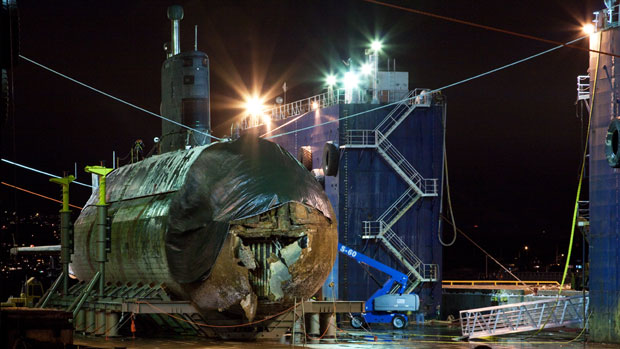
Some fender. The CBC reported on the extent of the damage:
The Canadian navy admitted that the submarine crashed off British Columbia in June, but it never described the extent of damage or released a photograph.
“I was gobsmacked. I had no idea that this level of damage had occurred,” said Senator Colin Kenny, the former head of the Senate defence committee. “That may explain why the navy took it out of the water at night.”
[. . .]
Some familiar with the submarine say its pressure hull, the area in which the sailors are housed, may be heavily damaged and that would mean the sub will never go to sea again.
“Canada needs a submarine fleet, and to have this boat not be available would be tragic,” Kenny said
The RCN claimed that there was no cover-up and that they have been completely above-board and “transparent” about the incident. It’s an odd definition of “transparency” that requires you to submit a formal Access to Information request to get the report — and the photos of the damage to the hull were censored from the report anyway.
Back in 2004, it was reported that our submarines were without torpedo armament, but that they would be “fully armed” by 2006. The CBC report mentioned in passing that eight years later, they’re still lacking torpedoes:
The navy said HMCS Windsor is to undergo trials “in the coming months” and is also expected to be back in operation later in 2012.
Not one submarine is capable of firing a torpedo, however the navy said Tuesday that a test firing of a torpedo from HMCS Victoria is planned for the coming weeks and the submarine is supposed to be operational this year.
Back to John Ivison:
In all this time, the fleet has hardly been crucial to our defence. According to people familiar with its role, it has spent time at sea monitoring fishing fleets and acting as “prey” for U.S. forces, who don’t have diesel-electric subs of their own and like to use ours for hunting practice.
Peter MacKay, the Defence Minister, recently lamented the decision to buy the British diesel-electric subs, which are not capable of diving below ice in the Arctic. “In an ideal world, I know nuclear subs are what’s needed under deep water, deep ice,” he mused.
That we do not live in an ideal world was quickly made apparent by Government House Leader Peter Van Loan, who all but disowned the fleet in a response to a question in the House. “There is no plan to replace the diesel-electric fleet purchased by the Liberals,” he said.
But if there is no plan to replace the fleet, is there a plan to scrap it?
[. . .]
The Navy defines “full operational capability” as having a weapons-ready sub on each coast. It has yet to put one sub to sea that meets that standard, a decade after the first one was received.
The hope is that two boats will be fully operational within two years, with a “swing boat” available to take over when one goes for refit. That may prove wildly optimistic. Submarines may be a useful addition to our battery of defences — but only if they work. And not at any cost.
These subs have proven themselves to be lemons, they are already past mid-life and the odds are against us having even three boats with operational capacity at any one time.
Comments Off on Is it time to abandon the RCN’s submarine experiment?
February 27, 2012
BBC: Could Britain still defend the Falkland Islands?
The BBC has a then-and-now summary of the military balance in the south Atlantic in 1982 and today:
1982: On the eve of the invasion, there were about 70 Royal Marines stationed on the islands — twice the usual number due to a changeover. They were, in theory, backed up by about 120 local reservists, although only a small proportion reported for duty. HMS Endurance, an Antarctic ice patrol vessel, was the only ship based in the South Atlantic at the time. And there were no fighter jets — none of the island’s airstrips were long enough. The only planes that could land before the war came from Argentina. Supplying the Falklands by sea from Britain took two weeks.
2012: The major difference is the construction of RAF Mount Pleasant, a modern air base housing four Eurofighter Typhoon strike fighters, a Hercules transport plane and VC-10 tanker plane. There are also Rapier missile batteries in several locations. The British garrison numbers 1,200, including 100 infantrymen, with 200 reservists in the Falkland Islands Defence Force. The Royal Navy has a patrol vessel, an auxiliary support ship, and frigate or state-of-the-art destroyer. It’s reported that a British nuclear-powered submarine is in the South Atlantic, but the Ministry of Defence will not discuss operational matters. “It’s quite a considerable deterrent force,” says Peter Felstead, editor of Jane’s Defence Weekly. Military experts believe the islands are now virtually impregnable. Any sign of Argentine invasion and the islands could be quickly reinforced by air.
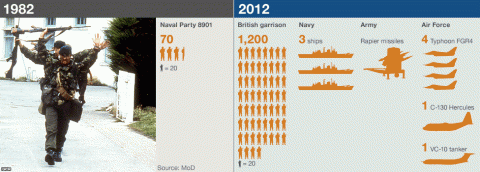
Just as we established the last time this was up for discussion, Argentina doesn’t have the military forces for a stand-up fight, but if they can take the RAF base in a surprise attack by special forces, Britain probably can’t recapture the islands.
Comments Off on BBC: Could Britain still defend the Falkland Islands?
February 19, 2012
While cutting back the troops, the MoD bureaucrats get big bonus payments
C. Northcote Parkinson formulated the law that bears his name. He documented the phenomenon (PDF) of more and more bureaucrats supporting fewer and fewer ships and sailors back in 1955:
The accompanying table is derived from Admiralty statistics for 1914 and 1928. The criticism voiced at the time centered on the comparison between the sharp fall in numbers of those available for fighting and the sharp rise in those available only for administration, the creation, it was said, of “a magnificent Navy on land.” But that comparison is not to the present purpose. What we have to note is that the 2,000 Admiralty officials of 1914 had become the 3,569 of 1928; and that this growth was unrelated to any possible increase in their work. The Navy during that period had diminished, in point of fact, by a third in men and two-thirds in ships. Nor, from 1922 onwards, was its strength even expected to increase, for its total of ships (unlike its total of officials) was limited by the Washington Naval Agreement of that year. Yet in these circumstances we had a 78.45 percent increase in Admiralty officials over a period of fourteen years; an average increase of 5.6 percent a year on the earlier total. In fact, as we shall see, the rate of increase was not as regular as that. All we have to consider, at this stage, is the percentage rise over a given period.
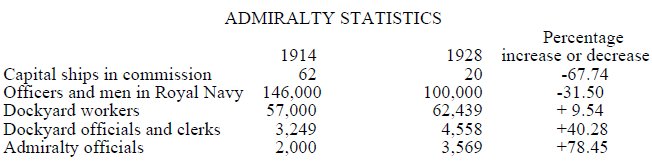
His law is still operative, as shown recently in healthy bonus payments to bureaucrats in the British Ministry of Defence at the same time that the troops are under a pay freeze and reduction in force:
One senior civil servant was awarded an £85,831 bonus on top of their six-figure salary — at the same time as members of the armed forces have been subject to a two-year pay freeze and 20,000 are to be made redundant.
The bonuses have been paid since April last year and have seen more than 55,000 officials awarded extra payments for their performance — out of a payroll of 83,000.
The ministry expects to pay more in bonuses in the current financial year than the last, even thought it is attempting to drastically reduce the number of civil servants as part of cuts to Government expenditure.
Comments Off on While cutting back the troops, the MoD bureaucrats get big bonus payments
February 17, 2012
Colby Cosh on the current drama around the Falkland Islands
The last time Colby Cosh discussed the Falkland Islands, we had a bit of a discussion on Twitter, with my pessimism about Britain’s strategic situation finally persuading him to say “You’ve convinced me to worry about this a little more than I would’ve” (summary in this post). He’s now posted a new article at Maclean’s, which I think accurately captures the situation in the south Atlantic:
Argentina, the world press tells us, intends to rename its top soccer league the “Cruiser General Belgrano First Division”, in honour of the Argentine ship sunk by the Royal Navy during the 1982 Falklands War. Far be it from any outsider to prescribe how a country honours its war dead, but honour is not what the move is about: it’s part of a continuing, exhausting barrage of Falklands agitprop from Argentina’s Kirchner government. Kirchner is scrambling to keep Argentine economic growth rolling, barracking businesses and workers in the classic caudillo manner as inflation outpaces the dubious official statistics. She has tried, with some success, to close off Southern Hemisphere ports to boats flying the maritime flag of the Falklands and to weld traditionally UK-friendly neighbours into a regional bloc against “colonialism”. Tensions are high and the Falkland Islanders are feeling besieged.
Britain is passing through a phase of relative strategic vulnerability when it comes to the Falklands. The islands are garrisoned much more strongly than they were in 1982 and the RAF has a proper airfield. But the UK has sold off its Harrier fleet, and its naval force-projection capacity is a little threadbare; public austerity has forced the Royal Navy to wait until 2016 for a new Nimitz-sized aircraft-carrier class to come into play. General Sir Michael Jackson, often considered the top UK commentator on military affairs (how many General Sirs are there?), recently summed up the situation by suggesting that the Falklands could be defended—but if Argentina captured them in a coup de main, as it did in ’82, its soldiers could probably not now be driven off. From a game-theoretic standpoint, the situation is a nightmare.
Update, 21 February: Brendan O’Neill explains that in the modern celebrity-fuelled world, the Penn really is mightier than the sword:
Easily the most extraordinary thing about Sean Penn’s recent comments on the Falkland Islands is the impact that they made. The tidal wave of furious commentary has tended to focus on Penn’s undoubted combination of daftness and arrogance, with enraged British hacks asking ‘where does Mr Madonna get off holding a press conference to pontificate about the serious affairs of the South Atlantic?’. That is indeed a good question. But a better and more pressing one is this: how on earth did the musings of one muppet make such a massive impact, intensifying the stand-off between Argentina and Britain, generating acres of newsprint, and even provoking a huge protest in the Falkland Islands themselves under the banner ‘Falk You, Sean’?
[. . .]
The Penn affair confirms the extraordinary and terrifying power of celebrity today. It shows that in our celeb-obsessed era, the famous and allegedly fabulous are no longer used simply to advertise booze or to titillate the readers of gossip columns — they have become actual tools of global politics. (In both senses of the word ‘tool’ — ‘a device used to carry out a particular function’ and ‘one who lacks the mental capacity to know he is being used’.) Indeed, Kirchner’s use of Penn in her war of words with Britain shows that she is a sussed and wily leader — she recognises that, today, a comment from a celeb is a far more effective political manoeuvre than readying a warship or making a stern speech at the United Nations. Her message is basically: ‘I’ll see your Prince William and raise you Sean Penn…’
Comments Off on Colby Cosh on the current drama around the Falkland Islands
February 16, 2012
The economics of the military-industrial complex
Eisenhower was right: the military-industrial complex has the US government tight within its grip, and there’s no easy fix. Strategy Page has a useful overview:
For decades the U.S. Armed Forces has been having problems with rapidly growing (much greater than inflation) costs of weapons. Congress passes laws to try and cope and the laws are ignored. One example is the laws calling for accurate life-cycle costs (for development, manufacturer, and maintenance of weapons over their entire service life). A recent study found out that, despite laws calling for accuracy and consistency in these numbers, most manufacturers manipulated the data to make their systems look less expensive than they actually were. The Department of Defense is increasingly taking extreme measures in the face of this corruption and cancelling more and more very expensive systems. But the manufacturers continue to use smoke and mirrors to get new projects started and failed ones funded.
New weapons get approved because of another form of procurement corruption, the Low Ball Bid. Last year the U.S. Air Force demanded that defense contractors stop low balling, which in practice means submitting unrealistically low bids for new weapons (to make it easier for Congress to get things started) and then coming back for more and more money as “unforeseen problems” appear and costs keep escalating and delivery is delayed. Currently, procurement projects are about a third over budget and most items are late as well. Procurement of weapons and major equipment make up about a third of the defense budget. While this is expected to decline over the next decade, as defense budgets shrink, the problem also extends to upgrades and refurbishment of existing equipment.
The most intractable problem is the decades old contractor practice of deliberately making an unreasonably low estimate of cost when proposing a design. The military goes along with this, in the interest of getting Congress to approve the money. Since Congress has a short memory the military does not take much heat for this never ending “low ball” planning process.
Comments Off on The economics of the military-industrial complex
February 14, 2012
Colombia looks to upgrade their submarine fleet
With relations in a parlous state between Colombia and Venezuela, Colombia is considering upgrading their navy:
Colombia is negotiating with Germany to buy up to six recently retired Type 206A coastal submarines. The 206As are meant to be an inexpensive counter to new Russian Kilo subs being purchased by neighboring Venezuela. Colombia still has two older (1,200 ton) Type 209 subs and nine miniature subs. All are over three decades old, and so are the Type 206As. But the 206As have been better cared for and were updated in the 1990s. Colombia already has sailors with lots of experience on German submarines and the Type 206s can be obtained cheap. Exactly how cheap is currently under negotiation.
[. . .] If there were a war with Venezuela (which has been acting very belligerent over the last few years), the Type 206s would be used to shut down Venezuelan ports and destroy oil facilities. Venezuela also has two 1970s era Type 209 subs, said to be in worse shape than their Colombian counterparts.

Bundesmarine Type 206A submarine U22 in December 2006
Wikipedia says of these submarines:
The Type 206 is a class of diesel-electric submarines (U-boats) developed by Howaldtswerke-Deutsche Werft (HDW). Its design is based on the preceding Type 205 submarine class. These small and agile submarines were built during the Cold War to operate in the shallow Baltic Sea and attack Warsaw Pact shipping if the war turned hot. The pressure hulls were built out of non-magnetic steel to counter the threat of magnetic naval mines and make detection with MAD sensors more difficult. The low emission profile allowed the submarines in exercises to intrude even into well protected opposing forces such as carrier formations with their screen.
[. . .]
A major mid-life modernisation was conducted on twelve of these submarines, the boats concerned now being officially designated Type 206A. The work started in mid-1987 and completed in February 1992, being carried out by Nordseewerke, Emden; this upgrade includes:
The STN Atlas DBQS-21D sonar has been fitted, together with new periscopes, and a new weapon control system (LEWA). The ESM system has been replaced and GPS navigation installed. The rebuilt submarines are armed with new torpedoes (Seeaal), and the propulsion system has been comprehensively refurbished, and improvements have been made to the accommodation.
Comments Off on Colombia looks to upgrade their submarine fleet
February 11, 2012
Argentina accuses Britain of deploying nuclear weapons in Falkland Islands
Raising the rhetorical stake yet again, Argentina has taken their complaint to the United Nations:
Argentina has accused Britain of deploying nuclear weapons near the Falkland Islands and “militarising” the south Atlantic.
The Argentinian foreign minister, Héctor Timerman, lodged a formal protest at the United Nations on Friday and showed slides of British military bases in the region, saying they represented a threat to all south America.
He said Buenos Aires had intelligence that a Vanguard submarine was operating in the area. “Thus far the UK refuses to say whether it is true or not,” he told a press conference in New York. “Are there nuclear weapons or are there not? The information Argentina has is that there are these nuclear weapons.” Quoting John Lennon, he added: “Give peace a chance.”
Britain’s ambassador to the UN, Mark Lyall Grant, said London did not comment on the disposition of nuclear weapons or submarines but that it was “manifestly absurd” to say it was militarising the region. Britain’s defence posture remained unchanged, he said.
There was a report in the press that the Royal Navy had sent a nuclear powered submarine to the south Atlantic, but that it was conventionally armed. No nuclear power is in the habit of detailing where their nuclear weapons are deployed, so don’t expect Britain to break ranks with the others.
Also in the Guardian, Marina Hyde characterizes the decision to send a member of the royal family to the Falklands is the wrong kind of gesture:
The technical military term for the decision to deploy the second in line to the throne to the Falkland Islands is William-waving. If dispatching a fancy new warship to the archipelago on the eve of the 30th anniversary of the conflict with Argentina sends a message, then dispatching Prince William makes a hand gesture.
Of course, the Duke of Cambridge is not in the South Atlantic in his capacity as the male lead from the latest, successful instalment of the hit-and-miss Windsor Wedding franchise. His other day job is as an RAF search and rescue pilot, which is genuinely commendable — but need he really have been sent to the Falklands this week in a posting described by William Hague as “entirely routine”? If the foreign secretary truly wishes to claim that the deployment of Prince William is a business as perfunctory as deciding whether to serve tea or coffee at a meeting, then that is a matter for him. But many of us will find our disbelief simply impossible to suspend in this case, and will nurse a deep suspicion that such things are discussed at prime ministerial level.
Comments Off on Argentina accuses Britain of deploying nuclear weapons in Falkland Islands
February 7, 2012
Contrasting Canadian and Australian approaches to national defence spending
Matthew Fisher considers the way Australia deals with defence spending in comparison to Canada:
Australia may not immediately spring to mind as the country with which to best compare Canada’s defence spending, but it is not that much of a stretch. They share the same values and allies, have similarly robust resource-based economies, generous welfare nets and military histories from the Boer War through to the war in Afghanistan that usually have dovetailed.
Although Canada’s economy is nearly twice the size of Australia’s — and has about 40 per cent more people — Canada lags far behind in defence spending.
Australia spent $29 billion on its armed forces last year. That is about $7 billion more than Canada did. Given the relative size of the two economies and populations, for the federal government to match Australia on defence spending would require an annual out-lay of between $35 billion and $40 billion, rather than the $22 billion that was spent last year.
There are reasons why Australia spends more. But taken together, they do not account for the staggering gap between the two countries.
Support for — or hostility toward — defence spending in Canada follows the usual political fault lines. This is in sharp contrast to Australia, where there is a broad political consensus that adequate funding is vital to the national interest. So much so, in fact, that for Australian parliamentarians and the media, defence spending is not a hugely controversial subject.
Comments Off on Contrasting Canadian and Australian approaches to national defence spending
February 2, 2012
Where are the carriers today?
Just in case you were wondering where the US Navy has its major surface fleet components distributed, here’s a non-classified snapshot, courtesy of Stratfor:
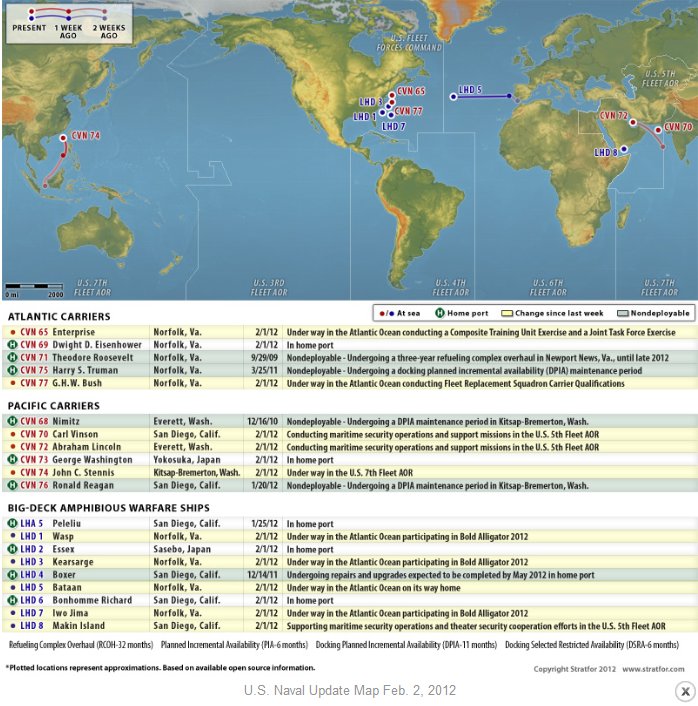
The Naval Update Map shows an approximation of the current locations of U.S. Carrier Strike Groups (CSGs) and Amphibious Ready Groups (ARGs), based on available open-source information. No classified or operationally sensitive information is included in this weekly update. CSGs and ARGs are the keys to U.S. dominance of the world’s oceans. A CSG is centered on an aircraft carrier, which projects U.S. naval and air power and supports a carrier air wing (CVW). The CSG includes significant offensive strike capability. An ARG is centered on three amphibious warfare ships, with a Marine Expeditionary Unit (MEU) embarked. An MEU is built around a heavily reinforced and mobile battalion of Marines.
Comments Off on Where are the carriers today?
January 23, 2012
Raising the wreck of the earlier HMS Victory
The famous British warship HMS Victory preserved in Portsmouth was built to replace an earlier ship lost in a storm in 1744:
The remains of a 300-year-old warship are to be raised from the sea bed, according to reports.
The wreck of HMS Victory, a predecessor of Nelson’s famous flagship, was found near the Channel Islands in 2008.
The British warship, which went down in a storm in 1744 killing more than 1,000 sailors, could contain gold coins worth an estimated £500m.
The Sunday Times says the Maritime Heritage Foundation is set to manage the wreck’s raising.
It also reports that the charity will employ Odyssey Marine Exploration to carry out the recovery.
The American company found the ship four years ago, with the ship’s identity confirmed by a bronze cannon.
Comments Off on Raising the wreck of the earlier HMS Victory
January 17, 2012
Details on the British defence cuts
The unit hardest hit by the reductions will be the Brigade of Gurkhas:
In a statement, the MoD revealed it was looking to shed 2,900 posts from the army, around 1,000 from the RAF and 300 from the Royal Navy.
The total is higher than the first round of the process last year, and there are expected to be more compulsory redundancy notices this time.
The MoD announced it was looking to shed approximately 400 Gurkhas — one in eight of the brigade. Approximately 500 infantry privates with more than six years’ service will also be axed.
The senior ranks of the army have not been spared. Eight brigadiers and 60 lieutenant colonels are expected to go.
The Royal Navy will lose five commodores and 17 captains. Nineteen Royal Marine officers will be shed, but no one from the ranks.
The RAF will lose up to 15 air commodores and 30 group captains. The MoD believes that by slowing recruiting, and not replacing those who leave, the navy and the RAF will be able to achieve the cuts they need without a “tranche 3” of redundancies. The army needs to shed almost 20,000 jobs over the next eight years and will continue to make cuts for years to come.
Comments Off on Details on the British defence cuts
January 2, 2012
Australia the hot destination for former RN, RCN, and USN sailors
Australia’s job market is very tight, and the military is feeling the pinch. Strategy Page explains how the military is coping:
Noting that Britain was downsizing its armed forces, and cutting loose a lot of experienced personnel, the Australian Navy has sent recruiting officers to Britain to see if there would be interest among some of these former (or soon-to-be former) British sailors in joining the Australian Navy. The navy is particularly interested in obtaining personnel with technical skills. Years of low unemployment in Australia (partly because China is buying so many raw materials) has caused a shortage of engineering and technical specialists in the navy. The mining companies have been luring away a lot of technical personnel with higher pay and better working conditions. As a result, for example, the navy only has crews for three of its six submarines.
For over two years now the navy has been recruiting foreigners who possess needed technical skills. Australia is a nation of immigrants, and the admirals point out that recruiting a foreigner is cheaper than training an Australian to do these tasks. But sending recruiters to foreign countries is a new angle. Australia has also been offering navy jobs to sailors from Canada, New Zealand and the United States. All four foreign nations share a common language and, in general, culture with Australia. Moreover, sailors from these foreign nations have gone through similar security vetting. The recruiting offers are being sweetened with quick granting of Australian citizenship after less than a year of service.
Comments Off on Australia the hot destination for former RN, RCN, and USN sailors
December 26, 2011
Evaluating French aircraft carrier performance in the Libya campaign
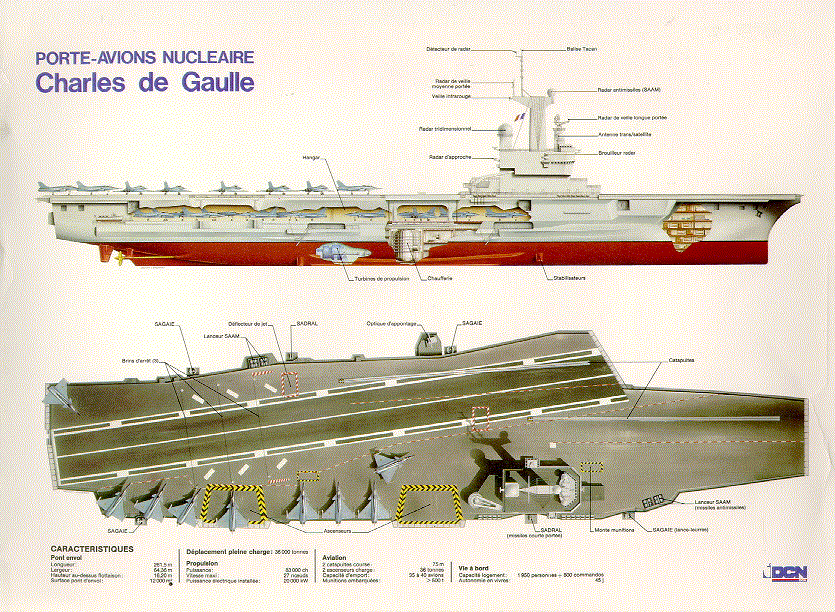
Strategy Page summarizes the efforts of the French aircraft carrier de Gaulle in the recently concluded Libyan operations:
The French nuclear aircraft carrier, the Charles de Gaulle, put in an epic performance of sustained combat air operations off Libya this year. From March to August France was one of the major contributors to the effort, flying 25 percent of the air sorties and contributing many of the warships off the coast of Libya. The 4,500 French air sorties put their aircraft in the air for 20,000 hours. About 30 percent of French sorties were flown from the de Gaulle and over half the French strike sorties were flown from the de Gaulle. Most (62 percent) of the carrier sorties were combat missions (usually bombing). The de Gaulle averaged 11.25 sorties per day when it was conducting air operations. The de Gaulle spent 120 flying days off Libya, in one case 63 straight days conducting combat operations. Aircraft operating from the de Gaulle spent 3,600 hours in the air and conducted 2,380 catapult takeoffs and carrier landings.
French warplanes carried out 35 percent of the bombing missions, using 950 smart bombs. These included 15 French made SCALP missiles and 225 Hammer GPS guided bombs. French helicopter gunships flew 90 percent of NATO helicopter attack missions, using 431 HOT missiles and thousands of cannon rounds. French warships fired over 3,000 rounds of 100mm and 76mm naval gun rounds at sea and land targets off the Libyan coast.
Comments Off on Evaluating French aircraft carrier performance in the Libya campaign


