Quotulatiousness

February 22, 2019

Germany’s armed forces – from world class to laughing stock

Filed under: Germany, Government, Military — Tags: , , , , , — Nicholas @ 05:00

Germany’s military has fallen on very hard times, and there’s so much wrong that it will be very difficult to fix even with all the goodwill in the world:

The German Navy training ship Gorch Fock (launched in 1958) under full sail (less the spanker topsail) in Kiel Fjord near the Laboe Naval Memorial in July 2006.
Photo by Felix Koenig via Wikimedia Commons.

Most Germans’ eyes glaze over at the mention of the Bundeswehr’s perpetual troubles, but an affair surrounding the Gorch Fock, the navy’s three-masted naval training ship, has caught their attention.

Launched in 1958 to school a new generation of West German naval recruits, the imposing 81-meter ship, which takes its name from a popular seafaring German author’s pseudonym, is more than just a training vessel; to many, the Gorch Fock — whose likeness was etched onto some Deutsche Mark bills — is a symbol of Germany’s postwar revival.

The ship’s iconic status is one reason why few objected when the Bundeswehr announced in 2015 that it needed a major overhaul. Until, that is, the price tag exploded from an initial projection of €10 million to €135 million, according to the latest estimate.

Bundeswehr officials claimed the depth of the ship’s troubles only became clear when it was in dry dock, but few are buying such explanations. “When the repairs cost more than a new ship, something is obviously amiss,” Bartels, the Bundeswehr’s parliamentary overseer, said in an interview.

The Gorch Fock “is a symptom of the Bundeswehr’s broader problems,” Bartels said. “Everything takes too long and costs too much money. It’s as if time and money were endless resources, and in the end no one takes responsibility.”

Almost overnight, the ship has gone from pride and joy to running gag. Last week, German weekly Der Spiegel pictured the Gorch Fock on its cover under the headline, “Ship of Fools.”

It’s an apt metaphor for Germany’s body politic as well. Given Germany’s size and economic might, Berlin’s attention to security is surprisingly shallow; citizens and politicians alike often seem oblivious to the challenges the country faces. Though Germany faces growing security threats from both Russia and China, one wouldn’t know it hanging around the German capital.

Much of the media now portrays the U.S. as a security threat on par with Russia. Public attitudes have moved in a similar direction. Security discussions are driven by a handful of like-minded think tank analysts who seem to spend most their time on Twitter, fretting about whether Trump will pull the plug on NATO.

More Germans believe China is a better partner for their country than the U.S., according to a survey published last week by Atlantik Brücke, a Berlin-based transatlantic lobbying group. About 80 percent of those surveyed consider U.S.-German relations to be “negative” or “very negative.”

H/T to Instapundit for the link.
February 17, 2019

Finland’s Desperate Fight – WW2 – 025 – February 16 1940

Filed under: Europe, History, Military, Russia, WW2 — Tags: , , , , , , — Nicholas @ 06:00

World War Two
Published on 16 Feb 2019

After more than a week of preliminary bombardments and attacks, the Red Army finally attacks the Finnish defensive positions on the Karelian Isthmus en masse. They throw thousands of troops at the Finns at the entire width of their lines, even exceeding them. The Finns defend the best as they can, but their winning streak seems to come to an end.

Join us on Patreon: https://www.patreon.com/TimeGhostHistory
Or join The TimeGhost Army directly at: https://timeghost.tv

Follow WW2 day by day on Instagram @World_war_two_realtime https://www.instagram.com/world_war_t…

Between 2 Wars: https://www.youtube.com/playlist?list…
Source list: http://bit.ly/WW2sources

Written and Hosted by: Indy Neidell
Produced and Directed by: Spartacus Olsson and Astrid Deinhard
Executive Producers: Bodo Rittenauer, Astrid Deinhard, Indy Neidell, Spartacus Olsson
Creative Producer: Joram Appel
Research by: Indy Neidell
Edited by: Iryna Dulka
Map animations: Eastory

Colorizations by Norman Stewart.
Thumbnail Colorization by Julius Jääskeläinen: https://www.flickr.com/photos/juliusjaa/

Photos of the Winter War are mostly from the Finnish Wartime Photograph Archive (SA-Kuva).

Eastory’s channel: https://www.youtube.com/channel/UCEly…
Archive by Screenocean/Reuters https://www.screenocean.com

A TimeGhost chronological documentary produced by OnLion Entertainment GmbH.

From the comments:

World War Two
2 days ago

Major developments in the Winter War this week! The thumbnail (colorized by JuliusJaa – https://www.flickr.com/photos/juliusjaa/) depicts Aarne Juutilainen or the “The Terror of Morocco”. This particular photo was taken earlier in December 1939 during the battle of Kollaa, where he acquired a hero status. He owed his name to his service in the French Foreign Legion in Morocco, where he served from 1930 to 1935. By 1940, he commanded his own ‘Moroccan company’, a unit made out of decorated soldiers known for their superior skills.

We sincerely hope that you enjoy the videos we put out for you all! As Indy notes at the end of the video, especially important for today’s episode (there are 14 maps in this) is Eastory, who researches and animates our maps for us. Check out his channel as well! It’s really good -> https://www.youtube.com/channel/UCElybFZ60Hk1NSjgCf7I2sg

Please do consider supporting us on Patreon. That allows us to keep working with awesome people like Eastory and will help us create even more content for you all to enjoy.

Cheers,
Joram

February 9, 2019

HMS Dreadnought – Guide 001

Filed under: Britain, History, Military, Technology — Tags: , , , — Nicholas @ 02:00

Drachinifel
Published on 12 Dec 2018

HMS Dreadnought, the first dreadnought battleship and game changer for the British Royal Navy, is today’s subject.

Want to support the channel? – https://www.patreon.com/Drachinifel

Want to talk about ships? https://discord.gg/TYu88mt

Music – https://www.youtube.com/c/NCMEpicMusic

January 24, 2019

The Sinking of HMS Glorious: An Avoidable Tragedy?

Filed under: Britain, Germany, History, Military, WW2 — Tags: , , , — Nicholas @ 02:00

Historigraph
Published on 27 Aug 2018

The Sinking of HMS Glorious, on June 8 1940, was one of the worst British naval disasters of the Second World War. Over 1500 losing their lives as two German battleships sunk three British ships. In this video, we will recount the events and the heroism of Glorious’ two escorts (HMS Ardent and HMS Acasta), before looking at the post-war controversy over whether the disaster was ‘covered up’ by the Admiralty.

If you enjoyed this video and want to see more made, consider supporting my efforts on Patreon: https://www.patreon.com/historigraph

► Twitter: https://twitter.com/historigraph
►Patreon: https://www.patreon.com/historigraph
►Discord: https://discord.gg/f8JZw93
►My Gaming Channel: https://www.youtube.com/c/Addaway

Sources:

John Winton, Carrier Glorious (Cassell: 1986)

Stephen Roskill, Churchill and the Admirals (Pen and Sword, 1977)

Corelli Barnett, Engage The Enemy More Closely: The Royal Navy in the Second World War (Penguin, 1991)

Henrik Lunde, Hitler’s Preemptive War: The Battle for Norway, 1940. (kindle edition)

Earl Ziemke, German Northern Theater of Operations 1940-1945. (kindle edition)

Record of the Hansard Debate from 1999: https://api.parliament.uk/historic-ha…

Full Casualty List for HMS Glorious can be found here: http://www.naval-history.net/xDKCas19…

From the comments:

1. Unlike the Battle of the River Plate from my last video, we do not know the precise movements of the ships, particularly the British ones, during the battle. The movements in this video should thus be taken as purely illustrative.

2. As you might be able to tell there is still a pretty intense debate over the reasons for Glorious’ sinking, particularly over what knowledge the officers on board Devonshire had or didn’t have about Glorious’ trouble. In particular there is testimony from one midshipman that the ship’s captain and Admiral Cunningham (who was on board) knew what was happening and took no action. It is only his word, so many of the historians I have read do not seem to have bought much into it, but it appears in this documentary from 1997: https://www.youtube.com/watch?v=1yAahSUiXt4

January 3, 2019

The ship that revolutionised naval warfare

Filed under: Britain, History, Military, Technology — Tags: , — Nicholas @ 02:00

Lindybeige
Published on 13 Dec 2018

Thanks to World of Warships for sponsoring this video. Follow the link https://wo.ws/2Pp7LgQ and use the code “LINDYBEIGE” to receive the Premium Soviet Ship ‘Diana’, 500 Doubloons, and 7 Premium days of game time. For new accounts only.

Support me on Patreon: https://www.patreon.com/Lindybeige

Many thanks to the helpful staff at the Discovery Museum in Newcastle upon Tyne. Here is the museum’s website:
https://discoverymuseum.org.uk/

Lindybeige: a channel of archaeology, ancient and medieval warfare, rants, swing dance, travelogues, evolution, and whatever else occurs to me to make.

▼ Follow me…

Twitter: https://twitter.com/Lindybeige I may have some drivel to contribute to the Twittersphere, plus you get notice of uploads.

website: http://www.LloydianAspects.co.uk

December 26, 2018

Operation Sealion: Actually a Bad Idea

Filed under: Britain, Germany, History, Military, WW2 — Tags: , , , — Nicholas @ 02:00

Historigraph
Published on 1 Dec 2018

Join us in #WarThunder for free using this link and get a premium tank or aircraft and three days of premium time as a bonus: http://v2.xyz/WarThunderWithHistorigraph

If you enjoyed this video and want to see more made, consider supporting my efforts on Patreon: https://www.patreon.com/historigraph

#OperationSealion #Historigraph

►Twitter: https://twitter.com/historigraph
►Instagram: https://www.instagram.com/historigraph
►Patreon: https://www.patreon.com/historigraph
►Discord: https://discord.gg/f8JZw93
►My Gaming Channel: https://www.youtube.com/c/Addaway
►My Twitch: https://www.twitch.tv/addaway

Sources:

Philips Payson O’Brien, How the War was Won

Stephen Bungay, The Most Dangerous Enemy

Leo McKinstry, Operation Sealion: How Britain Crushed the German War Machine

https://www.naval-history.net for factual information on locations of RN ships

December 19, 2018

HMCS Haida – Guide 027 (Special)

Filed under: Cancon, History, Military, WW2 — Tags: , , , , — Nicholas @ 02:00

Drachinifel
Published on 13 Aug 2017

The most successful Canadian warship, HMCS Haida, is the subject of today’s video

The robotic narration on this video is painfully irritating!

Update, 14 February 2021: Drachinifel updated the narration at some point after I posted the original.

December 16, 2018

Perkele! Finland Strikes Back – WW2 – 016 15 December 1939

Filed under: China, Europe, History, Japan, Military, Russia, WW2 — Tags: , , , , — Nicholas @ 04:00

World War Two
Published on 15 Dec 2018

In the second week of the Winter War, during multiple counteroffensives, including the famous Sausage War, the Finnish Defence Forces dash any hopes of a quick victory that the Red Army and Stalin might have had.

WW2 day by day on Instagram @World_war_two_realtime https://www.instagram.com/world_war_t…

Between 2 Wars: https://www.youtube.com/playlist?list…

Join us on Patreon: https://www.patreon.com/TimeGhostHistory
Or join The TimeGhost Army directly at: https://timeghost.tv

Written and Hosted by: Indy Neidell
Produced and Directed by: Spartacus Olsson and Astrid Deinhard
Executive Producers: Bodo Rittenauer, Astrid Deinhard, Indy Neidell, Spartacus Olsson
Research by: Indy Neidell
Edited by: Wieke Kapteijns
Map animations by: Mikk Tali aka Eastory
Community Manager: Joram Appel

Coloring by Spartacus Olsson

Thumbnail depicting Finnish soldiers using a slingshot to lob grenades at the Red Army. Colorized by Cassowary https://www.flickr.com/photos/cassowa…

Eastory’s channel: https://www.youtube.com/channel/UCEly…
Archive by Screenocean/Reuters https://www.screenocean.com

A TimeGhost chronological documentary produced by OnLion Entertainment GmbH

The Last British Battleship?

Filed under: Britain, History, Japan, Military — Tags: , — Nicholas @ 02:00

Mark Felton Productions
Published on 13 Nov 2018

Does a British battleship still exist? Yes, but not in Britain. Find out the full fascinating story of the last of her kind.

Support my channel by becoming a Patron: https://www.patreon.com/markfeltonpro…

Photos: Nesmad, Ningyou, nattou, Mikasa Historic Memorial Warship
Video: YouTube Creative Commons

December 14, 2018

Dreadnought: The Battleship that Changed Everything

Filed under: Britain, France, Germany, History, Military, Russia, WW1 — Tags: , , , — Nicholas @ 02:00

Historigraph
Published on 24 Nov 2018

So it’s probably worth noting here that when Dreadnought made all other battleships irrelevant, it didn’t do so equally. For example, Japan had constructed two ‘semi-dreadnoughts’ a couple of years earlier, with more 10-inch guns than was standard at the time. The Americans too were moving towards building an ‘all-big-gun’ battleship, but they were much slower at getting them built than the British.

If you enjoyed this video and want to see more made, consider supporting my efforts on Patreon: https://www.patreon.com/historigraph

Sources:
Robert K. Massie, Dreadnought: Britain, Germany and the Coming of the Great War
Ben Wilson, Empire of the Deep: The Rise and Fall of the British Navy

December 7, 2018

“A date that will live in infamy” – Speech

Filed under: History, Japan, Military, Pacific, USA, WW2 — Tags: , , — Nicholas @ 02:00

FootageArchive – Videos From The Past
Published on 19 Mar 2015

Welcome to FootageArchive! On this channel you’ll find historic and educational videos from the 1900s. Watch, learn, and take a trip back in time as we gain insight into a previous time. Subscribe for more.

Note: this video contains archived public domain / licensed footage. This footage serves documentary purposes on world history and is to be viewed as educational.

December 2, 2018

Preliminary report posted on the sinking of Norwegian frigate Helge Ingstad

Filed under: Europe, Military — Tags: , , , — Nicholas @ 05:00

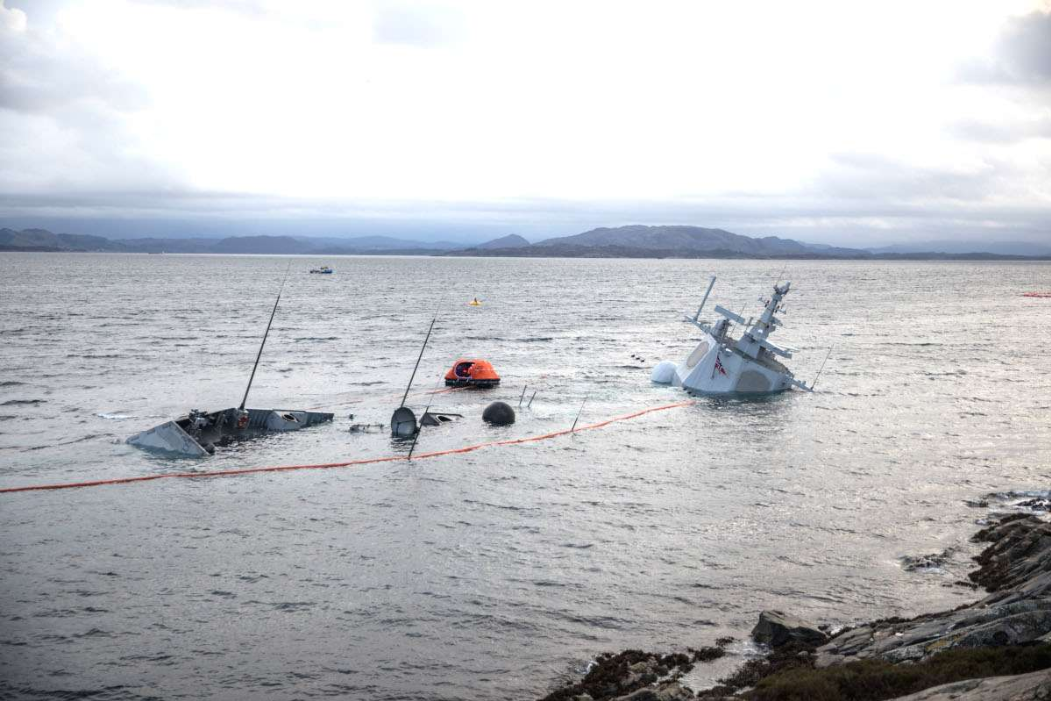
The Accident Investigation Board of Norway (AIBN) and the Defense Accident Investigation Board of Norway (DAIBN) have made their initial joint report on the sinking of HNoMS Helge Ingstad available to the public:

HNoMS Helge Ingstad after grounding, 13 November 2018.
Photo via The Drive.

“This report is a preliminary presentation of the AIBN’s investigations relating to the accident and does not provide a full picture,” the report warns up front. “The report may contain errors and inaccuracies.”

Based on what the investigators have determined so far, Helge Ingstad entered the fjord heading south and checked in with the Fedje Maritime Traffic Center, or Fedje VTS, at around 2:40 AM local time. Any ship over 80 feet long has to alert this control center before entering due to the narrow nature of the waterway.

The ship was traveling at approximately 20 miles per hour and had its navigation lights on. The ship’s Automatic Identification System (AIS) transponder was set to “receive only” mode, meaning that it was not transmitting its own position and other information to ships in the area.

At 3:40 AM, personnel on Helge Ingstad‘s bridge began to turn control of the ship over the next watch. At that time, the ship’s crew was aware of three northbound ships on its radar screen and had also visually observed “an object with many lights was observed lying still just outside the Sture terminal,” according to the report.

Sola did not leave the terminal until 3:45 AM. Less than 15 minutes later, the tanker’s crew radioed the Fedje VTS to inquire about a contract on their radar that was sailing with its AIS transponder apparently off.

At 4:00 AM, Fedje VTS identified the ship in question as probably Helge Ingstad and the tanker and the frigate began communicating directly. Approximately one minute later, the two ships collided.

[…]

A final report on the incident should contain more thorough explanations of exactly how the final moments of the collision played out and recommendations for the Norwegian Navy to try and prevent these sorts of accidents in the future. “So far, the AIBN has not seen any indication of technical systems not working as intended up until the time of the collision,” the report notes.

Separate from its findings regarding the events leading to the collision, the AIBN has also uncovered a serious technical issue that could have impacts well beyond this particular accident. Norwegian officials have alerted both the country’s navy and Spanish shipbuilder Navantia, which built the Helge Ingstad and Norway’s four other Fridtjof Nansen-class frigates, with concerns they have about the basic “watertight integrity” of the ships.

“The AIBN has found safety critical issues relating to the vessel’s watertight compartments,” an annex to the main report explains. “This must be assumed to also apply to the other four Nansen-class frigates. It cannot be excluded that the same applies to vessels of a similar design delivered by Navantia, or that the design concept continues to be used for similar vessel models.”

Update, 24 June 2019: The Norwegian government has decided to scrap the ship rather than undertake repairs.

November 29, 2018

The Royal Navy’s “Nelsol” and “Rodnol” – a battleship design driven by lessons from Jutland

Filed under: Britain, History, Military, Technology, WW1, WW2 — Tags: , , , — Nicholas @ 05:00

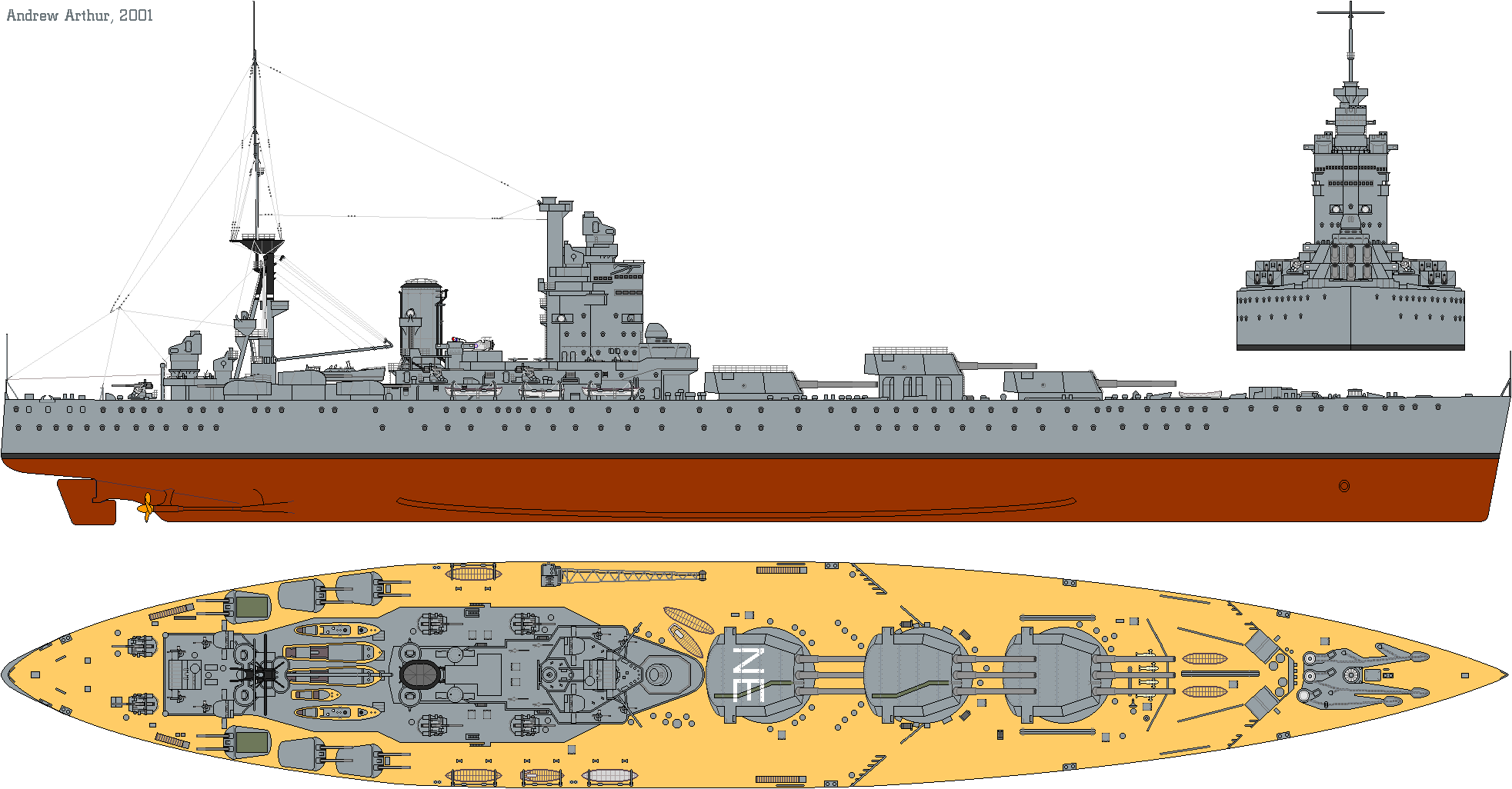
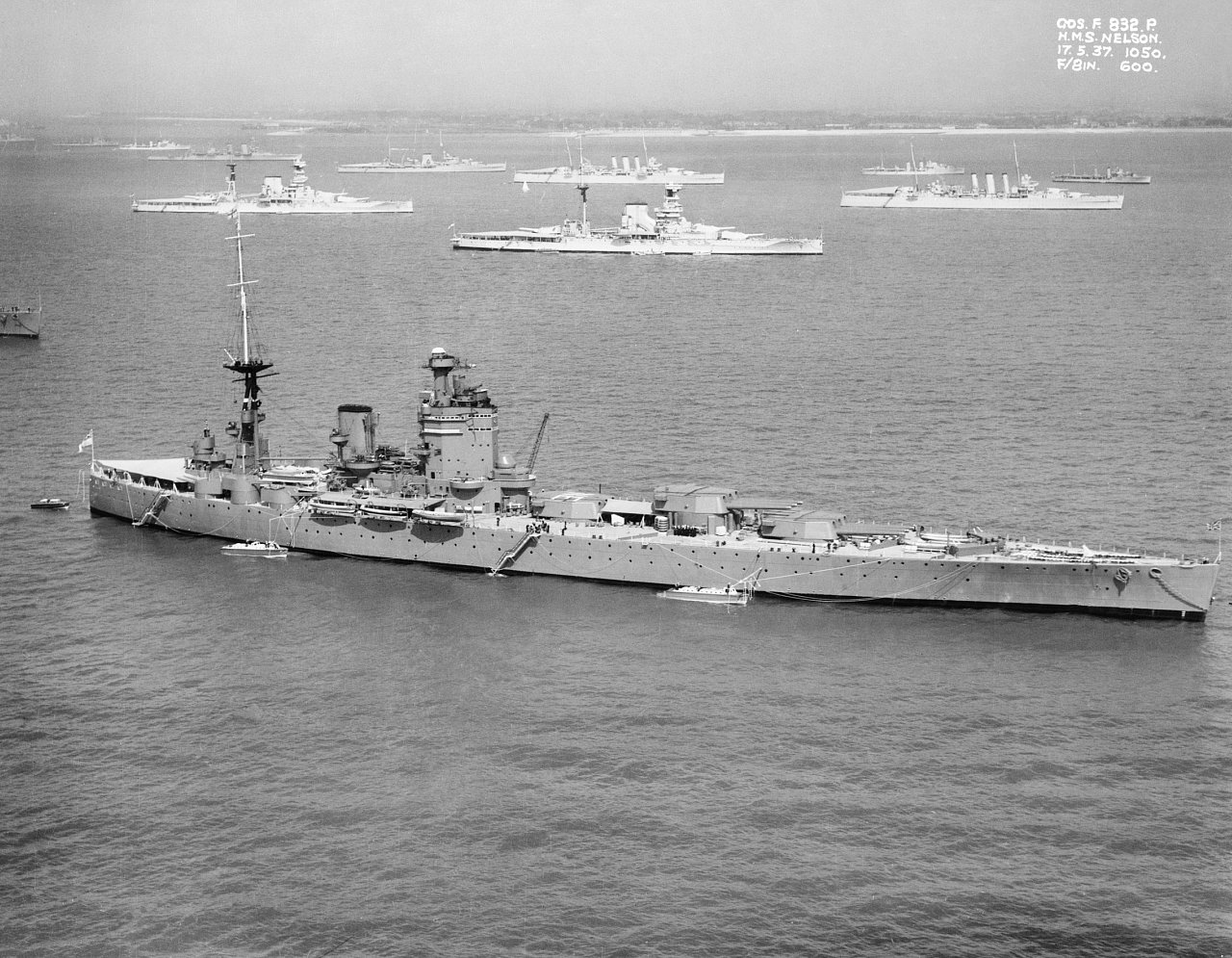
One of my favourite quirky ship designs is profiled at Naval Gazing: HMS Nelson and HMS Rodney. These two ships, known derisively by the names “Nelsol” and “Rodnol” (because of their odd profile resemblance to a class of RN oilers, whose names all ended in “-ol”), were the first post-WW1 British battleships designed to incorporate the bitter lessons learned at the battle of Jutland in 1916. Their construction was also influenced by the round of naval treaty talks that aimed to stop a renewed naval arms race and limit the major navies in both number and size of ships.

HMS Nelson profile drawing as she appeared circa 1931.
Image by Emoscopes via Wikimedia Commons.

At the end of WWI, the Royal Navy faced a crisis. During the war, it had suspended new capital ship construction except for a handful of battlecruisers, while the American and Japanese building programs had continued to churn out ships that were more modern than the bulk of the British fleet. Worse, the British battlefleet had seen hard war service, and many of the early dreadnoughts were in bad shape and essentially unfit for further service. New battleships would be needed, ships that fully reflected the lessons of the war.

HMS Nelson off Spithead for the 1937 Fleet Review. Anchored in the background are two Queen Elizabeth-class battleships and two cruisers of the London class.
Photo via Wikimedia Commons.

The most important of these was the need for an all-or-nothing armor scheme, as developed in the US. The war had seen major improvements in armor-piercing shells, and they required significantly more armor than previous vessels. However, the increased range gave designers a way out. Previously, the size of citadels had been set by the need to preserve stability and buoyancy if the ends were riddled. At long range, the many hits necessary to riddle the ends would not happen, and the citadel could be shrunk to thicken the armor. The British also looked to improve on the 15″ gun due to the proliferation of 16″ weapons in the American and Japanese navies. They investigated the triple turret, abandoned a decade earlier amid fears of increased mechanical complexity, and the 18″ gun under the cover name of 15″/B.

Two parallel design series were started, one for battleships, the other for battlecruisers. As this series was developed, the designers saw a serious problem with the battlecruisers. The boiler uptakes would leave large holes in the armored deck, and if the ship was headed towards the enemy, shells might be able to pass through the holes and into the aft magazines. The solution was to move all three turrets forward of the engines, on the basis of war experience showing that ships rarely if ever engaged targets directly aft.

The Kerch Strait stand-off

Filed under: Military, Russia — Tags: , , , , , — Nicholas @ 03:00

The Russians are attempting to cut off Ukrainian access to the Sea of Azov, cloaking that action in standard disinformation to claim that Ukraine is the aggressor, etc. Shoshana Bryen outlines the situation at the moment:

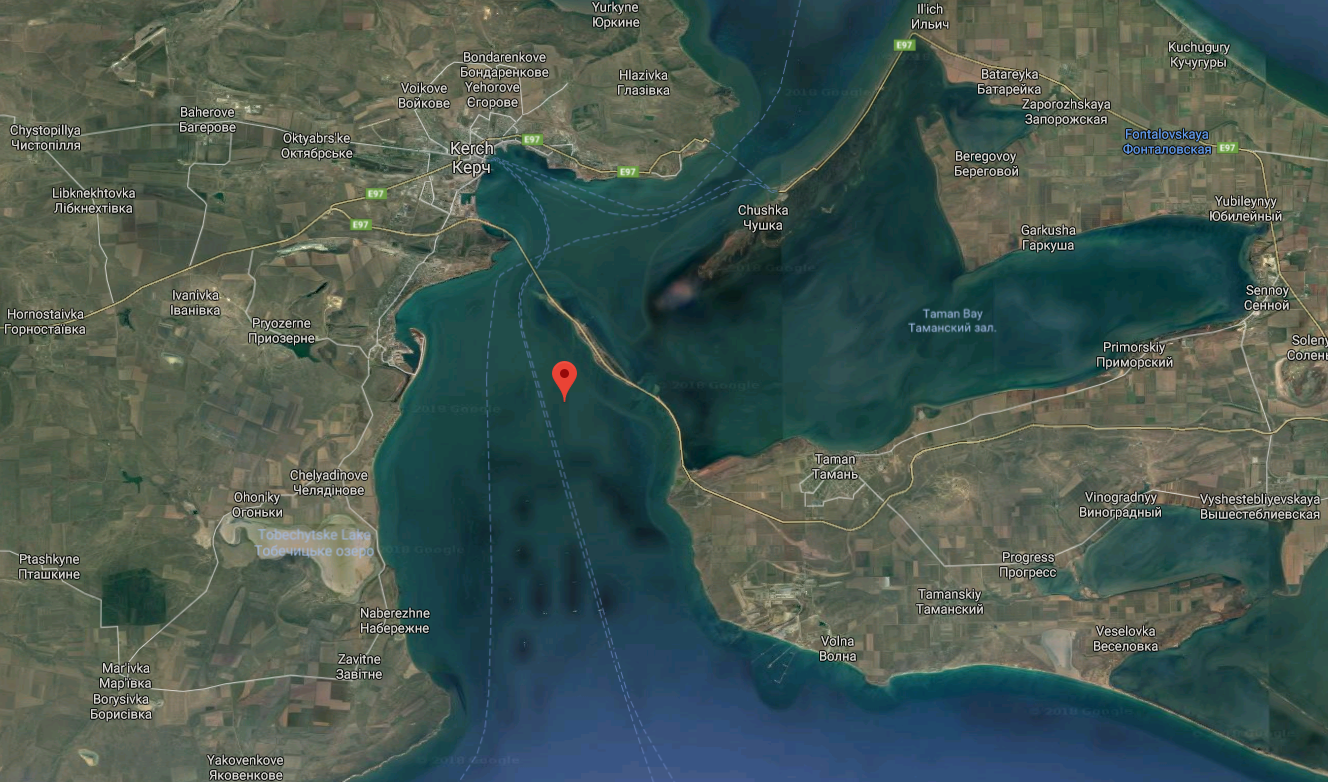
Satellite view of the Kerch Strait via Google Maps

Every story has a starting point. Don’t start with the Russian capture this week of two (or three) Ukrainian ships and the injury to three (or six) Ukrainian sailors. The Russian habit is to do as it likes with smaller countries and then announce that the other guy did it (or it never happened at all). That is the story of the Russian war in Ukraine and the 2014 illegal annexation of Crimea, and that is the Russian story of the Ukrainian ships – two ships, not three, three injured not six; anyhow, Ukraine was sailing out of its lane.

Start instead with the bridge over the narrow Kerch Strait that opened earlier in 2018. It is the only entrance to the Azov Sea from the Black Sea, spanning the Taman Peninsula in Russia and the Kerch Peninsula in Crimea. Earlier plans for the bridge were completed between Russia and Ukraine, but that was before the Russians occupied Crimea. There is an agreement for Ukrainian passage to its two ports along the Azov Sea, but Ukraine has complained that the bridge is the beginning of a blockade that would ultimately control or end Ukrainian shipping. There have been delays for Ukrainian ships passing through, sometimes days, and oh, by the way, the bridge is very low – nearly flat – over the water, meaning that Ukrainian ships over 115 feet can’t pass at all. And now there is a Russian ship parked under the bridge, blocking traffic.

It is estimated that Ukrainian shipping through the strait is down nearly 25% since the bridge opened – as the Ukrainians feared and as the Russians planned.

Austin Bay looks at the military and diplomatic side:

Closing the Kerch Strait effectively blockades Berdyansk and Mariupol, two Ukrainian ports on the Sea of Azov’s north coast.

In 2015, while visiting Crimea, Vladimir Putin himself said he hoped there would be no “full-scale direct clashes” between Ukrainian and Russian forces.

But on Nov. 25, Russia’s war against Ukraine escalated as verifiably Russian coast guard forces under the command of the Russian Federal Security Service intercepted (rammed says Ukraine), boarded and seized two verifiably Ukrainian naval vessels and a Ukrainian tugboat. The 24 Ukrainians on board the ships became Russian prisoners.

The Kremlin claimed the Ukrainian vessels had conducted “dangerous maneuvers” in Russian territorial water.

Putin’s Kremlin specializes in adding complex twists to blatant falsehoods. There is no evidence the Ukrainian ships did anything but try to avoid being intercepted. Russian territorial water? To buy that you must accept Russia’s illegal seizure of the peninsula. However, the strait is an internationally recognized waterway open to transit by commercial shipping and naval vessels. Kerch is comparable to other straits around the globe, like the Strait of Hormuz at the mouth of the Persian Gulf. Iran routinely threatens to close Hormuz to shipping, but to do so would violate freedom of navigation and constitute an act of war.

Defense One reported that Kiev had informed Moscow that its naval vessels would transit the strait. Moreover, the Russians who boarded the Ukrainian ships were special operations commandos.

The Ukrainian ships were making a legal transit. As recently as 2003, Russia guaranteed Ukraine’s right to transit the strait. The 2003 treaty made the strait and Sea of Azov shared territory.

Like invading Crimea, the Russian seizure of Ukrainian ships is a calculated act of war. Russia has now anchored an oil tanker in the main sealane beneath the bridge, blocking all ship traffic.

Ukrainian Foreign Minister Pavlo Klimkin said ramming a Ukrainian vessel was an “act of armed aggression” and that Russia had violated “the freedom of maritime traffic.” He also cited specific articles in the United Nations Convention on the Law of the Sea that “bans the obstruction of peaceful transit across the Kerch Strait.”

Several articles referenced the possibility that NATO would … do something. Other than the usual diplomatic protests, I doubt that there’s much NATO can do in a situation like this. Direct military action should not even be considered an option (not that it’ll stop the odd wild-eyed editorial writer), as NATO does not have a direct interest at risk here. All western nations do have an interest in preserving and upholding freedom of the seas, but Russia knows that the west won’t likely risk getting into a shooting war over incidents like this.

You can get a very useful list of links including the current Kerch Strait confrontation from MILNEWS.ca.

November 26, 2018

Will the Kriegsmarine Rule the Waves? – WW2 – 013 24 November 1939

Filed under: China, Europe, Germany, History, Japan, Military, Russia, WW2 — Tags: , , , , , — Nicholas @ 04:00

World War Two
Published on 24 Nov 2018

The European Allies seek a countermeasure to the mysterious German mines, in China the Japanese advance, and in Poland it is the beginning of the Warsaw Ghetto.

WW2 day by day, every day is now live on our Instagram account @World_war_two_realtime https://www.instagram.com/world_war_t…

Join us on Patreon: https://www.patreon.com/TimeGhostHistory
Or join The TimeGhost Army directly at: https://timeghost.tv

Written and Hosted by: Indy Neidell
Produced and Directed by: Spartacus Olsson and Astrid Deinhard
Executive Producers: Bodo Rittenauer, Astrid Deinhard, Indy Neidell, Spartacus Olsson
Research by: Indy Neidell
Edited by: Wieke Kapteijns and Spartacus Olsson
Community Manager: Joram Appel

Coloring by Spartacus Olsson and Norman Stewart
Norman’s pictures https://oldtimesincolor.blogspot.com/

Archive by Screenocean/Reuters https://www.screenocean.com

A TimeGhost chronological documentary produced by OnLion Entertainment GmbH

« Newer PostsOlder Posts »

Powered by WordPress