Quotulatiousness

April 26, 2014

Twerking to Dvořák

Filed under: Media — Tags: — Nicholas @ 11:19

B-Classic presents The Classical Comeback: a new music video format that gives classical music the same recognition as pop and rock music by combining the timeless emotion of classical music with the visual talent of a contemporary director.

H/T to Michael Vincent who initially wasn’t impressed.

April 24, 2014

Joe Satriani – world-class musician and self-taught entrepreneur

Filed under: Books, Business, Media — Tags: , — Nicholas @ 08:42

Inc. Magazine isn’t where you’d normally expect to find profiles of famous musicians, but Jeff Haden’s article covers both the musical and the entrepreneurial sides of Joe Satriani:

Put aside selling millions of critically acclaimed solo albums. Put aside touring with Mick Jagger, Deep Purple, and Chickenfoot. Put aside teaching legendary guitarists like Steve Vai, Kirk Hammett, Andy Timmons, and Alex Skolnick and creating signature guitar and equipment lines. Put aside founding the long-running G3 concert series.

World class musician? Absolutely — but inside 14-time Grammy nominated guitarist Joe Satriani also beats the heart of a true entrepreneur.

This month marks the release of Satriani’s new book, Strange Beautiful Music: A Musical Memoir, as well as his career retrospective box set, The Complete Studio Recordings. It’s the perfect time to talk to him about the business of Joe Satriani. (Spoiler alert: While you might think entrepreneurs have nothing in common with musicians, you’re definitely wrong.)

[…]

It’s almost a given in the music business that artists eventually regret the terms of their first contract. They’re so happy to get signed that they will sign almost anything. Yet your experience was very different.

Success came to me in my late 20s. I had started touring when I was a teenager so I had already seen the good, the bad, and the ugly side of the music business. Plus setting up my own record company taught me a lot.

I walked into Relativity Records as a musician who could not be taken advantage of. That’s why I wound up owning all my own publishing and making a deal that was quite advantageous for a new solo artist. But I really didn’t think of myself as an entrepreneur. I thought of myself as an artist who felt strongly he should control every aspect of his art.

From a business and market opportunity point of view, instrumental rock was not exactly a happening genre. If your goal was to strike while the musical iron was hot your timing was way off.

What you just said is perfect. You encapsulated what I came to grips with when I looked for funding for my first record.

I remember getting turned down by everyone in my local community, and I was just looking for a few thousand dollars. If I had been starting a company to make plastic cups I could probably have gone to a bank and gotten a loan. But a guitar player getting a bank loan to record a record? That was just never going to happen.

After a week of being rejected by local studios and engineers I found this credit card offer in my mailbox. I was pre-approved because of, “My good standing in the community.”

April 20, 2014

QotD: Musical tastes

Filed under: Humour, Media, Quotations — Tags: , , — Nicholas @ 11:46

It was my business for a long time to tell people that approached the bandstand that their favorite song was of absolutely no interest to everyone else in the room, and we weren’t going to play it. It’s a delicate thing to tell people that the song that contains both the name of their illegitimate children and their pit bulls, and whose album cover is featured on both a tattoo on their chest and painted on the side of their van, isn’t very entertaining. Such information upsets people, like going to the monkey house at the zoo and throwing your poo at the apes. Those monkeys stop in their tracks and stare at you, I’m telling you.

Don’t ask me how I know that.

Sippican Cottage, “Well, I Put The Quarter Right In That Can, But All They Played Was Disco, Man”, Sippican Cottage, 2013-05-06

April 19, 2014

Transaction costs, takedown notices, and the DMCA

Filed under: Economics, Law, Media — Tags: , , , , — Nicholas @ 09:59

Mike Masnick reports on an inadvertent natural experiment that just came to light:

We’ve written a few times in the past about research done by Paul Heald on copyright and its impact on the availability of certain content. He’s recently published an interesting new study on how the DMCA’s notice-and-takedown regime facilitates making content available by decreasing transaction costs among parties. As we’ve discussed at length, the entertainment industry’s main focus in the next round of copyright reform is to wipe out the notice-and-takedown provisions of the DMCA. The legacy recording and movie industries want everyone else to act as copyright cops, and hate the idea that notice-and-takedown puts the initial burden on themselves as copyright holders.

However, Heald’s research looks at music on YouTube and concludes that the notice-and-takedown system has actually enabled much greater authorized availability of music, by reducing transaction costs. The idea is pretty straightforward. Without a notice-and-takedown provision, someone who wants to post music to YouTube needs to go out and seek a license. Of course, getting permission from all the various rightsholders is frequently impossible. The transaction costs of getting permission make it such that it’s way too high. Yet, with notice-and-takedown, the person can upload the content without permission, and then the copyright holder is given the option of what to do with it. On YouTube, that includes the option of monetizing it, thus “authorizing” the use. That creates a natural experiment for Heald to explore, in which he can see how much content is “authorized” thanks to such a setup. And the result, not surprisingly, is that this system has enabled much greater authorized (and monetized) access to music than an alternative, high transaction cost system, under which uploaders must first seek out permission to upload everything.

April 18, 2014

QotD: Opera

Filed under: Humour, Media, Quotations — Tags: , , , , — Nicholas @ 09:21

Opera, to a person genuinely fond of aural beauty, must inevitably appear tawdry and obnoxious, if only because it presents aural beauty in a frame of purely visual gaudiness, with overtones of the grossest sexual provocation. The most successful opera singers of the female sex, at least in America, are not those whom the majority of auditors admire most as singers but those whom the majority of male spectators desire most as mistresses. Opera is chiefly supported in all countries by the same sort of wealthy sensualists who also support musical comedy. One finds in the directors’ room the traditional stock company of the stage-door alley. Such vermin, of course, pose in the newspapers as devout and almost fanatical partisans of art; they exhibit themselves at every performance; one hears of their grand doings, through their press agents, almost every day. But one has merely to observe the sort of opera they think is good to get the measure of their actual artistic discrimination.

The genuine music-lover may accept the carnal husk of opera to get at the kernel of actual music within, but that is no sign that he approves the carnal husk or enjoys gnawing through it. Most musicians, indeed, prefer to hear operatic music outside the opera house; that is why one so often hears such things as “The Ride of the Valkyrie” in the concert hall. “The Ride of the Valkyrie” has a certain intrinsic value as pure music; played by a competent orchestra it may give civilized pleasure. But as it is commonly performed in an opera house, with a posse of flat beldames throwing themselves about the stage, it can only produce the effect of a dose of ipecacuanha. The sort of person who actually delights in such spectacles is the sort of person who delights in plush furniture. Such half-wits are in a majority in every opera house west of the Rhine. They go to the opera, not to hear music, not even to hear bad music, but merely to see a more or less obscene circus. A few, perhaps, have a further purpose; they desire to assist in that circus, to show themselves in the capacity of fashionables, to enchant the yokelry with their splendor. But the majority must be content with the more lowly aim. What they get for the outrageous prices they pay for seats is a chance to feast their eyes upon glittering members of the superior demi-monde, and to abase their groveling souls before magnificoes on their own side of the footlights. They esteem a performance, not in proportion as true music is on tap, but in proportion as the display of notorious characters on the stage is copious, and the exhibition of wealth in the boxes is lavish.

H.L. Mencken, “The Allied Arts: Opera”, Prejudices: Second Series, 1920.

April 16, 2014

Handel’s Messiah – the Live Aid of 1750

Filed under: Britain, History, Media, Religion — Tags: , , , — Nicholas @ 08:08

In the Telegraph, Michael White explains why Handel’s Messiah really was the 18th century equivalent of Live Aid:

Every year, his masterpiece reliably comes round, filling musicians’ diaries with unending renditions of the Hallelujah Chorus and “Surely he hath borne our griefs” (or “worn our briefs” as choirboys have it), like a tonic for the flagging bank balance. And it will be the same this week, with a performance of some kind or other guaranteed to come your way, unless you’re living in the Outer Hebrides without a choir in sight or sound.

But for good measure, there’s also a BBC TV programme on Saturday in which the historian Amanda Vickery is looking at Messiah’s back story. And it seems her interest isn’t in the piece as a gift to musicians but as a gift to the poor — focusing on a London performance in 1750 that was, as she says, an 18th-century precedent for Live Aid.

This performance took place at the Foundling Hospital in London, which these days is a museum but was then a children’s home attracting the support of celebrated figures in the arts world. Painters including Hogarth gave it canvases to exhibit; composers such as Handel gave it music to perform. And the funds raised helped keep it going — in something like the manner of that other famous children’s home, the Ospedale della Pietà, Venice, where Vivaldi gave his services.

[…]

The only problem was that Handel depended for commercial success on operatic ventures that proved disastrously expensive and went sour when public tastes changed (as they always do). Hence his interest in writing English oratorios: they were cheaper to produce than opera, avoided over-priced Italian singers and attracted decent audiences.

Hence Messiah, which was written not for London but for Dublin, where it was premiered in April 1742. A large crowd was clearly expected because notices published in advance begged gentlemen to leave their swords at home and ladies to attend “without Hoops”. The critical information on those notices, though, was that making room for more people would “greatly increase the Charity”; because even this initial Dublin try-out was a fundraiser, designed for the relief of prisoners and an infirmary.

So it was good causes that helped swell the turnout. And from what we know of how it went, the audience was high-minded, entering into the spirit of an entertainment that was happening in a concert hall but none the less used sacred texts.

Jonathan Swift, the Dean of Dublin’s Anglican Cathedral, had initially tried to stop his choir being involved, on the grounds that a concert hall wasn’t the right place for such things, and that one of the soloists, Susannah Cibber, was a woman of loose morals. But when she sang “He was despised” she did so with such beauty that another clergyman in the audience stood up and shouted “Woman, thy sins be forgiven”: the kind of engagement you might wish of modern audiences, if only they could be distracted from their iPhones.

April 4, 2014

Kurt Cobain’s legacy, twenty years on

Filed under: Media — Tags: , — Nicholas @ 07:02

In sp!ked, Tom Slater reflects on the life and work of Kurt Cobain:

… it’s impossible to separate the man from the music. Cobain was widely hailed as the last great rock icon — someone whose life, work and time coalesced to form one totemic legend. Any claim that pop music, in and of itself, can attain some level of immortality, as if, like the great works of antiquity, we can easily separate the work from the man and the myth, is ludicrous. Popular culture is always intertwined with the conditions, and often the person, that helped create it and make it cool. The question, two decades on, is what do we make of it all; of Nirvana, Generation X and Cobain himself.

The slacker generation marked a clear decline in rock youth culture, the point at which all that once made it vital, exuberant and exciting collapsed. Generation X was not about young teenagers railing against an unjust society but cutting themselves off from it and sneering at all the bigoted sheeple. On the day that Bikini Kill frontwoman Kathleen Hanna famously spray-painted the words ‘Kurt Smells Like Teen Spirit’ on the walls of Cobain’s flat, giving birth to the name of an anthem, Cobain, Hanna and a gaggle of their mates had been out spraying ‘God is gay’ on religious centres. In the scrawled liner notes to Nirvana’s 1992 compilation Incesticide, Cobain wrote: ‘If any of you in any way hate homosexuals, people of a different colour, or women, please do this one favour for us — leave us the fuck alone! Don’t come to our shows and don’t buy our records.’ Of course, it’s unlikely many Nirvana fans were card-carrying bigots or fundamentalist Christians — but that didn’t matter. Teenage rebellion had given way to putting the fucked up world to rights in the confines of your box bedroom.

[…]

Cobain disdained his own success, mainly because it meant people he didn’t like might like him. ‘Smells Like Teen Spirit’ and Nirvana’s platinum-selling second LP, Nevermind, sent his band into the rock stratosphere, but the idea the jocks he hated in high school might be buying his music sickened him. Their follow-up, In Utero, which enlisted lo-fi legend Steve Albini as producer, was an attempt at culling the unenlightened from their fanbase. The original mixes, before their record label softened them up, were vicious, lacking the more tuneful accessibility of Nevermind that helped catapult the band from Seattle basement bars to suburban minivan tape-decks. It was a calculated move, and one that, to Cobain’s chagrin, didn’t come off.

An almost visceral misanthropy runs through Cobain’s work. In Utero’s ‘Scentless Apprentice’ was inspired by the odourless antihero of Patrick Süskind’s Perfume, who is disgusted by the stink of mankind: ‘I can relate to that’, quipped Cobain in an interview. But this disgust for humanity went both ways: as Chuck Klosterman remarks in Eating The Dinosaur, ‘overt self-hatred defined the totality of [Nirvana’s] being’.

[…]

Cobain’s place in rock history is well earned. He left behind a sadly truncated canon of hard-edged, fraught and often beautiful songs. And like no other of his peers, he embodied the spirit of navel-gazing disaffection that defined Generation X. That is, rightly, his most salient legacy; forget the gory details of his death and his fraught personal life. But while Nirvana’s music stays with us, a stalwart resource for teens to listen to and thrash out their angst, we should hope that the sentiment he so perfectly articulated has all but faded away.

March 27, 2014

Smithsonian on the 50th anniversary of John Coltrane’s A Love Supreme

Filed under: History, Media — Tags: , , , — Nicholas @ 08:04

One of my all-time favourite jazz albums is turning 50, and the Smithsonian is marking the occasion:

The Smithsonian’s National Museum of American History will kick off the 13th annual Jazz Appreciation Month March 26 at 11 a.m., with donations from Ravi Coltrane, son of international music legends, John and Alice Coltrane, and from notable jazz photographer, Chuck Stewart. Coltrane will then discuss his father’s career and the famed studio album, A Love Supreme, widely considered one of the greatest jazz albums of all time and celebrating its 50th anniversary. During its own 50th anniversary year, the museum is displaying Coltrane’s original score in the “American Stories” exhibition through June 17. The ceremony will be webcast live online.

Ravi Coltrane will donate his father’s Selmer Mark VI tenor saxophone, made in Paris about 1965, the year that A Love Supreme was released. The saxophone is one of three principal saxophones Coltrane played and will be on view in the “American Stories” exhibition starting June 17. An accomplished bandleader and composer in his own right, Ravi Coltrane tours extensively with his own groups and with many other artists, including jazz musicians. He is a Blue Note recording artist.

“Today, a cherished and beloved Coltrane family heirloom becomes a national treasure and through Stewart’s never before seen images, our view of Coltrane expands,” said John Gray, director of the museum. “These generous donations help us preserve not only the legacy of individual artists, but of jazz music as a whole and its integral role in the history of music in America.”

H/T to Julian Sanchez for the link.

March 23, 2014

Rush to do 41st anniversary tour in 2015

Filed under: Cancon, Media — Tags: , — Nicholas @ 10:04

I refuse to believe that they’ve been around this long …

Rush wrapped up their worldwide Clockwork Angels tour just seven months ago, but they’re already planning a lengthy “41st anniversary” tour for 2015, according to guitarist Alex Lifeson. “The three of us just had a meeting,” Lifeson tells Rolling Stone. “We said, ‘Let’s not talk about anything band-wise for the next year. Let’s separate ourselves and come back rejuvenated.’ Unfortunately, the other people at that meeting didn’t hear what we were talking about, so there are already plans being made for spring of 2015. It’s going to be a 41st anniversary tour, or whatever they’re going to call it.”

The specifics of the tour are still in flux. “We haven’t really talked seriously about what we want to do,” says Lifeson. “But I think we’re probably going to lean towards making it a real sort of fan event, and really try to put something together that’s very pleasing for the fans across the board. That’s always been difficult, for us to sort of balance things.”

Published on 23 Oct 2013

Recorded in Dallas during the Clockwork Angels Tour 2012 with the Clockwork Angels String Ensemble

March 22, 2014

Variations on Bach

Filed under: Japan, Media — Tags: , , — Nicholas @ 10:11

Classic FM has a collection of 10 videos which use Bach’s music in varied ways, including this rather charming forest xylophone performance as an ad for a Japanese mobile phone:

Uploaded on 4 May 2011

Very nice music from a very long xylophone in the forest.
No CG or tape-cut. Four days spent.
This is for a newly launched cell phone of NTT Docomo, the largest mobile service provider in Japan. Shell of the new phone is wood and their idea is to use domestic woods that are produced after preservative maintenance of Japanese forest.
ドコモのサイトでステキな映像発見。

Music: “Jesu, Joy of Man’s Desiring”, by Bach
Cannes Lion Award Winner 2010

H/T to Samizdata for the link.

March 21, 2014

Kate Bush announces series of concerts in London

Filed under: Britain, Media — Tags: , , , — Nicholas @ 14:23

The Daily Mail describes it as a residency at the Hammersmith Apollo in London:

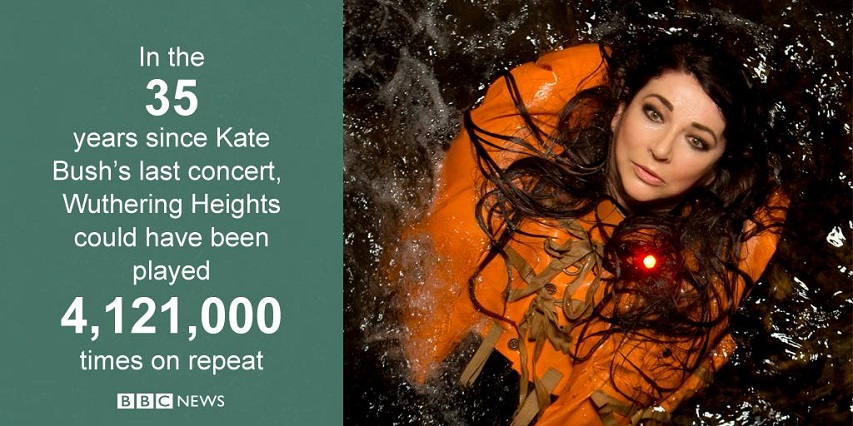
Kate Bush is to return to the stage in London — 35 years after she retired from touring after just six weeks on the road.

She will play a 15-date residency at the Hammersmith Apollo which was the venue for a celebrated concert film she made in 1979.

The 55-year-old made a surprise announcement about the shows — to be called Before The Dawn — on Friday morning, with the first taking place on August 26.

Bush talked about a desire to return to playing live in an interview three years ago, saying she would love to play again before she became ‘too ancient’.

She was just 20 when she completed The Tour Of Life after topping the charts with Wuthering Heights the previous year.

Over the years, theories about her absence from the stage have included her perfectionism, a fear of flying and the death of one of the tour crew, lighting director Bill Duffield, during a show.

But in a rare interview with Mojo magazine in 2011 to mark her comeback, she explained that her years of silence on the touring circuit were simply down to the sheer exertion of the ordeal.

‘It was enormously enjoyable. But physically it was absolutely exhausting,’ she said.


LONDON – 12th MAY: English singer Kate Bush performs live on stage at Hammersmith Odeon in London on the penultimate date of her European tour on 12th May 1979. (Photo by Peter Still/Redferns)

March 20, 2014

My mondegreens make more sense than your lyrics

Filed under: Media — Tags: , — Nicholas @ 07:59

Kevin Dettmar discusses the best form of mondegreen: the kind that makes more sense (to the listener anyway) than the actual lyrics being slurred or mumbled or bellowed by the lead singer:

I’ve been thinking a great deal lately about the important role that misunderstood lyrics play in the way rock music works. The problem is especially pointed in the case of the post-punk Gang of Four because they saw much of their music as a political intervention in the events of their day (the late 70s through the early 80s). But how can rock really “rage against the machine” if no one’s quite sure what it’s saying? What can it mean that a band that put a great deal of emphasis on its songwriting — pop songs as political theory — actively resisted making that theory more intelligible? Resisted to the degree that even smart and sympathetic critics have sometimes badly misread the work?

One answer involves taking the “mondegreen” seriously.

For better or worse, we seem to be stuck with the term that was coined in 1954 by the writer Sylvia Wright, in a piece in Harper’s Magazine. That the word is about the same age as rock and roll itself is a fitting coincidence. In her mother’s recitation of the ballad “The Bonnie Earl of Murray,” Wright as a child misheard the phrase “laid him on the green” as “Lady Mondegreen” and wove a coherent narrative around the mistake, or “mondegreen.”

[…]

My mistake, trivial in itself, does suggest something important about the capacity of rock music (in which marginal intelligibility is not just an accident but rather a constitutive element) to do significant political work. For my misreading, I’d suggest, wasn’t random free association. In important, if largely subconscious and unconscious ways, what I understood of the lyrics, and the politics of the sound of the song itself, conditioned me to fill in the blanks in my understanding from among a fairly limited range of possibilities.

In music as powerful as this — and for a listener as powerfully in its thrall as I was, as I am — the mumbly bits actually provide moments where I can become co-creator of this aggressive, political music along with the band. And that, I would submit, is powerful political pedagogy. The songs on Entertainment! don’t teach me what to think: They teach me how to think. The proof is in my mondegreens.

My mishearing the line wasn’t simply an error, then — or if an error, it was a productive one. Sylvia Wright insisted that “the point about what I shall hereafter call mondegreens … is that they are better than the original.” Dave Marsh maintains that his lyrics to “Smells Like Teen Spirit” are better than Cobain’s. What I heard at the end of “Ether” may not have been what King and Gill meant; but having my interpretation revealed through my misreadings tells me something about where my mind prefers to go. And that is precisely the work of ideological critique. “Ether” taught me not, or not only, about Gang of Four’s politics: More powerfully, it also taught me about my own.

H/T to Kathy Shaidle for the link. She also included a brilliant little music video to illustrate the point:

March 17, 2014

Shane McGowan – amazingly still not dead

Filed under: Britain, Media — Tags: , — Nicholas @ 08:46

In City Journal, Matthew Hennessey reports the unbelievable news that Shane McGowan is still alive:

They say God takes care of fools and drunks. If so, he’s been working overtime the last few decades taking care of Shane MacGowan. As the frontman and principal songwriter of the Irish rock band the Pogues, MacGowan is as famous for his lyrics and whiskey-timbered voice as for his unlikely longevity, despite a Homeric appetite for intoxicating substances, especially, but not limited to, alcohol. Though he cuts a shambolic figure, MacGowan is still upright at 56, a feat many view as a minor miracle. His rheumy eyes and distinctive throat-clearing cackle suggest not genius, necessarily, but late-stage dipsomania; there is nary a tooth left in his head. God or something like God must be taking care of MacGowan. He’s not been doing the job himself.

Throughout the 1980s and 1990s, reports of MacGowan’s impending demise were so frequent that English author Tim Bradford felt compelled to write a book called Is Shane MacGowan Still Alive? No one, not even MacGowan, takes talk of his mortality seriously anymore. “For the last 35 years I’ve supposed to have been dead in six months,” he has said. “But when all these bastards say you’re going to be dead in six months it tends to give you an incentive not to be. . . . Let’s face it, I’ve got a charmed life. I’m a lucky bastard, know what I mean?”

Whether luck, God, or some combination of the two is responsible for MacGowan’s Promethean tolerance for self-abuse, he has nonetheless been deservedly celebrated for the vivid originality of his songwriting, for which he has often been called Ireland’s greatest living poet. Indeed, his best writing evokes the poetry of William Blake, whose claim that “the road of excess leads to the palace of wisdom” has served as a road-map for MacGowan’s public career. “If you’re asking whether drink and drugs have worked for me,” he told an interviewer in 1994, “I’ve got to say they have. I’m one with William Blake on this one. Drink and drugs and all that shit, it’s a short cut to the subconscious.”

Fans and critics could be forgiven for thinking that MacGowan’s subconscious is a place of darkness, an insane asylum, a prison cell, or a congress of libertine Irish nationalists and saucy fair maidens groping their way toward alcoholic oblivion like Earth-bound fallen angels. But it is also a religious bouillabaisse of Celtic paganism, Catholic mysticism, and “drunken Zen.”

A perfect description: “Listening to the Pogues is like getting a punk-rock telegram from Brendan Behan.”

March 9, 2014

QotD: Puritan art

Filed under: Humour, Media, Quotations, USA — Tags: , , , , , — Nicholas @ 09:35

The saddest thing that I have ever heard in the concert hall is Herbert K. Hadley’s overture, “In Bohemia.” The title is a magnificent piece of profound, if unconscious irony. One looks, at least, for a leg flung in the air, a girl kissed, a cork popped, a flash of drawer-ruffles. What one encounters is a meeting of the Lake Mohonk Conference. Such prosy correctness and hollowness, in music, is almost inconceivable. It is as if the most voluptuous of the arts were suddenly converted into an abstract and austere science, like comparative grammar or astro-physics. Who’s Who in America says that Hadley was born in Somerville, Mass., and “studied violin and other branches in Vienna.” A prodigy thus unfolds itself: here is a man who lived in Vienna, and yet never heard a Strauss waltz! This, indeed, is an even greater feat than being born an artist in Somerville.

H.L. Mencken, “The Allied Arts: The Puritan as Artist”, Prejudices: Second Series, 1920.

March 6, 2014

Al Stewart – “Soho Needless to Say” (1978)

Filed under: Media — Tags: , , — Nicholas @ 10:35

« Newer PostsOlder Posts »

Powered by WordPress