Quotulatiousness

June 13, 2017

Dave Weigel’s The Show That Never Ends: The Rise and Fall of Prog Rock now available

Filed under: Books, Media — Tags: , , — Nicholas @ 06:00

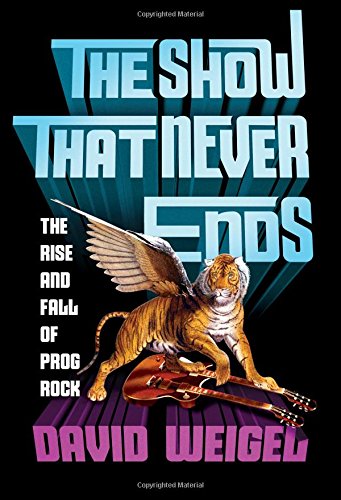
Several years back, Dave Weigel wrote a series of articles chronicling the rise and fall of Prog Rock. Today, his new book is being published:

The fact that I linked to all five parts of his 2012 series is probably enough of a clue that I’m a fan of the genre and will be purchasing my own copy of the book. Here’s some of the blurb from the Amazon.ca page (Click on the image above to go to the Amazon.ca site):

The Show That Never Ends is the definitive story of the extraordinary rise and fall of progressive (“prog”) rock. Epitomized by such classic, chart-topping bands as Yes, Genesis, Pink Floyd, Jethro Tull, and Emerson Lake & Palmer, along with such successors as Rush, Marillion, Asia, Styx, and Porcupine Tree, prog sold hundreds of millions of records. It brought into the mainstream concept albums, spaced-out cover art, crazy time signatures, multitrack recording, and stagecraft so bombastic it was spoofed in the classic movie This Is Spinal Tap.

With a vast knowledge of what Rolling Stone has called “the deliciously decadent genre that the punks failed to kill,” access to key people who made the music, and the passion of a true enthusiast, Washington Post national reporter David Weigel tells the story of prog in all its pomp, creativity, and excess.

Weigel explains exactly what was “progressive” about prog rock and how its complexity and experimentalism arose from such precursors as the Beach Boys’ Pet Sounds and the Beatles’ Sgt. Pepper. He traces prog’s popularity from the massive success of Procol Harum’s “Whiter Shade of Pale” and the Moody Blues’ “Nights in White Satin” in 1967. He reveals how prog’s best-selling, epochal albums were made, including The Dark Side of the Moon, Thick as a Brick, and Tubular Bells. And he explores the rise of new instruments into the prog mix, such as the synthesizer, flute, mellotron, and—famously—the double-neck guitar.

If this clip of Yes performing “Roundabout” doesn’t immediately suggest Spinal Tap, I can only assume you’ve never seen the movie:

But not everyone of my generation was a fan of prog: here’s James Lileks summing up what he thought of the age of musical excess:

It’s obvious from Note One that everyone involved in the effort had so much THC in their system you could dry-cure their phlegm and get a buzz off the resin, but instead of having the loose happy ho-di-hi-dee-ho cheer of a Cab Calloway reefer number, the songs are soaked with Art and Importance and Meaning. You can imagine the band members sitting down to hash out (sorry) the overarching themes of the album, how it should like start with Total Chaos man because those are the times in which we live with like war from the sky, okay, and then we’ll have flutes because flutes are peaceful like doves and my old lady can play that part because she like studied flute, man, in high school. The lyrics are all the same: AND THE KING OF QUEENS SAID TO THE EARTH THE HEIROPHANT SHALL NOW GIVE BIRTH / THE HOODED PRIESTS IN CHAMBERED LAIRS LEERED DOWN UPON THE LADIES FAIR / NEWWWW DAAAAY DAWNNNING!

May 24, 2017

“I don’t know if Lou would be cracking up about this or crying because it’s just too stupid”

Filed under: Cancon, Education, Media — Tags: , , , , , — Nicholas @ 03:00

Reactions to the University of Guelph student association’s characterizing Lou Reed’s “Walk on the Wild Side” as transphobic:

Friends of the late Lou Reed responded on Saturday with disbelief to a claim by a Canadian student body that the singer’s 1972 hit Walk on the Wild Side contains transphobic lyrics.

“I don’t know if Lou would be cracking up about this or crying because it’s just too stupid,” the singer’s longtime producer, Hal Willner, told the Guardian. “The song was a love song to all the people he knew and to New York City by a man who supported the community and the city his whole life.”

The Guelph Central Student Association, a group at the University of Guelph in Ontario, apologised for including the song on a playlist at a campus event.

In an apology published to Facebook and subsequently removed, the group said: “We now know the lyrics to this song are hurtful to our friends in the trans community and we’d like to unreservedly apologize for this error in judgement.”

The lyrics in question focus on Reed’s friends from Andy Warhol’s Factory, among them transgender “superstars” Holly Woodlawn and Candy Darling.

“Holly came from Miami, FLA,” Reed sings. “Hitchhiked her way across the USA/ Plucked her eyebrows on the way/ Shaved her legs and then he was a she/ She says, ‘Hey, babe, take a walk on the wild side.’”

Uploaded on 19 Nov 2009

***Rest in Peace to Holly [Woodlawn] who came from Miami, F-L-A, and who Lou first mentions in the opening lines of the song***

**Congratulations (a long overdue one at that) to the Newest Member of the Rock & Roll Hall of Fame: Lou Reed!**

*So sad to hear about Lou’s passing today at the age of 71. There will never be another one like you Lou. A true original and pioneer. Like The Who said in their Facebook status: “Walk On the Peaceful Side”*

“Walk On The Wild Side” from Lou Reed’s 1972 second solo album, Transformer, (after leaving the Velvet Underground) did not chart in the top 10 on Billboard. Some of the songs that year that did chart in the top 10 were: Gilbert O’Sullivan’s “Alone Again (Naturally),” Mac Davis “Don’t Get Hooked On Me,” and Wayne Newton “Daddy Don’t You Walk So Fast.” I’d say “Walk On The Wild Side” is just as memorable, if not more so than those ones. My favorite part of the song is probably the saxophone solo at the end 3:44.

To say the least, this song was highly controversial when it came out considering it is about transvestites who come to NYC for prostitution. They would say to their potential customers, “Take a walk on the wild side!” Lou Reed once said about the song: “I always thought it would be fun to introduce people to characters they maybe hadn’t met before, or hadn’t wanted to meet.” What an amazing storyteller and lyrical genius Lou Reed was.

Try to find another song from this time period where the artist talks so openly about subjects such as oral sex, transvestites, and drug use, there weren’t very many others. He was writing about things in a style that, frankly, almost no other artist at that time would even consider writing or singing about. Lou was well before his time, and has inspired countless artists from all genres. What a classic, classic song! Still no song like it to this day. What artist other than Lou could get away with lyrics like: “And the colored girls go doo do doo, doo do doo, doo do doo”?! The lyrics are way too clever and fun not to post in the description so here they are:

Lyrics:

Holly came from Miami, F.L.A.
Hitch-hiked her way across the U.S.A.
Plucked her eyebrows on the way
Shaved her legs and then he was a she
She says, ‘Hey babe, take a walk on the wild side’
He said, ‘Hey honey, take a walk on the wild side’

Candy came from out on the island
In the backroom she was everybody’s darlin’
But she never lost her head
Even when she was giving head
She says, ‘Hey babe, take a walk on the wild side’
He said, ‘Hey babe, take a walk on the wild side’

And the colored girls go
Doo do doo, doo do doo, doo do doo

Little Joe never once gave it away
Everybody had to pay and pay
A hustle here and a hustle there
New York City’s the place where they said
‘Hey babe, take a walk on the wild side’
I said, ‘Hey Joe, take a walk on the wild side’

Sugar plum fairy came and hit the streets
Lookin’ for soul food and a place to eat
Went to the Apollo, you should’ve seen ’em go go go
They said, ‘Hey sugar, take a walk on the wild side’
I said, ‘Hey babe, take a walk on the wild side’
Alright, huh

Jackie is just speeding away
Thought she was James Dean for a day
Then I guess she had to crash
Valium would have helped that bash
She said, ‘Hey babe, take a walk on the wild side’
I said, ‘Hey honey, take a walk on the wild side’

And the colored girls say
Doo do doo, doo do doo, doo do doo

May 21, 2017

What Fans Never Knew About Weird Al Yankovic

Filed under: Humour, Media — Tags: , , , — Nicholas @ 04:00

Published on 19 May 2017

With his seemingly endless optimism and light-hearted satire, Weird Al Yankovic has a power that goes beyond innovative lyrics and catchy tunes: he makes people happy. But Weird Al Yankovic’s path to success hasn’t always been smooth sailing. Here are the weirdest moments in Weird Al’s journey from a nerdy, accordion-playing teen to the Prince of Parody…

Dr. Demento | 0:23
Bathroom success | 1:15
Voice actor | 1:52
Band-mates forever | 2:35
The Saga Begins | 3:05
Top 10 triumph | 3:54
The UHF bomb | 4:33

April 15, 2017

Charles Mingus Sextet feat. Eric Dolphy – Take the “A” Train [complete]

Filed under: Media — Tags: , , — Nicholas @ 05:00

Published on 23 Apr 2013

Take the “A” Train

live on April 12, 1964
filmed in Norway

Charles Mingus – Bass
Eric Dolphy – Bass Clarinet
Clifford Jordan – Tenor Sax
Johnny Coles – Trumpet
Jaki Byard – Piano
Dannie Richmond – Drums

April 10, 2017

Audit Hollywood!

Filed under: Business, Law, Media, USA — Tags: , , , — Nicholas @ 03:00

Harry Shearer has launched a suit against the owners of the movie Spinal Tap after he and his co-stars earned a pitiful sum on merchandise and music royalties, despite the film’s continuing popularity. Movie studios and music conglomerates use impenetrable and complex accounting “rules” to hide any profits (as profits need to be shared with actors, directors, musicians, and writers):

Behind the ambitious, creative talent that is Hollywood lies a darker side of the entertainment industry little appreciated by the ordinary moviegoer. It’s an opaque world of film financing, revenue accretion and minimal profit share. If exposed, as our Spinal Tap lawsuit against Vivendi aims to do, fans will no doubt be horrified at the shameful gravy train that rolls for corporate rights holders at the expense of creators. So far, challenges to media conglomerates’ comfortable status quo provoke little more than derision, since the power balance is so skewed in their favor. But, for how much longer?

Spinal Tap began as a mock rock band that we four – Rob Reiner, Christopher Guest, Michael McKean and myself – developed for an appearance on a TV pilot at the end of the 1970s. On our own initiative, we wrote and recorded most of the songs and performed them live in several music clubs around L.A. before any cameras rolled. The ultimate movie was truly, in the words of Michael McKean, “the result of four very stubborn guys working very hard to create something new under the sun.”

[…]

Unfortunately, “Hollywood accounting” isn’t a practice confined to California. Within the success story that is the European film and television industry, which generated €122 billion in 2013, less than one-third of 1 percent was shared with the writers and directors of the works created. A peculiar definition of “fairness,” you might say.

Under French law, filmmakers should be paid a fee for their work plus an ongoing remuneration proportionate to the exploitation of their creation. In reality, less than 3 percent of French writers and directors receive anything more than the initial payment of that minimum guarantee. And 70 percent of all European film directors are asked to defer a proportion of their original fees (as we, the creators of This is Spinal Tap, originally agreed to do).

The Europeans are simply following Hollywood’s lead; however, Spinal Tap‘s rights are determined by US law. In fighting for creators’ rights against a French conglomerate, Spinal Tap is simply pursuing a legal path well-trodden by our American creator peers. The well-known science-fiction “flop” of a film, Return of the Jedi, has apparently never gone into profit despite earning almost $500 million worldwide. Harry Potter and the Order of the Phoenix, apparently “lost” almost $170 million.

April 4, 2017

Ray Manzarek – Riders on The Storm

Filed under: Media — Tags: , — Nicholas @ 05:00

Published on May 21, 2013

The wonderful Ray Manzarek tells of the making of “Riders on The Storm”
Rest in peace Ray

March 23, 2017

Simon Phillips – Force Majeure

Filed under: Media — Tags: , — Nicholas @ 02:00

Uploaded on Sep 9, 2008

Another from Simon Phillips Returns

March 19, 2017

Phonograph vs. Gramophone – The Invention of Sound Recording Part 1 I THE INDUSTRIAL REVOLUTION

Filed under: History, Media, Technology — Tags: , — Nicholas @ 02:00

Published on 27 Feb 2015

The desire to record the human voice can be traced back to the 10th century. Thomas Edison is the first man who finally crafted the phonograph, a machine that can record sound. A few more GREAT MINDS are necessary to improve the technology until the first record made of shellac is produced. Emile Berliner, the inventor of the gramophone, is the reason why record lovers still listen to vinyl LPs to this day! This is the first part of our small series about the invention of sound recording.

March 16, 2017

Simon Phillips – Manganese

Filed under: Media — Tags: , — Nicholas @ 02:00

Uploaded on Aug 21, 2009

One of his several amazing productions. Especially the beginning is mindblowing. Unfortunately no video. This track can be found on the Drum Nation Volume 1 CD.

March 12, 2017

QotD: The waning influence of pop music

Filed under: Business, Media, Quotations, USA — Tags: , , — Nicholas @ 01:00

Pop music’s impact on the greater culture is also largely over. There will never be another Beatles or Rolling Stones. That’s because “American culture” is over. Prior to the two great industrial wars of the 20th century, America did not have a unified national culture. It was federation of regions. New England may as well have been a different country from the Deep South or the Southwest. The South was very different from Appalachia. There was no unified “American” culture to which all the regional cultures submitted.

The great national project of conquering Europe and Asia opened the door for the flowering of an American culture after the war. Into it was drawn anything that could be sold as celebrating this new world power. It is why what we think of as American pop culture blew up after the war. In music, for example, producers scoured the land looking for authentic American sounds to package up and sell, in order to meet the demand of this new growing thing called Americana. It even went global, in search of spice to ad to the mix.

Like the music business itself, the great unifying national culture that blossomed in the 20th century has run its course. America is, to a great degree, falling back to its natural, regional state. Just look at the popularity of movies and TV shows by region and you see old weird America emerging again. Live acts now setup their tours to reflect the fact that they have greater appeal in some regions than in others. If you are a country act, for example, there’s no point in booking a lot of dates in the north, outside of the one-off festivals in the summer that feature a variety of acts.

That’s another lesson from pop music. The past is the actualized, the present is the actualizing and the future in the potential. Culture is that middle part, standing on the past in an effort to realize the potential that lies in the future. Once culture attains its natural end, it dies. What’s left is what it created. The grand unified pop culture of the Cold War era is now like an old factory building that has been renovated to be lofts, shops and boutique restaurants. It’s influence on what comes next is purely utilitarian.

The Z Man, “The Cycle of Life”, The Z Blog, 2017-03-01.

March 9, 2017

Simon Phillips & Protocol + Ndugu Chancler + Billy Ward: Biplane to Bermuda

Filed under: Media — Tags: , — Nicholas @ 02:00

Published on Jan 21, 2014

Simon Phillips & Protocol + Ndugu Chancler + Billy Ward
– Andy Timmons – Everette Harp – Steve Weingart – Del Atkins: Biplane to Bermuda – MD Drumfestival 2008

H/T to ESR who said “I had a very powerful experience recently. I found my love of jazz again. Here’s the recording that did it”.

February 24, 2017

Weird Al Yankovic Explains Autotune

Filed under: Humour, Media, Technology — Tags: , — Nicholas @ 02:00

Uploaded on 12 Nov 2009

February 1, 2017

Mike Oldfield Story (BBC Documentary)

Filed under: Britain, Media — Tags: , — Nicholas @ 03:00

Embedding has been disabled, so you’ll have to go to YouTube to watch this one.

Published on 3 Nov 2014

Documentary about the musician Mike Oldfield, whose 1973 album Tubular Bells launched the Virgin record label and became the biggest selling instrumental album of all time.

December 25, 2016

Repost – “Fairytale of New York”

Filed under: Media, USA — Tags: , , , — Nicholas @ 03:00

Time:

“Fairytale of New York,” The Pogues featuring Kirsty MacColl

This song came into being after Elvis Costello bet The Pogues’ lead singer Shane MacGowan that he couldn’t write a decent Christmas duet. The outcome: a call-and-response between a bickering couple that’s just as sweet as it is salty.

December 23, 2016

Repost – Kate Bush – Christmas Special 1979 (Private Remaster)

Filed under: Britain, Media — Tags: , , , — Nicholas @ 02:00

Published on 5 Oct 2013

I know there’s a good few copies of this out on YouTube, but here it is, again! The other copies were either split up into individual tracks, the best complete one (from BBC Four’s rebroadcast in 2009) had the wrong aspect ratio, which annoyed the hell out of me! So, here this is…

Video and audio have been tidied up very slightly, not much was needed!

Kate Bush – Christmas Special
Tracklist:
(Intro) 00:00
Violin 00:29
(Gymnopédie No.1 – composed by Erik Satie) 03:44
Symphony In Blue 04:44
Them Heavy People 08:20
(Intro for Peter Gabriel) 12:52
Here Comes The Flood (Peter Gabriel) 13:22
Ran Tan Waltz 17:02
December Will Be Magic Again 19:43
The Wedding List 23:35
Another Day (with Peter Gabriel) 28:05
Egypt 31:41
The Man With The Child In His Eyes 36:21
Don’t Push Your Foot On The Heartbreak 39:24

“I was recently asked about this BBC TV special and I thought I’d share my comments here. Kate: Kate Bush Christmas Special is a stage performance by Kate Bush with her special guest Peter Gabriel. Though most of the songs are not holiday ones, they come from Bush’s first three albums (Never for Ever her third album would be released in 1980 after this 1979 TV special was taped). The performances include costumes, choreographed dances and a wind machine, creating an eclectic music TV special to say the least.

This is one of the programs that makes my research quite difficult — because it calls itself a Christmas Special yet it contains only one performance of a Christmas song “December Will Be Magic Again” (a song that wouldn’t be released as a single by Bush until the following year, in 1980). TV programming that calls itself a Christmas Special and yet contains little to no Christmas entertainment is actually quite common — especially on the BBC.

Between the end of November and the end of December each year, there is quite a bit of special programming on television. Remember Elvis’ 1968 Comeback Special — it aired in December that year and includes only one holiday song, a performance of “Blue Christmas.” Is it considered a Christmas special? No, not really. And so, despite its title, the lack of holiday programming in Kate Bush’s 1979 TV special means it shouldn’t be considered a Christmas special either. But the Kate Bush Christmas Special is certainly worth watching!”

H/T to Ghost of a Flea for the link.
« Newer PostsOlder Posts »

Powered by WordPress