
Yesterday Uzbek photographer Umida Akhnedova was convicted of slandering and insulting her people. Her crime consisted of taking pictures, such as the one on the right, that government officials thought made Uzbekistan look bad. Among other things, The New York Times reports, Akhnedova was accused of “showing people with sour expressions or bowed heads, children in ragged clothing, old people begging for change or other images so dreary that, according to a panel of experts convened by the prosecutors, ‘a foreigner unfamiliar with Uzbekistan will conclude that this is a country where people live in the Middle Ages'” (a misleading impression, since the Spanish Inquisition never persecuted people for taking photographs). The government also charged that Akhnedova’s 2008 documentary about the Uzbek custom of verifying a bride’s virginity is “not in line with the requirements of ideology” and “promotes serious perversion in the young generation’s acceptance of cultural values.” Although her crime is punishable by up to three years in prison, the judge let her go, officially to celebrate the 18th anniversary of Uzbek independence but possibly also because the publicity surrounding the case was tarnishing Uzbekistan’s reputation (no mean feat).
Jacob Sullum, “One Frown Over the Line”, Hit and Run, 2010-02-11
February 11, 2010
QotD: Slandering and insulting Uzbekistan
January 29, 2010
Australia’s film censors got bored, so decided to call attention to themselves
At least, that’s a sensible an interpretation as I can come up with for this lovely little policy change:
A reader writes, “Australian Classification Board (ACB) is now banning depictions of small-breasted women in adult publications and films. They banned mainstream pornography from showing women with A-cup breasts, apparently on the grounds that they encourage paedophilia, and in spite of the fact this is a normal breast size for many adult women. Presumably small breasted women taking photographs of themselves will now be guilty of creating simulated child pornography, to say nothing of the message this sends to women with modestly sized chests or those who favour them. Australia has also banned pornographic depictions of female ejaculation, a normal orgasmic sexual response in many women, with censors branding it as ‘abhorrent.'”
Hard to come up with a sensible explanation for this, you have to admit.
January 18, 2010
Why just be shallow? Show off your shallowness for the next generation
It used to be that you could show off your lack of imagination by naming your kid after sports stars. These days, it’s names from popular films that are all the rage:
According to a rather sketchy report in the Sun, some parents have inexplicably decided it’s a bright idea to name a kid Neytiri or Toruk or indeed Pandora. The latter is top choice in the US, “with UK parents set to follow”.
The Sun appears to have got the shock news from blinkbox.com, which suggested that the $1bn box office barrier acts as a trigger for movie-based sprogbranding. A spokesman offered: “Past the $100m barrier, the chances of a film’s star lending their name to a child increase.”
This remarkable and almost unbelievable fact explains, of course, why priests have in recent years been obliged to utter: “I christen thee Bilbo Dark Knight Barbossa Gollum Jack Sparrow III…”
It almost makes you sympathetic to those countries which legally restrict the names parents are allowed to select for their children . . .
January 8, 2010
Snow, 1963
What would happen if you took a typical Canadian snowfall and dumped it on Britain? In 1963, this is what happened. As you can see, it must have been the “right kind of snow”.
H/T to Roger Henry for the link.
January 6, 2010
Why Avatar might not appeal to soldiers
After watching Avatar, Gregg Easterbrook wonders at the gaping plot holes in the story, especially the military ones:
Then there’s director James Cameron’s view of military personnel. If I were a military man or woman, I would find “Avatar” insulting. With one exception, the helicopter pilot played by Michelle Rodriguez — her character is twice referred to as a Marine, suggesting the military personnel are regular military, not mercenaries — all the people in fatigues are brainless sadists. They want to kill, kill, kill the innocent. They can’t wait to begin the next atrocity. It’s true that the U.S. military has conducted atrocities, in Vietnam and during the Plains Indians wars. But slaughter of the innocent is rare in U.S. military annals. In “Avatar,” it’s the norm. The bloodthirsty military personnel readily comply with the colonel’s orders to gun down natives. No one questions him — though in martial law, a soldier not only may but must refuse an illegal order. Plus the military personnel are depicted as such utter morons — not a brain in any of their heads — that none notice the TOTALLY OBVIOUS detail that Pandora’s unusual biology will be worth more than its minerals. Yes, movies traffic in absurd super-simplifications. But we’re supposed to accept that of the deployment of several hundred, every soldier save one is a low-IQ cold-blooded murderer.
What does “Avatar” build up to? Watching the invading soldiers — most of whom happen to be former American military personnel — die is the big cathartic ending of the flick. Extended sequences show Americans being graphically slaughtered in the natives’ counterattack. The deaths of aliens are depicted as heartbreaking tragedies, while the deaths of American security forces are depicted as a whooping good time. In Cameron’s “Aliens,” “The Abyss” and his television show “Dark Angel,” U.S. military personnel are either the bad guys or complete idiots, often shown graphically slaughtered. Cameron is hardly the only commercial-film director to present watching evil U.S. soldiers slaughtered as popcorn-chomping suburban shopping mall fun: in the second “X-Men” flick, U.S. soldiers are the bad guys and graphically killed off. Films that criticize the military for its faults are one thing: When did watching depictions of U.S. soldiers dying become a form of fun?
January 5, 2010
Felicia Day in follow-on to Avatar?
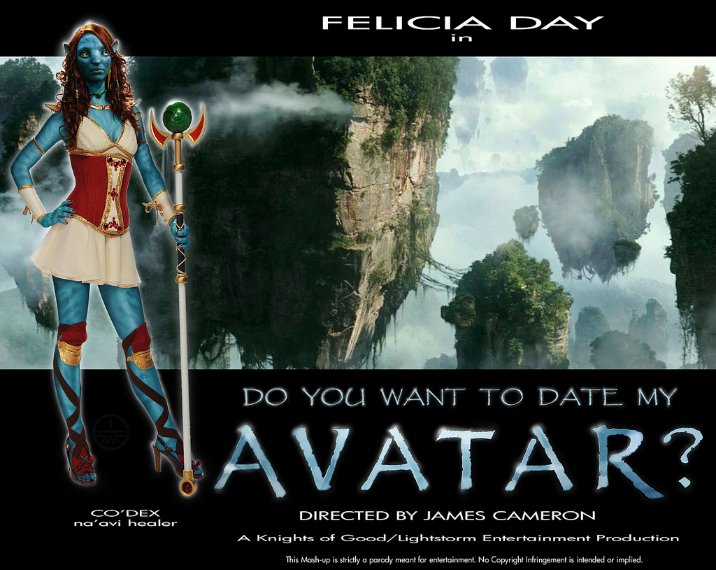
Original image here. Tweeted by Jeff Carlisle.
December 21, 2009
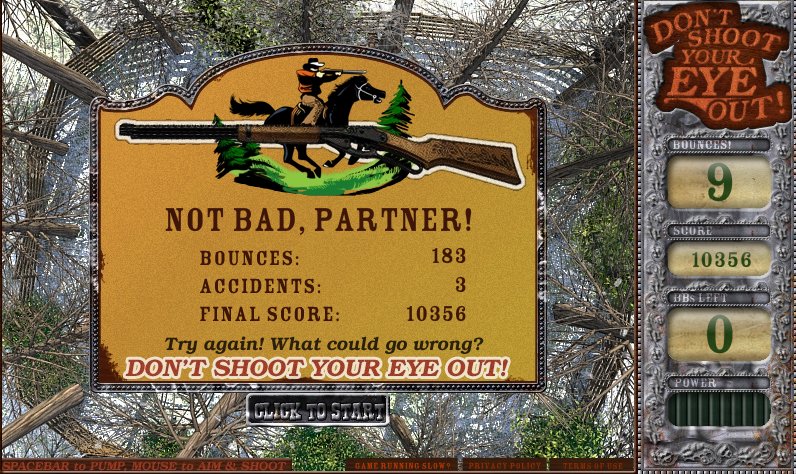
Don’t shoot your eye out!
An amusing little time-waster.
H/T to Jason Ciastko for the link.
Update: I didn’t do as well as Liam did (in the comments), but he’s right that the upper left seems to provide much more opportunity for scoring:
December 8, 2009
Casting The Hobbit
In what I’m sure was meant to stir the fans, The Guardian headlines this story with “Tom Waits to star in The Hobbit?”:
Will Tom Waits battle Bilbo Baggins? A “trusted” source working on Guillermo del Toro’s production of The Hobbit claims that the singer-songwriter is up for a part.
Waits has acted before, in films such as Terry Gilliam’s The Imaginarium of Doctor Parnassus, Robert Altman’s Short Cuts and Jim Jarmusch’s Down By Law. But he has never played the kind of character you would expect to find in a JRR Tolkien’s novel. Though the role under consideration isn’t clear, an anonymous source told Ain’t It Cool News that Waits is near the top of del Toro’s list. “As much as I’d like to say he’s a lock, I’m told he’s simply someone the production is talking about,” claims the source, “but they seem to be talking about him pretty seriously.”
For all his charms, Waits seems an unlikely pick for Bilbo, the titular hobbit played by Ian Holm in The Lord of the Rings films. He is, above all, too grumpy. Besides, a cornucopia of much more avuncular, nerdy actors, including The Office‘s Martin Freeman, Harry Potter’s Daniel Radcliffe and Doctor Who‘s David Tennant are reportedly under consideration for the part. The film-makers are reportedly auditioning unknown actors too.
November 26, 2009
Damning with not-so-faint damns
A clearly impartial and unbiased advance review of James Cameron’s Avatar, due for release in December:
Budgeted at a reported $237m (£143m), Avatar is Cameron’s first dramatic feature since the record-breaking Titanic, back in 1997. The film is a science-fiction fantasy set on a verdant planet called Pandora and following the adventures of a US Marine played by Sam Worthington. Cameron shot the film on his own patented “fusion digital 3D camera system” and experts argue that the results take 3D techniques to a whole new level. [. . .]
The reviewer, however, begs to differ, describing the film as “alienating” and “weird”. Moreover, he/she argues that its pioneering visual technology is liable to induce nausea in the viewer. “The problem is with cutting in between 3D focus points and perspective,” the mystery critic writes. “The mind cannot adjust to it without a buffer — thus, Avatar is literally vomit inducing.”
Even the review’s praise comes with a sting in the tail. “There are some beautiful moments [in the film],” it concedes. “But overall it’s a horrible piece of shit.”
November 11, 2009
October 20, 2009
More “tech the tech” talk from J.J. Abrams
You felt that the “chance” meeting between the new Kirk and the old Spock was more like a run through the infinite improbability drive than a sensible plot point? Wait . . . it gets more improbable:
When Star Trek arrives on Blu-ray and DVD Nov. 17, extras like deleted scenes and commentary will answer some lingering questions. Abrams said the DVD includes a scene cut from the film that features Spock Prime (Nimoy) dropping some logic about the unlikely chance meeting.
“In the scene, Spock explains that (the encounter of Kirk and Spock Prime) is a result of the universe trying to restore balance after the time line is changed,” Abrams said. “They acknowledged the coincidence as a function of the universe to heal itself.”
Abrams said he cut that scene because he liked the mystery the chance meeting provided — and the idea that Kirk and Spock are destined to be friends. (Another DVD mini-feature, titled “The Shatner Conundrum,” will tackle the absence of William Shatner, the original Captain Kirk, from Abrams’ movie, according to io9.com.)
September 17, 2009
An alternate reading of Inglourious Basterds
Tyler Cowen has a very different view of Quentin Tarantino’s latest movie, Inglourious Basterds:
Tarantino made his Hong Kong movie, his martial arts movie, and his Blaxpoitation flick but I never expected him to dip into Nazi cinema. He sure loves hearing those Germans talk — boy are they eloquent — and fascist chattering takes up most of the movie. There is a veneer of a Jewish revenge plot against the Germans, but most of the movie strikes me as a re-aestheticization of various Nazi ideals, cinematic, linguistic, and otherwise. I’m not suggesting Tarantino literally favors the rule of Hitler, rather he probably got a kick out of getting away with such a swindle, right under the noses of Hollywood and with commercial success to boot. The Jewish assassin squad members hardly seem virtuous (in some ways they’re portrayed to fit Nazi stereotypes), whereas the German characters light up the screen and show extreme cleverness. (Hitler by the way is a “crummy Austrian,” not up to the more rigorous German ideal.) The sniper “movie within a movie” — which has Tarantino constructing a Nazi movie for a screening scene — is a stand-in for the broader enterprise. Throughout one wonders what are the implied references to Israel, such as when the Jewish suicide bombers strap explosives to themselves. There is homage to Riefenstahl, Pabst, Emil Jannings, Nazi “mountain movies” and other unsavory bits. I found viewing this movie a disturbing and negative experience. I’ve done a lot of work on the history of the state and the arts; if you don’t believe me, go away and research Nazi cinema and watch the film again.
Once again, it isn’t a movie I was particularly interested in seeing, and this interpretation makes me even less likely to shell out the price of admission.
September 14, 2009
Should publicly funded media be free?
Let’s just set aside the whole question about whether the government should be even in the media-provider business* . . . if the government paid for it (that is, if you paid for it), shouldn’t it be available to you for free?
Let’s put aside my personal frustration at having my work locked away. The real question here is, since CBC content is funded by the public, shouldn’t the public own it? Or at least have access to it? Actually, the CBC archives are just the tip of the iceberg: the overwhelming majority of stuff made for Canadians with Canadians’ money is inaccessible to Canadians.
In Canada, movies are supported by Telefilm, TV by the Canadian Television Fund, books and art by The Canada Council for the Arts, and so on. But most of this stuff isn’t distributed very well or for very long, and you can only get your hands on a fraction of it.
So I want to put forth one more contrarian position: I think that any publicly funded content should (within, say, 5 years of its creation) be released to the public domain.
Thoughts?
* No, they bloody shouldn’t be. IMO. YMMV, etc.
How to sell a film to a major studio
John Scalzi provides some helpful hints to the producers of Creation, who are complaining that they can’t get a US distributor to pick up the movie (because of all the Christian fundamentalists, y’see):
. . . leaving aside any discussion of the actual quality of the film, it may be that a quiet story about the difficult relationship between an increasingly agnostic 19th Century British scientist and his increasingly devout wife, thrown into sharp relief by the death of their beloved 10-year-old daughter, performed by mid-list stars, is not exactly the sort of film that’s going to draw in a huge winter holiday crowd, regardless of whether that scientist happens to be Darwin or not, and that these facts are rather more pertinent, from a potential distributor’s point of view.
The major US studios are no longer really tuned to distribute films like this in any event. Maybe if Charles Darwin were played by Will Smith, was a gun-toting robot sent back from the future to learn how to love, and to kill the crap out of the alien baby eaters cleverly disguised as Galapagos tortoises, and then some way were contrived for Jennifer Connelly to expose her breasts to RoboDarwin two-thirds of the way through the film, and there were explosions and lasers and stunt men flying 150 feet into the air, then we might be talking wide-release from a modern major studio. Otherwise, you know, not so much. The “oh, it’s too controversial for Americans” comment is, I suspect, a bit of face-saving rationalization from a producer flummoxed that such an obvious bit of Oscar-trollery such as this film has been to date widely ignored by the people he assumed would fall over themselves to have such a thing.
September 3, 2009
That’d better be a really, really good concert
Colby Cosh reposts a very odd craigslist posting (well, I’m assuming that it’s not representative of typical craigslist postings . . .)


