
All therapy books start with a claim that their form of therapy will change everything. Previous forms of therapy have required years or even decades to produce ambiguous results. Our form of therapy can produce total transformation in five to ten sessions! Previous forms of therapy have only helped ameliorate the stress of symptoms. Our form of therapy destroys symptoms at the root!
All psychotherapy books bring up the Dodo Bird Verdict – the observation, confirmed in study after study, that all psychotherapies are about equally good, and the only things that matters are “nonspecific factors” like how much patients like their therapist. Some people might think this suggests our form of therapy will only be about as good as other forms. This, all therapy books agree, would be a foolish and perverse interpretation of these findings. The correct interpretation is that all previous forms of therapy must be equally wrong. The only reason they ever produce good results at all is because sometimes therapists accidentally stumble into using our form of therapy, without even knowing it. Since every form of therapy is about equally likely to stumble into using our form of therapy, every other form is equally good. But now that our form of therapy has been formalized and written up, there is no longer any need to stumble blindly! Everyone can just use our form of therapy all the time, for everything! Nobody has ever done a study of our form of therapy. But when they do, it’s going to be amazing! Nobody has even invented numbers high enough to express how big the effect size of our form of therapy is going to be!
Consider the case of Bob. Bob had some standard-issue psychological problem. He had been in and out of therapy for years, tried dozens of different medications, none of them had helped at all. Then he decided to try our form of therapy. In his first session, the therapist asked him “Have you ever considered that your problems might be because of [the kind of thing our form of therapy says all problems are because of]?” Bob started laughing and crying simultaneously, eventually breaking into a convulsive fit. After three minutes, he recovered and proceeded to tell a story of how [everything in his life was exactly in accordance with our form of therapy’s predictions] and he had always reacted by [doing exactly the kind of thing our form of therapy predicts that he would]. Now that all of this was out in consciousness, he no longer felt any desire to have psychological problems. In a followup session two weeks later, the therapist confirmed that he no longer had any psychological problems, and had become the CEO of a Fortune 500 company and a renowned pentathlete.
Not every case goes this smoothly. Consider the case of Sarah. Sarah also has some standard-issue psychological problem. She had also been in and out of therapy for years, tried dozens of different medications, none of them had helped at all. Then she decided to try our form of therapy. In her first session, the therapist asked her “Have you ever considered that your problems might be because of [the kind of thing our form of therapy says all problems are because of]?” Sarah said “No, I don’t think they are.” The therapist asked “Are you sure you’re not just repressing the fact that they totally definitely are, for sure?” As soon as Sarah heard this, she gasped, and her eyes seemed to light up with an inner fire. Then she proceeded to tell a story of how [everything in her life was exactly in accordance with our form of therapy’s predictions] and she had always reacted by [doing exactly the kind of thing our form of therapy predicts that she would], only she was repressing this because she was scared of how powerful she would be if she recovered. Now that all of this was out in consciousness, she no longer felt any desire to have psychological problems. In a followup session two weeks later, the therapist confirmed that she no longer had any psychological problems, and had become the hand-picked successor to the Dalai Lama and the mother of five healthy children.
Previous forms of therapy have failed because they were ungrounded. They were ridiculous mental castles built in the clouds by armchair speculators. But our form of therapy is based on hard science! For example, it probably acts on synapses or the hippocampus or something. Here are three neuroscience papers which vaguely remind us of our form of therapy. One day, neuroscience will catch up to us and realize that the principles of our form of therapy are the principles that govern the organization of the entire brain – if not all of multicellular life.
Scott Alexander, “Book Review: All Therapy Books”, Slate Star Codex, 2019-11-21.
March 15, 2020
QotD: The latest breakthrough in psychological therapy
February 29, 2020
QotD: Perceived causes of madness during the Renaissance
In some cases, it was the result of an excess of passions, flightiness, or imagination: the most famous example is Don Quixote, who went crazy after reading too many fiction books. This was actually considered a very serious risk by practically all classical authorities, especially for women. Foucault quotes Edme-Pierre Beauchesne:
In the earliest epochs of French gallantry and manners, the less perfected minds of women were content with facts and events as marvelous as they were unbelievable; now they demand believable facts yet sentiments so marvelous that their own minds are disturbed and confounded by them; they then seek, in all that surrounds them, to realize the marvels by which they are enchanted; but everything seems to them without sentiment and without life, because they are trying to find what does not exist in nature.
And a newspaper of the time:
The existence of so many authors has produced a host of readers, and continued reading generates every nervous complaint; perhaps of all the causes that have harmed women’s health, the principal one has been the infinite multiplication of novels in the last hundred years … a girl who at ten reads instead of running will, at twenty, be a woman with the vapors and not a good nurse.
Novels weren’t the only danger, of course. There were other hazards to watch for, like waking up too late:
The moment at which our women rise in Paris is far removed from that which nature has indicated; the best hours of the day have slipped away; the purest air has disappeared; no one has benefited from it. The vapors, the harmful exhalations, attracted by the sun’s heat, are already rising in the atmosphere.
Also, freedom:
For a long time, certain forms of melancholia were considered specifically English; this was a fact in medicine and a constant in literature … Spurzheim made a synthesis of all these analyses in one of the last texts devoted to them. Madness, “more frequent in England than anywhere else,” is merely the penalty of the liberty that reigns there, and of the wealth universally enjoyed. Freedom of conscience entails more dangers than authority and despotism. “Religious sentiments exist without restriction; every individual is entitled to preach to anyone who will listen to him”, and by listening to such different opinions, “minds are disturbed in the search for truth.”
These are a very selective sampling of quotes from just one of Foucault’s many chapters, and some of them are separated by centuries from others, but the overall impression I got was that conformity/wholesomeness/clean living was salubrious, and deviations from these likely to cause madness. Essentially, if you deviate from your humanity a little bit of the way – by failing to be a godly, sober-living, and industrious person – then that can compound on itself and make you lose practically all of your humanity. You will end up a feral madman, little different from a beast.
Scott Alexander, “Book review: Madness and Civilization”, Slate Star Codex, 2018-01-04.
December 15, 2019
From “mascupathy” to “toxic masculinity”
Suzanne Venker on the well-aired notion that males are suffering from “toxic masculinity”, and must be “cured” by being more like females:

“End Toxic Masculinity” by labnusantara is licensed under CC BY-NC-ND 2.0


I’ve always been fascinated at the ease with which specious ideas spread. One day you’re living your life, and unbeknownst to you, someone who holds a reasonable measure of power has an idea based on his or her “research.” That person tells someone else, and then that person tells someone else, and the next thing you know, this new idea has spread like wildfire and people everywhere who are clamoring for answers to complex problems jump on board and say, “Yes, that’s it! That must be it!” All of a sudden, you start reading and hearing about it in the news. An idea has been born. It is now a fact.
That’s how I imagine we arrived at the bogus concept known as “toxic masculinity,” which was apparently deemed “mascupathy” 10 years go by psychotherapist Randy Flood. Mascupathy, Flood and his colleagues decided, is the failure of a man to shed his traditional manly ways. At that point, he officially has a disease.
“We just believe,” writes Flood in Mascupathy: Understanding and Healing The Malaise of American Manhood, “that there is a disease process that goes on when we raise boys to cut off half of their humanity in order to pursue the pinnacle of masculinity.”
This is the conclusion some, such as Flood, have come to for why men and boys are struggling:
Women are graduating from college at higher levels. the male suicide rate is four times that of women, men have a harder time moving out of their parents’ homes than women. There are so many statistics that are telling us that men are struggling. Ninety-eight percent of mass shooters are men, but when there is a shooting we don’t talk about men’s mental health.
Actually, many people have addressed men’s mental health. We simply didn’t arrive at the same conclusion. Men and boys aren’t suffering from an overdose of masculinity; they’re suffering from a dearth of masculinity.
How could it be the former when millions of boys come from fatherless homes and when most boys are products of public schools, where only 23% of teachers are male? Single motherhood has skyrocketed over the last five decades — a whopping 40% increase. Who do we suppose is encouraging boys to “pursue the pinnacle of masculinity”? Their mothers and their female teachers?
Hardly. In schools, girls have the upper hand while boys go along for the ride. Their interests and their innate aggression were stifled the moment we got rid of recess and told boys to sit still and read books centered on women and girls. At home, boys of single mothers are largely responsible for themselves, which is why so many get into trouble. To the extent that single mothers are home, they may be very good at mothering. But they can’t be a father.
November 19, 2019
QotD: [Trump | Obama | Bush | Clinton] Derangement Syndrome
Arthur Chrenkoff, “Denying the sky is blue because Orange Man Bad”, The Daily Chrenk, 2019-10-18.
October 26, 2019
The Frankfurt School and you
At Rotten Chestnuts, Severian suggests we consider the origins of a large part of modern progressive thoughts:
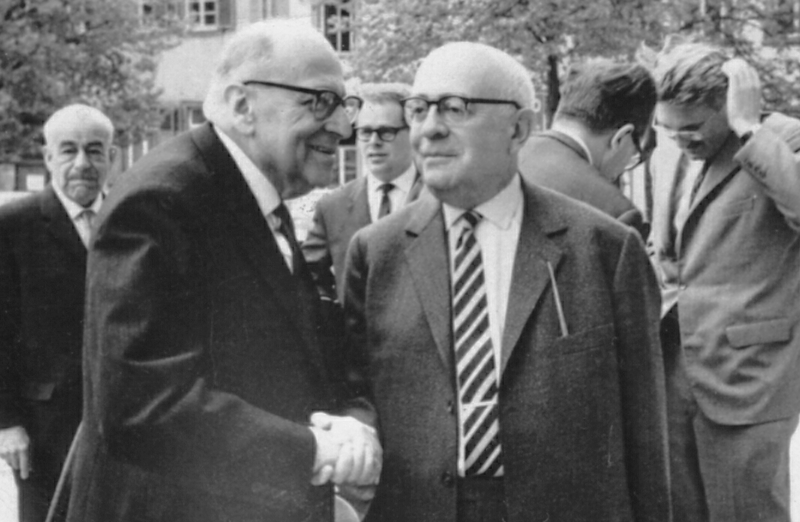
Notable members of the Frankfurt School in Heidelberg, April 1964 at the Max Weber-Soziologentag. Max Horkheimer is front left, Theodor W. Adorno front right, and Jürgen Habermas is in the background, right, running his hand through his hair. Siegfried Landshut is in the background left.
Photograph by Jeremy J. Shapiro via Wikimedia Commons.
It occurs to me that Our Thing ought to take a long, hard look at the Frankfurt School.
Those were the guys, of course, who pioneered the notion that their political opponents must be mentally ill. Given that
- all sane people are good; and
- good people only want good things; and
- Socialism is a good thing;
then
- anyone who doesn’t want Socialism wants a bad thing;
- therefore is a bad person;
- therefore is insane.
Anyone with the common sense God gave little catfish recognizes this as begging the question. And not particularly subtle question-begging, either, which is why it took over 1,000 pages (!) of ponderous Teutonic prose to disguise it. It’s science, comrades. Only Socialism, or a .38 to the back of the neck, will cure us …
… assuming, of course, that we want to be cured.
The Frankfurt Schoolers assumed this, of course, as did all those freelance critical theorists running the NKVD’s torture chambers. But that was then. The Frankfurt Schoolers were shockingly bourgeois on so many things. They thought homosexuality was a mental illness, if you can believe it, and I doubt even Herbert Marcuse would’ve signed off on “drag queen story hour,” let alone the state-mandated chemical castration of 6 year old boys. Only the peerless enlightenment of the Current Year recognizes this, comrades.
October 15, 2019
QotD: Over-protected children become insecure adults
Jonathan Haidt, quoted by Naomi Firsht, “The Fragile Generation”, Spiked, 2017-08-31.
June 25, 2019
QotD: Perpetual adolescence
SENATOR BEN SASSE: Yes, so this book is 100 percent not about politics, and it’s 99 percent not about policy. It’s about this new category of perpetual adolescence. And, first, let’s just say that, over the last two millennia or so, the emergence of a category called adolescence is a pretty special gift. We believe that, when our kids become biological adults, when they hit puberty, they don’t have to be fully formed, morally, emotionally, economically, educationally, in terms of household structure. They don’t have to go out and be fully adult immediately. They don’t have to go off to war, and they don’t have to become economically self-sufficient. That’s glorious, to have that protected space between childhood and adulthood. But it’s only glorious if you understand that it’s a transitional state, it’s a means to an end. Peter Pan’s Neverland is a hell. It’s a dystopia. And we don’t want to be — have our kids caught at a place where they’re not learning how to be adults. And, right now, we’re not tending to the habit formation aspects of a republic.
“Face the Nation transcript, May 14, 2017: Schiff, Sasse, Gates”, CBS News, 2017-05-14.
June 24, 2019
The idea of “infinity”
David Warren, staunch man of the 13th century, might be termed an opponent of the notion of infinity:
The term “infinity” was an invention of the Devil. This, gentle reader will understand, is my humble opinion. Or if the Devil didn’t invent it, he “evolved” it, from the more innocent usages that conveyed “unlimited,” or “countless,” or “unknowably” large or small. What is finite has an ending, can be finished, finis. What is infinite cannot be; it is open-ended. There is, where we look for an end, nothing there.
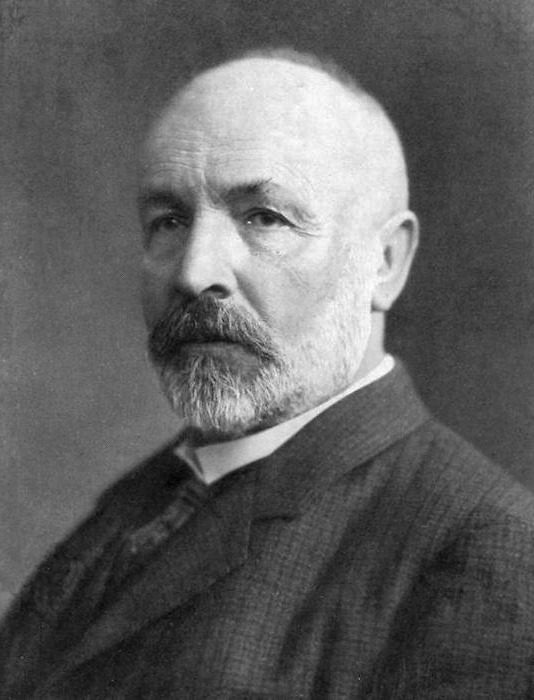
Portrait of Georg Cantor
Photographer unknown, via Wikimedia Commons.Nothing is quite the opposite of something. Perhaps this is a fact no longer taught in our schools: that “nothing” can do nothing for you. Whereas, “something” might. For in its modern usage, “infinity” has become a thing. It has become “virtually” an agent, a kind of god, demanding to be worshipped. The very Christian idea of Alpha and Omega — from the first to the last letter of the (Greek) alphabet, from beginning to end — is subtly replaced in our minds with the progressive idea, “from one to infinity.”
Which is where the human mind checks out. “So what is infinity plus one?” one asks. There can be no answer. Today we are hanging on a cross of “infinity.”
The mathematician Georg Cantor (1845–1918), in his lucid moments (when out of insane asylums), invented set theory. It may be found, lodged in the heart of post-modern reasoning. My hero Wittgenstein, among others, explained how pernicious it was. Scholastic theologians had already spotted the fly in the “infinite” ointment. It is pantheist, and in Cantor’s “final” posit of an infinity of infinities, it is a direct challenge to the unity or uniqueness of the revealed God. Cantor himself was under the impression that God existed, in the sense that God had communicated set theory to Cantor of all people. I, at least, am sceptical of those who claim direct communication with God, especially those who spend a lot of time in bat houses, and wonder with whom they were really chatting. (I don’t doubt that the mad can be brilliant, however.)
June 12, 2019
Men’s mental health and the conflicting demands they face
In Psychology Today, Rob Whitley explains the paradoxical demands that men make active efforts to talk about mental health issues and to “check their privilege” and shut up:
Men, Please Talk More
Men experience elevated rates of numerous mental health issues including suicide and substance use disorder while showing low rates of mental health service utilization and a tendency to bottle-up. This has led many scholars to posit a silent crisis of men’s mental health.
Consequently, many mental health organizations and high-profile individuals are sending out an insistent message that men must talk more about their mental health.
Even royalty has endorsed this message, with HRH Prince William stating in a recent documentary that we need to “pass the message onto men everywhere that it’s okay to talk about mental health… and be able to talk about our emotions.”
Fine words indeed.
Men, Please Shut Up
However, other individuals and organizations are sending out a completely different message, namely that men as a group need to remain silent and “check their privilege.” As wryly noted by Bloomberg journalist Ramesh Ponnuru “check your privilege means shut your mouth.”
Such messages can be seen all over the Internet, with pleas for men to shut-up or stop whining. Of note, these pleas come from both men and women. These echo comments men often hear in face-to-face interactions, even from their intimates and their employers.
Indeed, such perspectives can emanate from high places, including the U.S. Senate, with Hawaii Senator Mazie Hirono recently stating, “I just want to say to the men in this country: just shut up and step up. Do the right thing for a change.” For some, male silence is a sign of moral rectitude.
This situation creates a men’s mental health double-bind. On the one hand, men are being told to talk more and open-up; on the other hand, men are being told to check their privilege and be silent. This can only create cognitive and emotional distress.
Interestingly, the men’s mental health double-bind manifests itself beyond the borders of the U.S. As such, examples from the U.K and Canada are given below to illustrate its global nature.
May 11, 2019
The “Euphemism Treadmill”
An older post by Stan Hingston on the urgent need of many people to demand others use their chosen euphemisms, especially when the word objected to is itself already a euphemism:
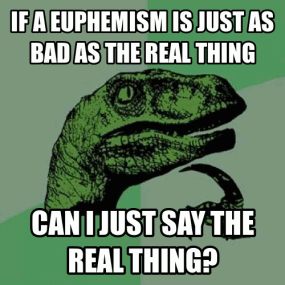
Stephen Pinker in his 2003 book The Blank Slate coined the name euphemism treadmill for the process whereby words introduced to replace an offensive word, over time become offensive themselves. A current example of this is mental retardation.
The word itself comes from the Latin retardare meaning “to make slow, delay or hinder”.
Retardation was first used in the psychiatric sense in 1895, and eventually replaced older terms – once neutral themselves – like moron, imbecile, idiot, feeble-minded and cretin. Each of these terms had a specific meaning as to severity and age of development (cretinism for example referred to severe congenital hypothyroidism) but these meanings often differed between countries. The new term was subdivided into degrees of mild, moderate and severe mental retardation. These new technical terms were no doubt welcomed by those affected, as the previous names were being used as derogatory insults (as indeed they still are).
By the 1960s when I was in grade school, the same process had occurred with retardation. “Retard” was a common playground insult, as in “Look where yer goin’, ya retard!” To us at the time it was considered harmless fun (although I now recognize the potential to really hurt someone who did have an intellectual disability). In Grade 7 my buddy Doug and I did impersonations of “retarded chipmunks” in which we tucked our lower lip inside our upper front teeth and crossed our eyes.
Since that time retardation has been gradually replaced by a variety of more acceptable (at least for now) terms including mentally handicapped, mentally impaired, mentally challenged, intellectually challenged, intellectually disabled, learning disabled, and developmentally disabled. The last two of course are broader terms that include other conditions not covered by the meaning of mental retardation.
The problem of technically defined terms being appropriated by “the masses” and misused is not soluble by professional bodies, and given the flexibility of the English language, probably not even by a French-style “official language commission” empowered with all the majesty of law: it would be a massive waste of time and effort. Of course, “massive waste of time and effort” is pretty much baked into the bones of government agencies…
March 4, 2019
March 1, 2019
QotD: Toxic masculinity
Thanks to the new guidelines from the American Psychological Association (APA) for practice with men and boys, male psychology is no longer a mystery and mental health professionals are now equipped with the tools they need to combat the worst forms of it. According to the APA, boys and men are at risk of suffering from traditional masculinity which is on the whole unhealthy. Turns out, the traditional masculinity that drives many of us men to be confident, assertive, adventurous, stoic, and willing to take risks for our goals, the people we love, and sometimes even complete strangers are bad for us and society.
Who knew?
Biologists, philosophers, theologians, physicians, parents, and really almost all regular folk have long believed that there are meaningful and biologically-based psychological differences between males and females. Fortunately for us mere mortals, the APA is setting the record straight. It is an oppressive patriarchy, not biology, that has shaped our psychology. Gender and the masculine traits associated with being male are social constructs. The APA obviously isn’t denying that evolution is true. They aren’t some kind of silly group of religious fundamentalists. But like most educated progressives, they understand that evolution stopped at the neck.
There is this odd group of evolutionary psychologists who seem hell-bent on holding onto antiquated views about human mental and social life. It seems pretty clear that these individuals are the academic wing of the alt-right. Don’t be fooled by surveys suggesting the majority of evolutionary psychologists self-identify as liberal. We can’t trust people to self-report their own politics. Only the most enlightened are in a position to tell everyone else what they really think. I would laugh at how ridiculous the academics are who continue to insist that males and females are distinct in any meaningful way, but I now know that comedy is a form of oppression.
Perhaps the saddest part of reading the new APA guidelines is realizing just how many American boys and men suffer from traditional masculinity and don’t even realize it, and how many mothers and wives tolerate and even promote this sickness. There are millions of couples and families across the United States who are living lives imprisoned by traditional gender roles and on the surface appear to be happy and flourishing. I especially feel for all the conservatives and devout Christians who are most vulnerable to this illness. It doesn’t help when alt-right institutions such as Harvard publish research suggesting that children may benefit from being raised in such traditionally religious homes.
Clay Routledge, “Thank you, APA”, Quillette, 2019-01-22.
February 25, 2019
Modern parenting – too many helicopters yield lots of snowflakes
It’s a commonplace assertion that children today have less unscheduled, unsupervised opportunities for play and exploration, and parents have been indoctrinated into the belief that the world has become a much more dangerous place and their kids need 24/7 protection from those myriad dangers. “Helicopter” parenting is a rational response to this indoctrination, but it comes with costs to the growth and maturity of the next generation. More than a decade ago, I posted this graphic showing how each generation has been more protective of their own children than their parents had been for them:

The problem has been getting worse over time, as Rob Creasy and Fiona Corby describe:
Children growing up in the UK are said to be some of the unhappiest in the industrialised world. The UK now has the highest rates of self harm in Europe. And the NSPCC’s ChildLine Annual Review lists it as one of the top reasons why children contact the charity.
Children’s mental health has becomes one of British society’s most pressing issues. A recent report from the Prince’s Trust highlights how increasing numbers of children and young people are unhappy with their lives, sometimes with tragic consequences.
This is a generation of young people that has been labelled as “snowflakes” – unable to handle stress and more prone to taking offence. They are also said to have less psychological resilience than previous generations. And are thought to be too emotionally vulnerable to cope with views that challenge their own.
[…]
Children’s lives are being stifled. No longer are children able to spend time with friends unsupervised, explore their community or hang around in groups without being viewed with suspicion. Very little unsupervised play and activity occurs for children in public spaces or even in homes – and a children’s spare time is often eaten up by homework or organised activity.
This is further impacted by the way children are taught in schools and how pressure to succeed has led to a taming of education. But if children are never challenged, if they don’t ever experience adversity, or face risks then it is not surprising they will lack resilience.
February 23, 2019
QotD: “Toxic masculinity”
And then we have toxic masculinity. Is there toxic masculinity? Of course there is. Well, there is toxic and it can have a masculine expression. Because of obvious biological differences, the most toxic of women will have issues beating up people or raping them. It can be done, but it won’t be common.
Is masculinity toxic? Not more than femininity. The latest insistence on doing everything the feminine way has got us “feminine business” and “feminine politics” where everything is run on image, innuendo and gossip: the female version of toxicity. You’re either with the group or out, and if you’re out we’ll demonize you.
So blaming everything on men is bad-crazy.
I have a friend who has been trying to defend the Gillette ad as in “But they’re giving to causes that help raise boys who are fatherless” etc. I love her to death, but no. While that might be laudable, the fact is that that add is another brick in the wall of “If you’re a woman and your life isn’t perfect it’s a man’s fault.”
This bad crazy not only destroys marriages, it destroys GIRLS. You see that thing above “to succeed you must sacrifice?” If you infect females with the idea that they’re owed success and if they don’t get it, it’s men’s fault, you’re both undermining them and turning them into rage-filled screeching monkeys, who are exactly zero use to society. (Oh, but they vote for Marxists, so I guess there’s that.)
Worse, this bad crazy is riding on other bad crazy. Which like most bad crazy since the twentieth century has its origins on the insane crazy of Marx.
The question is, WHY was this ad made at all? It certainly doesn’t sell razors. So, why?
Because for decades we’ve taught our children their most important role in life is the crazy cakes “change the world” or “make a difference” and the difference they’re supposed to make is in the class-war (or race war, or sex war now) sense of bringing about the Marxist paradise. We tell them they’re supposed to speak for the voiceless, then tell them the voiceless are the “designated victim classes” (whom frankly we can’t get to SHUT UP.) We tell them this is what gives meaning to life. We tell them through school, through entertainment, through news narratives, through the people who are being lionized.
And this is bad crazy. Really bad crazy. By itself it is a wrench that will take society apart. We have publishers, writers, journalists, and probably taxi drivers, policemen, engineers and who knows what, increasingly convinced their highest calling is not doing their job, but “educating” or “improving” or “raising the consciousness of” other people.
Even for a credo that worked with humanity — say Christianity — when a society becomes convinced pushing the idea is more important than doing their job, the wheels come off. BUT when the credo is neo-Marxism, or actually “increasingly elaborate excuses as for the only thing Marxism brings about is death” it’s exponentially worse.
It’s also the explanation for why the wheels come off every field that gets taken over by the left: because the people in those fields stop understanding what their actual job is.
And it’s everywhere. At such a deep level that most people — even those mad at Gillette — didn’t see that the actual problem is that no one involved in the damn ad understood it had NOTHING to do with SELLING the product.
It’s bad crazy. There’s a lot of bad crazy running in the world. And we must stop it — and build under, build over, build around — or it will kill society.
Sarah Hoyt, “Bad Crazy”, Libertarian Enterprise, 2019-01-20.
February 19, 2019
Judging a book by its cover (or people by their appearance)
In the latest Libertarian Enterprise, Sean Gabb reviews How to Judge People by What They Look Like, by Edward Dutton:
This short book is equally naughty and entertaining. It bounces along, making its points in a light-hearted and generally a witty manner. It is naughty so far as it is a flat challenge to many of the pieties of our age.
We are told never to judge a book by its cover — that the substance of a person, this being character and intelligence, have no measurable relationship to his external form, this being his physical appearance. At the extreme, of looking at correlations between race and intelligence, you can get into serious trouble for disputing this piety. Even moderate dissent earns hostility or just ridicule. Look, for example, at the relevant textbooks. The phlogiston theory is covered as an early theory of combustion, superseded by the truth. Phrenology is denounced as barely short of a moral and intellectual failing. No one thinks ill of Lamarck for this theory of inherited characteristics. Lombroso and his measurement of criminal heads are seen as steps on the road to Auschwitz.
The author of this book takes aim at every one of these pieties. He begins with the easy targets. Within ethnic groups, he goes over the increasingly rehabilitated claim that intelligence is largely inherited — about 80 per cent. He adds the other increasingly rehabilitated claim that there are differences of average intelligence between groups—that the peaks of each distribution curve occur at different points along the scale.
[…]
Now, what follows from all this? The answer is that all truth is important — so far as this is the truth; and I do lack the statistical grounding and the time or inclination to check the author’s scholarship. Even when a particular truth has no practical value, a regard for truth is a generally useful prejudice. But there are certain conclusions that appear to follow.
First, there is has been a progressively greater diversity of external form since the industrial revolution. The stated reason for this is that the harsh conditions of a traditional society, in which about 40 per cent of children died, and the higher classes had more surviving offspring, created a strong bias towards the survival of the intelligent and conscientious. Since then, the fall of infant mortality towards zero has thrown this process into reverse. That may explain the growing fall in genius or just high intellectual quality as a fraction of modern populations. It may also explain the decay — and the author says nothing of this — of free institutions, and their replacement by less complex and more maternal forms of government. Old England was free because its people were capable of being free. Modern England is unfree because the people have changed.


