
What if … bear with me a moment … checking social media every 15 minutes keeps us in a state of constant stress & agitation without actually keeping us better informed than the old days of reading the morning paper & occasionally watching the evening news did?
Zack Stentz, Twitter, 2018-07-16.
October 26, 2020
October 21, 2020
QotD: The Guardian
A less impressed commenter, unrelated to the editor, asks,
What is it with people’s inability to ignore the things they don’t like?
Meaning things you don’t like and which have no bearing whatsoever on your everyday life or the turning of the world. Say, “our” alleged “obsession” with cupcakes and their supposedly debilitating effects on helpless, hapless womenfolk. Women being so mentally insubstantial that even a tiny cake can unhinge their minds, apparently. But fretting ostentatiously about things of no importance has long been a standard template for Guardian articles, especially if you can shoehorn in some sophomoric theorising. It’s something most papers do to some extent, due to the obligation to Fill Space Somehow, but the Guardian is by far the greatest exponent and the most grandiose. Many of its contributors have mastered inadvertent surrealism. First you find some tiny, utterly trivial personal anecdote or grumble and then inflate it to sociological status with lots of wild, baseless assertion. Anything from the feminist politics of toddler excrement to the cruel, cruel agonies of spellcheck software. Whether the complaint is valid, or even sane, or can withstand a minute’s scrutiny, really doesn’t matter. It’s all about display — being outraged as theatre and social positioning. Which is why something as dull as temporary building renovation can be described vehemently, repeatedly and in all seriousness as “cultural apartheid.”
David Thompson, “The Cupcake Menace”, David Thompson, 2013-10-20.
Comments Off on QotD: The Guardian
October 4, 2020
QotD: What everyone always suspected about Washington, D.C.
Ryan Murphy, an economist at Southern Methodist University, “matched up the ‘constellation of disinhibition, boldness and meanness’ that marks psychopathy with a previously existing map of the states’ predominant personality traits, he found that dense, coastal areas scored highest by far – with Washington dominant among them. ‘The District of Columbia is measured to be far more psychopathic than any individual state in the country,’ Murphy writes in the paper.”
That explains an awful lot, now doesn’t it?
Justin Raimondo, “Washington, D.C. – The Epicenter of Crazy”, AntiWar.com, 2018-06-25.
Comments Off on QotD: What everyone always suspected about Washington, D.C.
September 27, 2020
Homelessness in Los Angeles
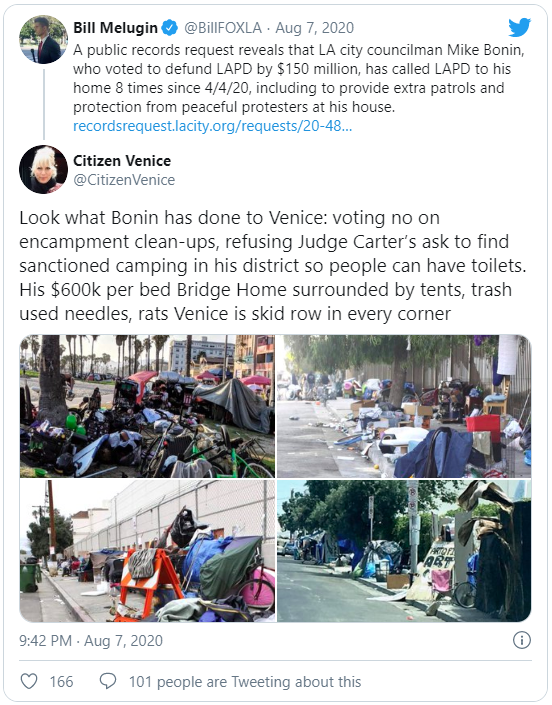
In Quillette, Amy Alkon talks about the homeless crisis in LA, particularly her own immediate experience with a couple who “camped out” in front of her house.
Throughout [Los Angeles Mayor Eric] Garcetti’s seven years as Mayor, Los Angeles has witnessed a shocking explosion of homelessness. When he took office in 2013, the city had about 23,000 residents classified as homeless, two thirds of whom were unsheltered, living on the streets. By mid-2019, the figure was about 36,000, and three-quarters of them were living on the streets. Currently, there are 41,000 homeless. Garcetti’s pet plan to alleviate the homelessness crisis was the construction of permanent supportive housing. In 2016, compassionate voters approved $1.2 billion in new spending to fund these units. Three years later, only 72 apartments had been built, at a cost of about $690,000 apiece. Meanwhile, an El Salvador-based company has come up with nifty $4,000 3D-printed houses that look like great places to live and can be put up in a single day.
There’s also been a failure to admit that housing alone isn’t the solution. As urban-policy researcher Christopher Rufo explains, only about 20 percent of the homeless population are people down on their luck, who just need housing and a few supportive services to get back on their feet. Approximately 75 percent of the unsheltered homeless have substance-abuse disorders and 78 percent have mental-health disorders. Many have both.
As a bleeding-heart libertarian, I feel personally compelled to try to help people who are struggling. I do this by volunteering as a mediator, doing free dispute resolution to provide “access to justice” to people who can’t afford court. And since about 2009, I personally have given support to one of those easily helpable 20 percent Rufo refers to, getting him paying work and a bank account, and storing his stuff in my garage. He is a good man and a hard worker — sober for many years — who simply seems to have issues in the “front-office” organizational parts of his brain that help most of us get our act together to, say, pay bills on time. He just needs somebody to back him up on the bureaucratic aspects of life. I’m happy to say he now has a roof over his head. He lives in a motel across the country, and all I still do for him is provide him with a permanent address. I receive his Veterans Administration and Social Security mail at my house, which I mail to him with smiley faces and hearts on the envelopes, colored in with pink and orange highlighter.
This success story would not be possible for most homeless people, the nearly 80 percent who are addicted and/or mentally ill. As Rufo writes:
Progressives have rallied around the slogan “Housing First,” but haven’t confronted the deeper question: And then what? It’s important to understand that, even on Skid Row, approximately 70 percent of the poor, addicted, disabled, and mentally ill residents are already housed in the neighborhood’s dense network of permanent supportive-housing units, nonprofit developments, emergency shelters, Section 8 apartments, and single room-occupancy hotels.
When I toured the area with Richard Copley, a former homeless addict who now works security at the Midnight Mission, he explained that when he was in the depths of his methamphetamine addiction, he had a hotel room but chose to spend the night in his tent on the streets to be “closer to the action.” Copley now lives … at the Ward Hotel — which he calls the “mental ward” — where he says there are frequent fights and drugs are available at all hours of the day. The truth is that homelessness is not primarily a housing problem but a human one. Mayors, developers, and service providers want to cut ribbons in front of new residential towers, but the real challenge is not just to build new apartment units but to rebuild the human beings who live inside them.
The situation is especially tragic for those who are so mentally ill that they cannot take care of themselves, and are often a danger to both themselves and others. And I sometimes wonder which movie star or other famous person needs to be stabbed or bludgeoned before politicians take meaningful action.
It’s fashionable in progressive circles to demonize law enforcement, but Rufo explains that in 2006, then-L.A. police chief Bill Bratton implemented a “Broken Windows” policing initiative on Skid Row. It led to a 42 percent reduction in felonies, a 50 percent reduction in deaths by overdose, and a 75 percent reduction in homicides. The overall homeless population was reduced from 1,876 people to 700 — a huge success. Activists filed lawsuits and ran publicity campaigns, slowly killing Bratton’s program, on the grounds that it “criminalizes homelessness.” As a libertarian, I’m opposed to drug laws and forced behavior — but only to a point. It is not compassion to leave people to be victimized by criminals simply because they are unhoused, nor is leaving mentally and physically disabled people strewn across the streets amidst piles of garbage a form of freedom.
Mayor Garcetti, in lieu of admitting the real challenges — the first step to taking meaningful action to alleviate the homelessness crisis — has simply ignored the human results of his failed policy. As a result, whole sections of the city, including formerly livable streets in my beloved Venice, have been turned into Skid Row by the Sea.
Comments Off on Homelessness in Los Angeles
September 8, 2020
2020 is a cracking year
And by “cracking” I don’t mean the old Victorian expression for “very good”. Sarah Hoyt explains the cracks at the Libertarian Enterprise:

“Covid 19 Masks” by baldeaglebluff is licensed under CC BY-SA 2.0


It’s 2020 and we’re all cracking.
And no, by that I don’t mean that we’re cracking like crazy on our writing. Most of us are having trouble writing. A lot of us are having trouble reading. Though I’ve finally got out of the Pride and Prejudice fanfic jag.
I’ve seen people suddenly lose it and start crying over dirty dishes. Or the fact we ran out of peanut butter.
Okay, that was me. Yesterday. But I’ve been watching signs of just that much fragility in everyone I know.
Part of it is the lockdown. Man — and verily, woman — is a social animal. Not only is it not good for Man — do I need to say “and woman again?” — to be alone, it’s not good for us, when going out to be confronted with “truncated” human faces.
It is instinctive in humans to see human faces in everything. Don’t believe me? Look at a random pattern long enough, and you’ll find faces. Truncated human faces, the mouth gone, are deeply unsettling to the back of our brain. It is wrong, mutilated.
Suicides are through the roof. Mental health issues abound. The young are suffering particularly badly, because on top of all they believe they’re going to die. (The rest of us are already dead from the ice age, acid rain, fossil fuel depletion, alar, global warming, ozone depletion … I’m sure I’m forgetting some things. After so much death, one becomes resilient. Those of us forty and over won’t die. Even if they kill us.)
But the other part of it is that in a contentious political year there’s nowhere to escape.
Remember when you used to have friends that believed exactly the opposite of what you did, and you both knew it, but you were still friends? You couldn’t talk politics, but you could talk knitting, embroidery, kids, gardening, furniture refinishing, science fiction? You could sit down and have a cup of coffee with someone whose political views you considered despicable and not mention politics? Not even once?
But that was before the invasion of those for whom everything is political. Oh, cancel culture already existed. Before social media, I was terrified of saying the wrong word and revealing my real thoughts, and getting blacklisted by publishing houses.
But there were spaces you could draw a breath. Places where you didn’t have to talk and/or think about politics.
Comments Off on 2020 is a cracking year
August 21, 2020
QotD: Our overprotective culture
There’s a rule of thumb for dealing with elderly people in old age homes: Never do anything for anyone that they can do for themselves. It sounds cruel, but it’s not cruel.
This is one of the pathologies of our culture. A major pathology, and this is associated with a kind of immaturity and a kind of fear and this Oedipal mother problem, which is, “I don’t want you to suffer any distress right now.” Fine, but what about tomorrow and next week and next month? You might have to suffer a lot of distress right now so that you’re better next week and next month.
Jordan Peterson, “Christie Blatchford Sits Down With ‘Warrior For Common Sense’ Jordan Peterson”, National Post, 2018-02-07.
Comments Off on QotD: Our overprotective culture
July 25, 2020
“The Ballad of Bull” Pt.2 – Combat Medics – Sabaton History 077 [Official]
Sabaton History
Published 24 Jul 2020Sometimes war is killing, sometimes war is saving lives.
In the first episode we have seen Leslie “Bull” Allen become a hero, not through the death of his enemies, but by saving his comrades’ lives. And there were others like him. Soldiers and medics, whose first duty it was to preserve lives during war, even when it meant endangering their own safety. Here are three short stories of men and women, who served as medics at the front line of the Second World War, and became heroes to their country.
Support Sabaton History on Patreon: https://www.patreon.com/sabatonhistory
Listen to “The Ballad of Bull” on the album Heroes:
CD: http://bit.ly/HeroesStore
Spotify: http://bit.ly/HeroesSpotify
Apple Music: http://bit.ly/HeroesAppleMusic
iTunes: http://bit.ly/HeroesiTunes
Amazon: http://bit.ly/HeroesAmz
Google Play: http://bit.ly/HeroesGooglePListen to Sabaton on Spotify: http://smarturl.it/SabatonSpotify
Official Sabaton Merchandise Shop: http://bit.ly/SabatonOfficialShopHosted by: Indy Neidell
Written by: Markus Linke and Indy Neidell
Directed by: Astrid Deinhard and Wieke Kapteijns
Produced by: Pär Sundström, Astrid Deinhard and Spartacus Olsson
Creative Producer: Joram Appel
Community Manager: Maria Kyhle
Executive Producers: Pär Sundström, Joakim Broden, Tomas Sunmo, Indy Neidell, Astrid Deinhard, and Spartacus Olsson
Post-Production Director: Wieke Kapteijns
Edited by: Iryna Dulka
Sound Editing by: Marek Kaminski
Maps by: Eastory – https://www.youtube.com/c/eastoryArchive by: Reuters/Screenocean https://www.screenocean.com
Music by SabatonColorizations:
– Olga Shirnina, a.k.a. Klimbim – https://klimbim2014.wordpress.com/Sources:
– Photos of Desmond Doss Courtesy of the Desmond Doss Council
– Frame vector created by milano83 – www.freepik.com
– Arkiv i Nordland
– P.Fisxo from WikimediaAn OnLion Entertainment GmbH and Raging Beaver Publishing AB co-Production.
© Raging Beaver Publishing AB, 2019 – all rights reserved.
From the comments:
Sabaton History
2 days ago
The medical staff in war — combat medics, field surgeons and nurses, ambulance drivers and medevac crews — are often the unsung heroes of war, literally and figuratively.That doesn’t mean that they don’t deserve to be remembered and their sacrifices honored. There are undoubtedly many instances of exceptional bravery among the medical staff of wars throughout history — for which they rightly should be praised. But they should also be remembered for their everyday work in trenches or field hospitals, in jungles and deserts, at sea or in mid-air. Treating a seemingly endless stream of incoming wounded, trying to give relief to those in pain, comfort to those in agony, and hope to to those who have lost theirs — day in and day out, for as long as the war will last.
If you missed part one of “The Ballad of Bull” you can see it right here.
Comments Off on “The Ballad of Bull” Pt.2 – Combat Medics – Sabaton History 077 [Official]
June 12, 2020
J.K. Rowling on her most recent “cancellation”
I know a lot of Harry Potter fans are upset with their formerly favourite author for her stance on transgenderism … or what they’ve heard about her stance … or what their friends have said about her stance … so J.K. Rowling has posted an essay on her own site explaining what happened and how she has been coping with being “cancelled” so many times:

… as a much-banned author, I’m interested in freedom of speech and have publicly defended it, even unto Donald Trump.
The fourth is where things start to get truly personal. I’m concerned about the huge explosion in young women wishing to transition and also about the increasing numbers who seem to be detransitioning (returning to their original sex), because they regret taking steps that have, in some cases, altered their bodies irrevocably, and taken away their fertility. Some say they decided to transition after realising they were same-sex attracted, and that transitioning was partly driven by homophobia, either in society or in their families.
Most people probably aren’t aware – I certainly wasn’t, until I started researching this issue properly – that ten years ago, the majority of people wanting to transition to the opposite sex were male. That ratio has now reversed. The UK has experienced a 4400% increase in girls being referred for transitioning treatment. Autistic girls are hugely overrepresented in their numbers.
The same phenomenon has been seen in the US. In 2018, American physician and researcher Lisa Littman set out to explore it. In an interview, she said:
“Parents online were describing a very unusual pattern of transgender-identification where multiple friends and even entire friend groups became transgender-identified at the same time. I would have been remiss had I not considered social contagion and peer influences as potential factors.”
Littman mentioned Tumblr, Reddit, Instagram and YouTube as contributing factors to Rapid Onset Gender Dysphoria, where she believes that in the realm of transgender identification “youth have created particularly insular echo chambers.”
Her paper caused a furore. She was accused of bias and of spreading misinformation about transgender people, subjected to a tsunami of abuse and a concerted campaign to discredit both her and her work. The journal took the paper offline and re-reviewed it before republishing it. However, her career took a similar hit to that suffered by Maya Forstater. Lisa Littman had dared challenge one of the central tenets of trans activism, which is that a person’s gender identity is innate, like sexual orientation. Nobody, the activists insisted, could ever be persuaded into being trans.
The argument of many current trans activists is that if you don’t let a gender dysphoric teenager transition, they will kill themselves. In an article explaining why he resigned from the Tavistock (an NHS gender clinic in England) psychiatrist Marcus Evans stated that claims that children will kill themselves if not permitted to transition do not “align substantially with any robust data or studies in this area. Nor do they align with the cases I have encountered over decades as a psychotherapist.”
The writings of young trans men reveal a group of notably sensitive and clever people. The more of their accounts of gender dysphoria I’ve read, with their insightful descriptions of anxiety, dissociation, eating disorders, self-harm and self-hatred, the more I’ve wondered whether, if I’d been born 30 years later, I too might have tried to transition. The allure of escaping womanhood would have been huge. I struggled with severe OCD as a teenager. If I’d found community and sympathy online that I couldn’t find in my immediate environment, I believe I could have been persuaded to turn myself into the son my father had openly said he’d have preferred.
When I read about the theory of gender identity, I remember how mentally sexless I felt in youth. I remember Colette’s description of herself as a “mental hermaphrodite” and Simone de Beauvoir’s words: “It is perfectly natural for the future woman to feel indignant at the limitations posed upon her by her sex. The real question is not why she should reject them: the problem is rather to understand why she accepts them.”
As I didn’t have a realistic possibility of becoming a man back in the 1980s, it had to be books and music that got me through both my mental health issues and the sexualised scrutiny and judgement that sets so many girls to war against their bodies in their teens. Fortunately for me, I found my own sense of otherness, and my ambivalence about being a woman, reflected in the work of female writers and musicians who reassured me that, in spite of everything a sexist world tries to throw at the female-bodied, it’s fine not to feel pink, frilly and compliant inside your own head; it’s OK to feel confused, dark, both sexual and non-sexual, unsure of what or who you are.
I want to be very clear here: I know transition will be a solution for some gender dysphoric people, although I’m also aware through extensive research that studies have consistently shown that between 60-90% of gender dysphoric teens will grow out of their dysphoria. Again and again I’ve been told to “just meet some trans people.” I have: in addition to a few younger people, who were all adorable, I happen to know a self-described transsexual woman who’s older than I am and wonderful. Although she’s open about her past as a gay man, I’ve always found it hard to think of her as anything other than a woman, and I believe (and certainly hope) she’s completely happy to have transitioned. Being older, though, she went through a long and rigorous process of evaluation, psychotherapy and staged transformation. The current explosion of trans activism is urging a removal of almost all the robust systems through which candidates for sex reassignment were once required to pass. A man who intends to have no surgery and take no hormones may now secure himself a Gender Recognition Certificate and be a woman in the sight of the law. Many people aren’t aware of this.
Comments Off on J.K. Rowling on her most recent “cancellation”
QotD: Homelessness in America
90% of the homeless in America and the hard core ones are people with mental health issues, people with drug abuse issues and people who have found they can live without having to do anything for it, and can be “free” and outside society. I’ve overheard conversations in the park, and I suppose that most of the people who “dropped out” in the sixties are dead, but a lot of them are alive and going from soup kitchen to free clinic, with a bit of begging in between.
Yes, there are entire families in this system, including homeless children – but for them to stay in it, the parents need to have some sort of serious issue. Otherwise, even if they can’t find work, there is assistance available to get them at least into public housing, which, nightmarish though it is, is not living in the park.
I’m not going to pretend this doesn’t happen to normal families too – see where I came very close to that level and more than once too – but normal families usually tend to bounce back. They go through a few months of mess and horror, and then they claw back to some semblance of normalcy. (This might change as our economy dives and programs of necessity get cut. The ones for the DESERVING poor will be cut first, of course, since they rarely riot.)
The problem with this is that when people get appalled at the conditions the homeless live in and start offering “homeless services” there is an entire network, not just of homeless but of social workers who direct the homeless to the cities with better services.
I swear to you and I’m not even joking that right now there are plenty more homeless on Colorado Springs streets than in Denver, despite the Springs being much smaller.
The Springs also has its soup kitchens and other services downtown and within easy walking distance of each other.
This means downtown businesses are closing, except for bars and restaurants which can control access. And that the library is of course a place to camp in the cool/warm during the day.
It means more than that. We moved within easy driving distance of downtown, because when we lived downtown when we first came to Colorado Springs, I used to take walks every day. When we moved to our little mountain village, without these, I gained ten pounds a year. I used to love walking downtown, dropping by the deli and the three bookstores (only one left, and it’s MOSTLY a restaurant now) checking out the other little shops which ranged from yarn to weird import crafts.
Now those are gone. Worse – the last two times I walked downtown alone (i.e. without commanding the muscle, aka older son to go with me) someone FOLLOWED me and I had to employ stuff from my childhood to lose them. Once it was a large and addled looking male, and yes, he was following me. And once it was TWO large and addled looking males. For the icing on the cake – not related to this, but from a blog entry – I clicked on the sex offenders registry. Yes, I know, a lot of people there are there because someone accused them and was never proven. Our local one at least has notes on whether it’s accusation, trial or conviction and also whether the crime was against children or adults.
The downtown zipcode is FULL of registered sex offenders who’ve done hard time and who have committed their crimes against adults. The faces are very familiar from my walks, and yep, one was the guy who tried to follow me.
Sarah Hoyt, “Of Books, Compassion And Cruelty A Blast From The Past From June 2013”, According to Hoyt, 2020-03-10.
Comments Off on QotD: Homelessness in America
June 9, 2020
It was scientifically inevitable for the Communists to win the Cold War – as foretold in the prophecies
Sarah Hoyt on the “script” that progressives operated under during the Cold War and almost unchanged in detail to the present day, too:

Krushchev, Brezhnev and other Soviet leaders review the Revolution parade in Red Square, 1962.
LIFE magazine photo by Stan Wayman.
… the Cold War had two sides: the USSR and our elites, who had been corrupted and taken over for a long time thanks to the communist agents who had long-marched through our media, our entertainment and our bureaucracy.
Heinlein claimed the Democrats had been taken over by communists, secretly, by the 40s. I have no reason to doubt him. I’m sure most of the bureaucracy and governments in Europe had been taken over that way also.
Even so called conservatives assumed communism would eventually win, because according to the numbers coming out of the USSR and the reporters visiting the USSR — anyone know where Duranty is buried? there should be a line to piss on his grave — they were just so much more efficient. Scientific governance, you know? And anyway, technology was going to be so advanced that most humans would be unemployable, and by the way, there were more and more humans every year, so it was impossible to have all these bourgeois luxuries. So communism, efficient, compassionate, communism was the future, the only way.
The realists who saw it was the only way were willing to do anything to bring it about. Because the people who weren’t as intelligent/well informed would otherwise destroy the world and bring about unimaginable catastrophe.
“Conservatives” were merely those who wanted communism to arrive slower and be a little less violent. Communism with a human face. Socialism on the way to communism. Easing us into our role as cogs in the machinery of the future — where there was no room for personal frills or really emotions — with gentle pneumatic shocks, instead of with the excesses of the Russian and Soviet revolution.
All of this btw is based on three glaring fallacies (phaluscies, since you have to be a dickhead to believe them particularly now.)
1- People are a drain not an asset. They are also a sort of robot incapable of changing behavior in response to changing circumstances.
2- Wealth can’t grow, nor can the carrying capacity of the Earth improve. So since humans can’t respond to reduced infant mortality by having fewer children, the only way to feed everyone is to reduce everyone’s rations. Forever.
3- It is possible for “the best”, properly educated people to be utterly selfless and to administer everyone’s wealth equally and for the common good. They will not revel in power, nor will they avail themselves of any excess. Because, they are absolutely moral and all seeing.
Note the left is still running this script. And some on the right too (Hello, Pierre Delecto!) not to mention all of Europe, left and right. Also note #1 conflicts with the left idea that they can bring about a future in which humans change to be all selfless, etc. But that’s actually complicated and tied in to their myths, which honestly are a Christian heresy, complete with paradise lost.
I know when they started out, the USSR thought it could “engineer” a new human. Homo Sovieticus. But I don’t know enough of Soviet myth to know what underlay that. Maybe it was a behaviorist thing and they thought humans could be trained into being completely selfless automatons. I know by the time I was reading communist theorists (no, I didn’t buy their arguments, but I was required to read them, given when and where I grew up) in the seventies, the philosophy had fallen prey to the agitprop notion that people in madhouses in the US were political prisoners just as in the USSR. (BTW this is part of what underlay the closing of the madhouses.) And that was part of a push in the seventies, as the malfeasance of USSR was starting to be glaring, amid escaped dissidents and escaping information. The push was to “prove” that both systems were equally bad. (The left is still flogging that dead equine, too. So Cubans and Venezuelans are starving? So how many people die of anomie and not being loved enough under capitalism? REEEEE.) So, since Soviets put dissidents in mad houses, so did we. But that necessitated that people who widdled on themselves and/or thought they were a lampshade with a set of dishes thrown in be completely sane “political dissidents”. The only way to do this was to attribute anything communists don’t like to “insanity brought about by capitalism.” This led to crazier byways of thought. For instance, it led to the idea of the pre-historic, pre-agriculture paradise, where everyone was equal, there was no poverty, need, greed, or the heartbreak of psoriasis. A sub-branch of the church believed women were in charge and everyone worshiped the mother goddess. And some of these “scientific, atheist socialists” also believe the goddess actually exists, though G-d doesn’t.
David Friedman had a different formulation for the utopian world many progressives wish for the rest of us:
In the ideal socialist state power will not attract power freaks. People who make decisions will show no slightest bias towards their own interests. There will be no way for a clever man to bend the institutions to serve his own ends. And the rivers will run uphill.
Comments Off on It was scientifically inevitable for the Communists to win the Cold War – as foretold in the prophecies
June 5, 2020
“The Ballad Of Bull” – Leslie “Bull” Allen – Sabaton History 070 [Official]
Sabaton History
Published 4 Jun 2020Sometimes war is killing, sometimes it’s saving lives. This week we turn a soldier who became a hero, not for killing his foes, but for saving his fellow men. Medic Leslie “Bull” Allen’s story is a story about courage in the face of fire. The battle for Mount Tambu in 1943 in Papua New Guinea was vicious and bloody, and the field was soon littered with many wounded men crying for help. Without much regard for his own safety, “Bull” Allen stormed forward into the fray. 12 times he went, and 12 times he came back with a wounded soldier on his back.
Support Sabaton History on Patreon: https://www.patreon.com/sabatonhistory
Listen to “The Ballad Of Bull” on the album Heroes here:
CD: http://bit.ly/HeroesStore
Spotify: http://bit.ly/HeroesSpotify
Apple Music: http://bit.ly/HeroesAppleMusic
iTunes: http://bit.ly/HeroesiTunes
Amazon: http://bit.ly/HeroesAmz
Google Play: http://bit.ly/HeroesGooglePCheck out the trailer for Sabaton’s new album The Great War right here: https://www.youtube.com/watch?v=HCZP1…
Listen to Sabaton on Spotify: http://smarturl.it/SabatonSpotify
Official Sabaton Merchandise Shop: http://bit.ly/SabatonOfficialShopHosted by: Indy Neidell
Written by: Markus Linke and Indy Neidell
Directed by: Astrid Deinhard and Wieke Kapteijns
Produced by: Pär Sundström, Astrid Deinhard and Spartacus Olsson
Creative Producer: Joram Appel
Executive Producers: Pär Sundström, Joakim Broden, Tomas Sunmo, Indy Neidell, Astrid Deinhard, and Spartacus Olsson
Post-Production Director: Wieke Kapteijns
Edited by: Iryna Dulka
Sound Editing by: Marek Kaminski
Maps by: Eastory – https://www.youtube.com/c/eastoryArchive by: Reuters/Screenocean https://www.screenocean.com
Music by Sabaton.Sources:
– State Library Victoria
– Motorboat sound by bockelsound from freesound.orgAn OnLion Entertainment GmbH and Raging Beaver Publishing AB co-Production.
© Raging Beaver Publishing AB, 2019 – all rights reserved.

Comments Off on “The Ballad Of Bull” – Leslie “Bull” Allen – Sabaton History 070 [Official]
May 25, 2020
QotD: Sociopaths and politicians
The key thing about the modern sociopath is the ambivalence toward the truth. They think saying something is the same as doing something. What matters is if the words get the listener to do what the sociopath wants them to do. Standing in front of crowd, making false claims, is fine if it causes people to buy product. If the truth sells more product, then the truth is better. From the perspective of the modern sociopath, the difference is about the results, not the accuracy of the statements. The truth or a lie, whichever works.
Now replace “sociopath” with “politician” and “product” with “votes” and you have the modern managerial democracy. It’s not that our politicians lie. It’s that for them, a lie is indistinguishable from the truth. That’s why they seem so utterly shameless. Shame requires a sense of right and wrong, a knowledge that what you said or did is intrinsically wrong. For the people who rule over us, right and wrong only exist in the context of their own ambitions. Something is “right” if it benefits the person in the moment.
“The Z Man”, “Rule by Sociopath”, The Z Blog, 2018-02-21.
Comments Off on QotD: Sociopaths and politicians
May 13, 2020
Rudolf Hess – Nazi Pacifist, Traitor or Madman? – WW2 Special Episode
World War Two
Published 12 May 2020In a series of events, Hitler’s second in command Rudolf Hess decides to fly to Britain to enter peace negotiations with the Allies. But the true reasons behind and effects of his action remain ambiguous at best.
Join us on Patreon: https://www.patreon.com/TimeGhostHistory
Or join The TimeGhost Army directly at: https://timeghost.tvFollow WW2 day by day on Instagram @World_war_two_realtime https://www.instagram.com/world_war_t…
Between 2 Wars: https://www.youtube.com/playlist?list…
Source list: http://bit.ly/WW2sourcesHosted by: Indy Neidell
Written by: Joram Appel
Director: Astrid Deinhard
Producers: Astrid Deinhard and Spartacus Olsson
Executive Producers: Astrid Deinhard, Indy Neidell, Spartacus Olsson, Bodo Rittenauer
Creative Producer: Joram Appel
Post-Production Director: Wieke Kapteijns
Research by: Joram Appel
Edited by: Mikołaj Cackowski
Sound design: Marek Kamiński
Map animations: Eastory (https://www.youtube.com/c/eastory)Colorizations by:
Norman Stewart, https://oldtimesincolor.blogspot.com/
Carlos Ortega Pereira, BlauColorizations, https://www.instagram.com/blaucoloriz…
Jaris Almazani (Artistic Man), https://instagram.com/artistic.man?ig…
Olga Shirnina, https://klimbim2014.wordpress.com
Adrien Fillon, https://www.instagram.com/adrien.colo…Bibliography:
– Balfour, Michael, Propaganda in War, 1939–45: Organizations, Policies, and Publics in Britain and Germany (London, 1979).
– Fox, Jo. “Propaganda and the Flight of Rudolf Hess, 1941-45”. In: The Journal of Modern History 83:1 (March 2011) 78-110.
– Gorodetsky, Gabriel, “The Hess Affair and Anglo-Soviet Relations on the Eve of ‘Barbarossa'”. In: The English Historical Review 101:399 (Apr 1986) 405-420.
– Görtemaker, Manfred, “The Bizarre Mission: Rudolf Hess in Britain,” in Britain and Germany in the 20th Century, ed. M. Görtemaker (Oxford, 2006), 75–101.
– Heiden, Konrad, “Hitler’s Better Half”. In: Foreign Affairs 20:1 (Oct 1941) 73-86.
– Kettenacker, Lothar, “Mishandling a Spectacular Event: The Rudolf Hess Affair,” in Flight from Reality: Rudolf Hess and His Mission to Scotland, ed. David Stafford (London, 2002) 19–38.
– Schmidt, Rainer, “The Marketing of Rudolf Hess: A Key to the ‘Preventative War Debate’?” War in History 5 (1998) 62-83.Sources:
Bundesarchiv
Portraits of Douglas Douglas-Hamilton, duke of Hamilton and Duff Cooper, MP, courtesy National Portrait Gallery
Narodowe Archiwum Cyfrowe
Zentralbibliothek Zürich
Portrait of Max Aitken, Lord Beaverbrook, courtesy Nationaal Archief
IWM D 8987Soundtracks from the Epidemic Sound:
Rannar Sillard – “March Of The Brave 4”
Reynard Seidel – “Deflection”
Andreas Jamsheree – “Guilty Shadows 4”
Johannes Bornlof – “The Inspector 4”
Johannes Bornlof – “Deviation In Time”Archive by Screenocean/Reuters https://www.screenocean.com.
A TimeGhost chronological documentary produced by OnLion Entertainment GmbH.

Comments Off on Rudolf Hess – Nazi Pacifist, Traitor or Madman? – WW2 Special Episode
May 2, 2020
QotD: Today’s psychological epidemic
There’s an epidemic of self-diagnosis among young people, there’s a race to multiply pathology, there’s a glorification of disorders like borderline personality disorder, which is rare. When being the most oppressed victim gives you the highest status, then it’s a race to the bottom.
We’re not helping young people figure out a noble and difficult pathway forward, where they bear responsibility and march forthrightly into adulthood. Quite the contrary. We’re saying, “Well, the system is corrupt and there’s no point in taking part in it. You’re going to be victimized no matter what you do.” And so the race is on for who gets to play the victim card with the highest degree of status. And it’s really bad, it’s especially bad for adolescents because they’re trying to sort their identity out, they’re already a mess.
Jordan Peterson, “Christie Blatchford Sits Down With ‘Warrior For Common Sense’ Jordan Peterson”, National Post, 2018-02-07.
Comments Off on QotD: Today’s psychological epidemic
April 13, 2020
QotD: Foucault’s “Ship of Fools”
Renaissance men developed a delightful, yet horrible way of dealing with their mad denizens: they were put on a ship and entrusted to mariners because folly, water, and sea, as everyone then knew, had an affinity for each other. Thus, “Ships of Fools” crisscrossed the seas and canals of Europe with their comic and pathetic cargo of souls. Some of them found pleasure and even a cure in the changing surroundings, in the isolation of being cast off, while others withdrew further, became worse, or died alone and away from their families. The cities and villages which had thus rid themselves of their crazed and crazy, could now take pleasure in watching the exciting sideshow when a ship full of foreign lunatics would dock at their harbors.
This was such a great piece of historical trivia that I was shocked I’d never heard it before. Some quick research revealed the reason: it is completely, 100% false. Apparently Foucault looked at an allegorical painting by Hieronymus Bosch, decided it definitely existed in real life, and concocted the rest from his imagination.
Foucault apologists try to rescue this, say that he was just being poetic in some way. He wasn’t. Page 8 in my copy: “Of all these romantic or satiric vessels, the Narrenschiff [Ship Of Fools] is the only one that had a real existence — for they did exist, these boats that conveyed their insane cargo from town to town.” He really, really doubled down on this point. As far as I can tell, this is just as bad a failing of scholarship as it sounds – and surprising, since everything else about the book gives the impression of Foucault as an incredibly knowledgeable and wide-ranging scholar.
Scott Alexander, “Book review: Madness and Civilization”, Slate Star Codex, 2018-01-04.
Comments Off on QotD: Foucault’s “Ship of Fools”


