As noted here many times, it helps if you think of Antifa not as a political movement but as a metastasising personality disorder, a Cluster B contagion. An attempt to dominate by deranged and spiteful egos, rendered in shattered glass and burning livelihoods. They will never be satisfied and can never be appeased, merely encouraged and emboldened by any concession, any excuse, any hesitation.
They destroy and burn and intimidate, and beat people senseless, because they enjoy it. It’s something they wish to do, and choose to do, repeatedly. It makes them feel powerful. Everything else is a pretext, a rationalisation, a lie:
This is us taking the high road. This is us trying to create a world filled with love.
David Thompson, commenting on “Files of the Severely Educated”, DavidThompson, 2021-04-18.
July 19, 2021
QotD: Antifa
July 8, 2021
QotD: Psychopaths
- Psychopaths show a disregard for, and violation of, the rights of others.
- They fail to conform to social norms with respect to lawful behaviours.
- They are always deceitful … They are nasty, aggressive con artists.
- They are massively impulsive and fail to plan ahead.
- They show irritability and aggressiveness, as indicated by repeated physical fights and assaults.
- They manifest a reckless disregard for the physical and psychological safety of others.
- They are consistently irresponsible. Repeated failure to sustain consistent work behaviour … are their hallmark.
- They show lack of remorse. They are indifferent to, or rationalize, having hurt, mistreated or stolen from another … It can seem that labelling them as anti-social is a serious understatement.
From Furnham, Adrian. 50 Psychology Ideas You Really Need to Know. London: Quercus Publishing, p. 25. The heading of the chapter is “Seem Sane”. This is the statement at the start of the discussion:
Psychopaths are without conscience and incapable of empathy, guilt or loyalty to anyone but themselves.
Anyway, I just thought I would mention it.
Steve Kates, “Psychopath ‘diagnostic criteria'”, Catallaxy Files, 2021-04-07.
June 12, 2021
QotD: The assassination attempt(s) on Bismarck
Ferdinand Cohen-Blind, a Badenese student of pan-German sentiments, waylaid Bismarck with a pistol on the Unter den Linden. He fired five rounds. None missed. Three merely grazed his midsection, and two ricocheted off his ribs. He went home and ate a big lunch before letting himself be examined by a doctor.
But even the books that condescend to mention this triviality may not tell you about the other time a guy shot Bismarck: A young Catholic tried to kill him in July 1874, during the anti-Catholic Kulturkampf Bismarck had engineered, but only managed to score his right hand with a bullet.
The point is not that Bismarck was particularly hated, although he was. The point is that this period of European (and American) history was crawling with young, often solitary male terrorists, most of whom showed signs of mental disorder when caught and tried, and most of whom were attached to some prevailing utopian cause. They tended to be anarchists, nationalists or socialists, but the distinctions are not always clear, and were not thought particularly important. The 19th-century mind identified these young men as congenital conspirators. It emphasized what they had in common: social maladjustment, mania, an overwhelming sense of mission and, usually, a prior record of minor crimes.
[…]
Bismarck was not much of a democrat, but his example is instructive. He was so phlegmatic about being shot that he obtained both of the guns he had been shot with. He kept them in his desk, ready for use against a third guy with the same bright idea.
Colby Cosh, “Those old terrorist tendencies”, Maclean’s, 2014-12-07.
June 11, 2021
QotD: Twitter
Clive Mansa (@clivemansa), Twitter, 2021-03-09.
May 23, 2021
QotD: The psychological impact of extended lockdowns
Theodore Dalrymple (TD): The first thing to say is that I do not like the term “mental health.” Was Isaac Newton mentally healthy, or Michelangelo? I think part of the problem is very concept of mental health. It implies that there is some state or condition of mind deviation from which is analogous to illness. Once this idea takes hold, it is clearly up to an expert to cure the person, or better still prevent him from getting ill in the first place. This expectation cannot be met, but the idea that it can be makes people more fragile.
Second, people clearly vary much in their response to confinements, lockdowns, closures of resorts of entertainment, etc. For myself, I have reached the age of misanthropy or self-sufficiency when these things make comparatively little difference to my life. I have plenty of space and plenty of things to do, in essence reading and writing. But that does not make me mentally healthier than a young man who is frustrated because he cannot play football with his friends and becomes ratty – moreover living in a very confined space.
Depression is so loosely defined a term that it has become almost valueless as a diagnosis. How often have you heard someone say “I’m unhappy” rather than “I’m depressed?” The semantic shift is very important. The proper response to someone who says that he is depressed is to give him antidepressants, even though these don’t work in the majority of cases, except as a placebo, and have potential side-effects. It is always tempting for people who are unhappy to drink alcohol – to drown their sorrows, as we say. Of course, if you drink too much, you might become really and truly depressed. A person who did not respond to the current situation with a little gloom would be odd.
Claudio Grass, “Theodore Dalrymple: Self-Control And Self-Respect Have Become Undervalued”, The Iconoclast, 2021-02-17.
May 19, 2021
QotD: School is prison for kids
School is child prison. It’s forcing kids to spend their childhood — a happy time! a time of natural curiosity and exploration and wonder — sitting in un-air-conditioned blocky buildings, cramped into identical desks, listening to someone drone on about the difference between alliteration and assonance, desperate to even be able to fidget but knowing that if they do their teacher will yell at them, and maybe they’ll get a detention that extends their sentence even longer without parole. The anti-psychiatric-abuse community has invented the “Burrito Test” — if a place won’t let you microwave a burrito without asking permission, it’s an institution. Doesn’t matter if the name is “Center For Flourishing” or whatever and the aides are social workers in street clothes instead of nurses in scrubs — if it doesn’t pass the Burrito Test, it’s an institution. There is no way school will let you microwave a burrito without permission. THEY WILL NOT EVEN LET YOU GO TO THE BATHROOM WITHOUT PERMISSION. YOU HAVE TO RAISE YOUR HAND AND ASK YOUR TEACHER FOR SOMETHING CALLED “THE BATHROOM PASS” IN FRONT OF YOUR ENTIRE CLASS, AND IF SHE DOESN’T LIKE YOU, SHE CAN JUST SAY NO.
I don’t like actual prisons, the ones for criminals, but I will say this for them — people keep them around because they honestly believe they prevent crime. If someone found proof-positive that prisons didn’t prevent any crimes at all, but still suggested that we should keep sending people there, because it means we’d have “fewer middle-aged people on the streets” and “fewer adults forced to go home to empty apartments and houses”, then MAYBE YOU WOULD START TO UNDERSTAND HOW I FEEL ABOUT SENDING PEOPLE TO SCHOOL FOR THE SAME REASON.
I sometimes sit in on child psychiatrists’ case conferences, and I want to scream at them. There’s the kid who locks herself in the bathroom every morning so her parents can’t drag her to child prison, and her parents stand outside the bathroom door to yell at her for hours until she finally gives in and goes, and everyone is trying to medicate her or figure out how to remove the bathroom locks, and THEY ARE SOLVING THE WRONG PROBLEM. There are all the kids who had bedwetting or awful depression or constant panic attacks, and then as soon as the coronavirus caused the child prisons to shut down the kids mysteriously became instantly better. I have heard stories of kids bullied to the point where it would be unfair not to call it torture, and the child prisons respond according to Procedures which look very good on paper and hit all the right We-Are-Taking-This-Seriously buzzwords but somehow never result in the kids not being tortured every day, and if the kids’ parents were to stop bringing them to child prison every day to get tortured anew the cops would haul those parents to jail, and sometimes the only solution is the parents to switch them to the charter schools THAT FREDDIE DEBOER WANTS TO SHUT DOWN.
I see people on Twitter and Reddit post their stories from child prison, all of which they treat like it’s perfectly normal. The district that wanted to save money, so it banned teachers from turning the heat above 50 degrees in the depths of winter. The district that decided running was an unsafe activity, and so any child who ran or jumped or played other-than-sedately during recess would get sent to detention — yeah, that’s fine, let’s just make all our children spent the first 18 years of their life somewhere they’re not allowed to run, that’ll be totally normal child development. You might object that they can run at home, but of course teachers assign three hours of homework a day despite ample evidence that homework does not help learning. Preventing children from having any free time, or the ability to do any of the things they want to do seems to just be an end in itself. Every single doctor and psychologist in the world has pointed out that children and teens naturally follow a different sleep pattern than adults, probably closer to 12 PM to 9 AM than the average adult’s 10 – 7. Child prisons usually start around 7 or 8 AM, meaning any child who shows up on time is necessarily sleep-deprived in ways that probably harm their health and development.
School forces children to be confined in an uninhabitable environment, restrained from moving, and psychologically tortured in a state of profound sleep deprivation, under pain of imprisoning their parents if they refuse. The only possible justification for this is that it achieves some kind of profound social benefit like eliminating poverty. If it doesn’t, you might as well replace it with something less traumatizing, like child labor. The kid will still have to spend eight hours of their day toiling in a terrible environment, but at least they’ll get some pocket money! At least their boss can’t tell them to keep working off the clock under the guise of “homework”! I have worked as a medical resident, widely considered one of the most horrifying and abusive jobs it is possible to take in a First World country. I can say with absolute confidence that I would gladly do another four years of residency if the only alternative was another four years of high school.
Scott Alexander, “Book Review — The Cult of Smart”, Astral Codex Ten, 2021-02-17.
April 18, 2021
Take a moment to reflect on the plight of those poor, alienated students at Haverford College in Pennsylvania
In Quillette, Jonathan Kay outlines some of the issues faced by the students of an expensive elite academic institution and how it impacts their mental health:

In December, I wrote a detailed report for Quillette about the race-based social panic that had recently erupted at Haverford College in Pennsylvania. One of the reasons why the meltdown seemed so surreal, I noted, is that this elite school appears to the outside world as picturesque and serene. The average annual cost of attendance is about US$76,000. And most of these students live extremely privileged lives, insulated (physically and otherwise) from what any normal person would regard as suffering. Nor is there much in the way of substantive political discord on campus. According to survey results released in late 2019, 79 percent of Haverford students self-identify as politically liberal, while only 3.5 percent self-identify as conservative. It’s as close to an ideological monoculture as you can find outside of a monastery or cult. On paper, it resembles one of those utopian micro-societies conceived by science-fiction writers or 19th-century social theorists.
The survey results I’m alluding to originate with Haverford’s “Clearness Committee,” an excellent resource for anyone seeking to understand the attitudes of students at hyper-progressive schools. The most recent Clearness survey, completed by more than two-thirds of Haverford students in 2019, contained 133 survey questions pertaining to everything from how much students sleep, to how many friends they have, to how they feel about campus jocks. There is also a substantial section dedicated to the theme of “marginalization.” Amazingly, 43 percent of respondents said they felt personally marginalized on campus because of some aspect of their identity. This included 61 percent of gay students, and more than 90 percent of trans students.
This is an odd-seeming result given the sheer number of LGBT individuals on Haverford’s campus. No fewer than 31 percent of student respondents identified themselves as something other than straight. In regard to gender, almost six percent self-identified as trans or some variant of non-binary. Both of these percentages exceed the overall American average by an order of decimal magnitude. Despite having only about 1,300 students (smaller than many public high schools), Haverford has a resource center for LGBT students, a pro-LGBT hiring policy, an LGBT studies program, dedicated LGBT living arrangements, a health insurance policy that covers hormone replacement therapy, and numerous other resources. Outside of other similarly liberal campuses, it is hard to imagine a more welcoming environment for LGBT youth anywhere on the planet.
It’s also telling that self-reported marginalization rates for Haverford’s gay students are almost identical to those for self-described bisexuals (62 percent) and asexuals (59 percent); and that the rate for students who self-identify under the loose category of “non-binary” (89 percent) is almost identical to the rate for students who, being trans, experience actual gender dysphoria (91 percent). The report authors conclude that there is “a series of immediate crises facing Haverford’s transgender population.” Yet despite the abundant write-in information supplied by surveyed students, no real evidence of these crises appears. What we get instead are vague testimonials about perceived attitudes and atmosphere. (“As a nonbinary person, athletics is inherently exclusive because it is gendered. We need to put that phrase to rest and start talking about the real divisions on campus—such as who feels comfortable going to parties hosted by athletes and who doesn’t.”) Even amidst the melodramatic throes of last year’s student strike, at a time when every imaginable identity-based grievance was described in lengthy student manifestos, no one could point to a single recent incident of real homophobia or transphobia targeting Haverford students.
March 3, 2021
Gen Z is suffering … but not enough?
In Quillette, Freya India considers the plight many of her cohort find themselves in during the ongoing efforts to combat the spread of the Wuhan Coronavirus (aka Covid-19):

“Gen Z” by EpicTop10.com is licensed under CC BY 2.0

My generation is miserable. Gen Z, those of us born after 1997, are the saddest, loneliest, and most mentally fragile age group to date, cursed with rising rates of anxiety, depression, and suicide. How can that be? How can a generation with everything feel so desperately unhappy? By almost every metric, human life is dramatically better today than it ever has been. The number of people living in extreme poverty has fallen from around 90 percent in 1820 to just 10 percent in 2015, while rates of illiteracy, mortality, and battle deaths are also in rapid decline. For the most part, Gen Z are heirs to an immense fortune: a utopian world of instant gratification and technological dynamism. In theory, this should be the age of happiness.
And yet, misery abounds. In the United States, 54 percent of Gen Z report anxiety and nervousness, according to researchers at the American Psychological Association. This is compared with only 40 percent of millennials and a national average of 34 percent. It isn’t just a case of self-report bias either, since the suicide rate for Americans aged between 15 and 24 has risen by over 51 percent in the last decade. For Gen Z women in particular, suicide rates have risen a staggering 87 percent since 2007. In my home country of the UK, one in four girls is clinically depressed by the time they are 14.
There’s no shortage of articles trying to make sense of the mental health epidemic at a time of such global prosperity. Teens and pre-teens today, we’re told, are simply interred beneath the weight of political issues like climate change, immigration, and sexual assault, as well as fatigued by job stress, exam burnout, and the attainment of unrealistic social media standards. The antidote, many suggest, lies in practicing better “self-care,” from daily gratitude journaling to adopting a 38-step skincare routine. And it’s a popular remedy. Since the pandemic began, online searches for “self-care” have risen 250 percent, with schools, universities, and employers turning to compulsory wellness programmes like mindfulness training and meditation sessions to improve mental health.
But, I suspect the problem is more nuanced than this. I don’t doubt that Gen Z is under a lot of strain, but I also think our plight is unique. For the first time in history, much of our misery stems not from too much suffering, but from not suffering enough. Gen Z does face real problems. I have certainly felt beleaguered by the pressures of social media, an oversaturated job market and the impact of coronavirus restrictions on my education. On top of that, there’s the difficulty of simply trying to exist as a fallible human in a political climate which demands infallibility, where nothing feels light-hearted anymore, and everything we say or do in our youth is stained onto the Internet for all time.
So, pressure is no doubt part of it. But previous generations faced egregiously difficult times: world wars, pandemics, economic crises, political rebellions, totalitarian regimes, and conditions of extreme poverty. Not only that, but today there are a wider range of mental health services available than ever before, and Gen Z are more likely than any other generation to seek treatment. So, for our rates of mental illness and suicide to be so high in a time of relative peace, there must exist a more convincing explanation than simply the asperities of life.
What lurks over my generation is not just a sense of misery, but meaninglessness. We exist in a state of lethargy and unfulfillment, tormented not by the tragedy of it all, but the futility. This is a point most articles and public figures today are less willing to discuss. But, to examine this possibility isn’t to say that Gen Z never struggle — but to suggest that at least some of us are caught in a rut of boredom, not burnout.
February 12, 2021
A significant percentage of psychiatric problems have a genetic component
This is not an area I’ve heard much discussion about, other than on Scott Alexander‘s blog(s):
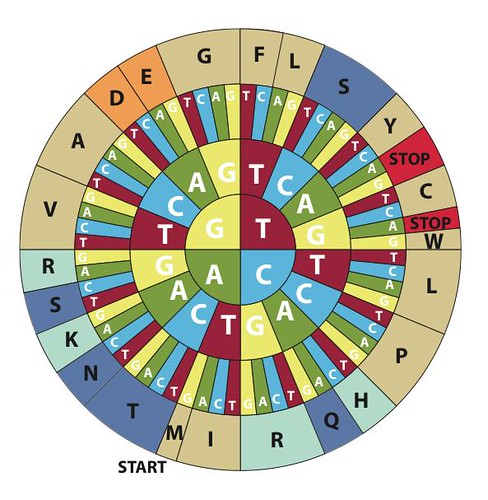
“Codon Wheel for translating genetic code from the Wellcome Trust Sanger Institute” by dullhunk is licensed under CC BY 2.0
Most psychiatric disorders are at least partly genetic. Some, like schizophrenia and ADHD, are very genetic, probably 80% plus. This is strange, because having psychiatric disorders seems bad, so you would expect evolution to have eliminated those genes. Researchers looking into this question argue between two hypotheses.
First, a failure. Evolution is imperfect, so some bad genes manage to slip through. This sounds dismissive, but it’s definitely true to some degree. Thousands of different genes contribute to risk for conditions like ADHD and schizophrenia, with each adding only a tiny amount of risk. When a gene is only very slightly bad, it takes evolution millennia to get rid of it, and during those millennia people are getting new very-slightly-bad mutations, so it all balances out at a certain level of bad genes per generation. Those bad genes are sufficient to explain the existing amount of ADHD and schizophrenia; they’re just evolution not working as well as we’d hope.
Second, a tradeoff between two goods. The genes for psychiatric disorders are good in some way. Maybe having some schizophrenia genes (maybe not enough to give you schizophrenia) makes you more creative and raises your inclusive fitness. This keeps schizophrenia risk genes in the population, and sometimes two people with very high level of these genes will mate and their child will have schizophrenia. “Higher creativity” vs. “lower schizophrenia risk” is a tradeoff, and different people are at different points on the tradeoff, and some people will be so far to one end that they will get schizophrenia.
Recent research has pretty heavily favored the failure hypothesis. If you have enough people’s genomes, you can use some complicated math to infer how evolution is affecting different genes. And on most of the schizophrenia risk genes we know about, evolution has been gradually eliminating them in a way that looks like they’re on net harmful — not keeping them around in a way that looks like they have counterbalancing advantages. In the modern day, people with genes for psychiatric disorders tend to have fewer, rather than more children than people without those genes – except in the case of ADHD, which I’m tempted to cynically attribute to them being less likely to remember to use contraception.
Also, a lot of the theories about how psychiatric disorder genes are good suggest that different disorders are good in opposite ways. For example, schizophrenia genes are supposed to give you more artistic creativity, whereas autism genes are supposed to make you more cool-headed and rational. This makes a kind of intuitive sense looking at the symptoms of the disorders. But it turns out that many, many of the genes that cause autism also cause schizophrenia, and vice versa. They seem to be general genes for having mental disorders, with a wide variety of negative effects — which seems like a better match for the first theory where they’re just plain bad news and evolution hasn’t gotten around to eliminating them yet.
January 20, 2021
QotD: Helping the homeless
I see a number of sources nowadays trying to pin these closures entirely on tight-fisted Republican governors, and I am sure this is partly true. But this misses an important element — that civil libertarians had real issues with both the conduct of these institutions (e.g. One Flew Over The Cuckoo’s Nest) and the fairness of the forced-institutionalization process. Also tied up in all this were Cold War stories of Soviet Russia using institutionalization in mental hospitals as a way to dispose of dissidents. After all, it is a short step from the totalitarian view of ideology (ie that everyone must believe, not just comply) to declaring that any deviation from the official orthodoxy constitutes mental illness.
Warren Meyer, “Why I Go Back and Forth On Issues of Forced Psychiatric Institutionalization”, Coyote Blog, 2018-09-20.
January 16, 2021
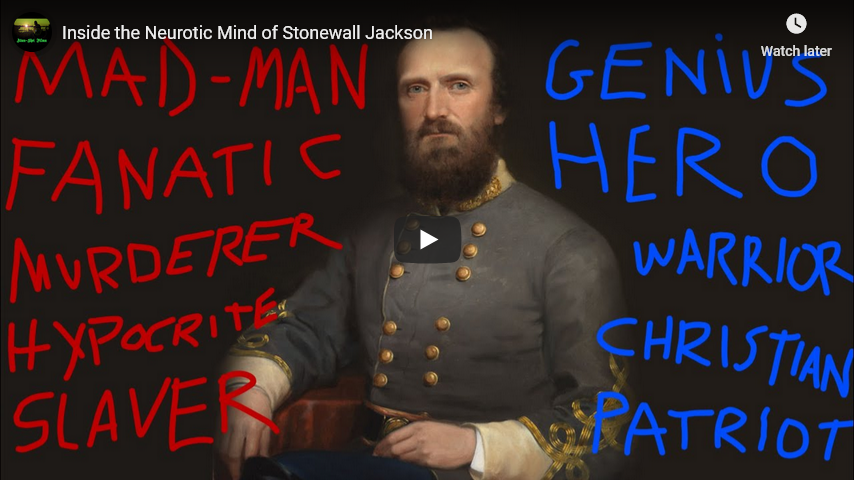
Inside the Neurotic Mind of Stonewall Jackson
Atun-Shei Films
Published 15 Jan 2021Let’s gossip about a man who’s been dead for 158 years.
Support Atun-Shei Films on Patreon ► https://www.patreon.com/atunsheifilms
Leave a Tip via Paypal ► https://www.paypal.me/atunsheifilms
Buy Merch ► teespring.com/stores/atun-shei-films
#ThomasJJackson #CivilWar #AmericanHistory
Original Music by Dillon DeRosa ► http://dillonderosa.com/
Reddit ► https://www.reddit.com/r/atunsheifilms
Twitter ► https://twitter.com/atun_shei
~REFERENCES~[1] Wallace Hettle. Inventing Stonewall Jackson: A Civil War Hero in History and Memory (2011). LSU Press, Page 3-9
[2] Hettle, Page 13-17
[3] Charles Royster. The Destructive War: William Tecumseh Sherman, Stonewall Jackson, and the Americans (1991). Vintage Books, Page 41-46
[4] Royster, Page 52-53
[5] Hettle, Page 20-21
[6] Royster, Page 65-67
[7] Chris Graham. “Myths and Misunderstandings: Stonewall Jackson’s Sunday School” (2017). The American Civil War Museum https://acwm.org/blog/myths-misunders…
[8] Royster, Page 63-65
[9] Royster, Page 60
[10] Royster, Page 49-51
[11] Mary Anna Jackson. Memoirs of Stonewall Jackson by his Widow, Marry Anna Jackson (1895). Prentice Press, Page 108
[12] Jackson, Page 120-121
[13] Hettle, Page 13-15
[14] Royster, Page 202
December 19, 2020
QotD: Ego and the A-listers
No. It’s more that ego games have a diminishing return. The farther you are up the ability and achievement bell curve, the less psychological gain you get from asserting or demonstrating your superiority over the merely average, and the more prone you are to welcome discovering new peers because there are so damn few of them that it gets lonely. There comes a point past which winning more ego contests becomes so pointless that even the most ambitious, suspicious, external-validation-fixated strivers tend to notice that it’s no fun any more and stop.
[…]
I think there are a couple of different reasons people tend to falsely attribute pathological, oversensitive egos to A-listers. Each reason is in its own way worth taking a look at.
The first and most obvious reason is projection. “Wow, if I were as talented as Terry Pratchett, I know I’d have a huge ego about it, so I guess he must.” Heh. Trust me on this; he doesn’t. This kind of thinking reveals a a lot about somebody’s ego and insecurity, alright, but not Terry’s.
There’s a flip side to projection that I think of as the “Asimov game”. I met Isaac Asimov just a few months before he died. Isaac had long been notorious for broadly egotistical behavior and a kind of cheerful bombast that got up a lot of peoples’ noses. But if you ever met him, and you were at all perceptive, you might see that it was all a sort of joke. Isaac was laughing inside at everyone who took his “egotism” seriously – and, at the same time, watching hungrily for people who could see through the self-parody, because they might – might – actually be among the vanishingly tiny minority that constituted his actual peers. The Asimov game is a constant temptation to extroverted A-listers; I’ve been known to fall into it myself. It’s not really anybody’s fault that a lot of people are fooled by it.
Another confusing fact is that though A-listers may not be about ego or status competition, they will often play such games ruthlessly and effectively when that gets them something they actually want. The something might be more money from a gig, or a night in the hay with an attractive wench, or whatever; the point is, if you catch an A-lister in that mode, you might well mistake for egotism some kinds of display behavior that actually serve much more immediate and instrumental purposes. Your typical A-lister in that situation (and this includes me, now) is blithely unconcerned that a bystander might think he’s egotistical; the money or the wench or the whatever is the goal, not the approval or disapproval of bystanders.
Finally, a lot of people confuse arrogance with ego. A-listers (and I am including myself, again, this time) are, as a rule, colossally arrogant. That is, they have utter confidence in their ability to meet challenges that would humble or break most people. Do not be fooled by the self-deprecating manner that many A-listers cultivate; it is a mask adopted for social purposes, mostly to avoid freaking out the normal monkeys. But this arrogance is not the same as egotism; in fact, in many ways it is the opposite. It is possible to be arrogant about one’s abilities compared to the statistically average human being and the range of challenges one is likely to encounter, but deeply and genuinely humble when dealing with peers or contemplating the vastness of one’s own ignorance and incapability relative to what one could imagine being. In fact, this combination of attitudes is completely typical of the A-listers I have known.
Eric S. Raymond, “Ego is for little people”, Armed and Dangerous, 2009-11-09.
December 4, 2020
“The Red Baron Pt. 2” – Kings of the Sky – Sabaton History 096 [Official]
Sabaton History
Published 3 Dec 2020They were the Aces in the sky — proud knights who flew their planes into deadly combat. Loved by the public, feared by their enemies, the victorious pilots of the Great War rose to prominence as gallant heroes. But the personal stories of those celebrated pilots were also memories full of excruciating pain, of terrible loss, and inner struggle. Body and mind of those aces were broken by the constant danger of fighting in the air. Those who survived bore more than a few scars.
Support Sabaton History on Patreon: https://www.patreon.com/sabatonhistory
Listen to “The Red Baron” on the album The Great War: https://music.sabaton.net/TheGreatWar
Watch the Official Lyrics Video of “The Red Baron” here: https://www.youtube.com/watch?v=3PXzg…
Listen to Sabaton on Spotify: http://smarturl.it/SabatonSpotify
Official Sabaton Merchandise Shop: http://bit.ly/SabatonOfficialShopHosted by: Indy Neidell
Written by: Markus Linke and Indy Neidell
Directed by: Astrid Deinhard and Wieke Kapteijns
Produced by: Pär Sundström, Astrid Deinhard and Spartacus Olsson
Creative Producer: Maria Kyhle
Executive Producers: Pär Sundström, Joakim Brodén, Tomas Sunmo, Indy Neidell, Astrid Deinhard, and Spartacus Olsson
Community Manager: Maria Kyhle
Post-Production Director: Wieke Kapteijns
Editor: Karolina Dołęga
Sound Editor: Marek Kamiński
Maps by: Eastory – https://www.youtube.com/c/eastory
Archive: Reuters/Screenocean – https://www.screenocean.comSources:
– National Archives NARA
– Imperial War Museums: EB1911, Q33851, Q33725, Q33875, Q23897, Q 105765, ART 1611, Q 63852, Q 63850, Q 93660, Q 55479, Q 60799, Q 10331, Q 67114, Q 66540,
– Library of Congress
– The Board of Trustees of the Science Museum
– Wellcome Images
– Icons form The Nano Project: iron cross By Souvik Maity, IN ld Plane by LUTFI GANI AL ACHMAD,
– planes of World War 1 courtesy of 11Amanda on Wikimedia CommonsAll music by: Sabaton
An OnLion Entertainment GmbH and Raging Beaver Publishing AB co-Production.
© Raging Beaver Publishing AB, 2019 – all rights reserved.

November 29, 2020
An unusually sympathetic biography of George III
Andrew Roberts reviews a new biography of King George III for The Critic:
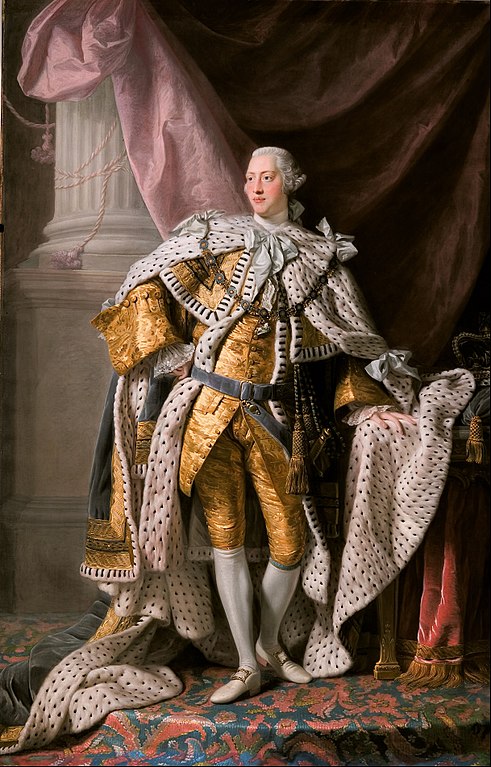
King George III in his coronation robes.
Portrait by Allan Ramsay (1713-1784), original in the Art Gallery of South Australia via Wikimedia Commons.
Over the past six years, Penguin have been publishing their excellent Monarchs series in which a leading historian writes a 30,000-word book on a king or queen from Athelstan to Elizabeth II. There are now 45 of them (including David Horspool on Oliver Cromwell, who sneaks in despite the monarchical rubric, and Jonathan Keates who reasonably enough lumped William III and Queen Mary together). These extended essays are attractively produced, can be read in a couple of hours, and many are true gems, from historians such as Tom Holland, John Guy, Tim Blanning, Norman Davies, Roger Knight, Jane Ridley, Richard Davenport-Hines, David Cannadine — you get the idea.
Now Professor Jeremy Black gives us a full-throated defence of the monarch who is only really generally known as the king who went insane and who lost the American colonies, and who now prances around in the camp-yet-sinister show-stopping song in Hamilton: The Musical. “When considering George III’s mistakes,” Black argues, persuasively, “it is important to assess the parameters of the possible and to consider comparisons.” With his expertise in eighteenth-century European history, Black is able to place George III in the wider context of contemporary monarchs such as Catherine the Great, Frederick the Great, Louis XVI and Napoleon.
“In contradiction to the Whig and American image of George as a tyrant, or at least a would-be tyrant,” Black states, “he had a strong conviction of the value of limited monarchy and was a willing student of the lessons of the Glorious Revolution and the subsequent Revolution Settlement.”
Black brilliantly demolishes the paranoiac Whig view of George as trying to accrete powers to himself unconstitutionally. The George who emerges is a far more attractive figure than the Whig historians depicted, let alone Thomas Jefferson with his 28 histrionic and inaccurate accusations against George in the Declaration of Independence, and especially Lin-Manuel Miranda’s hilarious but profoundly historically incorrect caricature.
Instead, Black portrays a monarch with “a strong religious faith, a passion for hunting and an interest in art, architecture, music, astronomy and exploration”. He was a Renaissance man with an Enlightenment viewpoint, although Black also lists his failings, which were obstinacy, self-righteousness and a certain amount of priggishness when young. Black calls him a “fogey”. These were hardly cardinal sins, and a world away from the lust for dictatorship of which he has been accused.
Jeremy Black — who is fast becoming a national treasure in his own right, having written well over 100 books — takes a refreshingly unmodish stance towards George (as you might have guessed from listing hunting amongst the king’s attributes). “His qualities are easier to understand for those who prize commitment, duty, and integrity,” he concludes, “than in a modern age when scorn and satire, even hatred of the nation’s history, are often prominent.”
October 30, 2020
Halloween Special: H. P. Lovecraft
Overly Sarcastic Productions
Published 31 Oct 2018HAPPY HALLOWEEN IT’S TIME TO GET SPOOKY WITH HISTORY’S MOST PROBLEMATIC HORROR WRITER LET’S GOOOOO
While there’s something to be said for separating the art from the artist, I think there’s a lot of merit in CONTEXTUALIZING the art WITH the artist. Did Lovecraft write some pretty incredible horror? Sure! Was he also a raging xenophobe? Absolutely! Are his perspectives on life connected with the stories he felt compelled to tell? Duh! If you look at Lovecraft’s writing through the lens of his life, clear patterns emerge that allow us to pin down what exactly he built his horror cosmology out of. It’s an invaluable analytical tool that allows us to take apart his writings by getting inside his head. So before you yell at me for Not Separating The Artist From The Art, know that it was completely intentional and I’m not sorry.
3:20 – THE CALL OF CTHULHU
8:40 – COOL AIR
10:36 – THE COLOR OUT OF SPACE
14:38 – THE DUNWICH HORROR
19:32 – THE SHADOW OVER INNSMOUTHPATREON: www.patreon.com/user?u=4664797
MERCH LINKS:
Shirts – https://overlysarcasticproducts.threa…
All the other stuff – http://www.cafepress.com/OverlySarcas…
From the comments:
Overly Sarcastic Productions
1 year ago
Hey gang! Can’t help but notice the comment section is a little bit on fire. That’s all good with me, but one recurring complaint I’ve noticed has started to get under my skin – namely that my explanation of non-euclidean geometry was insufficient, or even – dare I say – inaccurate. Now this is a fair complaint, because after a lifetime of experience finding that people’s eyes glaze over when I talk math at them, I concluded that interrupting a half-hour horror video with a long-winded explanation of a mathematical concept wouldn’t go over too well. I put it in layman’s terms and used a simple example to illustrate the point. However, since some of the more mathematically-inclined of you took offense, I now present in full a short (but comprehensive) explanation of what exactly non-euclidean geometry is.First, we axiomatically establish euclidean geometry. Euclidean geometry has five axioms:
1. We can draw a straight line between any two points.
2. We can infinitely extend a finite straight line.
3. We can draw a circle with any center and radius.
4. All right angles are equal to one another.
5. If two lines intersect with a third line, and the sum of the inner angles of those intersections is less than 180º, then those two lines must intersect if extended far enough.Axiom #5 is known as the PARALLEL POSTULATE. It has many equivalent statements, including the Triangle Postulate (“the sum of the angles in every triangle is 180º”) and Playfair’s Axiom (“given a line and a point not on that line, there exists ONE line parallel to the given line that intersects the given point”).
Euclidean geometry is, broadly, how geometry works on a flat plane.
However, there are geometries where the parallel postulate DOES NOT hold. These geometries are called “non-euclidean geometries”. There are, in fact, an infinite number of these geometries, and because the only defining characteristic is “the parallel postulate does not hold”, they can be all kinds of crazy shapes. (As you can see, my explanation of “this is just how geometry works on a curved surface” is quite reductive, but at the same time serves to get the general impression across without going into too much detail.)
An example of a non-euclidean geometry is “Elliptic geometry”, geometry on n-dimensional ellipses, which includes “Spherical geometry” as a subset. Spherical geometry is, predictably enough, how geometry works on the two-dimensional surface of a three-dimensional sphere.
In spherical geometry, “points” are defined the same as in euclidean geometry, but “line” is redefined to be “the shortest distance between two points over the surface of the sphere”, since there is no such thing as a “straight line” on a curved surface. All “lines” in spherical geometry are segments of “great circles” (which is defined as the set of points that exist at the intersection between the sphere and a plane passing through the center of that sphere).
The axiom that separates spherical geometry from euclidean geometry and replaces the parallel postulate is “5. There are NO parallel lines”. In spherical geometry, every line is a segment of a great circle, and any two great circles intersect at exactly two points. If two lines intersect when extended, they cannot be parallel, and thus there are no parallel lines in spherical geometry.
Since the Parallel Postulate is equivalent to Playfair’s Axiom, the fact that no parallel lines exist in spherical geometry negates Playfair’s Axiom, which thus negates the Parallel Postulate and defines spherical geometry as a non-euclidean geometry. Also, since the Triangle Postulate is another equivalent property to the Parallel Postulate, it is thus negated in spherical geometry. Hence, my use in-video of an example of a triangle drawn on the surface of a sphere whose inner angles sum greater than 180º.
Hope that cleared things up (and helped explain why I didn’t want to say “see, non-euclidean geometry is just a geometry where Euclid’s Parallel Postulate doesn’t hold – hold on, let me get the chalkboard to explain what THAT is-” in the video)
Peace!
-R ✌️