Quotulatiousness

February 23, 2022

From Shell Shock to PTSD – Understanding the Trauma of War – WW2 Special

Filed under: Britain, Germany, Health, History, Military, USA, WW1, WW2 — Tags: , , , — Nicholas @ 04:00

World War Two
Published 22 Feb 2022

Humanity has spent millennia developing ever more efficient ways to kill. This reaches its apogee in WWI and WWII, the most terrible conflicts in human history. Broken bodies bring with them broken minds. The trauma of war brings with it the mysteries of shell shock, war neurosis and PTSD.
(more…)

February 7, 2022

QotD: The Dunning-Kruger Effect

Filed under: Health, Media, Quotations — Tags: , , , — Nicholas @ 01:00

The Dunning-Kruger effect is a type of cognitive bias in which people believe that they are smarter and more capable than they really are. Essentially, low ability people do not possess the skills needed to recognize their own incompetence. The combination of poor self-awareness and low cognitive ability leads them to overestimate their own capabilities.

The term lends a scientific name and explanation to a problem that many people immediately recognize — that fools are blind to their own foolishness. As Charles Darwin wrote in his book The Descent of Man, “Ignorance more frequently begets confidence than does knowledge.”

An Overview of the Dunning-Kruger Effect
This phenomenon is something you have likely experienced in real life, perhaps around the dinner table at a holiday family gathering. Throughout the course of the meal, a member of your extended family begins spouting off on a topic at length, boldly proclaiming that he is correct and that everyone else’s opinion is stupid, uninformed, and just plain wrong. It may be plainly evident to everyone in the room that this person has no idea what he is talking about, yet he prattles on, blithely oblivious to his own ignorance.

The effect is named after researchers David Dunning and Justin Kruger, the two social psychologists who first described it. In their original study on this psychological phenomenon, they performed a series of four investigations and found that people who scored in the lowest percentiles on tests of grammar, humor, and logic also tended to dramatically overestimate how well they had performed. Their actual test scores placed them in the 12th percentile, yet they estimated that their performance placed them in the 62nd percentile.

Kendra Cherry, “What Is the Dunning-Kruger Effect?”, verywellmind, 2018-04-09.

January 1, 2022

QotD: Heinlein’s “Crazy Years”, Alfred Korzybski’s General Semantics, and modern times

While Heinlein (as far as I know) supplied no rationale for the advent and the recession of the craziness in the Crazy Years, A.E. van Vogt was freer with his speculations: insanity, either of individuals or of peoples, in van Vogt’s stories (and perhaps in the theories of Alfred Korzybski, who discovered or invented General Semantics) is caused by a fracture or disjunction between symbol and object. When your thoughts, and the thing about which you think, do not match up on a cognitive level, that is a falsehood, a false belief. When the emotions associated with the thought do not match to the thing about which you think, that is a false-to-facts association, which can range from merely a mistake to neurosis to psychosis, depending on the severity of the disjunction. You are crazy. If you hate your sister because she reminds you of your mother who beat you, that association is false-to-facts, neurotic. If you hate your sister because you have hallucinated that you are Cinderella, that association is falser-to-facts, more removed from reality, possibly psychotic.

The great and dire events of the early Twentieth Century no doubt confirmed Korzybski in the rightness of this theory. Nothing prevents a race of people from contracting and fomenting a false-to-facts belief: the fantasies of the Nazi Germans, pseudo-biology and pseudo-economics combined with the romance of neo-paganism, stirred the psyche of the German people for quite understandable reasons. From the point of view of General Semantics, the Germans had divorced their symbols from reality, they mistook metaphors for truth, and their emotions adapted to and reinforced the prevailing narrative. They told themselves stories about Wotan and the Blood, about being betrayed during the Great War, about needing room to live, about the wickedness of Jewish bankers and shopkeepers, about the origin of the wealth of nations — and they went crazy.

The Russians, earlier, and for equally psychological and psychopathic reasons told themselves a more coherent but more unreal story about history and destiny, taken from a Millenarian cultist named Marx, and they were, on an emotional level even if not on a cognitive level, convinced that shedding the blood of millions would bring about wealth as if from nowhere. And, because they used the word “scientific” to describe their brand of socialism, they actually thought their play-pretend neurotic story was a scientific theory that had been discovered by rigorous ratiocination — and they went crazy.

Berlin was bombed into submission during the Second World War, and the Berlin Wall collapsed along with the Soviet Empire at the end of the Cold War. But the modern methods of erecting false-to-facts dramas appealing to mass psychology, once discovered, did not fall when their practitioners fell: scientific socialism, naziism, fascism, communism, all have in common the subordination of word-association to political will. All these doctrines have a common ancestor, which is the social engineering theory of language: if you change the connotation of word, so the theory runs, you change the connotations of thoughts. General Semantics says that if an individual, or whole people en mass, adopt deliberately false beliefs, supported by deliberately manipulative word-uses, he or they will have increasingly unrealistic and maladaptive behaviors. Introduce Political Correctness, ignore factual correctness, and the people will go crazy.

The main sign of when madness has possessed a crowd, or a civilization, is when the people are fearful of imaginary or trivial dangers but nonchalant about real and deep dangers. When that happens, there is gradual deterioration of mores, orientation, and social institutions — the Crazy Years have arrived.

John C. Wright, “The Crazy Years and their Empty Moral Vocabulary”, John C. Wright, 2019-02-18.

December 21, 2021

QotD: The Royal Victimhood Olympics

Filed under: Britain, Humour, Media, Quotations — Tags: , , , — Nicholas @ 01:00

It’s funny to think that, when I was a child, the Queen’s Christmas speech was the cue for the nation to fall into a collective postprandial slumber. For the past few years, her nearest and dearest have seen to it that her life has outdone any Bond film when it comes to anticipation of what fresh hell awaits our battle-sore yet unbowed hero(ine) around the next corner. Is she going to ignore her favourite son’s alleged association with a dead paedophile? Her grandson’s allegation that her family contains a racist?

It’s certainly been a bumpy old ride of a year, making Her Majesty’s annus horribilis look like a teddy bears’ picnic. But though I’m not a royalist, I’m counting on this most stiff-upper-lipped of ladies not to mention those two little words which were inescapable this year: “mental health”, or the Mental Elf, as I’ve come to think of him.

Remember our old friends Elf and Safety? They’ve been replaced by Mental Elf, and he’s even more annoying, a nasty little imp intent on making every single member of this once-stoic island race confess to hidden sorrows.

The Royal Victimhood Olympics are now an open-season event, like tennis. The Prince of Wails had a head start, moaning about being sent to boarding school by his “distant” mother who – shame on her! – was a young woman doing her very best in a role she had neither wanted nor expected. Meghan Markle famously fled Frogmore Cottage with the Mental Elf in hot pursuit. Prince William, who appeared to be the sensible one, revealed this week he felt as if “the whole world was dying” after he helped save the life of a child while working as a helicopter pilot for the air-ambulance service.

And of course Sarah Ferguson has referred to herself as “the most persecuted woman in the history of the royal family”. All we need now is for Duchess Kate to weigh in with a detailed account of, say, her PMS problems and we’ve collected the full set of Unhappy Royal Families!

Yes, I know Princess Diana started it. But neurosis was just a part of her emotional repertoire. She realised that one of the best guarantees of good mental health is helping others rather than contemplating one’s navel. Or in the case of the wretched Fergie, one’s novel. The writing of Her Heart for a Compass was reportedly “therapeutic” and boosted her “self-esteem”. Is the world big enough for a more self-loving Fergie?

Julie Burchill, “The Queen is the last sane royal standing”, Spiked, 2021-12-09.

December 3, 2021

QotD: Questionable legal tactics

Filed under: Humour, Law, Quotations — Tags: , , — Nicholas @ 01:00

This is what I like to call a “reverse insanity defense”. You raise the defense in the hope that the judge is certifiably out of his friggin’ mind and grants it. Sadly, it rarely gets clients off the hook. It is, however, an excellent method of destroying your credibility with the court.

Conrad, “The Reverse Insanity Defense”, The Gweilo Diaries, 2004-09-28.

October 31, 2021

QotD: We’re still trapped in Heinlein’s “Crazy Years”

Filed under: Books, History, Quotations, Space, Technology, USA — Tags: , , , , — Nicholas @ 01:00

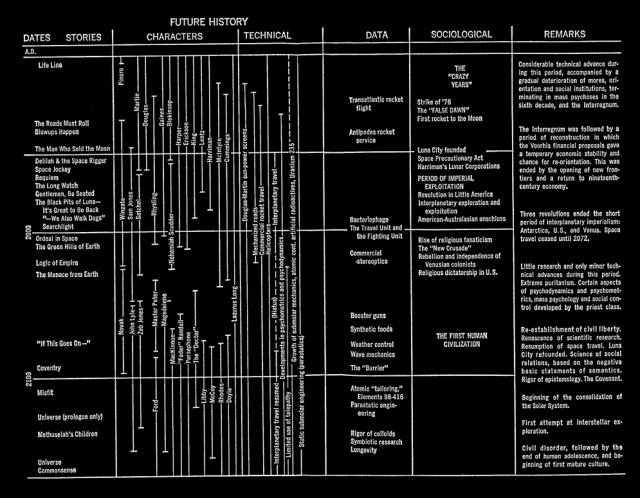
In Robert Heinlein’s famed “Future History” he constructed an elaborate timeline of thing to come, to provide a structure for his short stories.

Looking forward from the year 1940, when the timeline was first formed, it was reasonable, even conservative, guesswork to predict the moon landing by the 1980’s, forty years later, since the first powered flight by the Wright Brothers had been forty years earlier. Heinlein’s Luna City founded in 1990 a decade or so later, with colonies on Mars and Venus by 2000. Compare: a submersible ironclad was written up as a science romance by Jules Verne in 1869, based on the steam-powered “diving boat” of Robert Fulton, developed in 1801. In 1954 the first atomic-powered submarines — all three boats were named Nautilus — put to sea. The gap between Verne’s dream and Rickover’s reality was eight decades, about the time separating Heinlein’s writing of “Menace from Earth” and its projected date.

Looking back from the year 2010, however the dates seem remarkably optimistic and compressed. We have not even mounted a manned expedition to Mars as yet, and no return manned trips to the Moon are on the drawing boards.

One prediction that was remarkably prescient, however, was the advent of “The Crazy Years” described as “Considerable technical advance during this period, accompanied by a gradual deterioration of mores, orientation, and social institutions, terminating in mass psychoses in the sixth decade, and the interregnum.”

He optimistically predicts a recovery from the Crazy Years, the opening of a new frontier in space, and a return to nineteenth-century economy. Full maturity of the human race is achieved by a science of social relations “based on the negative basic statements of semantics.” Those of you who are A.E. van Vogt fans will recognize our old friends, general semantics and Null-A logic cropping up here. Van Vogt, like Heinlein, told tales of a future time when the Non-Aristotlean logic or “Null-A” training would give rise to a race of supermen, fully integrated and fully mature human beings, free of barbarism and neuroses.

Here is the chart [full size version here]. Note the REMARKS column to the right.

What Heinlein failed to predict was that the Crazy Years would simply continue up through 2010, with no sign of slackening. Ladies and gentlemen, we live in the Crazy Years.

John C. Wright, “The Crazy Years and their Empty Moral Vocabulary”, John C. Wright, 2019-02-18.

October 22, 2021

QotD: Post-traumatic stress disorder (PTSD) in the ancient (or medieval) world

PTSD is more than feeling bad about being in a war, or grief at the loss of a buddy. Here are the diagnostic guidelines. Note how a diagnosis requires one intrusion symptom (involuntary and instrusive memories, dreams, flashbacks, marked physiological reactions) and persistent avoidance of stimuli associated with the trauma and two negative alterations in cognition and mood associated with the trauma and two marked alterations in arousal and reactivity associated with the trauma. A lot of the examples being cited in the comments do not come anywhere near meeting that criteria. As I read and understand that, an individual who is voluntarily recounting the trauma – much less re-exposing themselves to it by going out to fight again – without significant reactions (read the guidelines – these are really very significant reactions) doesn’t fit the criteria. They may well have another form of mental wound, mind you; grief, fear, loss, guilt and so on are all very real things. But they do not, by our current medical definition, have this wound. Specificity here is necessary because we aren’t asking a question about grief or loss or guilt – feelings which all humans feel at one point or another – but about a very specific mental wound that combat (or other trauma) may inflict.)

That is often not the impression that you would get from a quick google search (though it does seem to be the general consensus of the range of ancient military historians I know) and that goes back to arguments ex silentio. A quick google search will turn up any number of articles written by folks who are generally not professional historians declaring that PTSD was an observed phenomenon in the deep past, citing the same small handful of debatable examples. But one thing you learn very rapidly as a historian is that if you go into a large evidence-base looking for something, you will find it.

That’s not a species of research positivity – it’s a warning about confirmation bias, especially if you do not establish a standard of proof before your investigation. It is all too easy to define down your definition of “proof” until the general noise of the source-base looks like proof. In this case, we have to ask – before we go looking – what would evidence of PTSD in ancient societies (I’m going to start there because it is where I am best informed) look like?

Well, ancient societies engaged in a lot of warfare. Among the citizenry – the sort of fellows who write to us and are written about in our sources – combat experience was almost ubiquitous. That only really changes as we get into the Roman Empire, as violence levels both decline generally and are pushed to the frontier via a professional army. The percentage of veterans in the citizen population (again, citizen here is an important caveat, but then those fellows basically are our primary source base) probably equaled that of the WWI generation in Britain or France, except all the time (there’s a point in the Second Punic War where the Roman censors went through the entire rolls, checking to see how many had managed to avoid military service and found only a few thousand in a citizen body of c. 150,000 adult males). So what ought we expect from our sources? We should expect to see signs of PTSD everywhere. It should be absolutely pervasive in a source-base produced almost entirely by, for and about combat veterans, in societies where military mortality exceeded modern rates by a robust margin.

And it simply isn’t there. There is one very frequently cited account in Herodotus (Hdt. 6.117) of a man named Epizelos experiencing what is generally understood as “conversion disorder” (which used to be badly labeled “hysterical blindness”) in combat. Without being wounded he went blind at a sudden terror in battle and never recovered his sight. Herodotus terms it a θῶμα – a “wonder” or “marvel”, a word that explicitly implies the strange uncommonness of the tale. Herodotus is concerned enough about how exceptional this sounds that he is quick not to vouch for its veracity – he brackets the story (beginning and end) noting that it was what he was told (by someone else) that Epizelos used to say happened to him. In short, this was uncommon enough that Herodotus distances himself from it, so as not to be thought as a teller of tall-tales (though Herodotus is, in fact, a teller of tall tales).

This one example – cited endlessly and breathlessly in internet articles – is remarkable not because it is typical, but because it is apparently very unusual (also, it is my understanding – with the necessary caveat that I am not an expert – that while conversion disorder is a consequence of emotional trauma, it is not clear that it is associated with PTSD more generally). Meanwhile, in the war literature of the Romans, in their poetry (including that by folks like Horace, who fought in quite terrible battles), in the military literature of the Greeks, in the reflections of Xenophon (both on his campaigns and his commands), in the body of Greek lyric poetry … all of it – nothing. It is simply not there – not as a concern that such a condition might befall someone, nor a report that it had done so. Nothing. The lacuna baffled me for years.

My impression is that the medieval literature looks much the same: a few scattered passages that, if you squint hard enough, might be PTSD set against a vast backdrop of nothing in a society where literature was dominated by the war-fighting class. More examples than in the classical corpus (but then the medieval corpus is much larger; oddly, the examples I’ve seen all seem to concern crusading particularly), but nothing close to what we would expect given a literary tradition absolutely dominated by military aristocrats and their (often clerical) families. I call this my impression, because the medieval corpus is both much larger and I have read much less of it; but if there is a hidden reservoir of accounts showing clear symptoms of PTSD, I have not found it yet. I was always struck that – despite the fact that monastic life was often a destination for medieval military aristocrats troubled by their life of violence – none of the monastic rules I have read (admittedly, not all of them), which often have guidelines for abbots to deal with difficult monks, have had anything about how to deal with the symptoms of PTSD.

Now that’s not to say there isn’t grief at loss, mind you! The lamentations of defeat, the sorrow of losing a loved one (even in victory), the misery of war – that you find in the ancient texts in abundance. It occupies literary topoi, it is depicted in artwork, it gets entire tragedies to stretch out in, it is addressed by great big political speeches, it sits at the cornerstone of the Iliad‘s narrative (one reason, no doubt, that the Iliad remains a useful text for soldiers working through their experiences). But the persistent symptoms of PTSD, no. I haven’t been able to find one “flashback” or combat-memory related dissociative episode in ancient literature. You might argue that they simply weren’t recorded, but that strikes me as unlikely in societies where other forms of war-damage were so fiercely valorized and which would have often seen – as with Epizalos – such symptoms as divine omens. There should be dozens and dozens of them. These are societies with active medical literature, after all!

I think the evidence strongly suggests that ancient combatants did not experience PTSD as we do now. The problem is that the evidence of silence leads us with few tools with which to answer why. One answer might be that it existed and they do not tell us – because it was considered shameful or cowardly, perhaps. Except that they do tell us about other cowardly or shameful things. And the loss and damage of war – death, captivity, refugees, wounds, the lot of it – are prominent motifs in Greek, Roman and European Medieval literature. War is not uniformly white-washed in these texts – not every medieval writer is Bertran. We can’t rule out some lacuna in the tradition, but given just how many wails and moans of grief and loss there are in the corpus it seems profoundly unlikely. I think we have to assume that it isn’t in the sources because they did not experience it or at least did not recognize the experience of it.

Bret Devereaux, “Fireside Friday”, A Collection of Unmitigated Pedantry, 2020-04-24.

October 9, 2021

You need to ask yourself “Am I the crazy one?” (and hope you don’t hear yourself answering…)

Filed under: Health, Media — Tags: , , , , , , — Nicholas @ 05:00

In The Line, Jen Gerson considers the widely predicted epidemic of mental health issues the experts thought would follow the Wuhan Coronavirus pandemic as it faded:

That warning doesn’t seem to have panned out, exactly. As this more recent op-ed in the Atlantic pointed out, rates of depression and anxiety spiked at the beginning of the pandemic, but then receded. Rates of life satisfaction are near pre-pandemic norms. And the suicide rate has actually declined for reasons no one can quite pin.

“The pandemic has been a test of the global psychological immune system, which appears more robust than we would have guessed. When familiar sources of enjoyment evaporated in the spring of 2020, people got creative. They participated in drive-by birthday parties, mutual-assistance groups, virtual cocktail evenings with old friends, and nightly cheers for health-care workers. Some people got really good at baking,” the authors wrote, optimistically.

I think they’re wrong. Or, rather, I think we proved to be resilient in all the ways that the authors were looking at, and far more fragile in the ways they weren’t.

I think we’re in the middle of the mental-health pandemic right now; I think we’re in it so deep that we can’t even see it anymore. And I think we can’t see it because the crisis is not taking the form we expected it to take.

We expected the post-pandemic mental-health crisis to look the way they used to look — invisible. The depressed sister who hasn’t called for months. The anxiety-ridden best friend who drowns her tics in pills and alcohol. For the majority of the population that doesn’t suffer from a diagnosable mental-health issue, mental-health crises are often hidden. We expected a traumatic post-pandemic mental-health crisis to look a lot like this — another person’s problem — but on a grander scale.

This assumption leaves our entire framework with a missing link. A mental-health pandemic isn’t necessarily going to show up on a self-reported survey about anxiety and depression levels.

It’s going to show up in behaviour — and often behaviour that can be rationalized.

Because crazy people don’t think they’re crazy. You can’t see it when you’re in it.

Look around; are people acting normal lately? Think of the protests we saw during the election, or the anti-vaccine marches through our downtown cores. Think of the mom wearing two masks who screamed because your kid got too close on the playground — was that rational, grounded, sane behaviour?

Something is happening to a lot of people, and you see it in both the COVID deniers and also those who have made a religion out of the dangers of the disease. There are people out there that still can’t collect the mail without taking “precautions”. How about the people who are still sanitizing their groceries? That might have been reasonable in the Spring of 2020, when we weren’t sure how COVID spread. Now it looks a lot more like OCD.

Have you not noticed that some of the most brilliant people, after spending months devoid of much human contact, are now acting like raving loons on outlets like Twitter? Increased dependency on a gamified and polarizing social media for socialization during periods of extended isolation seems to have broken the ability to think clearly or behave civilly. This is hard to quantify, but I can’t be the only one to feel as if social media has grown palpably worse over the last year.

September 26, 2021

QotD: Euphemism

Filed under: Media, Politics, Quotations — Tags: , , — Nicholas @ 01:00

Throughout the Globe piece, neither Robinson nor his interviewer is able to say the words “mentally ill,” let alone crazy. Rather, it is said that he “suffers from a mental illness,” or in Svendspeak, that he is “living with mental illness,” rather like a room-mate. This is a euphemism, a kind of linguistic prophylactic intended to shield the speaker, no less than the listener, from the harsh reality to which it refers. Like all euphemisms and some prophylactics, it will eventually wear out, requiring the substitution of some new euphemism in its place. In time, “living with mental illness” will be seen as a grievous insult, much as “coloured people” is to people of colour. (Except, of course, for those working at the National Association for the Advancement of Colored People.)

Andrew Coyne, “False Sensitivity”, andrewcoyne.com, 2005-05-07.

September 14, 2021

“If life is a status game … The logic of the status game dictates that humiliation must be uniquely catastrophic”

Filed under: Health, Science, USA — Tags: , , , , — Nicholas @ 05:00

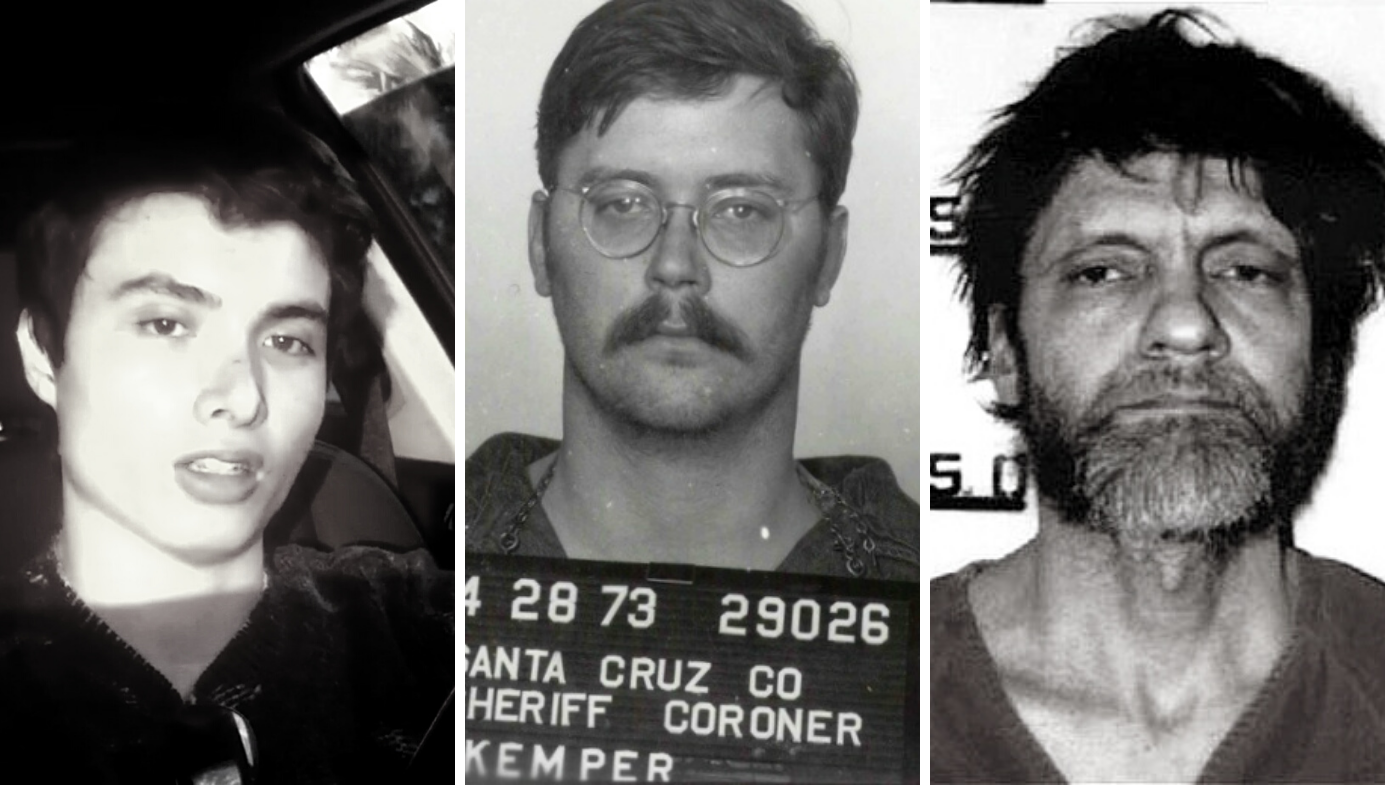
In Quillette, Will Storr recounts some harrowing early life experiences for three young men ‐ that read like setups for bad horror novels — and how those early humiliations led to tragedy:

Elliot Rodger, Ed Kemper and Ted Kaczynski.
Photos from Quillette.

If life is a status game, what happens when all our status is taken from us? What happens when we’re made to feel like nothing, again and again and again? Humiliation can be seen as the opposite of status, the hell to its heaven. Like status, humiliation comes from other people. Like status, it involves their judgement of our place in the social rankings. Like status, the higher they sit in the rankings, and the more of them there are, the more powerful their judgement. And, like status, it matters. Humiliation has been described by researchers as “the nuclear bomb of the emotions” and has been shown to cause major depressions, suicidal states, psychosis, extreme rage, and severe anxiety, “including ones characteristic of post traumatic stress disorder.” Criminal violence expert Professor James Gilligan describes the experience of humiliation as an “annihilation of the self.” His decades of research in prisons and prison hospitals, seeking the causes of violence, led him to “a psychological truth exemplified by the fact that one after another of the most violent men I have worked with over the years have described to me how they had been humiliated repeatedly throughout their childhoods.”

The logic of the status game dictates that humiliation must be uniquely catastrophic. For psychologists Professor Raymond Bergner and Dr Walter Torres humiliation is an absolute purging of status and the ability to claim it. They propose four preconditions for an episode to count as humiliating. Firstly, we should believe, as most of us do, that we’re deserving of status. Secondly, humiliating incidents are public. Thirdly, the person doing the degrading must themselves have some modicum of status. And finally, the stinger: the “rejection of the status to claim status.” Or, from our perspective, rejection from the status game entirely.

In severe states of humiliation, we tumble so spectacularly down the rankings that we’re no longer considered a useful co-player. So we’re gone, exiled, cancelled. Connection to our kin is severed. “The critical nature of this element is hard to overstate,” they write. “When humiliation annuls the status of individuals to claim status, they are in essence denied eligibility to recover the status they have lost.” If humans are players, programmed to seek connection and status, humiliation insults both our deepest needs. And there’s nothing we can do about it. “They have effectively lost the voice to make claims within the relevant community and especially to make counterclaims on their own behalf to remove their humiliation.” The only way to recover is to find a new game even if that means rebuilding an entire life and self. “Many humiliated individuals find it necessary to move to another community to recover their status, or more broadly, to reconstruct their lives.”

But there is one other option. An African proverb says, “the child who is not embraced by the village will burn it down to feel its warmth.” If the game rejects you, you can return in dominance as a vengeful god, using deadly violence to force the game to attend to you in humility. The life’s work of Professor Gilligan led him to conclude the fundamental cause of most human violence is the “wish to ward off or eliminate the feeling of shame and humiliation and replace it with its opposite, the feeling of pride.”

Of course, it would be naive to claim Ed, Ted, and Elliot were triggered solely as a response to humiliation. If the cauterisation of status was a simple mass killing switch, such crimes would be common. Various further contributory factors are possible. All three were men, which dramatically increases the likelihood they’d seek to restore their lost status with violence. Elliot Rodger was said to be on the autism spectrum, which might’ve impacted his ability to make friends and girlfriends; a court psychiatrist claimed Ed Kemper had paranoid schizophrenia (although this remains contested); and Kaczynski’s brother said Ted once “showed indications of schizophrenia.” But none of these conditions are answers in themselves, because the vast majority of those that have them don’t burn down their villages.

The ordeal endured by Kaczynski as a teen at Harvard beggars the imagination and could easily provide conspiracy theorists with copious confirmations of their fears: “What Ted didn’t know was that Murray had a history of working on behalf of secretive government agencies. This would be a study of harsh interrogation techniques, specifically the ‘effects of emotional and psychological trauma on unwitting human subjects.’ Once he’d detailed his secrets and philosophies, Ted was led into a brightly lit room, had wires and probes attached to him, and was sat in front of a one way mirror. There began a series of what Murray called ‘vehement, sweeping, and personally abusive’ attacks on his personal history and the rules and symbols by which he lived and hoped to live. ‘Every week for three years, someone met with him to verbally abuse him and humiliate him,’ Ted’s brother said. ‘He never told us about the experiments, but we noticed how he changed.’ Ted himself described the humiliation experiments as ‘the worst experience of my life.'”

July 19, 2021

QotD: Antifa

Filed under: Health, Politics, Quotations, USA — Tags: , , , , — Nicholas @ 01:00

As noted here many times, it helps if you think of Antifa not as a political movement but as a metastasising personality disorder, a Cluster B contagion. An attempt to dominate by deranged and spiteful egos, rendered in shattered glass and burning livelihoods. They will never be satisfied and can never be appeased, merely encouraged and emboldened by any concession, any excuse, any hesitation.

They destroy and burn and intimidate, and beat people senseless, because they enjoy it. It’s something they wish to do, and choose to do, repeatedly. It makes them feel powerful. Everything else is a pretext, a rationalisation, a lie:

    This is us taking the high road. This is us trying to create a world filled with love.

David Thompson, commenting on “Files of the Severely Educated”, DavidThompson, 2021-04-18.

July 8, 2021

QotD: Psychopaths

Filed under: Health, Quotations — Tags: , — Nicholas @ 01:00

Came across this today. Psychopath “diagnostic criteria”. These are all direct quotes.

  • Psychopaths show a disregard for, and violation of, the rights of others.
  • They fail to conform to social norms with respect to lawful behaviours.
  • They are always deceitful … They are nasty, aggressive con artists.
  • They are massively impulsive and fail to plan ahead.
  • They show irritability and aggressiveness, as indicated by repeated physical fights and assaults.
  • They manifest a reckless disregard for the physical and psychological safety of others.
  • They are consistently irresponsible. Repeated failure to sustain consistent work behaviour … are their hallmark.
  • They show lack of remorse. They are indifferent to, or rationalize, having hurt, mistreated or stolen from another … It can seem that labelling them as anti-social is a serious understatement.

From Furnham, Adrian. 50 Psychology Ideas You Really Need to Know. London: Quercus Publishing, p. 25. The heading of the chapter is “Seem Sane”. This is the statement at the start of the discussion:

    Psychopaths are without conscience and incapable of empathy, guilt or loyalty to anyone but themselves.

Anyway, I just thought I would mention it.

Steve Kates, “Psychopath ‘diagnostic criteria'”, Catallaxy Files, 2021-04-07.

June 12, 2021

QotD: The assassination attempt(s) on Bismarck

Filed under: Germany, History, Quotations — Tags: , , , , — Nicholas @ 01:00

… 19th-century history, particularly the years from the 1848 revolutions to the outbreak of the First World War in 1914. The key was Bismarck, the Prussian minister-president who unified Germany. If you want to learn about Bismarck, you will probably pick up a book by some historian of international relations, such as A.J.P. Taylor. That’s the right place to start. But it means you can read a lot about Bismarck before finding out about the time in May 1866 when a guy shot him.

Ferdinand Cohen-Blind, a Badenese student of pan-German sentiments, waylaid Bismarck with a pistol on the Unter den Linden. He fired five rounds. None missed. Three merely grazed his midsection, and two ricocheted off his ribs. He went home and ate a big lunch before letting himself be examined by a doctor.

But even the books that condescend to mention this triviality may not tell you about the other time a guy shot Bismarck: A young Catholic tried to kill him in July 1874, during the anti-Catholic Kulturkampf Bismarck had engineered, but only managed to score his right hand with a bullet.

The point is not that Bismarck was particularly hated, although he was. The point is that this period of European (and American) history was crawling with young, often solitary male terrorists, most of whom showed signs of mental disorder when caught and tried, and most of whom were attached to some prevailing utopian cause. They tended to be anarchists, nationalists or socialists, but the distinctions are not always clear, and were not thought particularly important. The 19th-century mind identified these young men as congenital conspirators. It emphasized what they had in common: social maladjustment, mania, an overwhelming sense of mission and, usually, a prior record of minor crimes.

[…]

Bismarck was not much of a democrat, but his example is instructive. He was so phlegmatic about being shot that he obtained both of the guns he had been shot with. He kept them in his desk, ready for use against a third guy with the same bright idea.

Colby Cosh, “Those old terrorist tendencies”, Maclean’s, 2014-12-07.

June 11, 2021

QotD: Twitter

Filed under: Humour, Media, Quotations, Technology — Tags: , , — Nicholas @ 01:00

Imagine being trapped in a room filled with strangers for a long period of time, and in that room, everyone is forced to hear all the stray thoughts from everyone else’s mind. After a time, you’d all be driven insane, yet on Twitter, we accept this as a matter of course.

Clive Mansa (@clivemansa), Twitter, 2021-03-09.

May 23, 2021

QotD: The psychological impact of extended lockdowns

Claudio Grass (CG): A lot has been said and written about the economic and financial impact of the covid crisis and all the lockdowns and restrictions that came with it. However, the mental health implications haven’t really received the attention they arguably merit, at least not by mainstream media or government officials. Over the last year, we saw self-reported depression rates creep up in many Western nations, while excessive alcohol consumption and the abuse of prescription drugs also jumped. Do such trends raise concerns over longer-term problems or will we all simply snap back to normal once the crisis is over?

Theodore Dalrymple (TD): The first thing to say is that I do not like the term “mental health.” Was Isaac Newton mentally healthy, or Michelangelo? I think part of the problem is very concept of mental health. It implies that there is some state or condition of mind deviation from which is analogous to illness. Once this idea takes hold, it is clearly up to an expert to cure the person, or better still prevent him from getting ill in the first place. This expectation cannot be met, but the idea that it can be makes people more fragile.

Second, people clearly vary much in their response to confinements, lockdowns, closures of resorts of entertainment, etc. For myself, I have reached the age of misanthropy or self-sufficiency when these things make comparatively little difference to my life. I have plenty of space and plenty of things to do, in essence reading and writing. But that does not make me mentally healthier than a young man who is frustrated because he cannot play football with his friends and becomes ratty – moreover living in a very confined space.

Depression is so loosely defined a term that it has become almost valueless as a diagnosis. How often have you heard someone say “I’m unhappy” rather than “I’m depressed?” The semantic shift is very important. The proper response to someone who says that he is depressed is to give him antidepressants, even though these don’t work in the majority of cases, except as a placebo, and have potential side-effects. It is always tempting for people who are unhappy to drink alcohol – to drown their sorrows, as we say. Of course, if you drink too much, you might become really and truly depressed. A person who did not respond to the current situation with a little gloom would be odd.

Claudio Grass, “Theodore Dalrymple: Self-Control And Self-Respect Have Become Undervalued”, The Iconoclast, 2021-02-17.

« Newer PostsOlder Posts »

Powered by WordPress