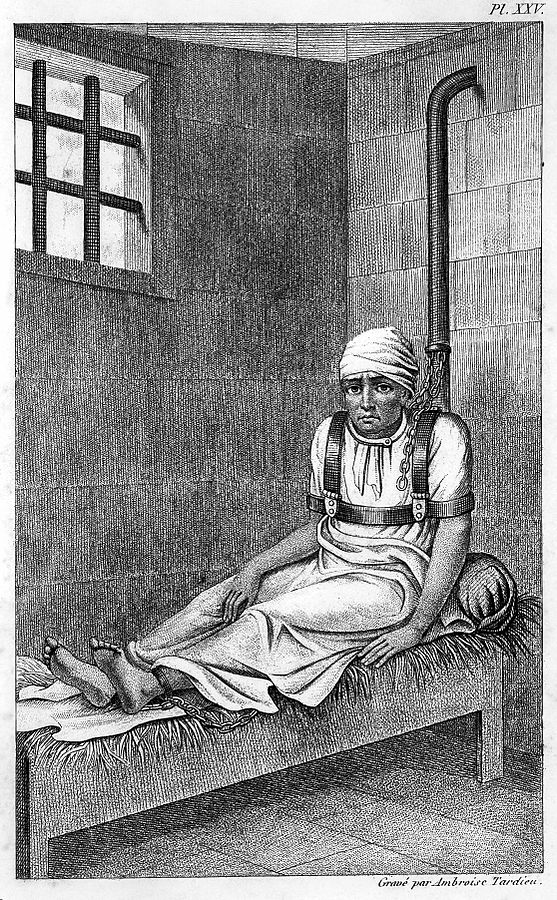
[In Desperate Remedies: Psychiatry’s Turbulent Quest to Cure Mental Illness, Andrew] Scull stresses the degree to which external pressures have shaped psychiatry. “Community psychiatry” supplanted “institutional psychiatry” in part because of professional insecurity. Psychiatrists needed a new model for dealing with mental diseases to keep pace with the advances that mainstream health care was making with other diseases. Fiscal conservatives viewed the practice of confining hundreds of thousands of Americans to long-term commitment as overly expensive, and civil libertarians viewed it as unjust.
Deinstitutionalization began slowly at first, in the 1950s, but the pace accelerated around 1970, despite signs that all was not going according to plan. On the ground, psychiatrists noticed earlier than anyone else that the most obvious question — where are these people going to go when they leave the mental institutions? — had no clear answers. Whatever misgivings psychiatrists voiced over the system’s abandonment of the mentally ill to streets, slums, and jails was too little and too late.
That modern psychiatry is mostly practiced outside of mental institutions is not its only difference from premodern psychiatry. Scull devotes extensive coverage to two equally decisive developments: the rise and fall of Freudianism, and psychopharmacology.
The Freudians normalized therapy in America and provided crucial intellectual support for the idea that mental health care is for everyone, not just the deranged. Around the same time as deinstitutionalization, Freud’s reputation, especially in elite circles, was on a level with Newton and Copernicus. Since then, Freudianism has mostly gone the way of phlogiston and leeches. That happened not just because people decided the psychoanalysts’ approach to therapy didn’t work but also because insurance wouldn’t pay for it. Insurance would, however, pay for modes of therapy that were less open-ended than the “reconstruction of personality that psychoanalysis proclaimed as its mission”, more targeted to a specific psychological symptom, and, most crucially of all, performed by non-M.D.s. Therapy was on the rise, but psychiatrists found themselves doing less and less of it.
As psychiatry cast aside Freudian concepts such as the “refrigerator mother”, which rooted mental illness in psychodynamic tensions, it increasingly trained its focus on biology. Drugs contributed to, and gained a boost from, this reorientation. Scull loathes the drug industry and only grudgingly allows that it has made improvements in the lives of mentally ill Americans. He divides up the vast American drug-taking public into three groups: those for whom they work, those for whom they don’t work, and those for whom they may work, but not enough to counter the unpleasant side effects. He argues that the last two groups are insupportably large.
Stephen Eide, “Soul Doctors”, City Journal, 2022-05-18.
September 11, 2022
QotD: De-institutionalization
August 31, 2022
QotD: John Keegan’s The Face of Battle
The Face of Battle (1976) is in some ways an oddly titled book. The title implies there is a singular face to battle that the author, John Keegan, is going to discover (and indeed, to take his forward, that is certainly the question he looked to answer). But that plan doesn’t survive contact with the table of contents, which makes it quite clear that Keegan is going to present not one face of battle, but the faces of three different battles and they will look rather different. Rather than reinventing the wheel, I am going to follow Keegan’s examples to make my point here (although I should note that of course The Face of Battle is a book not without its flaws, as is true with any work of history).
Keegan’s first battle is Agincourt (1415). While famous for the place of the English longbow in it, at Agincourt the French advance (both mounted and dismounted) did reach the English lines; of this the sources for the battle are quite clear. And so the terror we are discussing is the terror of shock; not shock in the sense of a sudden shock or in the sense of a jolt of electricity, rather shock as the opposite of fire. Shock combat is the combat when two bodies of soldiers press into each other in mass hand-to-hand combat (which is, contrary to Hollywood, not so much a disorganized melee as a series of combats along the line of contact where the two formations meet). The advancing French had to will themselves forward into a terrifying shock encounter, while the English had to (like our hoplites above) hold themselves in place while watching the terrifying prospect of a shock engagement walk steadily towards them.
There is actually quite a bit of evidence that the terror of a shock engagement is something different from the other terrors of war (to be clear, not “better” or “worse”, merely different in important ways). There are numerous examples of units which could stand for extend periods under fire but which collapsed almost immediately at the potential of a shock engagement. To draw a much more recent example, at Bai Beche in 2001, a force of Taliban withstood two days of heavy bombing and had repulsed an infantry assault besides, but collapsed almost immediately when successfully surprised by a cavalry charge (yes, in 2001) in their rear (an incident noted in S. Biddle, “Afghanistan and the Future of Warfare”, Foreign Affairs 82.2 (2003)).
And so our sources for state-on-state pre-gunpowder warfare (which is where you tend to find more fully “shock” oriented combat systems) stress similar sequences of fear: the dread inspired by the sight of the enemy army drawing up before you (Greek literature is particularly replete with descriptions of teeth-chattering and trembling in those moments and it is not hard to imagine why), followed by the steady dread-anticipation as the armies advanced, each step bringing that moment of collision closer. Often in such engagements one side might break before contact as the fear not of what was happening, but what was about to happen built up. And only then the long anticipated not-so-sudden shock of the formations coming together – rarely for long given the overpowering human urge not to be near an enemy trying to stab you with a sharp stick. There is something, I think, quite fundamental in the human psyche that understands another human with a sharp point, or a huge horse rapidly closing on a deeper level than it understands bullets or arrows.
Which brings us to Keegan’s second battle, Waterloo (1815), defined in part by the ability of the British to manage to hold firm under extended fire from artillery and infantry. The French artillery in an 80-gun grand battery opened fire at 11:50am and kept it up for hours until the French cavalry advanced (hoping that the British troops were suitably “softened” by the guns to be dislodged) at 4pm. In contrast to Agincourt (or a hoplite battle) which may have ended in just a couple of hours and consisted mostly of grim anticipation, soldiers (on both sides) at Waterloo were forced to experience a rather different sort of terror: forced to stand in active harm for hours on end, as bullets and cannon shot whizzed overhead.
The difference of this is perhaps most clearly extreme if we move still forward to the Somme (1916) and bombardment. The British had prepared for their assault with a week long artillery barrage, in which British guns fired 1.5 million shells (that is about 148 shells fired a minute, every minute for a week). At the first sound of guns, soldiers (in this case, the Germans, but it had been the French’s turn just that February to be on the receiving end of a bombardment at Verdun) rushed into their dug-out bomb shelters at the base of their trench and then waited. Unlike the British at Waterloo, who might content themselves that, one way or another, the terror of fire would not last a day, the soldier of WWI had no way of knowing when the barrage would cease and the battle proper begin. Indeed, they could not see the battlefield at all, only sit under the ground as it shook around them and try to be ready, at any moment when the barrage stopped to rush back up to the lip of the trench to set up the machine guns – because if they were late to do it, they’d arrive to find British grenades and bayonets instead.
We will get into wounds, both physical and mental, next week, but it is striking to me that repeatedly there are reports after such barrages of soldiers so mentally broken by the strain of it that they wandered as if dazed or mindless, apparently driven mad by the bombardment. Reports of such immediate combat trauma are vanishingly rare in the pre-modern corpus (Hdt. 6.117 being the rare example). And it is not hard to see why the constant threat of sudden, unavoidable death hanging over you, day and night, for days or in some cases weeks on end produces a wholly different kind of terror.
And yet, to extend beyond Keegan’s three studies, in talking to contemporary veterans, it seems to me this terror of fire – being forced to stand (or hide) under long continuous fire – is not always quite the same as the terror of the modern battlefield. Of course I can only speak to this second hand (but what else can a historian generally do?), but there seems to be something different about a battlefield where everything might seem peaceful and fine and even a bit boring until suddenly the mortar siren sounds or a roadside IED goes off and the peril is immediate. The experience of such fear sometimes expresses itself in a sort of hypervigilance which seems entirely unknown to Greek or Roman writers (who in most cases could hardly have needed such vigilance; true surprise attacks were quite rare as it is extremely hard to sneak one entire army up on another) and doesn’t seem particularly prominent in the descriptions of “shell-shock” (which today we’d call PTSD) from the First World War, compared to the prominence of intense fatigue, the thousand-yard-stare and raw emotional exhaustion. I do wonder though if we might find something quite analogous looking into the trauma of having a village raided by surprise under the first system of war.
Bret Devereaux, “Collections: The Universal Warrior, Part IIa: The Many Faces of Battle”, A Collection of Unmitigated Pedantry, 2021-02-05.

July 29, 2022
Joe “Leonid Brezhnev” Biden
Chris Bray says if you saw anyone else speaking the way Joe Biden did the other day, you’d be concerned about medical or psychological crises:
This is an increasingly strange moment, and the President of the United States is an increasingly strange and incoherent man. This is not something that has to be a partisan point, and I propose no next step that serves anyone’s politics — just notice, for now, and figure out the rest on your own terms. I’ve compared Joe Biden to Leonid Brezhnev, and Biden’s place in our political trajectory to Brezhnev’s position as an indicator of societal decline, and here we are again. I’ll get to the insane substance in a moment, but let’s start with the obviousness of the man’s bizarre affect. Turn off your politics for a moment and pretend you’re just watching the old guy who lives down the street. Watch this closely, ideally on full screen — and notice that he blinks once, around the 1:22 mark (and maybe a little one at 0:07):
If you saw a pastor or a small-town mayor or a school principal speaking like this, you would think it was unsettling. If you saw an elderly man in your family speaking this way, you’d call the doctor. This is video posted on the blue-checked POTUS account, official footage that someone at the White House decided to move to the foreground, and it’s disturbing. They didn’t notice the dead-eyed, overdosed stare?
The effect of the whole speech this footage is taken from is even more disturbing, if you can stomach it all. At least watch from 8:20 to 8:30, if you’re inclined to take notice of the thing, and watch the weird shift.
July 13, 2022
Joe Biden’s age and health can suddenly be discussed in the New York Times
In the free-to-cheapskates portion of Matt Taibbi’s TK News article on “The New Kremlinology”, he discusses the sudden change of policy for the New York Times regarding Joe Biden’s physical and cognitive condition:

After reading his formal remarks from the teleprompter, Joe Biden walks away from reporters without answering questions, August 2021.
On Monday, the New York Times ran a story pegged to a new poll, showing Joe Biden dragging a sub-Trumpish 33% approval rating into the midterms. The language was grave:
Widespread concerns about the economy and inflation have helped turn the national mood decidedly dark, both on Mr. Biden and the trajectory of the nation… a pervasive sense of pessimism that spans every corner of the country …
The article followed another from the weekend, “At 79, Biden Is Testing the Boundaries of Age and the Presidency”. That piece, about Biden’s age — code for “cognitive decline” — was full of doom as well:
Mr. Biden looks older than just a few years ago, a political liability that cannot be solved by traditional White House stratagems like staff shake-ups … Some aides quietly watch out for him. He often shuffles when he walks, and aides worry he will trip on a wire. He stumbles over words during public events, and they hold their breath to see if he makes it to the end without a gaffe.
Biden’s descent was obvious six years ago. Following the candidate in places like Nevada, Iowa, and New Hampshire, I listened to traveling press joke about his general lack of awareness and discuss new precautions his aides seemed to be taking to prevent him engaging audience members at events. Biden at the time was earning negative headlines for doing things like jamming a forefinger into the sternum of a black activist named Tracye Redd in Waterloo, Iowa, one of several such incidents just on that trip.
My former editor at Rolling Stone John Hendrickson, a genial, patient person whom I like a great deal, insisted from afar that Biden’s problems were due to continuing difficulties with a childhood stutter, something John had also overcome. He went on to write a piece for the Atlantic called “Joe Biden’s Stutter, and Mine” that became a viral phenomenon, abetting a common explanation for Biden’s stump behavior: he was dealing with a disability. The Times added op-eds from heroes like airline pilot Captain “Sully” Sullenberger with titles like, “Like Joe Biden, I Once Stuttered, Too. I Dare You to Mock Me”.
But I’d covered a much sharper Biden in 2008 and felt that even if the drain of overcoming a stutter had some effect, the problems were cognitive, not speech-related. He struggled to remember where he was and veered constantly into inappropriateness, challenging people physically, telling crazy-ass stories, and angering instantly. He’d move to inch-close face range of undecideds like Cedar Rapids resident Jaimee Warbasse and grab her hand (“we’re talking minutes”, she said) before saying, “If I haven’t swayed you today, then I can’t.” I called the mental health professionals who were all too happy to diagnose Donald Trump from afar for a story about the effort to remove Trump under the 25th amendment, and all declined to discuss Biden even off the record for “ethical” reasons.
This week, all that changed. Add stories like “Biden Promised to Stay Above the Fray, but Democrats Want a Fighter” and Michelle Goldberg’s “Joe Biden is Too Old to Be President Again”, and what we’ve got is a newspaper that catches real history spasmodically and often years late, but has the accuracy of an atomic clock when it comes to recording the shifting attitudes of elite opinion.
June 27, 2022
QotD: Perfectionism
Perfectionism should be classified as a disability.
It has blighted more lives than autism, destroyed more potential work than brain damage, stopped more achievement than mis-education. It can devour entire civilizations, and arguably has. […] If you’re an artist or even just a “creator” or worker: a writer, an artist, a programmer, a cook, holy heck, even a house cleaner, you know exactly what I’m talking about.
There’s this odd tendency to be more dissatisfied with our work the better we do and then to decide not to do things because, what the heck, it will never be good enough.
The way it blights lives is … interesting. As in I’ve seen perfectionists utterly ruin themselves by doing nothing. Oh, you want to write/create/climb your work ladder? But you look at your work and you know you’re not good enough because you can see flaws, so why even try. And then you do nothing. And then … and then you’re 65 and you’ve done nothing and achieved nothing in your life, and it’s a miracle if you came close to supporting yourself. (And the only reason you’ve done so is because you did some job you considered was menial and didn’t matter, so your perfectionism didn’t infect THAT.)
If you’re a true perfectionist, you also never had any relationships. Because even though you’re far from the ideal mate, you judge every potential by tagging up defects. If you can’t have perfection, why bother.
The very smart are extremely susceptible to this, but everyone can fall into the trap. If you care or know enough about any field, the flaws in your own (and others) work will stand out glaringly and in relief and then you can’t do ANYTHING.
Of course, the more you practice and know the more flaws you see. And it eventually shuts you down. I catch myself in this trap frequently to the point of being amazed when semi-pro anthos buy my work, because I’m sure it’s the worst thing ever written. And I can shut myself down for years. (I’m not alone, I know you know other writers with this problem.)
Sarah Hoyt, “The Flaw in Flawless”, According to Hoyt, 2019-02-27.
June 24, 2022
“… most of the ‘mental health crisis’ is just loneliness”
Ed West believes we’re suffering so many social ailments because we’re social creatures, evolutionarily speaking, and modern society has reduced or eliminated so many traditional community social gatherings — made far, far worse by arbitrary lockdown rules and harsh enforcement during the Wuhan Coronavirus panicdemic. He’s talking specifically about Britain and Europe, but the same definitely applies here in North America:

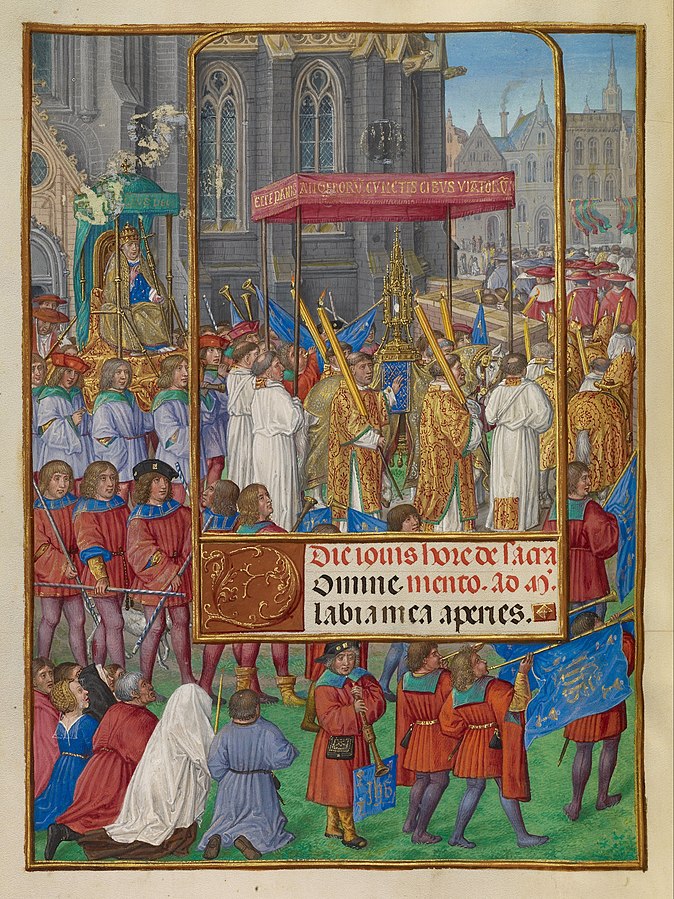
“Procession for Corpus Christi” attributed to Master of James IV of Scotland (Flemish, before 1465 – about 1541), illuminator.
Original illumination in the Getty Center Collection via Wikimedia Commons.
Last week, for example, most of continental Europe got a holiday to mark Corpus Christi, once a huge event in England but killed off by the Reformation. Why can’t we have a holiday too? It was 27 degrees in London last Thursday — it would have been great.
We’re all aware, on some subconscious level, that there is a need for communal feasts and holidays, and in some ways the idea of a June procession to celebrate the official religion has made a comeback with Pride. The feast-shaped hole in our lives is why, from time to time, the great and the good come up with very boring ideas for substitutes feasts, the latest being “Celebration Day”. The idea is for “one day in the year when we can all take a pause in our busy lives to reflect, remember and celebrate the lives of people no longer here”. You mean, like the feast of All Saints’ and All Souls’, which again was a huge part of our calendar once and is still marked in Catholic countries? Like that one?
[…]
Contrary to the fashionable Noughties takes about the evils of supernatural belief, religion has huge psychological benefits. There is a vast array of evidence showing that attending religious ceremonies increases dopamine responses in the brain. Overcoming our fear of death is not even the key part; it is meeting other people and taking part in a common ritual, which has huge benefits, including reduced risk of suicide or addiction. Religious attendance is “associated with lower psychological distress” and “related to higher well-being”.
Modernity, diet and substance abuse may have slightly increased rates of extreme mental illness such as schizophrenia, while social media has allowed people with personality disorders to become prevalent, especially in politics. But most of the “mental health crisis” is just loneliness. People attend fewer communal events because of the decline of religion, they see other people less regularly and they have fewer friends — of course they’re unhappy! Humans are not just social mammals, we are ultra-social by the standards of other species; that’s why we need common rituals and why we’re chasing that religious feeling everywhere and can’t find it. It is why, as Madeline Grant wrote in the Telegraph this week, that as well as progressive institutions adopting religious-type feasts, even exercise classes increasingly resemble Mass.
Lockdown, traumatic though it was, was merely an extreme version of the trend towards solitude already underway (with working from home, online shopping and various other lockdown activities on the rise before 2020). Most traditional societies would consider our everyday lives in non-Covid times to be a form of lockdown, with historically very unusual levels of isolation. That is why the extreme loneliness of lockdown gave rise to ersatz rituals such as Clap for Carers.
Yet you just can’t beat the real thing. As Parker wrote at the time, ritual decline was a real sadness in our lives: “From the Middle Ages until the first half of the 20th century, Whitsun and the week that followed was the chief summer holiday of the year in Britain. It was a time for all kinds of communal merry-making, varying over the centuries but consistent in spirit: the season for feasts and fairs, dancing and drinking, school and church processions, and generally having a good time.”
June 22, 2022
June 21, 2022
The Early Emperors – Part 4: Caligula, The First Insane Tyrant
seangabb
Published 31 Oct 2021The Roman Empire was the last and the greatest of the ancient empires. It is the origin from which springs the history of Western Europe and those nations that descend from the Western Roman Empire. It is the political entity within which the Christian faith was born, and the growth of the Church within the Empire, and its eventual establishment as the sole faith of the Empire, have left an indelible impression on all modern denominations. Its history, together with that of the ancient Greeks and the Jews, is our history. To understand how the Empire emerged from a great though finally dysfunctional republic, and how it was consolidated by its early rulers, is partly how we understand ourselves.
Here is a series of lectures given by Sean Gabb in late 2021, in which he discusses and tries to explain the achievement of the early Emperors. For reasons of politeness and data protection, all student contributions have been removed.
More by Sean Gabb on the Ancient World: https://www.classicstuition.co.uk/
Learn Latin or Greek or both with him: https://www.udemy.com/user/sean-gabb/
His historical novels (under the pen name “Richard Blake”): https://www.amazon.co.uk/Richard-Blak…
June 17, 2022
June 16, 2022
Among GenZ adults, LGBT identification tracks far higher than LGBT behaviour
In conversation on social media the other day, I speculated that in years gone by, some possibly significant proportion of self-identified lesbians would probably identify as asexuals today. Coming of age long before more relaxed modern attitudes toward non-heterosexual relationships, women who were not attracted to men would probably assume that this lack of attraction meant they must be lesbians. Similarly, Eric Kaufmann discusses a recent survey that shows some interesting divergence among GenZ adults between their declared sexual orientation and their actual behaviour:
A granular look at survey data on same-sex behaviour and LGBT identity shows that identification is increasingly diverging from behaviour. More importantly, those who adopt an LGBT identity but display conventionally heterosexual behaviour are a growing and distinct group, who lean strongly to the left politically and experience considerably greater mental health problems than the rest of the population.
By contrast, those who engage in same-sex behaviour are more politically moderate and psychologically stable. These facts sit awkwardly with the progressive view that the rise in LGBT identity, like left-handedness, is explained by people increasingly feeling that they can come out of the closet because society is more liberal. My analysis of these data raise another interesting question: Has some of the increase in anxiety and depression among young people, like the LGBT identity surge, arisen from a culture that values divergence and boundary-transgression over conformity to traditional norms and roles?
[…]
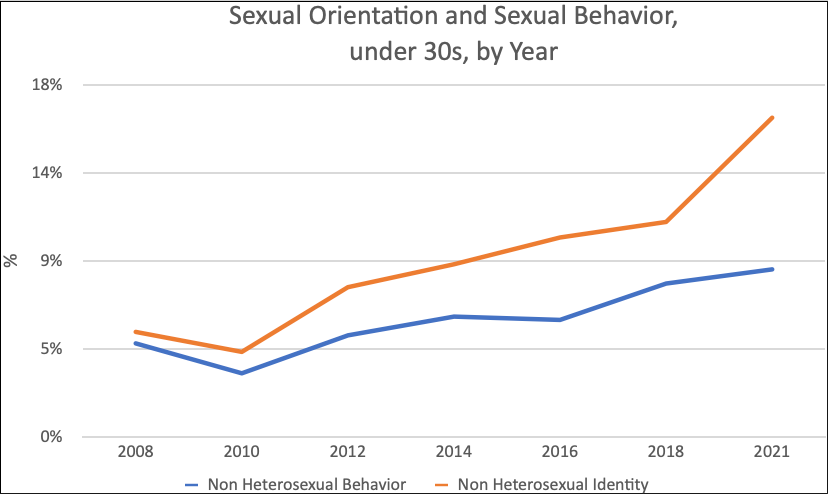
But has the LGBT share of young people really tripled in a decade? It has not. First, a growing share of LGBT identifiers engage in purely heterosexual behaviour. Figure 1, drawn from the General Social Survey (GSS), shows that, in 2008, about five percent of Americans under the age of 30 identified as LGBT and a similar number had a same-sex partnership in that year. By 2021, the proportion identifying as LGBT had increased 11 points to 16.3 percent but the share reporting same-sex relations had only risen four points, to 8.6 percent. LGBT identity had become twice as prevalent as LGBT behaviour. We must also bear in mind that 20 percent of young people now report no sex in the previous year, which means the four-point rise in same-sex partnering since 2008 is actually closer to a three-point rise: not nothing, but hardly a sexual revolution.
The trend towards greater LGBT identification has been particularly pronounced for young women, among whom there are three bisexuals for every lesbian in the 2018–21 period. Among young men, on the other hand, gays outnumber bisexuals and the LGBT total is only half as large as it is for women. Other large major surveys conducted by the Foundation for Individual Rights in Education (FIRE) and by Cooperative Congressional Election Study (CCES) find a similar pattern.
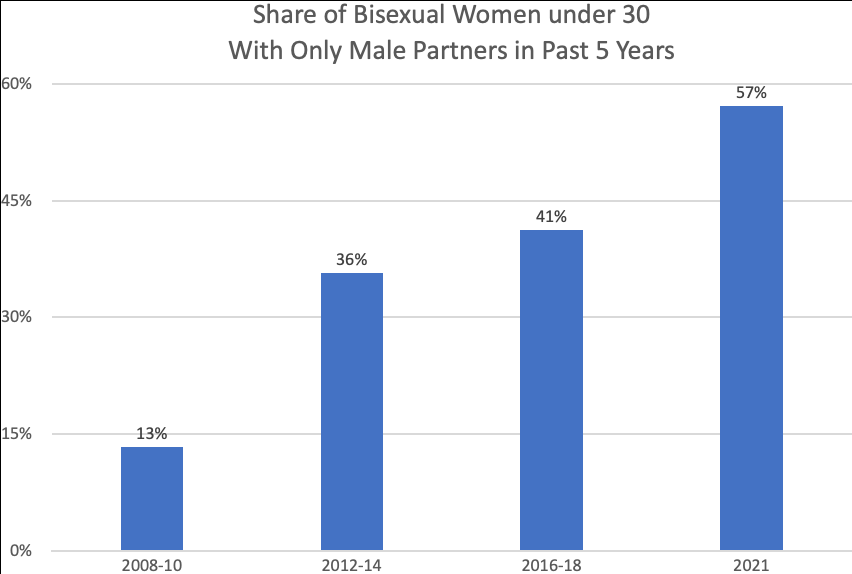
Furthermore, the GSS data show that bisexual women are the fastest-growing category, accounting for a disproportionate share of the post-2010 rise. A closer look at trends among female bisexuals in figure 2 shows that an increasing share of them display conventional sexual behaviour. In 2008–10, just 13 percent of female bisexuals said they only had male partners during the past five years. By 2018 this was up to 53 percent, rising to 57 percent in 2021. Most young female bisexuals today are arguably LGBT in name only.
June 14, 2022
Gender dysphoria and body dysmorphia
Once upon a time, in the dark recesses of ancient history (say, 2015 or so), most of the people expressing dissatisfaction with their birth gender were male. Shortly after that, the numbers inverted significantly and today it’s predominantly females demanding “gender affirming” treatment:
Girls who reject femininity or self identify as male or “non-binary” actually have a form of body dysmorphia. Rejecting their feminine body parts, for instance by flattening their chests, shows repulsion toward the areas they feel are not fit for acceptance. The trend of “binding” to produce a flat, androgynous body is dangerous, cutting off the air supply and possibly causing permanent damage, but it is encouraged as a precursor to transitioning from female to male.
In fact, transgendered people who were born women tend to suffer from eating disorders in an “extremely high proportion”, according to the Duke University Health System.
Make no mistake, a young woman who is dieting obsessively does not wish to look feminine or capable of having children. Many women who achieve their desired weight by extreme dieting cease to have periods and even grow downy hair on the face which resembles the incoming beard of a pre-pubescent man.
So is gender dysphoria essentially interchangeable with body dysmorphia? The woke people working at the NHS and gender reassignment clinics would never admit it, and would deny any correlation despite the statistics. But they are seeing more gender dysphoric young women than ever.
According to this article, entitled “Why Are So Many Females Coming out as Trans/Non-Binary?” in recent years the proportion of young women coming out as trans as opposed to men has increased dramatically. This shows a reversal from the previous trend years ago of more men wishing to become the opposite sex. But the incidence of actual transitions carried out does not show a corresponding rise for women, and that should prove many young women eventually grow out of identifying as trans, or “desist” from the desire to become male. “Desistance” refers to the situation where a young person who experiences gender dysphoria eventually “grows out of it” and decides not to go through with a sex change.
The occurrence of desistance among youngsters supports the position that they should not be allowed to undergo irreversible operations such as mastectomy or be pumped full of hormones (including puberty blocking “treatments”) which they are likely later to regret. Sadly, many medical “experts” don’t believe the figures cited for desistance among young people and discount them as flawed due to the looser criteria for diagnosing gender dysphoria used in the past. In other words, young boys who liked to wear dresses and would have been diagnosed as transgendered in previous years would not so qualify today, but young girls who hate their bodies and want to mutilate their breasts would be eligible for such “treatments”. The reasoning goes on that a whole raft subsisted of boys who were merely “gay boys who may have been experimenting with different ways of expressing gender but who were never really transgender in the first place”.
Such conclusions defy common sense or any logic or human decency. This article cites the findings of one Thomas Steensma, a clinician and researcher at the Centre of Expertise on Gender Dysphoria at the VU University Medical Centre in Amsterdam. He conveniently found in a study that desistance rates were lower in older, female children than in young boys.
H/T to Blazing Cat Fur for the link.
May 31, 2022
Conspiracy theorists, like the deeply paranoid, aren’t always wrong
Chris Bray responds to a common response he’s encountered from people who are worried that everything we’re seeing is somehow part of a deep-laid, nefarious plan to … do something. Something evil, something terrible, something … undefined but wrong:
If all of our problems are caused by a secret cabal who are having a new Wannsee Conference [Wiki]— twelve assholes sitting around a table and carefully planning our destruction — then we could solve that problem in half an hour with a dozen lampposts. We just need some names and an address: problem solved.
I think it’s much harder if there’s no they and no plan behind an event like the Uvalde school shooting. You can kill a few plotters, but how do you fix a broadly distributed collapse of courage, honor, decency, competence, knowledge, skill, morality and … a bunch of other things, but that list is a good start. If identifiable actors are tearing things apart, you can know where to put your hands to stop them; you can act. If we’re just trapped in a miasma of vicious mediocrity and weakness, where are the levers that change our course? What’s the solution to widespread societal degradation, to a suicidal loss of shared values and ordinary ability?
Facing an endless string of metastasizing and coalescing implosions — the lockdown-induced mental health crisis among children, appalling growth in energy prices, severe fertilizer shortages, supply chain collapse, unacknowledged vaccine injuries, vaccines that make illness more likely, military failure and the madness of the Afghanistan debacle, an emerging food shortage that’s starting to look really disturbing — the easiest way to deal with it is to say that it’s all one crisis planned and implemented by one set of people. If that’s true, the solution doesn’t even require a full box of ammunition, and we could wake up tomorrow morning in a world that we’ve repaired.
But the problem is that I mostly don’t think it’s true. I think it’s all one interwoven societal crisis, but that it’s connected by the uselessness of overcredentialed weak people. As for the view that they’re planning all of this, I increasingly think that our bullshit elites, our highly compliant social climbers in positions of power, mostly couldn’t plan a plate of toast.
Now, this is important: This doesn’t mean that I don’t think any of it is ever true. Of course there’s fake news. There are false flags, there are staged ops, and there are crisis actors. (The Ghost Of Kyiv, Ukraine’s boldest fighter pilot, agrees with me.) It seems pretty clear at this point that the plot to kidnap Gretchen Whitmer, that terrifying thing, was some socially awkward dorks being urgently and persistently goaded by FBI provocateurs. And it’s no longer possible to pretend that the Capitol Police didn’t just open the doors on January 6 to the “mob” that “broke in”.
But the transition from “some things are fake” to it’s all a lie and a plan every step of the way is a bigger claim — he says, carefully — and one that doesn’t make that much sense. With regard to Uvalde and the cops who wouldn’t act, for example, cowardice and incompetence work just fine as an explanation, because we have examples to compare the moment to. Peacetime militaries build an officer corps around rules-focused behavior, around the ability to comply and to operate within a hierarchy; then wartime militaries go through a period of officer purges, as they work to find high-functioning leaders who can tolerate the chaos and pain of battle. Confronted with a high level of brutality and danger, some people just can’t do it. This strikes me as an unremarkable fact, and one that doesn’t require extraordinary explanations. The school district police chief, a bureaucrat for decades, pushing paper and going to meetings, was confronted with sudden shock and horror on an extraordinarily harrowing scale, and he lacked the ability to respond. McClellan also couldn’t bring himself to attack Richmond.
May 29, 2022
We’ve evolved to the point that you don’t even need to turn the page for Gell-Mann Amnesia to kick in
Chris Bray has an almost unbelievable example of Gell-Mann Amnesia … literally on the same page of the site, two stories show how un-self-aware — and reflexively critical of non-progressives — the media can be:
Take exactly the same argument about exactly the same event and wedge it into two very different frames. Watch the result.
Here’s Politico, today, attending the NRA convention in Texas in the aftermath of a mass shooting at a school …
… and finding that NRA members are still gun-addled idiots who deflect concerns about guns by inventing a stupid fantasy argument — a conspiracy theory! — about mental illness:
Here, amid acres of guns and tactical gear inside a cavernous convention hall, the proximate cause of the mass shooting in Uvalde, Texas, was not a rifle, but mental illness, shadowy forces of evil or, as one man in a “Let’s Go Brandon” T-shirt put it, the “destruction of our children” by the teachings of the left.
These idiots, can you believe that? They were actually dumb enough to argue that the rifle didn’t cause the shooting, and instead they blamed — wait for it, because OMFG — mental illness. What morons! Imagine being so caught up in stupid far-right conspiracy theories that you’d blame a school shooting on mental illness.
Okay, now. Watch this.
On the very same day, Politico posted this story, right underneath the NRA story on the front page:
And this is what Politico says those professors found:
POLITICO: Can you take us through the profile of mass shooters that emerged from your research?
Peterson: There’s this really consistent pathway. Early childhood trauma seems to be the foundation, whether violence in the home, sexual assault, parental suicides, extreme bullying. Then you see the build toward hopelessness, despair, isolation, self-loathing, oftentimes rejection from peers. That turns into a really identifiable crisis point where they’re acting differently. Sometimes they have previous suicide attempts.
The professors go on to say that the start of the solution to the crisis of school shootings is to improve the quality of childhood mental health services: “We need to build teams to investigate when kids are in crisis and then link those kids to mental health services. The problem is that in a lot of places, those services are not there. There’s no community mental health and no school-based mental health.”
Same publication, same day, same page.
May 28, 2022
Scott Alexander on the “Hearing Voices Movement”
I’d never heard of the Hearing Voices Movement, but I don’t read the [spit] New York Times [spit]. Scott Alexander almost certainly also avoids reading the NYT, but he responds to a recent article there on the phenomenon that some of his psychiatric patients have reported:
The New York Times has an article out on the Hearing Voices Movement — ie people with hallucinations and delusions who want this to be treated as normal and okay rather than medicalized. Freddie deBoer has a pretty passionate response here. Other people have differently passionate responses:
I’ve met some Hearing Voices members. My impression is that everyone on every side of this discussion is a good person trying to make the best of a bad situation (except of course New York Times journalists, who are evil people destroying America). Some specific thoughts:
2:
Plenty of people hear voices. Some of these people are your typical homeless schizophrenic, but many aren’t. One of my patients was a successful computer programmer who had near-daily auditory hallucinations. He realized they weren’t real, did his best to ignore them, and got on with his successful life — just like he had been doing for the past twenty years. He was seeing me for unrelated depression.
This guy kept his condition secret from his friends and co-workers. I don’t blame him for this choice at all. But when everybody who can hide it does, we only hear about the people who can’t keep it hidden, who are usually worst-case scenarios. Also (as a bunch of 1980s gay people can tell you) keeping a basic fact about yourself hidden from everyone you know sucks.
I recommended Hearing Voices Movement to this guy. I can’t remember whether he took me up on it or not. But I thought it would be helpful for him to have people he could talk to about his situation who wouldn’t think he was crazy, or try to get him locked up.
3:
People hate admitting that some cases are mild, and others are severe. Especially the kind of people who work at the New York Times
I talked about this a while back in the context of the autism rights movement. Many autistic people live great lives, enjoy the beneficial parts of their condition, and find it annoying or oppressive when psychiatrists keep trying to medicate them. Many other autistic people can’t live outside of institutions and constantly try to chew off their own body parts. A reasonable conclusion might be “the first group seem mild and should be left alone, the second group seem severe and probably need intensive treatment”, but it’s surprisingly hard to convince people of this.
Calling some cases “mild” sounds trivializing. Calling other cases “severe” sounds stigmatizing. Whatever your criteria for a mild case are, there will be someone who fits those criteria, but says the condition ruined their life and you are dismissing their pain. Whatever your criteria for a severe case are, there will be someone who fits those criteria but is thriving and living their best life and accuses you of wanting to imprison them in a hospital 24-7.
And that’s just the activists! We psychiatrists have the same problem from a different direction: we have seen some crazy @#!$. No matter how mild your case is, we’ve seen some case that looked like that at first glance, then slowly descended into a horror movie premise. Our instinct is naturally to round off the person who uses Xanax once a month to the lifetime drug abuser, the mildly depressed housewife to the gory suicide victim, and the occasional voice-hearer to the guy who needs to be in a straitjacket.
Still, some cases are mild and others are severe. People with mild psychosis — like my patient the programmer — probably don’t need to be on really strong medications with severe side effects. They probably just need support. In a perfect world, expert psychiatrists would have a major role in providing that support. In the real world, a lot of these patients expect their psychiatrist to freak out, overmedicate them, and maybe even commit them to a hospital. This being the real world, many of those patients are right. So they look elsewhere.