Incidentally, I am thoroughly convinced that a majority of self-described incels are men who could find meaningful and fulfilling sexual and romantic success, both short-term and long, but who have developed such a wildly unrealistic idea about what actual human women look like that their standards are laughably high. And it’s easy to make fun of that, but I also think that the conditioning inherent to constantly looking at filtered and photoshopped pictures is powerful.
Freddie deBoer, “Some Reasons Why Smartphones Might Make Adolescents Anxious and Depressed”, Freddie deBoer, 2023-03-07.
June 15, 2023
May 31, 2023
The War Against The Patriarchy, updated
Janice Fiamengo responds to a recent Joel Kotkin op-ed in the National Post discussing the “war of the sexes” and the long, long string of victories chalked up by the “weaker sex”:
The war between the sexes has ended, and rather than a co-operative future that could benefit all, it has turned out to be more like a lopsided win for the female side.
So begins Joel Kotkin’s National Post op/ed “Women have won the ‘war between the sexes’, but at what cost?” It is a welcome but disappointing analysis that starts with a show of defiance and ends in quiet desperation. Of course, it’s good to find anyone in a major newspaper willing to cast a less-than-adulatory eye on “The Future [that] is Female” or to write sympathetically about men, and Kotkin, a prolific author on cities and technocracy, proves his good faith on the strength of that opening statement alone. Aside from the wishful thinking of believing feminism to be winding down (was #MeToo a prelude to ceasefire?) or ever having envisioned a co-operative future (he should take a look at Kate Millett’s incendiary “Theory of Sexual Politics“), Kotkin is to be commended for daring to name as a war the decades of post-1960s activism, in which all the decisive victories have been claimed by feminists against men.
Kotkin, however, isn’t able to continue in the take-no-prisoners style he chose for his opening salvo. He is prevented, either by his own prudence, his lack of deep knowledge, or the paper’s editorial insistence, from targeting feminist ideology and policies in the rest of the article. In fact, the article doesn’t name a single piece of debilitating feminist legislation or even make one reference to the many expressions of anti-male contempt that are now deeply embedded in our public culture. The result is a curiously disembodied discussion in which serious social problems linked to male decline are pointed to without any attempt made to say exactly how they came about or how they might be reversed.
“The crux of the problem,” Kotkin tells us to start off, “lies in the fact that as women rise, men seem to be falling.” Here we see him start to draw back from the attack, as if afraid to say what he really thinks. His phrasing makes male decline sound like a natural phenomenon, an illustration of the primordial principle of Yin and Yang. Or perhaps it is simply that men, with their allegedly fragile egos and hegemonic masculinity, haven’t been able to compete against all that female ability, once dammed up by the patriarchy, now finally being let loose on the world (though always with calls for more to be done to assist women).
[…]
Kotkin refers to men “left behind” in the economy, but he keeps mum about the decades of affirmative action in higher education and hiring (detailed by Paul Nathanson and Katherine Young in Legalizing Misandry, pp. 81-124) as well as draconian sexual harassment legislation that have made work life unrewarding and often punitive for men.
He stresses the loss of sexual amity and of willingness to marry, but avoids discussing the nightmare of family law that has made marriage or even cohabitation perilous for many men.
The sins of omission do not end there. Perhaps working on the assumption — not without basis — that any discussion of social problems will need to focus on women at least as much as on men, Kotkin proceeds to backtrack on his earlier claim about women’s victory in the sex war, outlining instead a downbeat portrait of women’s troubles. Citing research by Jonathan Haidt, he tells us that adolescent girls have been severely affected by depression and self-harm, that many young women, without reliable men to support them, have had to fend for themselves in a difficult economic climate, and that single mothers, left with few options, are unable to offer stability to their children. It looks as if the decline of men mentioned early in the article has mainly hurt women and their children.
What Kotkin neglects to mention — surely deliberately — is that adolescent boys commit suicide at 4 X the rate of girls, resolving their depression decisively enough that Haidt seems not to have felt the need to account for them; that women are the ones who choose divorce in approximately 70% of cases; and that divorced fathers are too often denied a real role in their children’s lives while being burdened past endurance by exorbitant support payments. In other words, for every sad woman held up for our concern, there is a plurality of equally sad men rendered invisible in the conventional reporting. The staggering statistics on male suicide provide a stark illustration of Kotkin’s initial contention about the casualties of the sex war — yet he leaves these aside, choosing instead to voice the now-obligatory concern about the trans threat to women’s sports.
Perhaps most importantly, Kotkin suggests through his word choice that the data he cites are simply “trends”, occurrences that came about through economic and demographic factors independent of the sex war initially evoked. But they aren’t. They flow directly from a feminist vision in which the family — explicitly understood by feminist leaders to be a source of abuse and oppression — must be transformed and women liberated from reliance on the fathers of their children. Under this vision, a more just and equitable world will be ushered in by women’s superior leadership once they are freed from their unpaid labor in the home and the many sexist barriers that hold them back. That freedom must be aided, according to conventional wisdom, through abundant contraception, unfettered abortion, collectivized child care, no-fault divorce, programs and propaganda to urge men to do more housework, and non-stop encouragement to women — in movies, sit-coms, advertising, articles, and government equity programs — to give up on their men.
May 10, 2023
From Thomas Szasz to Jordan Neely – how noble ideals can lead to terrible results
At Samizdata, Natalie Solent remembers how her early discovery of Ideology and Insanity by Thomas Szasz helped to shape her philosophical views in a generally libertarian direction. On the other hand, as the death of Jordan Neely shows, one of the long-term results of Szasz’s denunciation of the institutionalization of the mentally ill has been a vast increase in violence, vandalism, and anti-social behaviour in urban areas:
Szasz believed that if we accept that “mental illness” is a euphemism for behaviors that are disapproved of, then the state has no right to force psychiatric “treatment” on these individuals
Great stuff. I think Szasz still has much to teach us… but I suppose by now you have all heard of the killing of Jordan Neely on a New York subway train?
I have linked to the Wikipedia account for convenience, but I do not trust Wikipedia. There are very few media outlets I do trust on subjects like this. The magazine USA Today initially called Neely a “beloved subway performer”. USA Today has changed the article since, but I saw it when it still had the original wording. The article was right to say that Jordan Neely was a human being with a tragic past, but he was not beloved by users of the New York subway. Back in 2013, a Reddit post on /r/nyc warned passengers, “Try to stay away from the Michael Jackson impersonator if you see him … Just avoid the guy at all costs, try not to look at him at all. Stay safe.” That was Neely. By the time of his death, he had been arrested more than forty times, including for crimes of violence.
There are thousands of Americans like Neely who still live as he lived, exercising the right Thomas Szasz helped gain them to be mentally ill (or whatever you want to call it) drug addicts living on the subways and roadside verges of America. It is not going well for them or for others. A viral graph shows the declining proportion of Americans held in mental hospitals and the rising proportion of Americans held in prisons forming a neat “X” over the course of the twentieth century. Liberals in the U.S. sense have a prodigious capacity to not see inconvenient facts, but even they are being forced to notice that the presence of the crazies and junkies is causing their beloved public spaces and public facilities to become dirty, frightening places to which much of the public only goes when it must.
There is a libertarian solution of course: fewer public spaces. This would increase, not decrease, the number of places where the public could happily go. Junkies and crazies are much less of a problem in shopping malls, because the owners still retain some power to eject them. I feel no shame in saying that a further benefit would be that said junkies and crazies would be under more pressure to seek treatment if the state no longer facilitated them sleeping on the sidewalks and the subway trains.
Unfortunately for everyone, this solution is politically impossible in the current climate. Even in the miraculous event that the public transport systems and the streets of New York, San Francisco and Chicago were privatised tomorrow, anti-discrimination law would ensure that practically no one could be excluded.
Thomas Szasz had a noble ideal. Sadly, the way it combined with the dominant ideals of our time has produced very bad results. I know what should and could be done to make things better in a sane society, but the US in 2023 is not that society. So what can be done?
April 17, 2023
The lingering pandemic of fear
Liz Hodgkinson on the pattern of fear that the state, media, and public health messaging instilled into so many people during the Wuhan Coronavirus pandemic:

“Covid 19 Masks” by baldeaglebluff is licensed under CC BY-SA 2.0
The Stoics of ancient times believed that in many cases it was possible to control pain by thought alone. To achieve this, they stoically, as it were, accepted painful or unpleasant sensations, viewing them with studied indifference. As such, the pain often went away of its own accord, although to be fair they did use a painkiller known as theriac, which contained opium.
The opposite is also true, in that you can induce pain or disease by thought alone, causing acute and sometimes lasting physical symptoms. Although ancient and tribal societies understood that the power of suggestion can be so strong that it may make people well or ill, this seems to have been forgotten in modern, mechanistic medicine with its insistence on tests, scans, screens and so on.
Because of this, I am now wondering whether as many people would have gone down with Covid (or what passed for it) if, instead of a flu-like illness being ramped up as the worst and most dangerous disease ever to affect humankind, it had been ignored.
As it was, around 80 per cent – and it may have been more – of the world’s population were gripped by such a fear of the bug that they actually thought themselves into illness. Once the PCR test was introduced, people began testing themselves, sometimes hourly, and if the test showed positive they waited for symptoms to appear. More often than not, they obliged.
Then people became terrified to step out of the house without wearing a mask, even though all the evidence showed that these muzzles were more or less ineffective and that even the surgical-quality ones lasted only a couple of hours, at most. People were also nervous of getting close to anybody else, edging away if somebody came within a few feet of them. Only the other day, as I was in a queue waiting to pay for an item, a masked woman in front of me turned round and said crossly: “Do you mind not standing so close to me?” I wondered about making a quick riposte but decided that there was no way I could penetrate this kind of stupidity.
There was also the handwashing ritual where shops, doctors’ surgeries, solicitors’ and estate agents’ offices, for instance, forced hand sanitiser on to you, and sometimes took your temperature as you walked in.
The cleaning nonsense went even further, with hotels, gyms and other places where people gathered announcing “enhanced cleaning”. This may or may not have halted the virus in its tracks but it certainly increased fear. I still see people in the gym furiously scrubbing down bikes, treadmills and other equipment in case a germ from a previous user has had the audacity to linger on the machine.
March 14, 2023
March 9, 2023
February 27, 2023
QotD: Sigmund Freud’s insights
Sigmund Freud was a perverted old cokehead, but he had some useful insights. One of them is that anxiety works like a spring (my paraphrase). You need a spring to have a certain tension in order to work, but if you compress it too tightly, it breaks. Anxiety that can’t be discharged (his term) in healthy, socially beneficial ways instead gets discharged in unhealthy, neurotic ways.
That’s what happened with Anna O., history’s most famous psychiatric patient. She had a very turbulent love/hate relationship with her father, as tightly wound girls do. When he became deathly ill on a family vacation, the unresolvable tension caused a whole host of physical symptoms, including hysterical paralysis. Pioneering psychologist Josef Breuer “talked her through” it, finally resolving the emotional conflict and “curing” the patient.
All this would’ve been interesting, but largely irrelevant, were it not for World War I. The world at large didn’t care about the problems of overprivileged Jewish girls, but they did care about their soldiers suddenly going crazy in the trenches. Once military doctors finally ruled out a physical cause, they were left with Freudian explanations: A soldier can’t stop fighting, because he’s an honorable, dutiful soldier. Yet that soldier must stop fighting. The only honorable way out is a wound. If the enemy doesn’t wound him, then, his subconscious will. Hence the bizarre “conversion disorders” — hysterical blindness, paralysis, mutism, etc. — characteristic of “shell shock.”
But a funny thing happened. While everyone now acknowledged the real power of the subconscious mind, we sort of … forgot … about it. Psychology, particularly psychotherapy, went back to being a ghetto Jewish preoccupation. Bored, over-privileged housewives might go to a shrink to talk through their “issues”, but as for the rest of us, well, if we weren’t going into combat anytime soon, why bother? Outside of a few crusty old reactionaries (like yours truly) making fun of SJWs, when was the last time you heard the word “neurotic”?
But that’s the thing: either the subconscious is real, or it isn’t. When we say “neurotic” (the few of us who still do), we usually mean people like Anna O. — rich, cosseted, politically active human toothaches who try to force the entire world into the all-encompassing drama of their Daddy Issues (see also: Virginia Woolf). But that’s not how Freud meant it. According to him, we’re all neurotic to some degree or another, because that’s just how anxiety works.
We all have strong emotional impulses that run counter our self-image. Hence the entire panoply of pop-Freudianism: The preacher who constantly rails against homosexuality from the pulpit is secretly gay (“projection”). The strict, controlling, everything-in-its-place type is a sadist (“anal-retentive”). The player who can’t settle down with any woman is actually trying to find a Mommy figure (“Oedipus complex”). And, of course, the — ahem — daddy of them all, the crippling Daddy Issues that make feminists such fun.
But that’s just the thing: Either anxiety works that way or it doesn’t. Just because we don’t see a specific syndrome in ourselves doesn’t mean we don’t have a whole bunch of anxiety we need to discharge. Just because it’s subclinical, in other words, doesn’t mean it’s not real, or unimportant. See for example the legions of keyboard commandos who show up in the comments of any blog with more than fourteen readers. Yeah, sure, it’s possible that those guys all got kicked out of SEAL Team 6 for being too badass … but it’s probably classic identification. They’re deeply uneasy about the world and their place in it, so they construct themselves an identity as the Rambo of Evergreen Terrace.
Severian, “High Anxiety”, Rotten Chestnuts, 2020-03-16.
February 19, 2023
February 15, 2023
QotD: The divine right of kings
The best case for divine right monarchy is the voters’ behavior in a democracy. Unfortunately, the worst case for divine right monarchy is: divine right monarchs.
England’s James I, for instance, was a deeply weird dude. Though he wrote a whole book about his divine right to rule, he kept his weirdness sufficiently in check so as not to alienate his court. Alas, his heir didn’t bother, and we know how that turned out. And so it went with just about any divine right monarch — the more people who actually saw him, the flimsier the theory seemed. History is full of examples of kingdoms “ruled” by insane kings, but not too many of kingdoms thriving when the people knew the king was a lunatic. Feebleminded monarchs are generally kept under lock and key by their courtiers, or they end up Epsteined.
Even democracies once understood this. Pick any 19th century American legislator, for example. As P.J. O’Rourke once said about rock stars, to call one of these guys a drunken, borderline-illiterate pervert just means you’ve read his autobiography. But they knew enough to keep it sufficiently in check around the voters, so that so long as they didn’t actually Chappaquiddick someone, they’d face no repercussions.
Speaking of Chappaquiddick, the Media has always been complicit in the great game of Fool-the-Rubes. They only do it for Democrats now, of course, but that’s the real problem these days: the Media has been doing all this for so long, and so successfully, that they no longer feel the need to bother. Just as Charles I decided to let his freak flag fly because hey, why not, I’m the king, so the Democrat-Media complex went all-in in 2008. You watch these guys — Don Lemon, say, mocking Trump voters as illiterate hicks — and the expression on their face is one of relief. It feels good to finally let it all out, and the more you do it, the better it feels.
Severian, “Rule by Lunatic”, Rotten Chestnuts, 2020-01-29.
January 30, 2023
Crime on Toronto’s public transit system is merely a symptom of a wider social problem
As posted the other day, Matt Gurney’s dispiriting experiences on an ordinary ride on the TTC are perhaps leading indicators of much wider issues in all of western society:

“Toronto subway new train” by BeyondDC is licensed under CC BY-NC-ND 2.0 .
Caveats abound. Toronto is, relatively speaking, still a safe city. The TTC moves many millions of people a week; a large percentage of whom are not being knifed, shot or burnt alive. And so on. We at The Line also suspect that whatever is happening in Toronto isn’t happening only in Toronto, but Toronto’s scale (and the huge scope of the TTC specifically) might be gathering in one place a series of incidents that would be reported as unconnected random crimes in any other city. A few muggings in Montreal or Winnipeg above the usual baseline for such crimes won’t fit the media’s love of patterns as much as a similar number of incidents on a streetcar or subway line.
Fair enough, duly noted, and all that jazz.
But what is happening out there?
Your Line editors have theories, and we’ve never hesitated to share them before: we think the pandemic has driven a portion of the population bonkers. We’d go further and say that we think it has left all of us, every last one, less stable, less patient, less calm and less empathetic. For the vast majority of us, this will manifest itself in many unpleasant but ultimately harmless ways. We’ll be more short-tempered. Less jovial at a party. Less patient with strangers, or even with loved ones. Maybe a bit more reclusive.
But what about the relatively small majority of us that were, pre-2020, already on the edge of deeper, more serious problems? What about those who were already experiencing mental-health issues, or living on the edge of real, grinding poverty?
It’s not like the overall societal situation has really improved, right? COVID-19 itself killed tens of thousands, and took a physical toll on many more, but we all suffered the stress and fear not just of the plague, but of the steps taken to mitigate it. (Lockdowns may have been necessary early in the pandemic, but they were never fun or easy, and that societal bill may be coming due.) Since COVID began to abate, rather than a chance to chill out, we’ve had convoys, a war, renewed plausible risk of nuclear war, and now a punishing period of inflation and interest-rate hikes that are putting many into real financial distress. We are coping with all of this while still processing our COVID-era stress and anxiety.
The timing isn’t great, is what we’re saying.
And on the other side of the coin, basically all our societal institutions that we’d turn to to cope with these issues — hospitals, social services, homeless shelters, police forces, private charities, even personal or family support networks — are fried. Just maxed out. We have financial, supply chain and, most critically, human-resource deficits everywhere. The people we have left on the job are exhausted and at their wits’ end.
This leaves us, on balance, less able to handle challenges than we were in 2020, due to literal exhaustion of both institutions and individuals. Meanwhile, against the backdrop of this erosion of our capacity, our challenges have all gotten worse!
It’s not hard to do the mental math on this, friends. It seems to us that in 2020, the policy of Canadian governments from coast to coast to coast, and at every level, was to basically keep a lid on problems like crime, homelessness, housing prices and shortages, mental health and health-care system dysfunction, and probably others we could add. One politician might put a bit more emphasis on some of these issues than others, in line with their partisan priors, but overall, the pre-2020 status quo in Canada was pretty good, and our political class, writ large, basically self-identified as guardians of that status quo, while maybe tinkering a bit at the margins (and declaring themselves progressive heroes for the trouble of the tinkering).
But then COVID-19 happens, and all our problems get worse. And all our ways of dealing with those problems get less effective. It doesn’t have to be by much. Just enough to bend all those flatlined (or maybe slightly improving) trendlines down. Instead of homelessness being kind of frozen in place in the big cities, it starts getting worse, bit at a time, month after month. The mental-health-care and homeless shelter systems that weren’t really doing a great job in 2020, but were more or less keeping big crises at a manageable level, started seeing a few more people fall through the cracks each month, month after month. Those people are just gone, baby, gone.
The health-care system that used to function well enough to keep people reasonably content, if not happy, locks up, and waitlists balloon, and soon we can’t even get kids needed surgeries on time.
The housing shortage goes insane, and prices somehow survive the pandemic basically untouched.
The court system locks up, meaning more and more violent criminals get bail and then re-offend, even killing cops when they should be behind bars.
None of these swings were dramatic. They were all just enough to set us on a course to this, a moment in time where the problems have had years to compound themselves and are now compounding each other.
Here’s the rub, folks. The Line doesn’t believe or accept that any of the problems we face today, alone or in combination, are automatically fatal. We can fix them all. But we need leaders, including both elected officials and bureaucrats, who fundamentally see themselves as problem fixers, and who understand right down deep in their bones that that is what their jobs are, and that they are no longer what they’ve been able to be for generations: hands-off middle managers of stable prosperity.
January 27, 2023
Post-pandemic travelling on the TTC: ride the Red Rocket … cautiously
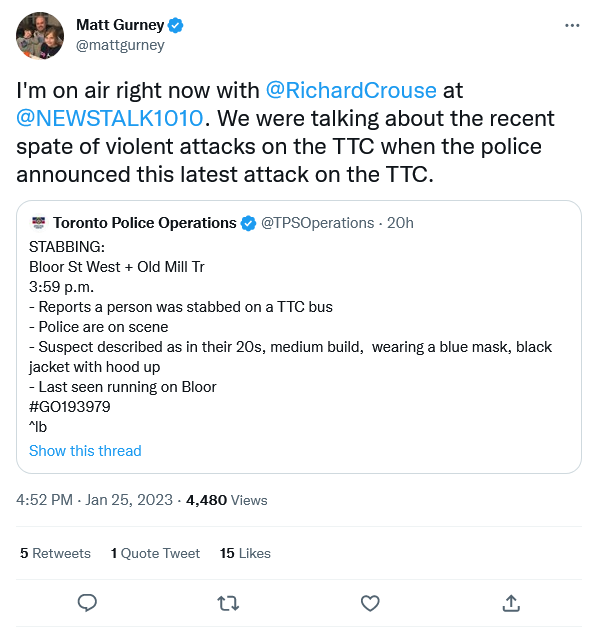
Matt Gurney posted a series of tweets about his recent subway experiences in Toronto:
I rode the TTC three times today. Once to downtown from my home in midtown. Once within downtown to a different place. And then home from downtown.
On two of those three rides, there was someone having a very obvious mental-health crisis on the vehicle with us.
The first one was a young man who clapped his hands over his ears and shrieked incoherently at random intervals. And then he got off.
The second, an older man sat in a chair and screamed nonsense constantly for ten stops. Maybe more. That’s just when I got off.
I’m working on a bigger piece for later so I’ll save any complex thoughts and big conclusions for then. But there was something interesting I noticed today. I’m a regular TTC rider. Not daily but frequent. And for the first time today, I’m noticing gallows humour and planning.
“Good luck to everyone,” cracked one guy. There was laughter. Everyone knew what he meant.
But I’m also seeing little groups of strangers agreeing to each keep watch on one direction or another. Sometimes also joking about it.
None of this is funny, but my gut tells me that if Torotonians are now so thoroughly convinced that riding the TTC is so risky that it’s worth a dark joke, any politician who reacts to the next unprovoked attack or murder with a proposal for a national summit is gonna get smoked.
I like the TTC. I have great access to it. It’s super convenient and affordable. It’s a huge asset for me. I have token cufflinks. I’m a fan, is what I’m saying.
I’m now at the point where I’d think twice before taking my kids on it. And we used to ride it just to kill the time.
My son used to stand on the couch in our living room looking out the window counting buses as they went by, loudly shouting to announce each one. Getting to go on a bus or subway or a streetcar was an event for him. My daughter, maybe a bit less excited. Still loved it.
Ah man.
Anyway. I hope tomorrow is better.
Update: You might think the increased concern over using the TTC might be merely a bit of confirmation bias informed by recent reporting, but apparently the situation is serious enough that Toronto Police will be stepping up their presence on the system.
December 31, 2022
If Hell is “other people”, then the deepest level of Hell must be “other high school students”
Tom Knighton on a recent post from FEE about the awfulness of the school experience for a lot of students:

“Leaside High School entrance Toronto Ontario Canada” by ammiiirrrr is licensed under CC BY-NC-SA 2.0 .
I was never a big fan of school. While I always thought education was important, I never liked school itself.
Part of that was because I was the kid most likely to get picked on, but even when that wasn’t happening, I still didn’t like it. Learning boring stuff while not getting to delve deeper into interesting topics just made it a chore to be endured.
Couple with the fact that cruelty is such a part of the “educational experience”, it’s no wonder that I didn’t like it.
Hell, even when everyone was being chill, the fact that I didn’t fit in did a number on me, including a time when I genuinely wanted to end my own life. I don’t talk about that kind of thing much, but it was a stark reality of that time.
[…]
Granted, I always chalked my difficulties at the time — and I’m much better now, I should note — with a number of things besides the structure of school itself. Mostly the fact that it was a small school, I was the weird kid, and while I had friends, I never felt like I really fit in.
Yet I can’t rule out that the structured nature of education at the time contributed greatly to the problem.
As noted in the original piece, the patterns for suicidal behavior in teens don’t match up with adults. That tells us that there’s something at play other than just the weather, the temperature, or whatever.
Regardless, it raises serious questions about our schools as an environment. Teachers and administrators would tell you that they strive to create a nurturing environment for students of all ages. I’m pretty sure most of them mean it, too.
Yet these studies suggest that they’re failing. Miserably.
But let’s not ignore the possibility that much of this may well be because, frankly, kids can be little sociopaths. They’re mean. They’re cruel. Someone will seek out those they perceive as weak and victimize them while others get to enjoy the show, even while being glad they’re not the target.
Then there’s the fact that it’s impossible to hide from any deficiencies you might have, including social deficiencies just as good fortune with finding romantic partners of your preferred sex and that’s going to play a role as well.
December 21, 2022
QotD: The Spoon Theory
The blogger Christine Miserandino, who has lupus, coined the term spoonie in a 2003 post called “The Spoon Theory”. A spoon, Miserandino explained, equates to a certain amount of energy. The Healthy have unlimited spoons. The Sick — the spoonies — only have a few. They might use one spoon to shower, two to get groceries, and four to go to work. They have to be strategic about how they spend their spoons.
Since then, the theory has ballooned into an illness kingdom filled with micro-celebrities offering discounts on supplements and tinctures; podcasts on dating as a spoonie; spoonie clubs on college campuses; a weekly magazine; and online stores with spoonie merch. In the past few years, spoonie-ism has dovetailed with the #MeToo movement and the ascendance of identity politics. The result is a worldview that is highly skeptical of so-called male-dominated power structures, and that insists on trusting the lived experience of individuals — especially those from groups that have historically been disbelieved. So what do spoonies need from you? “To believe; Be understanding; Be patient; To educate yourself; Show compassion; Don’t question”.
Spoonie illnesses include, but are not limited to, serious diseases like multiple sclerosis and Crohn’s disease, but also harder-to-diagnose ones that manifest differently in different people: polycystic ovary syndrome (PCOS), Rheumatoid arthritis (RA), endometriosis, postural orthostatic tachycardia syndrome (POTS), Ehlers-Danlos syndrome, dysautonomia, Guillain-Barré Syndrome, gastroparesis, and fibromyalgia. Another spoonie illness is myalgic encephalomyelitis — or chronic fatigue syndrome — which has now been linked to long Covid.
These illnesses are often “invisible”: To most people, spoonies may appear healthy and able-bodied, especially when they’re young. Many of the conditions affect women more frequently, and most are chronic illnesses that can be managed, but not cured. A diagnosis often lasts for a lifetime, while symptoms come, go, morph, and multiply.
Spoonies find community in having complicated conditions that are often hard to identify and difficult to treat. That’s why a lot of spoonies include a zebra emoji in their social media bios, borrowed from the old doctor’s adage: “When you hear hoof beats, look for horses, not zebras.” In other words: assume your patient has a more common illness, rather than a rare one.
The spoonie mantra might be: I am the zebra.
Although the term is relatively new, the spoonies fit into a long history of women having amorphous, hard-to-diagnose conditions. Since ancient times, women who were diagnosed under the general category of “hysteria” were prescribed treatments such as sex, hanging upside down, and the placement of leeches on the abdomen. Then, in the 19th century, the new field of psychoanalysis concluded that women with hysteria were not suffering from physical disorders, but mental ones. Whether the women’s inexplicable pain was a function of their brains or of their bodies — or of each other (see mass hysteria), or of the devil (see Salem, 1692) — has always been a fraught subject.
And then the internet arrived and created a 21st century version of Freud’s Vienna, in which everyone was always on the couch, perpetually the patient.
Suzy Weiss, “Hurts So Good”, Common Sense, 2022-09-06.
December 18, 2022
November 26, 2022
QotD: The search for “authenticity”
The search for authenticity is not only futile but actively harmful, both psychologically and socially, for in general, authenticity is thought to require behavior without the restraints of normal civilized conduct, amongst which are the capacity and willingness on occasion to be hypocritical and insincere. Of course, the precise amount of hypocrisy and insincerity that one should indulge in is always a matter of judgment, but authenticity is brutish if it means saying and doing whatever one wants whenever one wants it.
Shakespeare knew that authenticity, in this sense, is for most people impossible and in all cases undesirable. The first few lines of Sonnet 138 should be enough to prove it:
When my love swears that she is made of truth,
I do believe her, though I know she lies,
That she may think me some untutored youth,
Unlearnèd in the world’s false subtleties.
Thus vainly thinking that she thinks me young,
Although she knows my days are past the best,
Simply I credit her false speaking tongue:
On both sides thus is simple truth suppressed.Should Shakespeare abandon his love because he knows she is inauthentic in what she says? Of course not:
Oh, love’s best habit is in seeming trust …
Away, then, with your self-esteem, your true self and your authenticity, and all the bogus desiderata of modern psychology.
Theodore Dalrymple, “Lose Yourself”, Taki’s Magazine, 2018-11-10.