
Because rice is such a different crop than wheat or barley, there are a lot of differences in the way that rice cultivation shapes the countryside. […] The thing to note about rice is that it is both much more productive on a per-acre basis than wheat or barley, but also much more labor intensive; it also relies on different forms of capital to be productive. Whole-grain wheat and brown rice have similar calorie and nutritional value (brown rice is somewhat better in most categories) on a unit-weight basis (so, per pound or ton), but the yield difference is fairly large: rice is typically around (very roughly) 50% more productive per acre than wheat. Moreover, rice plants have a more favorable ratio of seeds-to-plants, meaning that the demand to put away seeds for the next harvest is easier – whereas crop-to-seed ratios on pre-modern wheat range from 3:1 to 10:1, rice can achieve figures as high as 100:1. As a result, not only is the gross yield higher (that is, more tons of seed per field) but a lower percentage of that seed has to be saved for the next planting.
At the same time, the irrigation demands for effective production of wet-rice requires a lot of labor to build and maintain. Fields need to be flooded and drained; in some cases (particularly pre-modern terrace farming) this may involve moving the water manually, in buckets, from lower fields to higher ones. Irrigation canals connecting paddies can make this job somewhat easier, as can bucket-lifts, but that still demands moving quite a lot of water. In any irrigation system, the bunds need to be maintained and the water level carefully controlled, with also involves potentially quite a lot of labor.
The consequence of all of this is that while the rice farming household seems to be roughly the same size as the wheat-farming household (that is, an extended family unit of variable size, but typically around 8 or so members), the farm is much smaller, with common household farm sizes, even in the modern period, clustering around 1 hectare (2.47 acres) in comparison to the standard household wheat farms clustered around 4-6 acres (which, you may note with the yield figures above, lands us right back at around the same subsistence standard).
Moreover, rice cultivation is less soil dependent (but more water dependent) because wet-rice farming both encourages nitrogen fixation in the soil (maintaining the fertility of it generally without expensive manure use) and because rice farming leads naturally to a process known as pozdolisation, slowly converting the underlying soil over a few years to a set of characteristics which are more favorable for more rice cultivation. So whereas with wheat cultivation, where you often have clumps of marginal land (soil that is too wet, too dry, too rocky, too acidic, too uneven, too heavily forested, and so on), rice cultivation tends to be able to make use of almost any land where there is sufficient water (although terracing may be needed to level out the land). The reliance on the rice itself to “terraform” its own fields does mean that new rice fields tended to under-produce for the first few years.
The result of this, so far as I can tell, is that in well-watered areas, like much of South China, the human landscape that is created by pre-modern rice cultivation is both more dense and more uniform in its density; large zones of very dense rice cultivation rather than pockets of villages separated by sparsely inhabited forests or pasture. Indeed, pasture in particular seems in most cases almost entirely pushed out by rice cultivation. That has very significant implications for warfare and I have to admit that in reading about rice farming for this post, I had one of those “oh!” moments of sudden understanding – in this case, how armies in pre-modern China could be so large and achieve such massive local concentrations. But as we’ve discussed, the size of an army is mainly constrained by logistics and the key factor here is the ability to forage food locally, which is in turn a product of local population density. If you effectively double (or more!) the population density, the maximum size of a local army also dramatically increases (and at the same time, a society which is even more concentrated around rivers is also likelier to allow for riverine logistics, which further improves the logistical situation for mass armies).
But it also goes to the difficulty many Chinese states experienced in maintaining large and effective cavalry arms without becoming reliant on Steppe peoples for horses. Unlike Europe or the Near East, where there are spots of good horse country here and there, often less suited to intensive wheat cultivation, most horse-pasturage in the rice-farming zone could have – and was – turned over to far more productive rice cultivation. Indeed, rice cultivation seems to have been so productive and suitable to a sufficient range of lands that it could push out a lot of other kinds of land-use, somewhat flattening the “ideal city” model that assumed wheat and barley cultivation.
Bret Devereaux, “Collections: Bread, How Did They Make It? Addendum: Rice!”, A Collection of Unmitigated Pedantry, 2020-09-04.
September 4, 2023
QotD: Historical rice farming versus wheat or barley farming
August 27, 2023
QotD: Getting food to market in pre-modern societies
Truly long-distance bulk grain transport overland wasn’t viable for reasons we’ve actually already discussed. There is simply nothing available in the pre-modern period to carry the grain overland that doesn’t also eat it. While moving grain short distances (especially to simply fill capacity while the main profit is in other, lower-bulk, higher value goods) can be efficient enough, at long distance, all of the grain ends up eaten by the animals or people moving it.
The seaborne version of this sort of itinerant, short-distance trade is called cabotage. Now today cabotage has a particular, technical legal meaning, but when we use this word in the past, it refers not to the legal status of a ship but a style of shipping using small boats to move mixed cargo up and down the coast. In essence, cabotage works much the same as the small caravans – the merchant buys in each port whatever looks likely to turn a profit and sells whatever [is] in demand. By keeping a mixed cargo of many different sorts of things, he protects against risk – he’s always likely to be able to sell something in his boat for a profit. Such traders generally work on very short distances, often connecting smaller ports which simply cannot accommodate larger, deeper-draft long-distance traders. Such cabotage trading was the background “hum” of commerce on many pre-modern coastlines and might serve to move grain up or down the coast, although not very much of it. Remember that grain is a bulk commodity, and cabotage traders, by definition, are moving small volumes.
But when it comes to moving large volumes, the sea changes everything. The fundamental problem with transporting food on land is that the energy to transport the food must come from food, either processed into muscle power by porters or animals. But at sea, that energy can come from the wind. So while the crew of a ship eats the food, the ship can be scaled up without scaling up the food requirements of the crew or the crew itself. At the same time, sea-transit is much faster than land transit and that speed is obtained from the wind without further inputs of food. It is hard to overstate how tremendous a change in context this is. Using the figures from the Price Edict of Diocletian, we tend to estimate that river transport was five times cheaper than land transport, and sea-transport was twenty times cheaper than land transport. So while the transport of bulk goods like grain on land was limited to fairly small amounts moving over short distances – say from the farm to the nearest town or port – grain could be moved long distances en masse by sea.
Now the scale and character of long-distance transport is heavily impacted by the political realities of the local waterways. If the seas are politically divided, or full of pirates, it is going to be hard to operate big, slow vulnerable grain-freighters and still make a profit after some of them get seized, pirated or sunk. But when we have periods of political unity and relatively safe seas, we see that this sort of transport can reach quite impressive scale. For instance the port regulations of late Hellenistic and Roman Thasos – itself a decent sized, but by no means massive port – divided its harbor into two areas, one for ships carrying 80-130 tons of cargo and one for ships 130+ tons (those regulations are SEG XVII 417). A brief bit of math indicates that the distribution of free grain in the city of Rome – likely less than a third of the total grain demands of the city – required the import, by sea of some 630 tons of grain per day through the sailing season. The scale of grain shipment in the back half of the Middle Ages (post-1000 or so) was also on a vast scale, with trade-oriented Italian cities exploding in population as they imported grain (Genoa being particularly well known for this, but by no means alone in it); with that came the reemergence of truly large grain-freighters.
Bret Devereaux, “Collections: Bread, How Did They Make It? Part IV: Markets, Merchants and the Tax Man”, A Collection of Unmitigated Pedantry, 2020-08-21.
August 21, 2023
Some good reasons why the Russo-Ukraine war is misunderstood in the West
A few days back, Bruce Gudmundsson outlined a few of the reasons the Western — particularly the English-language — reporting on the ongoing conflict between Russia and Ukraine gets it wrong:
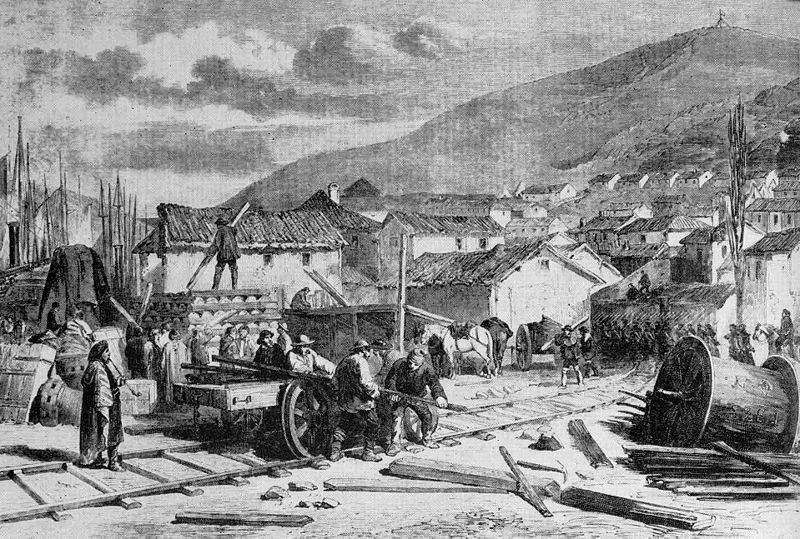
Railways have played a significant role in warfare since at least the Crimean War.
Navvies working on the Grand Crimean Central Railway, 1854. From Thomas Brassey, Railway Builder (1969).
As I live within a bowshot of a railroad crossing, the screech of metal wheels on metal rails frequently reminds me of one of the many things that so many Anglophone commentators get wrong about the war in Ukraine. Coming from places afflicted with (hat tip to Arlo Guthrie [NR: I’d give the credit to Steve Goodman, personally]) “the disappearing railroad blues”, these writers find it hard to imagine the degree to which Russian soldiers exploit the ability of the iron horse to move vast numbers of hundred-pound artillery shells. This blindspot, in turn, causes them to place far too much importance on means of movement, such as ships and trucks, that play second fiddle in the logistical symphony that supplies Russian forces in the field.
Tales of soldiers stealing pickles from convenience stores spark thoughts of another mistake that English-speaking critics have made with respect to the Russian supply system. Wise generals, from Alexander the Great to Francisco Franco, have long deployed vast quantities of food along with their armies. Nonetheless, the enduring fondness of English-speaking soldiers for bully beef, tinned biscuits, and other meals-ready-to-eat sets them apart from most other fighting men, past or present. To put things another way, we should not have been surprised that, when organizing an invasion of one of the great food-producing countries of our planet, Russian logisticians preferred the dispatch of fuel and ammunition to the delivery of items that could have been found in every bodega along the line of march.
Anglophone analysts also drew the wrong conclusions from reports of the loss, in battle, of Russian general officers. Such casualties, they argued, stemmed from an absence of trust. That is, Russian generals were killed because, lacking confidence in the competence of colonels, captains, and corporals, they felt obliged to exercise close supervision over forces engaged in combat.
The participation of generals in firefights, however, need not reflect an absence of faith in the fidelity and abilities of subordinates. Indeed, the original gangsters of “trust tactics” often recommended that the general officers commanding formations lead from the front. I suspect, moreover, that Russian leaders also understood that seeing a general die a soldier’s death usually exercises a positive influence on the morale of his subordinates. (“Say what you will about old General Strelkov, but he never asked us to do anything he wasn’t willing to do himself.”)
Finally, few who made much of the battle deaths of Russian general officers seem to have been aware that the Russian forces that crossed into Ukraine on 24 February 2022 were organized in a way that provided them with an extraordinarily high proportion of fighting generals. That is, when a peacetime formation formed a battalion tactical group, the general in charge of that organization usually took command of the unit it spawned. Thus, rather than having one general for every four or five battalions, the Russian forces of the first few months of the “special military operation” had five or six flag-rank officers for every four or five battalions.
August 12, 2023
Churchill and India
Andreas Koureas posted an extremely long thread on Twitter, outlining the complex situation he and his government faced during the Bengal Famine of 1943, along with more biographical details of Churchill’s views of India as a whole (edits and reformats as needed):
The most misunderstood part of Sir Winston Churchill’s life is his relationship with India. He neither hated Indians nor did he cause/contribute to the Bengal Famine. After reading through thousands of pages of primary sources, here’s what really happened.
A thread 🧵
I’ve covered this topic before, but in a recent poll my followers wanted a more in-depth thread. Sources are cited at the end. I’m also currently co-authoring a paper for a peer reviewed journal on the subject of the Bengal Famine, which should hopefully be out later this year.
I’ll first address the Bengal Famine (as that is the most serious accusation) and then Churchill’s general views on India. It goes without saying that there will be political activists who will completely ignore what I have to say, as well as the primary sources I’ll cite. I have no doubt, that just like in the past, there will be those who accuse me of only using “British sources”.
This is not true. I have primary sources written by Indians as well as papers by Indian academics.
Moreover, I have no doubt that such activists will, choose to “cite” the ahistorical journalistic articles from The Guardian or conspiratorial books like Churchill’s Secret War by Mukerjee — a debunked book that ignores most of what I’m about to write about, and is really what sparked the conspiracy of Churchill and the Bengal Famine. For everyone else, I hope you find this thread useful.
(more…)
August 2, 2023
How Shipping Containers Took Over the World (then broke it)
Calum
Published 5 Oct 2022The humble shipping container changed our society — it made International shipping cheaper, economies larger and the world much, much smaller. But what did the shipping container replace, how did it take over shipping and where has our dependance on these simple metal boxes led us?
(more…)
July 25, 2023
WWI Footage: Narrow Gauge Train Lines in France
Charlie Dean Archives
Published 14 Aug 2013American forces constructing railways throughout France to help move men and supplies during World War One. We see US Army personnel laying the sleepers and track for the extensive network of two foot (60cm) narrow gauge lines, ballasting work, loading and laying of pre-built trackwork. We also see scenes of the railway in action as the little trains trundle along country lanes and through the town streets. The film ends with scenes of the train taking soldiers towards the front lines.
After the war the lines were abandoned and most of the locomotives and rollingstock simply left where they were last used, with many being salvaged by the locals to help with logging activities.
CharlieDeanArchives – Archive footage from the 20th century making history come alive!
July 8, 2023
The Perfect D-Day That History Forgot
Real Time History
Published 7 Jul 2023The summer of 1944 saw the Allies land in France not once but twice. Two months after Operation Overlord, the Allies also landed in Southern France during Operation Dragoon. It was “the perfect landing” and opened up the important ports of Marseille and Toulon for Allied logistics.
(more…)
June 19, 2023
Patterns of incompetence
In Palladium, Harold Robertson says that complex systems that we all depend on will not have the resilience to survive our society-wide failure of competence:

Graphic for Rhode Island College’s Office of Diversity, Equity and Inclusion.
At a casual glance, the recent cascades of American disasters might seem unrelated. In a span of fewer than six months in 2017, three U.S. Naval warships experienced three separate collisions resulting in 17 deaths. A year later, powerlines owned by PG&E started a wildfire that killed 85 people. The pipeline carrying almost half of the East Coast’s gasoline shut down due to a ransomware attack. Almost half a million intermodal containers sat on cargo ships unable to dock at Los Angeles ports. A train carrying thousands of tons of hazardous and flammable chemicals derailed near East Palestine, Ohio. Air Traffic Control cleared a FedEx plane to land on a runway occupied by a Southwest plane preparing to take off. Eye drops contaminated with antibiotic-resistant bacteria killed four and blinded fourteen.
While disasters like these are often front-page news, the broader connection between the disasters barely elicits any mention. America must be understood as a system of interwoven systems; the healthcare system sends a bill to a patient using the postal system, and that patient uses the mobile phone system to pay the bill with a credit card issued by the banking system. All these systems must be assumed to work for anyone to make even simple decisions. But the failure of one system has cascading consequences for all of the adjacent systems. As a consequence of escalating rates of failure, America’s complex systems are slowly collapsing.
The core issue is that changing political mores have established the systematic promotion of the unqualified and sidelining of the competent. This has continually weakened our society’s ability to manage modern systems. At its inception, it represented a break from the trend of the 1920s to the 1960s, when the direct meritocratic evaluation of competence became the norm across vast swaths of American society.
In the first decades of the twentieth century, the idea that individuals should be systematically evaluated and selected based on their ability rather than wealth, class, or political connections, led to significant changes in selection techniques at all levels of American society. The Scholastic Aptitude Test (SAT) revolutionized college admissions by allowing elite universities to find and recruit talented students from beyond the boarding schools of New England. Following the adoption of the SAT, aptitude tests such as Wonderlic (1936), Graduate Record Examination (1936), Army General Classification Test (1941), and Law School Admission Test (1948) swept the United States. Spurred on by the demands of two world wars, this system of institutional management electrified the Tennessee Valley, created the first atom bomb, invented the transistor, and put a man on the moon.
By the 1960s, the systematic selection for competence came into direct conflict with the political imperatives of the civil rights movement. During the period from 1961 to 1972, a series of Supreme Court rulings, executive orders, and laws — most critically, the Civil Rights Act of 1964 — put meritocracy and the new political imperative of protected-group diversity on a collision course. Administrative law judges have accepted statistically observable disparities in outcomes between groups as prima facie evidence of illegal discrimination. The result has been clear: any time meritocracy and diversity come into direct conflict, diversity must take priority.
The resulting norms have steadily eroded institutional competency, causing America’s complex systems to fail with increasing regularity. In the language of a systems theorist, by decreasing the competency of the actors within the system, formerly stable systems have begun to experience normal accidents at a rate that is faster than the system can adapt. The prognosis is harsh but clear: either selection for competence will return or America will experience devolution to more primitive forms of civilization and loss of geopolitical power.
H/T to Theophilus Chilton for the link.
June 7, 2023
A Harbour goes to France – Mulberry Harbours – Normandy Landings
British Army Documentaries
Published 24 Jun 2020Mulberry harbours were temporary portable harbours developed by the United Kingdom during the Second World War to facilitate the rapid offloading of cargo onto beaches during the Allied invasion of Normandy in June 1944. After the Allies successfully held beachheads following D-Day, two prefabricated harbours were taken in sections across the English Channel from UK with the invading army and assembled off Omaha Beach (Mulberry “A”) and Gold Beach (Mulberry “B”).
(more…)
QotD: A “second front” in 1943
There are some points in their favour. The invasions of North Africa definitely took resources that could have been built up in Britain, and therefore slowed things down. (And the withdrawal of the new escort carriers, escort groups, and shipping from the Battle of the Atlantic for the North African adventure, definitely did huge damage in the loss of shipping and supplies, slowing things down further.) As a result the huge buildup in North Africa was much easier to use against Italy before moving on to France. Certainly another distraction or delay … but only if you don’t think that knocking Italy out of the war would make Germany weaker!
But once Sledgehammer [the plan to invade France in 1942] was abandoned, this operation was the only possible way to get US troops into combat in Europe, short of shipping some to Russia. It was also the only possible way of coming close to keeping Roosevelt’s ridiculous promise to the Russians.
[…]
Nonetheless it is wrong to think that the British never had any intention of [mounting Operation] Roundup. Despite what Roosevelt and many other Americans convinced themselves, the British were, at the start of 1942, far more optimistic about the possibility of invading Europe through France in 1943 than they had been about Sledgehammer. Their studies seemed to show that Germany would only have to be weaker, not suddenly collapse, to make invasion in 1943 a realistic possibility. Realistic that is as long as the rest of the plans for training and shipping troops, building and concentrating invasion craft, and moving enough supplies to make it sustainable, all came together.
They didn’t.
For the British, the middle of 1942 revealed how little would be available in time for the middle of 1943. Even on the best assumptions of American training and preparation, there was no chance that the majority of forces for Roundup would not be British … assuming they could supply them either. In practice mid-1942 saw the Axis continue to advance on every front. Burma collapsed; the Allied position in New Guinea was under threat; the Japanese were still expanding to places like Guadalcanal; Rommel was advancing in Egypt; the Germans were advancing on the Caucasian oil fields and towards the Middle East; and more and more was needed just to keep Russia in the war. As a result British troops, shipping and supplies were continuing to flow away from Britain, not towards it.
Much of the Royal Navy was trying to save the dangerous losses caused by [US Chief of Naval Operations Admiral] King’s refusal to have convoys in American waters (too “defensive-minded” he thought.) These alone, the worst eight months of the war, were threatening to scupper Roundup. The rest was so busily deployed in the Indian and Pacific Oceans against the Japanese, or North Atlantic trying to fight supplies through to Russia (a high proportion of tanks and planes defending Moscow were British-supplied), that there was virtually nothing left in the Med to slow Rommel’s advance. The merchant ships surviving the fight across the oceans were actually more vitally needed to take men and equipment from the UK to other places than to bring in a buildup for the UK.
Nor was the American buildup going to plan. Less well-trained troops were becoming available too slowly, could not be shipped in adequate numbers anyway, and were in no condition to face German veterans. (The very best US units to go into action in 1942 – the Marines in Guadalcanal – and 1943 – the 1st Infantry and 1st Armored divisions which were actually professional troops not conscripts in North Africa – had very steep learning curves. Particularly at Kasserine. They were clearly not fit to face German veterans yet.
And American resource buildup was also not up to promises. King and MacArthur were milking supplies far beyond what had originally been agreed under “Germany first”. In practical terms they were doing so for the same reasons the British were: an immediate desperate situation had to be saved before a future ideal one could be pursued.
Nonetheless I have read all sorts of apparently serious suggestions that after North Africa was cleared, or at the very least after Sicily was cleared, an invasion of France should have happened.
Delusional.
Nigel Davies, “The ‘Invasion of France in 1943’ lunacy”, rethinking history, 2021-06-21.
June 4, 2023
D-Day Series: RCN and Operation Neptune
Valour Canada
Published 28 Dec 2015This video describes the Royal Canadian Navy’s (RCN) invaluable contributions to the invasion on D-Day, June 6, 1944. Operation Neptune was the name of the English Channel-crossing portion of the larger Normandy invasion (named Operation Overlord).
1. Overview (0:00)
Dawn. June 6, 1944. D-Day. Operation Overlord, the largest amphibious invasion in history, is about to begin. This is a description of the battlefield prior to the attack and also tells how the RCN played an important role both in the English Channel and along the French coast.2. Stop the U-boats (2:55)
Churchill said that the only thing that scared him during the war were the U-boats. This describes the problematic German U-boats and how the British and Canadian Navies (Operation Neptune) worked together to find, track, and destroy the underwater menace prior to D-Day.3. Clear the Mines (6:27)
“There is no doubt that the mine is our greatest obstacle to success” – British Admiral Bertram Ramsay. The size and effectiveness of the German minefield that guarded the D-Day beaches and how the Allied Navies worked together to prepare a route through which the invasion could occur.4. Cover the Beaches (9:49)
The Canadian Tribal-class destroyers played a significant role in eliminating the German Navy’s major surface warships’ threat to the invasion fleet. The RCN destroyer squadron and their mission of clearing the English Channel of German ships before, during, and after the invasion. A battle between the Canadian destroyers Haida and Huron and four German ships near the port of Brest on June 9 is discussed. Also covered are the two Canadian destroyers, Algonquin and Sioux, that were tasked with shore bombardment at Juno Beach.5. Land the Troops (13:01)
Shortly after dawn and following a forty-minute naval barrage at Juno Beach, the first Canadian soldiers came ashore. By noon, the beach was held by the Canadians and millions of tons of supplies were being brought ashore. This section describes the first waves of the invasion and the tanks, artillery, vehicles, and supplies that were soon to follow.
(more…)
June 3, 2023
Why Was Normandy Selected For D-Day?
Real Engineering
Published 28 Mar 2020In the debut episode of the Logistics of D-Day we explore the logic and planning that resulted in Normandy being chosen as the location for the largest amphibious invasion in the history of human kind.
(more…)
April 28, 2023
QotD: The high-water mark of the Panzerarmee Afrika
Even here, however, let us be honest. Smashing 8th Army at Gazala and taking tens of thousands of prisoners at Tobruk did little to solve the strategic problem. Unless the British were destroyed altogether, they would reinforce to a level the Axis could not match. Many later analysts argue that the Panzerarmee should have paused now, waited until some sort of combined airborne-naval operation had been launched against Malta to improve the logistics, and only then acted. Such arguments ignore the dynamic of the desert battle, however; they ignore the morale imperative of keeping a victorious army in motion; above all they ignore the personality of Rommel himself.
Pause? Halt? Wait? Anyone who expected Rommel to ease up on the throttle clearly hadn’t been paying attention. Instead, the Panzerarmee vaulted across the border into Egypt with virtually no preparation. To Rommel, to his men, and even to Hitler and Mussolini, it must have looked like a great victory lay just over the next horizon: Cairo, Alexandria, the Suez Canal, the British Empire itself.
In reality, it is possible today to see what the great Prussian philosopher of war Karl von Clausewitz once called the “culmination point” — that moment in every campaign when the offensive begins to lose steam, run down, and eventually stop altogether. The Panzerarmee was exhausted, its equipment was worn out and in desperate need of repair. Captured British stores and vehicles had become its life-blood, Canadian Ford trucks in particular. The manpower was breaking down. A chronic shortage of potable water had put thousands of soldiers on the sick rolls. Colonel Siegfried Westphal, the Panzerarmee‘s operations chief (the “Ia”, in German parlance), was yellow with jaundice. The army’s intelligence chief (the “Ic”), Colonel Friedrich Wilhelm von Mellenthin, was wasting away with amoebic dysentery. Rommel had a little of both, as well as a serious blood-pressure problem (no doubt stress-induced) and a chronic and bothersome sinusitis condition. While it would be easy to view all these illnesses as simple bad luck, they were, in fact, the price Rommel and all the rest of them were paying for fighting an overseas expeditionary campaign with inadequate resources.
The same might be said for the rest of the campaign. The Panzerarmee made an ad hoc attempt to break thought the British bottleneck at El Alamein in July. It failed, coming to grief against British defenses on the Ruweisat ridge. There was a second, more deliberate, attempt in August. After an initial breakthrough, it crashed into strong British defenses at Alam Halfa ridge and it, too, failed. After yet another long pause, a “third battle of El Alamein” began in late October. This time, it was the well supplied British on the attack, however, and they managed to smash through the Panzerarmee and drive Rommel and company back, not hundreds of miles, but more than a thousand, out of the desert altogether and into Tunisia. There was still fighting to be done in Africa, but the “desert war” was over.
Robert Citino, “Drive to Nowhere: The Myth of the Afrika Korps, 1941-43″, The National WWII Museum, 2012. (Originally published in MHQ, Summer 2012).
March 30, 2023
The use and mis-use of wargames
Cheating in wargames must be approximately five minutes younger than wargames themselves … famously, the Imperial Japanese Navy didn’t like the outcome of wargaming what became the Battle of Midway and “cheated” by refloating the aircraft carriers shown as sunk in the simulation and Wehrmacht General Paulus ran a wargame that showed Operation Barbarossa would fail and he was also told to ignore the results and ended up in Stalingrad. Lessons can be learned from formal wargames, but as CDR Salamander points out, a wargame outcome can be custom-tailored as the leaders require:
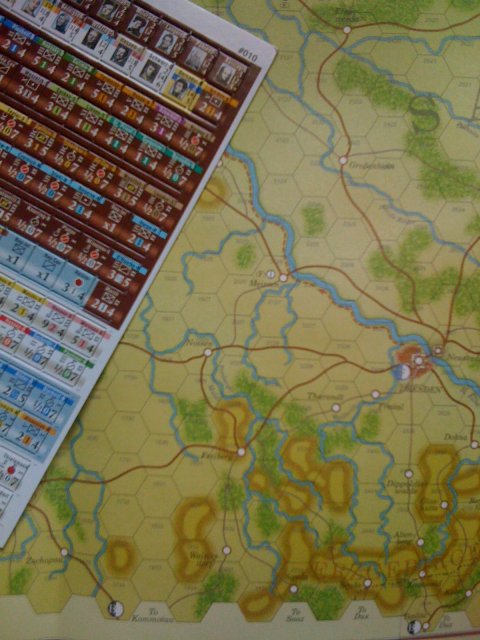
Not this kind of civilian wargame … a real wargame run by professional military staff!
One of the things that will get my eye twitching faster than about anything else is when someone responds to a question or concern with a, “Well, in our wargames …”
Bullshit.
That may work for civilians or under-briefed lawmakers who lack the depth in military matters, but anyone who has run or been part of a wargame knows that you can design one to give you the outcomes you want.
Planning assumptions etc … it is all flexible.
Wargames, done right, don’t tell you the future, but they do help inform gaps in your OPLAN, thinking, or expectations of the enemy … and shortfalls you might have.
At the POLMIL level — where our most senior uniformed and civilian leaders live — you have distinctly different concerns than Tactical, Operational, or — if your Planning Confession separates Strategic from the POLMIL level — Strategic level.
For the senior uniformed leader to make this statement, as if it were a bolt out of the blue, is simply gobsmacking;
A “big lesson learned comes out of Ukraine, which is the incredible consumption rates of conventional munitions in what really is a limited regional war,” General Mark Milley, the chairman of the Joint Chiefs of Staff, told the House Armed Services Committee.
“If there was a war on the Korean peninsula or a great power war between United States and Russia, United States and China, those consumption rates would be off the charts,” he said.
Whose charts? Who made them and using what metrics and dataset?
Yes … that is a lesson for most out there … but it should not be for the CJCS. Hell, I remember certain aspects of updating the OPLAN for Korea a quarter century ago when we beat the drum that, “We don’t have enough ____ and only a few days of ____ before we are combat ineffective.”
This. Is. Not. New.
As we mentioned last July, magazine depth has been a chronic shortfall for a long time.
I have trouble believing that the CJCS is shocked, SHOCKED, that this is an issue.
It isn’t a “lesson learned” — it is a lesson ignored.
One of the easiest, most obvious-to-the-accountants economy any military can make is to scrimp on the inventory of live ammunition … if there’s no war, much of the stored munitions must be disposed of at a cost, and what’re the chances they’ll throw a war before the next election? Plus, if there’s only so much in storage, it’s not economical to have the training allowance of ammunition go up, so you can reduce the resupply levels and free up money in the budget for sexier, more mediagenic toys.
February 24, 2023
Up Close and Personal – Mountain Warfare in Italy – WW2 Special
World War Two
Published 23 Feb 2023Thanks to Curiosity Stream for sponsoring today’s video
Even as the Allied and Axis commanders focus on the sweeping warfare of the Eastern Front and the planning for the invasion of Europe, their men continue to fight a grinding war of attrition high in the Italian mountains. It’s a war of merciless terrain, brutal close-quarters combat, and vast quantities of artillery and bombs. They may be playing second fiddle, but the soldiers on the Italian front will never forget these battles.
(more…)


