
Published on 18 May 2015
Mustafa Kemal or simply Atatürk was the founder of the modern, secular Turkish Republic. He earned his stripes as an officer in World War 1 as the defender of Gallipoli against the ANZAC troops. You can find out all about Mustafa Kemal Atatürk during the last years of the Ottoman Empire in our biography.
May 20, 2015
Mustafa Kemal Atatürk I WHO DID WHAT IN WORLD WAR 1?
Comments Off on Mustafa Kemal Atatürk I WHO DID WHAT IN WORLD WAR 1?
May 16, 2015
Kazakhstan’s looming succession crisis
At The Diplomat, Catharine Putz wonders if there can be a Kazakhstan without President Nursultan Nazarbayev:
In a new report, the International Crisis Group says that Kazakhstan is facing a stress test – its only president since independence turns 75 this summer and Russia’s “actions in Ukraine cast a shadow over Kazakhstan.” To date, the report notes, Kazakhstan’s devotion to continuity has trumped needed democratic reforms. Nursultan Nazarbayev’s recent landslide reelection demonstrates his absolute centrality to political stability in the country and could prove to be “a serious vulnerability.”
The report encourages Kazakhstan to act soon – reconfirming its independence from Russia and lifting the veil on government operations in order to reassure citizens and foreign powers “that the state is not the work of one man or an exclusive ethnic project and that the transition to a post-Nazarbayev era will be smooth.” The report recommends that Kazakhstan continue to pursue a multi-vector foreign policy by engaging equally with Russia and the EU; take a “recognizable role” in pursuing a solution to the Ukraine crisis; give senior officials – other than Nazarbayev – some stage time; practice restraint in issues of language, ethnicity, and nationalism; and broaden economic development beyond Astana.
This is not the first time parallels have been drawn between Ukraine and Kazakhstan. Kazakhstan, like all of Central Asia, had a sizeable ethnic Russian population when the Soviet Union dissolved. That population has dwindled; in a country of 17 million a 2009 census determined that ethnic Russians accounted for 23 percent, ethnic Kazakhs more than 60 percent. This is a more modern development, as it wasn’t until the mid-1980s that the ethnic Kazakh population bypassed that of ethnic Russians in the region. Now, most ethnic Russians are concentrated along the northern border with Russia.
How do you say “Après moi, le déluge” in Kazakh?
Comments Off on Kazakhstan’s looming succession crisis
May 5, 2015
Conrad von Hötzendorf I WHO DID WHAT IN WW1?
Published on 4 May 2015
Conrad von Hötzendorf was one of the main figures pushing for war and escalating the July crisis in 1914 leading to World War 1. His failure as commander in chief of Austria-Hungary were staggering but still today some consider him a military genius. Who was this man who polarizes military scholars till today and played such a huge role in the downfall of the Habsburg empire? Find out in our biography.
Comments Off on Conrad von Hötzendorf I WHO DID WHAT IN WW1?
April 17, 2015
Grant and Lee at Appomattox
In The Federalist, John Daniel Davidson posted an article earlier this month marking the 150th anniversary of Appomattox:
If ever the vanquished had reason to be bitter, or a victor had cause to be punitive, it was Lee and Grant. Yet their comportment at Appomattox stands today as a testament to the ideals of national reconciliation, goodwill, and honor and respect for one’s enemy. In his epic narrative history of the Civil War, Shelby Foote recounts two instances from Appomattox that suggest Lee and Grant were both thinking of the greater good, keenly aware that an enduring peace depended in part on their humility and generosity.
Early on the morning of April 9, Lee called a conference with his generals so they could give their opinions on surrender. All of them concurred that under the circumstances surrender was the only option, except the young Brigadier General Edward Alexander, who, writes Foote, “proposed that the troops take to the woods, individually and in small groups, under orders to report to the governors of their respective states. That way, he believed, two thirds of the army would avoid capture by the Yankees.”
Lee gently rebuked Alexander, reminding him, “We must consider its effect on the country as a whole.” The men, he said, “would be without rations and under no control of officers. They would be compelled to rob and steal in order to live. They would become mere bands of marauders, and the enemy’s cavalry would pursue them and overrun many sections that may never have occasion to visit. We would bring on a state of affairs it would take the country years to recover from.” Alexander would later write: “I had not a single word to say in reply. He had answered my suggestion from a plane so far above it that I was ashamed of having made it.”
Grant’s terms of surrender were remarkable for their leniency on the Confederate Army. Although the rebels would be required to turn over their arms, artillery, and private property, Grant added an impromptu final sentence: “This will not embrace the side arms of the officers, nor their private horses or baggage.” At Lee’s request, he also allowed Confederate cavalrymen and artillerists who owned their own horses and mules to keep them, reasoning that most were small farmers and would not be able to put in a crop “to carry themselves and their families through the next winter without the aid of the horses they are now riding.”
At this crucial moment, it was most important to Grant and Lee that the soldiers return home safely and get on with civilian life as soon as possible. Returning to his men, Lee told them, “I have done the best I could for you. Go home now, and if you make as good citizens as you have soldiers, you will do well, and I shall always be proud of you.” En route back to his headquarters, Grant heard salutes and cheering begin to rise up from nearby Union batteries. He sent orders to have them stopped. “The war is over,” he said. “The rebels are our countrymen again.”
Comments Off on Grant and Lee at Appomattox
April 11, 2015
Robert E. Lee
In City Journal, Ryan L. Cole reviews a recent book on one of America’s most famous generals:
America’s Civil War presents a set of forever ponderable “what ifs.” What if a Union soldier hadn’t discovered plans for the Confederate invasion of Maryland in 1862? What if Stonewall Jackson hadn’t been hit by friendly fire after the Battle of Chancellorsville? What if George Meade had pursued the wounded Army of Northern Virginia in the wake of Gettysburg? The list goes on.
But perhaps the most vexing hypothetical has always been: What if Robert E. Lee had accepted Abraham Lincoln’s offer to command Union forces at the outset of the conflict? This would have likely robbed the Confederacy of its greatest military mind. It may have also robbed the South of its fleeting glories, dramatically shortened the war, and made Lee — not Ulysses S. Grant or even Abraham Lincoln — the savior of the Union. It could even have made Lee a second George Washington.
This decision and its ramifications are the basis of The Man Who Would Not Be Washington, Jonathan Horn’s thoughtful new life of the Confederate general. It would be wrong to call this a biography. Though Horn, a former speechwriter for President George W. Bush, assays Lee’s life from birth to death, the book is built around the premise that Lee was practically destined to become the second coming of Washington. Yet he declined, and the consequences of his refusal altered the course of the nation.
Lee had familial and professional connections to Washington. His father, Henry Lee III, better known as “Light-Horse” Harry Lee, was a dashing cavalry officer in the Continental Army. General Washington was impressed by Lee’s bravery and invited the young Virginian to join his personal staff. When Lee begged off, Washington asked Congress to give him an independent command. Like some other young officers, Lee found a mentor in Washington, who had no biological children of his own. He did, however, adopt and raise Martha Washington’s grandson, George Washington Parke Custis, as his own son. Custis’s daughter, Mary, wed Robert E. Lee. Their children, by birth and marriage, were direct descendants of America’s original first lady.
The Lees lived in Arlington House, a Potomac mansion overlooking Washington, built by Custis as a shrine to his adoptive father and a repository for his relics. Through marriage, Lee was heir to the tactile remains of Washington’s legacy; even the slaves he inherited from his father-in-law were descendants of those who had toiled at Mount Vernon. In his opening chapters, Horn carefully draws the connections between the two titular subjects and plots Lee’s rise to military distinction in the years leading up to the Civil War. The history is simply fascinating. Horn is a graceful writer, and when the occasion warrants, has a suitable flair for the dramatic. The pages blaze by.
Comments Off on Robert E. Lee
March 28, 2015
Senator Harry Reid is retiring
Here’s some high praise for the outgoing democratic senator Harry Reid, who announced yesterday he won’t be seeking re-election in 2016:
Today we will hear a lot about Reid’s “service” to the Senate and to the American people. Ha! “Service” indeed. The truth of the matter is that Harry Reid is a stone-cold killer who has damaged Washington considerably, who has elevated his own political preferences above the institution he was elected to protect, and who has made worse the partisan rancor that our self-described enlightened class claims to abhor. The greatest service he can do America is to go away.
From a purely Machiavellian perspective, there is a strong case to be made that Reid has been the most effective federal politician in the United States over the last decade or so. In order to protect the president and to advance his movements’ goals, Reid has been willing to diminish the influence, power, and effectiveness of his own institution; in order to thwart his opponents, he has demonstrated an extraordinary capacity to play dirty — a capacity that sets him apart even from other harsh players such as Chuck Schumer, Ted Cruz, and Dick Durbin; and, in order to satisfy his own need to feel powerful, he has perfected the scorched earth approach that has kept Obama’s presidency on life support since November of 2010 (in my estimation, the Democratic party’s success during the 2013 shutdown was the product of Reid’s obstinacy and resolve, not Obama’s).
National Review also reposted Kevin Williamson’s appreciation for Reid from 2014:
There are 53 Democrats in the Senate, plus two nominal independents who associate with them, and this clown caucus has chosen, since 2007, to place itself under the malignant leadership of Harry Reid, Washington’s answer to Frankenstein’s monster — stitched together out of the worst bits of Roger Chillingworth, Joe McCarthy, and Droopy — a teacup tyrant who has filled his own pockets to the tune of $10 million while decrying the allegedly baleful influence of the wealthy on politics, a man who has done violence to ethical standards left and right, using campaign funds for personal expenditures and trying to hide payments channeled to his granddaughter, who takes to the Senate floor to make patently false, malicious, and increasingly loopy claims about his political rivals, and who is leading a partisan assault on the Bill of Rights. If America needs a(nother) good reason to hand Democrats their heads come November, then they would do well to study the career of Harry Reid (D., Ritz-Carlton), the Sheriff of Nottingham to Barack Obama’s Prince John.
Harry Reid is in some ways a laughable figure, and one of his few charms is that he is known to make self-deprecating observations about his own unprepossessing nature. His obsession with Koch Industries and the intimations of venality that surround him might be grounds for annoyed eye-rolling if they were not of a piece with his audacious war on the most important of our fundamental constitutional liberties. The cheap histrionics, the gross hypocrisy, the outright lies, misusing campaign funds to tip his staff at the Ritz $3,300 — all of that would be just about bearable, but the shocking fact is that Harry Reid and his Senate Democrats are quietly attempting to repeal the First Amendment. And that elevates Senator Reid’s shenanigans from buffoonery to villainy.
Comments Off on Senator Harry Reid is retiring
QotD: The outbreak of war in 1914
This book thus strives to understand the July Crisis of 1914 as a modern event, the most complex of modern times, perhaps of any time so far. It is concerned less with why the war happened than with how it came about. Questions of why and how are logically inseparable, but they lead us in different directions. The question of how invites us to look closely at the sequences of interactions that produced certain outcomes. By contrast, the question of why invites us to go in search of remote and categorical causes: imperialism, nationalism, armaments, alliances, high finance, ideas of national honour, the mechanics of mobilization. The why approach brings a certain analytical clarity, but it also has a distorting effect, because it creates the illusion of a steadily building causal pressure; the factors pile up on top of each other pushing down on the events; political actors become mere executors of forces long established and beyond their control.
The story this book tells is, by contrast, saturated with agency. The key decision-makers — kings, emperors, foreign ministers, ambassadors, military commanders and a host of lesser officials — walked towards danger in watchful, calculated steps. The outbreak of war was the culmination of chains of decisions made by political actors with conscious objectives, who were capable of a degree of self-reflection, acknowledged a range of options and formed the best judgements they could on the basis of the best information they had to hand. Nationalism, armaments, alliances and finance were all part of the story, but they can be made to carry real explanatory weight only if they can be seen to have shaped the decisions that — in combination — made war break out.
Christopher Clark, The Sleepwalkers: How Europe Went To War In 1914, 2012.
Comments Off on QotD: The outbreak of war in 1914
February 25, 2015
Why Was Hötzendorf Allowed To Command? I OUT OF THE TRENCHES #8
Published on 23 Feb 2015
Indy sits in the chair of wisdom again to answer your questions. This week he tries to explain why Austro-Hungarian Chief of Staff Conrad von Hötzendorf was allowed to command an army at all.
Comments Off on Why Was Hötzendorf Allowed To Command? I OUT OF THE TRENCHES #8
February 17, 2015
Ontario’s political future seems unusually feminine
After the last serious challenger dropped out of the race to be leader of the Progressive Conservatives, Christine Elliot (my local MPP) now appears to be the default choice to fill the leadership role. Richard Anderson has a characteristic take on the near future of Ontario politics:
So that leaves Christine Elliott and a bunch of other people. I could, of course, look up the names of the other people but that would be a waste of valuable electrons. No doubt they are all honourable and public spirit individuals whose contributions to the political process Ontarians eagerly acknowledge. I guess. One would assume given the circumstances.
Christine Elliott is now unofficially the leader of the official opposition. In 2019 she will have the honour of being defeated by Kathleen Wynne in another improbable landslide. To some this sounds like a daunting and terrifying prospect. Don’t worry. When 2019 comes around you won’t be worried about another Win for Wynne. No sir. You’ll be too busy fighting for food at the burnt-out Loblaws to give a damn about politics. Change that you can believe in.
[…]
Growing up in that dark epoch known as the 1980s I well recall feminists complaining about how the world was run by cranky old men stuck in the past. Ancient dinosaurs who monopolized power and prevented those with youth and innovative ideas from coming to the fore of public life. So much has changed since that time. The male gerontocracy of the Reagan Era has been swept away by the female gerontocracy of the Wynne-Elliott Era. You’ve come a long way baby.
Now that feminism has utterly triumphed, with all three of the major parties run by women, we can appreciate how right the early feminists were about, well, everything. Now that women rule Ontario the economy is humming along splendidly, the finances are managed like a prudent housewife of old and peace and love has spread through out the land. Ordinary voters look to the Ontario matriarchy with a degree of trust and understanding that no male politician has ever commanded.
Let us give a moment of thanks.
Comments Off on Ontario’s political future seems unusually feminine
December 27, 2014
Who should have been the allied commanders on D-Day?
Nigel Davies ventures into alternatives again, this time looking at who were the best allied generals for the D-Day invasion (for the record, he’s quite right about the best Canadian corps commander):
The truth is that any successful high command should maximise the chances of success of any campaign by choosing the ‘best fit’ for the job.
But that is not how generals were chosen for D Day.
(I would love to start with divisional commanders, but there are way too many, so for space I will start with Corps and Army commanders, and work up to the top).
The outstanding Canadian of the campaign for instance was Guy Simonds. Described by many as the best Allied Corps commander in France, and credited with re-invigorating the Canadian Army HQ when he filled in while his less successful superior Harry Crerar was sick, Simonds was undoubtedly the standout Canadian officer in both Italy and France.Lieutenant General Guy Simonds, commander of the 2nd Canadian Corps.
He was however, the youngest Canadian division, corps or army commander, and the speed of his promotions pushed him past many superiors. He was also described as ‘cold and uninspiring’ even by those who called him ‘innovative and hard driving’. It can be taken as a two edged sword that Montgomery thought he was excellent (presumably implying Montgomery like qualities?) But his promotions seemed more related to ability than cronyism, and his achievements were undoubted.
Should he have been the Canadian Army commander instead of Crerar? Yes. Arguments against were mainly his lack of seniority, and lack of experience. but no Canadian had more experience, and lack of seniority was no bar in most of the other Allied armies.
It comes down to the simple fact that the Allied cause would have been better served by having Simonds in charge of Canadian forces than Crerar.
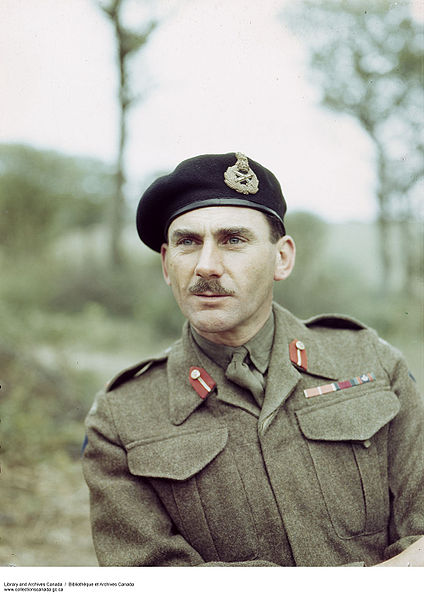
Simonds was a brilliant corps commander and (at least) a very good army commander, but he had one fatal flaw: he was no politician. Harry Crerar was a very “political” general, and played the political game with far greater talent than any other Canadian general. That got him into his role as army commander and his political skills kept him there despite the better “military” options available.
December 18, 2014
The Tsar’s new clothes
At Samizdata, Johnathan Pearce suspects that the folks at NATO headquarters are not getting as much sleep these days as they used to:
… it appears that the image of Putin as this ruthless, chess-playing genius wrongfooting silly old Cameron, Merkel, and the chap with the funny moonface from France is not quite standing up to scrutiny. Here’s a report by Bloomberg:
“The foundations on which Vladimir Putin built his 15 years in charge of Russia are giving way. The meltdown of the ruble, which has plunged 18 percent against the dollar in the last two days alone, is endangering the mantra of stability around which Putin has based his rule. While his approval rating is near an all-time high on the back of his stance over Ukraine, the currency crisis risks eroding it and undermining his authority, Moscow-based analysts said.
In a surprise move today, the Russian central bank raised interest rates by the most in 16 years, taking its benchmark to 17 percent. That failed to halt the rout in the ruble, which has plummeted to about 70 rubles a dollar from 34 as oil prices dived by almost half to below $60 a barrel. Russia relies on the energy industry for as much as a quarter of economic output, Moody’s Investors Service said in a Dec. 9 report.
Now might also be a good time to remind ourselves of the “curse of natural resources”.
It would be worth wondering what are the odds that Putin can last a lot longer in power. That said, a sobering thought is that when regimes are in deep trouble, they can do desperate, crazy things, as Argentina did in 1982 by invading the Falklands. If I were a planner for NATO right now, I’d be having a nervous Christmas and New Year ahead of me.
Comments Off on The Tsar’s new clothes
December 17, 2014
Ferdinand Foch I WHO DID WHAT IN WW1?
Published on 15 Dec 2014
Ferdinand Foch was one of the most famous Entente generals of World War 1. He already began his military career in the Franco-Prussian war of 1870/71. Until the end of WW1 he rose to the rank of Commander in Chief of the allied forces. War had always been central to Foch’s life, though neither he nor anyone else really foresaw the size, scope, and horrors of World War One. In this video we’re showing his impressive life.
Comments Off on Ferdinand Foch I WHO DID WHAT IN WW1?
December 6, 2014
QotD: Wartime failures of the peacetime army
Military operations are, arguably, especially mistake-prone, because militaries aren’t like other organizations. A normal bureaucracy has a job, and it does that job all the time. Militaries, on the other hand, tend to spend most of their time not really engaged in their main purpose: fighting wars.
Teles noted James Q. Wilson’s observation about the fundamental difference between a peacetime army and a wartime army. In peacetime, it’s easy to observe inputs but impossible to observe the output — which is to say, how ready your troops are to go out and kick some enemy butt on the battlefield. When you get into a war, this completely reverses. In the chaos of battle, it’s very difficult to know exactly what your people are doing. On the other hand, it’s relatively easy to observe whether they killed the people they were supposed to kill and took the territory they were supposed to take.
That means that the people who advance in a peacetime army are, unfortunately, not necessarily the same people you want around when the shooting breaks out. Virtually every major war I can think of has had a few well publicized firings early on of senior people who had done very well in the peacetime army but turned out not to be ready to lead their men into a fight. The most famous of these is probably George McClellan, who led the Union Army early in the Civil War. He was everything you could want in a soldier — second in his class at West Point, author of several training manuals, beloved of his men and his fellow officers. There was just one thing he wasn’t good at: winning battles. He was passive in the face of Confederate advances, and he didn’t want to attack until he had absolutely overwhelming force, by which he seemed to mean a huge chunk of the adult male population of the Union. You can argue that this was out of totally admirable concern for his men, but it still let the Confederates push uncomfortably close to Washington.
Ulysses S. Grant, the man who ultimately led the Union forces to victory, was a middling student at West Point and eventually left the army because it didn’t pay him enough to support a family. When the Civil War started, Grant was working for a harness company and not really excelling at it, either. But in some ways, having failed in the peacetime army made him more successful in the wartime version: He was not afraid to take risks, because he’d already tasted failure.
Megan McArdle, “Why Militaries Mess up So Often”, Bloomberg View, 2014-04-24
Comments Off on QotD: Wartime failures of the peacetime army
December 5, 2014
QotD: The art of political leadership
[A politician’s] ear is ever close to the ground. If he is an adept, he can hear the first murmurs of popular clamour before even the people themselves are conscious of them. If he is a master, he detects and whoops up to-day the delusions that the mob will cherish next year.
H.L. Mencken, Notes on Democracy, 1926.
Comments Off on QotD: The art of political leadership
November 24, 2014
QotD: “… a modern Tory version of Mackenzie King”
Harper is now the 6th longest serving PM in Canadian history having just surpassed Borden and Mulroney. The former fought a major war and the later revolutionized international trade policy. Harper? He abolished the Wheat Board. A sensible thing really. Not a big thing. This is not a government of big things, it is a government of small things. Harper is, as Lord Black has pointed out, a modern Tory version of Mackenzie King.
Now King did fight the Second World War. Sort of. He thought the whole thing rather a bother, getting in the way of his equivocating and crystal ball polishing. The general impression in Ottawa during the early Forties was that CD Howe was running the country. The only time in Canadian history when an engineer was given real power. I neither condemn or condone that fact, I simply point it out.
Harper would, of course, never delegate any important authority. Even the late Big Jim Flaherty was kept on a shorter leash than Paul Martin. A modern day CD Howe, assuming he could get elected, would never last five minutes in the Harper cabinet. Big Prime Ministers breed small cabinet ministers.
This leads to one of the essential problems of quasi-Presidential Prime Ministers. When the King falters so does the Kingdom. The Pearson government bungled along for five remarkably influential years. Mike had little idea of what was going on but with one of the strongest cabinets in Canadian history the business of government carried on.
If the PM doesn’t have any new ideas there are plenty of competent ministers more than willing to fill the gap. This is how men like Macdonald and King survived for political eons. How great Dynasties like those of the Tories in Ontario and Alberta were forged. If the King falters there is no shortage of Princes to carry the load.
Richard Anderson, “Steam Punk”, Gods of the Copybook Headings, 2014-11-18.
Comments Off on QotD: “… a modern Tory version of Mackenzie King”


