Quotulatiousness

December 8, 2025

If Britain’s political leadership were trying to destroy the country, what would they have done differently?

My Canadian readers — and possibly the occasional Aussie or Kiwi — can read Spaceman Spiff‘s essay and feel it applies almost 100% to our respective nations as well:
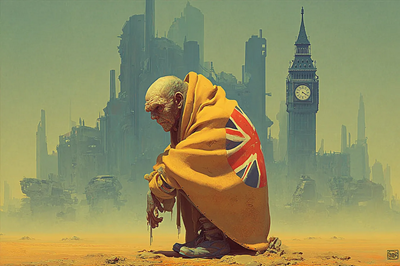
Image from Postcards from the Abyss

Britain is a disaster. The country seems to be in terminal decline.

Not only do we see a lack of ability to turn things around we witness leaders and prominent decision makers evidently clueless about normal life and the hardships many now face.

The political and media classes best reflect this phenomenon. Their views are insular, fictional and at odds with reality. They promote unorthodox ideas that are widely derided yet their enthusiasm is evident as are their hostile responses to being challenged.

Minor comments about immigration are treated as precursors to genocide. Criticism of a biased media unwilling to report events is dismissed as conspiracy. No discussion of climate policy and its unaffordable costs is tolerated. Deviation from the establishment view means excommunication and social exile.

Those in leadership positions drive Britain’s descent into authoritarian governance. Attempts to discuss changes to society leads to extreme overreactions, including jailing noticers, something they now boast about.

Britain has become a madhouse. Our leaders are unable to think like normal people. None of them are facing reality. They seem crazy.

Or, rather, they seem neurotic.

Neurosis is everywhere

Britain has degenerated into a technocratic regime that views the public as its enemy. Normal people disgust the country’s leaders and it shows. They no longer hide their contempt.

But there is a palpable sense of fear emanating from the powerful. Their reactions to normal events paint a troubling picture of who is leading the country, particularly the political and media classes.

If the British establishment were a person we would think them mentally unstable. The qualities we see most are those of a neurotic individual, a type that is well understood.

Here are some features visible in Britain’s ruling class.

Chronic anxiety and worry

A key attribute of neurosis is persistent fear or worry. Rumination is commonplace, circling around and around the same problems. There is also a tendency to overreact, with the response disproportionate to the issue at hand.

The current British regime is wracked with anxiety and worry. This defines them. They are vocal about their concerns.

We are reminded of an endless series of horrors we must attend to; systemic racism, lack of diversity, an imperial past and our cultural dominance along with our impact on the world.

One simple example illustrates the degree to which minds can become distorted by excessive worry.

James Watt perfected the steam engine in 1769 which kickstarted in the industrial revolution, changing the world forever. This would ultimately elevate most nations on earth and led eventually to the establishment of cheap abundant energy for almost everyone.

Until recently these events were viewed as an epoch-defining moment of engineering brilliance. Now this has been recast as a dark stain on Britain’s place in the world, with climate zealots keen to blame the British for all pollution caused by industrialization.

Instead of pride we now see embarrassment and even anxiety about the “damage” Britain has done to the world because it ushered in an era of cheap widespread energy for everyone.

Any rational person would understand this extreme view to be a distortion of reality and excessively negative, yet it permeates everything. Those who rule Britain are ashamed of our past. They worry about it. Only they do this, normal people are proud of our history.

[…]

Welcome to the madhouse

A system of governance driven by neurotics takes on their characteristics. Britain has become a neurotic bureaucracy; a neurocracy.

Neurotics overthink and live inside their heads. They lack the calm, detached strength needed to govern sensibly. Power structures inevitably take on these qualities.

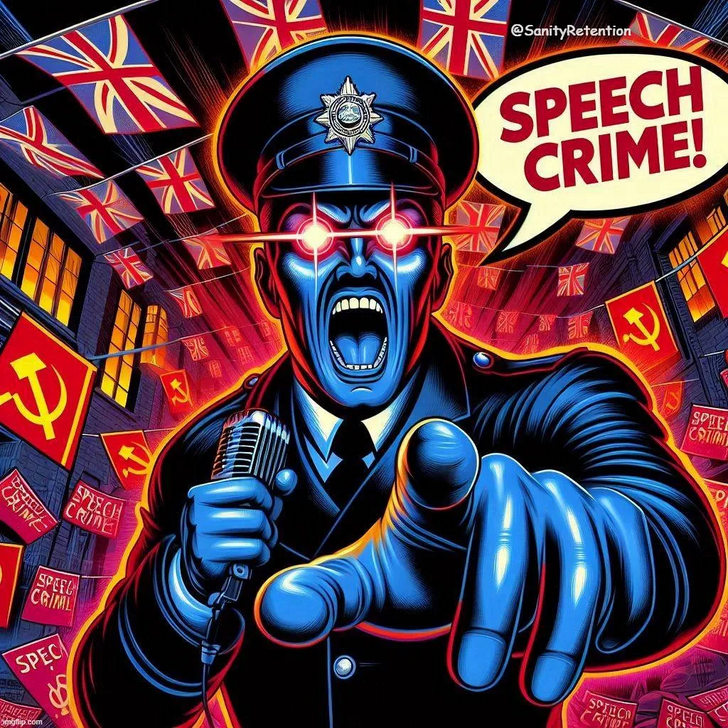
The British government has become paranoid. Digital IDs, internet regulation, censorship. They jail normal people for social media posts. Dissenting views are increasingly punished with custodial sentences.

These are not the actions of the mentally strong. This is an embattled minority fighting reality and becoming desperate.

A gulf is opening between the rulers and the ruled. Increasingly no common ground is even conceivable as the fictions needed to maintain narratives grow. They become overtly false but are needed to feed the neurosis.

One of the things I like about the social media site formerly known as Twitter is how quickly authoritarian bullshit like this can get called out:
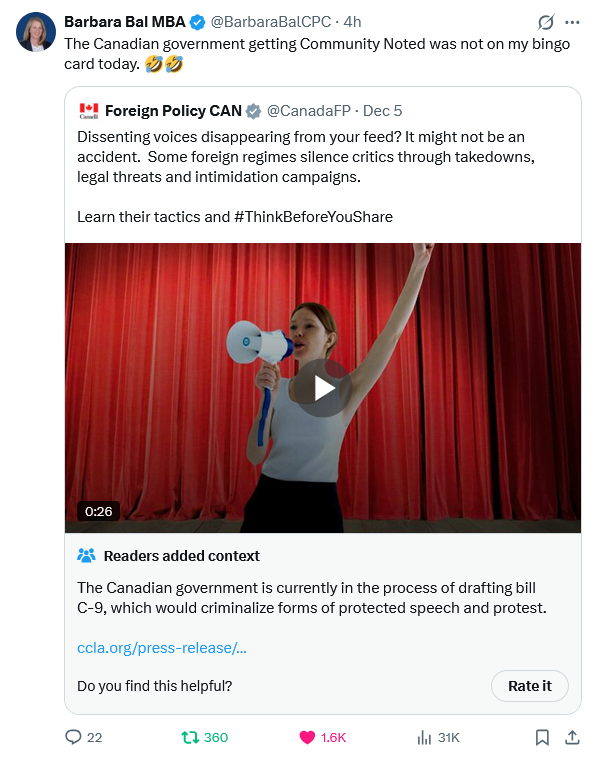
Update, 9 December: Welcome, Instapundit readers! Please do have a look around at some of my other posts you may find of interest. I send out a daily summary of posts here through my Substackhttps://substack.com/@nicholasrusson that you can subscribe to if you’d like to be informed of new posts in the future.

November 12, 2025

Bike lanes are only the start

Spaceman Spiff explains how aspirational schemes proposed by our technocratic governments at all levels seem to quickly and effortlessly shift from a nice non-intrusive improvement in life to an overbearing imposition of ever tighter controls on our lives:

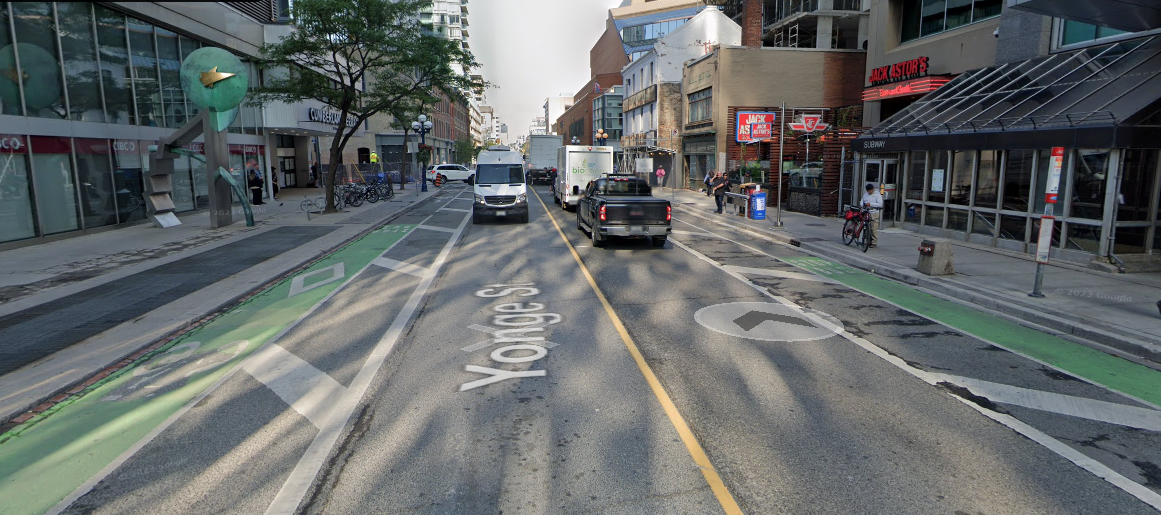
Bike lanes on Yonge Street north of Bloor Street in downtown Toronto.
Image from Google Street View

The adoption of cultural novelties follows a predictable path. Some bright idea is proposed and there is nominal support or at least not widespread opposition.

Soon after implementation begins its opposite is condemned. This is the first warning the lunatics have taken over the asylum. We move from a positive, optimistic drive to condemning a perceived negative. By then the intolerant are amassing, attracted to a secular pulpit with which to lecture the rest of us.

More time passes and condemnation of the opposite is not enough. We are commanded to behave in ways more pleasing to our public servants. We learn a key aspect of our future has been decided by a shadowy committee we have never heard of. A well-meaning experiment has become an imperative used to control us.

This absurd sequence is more common than it should be.

A common example in Britain is the creation of bike lanes.

The idea sounds benign. Let’s build cycle lanes to encourage exercise. It is broadly popular, a kind of inoffensive fad to encourage better health despite the weather being an impediment for most.

Few people actively object which is taken to mean they endorse these projects.

It is not long before support for helping cyclists degenerates into discouraging cars since people should be cycling more anyway. The initiative lends moral weight to an otherwise fringe view. The construction of the bike lanes accelerates these ideas as roads are narrowed and traffic slows, frustrating many. There are too many vehicles on the road we are told, all the more reason to get on your bike.

Soon suggestions are made to ban cars completely. The new idea proposed is to shut down the congested roads and replace them with even more bike lanes and pedestrian zones.

Some even openly discuss intentionally making driving awkward and expensive as an explicit goal. The technocratic mind often forgets its charges are people not slaves.

Before long everything shifts, then we wonder how we got to the point our own paid employees can openly gloat we will soon be banned from travelling in ways they dislike as if they are our controllers.

An idea appealing to a minority is imposed on all. Acquiescence to novelties becomes weaponized and subsumed into the ambitions of others. No one ever votes for these things. They seem to just appear.

The end result is often the destruction of goodwill as popular initiatives are rammed down our throats and used to berate us for failing to live up to the standards our public servants impose upon us.

We then tire of the lectures. We wonder where these lunatics come from.

A moment of complacency means unwanted bike lanes but before long it is banned cars, government-controlled IDs and digital currencies. Those who pay attention to the activist world often sense they’d build concentration camps if they could get away with it and all thanks to some benign-sounding scheme we didn’t object to.

November 2, 2025

QotD: The “Blob”, aka the Deep State

The parasitic unholy alliance of Big Corporations, Big Government, Big Bankers and their entire fan club and cheer squad of supporters. Dangerously, this also includes the watchdogs: the Spy Agencies and large parts of the media. The Blob takes money from citizens, pays other parts of the Blob (eg USAID, The UN, The BIS, The World Bank etc), pretends to “help” some token victim group or environmental cause, or even to monitor or audit The Blob, but the outcome benefits The Blob more than the victims. They line their own pockets and increase their own privileges.

The Blob also includes a special category of “useful idiots” who naively assist them in looting Western Civilization. These people are paid in status or an illusory sense of purpose rather than money. They may not realize they are part of the self-serving Blob, and in the long run are not only harming the trees, birds and whales they say they want to save, but are harming their own health, wealth, national security, and worse, that of their children.

Jo Nova, “The Secret Ruling Class – Why the anonymous Blob needs to be invisible”, JoNova, 2025-07-18.

October 19, 2025

Reframing the loss of elite legitimacy as a “loss of faith in democracy”

On his Substack, Frank Furedi illustrates how the public’s declining trust in political elites across the western world is being reframed in the legacy media as declining faith in democracy itself:

No doubt you have come across commentators and legacy politicians whining about the public’s loss of trust in democracy and in the key institutions of society.

“France is not alone in its crisis of political faith – belief in a democratic world is vanishing” commented Simon Tisdall last week in The Guardian.1 He noted that “belief that democracy is the form of governance best suited to the modern world is dwindling, especially among younger people“.

The tendentious claim that the current era of political malaise is an outcome of a loss of commitment to democracy is regularly echoed by mainstream commentators. This was the message of a recent Politico headline that stated that “Europe’s democracies are in danger, warn Merz and Macron”.2 It cited the German Chancellor Friedrich Merz stating that these “threats dwarf anything seen since the Cold War”. He noted that “the radiance of what we in the West call liberal democracy is noticeably diminishing”, adding: “it is no longer a given that the world will orient itself towards us, that it will follow our values of liberal democracy”.

If anything, the French President Macron was even more pessimistic than Merz. He warns that Europe is undergoing a “degeneration of democracy due to attacks from without and from within”. He was particularly concerned about the loss of faith in democracy within France. “On the inside we are turning on ourselves; we doubt our own democracy”, he noted, before adding, “we see everywhere that something is happening to our democratic fabric. Democratic debate is turning into a debate of hatred.” This statement coming from a man, whose presidency lacks a genuine mandate and relies on bureaucratic maneuvering exposes the cynicism of his concern for the “degeneration of democracy”.

[…]

Loss of elite authority

In reality the crisis of democracy narrative serves to mystify the real issues at stake. This narrative offers a misdiagnosis of the very real loss of legitimacy of the ruling elites as a loss of belief in democracy. As far as this dominant narrative is concerned every time people vote against the representatives of the legacy political establishment democracy is in trouble. So long as they win elections and populists aspirations are confined to the margins of society democracy is represented as a big success. But the very minute people vote the “wrong way” the mainstream commentators craft alarmist accounts about democratic backsliding. That is why the Remainer lobby often represents the outcome of the Brexit Referendum as an expression of “democratic backsliding”.

In theory, the term democratic backsliding refers to the declining integrity of democratic values. In practice it means the estrangement of significant sections of the public from their political institutions. The term democratic backsliding serves to mystify a very significant development, which is the legitimacy crisis of the legacy political establishment. Once understood from this perspective it becomes evident that it is not democracy that people no longer trust but the people and the institutions that rule over society.

As it happens the narrative of “democracy is in trouble” smacks of pure hypocrisy. Those who communicate this narrative are not so much interested in the integrity of democracy but in ensuring that people vote the right way. From their perspective if people vote the wrong way than democracy becomes dispensable. That is why more and more we hear the refrain that there is “too much democracy”. “Democracy Works Better when there is less of it” warned Financial Times commentator, Janan Ganesh.3 As far he is concerned, “no global trend is better documented than the crisis of democracy”, by which he means that too often people vote against the advice of the elites.


  1. https://www.theguardian.com/commentisfree/2025/oct/12/france-crisis-political-faith-belief-democratic-world-vanishing
  2. https://www.politico.eu/article/europe-democracies-danger-warn-friedrich-merz-emmanuel-macron/
  3. https://www.ft.com/content/f68c13a4-1130-49d5-b3c6-2270711d819e

September 21, 2025

“What do you remember of the summer when the English awoke?”

Filed under: Britain, History, Media, Politics — Tags: , , , , , , — Nicholas @ 03:00

In The Critic, David Shipley says that the rapid, visible rise in English nationalism is a new and positive thing in Britain:

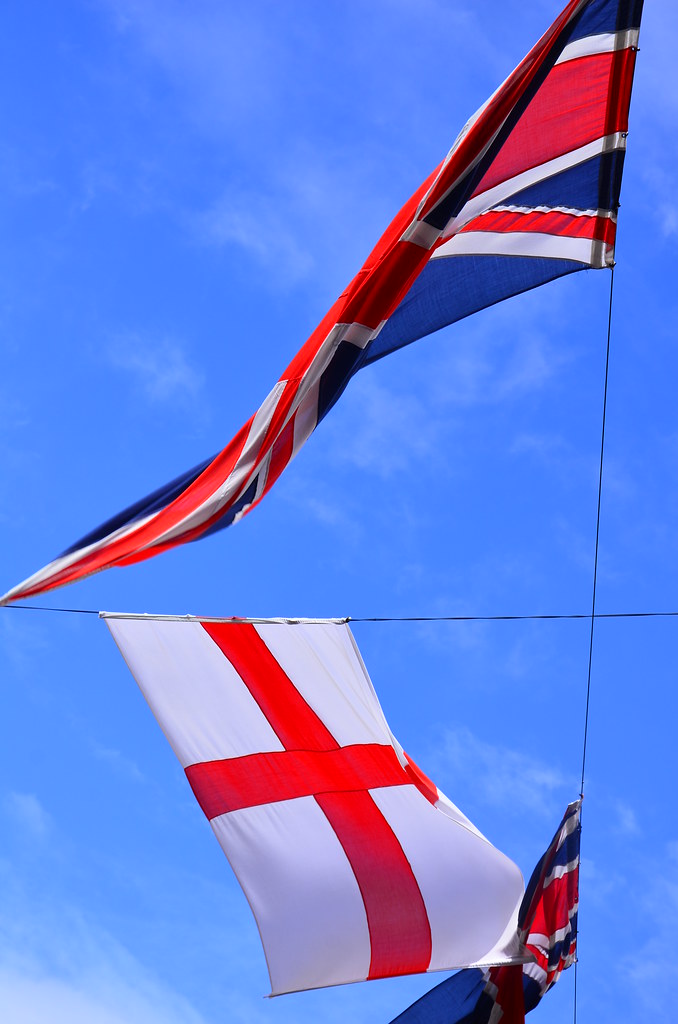
“Union Jacks and crosses of St George” by Ben Sutherland is licensed under CC BY 2.0 .

What do you remember of the summer when the English awoke? The summer of arguments over what “English” means, hotel protests, and of “flagging”. Overnight the England flag was everywhere. On lampposts, on bridges over motorways, and even painted on roundabouts, the St George’s cross appeared, as a challenge to the old regime, and a threat, or promise, of something new.

For this is new, make no mistake. In my lifetime, England’s flag has only been seen in force during football tournaments and at the rugby. Political figures of the left have seized upon this novelty as they have tried to resist the challenge. The Green Party leadership candidate Ellie Chowns insisted that “it’s traditionally not part of British culture to hang flags”, while Zack Polanski, the party’s new leader, said he wouldn’t fly the flag outside of football tournaments because “of what it represents to people who worry about that problematic history”, before going on to say he’s “worried that we’re importing fascism”. Meanwhile John McTernan, former advisor to Tony Blair insisted that flag flying isn’t an expression of “national pride”, but rather “being used to other people” (my italics).

Notionally sensible centrists, The News Agents suggested that the flag should be redefined as representing “tolerance, liberalism, democracy and Shakespeare” and that would deter “right-wing thugs” from using it. The propagandists of the regime recognise that it is in danger, and seem to believe that “British Values” are enough to hold back the tide.

York Council went ever further, saying that flagging has “coincided with a rise in racist incidents” and have decided to remove hundreds of England and Union flags, to which York’s “Flag Force” responded by announcing they would promptly replace every flag which was removed.

England’s flag was everywhere at the hotel protests too — standing for resistance against a Westminster regime that continues to force migrants upon communities which do not want them.

At the end of the summer, as the Last Night of the Proms coincided with the “Unite the Kingdom” march, the flag divide could not have been wider. On the streets of London that Saturday a sea of Union and St George flags, while at the Albert Hall it seemed one could wave any nation’s flag but England’s.

A Times cartoon from July caught the year’s mood. It depicted a group of unthreatening families protesting, holding signs saying We’re not far right – we’re worried about our kids and Deport Foreign Criminals. Beneath them, buried in the earth lurks a bald, beefy man with H A T E tattooed on his knuckles, and Made in England alongside the red cross of St George tattooed on his shoulder. Here, in the favoured paper of the British establishment, we see their fear that a deeper, more dangerous Englishness threatens to rise up, and threaten, or even destroy their order.

August 17, 2025

To replace a people, first you need to induce guilt and self-hate

On his Substack, Frank Furedi discusses just how negatively the British establishment views the national flag and those uncultured boors who display it:

“Union Jacks and crosses of St George” by Ben Sutherland is licensed under CC BY 2.0 .

First a confession. I am not a serial flag-waver. In fact, one of the features of British history that I always appreciate is that its people possessed so much confidence about itself that it did not see the need for ostentatious displays of patriotism and flag waving. However, today matters are different. The nation’s cultural and political elites regard the Union Jack and the St George’s Cross — the flag of England — with embarrassment and studied contempt. Today many British institutions would rather fly the Palestinian flag or the LGBTQ+ or of Ukraine than flags that bear the nation’s symbols. Outwardly pride in Britain is in danger of being displaced by the sentiment of self-loathing.

Foreign observers are often surprised by the relative absence of Britain’s flag in public spaces. As one such observer noted recently, in Oxford Pride flags are outnumbered the Union Jack “by at least fifty to one”. He noted that the “next day in London, I saw Pride flags all about, with the Union Jack reserved for tourist sites like the Tower of London, which also sported Pride flags”.

In fact, the British Establishment’s reaction towards England’s flag is often communicated through the sentiment of ridicule and hatred. This sentiment has been embraced by local councils, particularly ones that are under the influence of Labour and the Lib Dems. Many of them feel entitled to prevent these flags from being displayed. Most recently the Birmingham’s Labour dominated council has ordered the removal of Union and St George’s flags from lamp posts in this city. The Council announced its decision to remove the flag on the ground that they put the lives of pedestrians and motorists “at risk” despite being up to 25ft off the ground! Needless to say, the Council applies a different standard of judgment when it comes flying the Palestinian flag, which are flown all over the City. Presumably this flag does not constitute a danger to motorists and pedestrians.

In Birmingham, Britain’s second largest city flying the flag of the nation is regarded by local officialdom as a risk to safety.

The British Establishment feels contempt towards not only Britain’s flags but also towards the people who enthusiastically identify with them with patriotic pride. An incident involving Emily Thornberry, Labour MP for Islington South, in November 2014 captures well the contempt that significant sections of the British political class have towards the symbolic displays of patriotism. During a by-election campaign in Rochester, she posted a photo of a house displaying three St George’s flags, with a white van parked outside, and accompanied it with the arch caption, “Image from #Rochester”. The implication of her post was that those who decorated their house with the flags of England were a legitimate target of disdain. Since they were obviously morally inferior to her superior kind there was no need for a caption explaining this on her post.

Millennial Woes discusses how the contempt of the elites for the British people is leading to increasing possibility of civil unrest … or worse:

The short answer as to “why?” is that, even in mid 2025 when many people are sensing a mood developing, the government is still doing all the things that are bringing that mood about. They have no reverse gear. Despite their rhetoric, they are not reducing immigration and are certainly not doing mass deportation. In addition we have learned that, for years, they have been covertly propagandising us. Meantime the hate speech laws which muzzle us are still in force and being strengthened. Recently, the Online Safety Act came into force and the very next day numerous internet platforms had to start censoring content. We can literally see our oppression increasing in real-time. And even now, they want more. Always, we feel the government trying to stop us talking about its abuse of us. (Even as I type these words, I am aware that they could get the police raiding my home and seizing my devices.)

Image from Millennial Woes

The same is true in the media. This morning I heard that the BBC are making a high-profile drama about 11th Century Britain in which a key historical figure will be played by a Black actor. Our news media is still biased in favour of mass immigration at any cost. Adverts are still full of black-man-white-woman couples. It is relentless.

In business, White people are handicapped by preferential treatment for non-whites in employment, business loans and career opportunities. A few days ago I got an advert on YouTube featuring a business consultant woman who defiantly said “at the end of the day, diversity is the key to success”. Middle-class White people habitually work against each other and their group interests, causing personal failure and burning resentment for many of their ethnic kin.

It doesn’t actually matter whether the people who perpetuate all of this truly “believe” in it. What matters is that they are prepared to behave as if they do. The incentives have taken on a life of their own, become self-perpetuating, making alternatives almost illegal and certainly a guarantor of “social death” and “professional death”. Even with all the evidence that diversity is bad, nobody in the professional class will dare to speak against it because, even now, that would be the end of their career. And so the poisoning continues.

In short, I feel that my country’s mainstream is working constantly against my ethnic group surviving. Furthermore I see no end in sight for this ethnic sabotage.

And many other people think the same – more and more all the time, in fact. This is why they are getting ever more angry.

Among young people there are more reasons still, economic pressures which mean they can’t get on the property ladder and build the security to start a family. That is immensely frustrating for a lot of energetic young adults, and they haven’t got (haven’t been able to get) much to lose. When a society doesn’t facilitate this most basic desire in people, it should expect upheaval.

However, against this backdrop of oppression, dysfunction and madness, the main catalyst for civil unrest will be something much more concrete: refugees sexually assaulting White women and children. Such crimes are now occurring every day. Unfortunately, there is no reason why they will lessen in frequency. (I will not endanger myself further by explaining why. Everyone knows.)

And it is the fact that, indeed, “everyone knows” which makes civil unrest inevitable. It isn’t just spergs, theorycels, doomers, basement-dwellers and politics or race science obsessives any more; it’s the apolitical working-class who just want a decent chance at life. When they believe their own government is denying them that, it is inevitable that they will “rise up”. It is only a question of when, where, how and how many.

It has been pointed out that, during covid, the public didn’t “rise up”. But I say this was because, despite the restrictions and the perversity of that situation, throughout it people were still comfortable. Most importantly, they didn’t feel their children were in danger. That is the key thing. Dangers that never attended raising a child in Britain thirty years ago are now ubiquitous, even if you live in a nice middle-class town.

Update, 18 August: Welcome, visitors from Instapundit. Please do have a look around at other posts you may find of interest. I send out a daily summary of posts here through my Substack – https://substack.com/@nicholasrusson that you can subscribe to if you’d like to be informed of new posts in the future.
August 16, 2025

QotD: Rich anarchists

Filed under: Books, Economics, Politics, Quotations — Tags: , , , — Nicholas @ 01:00

So you talk about mobs and the working classes as if they were the question. You’ve got that eternal idiotic idea that if anarchy came it would come from the poor. Why should it? The poor have been rebels, but they have never been anarchists; they have more interest than anyone else in there being some decent government. The poor man really has a stake in the country. The rich man hasn’t; he can go away to New Guinea in a yacht. The poor have sometimes objected to being governed badly; the rich have always objected to being governed at all. Aristocrats were always anarchists …

G.K. Chesterton, The Man Who Was Thursday, 1908.

August 11, 2025

The problem with the theory that local government is more responsive is … people

Filed under: Government, Liberty, Politics, USA — Tags: , , — Nicholas @ 03:00

Poor Chris Bray is having a moment of deep cognitive dissonance over the vast chasm between his prior belief that local government is more sensible, more grounded, more responsive to the electorate than huge, distant, impersonal big government:

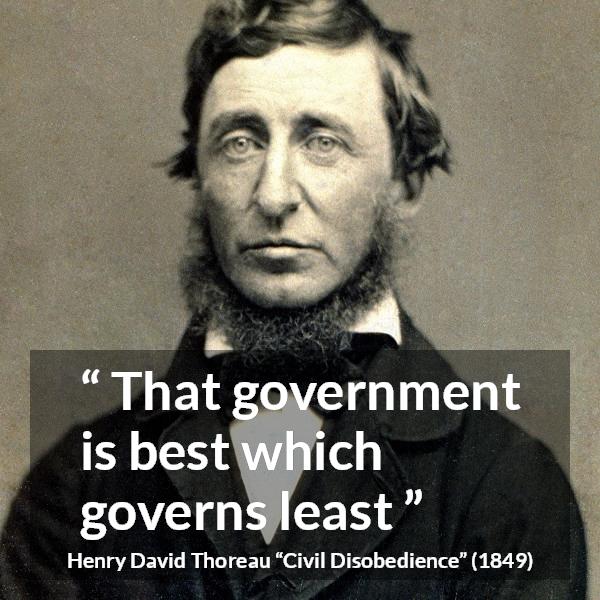
The more you deal with government, the more you are likely to agree with Thoreau

The problem of underlying principles and structural assumptions in a moment of profound cultural decay.

Like my old friend James Madison, the core of my understanding of political power is that authority becomes more rational and balanced as it gets closer to the people who are governed. Starting from home in my list of ideological priors, centralized power is usually going to be a steamroller, managed on top-down premises by people you’ve never met; local government, government by neighbors, is usually going to be more adept at listening and adapting. Your mayor is down the block, mowing his lawn. You can wave to him. When I worked at small town newspapers, I’d have breakfast with the city manager and the police chief — mostly so they could threaten to call my editor and have me fired, but still. They were here, right in front of me. I could talk to them. In the town where I’ve lived for a few years, now, I’ve waited at Trader Joe’s for a city councilman in cargo shorts and an old t-shirt to move over so I could get to the ground beef. They aren’t distant autocrats.

Sadly, though, a good few of them turn out to be proximate autocrats, and almost miraculously stupid. The problem with the theory of relatively well-balanced local authority is that some of the biggest goobers I’ve ever met have served on small town city councils and school boards, and your HOA board of literal neighbors makes Mussolini look like a hippie.

[Deleted a video here of an HOA officer being arrested, because it was staged.]

I wrote a quite carefully reported newspaper story about wasted money at a suburban school district, decades ago, that was critical but fair and elaborately sourced. The subsequent conversations I had with the members of the school board made me wonder if they had actual brain damage. No one on earth is more susceptible to psychotic conspiracy theories than small town elected officials, who respond to mild criticism by demanding to know WHO PUT YOU UP TO THIS, WHO ARE YOU REALLY WORKING FOR!?!?!?! WHAT’S YOUR TRUE AGENDA!?!?!?! WHO SENT YOU!?!?!?!? If you ask me for a list of the top ten people I’ve known personally and can’t stand at all, roughly eight of them were elected to local government positions in towns with low-five-figure populations, and I start grinding my teeth at the sound of their names. Wait, no: nine.

This topic is back on my mind this week because of Lina Hidalgo, though a county of five million people may be a bad example of real localism and neighborhood authority. Hidalgo is the county judge — in Texas, the chief executive officer — of Harris County. And she’s mad as a hatter. Click on the link to watch the video, but a tax increase is “not about politics, it’s about kids.” Never heard that one before.

[…]

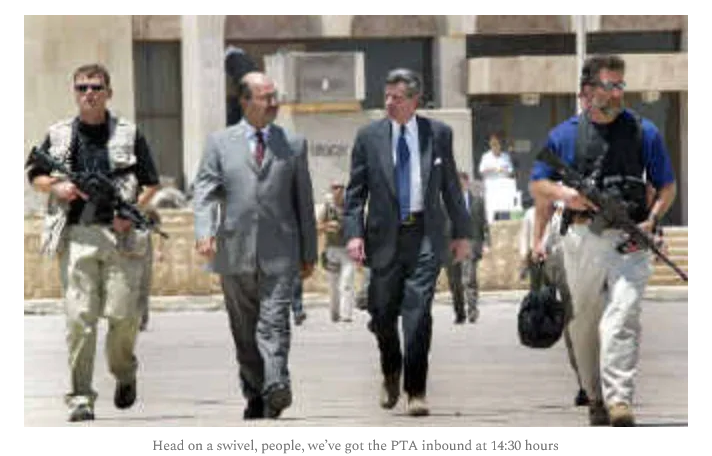
Making appalling decisions at the head of broken institutions, they respond to criticism by hiring men with guns as a shield against ordinary human contact. Like I said, the mayor is down the block, mowing his lawn, so you can wave to hi—STOP RIGHT THERE, GET ON THE GROUND.

The spirit of the NSBA letter lives on in a thousand local offices, where the problem with running schools is that parents exist, and the problem with running cities is that they have people in them.

August 10, 2025

Nova Scotia rediscovers the joys of dictatorial power

Filed under: Cancon, Government, Law, Liberty — Tags: , , , , — Nicholas @ 03:00

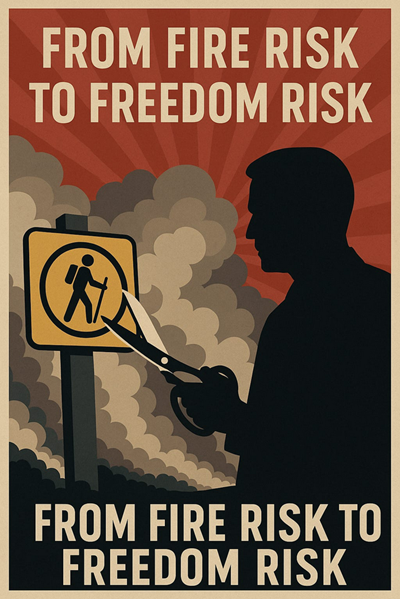
Clearly hankering for those glorious days when Canadians cowered in their homes due to the government’s public health diktats, Nova Scotia has now banned almost all outdoor activities in wooded areas across the province:

Image from Junk Economics

Nova Scotia’s Premier has decided that walking in the woods — yes, walking — is now so dangerous it carries a $25,000 fine.

Not for lighting a campfire. Not for running your ATV through dry brush. Not for tossing a cigarette. Just walking. In a province where there are currently four active wildfires … all under control.

This is not about preventing wildfires. This is about the politics of safety — and how governments turn fear into obedience.

I was born in Halifax, and my family’s roots run deep in Nova Scotia — deeper than the roads and towns that stand there now. Generations of my parents, grandparents, and great-grandparents — along with uncles, aunts, and cousins — are buried in its soil. My family weathered centuries of storms, wars, and political upheavals there, carving out a life from raw wilderness. This isn’t some detached policy rant from a distance. It’s personal. And it’s infuriating to watch a government use “safety” as a smokescreen for inaction, punishing people for living their lives while leaving the real problem unsolved.


The Problem They Didn’t Solve

In 2023, Nova Scotia suffered its worst wildfire season in history. At the time, the province had four Airbus H125 helicopters to fight fires.

In 2025, after all the smoke cleared and the “lessons learned” speeches were made, Nova Scotia … still has four Airbus H125 helicopters. Newer paint jobs, slightly upgraded safety features, same firefighting capacity. No fixed-wing aircraft. No surge ability. No major investment in manpower or pre-positioned crews.

The province didn’t fix the problem. They just hit refresh on the equipment list.

[…]


The Legal Overreach

The ban covers 89% of provincial land (Crown land) plus private forested land. Even if you own it, you can’t invite your mother over to walk her dog in your woods.

Section 7 of the Charter protects liberty, and the Forests Act was never intended to give cabinet the power to impose a province-wide walking ban. That’s legislative overreach wrapped in administrative convenience.

And the $25,000 fine? Grossly disproportionate — and in practice, quietly plea-bargained down because it’s more for optics than enforcement. A scarecrow penalty to make the Premier look tough on camera.


The Snitch Line and the COVID Flashback

Just like pandemic tip lines, Nova Scotia has invited citizens to report on each other for the crime of going for a picnic.

It’s hard to overstate how corrosive this is: encouraging suspicion, legitimising neighbour-against-neighbour policing, and normalising the idea that the government can criminalise any movement it decides is risky.

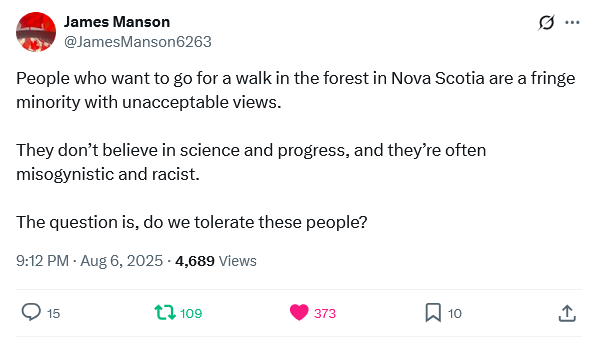
Of course, the commentariat is having a wonderful time of it:

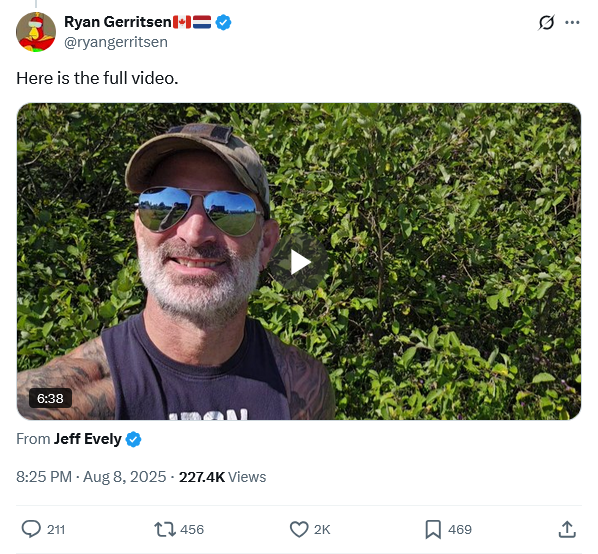
And what may be the first issued fine under the provincial ban went to Jeff Evely:

August 5, 2025

High tech and lust for power are a bad combination

Spaceman Spiff discusses the malign confluence of technocrats and amoral power-seekers (BIRM):

Today’s technocrats, assisted by billionaire tech bros, want to implement a digital surveillance grid that will eradicate any notion of anonymity or privacy forever.

Every major country, including the United States, is working on this with enthusiastic support from governments and their many agents.

The sales pitch is primarily platitudes about protecting people from harm, especially children.

What they seek is the end of the internet as it currently is, which means it will look a lot more like licensed corporate TV than the current free for all. From here their goal is to extend their surveillance operation into every aspect of our lives, from the energy we consume to the food we are permitted to eat.

This will probably cause a lot of damage, but it will ultimately fail.

Tech bro arrogance meets managerial control freakery

We are witnessing a partnership between the technocratic elite, with a limited understanding of technology, and silicone valley titans, who are blinded by the promise of technology.

Each group believes draconian surveillance systems combined with fancy data analysis will solve many societal problems and usher in a new era with them at the helm.

To the technocrats it promises full-spectrum control of all our choices. The food we eat, the material we consume, the ability to travel.

They are salivating at the thought of the ultimate control, the issuing of government-controlled digital currencies they can deactivate on a whim. No steak for the memelords, and no road trips for those without the right carbon profile.

They have been discussing these things for many years with a degree of enthusiasm bordering on mania.

The technologists see a chance to keep in with the powerful, to join the club. If they can be the trusted partner of the visionaries currently wrecking our world they will cash in and perhaps be spared from the concentration camps.

The technologists have powerful tools that promise amazing things. Machine learning, predictive programming, behavioural modelling.

Spotting patterns within trillions of data points is appealing to society’s tinkerers, all the better to predict problematic behaviours and to spot trends. Combined with nudge units and related horrors of social engineering this promises to be the holy grail for a technocratic managerialist regime absolutely convinced it can steer society in enlightened directions, just like they imagine they did during Covid.

It is all very futuristic, and it has clearly impressed our technology gurus as well as those who love control.

But along with the outsized data stores will come outsized cockups they cannot properly plan for.

Climate modelling has promised immense benefits and accuracy for decades and we have yet to see a single successful prediction. Indeed, some of the most famous climate predictions are almost comically wrong but nonetheless trigger endless rounds of funding, chatter, conferences and hubris. Such is the lure of anything that can be adapted to enforce top-down social control.

There have been many attempts to harness technology to predict the stock market, another obvious target. None of them worked either. It doesn’t seem to matter. No one is checking the track record. It is sold on its promise and that works because of who is buying. Or, rather, the type of person who embraces these schemes.

Digital surveillance, digital currencies, digital voting, digital IDs. Everything we do tracked and stored. Such absolute total control would make our superiors into gods as they exploit these powerful tools to direct us towards better versions of ourselves.

There is a delusion at play here. Those closest to this seem lost in their fantasies. They are blind.

August 2, 2025

Canada’s PM “… has a job which, like that of most politicians, requires low intelligence and moral vacuousness”

At Essays in Idleness, David Warren explains why Canadian political leadership is so desperately uninspiring … except to our enemies and ill-wishers:

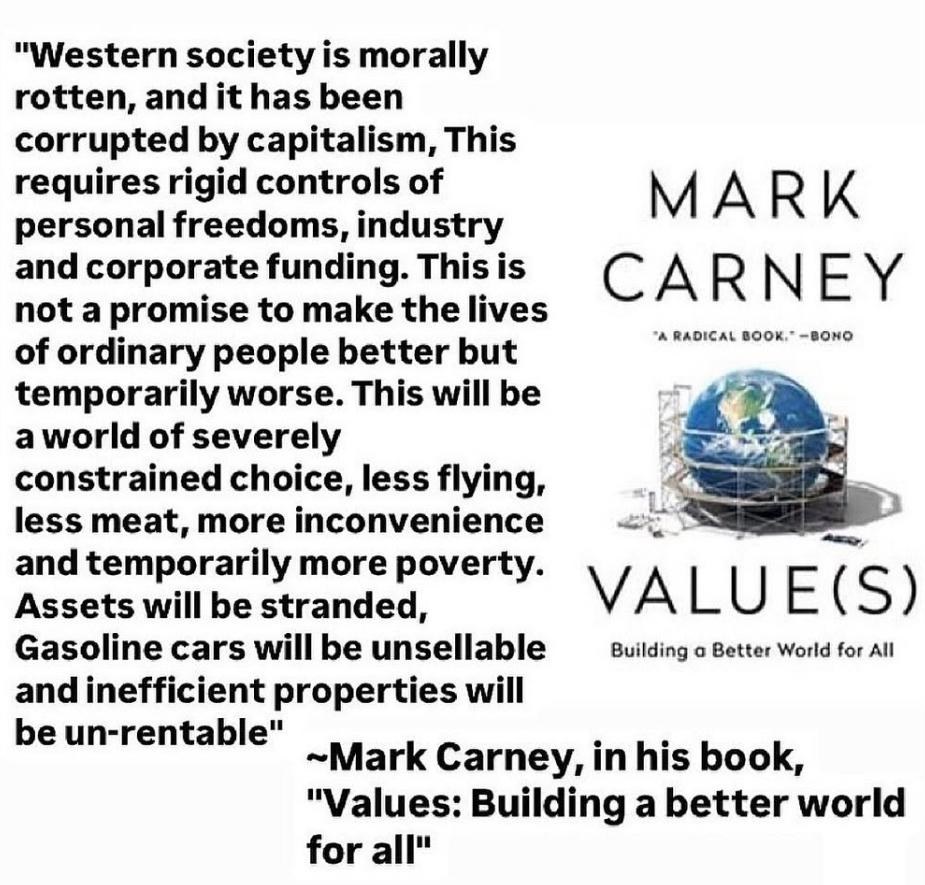
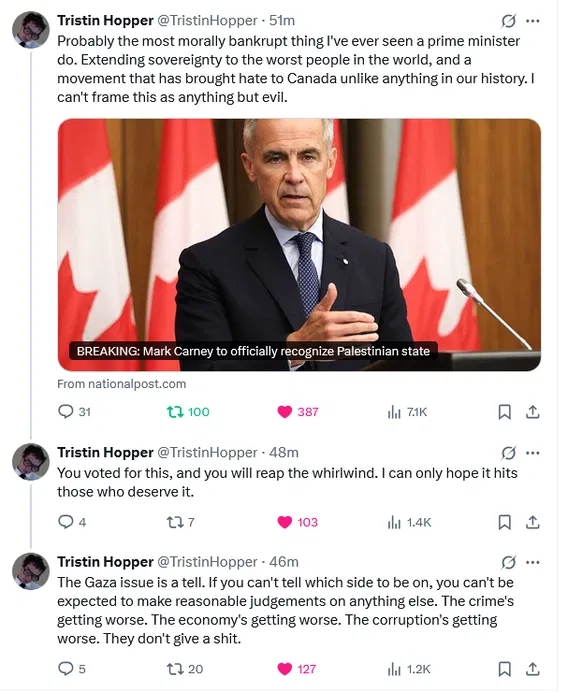
The Canadian prime minister — currently Mr Mark Carney — has a job which, like that of most politicians, requires low intelligence and moral vacuousness. At his cleverest he may exhibit a species of rat cunning. His views on Israel and the Middle East are quite uninteresting, for no rat cunning is required. He simply observes that an anti-Semitic policy is necessary, now that Muslim immigration exceeds the Jewish vote.

Not one good thing has come out of the Liberal Party since Louis St-Laurent was defeated in 1957. He, at least, achieved mediocrity. But what can we do? Canada’s population is one with the Liberals.

What happened on October 7th, 2023 — the slaughter of huge numbers of mostly unarmed Jews when Palestinians got outside the Gaza perimeter — can happen again and again. It will happen as long as Palestinians are, from childhood, taught or brainwashed to kill Jews throughout their education and social systems. I also protest against the disproportionate Israeli response. I think the Israelis have been much too restrained.

My model for “Palestine” would be Germany, or Japan. These formerly vicious nations became harmlessly bourgeois after they unconditionally surrendered to the United States and allies. It is ludicrous to think we should have offered them a peace deal, instead.

Damian Penny points out the sad truth that we get more obstinate even in support of a terrible idea when someone tries to bully us out of it:

… I find myself torn between being frustrated with my own government and simultaneously outraged by another government trying to bully us out of a policy decision with which I disagree.

I don’t expect most other Canadians to feel so conflicted, however. Trump may not realize it (nor care one bit even if he does understand it) but he just made it more likely that Canadian voters will rally around the flag.

This flag, specifically.

Nothing, and I mean nothing, has the motivational power of your opponent pushing back against you. That social media has given us a new and effective way to yell at and insult each other across partisan lines is part of the reason partisanship has become so much more entrenched in recent years.

And that includes me. During the last election campaign it was when I argued with Liberals on Facebook that I found myself feeling less like a Conservative voter and more like a Conservative militant, and my sparring partners likely felt the same way, only in the opposite direction.

Now, replace political partisanship with nationalism, and the effect becomes that much stronger.

Of course, hardcore supporters of either side won’t be moved. (That Carney is placing any conditions at all on Palestinian statehood, and saying a two-state solution remains the ultimate goal, makes him a filthy Zionist genocidaire as far as that crowd is concerned.) But sometimes it’s easy to forget that most people simply don’t pay as much attention to, and aren’t nearly as emotionally invested in, this conflict as much as we very online types are.

July 28, 2025

“According to elite theory our world is controlled by a ruling class”

Spaceman Spiff explores the notions of “elite theory”, which in one variant or another seems to be a bedrock belief of most dissidents in the west:

Elite theory is based on an important observation; small groups can more easily organize than large groups.

A modest number of wealthy individuals with common goals will easily run rings around a whole town, region or country because the masses cannot easily organize.

This infers enormous advantages, not the least of which is a small group can discuss and agree a strategy and then stick to it. Because of this some imagine elites as more able than they really are.

But power is tricky. All the money and all the clout in the world means nothing if you can’t project it far.

And our powerful, wealthy elites have one great weakness, they must work through others.

A hierarchy therefore exists which we occasionally glimpse adding to our confusion when we use words like “elites.”

Global rulers are ostensibly at the top. They sit above nation-states. They are truly post-national, controlling central banks and international finance. They are the closest thing we have to world controllers. Some seem to hold power over huge swathes of the globe, like gigantic economic zones.

In addition, all nations have visibly important people; kings, dictators, presidents and others. National elites are those whose power is largely confined to a territory. They lack the international reach of global elites.

The media represent power too. They are there to shape the narratives that govern our perceptions. Most traditional media outlets serve elite goals although some of their members wield tremendous power themselves.

The political class are the obvious lackeys of the powerful. Voters seem constantly amazed politicians never really improve anything once in power, but that is because they don’t serve those below them, only those above. Once you see this their behaviour makes much more sense. They dance to the tune of their paymasters. Their primary job is to pretend democracy works.

The corporate leaders are a less visible example of the same thing. They manage the commercial wing of elite interests while pretending to be businessmen.

Blackrock and others have almost completely abandoned anything resembling capitalism. They are gamers of systems, not the innovators of yesteryear. Just one reason our economies are struggling.

It is the major corporations who have helped establish diversity and climate goals, for instance, so they matter for furthering elite ambitions.

Local and regional elites exist too. Everything is replicated at ever smaller scales, including public sector employees and corporate managers.

These are the foot soldiers often oblivious to any elite goals. They just respond to the incentives and disincentives they are aware of at their level.

There is more, including academia and the major institutions. But the key idea is this is the hierarchy the powerful must work with to get anything done.

Projecting power downwards

At each stage there are numerous problems conveying information and taking action. Running the world is a demanding hobby. Power means nothing unless you can implement your schemes.

Communication is an ever-present issue. Things are misinterpreted. People misunderstand goals and aspirations.

There are probably no written plans. A lot of influence is achieved via think tanks and talking shops like the World Economic Forum, so is open to misinterpretation. It must be like herding cats as these grand ideas cascade down the hierarchy and are misunderstood or overlooked.

This process is further retarded by quotas and ideological capture. Woke brings many distortions; just ask the declining universities. Hiring for alignment does not select for the best. Elite need for control therefore leaves them with reduced options.

We’ve all seen some new appointee take over a position of authority and promptly run it into the ground. Imagine having to rely on that process to get anything done?

The lower down the totem pole we go the less able the people as a general rule. Specifically, in these benthic depths far from the centres of power, the minor lackeys run the grave risk of actually believing the claptrap used to control the masses which can be a real impediment to progress.

Those near the bottom generally lack the intellectual vigour to question anything which makes for obedient slaves, albeit dangerously detached from strategic awareness or understanding of the purpose of the narratives they uncritically embrace.

Such devotion is handy at first, it can provide real energy to make changes. Covid policies were established quickly thanks to this phenomenon. The implementation units were clearly unable to assess evidence or think for themselves; man on TV said wear mask and sit in back garden, so they did.

The price for such mindlessness is confusion and this is where control can be lost.

Anti-white animus gestated on university campuses was useful for the powerful to keep the most dangerous demographic down, and therefore less likely to form a counter-elite, but has now morphed into anti-Israel and pro-Palestine sentiment. It is evident many in academia, oblivious to the purpose of “decolonization,” have now misapplied this ethnic weapon to Israelis and Jews more generally to the horror of the powerful with plans of their own.

We see similar effects with climate zealots in positions of authority, especially in politics and media circles. It can be galling to realize some prominent person you once thought was capable actually thinks we only have twelve years to save the planet or wants to end cheeseburgers to help the coral reefs. Can they really be that impressionable?

What is frustrating for us must be maddening to the powerful as they watch brainwashed clowns misunderstand their goals. When your tools include the gullible things can get out of hand quickly.

That’s why many of the doom and gloom predictions based on some omniscient Illuminati are so off the mark despite their elevated position in society.

Projecting power is akin to shooting people in swimming pools. You can see them under the water, often very clearly, but it doesn’t necessarily help.

You fire off your rounds, but they quickly lose force as they enter some new medium of which you know very little, plus they can whizz away in unexpected directions, entirely missing their mark.

All that money and influence but you have to rely on dancing monkeys to get anything done. What use are trillions when Glenda in HR actually thinks her purpose in life is to root out systemic racism or heal the planet? Her initial zeal can quickly become a liability as ultimately happened during Covid when many began to wake up after the clownshow became too absurd to continue.

July 22, 2025

Bitter reality is coming for the laptop class

Spaceman Spiff foretells the end of the managed paradise of the “unsophisticated sophisticates” of the privileged laptop class who have been able to keep their dream alive at the expense of everyone outside their rarefied and protected bubbles:

There seems to be a section of society populated with gullible conformists who believe many of the manufactured narratives designed to manage society.

Most are the credentialed products of universities. The laptop class of professionals who operate the corporations, institutions and key organizations.

Their worldview is comprised of stories which are downloaded and stored as mental models. Adhering to these narratives can then devolve into belief systems that are placed beyond criticism. This in turn can easily degenerate into a kind of fanaticism.

Ideas like mass migration and the destruction of reliable energy sources are crazy and yet they are primarily in existence thanks to the efforts of this layer of society, the professionals who implement policies desired by the ruling class.

While some among them are cynically exploiting today’s fads for their own ends, many seem to be true believers.

How can they believe these things so completely? What is going on?

Rebels searching for causes

Most of today’s great crusades seem to have the same characteristics. They are easily downloaded and consumed, they are socially rewarded within some circles, and they are not immediately obvious as issues at all.

The most popular are pre-prepared to an almost comical degree and thoroughly focus-grouped to ensure minimal friction among their consumers.

Many even come with slogans attached. Diversity is our strength is every bit as artificial as two weeks to flatten the curve, but it goes down easily with no thought required, which is the point.

The ideas that stick are the ones most useful to demonstrate virtue. Showing off to your peers you are non-sexist, non-racist and non-homophobic helps secure your place in many professional hierarchies where visible in-group membership matters.

The most prized causes appear to be non-obvious where the conclusions are not reachable with the evidence available.

This confusing aspect makes many question some new idea or policy, but in the laptop class often triggers a sense of smugness that they see beyond the obvious to the obscure thanks to their impressive intellects. Criticism can then be dismissed as simplistic providing a rewarding sense of superiority.

Much of the above is evident in the belief systems of today’s professional classes.

[…]

What to make of all this?

Does any of this matter? Yes it does. It is this section of society that ultimately puts in place the ruinous ideas of the ruling class.

They are in the corporate offices, the local councils and the schools. They are running the television stations and the publishing houses. They are captured by groupthink. Everyone they know thinks as they do. All criticism is easily dismissed.

Very little can penetrate this bubble. Except one thing.

Over time reality intrudes. Models should be updated to accommodate new findings and observations, but that is challenging when they have been uncritically downloaded to satisfy psychological needs.

Contrary evidence threatens one’s sense of self so scrutiny is avoided. When these avoidances ultimately fail some dig even deeper. Magical thinking seems to be everywhere.

The ultimate effect is either a reassessment of one’s worldview, or a psychotic break from reality. We see examples of the latter; Trump Derangement Syndrome is one well known borderline psychosis but there are others.

June 8, 2025

Managerialism – threat or menace?

Filed under: Bureaucracy, Business, Government, USA — Tags: , , , , — Nicholas @ 05:00

In the New York Times (don’t worry … link is to an archived version), Nathan Levine explains to NYT readers why there is such a push back against the over-mighty technocratic organizations that have been running more and more of our fading civilization:

It is the culmination of a once marginalized, now transformative strand of political thought about who really holds power in the modern American system. Namely, that our democracy has been usurped by a permanent ruling class of wholly unaccountable managers and bureaucrats.

Anti-managerialism is back. Well positioned to answer decades of frustration with mainstream conservatives’ failure to deliver results, this old idea has become the central principle of the new right.

In fact, much of what is commonly called “populist” politics can be more accurately described as part of an anti-managerial revolution attempting to roll back the expansion of overbearing bureaucratic control into more and more areas of life.

Though it has so far met with limited success amid stiff resistance, grasping the nature of this anti-managerialism is essential to understanding the Trump administration’s effort to transform America’s institutional landscape, from government to universities and major corporations.

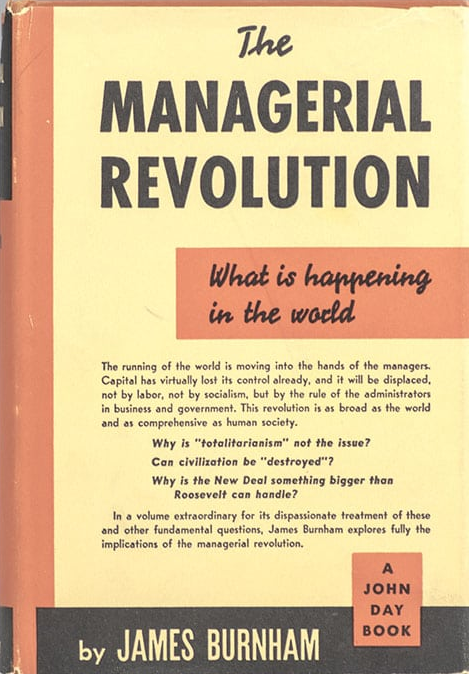
The idea’s intellectual history begins with the political philosopher James Burnham, who argued in his seminal 1941 book, The Managerial Revolution, that the aristocratic capitalist class was in the process of being overthrown by a revolution — just not, as the Marxists predicted, by the working class.

Instead, the exponential growth of mass and scale produced by the Industrial Revolution meant that in both corporation and state it was now those people cleverest at applying techniques of mass organization, procedure and propaganda — what he called the managerial class — who effectively controlled the means of production and would increasingly come to dominate society as a new technocratic oligarchy.

The book made an especially significant impression on George Orwell, who remarked that a managerial class consisting of “scientists, technicians, teachers, journalists, broadcasters, bureaucrats, professional politicians: in general, middling people”, hungry for “more power and more prestige”, would seek to entrench “a system which eliminates the upper class, keeps the working class in its place, and hands unlimited power to people very similar to themselves”.

Orwell was particularly struck by Burnham’s observation that the major political systems of the day — fascism, Communism and New Deal-era social democracy — were fundamentally similar in their turn toward the bureaucratic management of society. He observed that everywhere “laissez-faire capitalism gives way to planning and state interference” and “the mere owner loses power as against the technician and the bureaucrat”. Believing that accelerating managerial control risked dragging every society inexorably into totalitarianism, Orwell made Burnham’s ideas the basis of his novel 1984.

While the Cold War persisted, the view that America’s government might share some traits with the Soviet Union unsurprisingly proved unpopular, especially among Washington’s conservative establishment.

Nonetheless, the managerial class continued to grow, regardless of which political party controlled the government. Cold War defense budgets drove a relentless expansion of security state bureaucracy and the military-industrial complex. The advent of Great Society welfare programs and the Civil Rights Act demanded a re-engineering of social relations, prompting a dramatic proliferation of lawyers, regulatory bureaucrats and corporate compliance officers throughout much of public and private life. An ever-greater proportion of Americans began funneling through the credentialing machinery of higher education, inflating demand for yet more upper-middle-class managerial jobs.

May 9, 2025

They keep saying the quiet part out loud – democracy is a threat to the establishment

N.S. Lyons went to Barad-dûr Ottawa earlier this month to speak at the 2025 Civitas Canada Conference, and posted his remarks on his Substack:

The 2022 Freedom Convoy induced a state of panic in the Canadian federal government, yet the elected representatives proved completely unwilling to even talk to anyone from the protests. The government clearly persuaded itself that this was an actual insurrection, and waited for the violence to break out … and there was no violence, other than that provided by the police and a few paid actors.
A screenshot from a YouTube video showing the protest in front of Parliament in Ottawa on 30 January, 2022.
Photo via Wikimedia Commons.

Good evening ladies and gentlemen! It’s a pleasure to visit the North and get a glimpse behind the new Iron Curtain …

As it happens, the official theme of this conference is “Freedom and its Discontents: Liberal Democracy at a Crossroads”. That is a timely theme indeed. Because I think it isn’t too extreme to say that, all around the Western world today, democracy is under assault — even that it risks extinction. It risks extinction because the authorities that run our societies seem to find the practice, values, and very spirit of democracy to be increasingly intolerable.

In France, where the ruling government maintains power despite being the most widely hated in decades, the most popular candidate of the most popular political party has been barred from challenging that government in upcoming elections, on legal grounds that are openly political.

In Romania, when the “wrong” outsider candidate appeared poised to win an election, authorities simply canceled the election outright and then had him arrested, the unelected national security state inventing entirely unsupported excuses about foreign meddling to justify their coup d’état against the democratic process.

In Germany, the state has now begun the process of banning the country’s most popular party, supported by more than a quarter of the voting population, in order to avoid facing any real political opposition. “We did it in Romania, and we will obviously have to do it in Germany, if necessary”, is how a former European Commissioner confidently foreshadowed events on live television a few months ago.

One gets the sense that the honest view of our exasperated political elites is as captured in a Bloomberg News headline from last year which read: “2024 is a year of elections, and that’s a threat to democracy”.

In country after country, governments are moving to desperately tighten their grip over the people they rule, sharply curtailing freedom of speech and access to information, and using alleged threats to security and stability to justify granting themselves emergency powers, weaponizing the law, criminalizing dissent, and suppressing any meaningful political opposition.

In the United Kingdom, more than 12,000 people per year (that’s 33 per day on average) — are now arrested for speech- and literal thought-crimes, including silent prayer. UK jails now hold hundreds of political prisoners, more than anywhere else in Europe outside of Russia and Belarus. These are people persecuted for, essentially, voicing dissent over their government’s catastrophic policies. Recently, for instance, a British woman with no criminal history was jailed for more than two years for a single Facebook post criticizing the state’s willful failure to stop illegal migration.

In Brazil, a single Supreme Court judge, in alliance with the country’s leftist president, has effectively established a judicial dictatorship, locking up political rivals by decree, silencing the speech of opposition figures, and utilizing state leverage over the financial system to punish political enemies by banishing them from public economic life.

But of course Brazil’s authorities learned these tactics by observation. Observation of Canada, to be precise, where Justin Trudeau’s government first employed debanking — along with a little brute force — as a tool to crush peaceful protest of his draconian and disastrous pandemic lockdown policies.

Today, the Canadian government’s weaponization of the legal system and public institutions, including state-funded media, to impose a quasi-totalitarian progressive ideological regime, censor and jail dissenters, and effectively transform Canada into a one-party state, has, I’m afraid, won your country a real measure of global infamy. Many Canadians here may not be aware of just how your government appears from the outside, but I’m afraid it’s not a good look at all. Unfortunately I must report that when many of us look at Canada what we see is a global leader in progressive authoritarianism, out-of-control migration, growing anarcho-tyranny, foreign subversion, and ideologically-induced economic stagnation.

But then, what we might realistically call the liberal-authoritarian model is, sadly, the new normal in the West, where many hyphenated liberal-democracies seem to have concluded that they must now begin to cast off the democratic half of that historical compact.

It may seem that this hardening of control is a response to the rise of so-called populism, which has swept the Western world. Certainly many authoritarian measures have been justified, without any sense of irony, as necessary to defend “our democracy” (so-called) against the dissatisfaction of the actual demos. And it’s true that fear of populism — which is really fear of genuine democracy — does seem to consistently provoke a spiral of ham-fisted reactions by our increasingly authoritarian states. But the reality is that populism is itself a reaction, an organic immune response to the particularly unresponsive and anti-democratic new form of governance that has visibly overtaken the West in recent decades.

Older Posts »

Powered by WordPress