Quotulatiousness

March 5, 2026

“[I]nternational law is not law; it is a set of rules and claims that pretends to be law”

Filed under: Government, Law, Middle East, Military, USA — Tags: , , , — Nicholas @ 05:00

Lorenzo Warby discusses the charming illusion that “international law” is a real thing and must be treated as a real thing:

In domestic (“municipal”) law, questions of illegality arise. They arise because states have laws. They have laws because their laws come with remedies — consequences for breaking the law.

So, it is a genuine question whether President Trump is exceeding his constitutional authority in his attack on Iran. But that is a genuine question because the US has a Constitution that matters. The US is a rule-of-law state, no matter how much other common law jurisdictions may point and laugh at how politicised US law is.

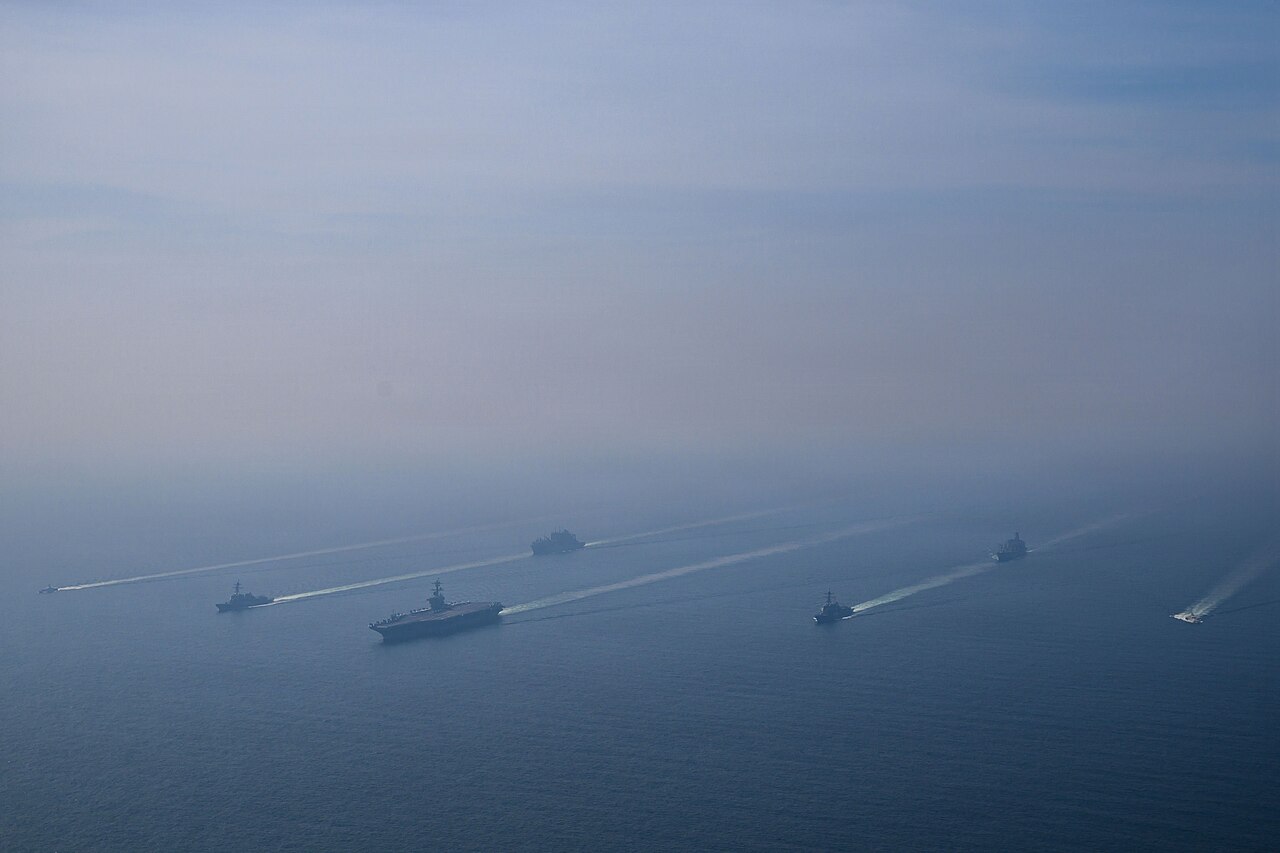
Nimitz-class aircraft carrier USS Abraham Lincoln (CVN 72), Arleigh Burke-class guided-missile destroyers USS Michael Murphy (DDG 112) and USS Frank E. Petersen Jr. (DDG 121), Henry J. Kaiser-class fleet replenishment oiler USNS Henry J. Kaiser (T-AO-187), Lewis and Clark-class dry cargo ship USNS Carl Brashear (T-AKE 7) and U.S. Coast Guard Sentinel-class fast-response cutters USCG Robert Goldman (WPC-1142) and USCGC Clarence Sutphin. Jr. (WPC-1147) sail in formation in the Arabian Sea, Feb. 6, 2026. The Abraham Lincoln Carrier Strike Group is deployed to the U.S. 5th Fleet area of operations to support maritime security and stability in the Middle East.
U.S. Navy photo by Mass Communication Specialist 1st Class Jesse Monford via Wikimedia Commons.

In terms of the international order, however, there is no such thing as an illegal war, because (public) international law is not law. It is a set of rules and claims that pretends to be law. It only pretends to be law as it has no remedies — apart from declarative statements, which are not enough to make it law. (Private international law does have enforceable and enforced remedies, so is law.)

One of the consequences of this is that (public) international law, as an academic discipline, has no substantive reality-tests. There are no decisions by judges that are enforceable and enforced. This has led to academic international law being the vector by which the toxic ideas of the Critical Theory magisterium, that increasingly dominates Anglo-American universities, have infected Law Schools.

(Public) International law should not be taught at Law Schools, because it is not law. It should be taught in International Relations or Political Science Departments. A PhD in International Law should not qualify you to teach in Law Schools. Indeed, if you cannot tell the difference between actual law — with genuine remedies — and a simulacrum of law, you should not be teaching students at all.

Rules-based international order

When folk refer to the rules-based international order, they are not referring to nothing. There are various rules and conventions it is convenient for states, and other agents, to follow.

There is also a difference between the mercantile maritime order and continental anarchy. It is not an accident that the original international conventions pertained to sea travel and trade.

Within continental anarchy, it is relative power that matters. A war that depletes your resources and capacities, but depletes those of your neighbours more, is a winning proposition, within the state-geopolitics of continental anarchy. The geopolitics of continental anarchy leads states to seek weak or subordinate neighbours. The mercantile maritime order, on the other hand, is all about creating win-win interactions.

Russia, India and China are all continental Powers that live, at least to some extent, in a situation of continental anarchy. But they are also trading States that benefit from the mercantile maritime order maintained by the US-and-allies maritime hegemony. The tension between China as a trading nation becoming the biggest single beneficiary of the mercantile maritime order maintained by the US-and-allies maritime hegemony, and the interests of the CCP (the Chinese Communist Party), is the central strategic difficulty that CCP China faces.

Israel faces the strategic dilemma of operating in a region of continental anarchy but seeking support from states deeply embedded in the mercantile maritime order. Whether the Middle East has to be a region of continental anarchy, or can it become far more embedded in the mercantile maritime order, is precisely what is at stake in the latest conflict.

Any social order has to be enforced. This is even more true of international orders. As there is no such thing as international (public) law, enforcing an international order is not a matter of rules, it is a matter of those who actively support and enforce that order and those who seek to subvert it.

A vivid example of how central enforceability is to any international order is given by comparing the treatment of Germany after the two World Wars. Germany was treated far more harshly after the Second World War than after the First World War. The crucial difference was that the Versailles order was not enforceable by the victors and the Potsdam order was.
March 3, 2026

Iran in the news

Filed under: Media, Middle East, Military, USA — Tags: , , , , , , — Nicholas @ 04:00

I haven’t bothered trying to keep up with the firehose of “news” about the combined US/Israeli operations against the Islamic State, as much of what is initially reported will be re-stated, retracted, refuted, and other words starting with “R” until something vaguely resembling objective analysis can be done. There are uncounted mainstream, specialist, and advocacy sites and there’s no point trying to keep up with them (for me, anyway). Here are a few bits of internet flotsam on issues arising from Operation Brass Balls (or whatever name they chose for it):

First up, J.D. Tuccille on the legality around President Trump’s decision to strike Iran:

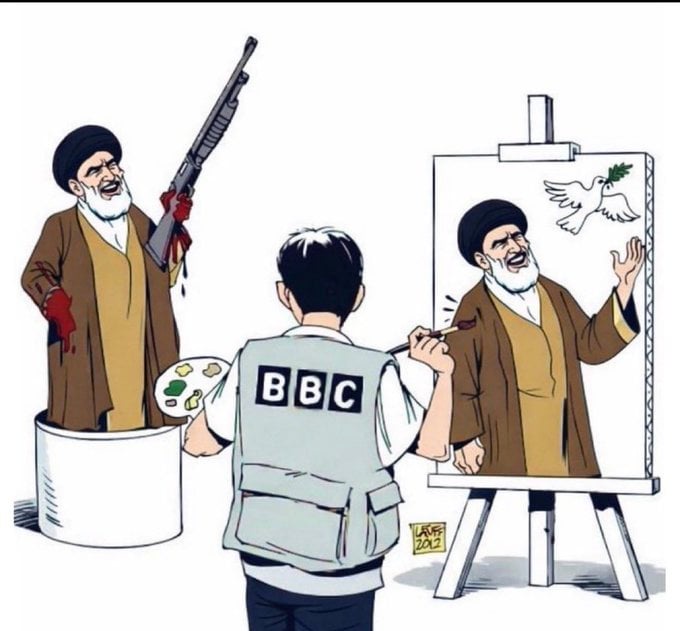
The BBC has a long history of … careful wording in describing events in Iran since 1979. I don’t think this cartoon is unfair in portraying that.

The world is undoubtedly a better place after the killing of Iran’s supreme leader Ayatollah Ali Khamenei and roughly 40 of his murderous colleagues by joint Israeli and American military strikes. Iran’s Islamist regime has slaughtered its own people while encouraging terrorism around the world for decades. But those strikes carry serious risks and costs. Are they worth the tradeoffs? The Trump administration should have made its case to Congress and the already skeptical public and satisfied the Constitution’s requirements by doing so.

War Without Debate

On Saturday, the U.S. and Israel launched much-anticipated strikes after claiming negotiations with the Iranian regime over the status of its nuclear weapons program had stalled.

“A short time ago, the United States military began major combat operations in Iran,” President Donald Trump announced. “Our objective is to defend the American people by eliminating imminent threats from the Iranian regime — a vicious group of very hard, terrible people. Its menacing activities directly endanger the United States, our troops, our bases overseas, and our allies throughout the world. For 47 years the Iranian regime has chanted ‘death to America’ and waged an unending campaign of bloodshed and mass murder, targeting the United States, our troops, and the innocent people in many, many countries.”

True enough. The president recited a litany of crimes in which the Islamist regime has been implicated, including the 1983 bombing of the U.S. Marine barracks in Beirut by Iranian proxy Hezbollah, and the October 7, 2023, Hamas attack on Israel, which Iranian forces helped plan. To this list we can add the attempted assassinations of Iranian dissident Masih Alinejad in Brooklyn and of then-presidential candidate Trump himself. Trump also called out Iran’s efforts to acquire nuclear weapons. And he urged the suffering Iranian people, who have weathered brutal attempts to suppress protests, to take advantage of the military strikes to overthrow the regime.

Unfortunately, this was the first time many Americans — members of the public and lawmakers alike — heard the Trump administration make a somewhat coherent argument for taking on Iran’s government. It came as strikes were already underway despite the Constitution reserving to Congress the responsibility to “provide for the common Defence”, “to declare War”, “to raise and support Armies”, and “to provide and maintain a Navy”. Lawmakers were informed of the attack on Iran, but only after the country was committed to hostilities and their related dangers and expense.

Congress and the People Were Never Consulted

“I am opposed to this War,” Rep. Thomas Massie (R–Ky.) objected. “This is not ‘America First’. When Congress reconvenes, I will work with @RepRoKhanna to force a Congressional vote on war with Iran. The Constitution requires a vote, and your Representative needs to be on record as opposing or supporting this war.”

Rep. Ro Khanna (D–Calif.) shares Massie’s skepticism towards military action. He and Massie might have voted against authorizing war with Iran even if they’d heard the administration’s arguments. Or perhaps they and other lawmakers would have been persuaded. We don’t know, because the president didn’t make a case until bombs and missiles had already been launched.

Andrew Doyle on the need for regime change:

The end point of armed conflict is impossible to predict. In her book On Violence (1970), the philosopher Hannah Arendt argued that when it comes to political violence, “the means used to achieve political goals are more often than not of greater relevance to the future world than the intended goals”. However well planned and executed, wars have a tendency to spiral out of control in ways never envisaged.

Whether Donald Trump’s decision to attack Iran will pay off depends upon the fates as much as anything else. The goal is regime change, which – given the appalling tyranny under which the Iranian people have suffered for five decades – is admirable and just. Yet the numerous unknown variables make this war the biggest risk that Trump has yet taken as president.

This war has the potential to escalate and engulf the entire region. Iran is already striking neighbouring Arab states allied with the US in a scattershot and desperate manner. With the death of the Ayatollah, it may be that the regime will be forced into a ceasefire while it seeks to re-establish its power. Yet the scenes of wild celebration on the streets of Iran would suggest that domestic revolution is its greatest threat. If the Islamic Revolutionary Guard Corps (not the country’s national army, but a kind of Praetorian guard for the mullahs) can be turned, the regime will fall.

Perhaps the worst case scenario is a widespread power struggle between competing militias and separatist groups. The IRGC itself could fragment, and we may see the kind of chaos that ensued after the Iraq war of 2003. The Trump administration has the advantage of the latest military technology and will insist that this enterprise will never require “boots on the ground”. It may be right, but who knows what factions will emerge with no centralised authority?

Those of us without a crystal ball should get used to the phrase: “we don’t know”. Various social media pundits are asserting with absolute certainty where all of this will lead. They would be wise to exercise greater caution. After the Twelve-Day War last June in which Israel and the US destroyed much of Iran’s nuclear infrastructure and air defence capabilities, many on the “America First” right were quick to prophesy the advent of World War III. Their claims to clairvoyance were unfounded.

CDR Salamander argues in favour of the punitive expedition as a legitimate tool in the nation’s war locker:

I support the strikes on Iran because it firmly fits into a view I have held on the use of national military power for decades, based on thousands of years of military practice. If you are not up to speed with the thousands of Americans dead and maimed by the Islamic Republic and its proxies over the last 47 years, then I have nothing more to discuss with you.

While I understand the academic argument of many that before any action takes place, there is a whole series of hoops, barriers, and puzzles of our own creation that we need to go through — I firmly believe that not only are those Constitutionally unnecessary for punitive expeditions in 2026, if done, needed and deserved strikes like we have seen in Iran could not take place without

Fortunes were made, institutions funded, and employment justified for legions under the old and failed post-WWII process swamp and GWOT nomenklatura that gave us unending and stillborn conflicts. To go that route again wouldn’t just be folly, it would be a self-destructive folly to refuse to change in the face of evidence.

I’ve seen older versions of OPLANS for Iran. Huge, bloody, and frankly undoable. They were only that way because they met the requirements of an old system that everyone nodded their heads to because all the smart people from Johns Hopkins, Harvard, Princeton and all the usual places said we had to do it this way.

Enough. Bollocks to all that. They have been measured the last quarter century and have been found wanting.

A series of events since October 7, 2023, including the 2024 election, has opened a window to do what we have not been able to do for a whole host of reasons — and there is a debt waiting to be paid.

We’ve been here before with Iran. In the modern context, we sank two warships and three speedboats of the Islamic Republic of Iran Navy in 1988 during Operation Praying Mantis as punishment for damaging USS Samuel B. Roberts (FFG 58) and Iran’s mining international waters in the Persian Gulf. We’ve played slap-n-tickle with them here and there while they have brutalized us at every turn when they are not brutalizing their own people.

Yes, it’s personal — but part of the reason we have been hesitant is that our national security intellectuals have been stuck in a world view that prevented action, by design.

Though not exclusive, the Powell Doctrine’s “Pottery Barn Rule” (that it appears he got from one of Thomas Frack’n Friedman’s columns), made it appear that we could only take action if we took the entire country and then remade it in our image.

We know how that operationalized over the last couple of decades.

We’ve done plenty of punitive expeditions in our nation’s history — but in the last few decades as a certain pedigree of policy maker held sway over our national security doctrine, it fell out of favor.

They failed the nation. Their institutions failed the nation. Their worldview was little more than a self-licking ice cream cone of self-regard.

There are also those who can find the funny aspects of any serious situation:

January 11, 2026

Iran in the news

Filed under: Media, Middle East, Politics, Religion — Tags: , , , , , — Nicholas @ 03:00

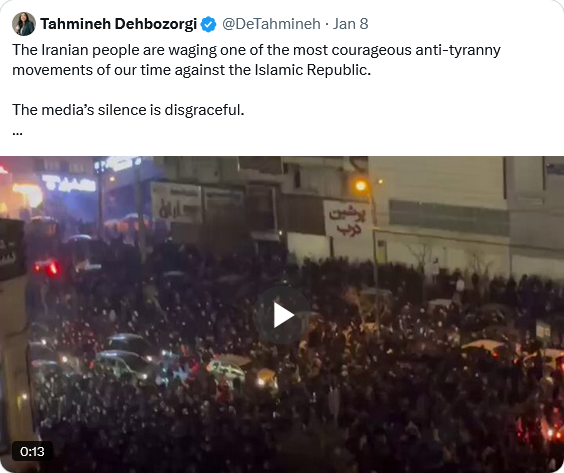
There’s a major upheaval going on in Iran, but the western media seem to be incapable of covering it with any depth — or in far too many cases, at all — even though it’s exactly the sort of thing they used to be very interested in. On the social media site formerly known as Twitter, Tahmineh Dehbozorgi provides useful context:

The Western liberal media is ignoring the Iranian uprising because explaining it would force an admission it is desperate to avoid: the Iranian people are rebelling against Islam itself, and that fact shatters the moral framework through which these institutions understand the world.

Ideally, to cover an uprising is not just to show crowds and slogans. It requires answering a basic question: why are people risking death? In Iran, the answer is simple and unavoidable. The people are rising up because the Islamic Republic of Iran has spent decades suffocating every aspect of life — speech, work, family, art, women, and economic survival — under a clerical system that treats liberty as a crime. There is no way to tell that story without confronting the nature of the regime.

Western media refuses to do so because it has fundamentally misunderstood Islam. Or worse, it has chosen not to understand it.

Islam, in Western progressive discourse, has been racialized. It is treated not as a belief system or a political ideology, but as a stand-in for race or ethnicity. Criticizing Islam is framed as an attack on “brown people”, Arabs, or “the Middle East”, as if Islam were a skin color rather than a doctrine.

This confusion is rooted in historical illiteracy. Western liberal media routinely collapses entire civilizations into a single stereotype: “all Middle Easterners are Arabs”, “all Arabs are Muslim”, and “all Muslims are a monolithic, oppressed identity group by white European colonizers”. Iranians disappear entirely in this framework. Their language, history, and culture — Persian, not Arab; ancient, not colonial; distinct, not interchangeable — are erased.

By treating Islam as a racial identity rather than an ideology, Western media strips millions of people of their ability to reject it. Iranian protesters become unintelligible. Their rebellion cannot be processed without breaking the rule that Islam must not be criticized. So instead of listening to Iranians, the media speaks over them — or ignores them entirely.

There is another reason the Iranian uprising is so threatening to Western media is economic issues.

As you know, Iran is not only a religious dictatorship. It is a centrally controlled, state-dominated economy where markets are strangled, private enterprise is criminalized or co-opted, and economic survival depends on proximity to political power. Decades of price controls, subsidies, nationalization, and bureaucratic micromanagement have obliterated the middle class and entrenched corruption as the only functional system. The result is not equality or justice. It is poverty, stagnation, and dependence on government’s dark void of empty promises.

Covering Iran honestly would require acknowledging that these policies are harmful. They have been tried. They have failed. Catastrophically.

This is deeply inconvenient for Western media institutions that routinely promote expansive state control, centralized economic planning, and technocratic governance as morally enlightened alternatives to liberal capitalism. Iran demonstrates where such systems lead when insulated from accountability and enforced by ideology. It shows that when the state controls livelihoods, non-conformity becomes existentially dangerous. That lesson cannot be acknowledged without undermining the moral authority of those who advocate similar ideas in softer language.

Western liberal media prefers not to hear this. Acknowledging it would require abandoning the lazy moral categories that dominate modern discourse: oppressor and oppressed, colonizer and colonized, white and non-white. Iranian protesters do not fit. They show that authoritarianism is not a Western invention imposed from outside, but something many societies are actively trying to escape.

That is what terrifies Western liberal media. And that is why the Iranian people are being ignored.

So the silence continues.

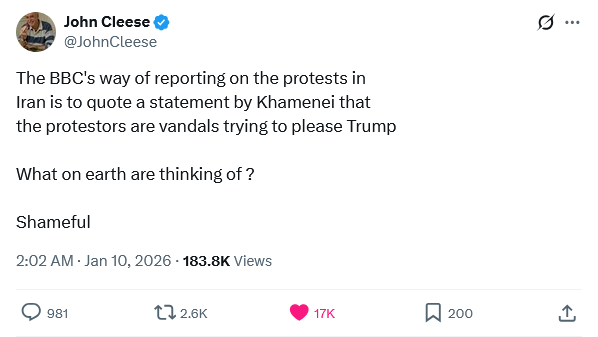
John Cleese:

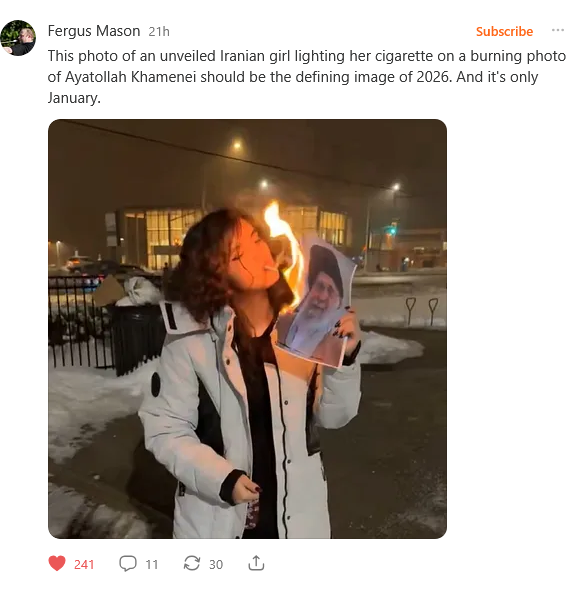
On Substack Notes, Fergus Mason shares what might be the most iconic photo of the young year:

Update, 12 January: Welcome, Instapundit readers! Have a look around at some of my other posts you may find of interest. I send out a daily summary of posts here through my Substackhttps://substack.com/@nicholasrusson that you can subscribe to if you’d like to be informed of new posts in the future.

December 31, 2025

The Royal Canadian Navy … a terrorist organization according to Iran

Filed under: Cancon, Middle East, Military — Tags: , , , — Nicholas @ 05:00

An unexpected post from True North Strategic Review, as Noah shares the details of a new announcement from the Islamic Republic of Iran about that well-known terrorist group known as His Majesty King Charles’s Royal Canadian Navy (RCN):

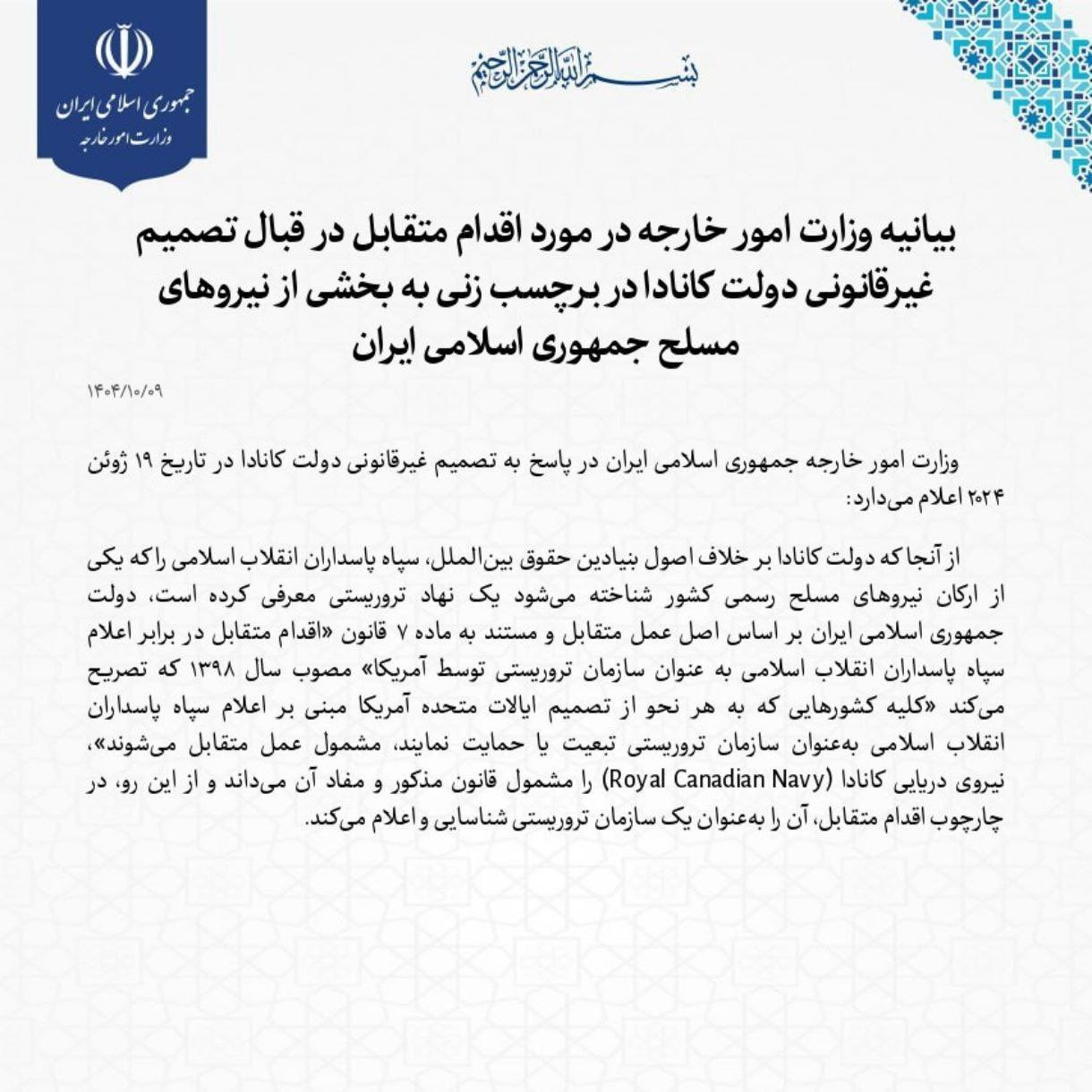
Statement from the Iranian Ministry of Foreign Affairs, via True North Strategic Review

Welp. Sometimes you wake up to the most random things imaginable. This is certainly one of them in my books.

The Iranian Ministry of Foreign Affairs has released a statement today officially designating the Royal Canadian Navy as a Terrorist Entity under the “Tit-for-Tat” trigger outlined in Article 7 of the Reciprocal Action Against the Declaration of the Islamic Revolutionary Guard Corps as a Terrorist Organization by the United States Act.

Here is the translated statement for those curious:

    Since the Canadian government has declared the Islamic Revolutionary Guard Corps, which is recognized as one of the pillars of the country’s official armed forces, a terrorist organization, contrary to the fundamental principles of international law, the government of the Islamic Republic of Iran, based on the principle of reciprocity and based on Article 7 of the “Reciprocal Action Against the Declaration of the Islamic Revolutionary Guard Corps as a Terrorist Organization by the United States” Act passed in 2019, which stipulates that “all countries that in any way comply with or support the decision of the United States of America to declare the Islamic Revolutionary Guard Corps as a terrorist organization shall be subject to reciprocity,” considers the Royal Canadian Navy to be subject to the aforementioned Act and its provisions, and therefore, within the framework of reciprocity, identifies and declares it as a terrorist organization.

For a bit of context, under the Reciprocal Action Against the Declaration of the Islamic Revolutionary Guard Corps as a Terrorist Organization by the United States Act, the Iranian government includes a clause stating that any country that supports or complies with the U.S. decision to label the IRGC as terrorists is also subject to reciprocity.

This retaliation clause is in direct response to the Canadian government’s decision last June to declare the Islamic Revolutionary Guard Corps as a terrorist entity. Although quite late to respond, the decision to designate the Royal Canadian Navy specifically is a curious one.

The likely scenario is that the choice was made based on operational proximity. The Royal Canadian Navy is the branch of the Canadian military most likely to physically encounter Iranian forces. They’re really the only branch that maintains a tangible, visible presence near Iranian territory. By designating the Navy specifically, Iran is creating a legal pretext to harass or target Canadian vessels in these international waters under the guise of Counter-Terrorism operations.

August 5, 2025

Inside the CIA Coup That Changed Iran Forever! – W2W 38

Filed under: Britain, History, Middle East, Russia, USA — Tags: , , , , , , , , — Nicholas @ 04:00

TimeGhost History
Published 3 Aug 2025

In 1953, a battle for Iran’s soul erupts on the streets of Tehran. Prime Minister Mosaddegh defies British oil interests, outwits Soviet intrigue, and faces down the Shah — but a secret Anglo-American plot changes history forever. As coups, street mobs, and betrayal plunge Iran into chaos, the nation’s fragile democracy is crushed and a brutal new order rises. This is the untold story of oil, espionage, and the coup that reshaped the Middle East.
(more…)

June 26, 2025

NATO members “commit” to a new 5% defence spending target

Filed under: Cancon, Europe, Military, USA — Tags: , , , , , , — Nicholas @ 03:00

As many predicted, just as Canada finally gets around to at least pretending to meet the 2% defence spending target we agreed to over a decade ago, those goalposts get moved:

So today the leaders of Nato convene for a landmark summit:

NATO countries agree to increase defence spending to 5%

That headline isn’t strictly accurate. Member states have apparently agreed to commit to a target of 5% by 2035, to mark the start of the fourteenth anniversary of the Ukraine war. Which means that, as always with Nato, they’ll all look butch at the photo-op, and then they’ll do bugger all. Even the “commitment” to a “target” is too much for Spain, which has secured an opt-out.

But hang on a minute: Nato has been at war — or at proxy-war — with Russia for three-and-a-half years now. So it’s been on a war-footing, supposedly, for seven-eighths of the length of the First World War. How’s that war-footing going? Per Nato’s head honcho, Mark Rutte (the woeful former Dutch PM — ask our pal Eva Vlaardingerbroek), earlier this month:

    The Russian army is developing its war capabilities by multiple times more than that of NATO despite having an economy 25 times smaller, NATO’s secretary general has warned …

    “The Russians, as we speak are reconstituting themselves at a rapid pace and producing four times more ammunition in three months than the whole of NATO in a year,” said Rutte.

That’s a rather confusing way of putting it; what he means is: the Russians (who, as Mark Levin assures us, “scare nobody”) produce more ammunition in three weeks than the whole of Nato does in a year. Can even Nato be that worthless?

Taking the Secretary-General at his word, if you’re wondering why the Pentagon has to divert ammo marked for Israel to Ukraine and then divert it back from Ukraine to Israel … well, let’s do what everybody else does and dredge up the only historical analogy anybody knows — not the First World War, but the Second (see Levin’s “Iranian Nazi regime”): We’re asked to believe that Nato needs longer than the US was in the Second World War for to move to a war-production footing.

To be sure, supply chains are always difficult: Iran’s threat to close the Strait of Hormuz could have seriously impacted McDonald’s need to recall the hash browns it sent to Montenegro and divert them to Kiribati.

Trump gets something very basic: Flying the highest of high-tech weaponry seven thousand miles to drop down a ventilation shaft opening the size of a dishwasher is the kind of brilliant, dazzling one-off only the United States can do. But what next? Almost all geopolitical conflicts start with a bit of shock-&-awe (Pearl Harbor, even the assassination of the Archduke) and then dwindle down to old-school wars of attrition – as the United States should certainly know after taking twenty years to lose to goatherds with fertiliser, and three years to lose to “a gas station masquerading as a country” (thank you, John McCain). In wars of attrition, old-fashioned unglamorous things become important, like the ability to manufacture bullets in a timely manner. The basic arithmetical calculations are not complex: Don’t get into a long war with an enemy whose stock of long-range ballistic missiles outnumbers your surface-to-air missiles.

So Trump had the narrowest window of opportunity, and used it.

On the other side, the last week-and-a-half mostly revealed the shallowness of the War Party. You’ll recall, for example, that Ted Cruz got into a spat with Tucker over the actual population of Iran. Last week, a UK podcast had a brief discussion on The US Army-Marine Corps Counter-Insurgency Field Manual, which notes the following (foot of page xxvi):

    The troop demands are significant. The manual’s recommendation is a minimum of twenty counterinsurgents per 1,000 residents.

That’s roughly what the British had in Malaya. Which they won, by the way. Twenty-two years ago, a couple of weeks after the fall of Saddam, I stopped on the shoulder of the main western highway from Jordan to Baghdad to fill up from an enterprising Iraqi who’d retrieved some supplies from a looted petrol station and was anxious to sell them to any passing Canadian tourists. As he was topping off, I asked him how agreeable he found the western soldiery. He grinned a big toothless grin and pointed to a chopper that had just come up over the horizon to hover above our heads. Then he said: “Americans only in the sky.”

We did not win that one, you’ll recall. Instead, we created an Iranian client-state.

That’s why Ted Cruz’s breezy indifference when Tucker asked him the population of Iran was so revealing. The senator told Tucker that it doesn’t matter whether the population of Iran is eighty million or a hundred million. Really?

Because, per the Pentagon’s own field manual, the latter figure would require finding an extra 400,000 troops. Oh, wait. If it’s a Nato mission, the other members could muster 127 guys between them, so it would only require 399,873 extra Americans.

Even if the public were minded to put one-and-a-half million pairs of boots on the ground, it couldn’t do it. “Americans only in the sky” equals what an Australian prime minister told me, after a flying visit to the troops in Afghanistan, was “the Crusader fort mentality”.

It doesn’t work. The political divide in America is between, crudely, Trumpians and neocons. The former are anti-war; the latter are pro-war … but a way of war that doesn’t work.

June 23, 2025

US strikes against Iranian nuclear facilities

Filed under: Media, Middle East, Military, Politics, USA — Tags: , , , , , — Nicholas @ 03:00

One of the most frustrating aspects of internet culture today is the need for instantaneous “analysis” of military events. We all understand the desire for such insight, but the accuracy of information available in the immediate aftermath of any event is highly variable. Between the need to control the narrative on the part of the participant powers, the propaganda value of being “first” to report, and the impossibility of accurate damage assessment, it’s a wise move to discount almost everything you hear about a big event for some time. Chris Bray suggests that the old “72 hours rule” may be insufficient for something like the US bunker busting strikes against Iranian nuclear research facilities:

First, wait a while. Sean Hannity just announced that “a source” told him the attack was a complete success, and all of Iran’s nuclear sites were fully destroyed. I’d hesitate to believe that, is the gentle way to put it. I’d also hesitate to believe the stories being told from the other direction, and don’t forget that Trump’s attack on Qasem Soleimani produced a full week of OH NO WORLD WAR III JUST BEGAN stories in the establishment media. The likelihood is that none of what you’re hearing this week is fully true. Wait and watch. I hope that Iran and the US are backchanneling while engaging in belligerent public posturing, but by definition we’re not going to see the backchanneling. We’ll see. The 72 Hour Rule is in effect, here, at the very least.

Second, the ludicrous story in which Trump is violating law and political norms with unilateral military action is, as always, a deliberate performance of political amnesia. These are our political norms, for crying out loud.

We should probably fix that. But the people who tolerated an American war in Libya without direct congressional authorization, and who tolerated an American war in Yemen without direct congressional authorization, and who tolerated an American war in Syria without direct congressional authorization, aren’t actually going to impeach a president over military strikes in the Middle East undertaken without direct congressional authorization. It’s a show. The More Than a Week Rule requires us to view this action in the longer and generally quite unfortunate context of American foreign policy, and the politicians who are outraged by unilateral military action in the Middle East have zero standing on that score.

Third, and related, the 2001 Authorization to Use Military Force is still in effect, and still being stretched and massaged beyond its intent and meaning, but note that Congress still hasn’t repealed it. A Congress that wished to restrain presidential military action in the Middle East would probably start there, and they haven’t.

Glenn “Instapundit” Reynolds has a few thoughts on the matter:

People have been singing about it since 1980, but yesterday’s bombing raids on Iranian nuclear facilities were the first bombing attack since the 1979 hostage seizure.

Despite numerous calls for action against the Islamic Republic, Operation Midnight Hammer was the first U.S. military action against important Iranian assets on Iranian territory. The bombs fell less than 24 hours ago, but here are a few preliminary takes.

Competence. The most striking thing about the attacks was the extreme competence displayed by the Air Force, the Defense Department under Secretary Pete Hegseth, the various intelligence assets involved, the State Department, and the entire administration. There were no leaks. (How did they avoid leaks? Basically, they didn’t tell any Democrats what was coming. Take note.)

Not only were there no leaks, but President Trump and the diplomatic apparatus kept the Iranians in the dark, giving the impression of waffling in the White House even as things were being lined up. They received unintentional help in this from Sen. Charles Schumer, who had been for some time pushing the “TACO” acronym — Trump Always Chickens Out — in the service of a storyline that Trump was all bluster and no follow-through. The Iranians, apparently dumb enough to believe Democrats and the mainstream news media (but I repeat myself) were snookered.

New Diplomacy: In dealing with the Iranians in the 1980s, Donald Regan told President Reagan that America had been repeatedly “snookered” by a bunch of “rug merchants”. The Iranians were in fact very good at leading Americans down the garden path, invoking (often imaginary) splits between “hard-line” and “moderate” Islamists in their government as excuses for delay and backtracking.

In truth, as Henry Kissinger once said, “An Iranian moderate is one who has run out of ammunition“. After these raids, and the many Israeli attacks that led up to them, all of Iran is out of ammunition.

June 14, 2025

Damian Penny’s diligent recycling efforts pay off

Filed under: Media, Middle East, Military, Weapons — Tags: , , , — Nicholas @ 03:00

At Rigid Thinking, Damian Penny has to be given top marks for recycling this week, although it’s not newspapers or plastic cartons he’s getting to do twice the work:

Please keep psychotic Twitter accounts with animated-squirrel avatars in your thoughts and prayers this weekend. They’re going through a tough time right now.

And, once again, the point I made last week is proven:

    Did this operation really do as much damage as the Ukrainians Israelis say? I dunno. I don’t begrudge the Ukrainians Israelis their own propaganda weapons.

    (Plus, these are Russian planes Shah-era jets for which getting parts is a massive pain in the ass, so there’s a good chance they might have just exploded on their own, like a Soviet television set left plugged in overnight.)

    But the mere fact that Ukraine Israel was able to pull this off at all, right under the Russians’ Iranians’ noses, is a game changer. The message to Czar Vladimir the Mullahs, that we can strike literally anywhere, couldn’t be more clear.

    We’ll get the whole story from the Ukrainian Israeli side soon enough. What I’m chomping at the bit to see is what’s in the Russian Iranian archives someday, when Putin the “Islamic Republic” is gone and McDonald’s has been restored to its rightful place in Red Square Azadi Square.

    A few weeks after the Russian invasion, when it became clear that they were in for a much harder time than anticipated, I wrote about how what would appear to be an authoritarian government’s great advantage over liberal democracy — the ability for its leaders to just “get stuff done” instead of having to put up with the horse-trading and lobbying and arguing and mean tweets which make can make things so exhausting and frustrating for a more open society — eventually becomes a disadvantage.

    […]

    If the leader can do whatever he wants without any serious resistance, everyone else learns to keep their heads down and not do nor say anything which will make him angry.

    Because you really, really wouldn’t like him when he’s angry.

    As a result, the guy in charge is surrounded by sycophants and yes-men who will nod along and feign enthusiasm for whatever he wants to do, even if they know it’s really risky and/or really, really stupid.

    That filters down to the drones (the human kind) and proles, too. I’m not a betting man, but I’d bet my entire hoard of Hawk Tuah meme coins that Russian Iranian intelligence services actually knew, or at least strongly suspected, that something like Operation Spiderweb Operation Rising Lion was in the works.

    Good for them. Now, you go and tell the Czar Ayatollah that there are Ukrainian Mossad operatives (and, at the risk of wishcasting, some Russians Iranians brave enough to assist them) thousands of miles away from Ukraine Israel, ready to take out much of the strategic bomber fleet air defences.

    Ukraine Israel, by contrast, is an open enough society to learn from its mistakes, see what actually works, and adapt accordingly. Russia Iran is a closed society which keeps doubling down on what it was already doing, and woe is you if you suggest a change of course.

    It doesn’t matter how much stronger you are in terms of weaponry, if your society and political system punishes anyone who might tell the leader he’s wrong.

Well, that was surprisingly easy to write about. Here’s hoping I don’t get lazy and get into the habit of throwing on old reruns, assuming you kids won’t know the difference.

March 18, 2025

Getting rid of Houthi and the Blowfish

Filed under: Middle East, Military, USA — Tags: , , , — Nicholas @ 03:00

It has been alarming just how long the west — and especially the United States — have been willing to put up with Houthi attacks on shipping going through the Red Sea. President Trump has indicated that American patience has run out, as CDR Salamander discusses:

The Houthi Ansarullah “Al-Sarkha” banner. Arabic text:
الله أكبر (Allah is the greatest)
الموت لأمريكا (death to America)
الموت لإسرائيل (death to Israel)
اللعنة على اليهود (a curse upon the Jews)
النصر للإسلام (victory to Islam)
Image and explanatory text from Wikimedia Commons.

… in the almost 18 months since the Houthi rebels have been attacking Western shipping in the Red Sea, we have mostly been playing defense.

Why have we been playing defense? The Biden Administration, like the Obama Administration, was worm-ridden with Iranian accommodationalists. The Houthi, like Hamas and Hezbollah, are Iranian proxies.

After the murder, rape, slaughter, and kidnapping from Gaza into Israel on October 7th, 2023 by Iranian proxies, the Houthi started their campaign of support — as directed by Iran — by attacking shipping in the Red Sea.

It could not be ignored, but we never took the needed action. We did not even do half-measures. At best we did quarter-measures.

The attacks continued and our credibility on the world stage degraded in proportion to that.

As we have discussed often here, we have a few thousand years of dealing with piracy and bad-faith actors on the high seas. It has direct costs in commerce, treasure, and lives.

This cannot be allowed to continue.

Over the weekend, the new Trump Administration put down a marker. We seem to have ratcheted things up a bit. Not much available on open source, but over the weekend, CENTCOM put out a few things;

    CENTCOM Forces Launch Large Scale Operation Against Iran-Backed Houthis in Yemen On March 15, U.S. Central Command initiated a series of operations consisting of precision strikes against Iran-backed Houthi targets across Yemen to defend American interests, deter enemies, and restore freedom of navigation.

[…]
Where is all this going? Well, let’s establish a few things first.

  1. Clearly what we were doing was not working.
  2. The Houthi are a 4th rate non-naval power. We like to tell everyone that, though we are the world’s second largest navy, we are the most capable. If we can’t keep the Houthi away from shipping through a major Sea Line of Communication, then why should anyone expect we could do more.
  3. Europe won’t/can’t help. They not only lack the capability to project power ashore against the Houthi to any reasonable measure, they lack the will.
  4. China does not care. It does not impact them. They benefit from this chaos against the West.
  5. Russia thinks this is wonderful.
  6. Iran can’t believe we are letting this go on. The Houthi are the last significant proxy, so they will do all they can to keep them going.

The lines are fairly clear right now. Not much room to maneuver. Looks like we will be at this for awhile. More extended range time.

February 22, 2025

How the US Turned Iran Into a Dictatorship

Filed under: Britain, History, Middle East, Military, USA — Tags: , , , , , , , — Nicholas @ 02:00

Real Time History
Published 4 Oct 2024

In 1953, Iran is at a crossroads. After decades of interference by foreign powers eager to exploit its oil reserves, the government decides it will throw them out and take control of the country’s wealth. But with the super powers’ Cold War paranoia and thirst for oil, it won’t be easy – especially once the CIA gets involved.
(more…)

December 10, 2024

M47 – The Most Boring Tank Ever? | Tank Chat #178

Filed under: History, Military, USA, Weapons — Tags: , , , , , , , , — Nicholas @ 02:00

The Tank Museum
Published Aug 9, 2024

The US built M47 probably isn’t the most interesting tank in history – but it was a vital part of NATO’s Cold War tank force.

Rushed into production at the outbreak of the Korean War, it never saw active service with the US military and was quickly superseded by the M48.

But large numbers were supplied to US Allies around the world – with Germany, Belgium, Italy, Portugal, Jordan, Pakistan and Austria being among the most significant users.

Probably the most famous M47 crewman of all, Arnold Schwarzenegger, served on the tank during his National Service.

00:00 | Intro
01:05 | M46 Sees Service in Korea
02:56 | Development Problems – And a Stop Gap
10:57 | Short Lived US service
12:47 | But An Export Success
15:24 | M47 plugs the gap for the US Army – goes on to serve abroad
15:46 | The Tank Museum’s M47 Restoration Project
(more…)

October 3, 2024

Middle East situation – “There are really two international delusions we are seeing in play”

Filed under: Middle East, Military, Politics — Tags: , , , , , , — Nicholas @ 04:00

CDR Salamander on the situation in the Middle East as we come up on the one-year anniversary of the Hamas terrorist attacks on Israeli civilians on the border between Israel and Gaza:

“Israeli flag, Tel Aviv, Star of David” by Tim Pearce, Los Gatos is licensed under CC BY 2.0 .

Less than a week since the invasion of Israel from Gaza and the resulting pogrom that witnessed the largest one day murder, rape, kidnapping and tortures of Jews since World War Two — it is clear that Israel has decided that it was finally time to reset and repair the damage from decades of bad international theory and delusion.

There are really two international delusions we are seeing in play, one Israel has more control over, one has yet to be fully revealed to be the folly it is.

You can see the threads heading back decades earlier, but the first delusion hit its peak during the Clinton Administration in the 1990s, the withdrawal from the Southern Lebanon security zone in 2000, and finished its summit with Israel’s withdrawal from Gaza in 2005.

The delusion was that The Smartest People in the Room™ in DC, New York, Brussels, and Tel Aviv could, if they talked enough, wished enough, and said nice things to each other enough, would find a way to get the various Palestinian. Hope, wishes, and a mistaken trust in international organizations convinced Israel to give peace a chance.

Peace had a chance, and it culminated on October 7th, 2023.

Now, it appears, Israel will take the world as it is, not as it and others wished it to be. The key part of “this world” that some schools of international security affairs for decades have refused to recognize is the common, evil thread connecting them all: The Islamic Republic of Iran.

Gaza

Hamas was always a proxy for Iran. It could not have been able to be the threat it was without two things: 1) Iran; 2) UN. There can be no returning to the world of October 6th, 2023.

Whatever status Gaza winds up having in the future, it will not be like the past. While there remains much hard work to be done in Gaza, the hardest military part is done. It will be pacified thoroughly, and then the really hard part — what will happen to the population and territory of Gaza — will have to be worked out.

Egypt wants nothing to do with it. The Arab nations have already let it be known they don’t want that radicalized population, and Israel cannot let another Hamas like governance take over that strip of land that points in to Israel like a dagger.

It appears that Israel is following a variation of my COA-A I posted four days after last year’s attacks. The bitter fruit of a half-century of bad theory will have to be fixed, somehow.

Lebanon

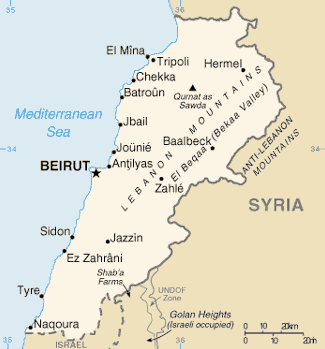
From its birth as a Shia militia boosted by Iran, Hezbollah has, even more than Hamas, been a proxy for Iran. Only vaguely connected to the Palestinian cause, it has simply become an advanced military force for Iran’s Islamic Revolutionary Guard Corps.

For a year, well over 60,000 Israeli citizens have been internally displaced from their homes in Northern Israel due to unending rocket attack from Hezbollah in Southern Lebanon. As they rightfully focused on the war in Gaza, (as President Lincoln advised, “One war at a time), Israel took the blows with minimal response until the last few weeks.

The formerly Christian led government of Lebanon cannot police their own nation, and have not been able to for decades, and the UN is more of a problem than a solution, Israel will have to take steps to secure her own safety.

Like the Gaza situation, this will create problems down the road because the hostile population is not going anywhere. That is an issue for later. For now, the rockets must stop.

September 28, 2024

Lebanon is no longer a nation … it’s a parasitized husk operated by Iran’s proxies

Filed under: Middle East, Military, Politics — Tags: , , , , , , — Nicholas @ 04:00

In UnHerd, Tom McTague explains why there can be no “settlement” of the South Lebanon problem, because Lebanon ceased functioning as an independent state and is now largely controlled by Hezbollah, which means it’s indirectly controlled by Iran:

[…] A similar assessment was made about Lebanon, a country without a functioning state or economy and at the mercy of Iran’s colonial army, Hezbollah. This, also, was a situation that was thought to be containable — even as Iran exploited the anarchic chaos of Iraq and Syria to supply its proxy with enough weapons to devastate Israel.

The central conceit of the Abraham Accords was that, irrespective of Hamas, Hezbollah and the occupation of the West Bank, once the Israel-Saudi axis was formed, Iran could be pushed back and contained without direct American involvement. But, then, the depth of Hamas’s murderous brutality on 7 October shattered that assumption, leaving not only a traumatised and vulnerable Israel, but also a traumatised and vulnerable Western order forced to confront the stark realities of the Middle East.

Today, Lebanon is a dead state, eaten alive by Hezbollah’s parasitic power. The scale of the catastrophe in the country is hard to comprehend, much of it caused by the disruptive nature of Syria’s civil war. Since its neighbour’s descent into anarchic hell, some 1.5 million Syrians have sought refuge in Lebanon — a tiny country with a population of just 5 million. But, more fundamentally, with Hezbollah fighting to protect Bashar al Assad, the opposing countries — led by Saudi Arabia — began withdrawing funds from Lebanese banks. This sparked a financial crisis that left Lebanon with no money for fuel.

By spring 2020, the country had defaulted on its debts, sending it into a downward spiral which the World Bank in 2021 described as among “the top 10, possibly top three, most severe crises globally since the mid-nineteenth century”. Lebanon’s GDP plummeted by around a third, with poverty doubling from 42% to 82% in two years. At the same time, the country’s capital, Beirut, was hit by an extraordinary explosion at its port, leaving more than 300,000 homeless. By 2023 the IMF described the situation as “very dangerous” and the US was warning that the collapse of the Lebanese state was “a real possibility”.

With Iranian support, however, Hezbollah created a shadow economy almost entirely separate from this wider collapse. It could escape the energy shortages, while creating its own banks, supermarkets and electricity network. Hezbollah isn’t just a terrorist group. It is a state within a state, complete with a far more advanced army. “They may have plunged Lebanon into complete chaos, but they themselves are not chaotic at all,” as Carmit Valensi, from the Institute for National Security Studies at Tel Aviv University, told the Jerusalem Post.

Then came 7 October, after which Hezbollah tied its fate to that of the Palestinians, promising to bombard Israel with rockets until the war in Gaza was brought to a close. We have witnessed the frightening scale of its power over the past year, its bombardment forcing some 100,000 Israelis from their homes in Galilee to the safety of the Israeli heartlands around Tel Aviv. For the first time since modern Israel’s creation, the land where Jews are able to live in their own state has shrunk; the rockets are a daily reminder of the country’s extraordinary vulnerability, threatened on all sides by states who actively want it removed from the map — even from history itself. The pretence that the Palestinian and Lebanese questions could be contained, ignored or bypassed as part of a wider grand strategy to contain Iran has been shattered.

July 24, 2024

Chieftain V T-62 | Operation Nasr, Iran – Iraq War, 1981

Filed under: Britain, History, Middle East, Military, Russia, Weapons — Tags: , , , , , , — Nicholas @ 02:00

The Tank Museum
Published Apr 13, 2024

Two tanks designed to fight each other in Northern Europe would face each other during the Iran-Iraq war in 1981. On one side, the British built Chieftain MBT. On the other, the Soviet-built T-62.

In this video, we examine what happened during Operation Nasr to find out which tank came out on top …

00:00 | Intro
01:19 | Meet the Tanks
02:15 | The T-62
03:26 | The Chieftain
06:21 | From Paper to the Battlefield
09:25 | The Outcome and Findings
(more…)

October 28, 2023

Israel’s Zugzwang

Filed under: Government, Media, Middle East, Military, USA — Tags: , , , , — Nicholas @ 05:00

Not being a huge chess nerd, I’d never encountered the term “zugzwang” before, but as Niall Ferguson and Jay Mens explain here, it’s an appropriate way to characterize the situation Israel finds itself in at the moment:

Zugzwang is one of the ultimate challenges for a chess player. In zugzwang, a player is in a situation where any move can only weaken one’s position and carries the risk of checkmate — but not moving isn’t an option. Beyond the intrinsic horror of Hamas’s October 7 massacre, it is now obvious that the attack was designed to provoke Israel into reacting. The extent of the zugzwang is increasingly clear, and Israel has few good options. Nor does the United States.

No one should have been surprised by the attacks on Israel by Hamas and Palestinian Islamic Jihad (PIJ). Over the last year, there have been more than a dozen public meetings between Iranian officials and the leaders of Hamas, Hezbollah, and PIJ. Enormous quantities of men and matériel have moved from Iraq into Syria, with other matériel arriving by land and air to Lebanon. Hezbollah and the Iranian Revolutionary Guards Corps (IRGC), the common thread of the region’s so-called “Axis of Resistance”, have worked to build and consolidate enormous bunkers and fortifications across Syria along with Hezbollah. Some anticipated another Lebanon War, others expected another Gaza War, and others expected a Third Intifada. The only thing few — if any — expected was a design to drag Israel into all these battles and several more at once.

The Imperative to Act

In the aftermath of October 7, Israel must strike back. Propelled by nationwide rage, a new government of national unity in Jerusalem has vowed to destroy Hamas. If that is the true goal, a ground operation in Gaza is necessary. Such an operation began in Israel on Friday night. The very nature of urban warfare means that it will have an enormous human cost and an uncertain duration. And this is not just urban warfare: there are two Gazas — the aboveground and the underground network of tunnels where Hamas’s men and weapons are stored.

And time is not on Israel’s side. International support is already waning, and nowhere more than in the Arab world. Egypt and Jordan, Israel’s most important security partners in the region, have already accused Israel of planning the ethnic cleansing of Gaza. Worse still, the operation will tie down a significant portion of Israel’s manpower and assets. Israel will, as a result, be especially vulnerable to the risk of overextension.

Gaza isn’t the only problem. There is also the West Bank, where unrest is already growing and where the Palestinian Authority is at risk of collapse. Then, to the north, Hezbollah has its vast arsenal of rockets, drones, men, and missiles in Lebanon, while on the Syrian border tens of thousands of Iraqi militants have amassed with the goal of “liberating” the Golan. Thousands more Iranian-made drones and ballistic missiles are spread out across dozens of bases in Iraq, Syria, and Yemen. For that reason, Israel now relies on American support. Jerusalem is likely waiting for the last of American reinforcements — including another carrier strike group — to arrive in the region prior to launching its attack. But is there an alternative?

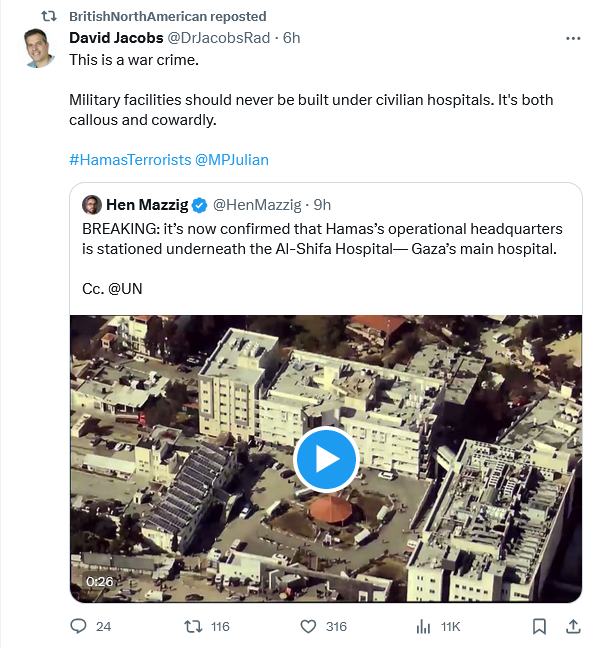
Of course, it’s widely believed that Hamas deliberately positions its facilities to make Israeli attacks less likely due to the elevated risk of unacceptable levels of collateral damage … like this:

Older Posts »

Powered by WordPress