Quotulatiousness

January 13, 2021

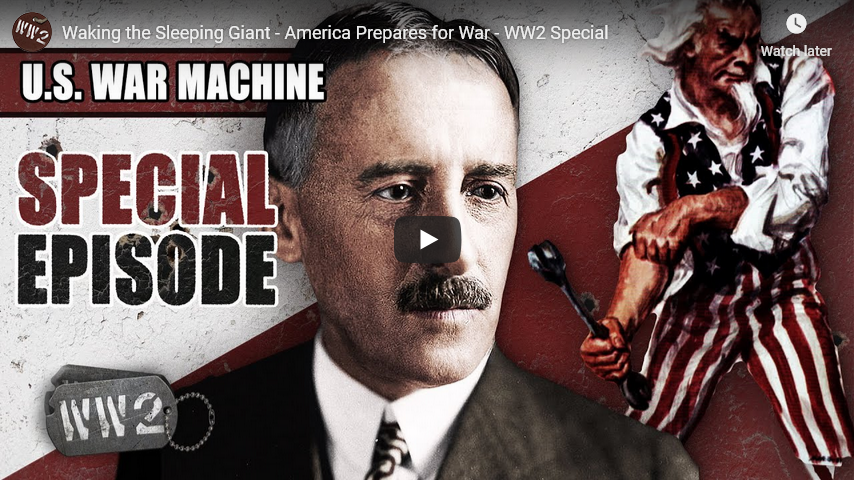
Waking the Sleeping Giant – America Prepares for War – WW2 Special

Filed under: Economics, Government, History, Military, USA, WW2 — Tags: , , , , , — Nicholas @ 04:00

World War Two
Published 12 Jan 2021

As the United States enters World War Two, a huge industrial giant awakens from hibernation. This episode covers industrial mobilization plans, their execution, and their potential.

Join us on Patreon: https://www.patreon.com/TimeGhostHistory
Or join The TimeGhost Army directly at: https://timeghost.tv

Follow WW2 day by day on Instagram @ww2_day_by_day – https://www.instagram.com/ww2_day_by_day
Between 2 Wars: https://www.youtube.com/playlist?list…
Source list: http://bit.ly/WW2sources

Hosted by: Indy Neidell
Written by: Joram Appel
Director: Astrid Deinhard
Producers: Astrid Deinhard and Spartacus Olsson
Executive Producers: Astrid Deinhard, Indy Neidell, Spartacus Olsson, Bodo Rittenauer
Creative Producer: Maria Kyhle
Post-Production Director: Wieke Kapteijns
Research by: Joram Appel
Edited by: Karolina Dołęga
Sound design: Marek Kamiński
Map animations: Eastory (https://www.youtube.com/c/eastory)

Colorizations by:
Dememorabilia – https://www.instagram.com/dememorabilia/
Norman Stewart – https://oldtimesincolor.blogspot.com/

Sources:
– Library of Congress
– National Archives NARA
– Picture of the first class of the Army Industrial College from National Defense University
– FDR Presidential Library & Museum
– Icons from the Noun Project: Artillery by Creative Mania, Douglas SBD Dauntless by Lluisa Iborra, Man by Milinda Courey, Factory Workers by Gan Khoon Lay, Soldier by Wonmo Kang, Old Car by Andri Graphic, progress 20% & 40% by Roberto Chiaveri.

Soundtracks from Epidemic Sound:
– “The Inspector 4” – Johannes Bornlöf
– “London” – Howard Harper-Barnes
– “Break Free” – Fabien Tell
– “Last Point of Safe Return” – Fabien Tell
– “Force Matrix” – Jon Bjork

Archive by Screenocean/Reuters https://www.screenocean.com.

A TimeGhost chronological documentary produced by OnLion Entertainment GmbH.

December 18, 2020

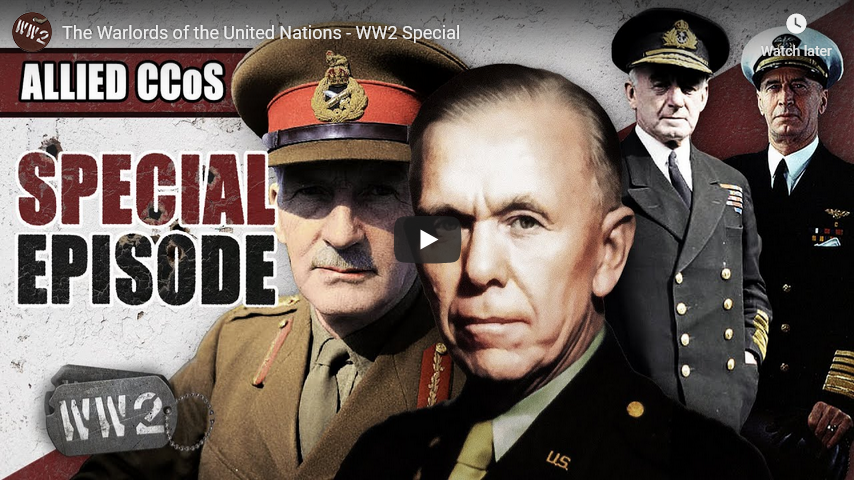
The Warlords of the United Nations – WW2 Special

Filed under: Britain, History, Military, USA, WW2 — Tags: , , , , — Nicholas @ 06:00

World War Two
Published 17 Dec 2020

Following the German declaration of war on America on the 11th of December 1941, Britain gained an invaluable ally. Securing a joint military command between the new partnership will be central to its success, the question is, how can this be achieved?

Join us on Patreon: https://www.patreon.com/TimeGhostHistory
Or join The TimeGhost Army directly at: https://timeghost.tv

Follow WW2 day by day on Instagram @ww2_day_by_day – https://www.instagram.com/ww2_day_by_day
Between 2 Wars: https://www.youtube.com/playlist?list…
Source list: http://bit.ly/WW2sources

Hosted by: Indy Neidell
Written by: Markus Linke and Indy Neidell
Director: Astrid Deinhard
Producers: Astrid Deinhard and Spartacus Olsson
Executive Producers: Astrid Deinhard, Indy Neidell, Spartacus Olsson, Bodo Rittenauer
Creative Producer: Maria Kyhle
Post-Production Director: Wieke Kapteijns
Research by: Markus Linke
Edited by: Miki Cackowski
Sound design: Marek Kamiński
Map animations: Eastory (https://www.youtube.com/c/eastory)

Colorizations by:
Norman Stewart – https://oldtimesincolor.blogspot.com/
Daniel Weiss
Adrien Fillon – https://www.instagram.com/adrien.colo…
Mikołaj Uchman

Sources:
IWM A 14040, TR153, H 10306, ME(RAF) 5052, A 16709

Soundtracks from Epidemic Sound:
Max Anson – “Ancient Saga”
Johannes Bornlof – “Magnificent March 3”
Howard Harper-Barnes – “London”
Rannar Sillard – “March Of The Brave 4”
Johannes Bornlof – “The Inspector 4”
Phoenix Tail – “At the Front”

Archive by Screenocean/Reuters https://www.screenocean.com.

A TimeGhost chronological documentary produced by OnLion Entertainment GmbH.

November 13, 2020

QotD: Military allies

Filed under: Britain, Cancon, History, Military, Quotations, USA, WW2 — Tags: , , , — Nicholas @ 01:00

Partnership implies the burden is shared more or less equally. If I bought twenty quid’s worth of shares in The Spectator and started swanning about bitching that Conrad Black didn’t treat me as a partner, he’d rightly think I’d gone nuts. The British in their time were at least as ruthless about such realities as the Americans are today. For example, in September 1944, in one of the lesser-known conferences to prepare for the post-war world, Churchill and Roosevelt met in Quebec City. They had no compunction about excluding from their deliberations the Canadian Prime Minister, Mackenzie King, even though he was the nominal host. There’s a cartoon of the time showing King peering through a keyhole as the top dogs settled the fate of the world without him.

And guess what? Militarily speaking, Canada was a far bigger player back then than Britain is today: the Royal Canadian Navy was the world’s third-biggest surface fleet, the Canucks got the worst beach at Normandy — but hey, why bore you with details? In those days that still wasn’t enough to get you a seat at the table.

Mark Steyn, “The Brutal Cuban Winter”, The Spectator, 2002-01-26.

November 6, 2020

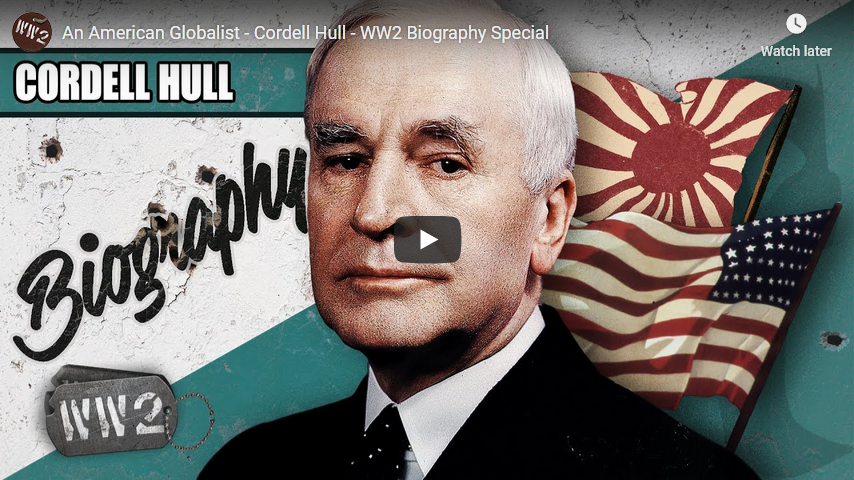
An American Globalist – Cordell Hull – WW2 Biography Special

Filed under: Americas, History, Japan, USA, WW2 — Tags: , , , , , , — Nicholas @ 06:00

World War Two
Published 5 Nov 2020

Cordell Hull is the face of American diplomacy in 1941 as it navigates the precarious road to war against Imperial Japan.

Join us on Patreon: https://www.patreon.com/TimeGhostHistory
Or join The TimeGhost Army directly at: https://timeghost.tv

Follow WW2 day by day on Instagram @ww2_day_by_day – https://www.instagram.com/ww2_day_by_day
Between 2 Wars: https://www.youtube.com/playlist?list…
Source list: http://bit.ly/WW2sources

Hosted by: Indy Neidell
Written by: Francis van Berkel and James Newman
Director: Astrid Deinhard
Producers: Astrid Deinhard and Spartacus Olsson
Executive Producers: Astrid Deinhard, Indy Neidell, Spartacus Olsson, Bodo Rittenauer
Creative Producer: Maria Kyhle
Post-Production Director: Wieke Kapteijns
Research by: James Newman
Edited by: Miki Cackowski
Sound design: Marek Kamiński
Map animations: Eastory (https://www.youtube.com/c/eastory)

Colorizations by:
Norman Stewart – https://oldtimesincolor.blogspot.com/
Mikolaj Uchman
Spartacus Olsson

Sources:
Naval History & Heritage Command
http://maps.bpl.org
FDR Presidential Library & Museum
Picture of MS St. Louis in Hamburg, United States Holocaust Memorial Museum, courtesy of Herbert and Vera Karliner
from the Noun Project: Skull by Muhamad Ulum, Handshake by priyanka, Pickaxe by Luke Anthony Firth, oil barrel by BomSymbols

Soundtracks from the Epidemic Sound:
Howard Harper-Barnes – “London”
Johannes Bornlof – “The Inspector 4”
Farell Wooten – “Blunt Object”
Philip Ayers – “Trapped in a Maze”
Johannes Bornlof – “Deviation In Time”

Archive by Screenocean/Reuters https://www.screenocean.com.

A TimeGhost chronological documentary produced by OnLion Entertainment GmbH.

October 7, 2020

QotD: The gullible generation

Filed under: Government, History, Liberty, Quotations, USA, WW2 — Tags: , , , , — Nicholas @ 01:00

World War II, which I have described (in The Probability Broach) as a struggle between competing brands of fascism, was much the same thing. For the beleaguered people of Europe, it meant being forced to choose between Adolf Hitler and Josef Stalin. Would you rather be shot or gassed?

For Americans, it meant looking for protection by a political regime so grossly and criminally corrupt that future historians will shake their heads, wondering how an entire people could be such suckers. “The Greatest Generation”, that miserable collectivist mouthpiece Tom Brokaw has called them. Looking back over what my father told me of his life, how his family suffered in the government-caused Great Depression, how he and his comrades risked unspeakable danger in the war, and how he became a prisoner in Germany — all to aggrandize the virtual godhood of Franklin Delano Roosevelt — I call them “The Gullible Generation”.

On the other hand, people loved the Roosevelt Administration so much that they passed a Constitutional amendment to make sure that no sonofabitch could ever be elected to more than two Presidential terms again.

World War II gave government complete, dictatorial control of American society, control of industry, control of communications, control of the economy, control that Roosevelt had desperately lusted after before the war, but failed to achieve. If anyone objected, or insisted on his rights under the Constitution, all the other side had to say was, “Don’t you know there’s a war on?”

The government enjoyed that level of control. Once the war was won, and people looked forward to a period of peace, the government plunged us into the Korean War, Vietnam, and an increasing number of undeclared and stupid conflicts in order to retain its power. “Don’t you know there’s a war on?” never worked quite as well as it had to shut dissenters up, but it’s clear that this scam will go on and on and on until something drastic is done to stop it.

L. Neil Smith, “The Deep State”, Libertarian Enterprise, 2019-04-14.

September 30, 2020

America First – Patriots or Nazis? – WW2 Special

Filed under: History, Media, Politics, USA — Tags: , , , , — Nicholas @ 04:00

World War Two
Published 29 Sep 2020

In 1941, the question of whether America should join the European War still isn’t settled. Different groups whip up opposition to it, and those such as the America First Committee seem suspiciously sympathetic to Hitler’s message and cause.

Join us on Patreon: https://www.patreon.com/TimeGhostHistory
Or join The TimeGhost Army directly at: https://timeghost.tv

Follow WW2 day by day on Instagram @ww2_day_by_day – https://www.instagram.com/ww2_day_by_day
Between 2 Wars: https://www.youtube.com/playlist?list…
Source list: http://bit.ly/WW2sources

Hosted by: Indy Neidell
Written by: Francis van Berkel and Indy Neidell
Director: Astrid Deinhard
Producers: Astrid Deinhard and Spartacus Olsson
Executive Producers: Astrid Deinhard, Indy Neidell, Spartacus Olsson, Bodo Rittenauer
Creative Producer: Joram Appel
Post-Production Director: Wieke Kapteijns
Research by: James Newman
Edited by: Miki Cackowski
Sound design: Marek Kamiński
Map animations: Eastory (https://www.youtube.com/c/eastory)

Colorizations by:
Daniel Weiss
Norman Stewart – https://oldtimesincolor.blogspot.com/

Sources:
from the Noun Project: people by ProSymbols

Soundtracks from the Epidemic Sound:
Reynard Seidel – “Deflection”
Johannes Bornlof – “The Inspector 4”
Philip Ayers – “Trapped in a Maze”
Johannes Bornlof – “Deviation In Time”
Phoenix Tail – “At the Front”

Archive by Screenocean/Reuters https://www.screenocean.com.

A TimeGhost chronological documentary produced by OnLion Entertainment GmbH.

August 16, 2020

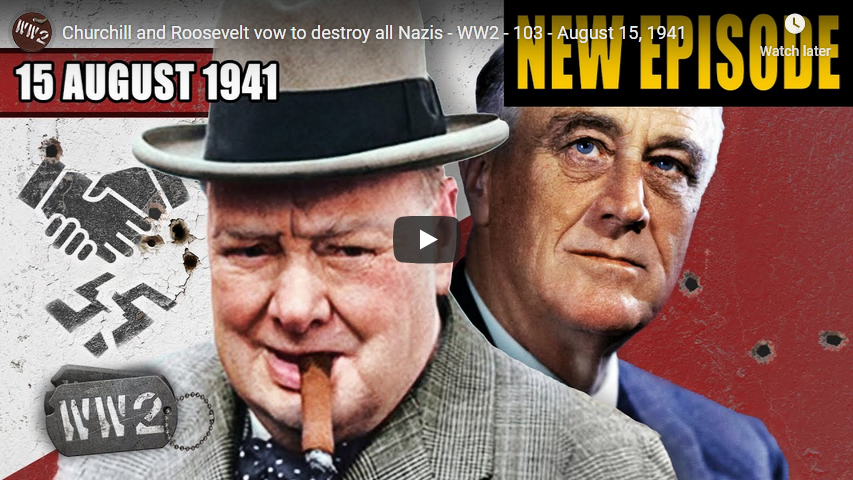
Churchill and Roosevelt vow to destroy all Nazis – WW2 – 103 – August 15, 1941

World War Two
Published 15 Aug 2020

Winston Churchill and Franklin Roosevelt issue a charter that lays out their thoughts for the future, the Soviets are in trouble on two fronts, and Adolf Hitler repeats his orders to those who failed to heed them the first time.

Join us on Patreon: https://www.patreon.com/TimeGhostHistory
Or join The TimeGhost Army directly at: https://timeghost.tv

Follow WW2 day by day on Instagram @World_war_two_realtime https://www.instagram.com/world_war_two_realtime
Between 2 Wars: https://www.youtube.com/playlist?list…
Source list: http://bit.ly/WW2sources

Written and Hosted by: Indy Neidell
Director: Astrid Deinhard
Producers: Astrid Deinhard and Spartacus Olsson
Executive Producers: Astrid Deinhard, Indy Neidell, Spartacus Olsson, Bodo Rittenauer
Creative Producer: Joram Appel
Post-Production Director: Wieke Kapteijns
Research by: Indy Neidell
Edited by: Iryna Dulka
Sound design: Marek Kamiński
Map animations: Eastory (https://www.youtube.com/c/eastory)

Colorizations by:
– Daniel Weiss
– Julius Jääskeläinen – https://www.facebook.com/JJcolorization/
– Cassowary Colorizations – https://www.cassowarycolor.com/
– Norman Stewart – https://oldtimesincolor.blogspot.com/
– Denis Marinov from Wikimedia

Sources:
– Bundesarchiv, CC-BY-SA 3.0: Bild_146-2005-0030, Bild_146-1971-070-61
– Imperial War Museum: E 1416, E 7014, E 3450E, E 7008, E 3438E, E 15023
– Narodowe Archiwum Cyfrowe
– Mil.ru
– egor7 from Wikimedia

Archive by Screenocean/Reuters https://www.screenocean.com.

A TimeGhost chronological documentary produced by OnLion Entertainment GmbH.

From the comments:

World War Two
3 days ago
Although the US has been steadily edging towards more and more support for the Western Allies since outbreak of war almost two years ago, it is this week that an active involvement in WW2 by the United States starts taking form. Let’s be clear though: both the US public, and the US administration are still staunchly opposed to sending in troops and becoming an active belligerent. But the tone of public and political discourse has begun to change, as it becomes increasingly obvious exactly how horrendous the threat is that humanity faces from Naziism.

August 10, 2020

FDR’s “New Deal” and the Great Depression

The Great Depression began with the collapse of the stock market in 1929 and was made worse by the frantic attempts of President Hoover to fix the problem. Despite the commonly asserted gibe that Hoover tried laissez faire methods to address the economic crisis, he was a dyed-in-the-wool progressive and a life-long control freak (the Smoot-Hawley Tariff Act which devasted world trade was passed in 1930). Franklin D. Roosevelt won the 1932 election by promising to undo Hoover’s economic interventions, yet once in office he turned out to be even more of a control freak than Hoover. His economic and political plans made Hoover’s efforts seem merely a pale shadow.

For newcomers to this issue, “New Deal” is the term used to describe the various policies to expand the size and scope of the federal government adopted by President Franklin Delano Roosevelt (a.k.a., FDR) during the 1930s.

And I’ve previously cited many experts to show that his policies undermined prosperity. Indeed, one of my main complaints is that he doubled down on many of the bad policies adopted by his predecessor, Herbert Hoover.

Let’s revisit the issue today by seeing what some other scholars have written about the New Deal. Let’s start with some analysis from Robert Higgs, a highly regarded economic historian.

    … as many observers claimed at the time, the New Deal did prolong the depression. … FDR and Congress, especially during the congressional sessions of 1933 and 1935, embraced interventionist policies on a wide front. With its bewildering, incoherent mass of new expenditures, taxes, subsidies, regulations, and direct government participation in productive activities, the New Deal created so much confusion, fear, uncertainty, and hostility among businessmen and investors that private investment, and hence overall private economic activity, never recovered enough to restore the high levels of production and employment enjoyed in the 1920s. … the American economy between 1930 and 1940 failed to add anything to its capital stock: net private investment for that eleven-year period totaled minus $3.1 billion. Without capital accumulation, no economy can grow. … If demagoguery were a powerful means of creating prosperity, then FDR might have lifted the country out of the depression in short order. But in 1939, ten years after its onset and six years after the commencement of the New Deal, 9.5 million persons, or 17.2 percent of the labor force, remained officially unemployed.

Writing for the American Institute for Economic Research, Professor Vincent Geloso also finds that FDR’s New Deal hurt rather than helped.

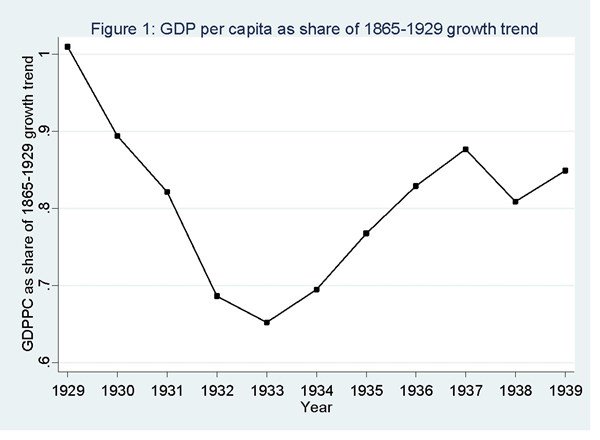
    … let us state clearly what is at stake: did the New Deal halt the slump or did it prolong the Great Depression? … The issue that macroeconomists tend to consider is whether the rebound was fast enough to return to the trendline. … The … figure below shows the observed GDP per capita between 1929 and 1939 expressed as the ratio of what GDP per capita would have been like had it continued at the trend of growth between 1865 and 1929. On that graph, a ratio of 1 implies that actual GDP is equal to what the trend line predicts. … As can be seen, by 1939, the United States was nowhere near the trendline. … Most of the economic historians who have written on the topic agree that the recovery was weak by all standards and paled in comparison with what was observed elsewhere. … there is also a wide level of agreement that other policies lengthened the depression. The one to receive the most flak from economic historians is the National Industrial Recovery Act (NIRA). … In essence, it constituted a piece of legislation that encouraged cartelization. By definition, this would reduce output and increase prices. As such, it is often accused of having delayed recovery. … other sets of policies (such as the Agricultural Adjustment Act, the National Labor Relations Act and the National Industrial Recovery Act) … were very probably counterproductive.

Here’s one of the charts from his article, which shows that the economy never recovered lost output during the 1930s.

April 20, 2020

The four distinct phases of the Great Depression in the United States

Filed under: Economics, Government, History, USA — Tags: , , , , , — Nicholas @ 03:00

An older post from Lawrence W. Reed at the Foundation for Economic Education outlines the low points of the Great Depression and debunks a few widely held myths about that cataclysmic economic era:

Phase 1, the Federal Reserve and the end of the Roaring 20’s:
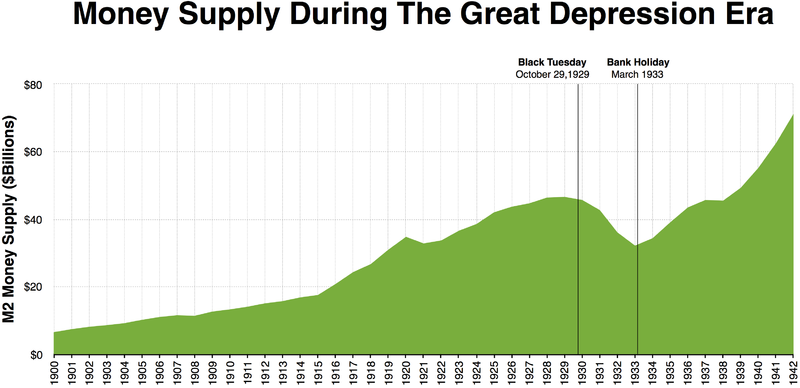
One of the most thorough and meticulously documented accounts of the Fed’s inflationary actions prior to 1929 is America’s Great Depression by the late Murray Rothbard. Using a broad measure that includes currency, demand and time deposits, and other ingredients, Rothbard estimated that the Federal Reserve expanded the money supply by more than 60 percent from mid-1921 to mid-1929. The flood of easy money drove interest rates down, pushed the stock market to dizzy heights, and gave birth to the “Roaring Twenties.”

By early 1929, the Federal Reserve was taking the punch away from the party. It choked off the money supply, raised interest rates, and for the next three years presided over a money supply that shrank by 30 percent. This deflation following the inflation wrenched the economy from tremendous boom to colossal bust.

The “smart” money — the Bernard Baruchs and the Joseph Kennedys who watched things like money supply — saw that the party was coming to an end before most other Americans did. Baruch actually began selling stocks and buying bonds and gold as early as 1928; Kennedy did likewise, commenting, “only a fool holds out for the top dollar.”

Phase 2, Hoover’s interventions and the disaster of Smoot-Hawley:
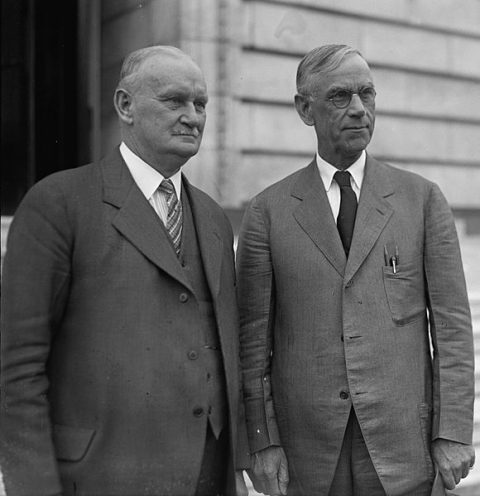
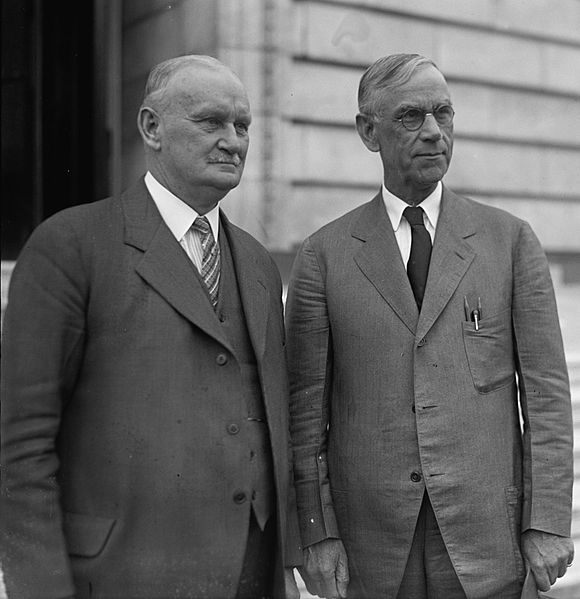
Willis C. Hawley (left) and Reed Smoot in April 1929, shortly before the Smoot–Hawley Tariff Act passed the House of Representatives.
Library of Congress photo via Wikimedia Commons.

Unemployment in 1930 averaged a mildly recessionary 8.9 percent, up from 3.2 percent in 1929. It shot up rapidly until peaking out at more than 25 percent in 1933. Until March 1933, these were the years of President Herbert Hoover — the man that anti-capitalists depict as a champion of noninterventionist, laissez-faire economics.

Did Hoover really subscribe to a “hands off the economy,” free-market philosophy? His opponent in the 1932 election, Franklin Roosevelt, didn’t think so. During the campaign, Roosevelt blasted Hoover for spending and taxing too much, boosting the national debt, choking off trade, and putting millions of people on the dole. He accused the president of “reckless and extravagant” spending, of thinking “that we ought to center control of everything in Washington as rapidly as possible,” and of presiding over “the greatest spending administration in peacetime in all of history.” Roosevelt’s running mate, John Nance Garner, charged that Hoover was “leading the country down the path of socialism.” Contrary to the modern myth about Hoover, Roosevelt and Garner were absolutely right.

The crowning folly of the Hoover administration was the Smoot-Hawley Tariff, passed in June 1930. It came on top of the Fordney-McCumber Tariff of 1922, which had already put American agriculture in a tailspin during the preceding decade. The most protectionist legislation in U.S. history, Smoot-Hawley virtually closed the borders to foreign goods and ignited a vicious international trade war. Professor Barry Poulson notes that not only were 887 tariffs sharply increased, but the act broadened the list of dutiable commodities to 3,218 items as well.

Officials in the administration and in Congress believed that raising trade barriers would force Americans to buy more goods made at home, which would solve the nagging unemployment problem. They ignored an important principle of international commerce: trade is ultimately a two-way street; if foreigners cannot sell their goods here, then they cannot earn the dollars they need to buy here.

Phase 3, FDR and the New Deal:
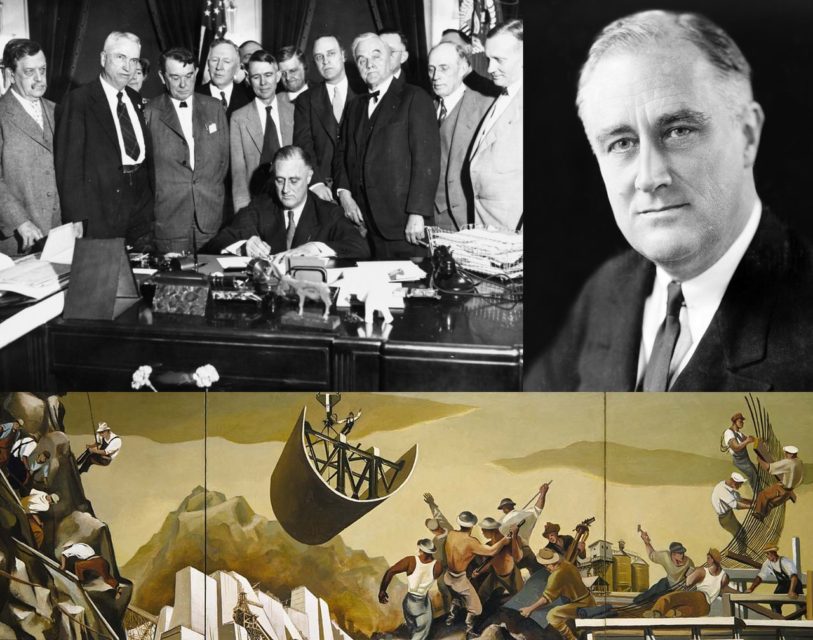
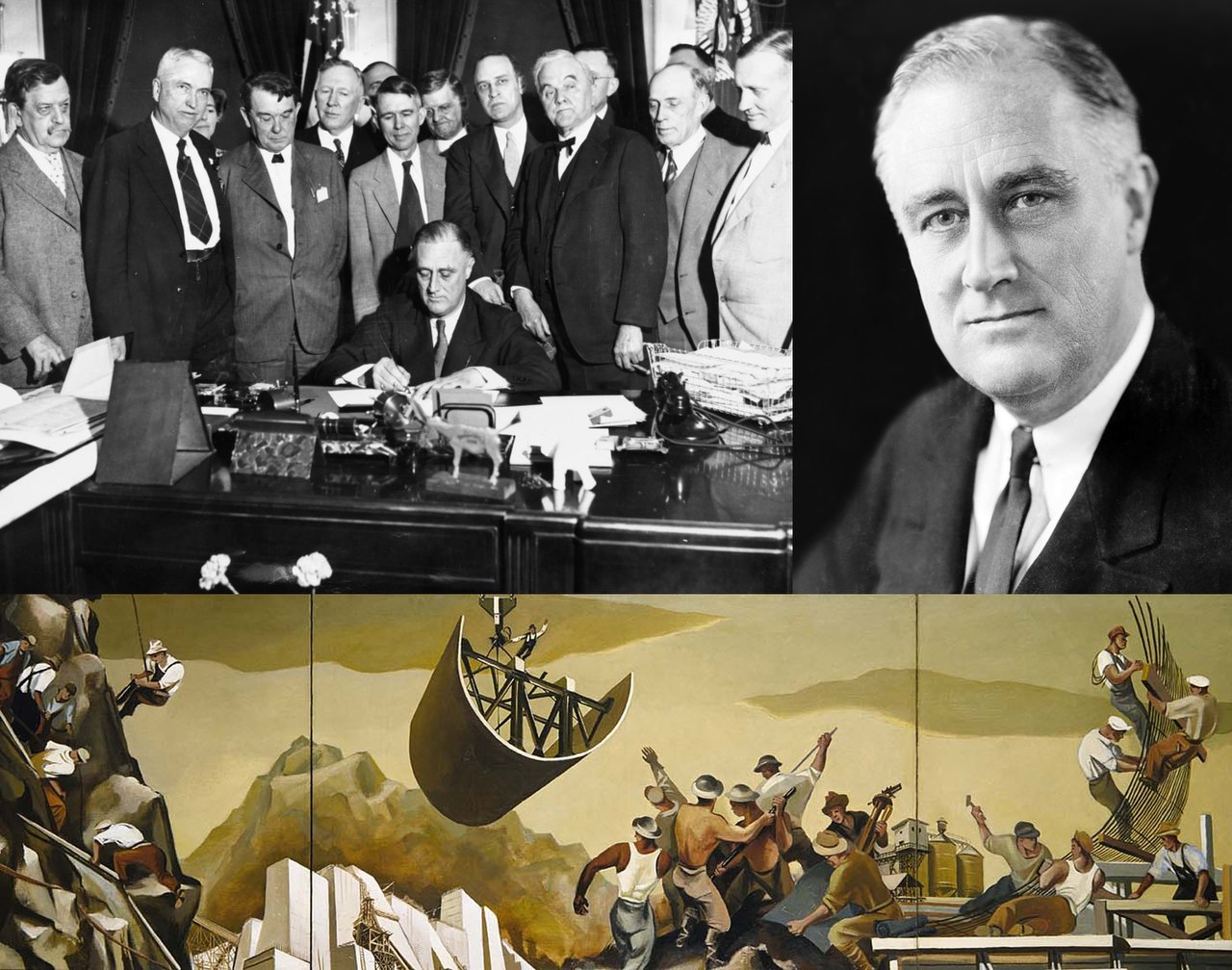
Top left: The Tennessee Valley Authority, part of the New Deal, being signed into law in 1933.
Top right: FDR (President Franklin Delano Roosevelt) was responsible for the New Deal.
Bottom: A public mural from one of the artists employed by the New Deal’s WPA program.
Wikimedia Commons.

Franklin Delano Roosevelt won the 1932 presidential election in a landslide, collecting 472 electoral votes to just 59 for the incumbent Herbert Hoover. The platform of the Democratic Party whose ticket Roosevelt headed declared, “We believe that a party platform is a covenant with the people to be faithfully kept by the party entrusted with power.” It called for a 25 percent reduction in federal spending, a balanced federal budget, a sound gold currency “to be preserved at all hazards,” the removal of government from areas that belonged more appropriately to private enterprise, and an end to the “extravagance” of Hoover’s farm programs. This is what candidate Roosevelt promised, but it bears no resemblance to what President Roosevelt actually delivered.

In the first year of the New Deal, Roosevelt proposed spending $10 billion while revenues were only $3 billion. Between 1933 and 1936, government expenditures rose by more than 83 percent. Federal debt skyrocketed by 73 percent.

[…] in 1935 the Works Progress Administration came along. It is known today as the very government program that gave rise to the new term, “boondoggle,” because it “produced” a lot more than the 77,000 bridges and 116,000 buildings to which its advocates loved to point as evidence of its efficacy. The stupefying roster of wasteful spending generated by these jobs programs represented a diversion of valuable resources to politically motivated and economically counterproductive purposes.

The American economy was soon relieved of the burden of some of the New Deal’s excesses when the Supreme Court outlawed the NRA in 1935 and the AAA in 1936, earning Roosevelt’s eternal wrath and derision. Recognizing much of what Roosevelt did as unconstitutional, the “nine old men” of the Court also threw out other, more minor acts and programs which hindered recovery.

Phase 4, the Wagner Act:

The stage was set for the 1937–38 collapse with the passage of the National Labor Relations Act in 1935 — better known as the Wagner Act and organized labor’s “Magna Carta.” […] Armed with these sweeping new powers, labor unions went on a militant organizing frenzy. Threats, boycotts, strikes, seizures of plants, and widespread violence pushed productivity down sharply and unemployment up dramatically. Membership in the nation’s labor unions soared; by 1941 there were two and a half times as many Americans in unions as in 1935.

[…]

Higgs draws a close connection between the level of private investment and the course of the American economy in the 1930s. The relentless assaults of the Roosevelt administration — in both word and deed — against business, property, and free enterprise guaranteed that the capital needed to jumpstart the economy was either taxed away or forced into hiding. When Roosevelt took America to war in 1941, he eased up on his antibusiness agenda, but a great deal of the nation’s capital was diverted into the war effort instead of into plant expansion or consumer goods. Not until both Roosevelt and the war were gone did investors feel confident enough to “set in motion the postwar investment boom that powered the economy’s return to sustained prosperity.”

April 12, 2020

QotD: The Gini coefficient

Filed under: Economics, Government, Politics, Quotations, USA — Tags: , , , , — Nicholas @ 01:00

At least for now, most progressives acknowledge that markets and economic growth are necessary. But progressives in academia contend that growth has proved itself secondary to equality efforts — something to be exploited, rather than appreciated. Not just nationally, but worldwide, policymakers and the press regard the subordination of growth to equality to be a benign practice, as in the recent line in the Indian periodical Mint: a policy aimed at “reducing inequality need not hurt growth.”

The redistributionist impulse has brought to the fore metrics such as the Gini coefficient, named after the ur-redistributor, Corrado Gini, an Italian social scientist who developed an early statistical measure of income distribution a century ago. A society where a single plutocrat earns all the income ranks a pure “1” on the Gini scale; one in which all earnings are perfectly equally distributed, the old Scandinavian ideal, scores a “0” by the Gini test. The Gini Index has been renamed or updated numerous times, but the principle remains the same. Income distribution and redistribution seem so crucial to progressives that French economist Thomas Piketty built an international bestseller around it, the wildly lauded Capital.

Through Gini’s lens, we now rank past eras. Decades in which policy endeavored or managed to even out and equalize earnings — the 1930s under Franklin Roosevelt, the 1960s under Lyndon Johnson — score high. Decades where policymakers focused on growth before equality, such as the 1920s, fare poorly. Decades about which social-justice advocates aren’t sure what to say — the 1970s, say — simply drop from the discussion. In the same hierarchy, federal debt moves down as a concern because austerity to reduce debt could hinder redistribution. Lately, advocates of economically progressive history have made taking any position other than theirs a dangerous practice. Academic culture longs to topple the idols of markets, just as it longs to topple statutes of Robert E. Lee.

But progressives have their metrics wrong and their story backward. The geeky Gini metric fails to capture the American economic dynamic: in our country, innovative bursts lead to great wealth, which then moves to the rest of the population. Equality campaigns don’t lead automatically to prosperity; instead, prosperity leads to a higher standard of living and, eventually, in democracies, to greater equality. The late Simon Kuznets, who posited that societies that grow economically eventually become more equal, was right: growth cannot be assumed. Prioritizing equality over markets and growth hurts markets and growth and, most important, the low earners for whom social-justice advocates claim to fight. Government debt matters as well. Those who ring the equality theme so loudly deprive their own constituents, whose goals are usually much more concrete: educational opportunity, homes, better electronics, and, most of all, jobs. Translated into policy, the equality impulse takes our future hostage.

Amity Shlaes, “Growth, Not Equality”, City Journal, 2018-01-21.

April 1, 2020

The end of US neutrality? The Lend-Lease Act – WW2 Special Episode

Filed under: Britain, History, Military, USA, WW2 — Tags: , , , — Nicholas @ 06:00

World War Two
Published 31 Mar 2020

The United States of America aims to remain neutral during World War Two. But they see it in their best interest to aid the British in their fight against Nazism. The Lend-Lease Act is designed to do exactly that.

Join us on Patreon: https://www.patreon.com/TimeGhostHistory
Or join The TimeGhost Army directly at: https://timeghost.tv

Follow WW2 day by day on Instagram @World_war_two_realtime https://www.instagram.com/world_war_t…
Between 2 Wars: https://www.youtube.com/playlist?list…
Source list: http://bit.ly/WW2sources

Hosted by: Indy Neidell
Written by: Joram Appel
Produced and Directed by: Spartacus Olsson and Astrid Deinhard
Executive Producers: Bodo Rittenauer, Astrid Deinhard, Indy Neidell, Spartacus Olsson
Creative Producer: Joram Appel
Post-Production Director: Wieke Kapteijns
Research by: Scott Grimwood and Joram Appel
Edited by: Mikołaj Cackowski
Map animations: Eastory (https://www.youtube.com/c/eastory)

Colorizations by:
Norman Stewart – https://oldtimesincolor.blogspot.com/
Adrien Fillon – https://www.instagram.com/adrien.colo…
Dememorabilia – https://www.instagram.com/dememorabilia/

Sources:
Plane by Graphic Enginer from the Noun Project
people by ProSymbols from the Noun Project
Allierte soldater under kampene om Narvik, courtesy Arkiv i Nordland https://flic.kr/p/a829tg

Soundtracks from the Epidemic Sound:
Johannes Bornlof – “Deviation in Time”
Rannar Sillard – “March Of The Brave 4”
Phoenix Tail – “At the Front”
Hakan Eriksson – “Epic Adventure Theme 3”
Johannes Bornlof – “The Inspector 4”

Archive by Screenocean/Reuters https://www.screenocean.com.

A TimeGhost chronological documentary produced by OnLion Entertainment GmbH.

From the comments:

World War Two
1 hour ago (edited)
On 11 March, 1941, American President Roosevelt signed the Lend-Lease Act, as Indy has covered in the weekly episode on that week. We wanted to revisit that bill in a special episode since it is arguably one of the most consequential American actions of the war before December 1941. Now, the effects of the bill are not visible immediately, but later in the war we will definitely revisit some of the materiel that entered British service under Lend-Lease. We hope you all remain safe and healthy!
Cheers, Joram

March 6, 2020

August von Mackensen in WW2, Stolen Wine, and America – WW2 – Out of the Foxholes 007

Filed under: France, Germany, History, Japan, Military, USA, Wine, WW2 — Tags: , , , , — Nicholas @ 06:00

World War Two
Published 5 Mar 2020

In this episode of Out of the Foxholes, we answer some community questions on what August von Mackensen did in World War Two, if there was a shortage on French wines and what the Axis’ perception of the Monroe Doctrine was.

Ask your own question for Out of the Foxholes here: https://community.timeghost.tv/c/Out-…

Join us on Patreon: https://www.patreon.com/TimeGhostHistory
Or join The TimeGhost Army directly at: https://timeghost.tv

Follow WW2 day by day on Instagram @World_war_two_realtime https://www.instagram.com/world_war_t…
Join our Discord Server: https://discord.gg/D6D2aYN.
Source list: http://bit.ly/WW2sources

Hosted by: Indy Neidell
Written by: Rune Væver Hartvig
Produced and Directed by: Spartacus Olsson and Astrid Deinhard
Executive Producers: Bodo Rittenauer, Astrid Deinhard, Indy Neidell, Spartacus Olsson
Creative Producer: Joram Appel
Post-Production Director: Wieke Kapteijns
Research by: Rune Væver Hartvig
Edited by: Mikołaj Cackowski
Map animations: Eastory (https://www.youtube.com/c/eastory)

Colorizations by:
Julius Jääskeläinen – https://www.facebook.com/JJcolorization/
Ruffneck88 – https://commons.wikimedia.org/wiki/Fi…

Sources:
Narodowe Archiwum Cyfrowe
IWM F 3551
Library of Congress
Wine Bottles by Ivan from the Noun Project
Spider by Sneha from the Noun Project
Spider Web by Valerie Lamm from the Noun Project

Soundtracks from the Epidemic Sound:
Trabant 33 – “When in Bavaria”
Philip Ayers – “Trapped in Maze”
Johannes Bornlof – “The Inspector”

Archive by Screenocean/Reuters https://www.screenocean.com.

A TimeGhost chronological documentary produced by OnLion Entertainment GmbH.

March 5, 2020

Chain Your Woman to the Stove – Feminism in the 1930s | BETWEEN 2 WARS I 1938 Part 2 of 4

Filed under: Economics, Europe, Germany, History, Politics, USA — Tags: , , , , , , — Nicholas @ 04:00

TimeGhost History
Published 4 Mar 2020

Under the yoke of economic depression and more and more authoritarian rulers, Western women face renewed misogyny, patriarchy, and decreasing independence. But not all women think this is such a bad thing.

Join us on Patreon: https://www.patreon.com/TimeGhostHistory

Hosted by: Indy Neidell
Written by: Spartacus Olsson
Directed by: Spartacus Olsson and Astrid Deinhard
Executive Producers: Bodo Rittenauer, Astrid Deinhard, Indy Neidell, Spartacus Olsson
Creative Producer: Joram Appel
Post-Production Director: Wieke Kapteijns
Research by: Spartacus Olsson
Edited by: Daniel Weiss
Sound design: Marek Kamiński

Sources:
Bundesarchiv_Bild:
101III-Alber-174-14A, 102-04517A, 102-17313, 102-17818,
111-098-069, 137-055879, 146-1973-010-31, 146-1975-069-35,
146-1976-112-03A, 146-2006-205, 146-2008-0271,
183-2000-0110-500, 183-2005-0502-502, 183-2005-0530-500,
183-E10868, 183-E20457, 183-H28245, 183-J02040,
183-S08630, 183-S68014, 183-S68021, 183-S68029,
noun_pipe By Icon Lauk,
noun_company By wardehpillai,
noun_Farmer By Francisca Muñoz Colina.

Colorizations by:
– Daniel Weiss
– Norman Stewart

Soundtracks from Epidemic Sound:
– “Sophisticated Gentlemen” – Golden Age Radio
– “The Inspector 4” – Johannes Bornlöf
– “Magnificent March 3” – Johannes Bornlöf
– “Last Point of Safe Return” – Fabien Tell
– “Step On It 5” – Magnus Ringblom
– “First Responders” – Skrya
– “Step Lightly” – Farrell Wooten
– “Try and Catch Us Now” – David Celeste
– “Not Safe Yet” – Gunnar Johnsen
– “The Dominion” – Bonnie Grace
– “The Charleston 3” – Håkan Eriksson

A TimeGhost chronological documentary produced by OnLion Entertainment GmbH.

From the comments:

TimeGhost History
2 days ago (edited)
So, we take a little break from the geopolitical developments in 1938 to look at the situation of women in the Western World in 1938. We’ve received a lot of requests on the WW2 channel to cover the situation on the home fronts. While we do mention it in the weekly episodes, and War Against Humanity covers the horrid parts of it, WWII was so much more. It literally changed the world’s culture in just six years. To do that subject justice we have asked Anna to join us as host for a new monthly WW2 series: On the Homefront.

A few years back Anna was a regular feature on German YouTube on her own channel and some of the bigger YouTube entertainment channels. She left YouTube to finish her studies, and because she was searching for more depth than YT entertainment content was offering her. As Astrid’s and my daughter, and having grown up with Indy around all the time, she has a passion for human history form childhood, especially cultural history.

She also has a personal relationship to this time through her grandparents, Herbert and Renate, Astrid’s parents who served in Germany during the war, on the front and at home. Herbert, a career administrator and later NCO in the Wehrmacht engineer corps, went on after the war to work for the British as translator, and then as a public servant supporting the creation of the Bundeswehr, the German defense forces, and eventually Germany’s contribution as NATO member.

Renate’s father, a bank director, died under mysterious circumstance in 1936 after repeatedly refusing to pay out money belonging to Jewish families to the Nazis. Her mother and sisters soldiered on under the Nazis as best they could, When the war broke out they first suffered under the Allied bombing, losing their home three times. When the bombing became a daily occurrence, Renate was drafted to the German flak and only barely survived the war.

Several years after the war Herbert and Renate met and started a family together. They both passed away only a few years ago, late enough so that Anna had a chance to spend countless hours over 23 years listening to their war stories, and what they took away from it: hope for a better world, and the knowledge that what happened in Germany between 1933 and 1945, must never happen again. Please join us to welcome Anna, our daughter to TimeGhost.

Spartacus

February 19, 2020

QotD: Myths the Greatest Generation believed

Filed under: Government, History, Quotations, USA, WW2 — Tags: , , , — Nicholas @ 01:00

In addition to inflating our confidence in overseas interventions, the war era fueled belief that government could be a major force for good at home, capable of solving every domestic problem. Franklin Roosevelt’s superb wartime management boosted the popular opinion of government and encouraged Americans to adopt war as a metaphor for government action in general. The war seemed to fulfill Teddy Roosevelt’s and Woodrow Wilson’s earlier progressive dreams that big government, acting in concert with big business and big labor, could solve any problem that it chose to tackle. Just as warfare was re-envisioned to fit the total-war model of World War II, governing became understood as a matter of trained professionals applying management methods to public policy.

This belief in the military-like efficiency of government inspired the ambitious welfare-state policies of the postwar era, especially Johnson’s War on Poverty. When, in 1972, Richard Nixon declared a War on Drugs, and when, in 1977, Jimmy Carter described the energy crisis as the “moral equivalent of war,” the model they had in mind was, again, World War II. Today, newspapers and scientific journals still proclaim the need for ambitious government action to fix enormously complex problems — for example, calling repeatedly for a “new Manhattan Project” to solve the problem of climate change.

War, as conservatives figured out early on, is a poor metaphor for government doing socially useful things. We can’t fight and win a “war” on poverty, or drugs, or cancer, because these things are nothing like war. The last heroic big-government project run along World War II lines was the Apollo program, which put Americans on the moon. This was a tremendous achievement, but here a military mindset was directly relevant: like the design of war machines a quarter-century earlier, the Saturn rockets were a discrete engineering challenge, one whose basic parameters were well understood.

E. M. Oblomov, “The Greatest Generation and the Greatest Illusion: Success in World War II led Americans to put too much faith in government — and we still do.”, City Journal, 2017-12-28.

January 8, 2020

Victor Davis Hanson – World War II Leadership

Filed under: Britain, Europe, Germany, History, Military, USA, WW2 — Tags: , , , , — Nicholas @ 04:00

Anang
Published 6 May 2012

If you want to read more about WW2 leadership, read Andrew Roberts Masters & Commanders.

Victor Hanson, a professor emeritus of Classics at California State University, Fresno, lectured to a history class on Masters and Commanders at Hillsdale College. In this fall seminar in classical and military history Professor Hanson examined how leaders, both civilian officials and generals on the battlefield, conducted themselves in wartime. That day’s class focused on Franklin D. Roosevelt and Winston Churchill and how those very different American and British leaders learned to work together to defeat Nazi Germany.

Original link: http://www.c-spanvideo.org/program/29…

« Newer PostsOlder Posts »

Powered by WordPress