Quotulatiousness

October 25, 2019

The World Takes Advantage of American Isolationism | BETWEEN TWO WARS | 1933 part 3 of 3

Filed under: History, Japan, Military, Pacific, USA — Tags: , , , , , , — Nicholas @ 04:00

TimeGhost History
Published 24 Oct 2019

America is very unprepared for rising tensions in the Pacific and in Europe. US President Franklin Roosevelt tries his best to re-arm the American Army and Navy, but the isolationist opposition is a fierce obstacle.

Join us on Patreon: https://www.patreon.com/TimeGhostHistory

Subscribe to our World War Two series: https://www.youtube.com/c/worldwartwo…

Hosted by: Indy Neidell
Written by: Joram Appel
Directed by: Spartacus Olsson and Astrid Deinhard
Executive Producers: Bodo Rittenauer, Astrid Deinhard, Indy Neidell, Spartacus Olsson
Creative Producer: Joram Appel
Post-Production Director: Wieke Kapteijns
Research by: Rune Vaever Hartvig, Sietse Kenter and Joram Appel
Edited by: Daniel Weiss
Sound design: Marek Kaminski

Picture colorizations by: Norman Stewart, Julius Jääskeläinen, Daniel Weiss and Joram Appel

A TimeGhost chronological documentary produced by OnLion Entertainment GmbH.

From the comments:

TimeGhost History
1 day ago (edited)
This episode is very much about the global ramifications of the US’s foreign policy. American inaction and isolationism left room for other nations to develop imperialist ambitions. There are of course a lot of other factors that influenced the rise of expansionist and militarist governments in Europe and East-Asia, many of which are explained in our other Between Two Wars episodes. In no way does this video have any connection to current-day events or our opinion on them. This is what happened, our future episodes will be about what followed. We’re historians and that’s all we want to do here.
Cheers,
Joram

October 18, 2019

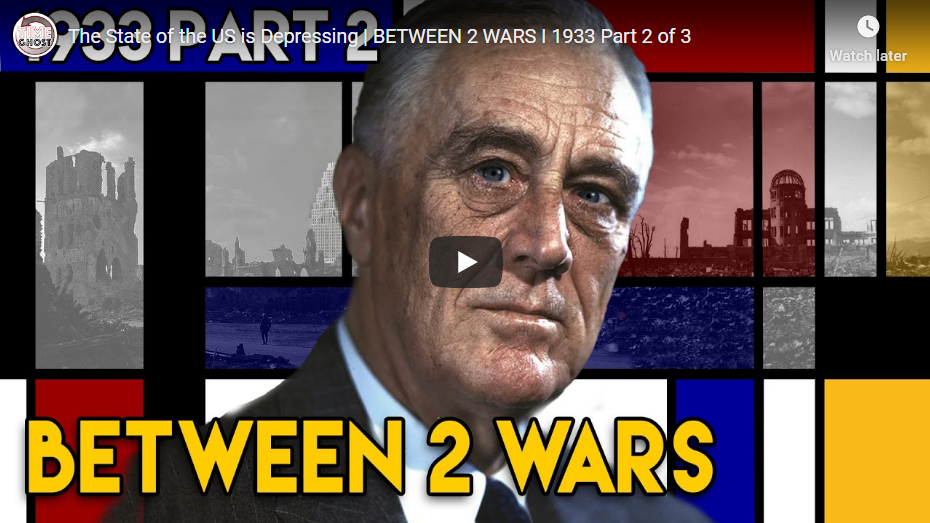
The State of the US is Depressing | BETWEEN 2 WARS I 1933 Part 2 of 3

Filed under: Economics, History, USA — Tags: , , , , , — Nicholas @ 04:00

TimeGhost History
Published 17 Oct 2019

The American economy is in a state of despair. Mass unemployment and poverty sweep the lands. In 1933, a new President is elected, promising to change things for the better. His name is Franklin D. Roosevelt.

Join us on Patreon: https://www.patreon.com/TimeGhostHistory

Subscribe to our World War Two series: https://www.youtube.com/c/worldwartwo…

Hosted by: Indy Neidell
Written by: Francis van Berkel and Spartacus Olsson
Directed by: Spartacus Olsson and Astrid Deinhard
Executive Producers: Bodo Rittenauer, Astrid Deinhard, Indy Neidell, Spartacus Olsson
Creative Producer: Joram Appel
Post-Production Director: Wieke Kapteijns
Research by: Francis van Berkel
Edited by: Wieke Kapteijns
Sound design: Marek Kaminski

Colorized pictures by Norman Steward, Daniel Weiss and Joram Appel.

Sources:

A TimeGhost chronological documentary produced by OnLion Entertainment GmbH.

From the comments:

TimeGhost History
12 minutes ago (edited)
If you’re new here, you might not be familiar with Indy Neidell and his other work. Not only are we doing “Between Two Wars”, on the events and years leading up to World War Two (of which this video is a part), also we’re covering World War Two in realtime week-by-week, exactly 79 years after it all happened. We have now entered the second year of the war. If you haven’t already, check out the World War Two Channel for what maybe one day will become the most complete account of The Second World War: https://www.youtube.com/c/worldwartwo

Cheers,
Joram

September 8, 2019

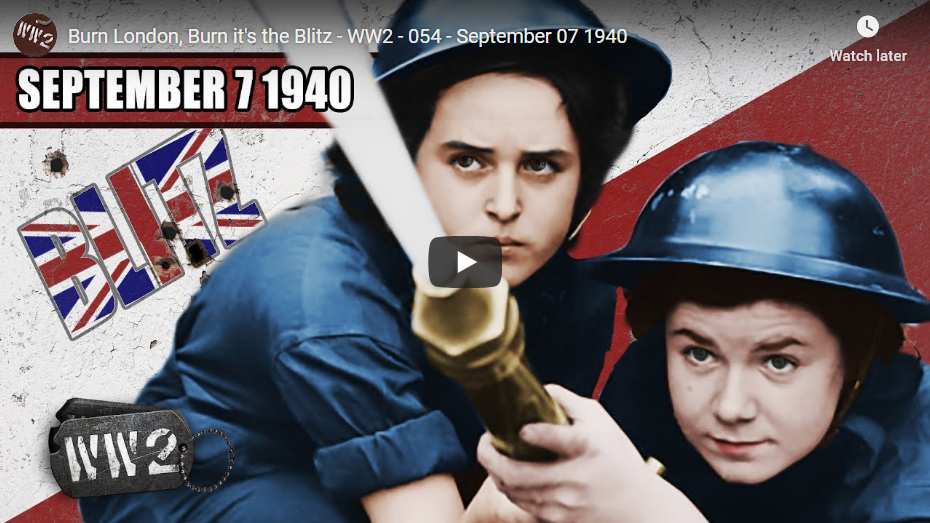
Burn London, Burn it’s the Blitz – WW2 – 054 – September 07 1940

World War Two
Published on 7 Sep 2019

This week, the battle in the skies of Britain enters a new, even deadlier phase, as the crowded streets of London turn into a war zone. It is the start of the Blitz.

Join us on Patreon: https://www.patreon.com/TimeGhostHistory
Or join The TimeGhost Army directly at: https://timeghost.tv

Follow WW2 day by day on Instagram @World_war_two_realtime https://www.instagram.com/world_war_t…
Join our Discord Server: https://discord.gg/D6D2aYN.
Between 2 Wars: https://www.youtube.com/playlist?list…
Source list: http://bit.ly/WW2sources

Written and Hosted by: Indy Neidell
Produced and Directed by: Spartacus Olsson and Astrid Deinhard
Executive Producers: Bodo Rittenauer, Astrid Deinhard, Indy Neidell, Spartacus Olsson
Creative Producer: Joram Appel
Research by: Indy Neidell
Edited by: Iryna Dulka
Map animations: Eastory

Colorisations by Norman Stewart and Julius Jääskeläinen https://www.facebook.com/JJcolorization/

Eastory’s channel: https://www.youtube.com/channel/UCEly…
Archive by Screenocean/Reuters https://www.screenocean.com.

Sources:
– IWM: SP 2553, FL 5186, H 23836, HU 93069, CH 19
– Colorization of Hugo Sperrle by Ruffneck88
– Narodowe Archiwum Cyfrowe

A TimeGhost chronological documentary produced by OnLion Entertainment GmbH.

April 24, 2019

QotD: The Utopia of Damned Fools

Filed under: Government, History, Politics, Quotations, USA — Tags: , , , , — Nicholas @ 01:00

The money began to pour out on November 16, 1933, to the tune of a deafening hullabaloo. By December 1 more than 1,000,000 were on the CWA [Civil Works Administration] pay roll; by January, 1934, the number reached 4,100,000. Press agents in eight-hour shifts worked day and night to tell a panting country what it was all about. The Depression, it was explained, was being given a series of adroit and fatal blows, above, below and athwart the belt. In six months there would be no more unemployment, the wheels of industry would be spinning, and the More Abundant Life would be on us. Brains had at last conquered the fear of fear.

What actually happened belongs to history. By the opening of Spring [Harry] Hopkins had got rid of his billion, and the whole thing had blown up with a bang. More people were out of work than ever before. The wheels of industry resolutely refused to spin. The More Abundant Life continued to linger over the sky line. There ensued a pause for taking breath, and then another stupendous assault was launched upon the taxpayer. This time the amount demanded was $4,880,000,000. It is now in hand, and plans are under way to lay it out where it will do the most good in next year’s campaign.

Go back to the clippings and read them again. Consider well what they say. Four preposterous nonentities, all of them professional uplifters, returning from a junket at the taxpayer’s expense, sit in a smoking car munching peanuts and talking shop. Their sole business in life is spending other people’s money. In the past they have always had to put in four-fifths of their time cadging it, but now the New Deal has admitted them to the vaults of the public treasury, and just beyond the public treasury, shackled in a gigantic lemon-squeezer worked by steam, groans the taxpayer. They feel their oats, and are busting with ideals. For them, at least, the More Abundant Life has surely come.

Suddenly one of them, biting down hard on a peanut, has an inspiration. He leapt to his feet exultant, palpitating like a crusader shinning up the walls of Antioch. How, now, comrade, have you bitten into a worm? Nay, gents, I have thought of a good one, a swell one, the damndest you will ever heard tell of. Why not put everyone to work? Why not shovel it out in a really Large Way. Why higgle and temporize? We won’t be here forever, and when we are gone we’ll be gone a long while.

But the Leader? Wasn’t he babbling again, only the other day, of balancing the budget? Isn’t it a fact that he shows some sign of wobbling of late – that the flop of the NRA [National Recovery Administration] has given him to think? Well, we can only try. We have fetched him before, and maybe we can fetch him again. So the train reaches Washington, the porter gets his tip from the taxpayer’s pocket, and the next day the four brethren meet to figure out the details. But they never get further than a few scratches, for The Leader is in one of his intuitive moods, and his Christian Science smile is in high gear. Say no more, Harry, it is done! The next morning the money begins to gush and billow out of the Treasury. Six months later a billion is gone, and plans are under way to collar five times as much more.

Such is government by the Brain Trust. Such is the fate of the taxpayer under a Planned Economy. Such is the Utopia of Damned Fools.

H.L. Mencken, “The New Deal”, The Mencken Chrestomathy, 1982 (article originally published 1935-05).

March 15, 2019

Charles De Gaulle

Filed under: France, History, WW2 — Tags: , , , , , , , — Nicholas @ 05:00

Colby Cosh linked to an interesting Peter Hitchens review of a recent biography of Charles De Gaulle (De Gaulle by Julian Jackson):

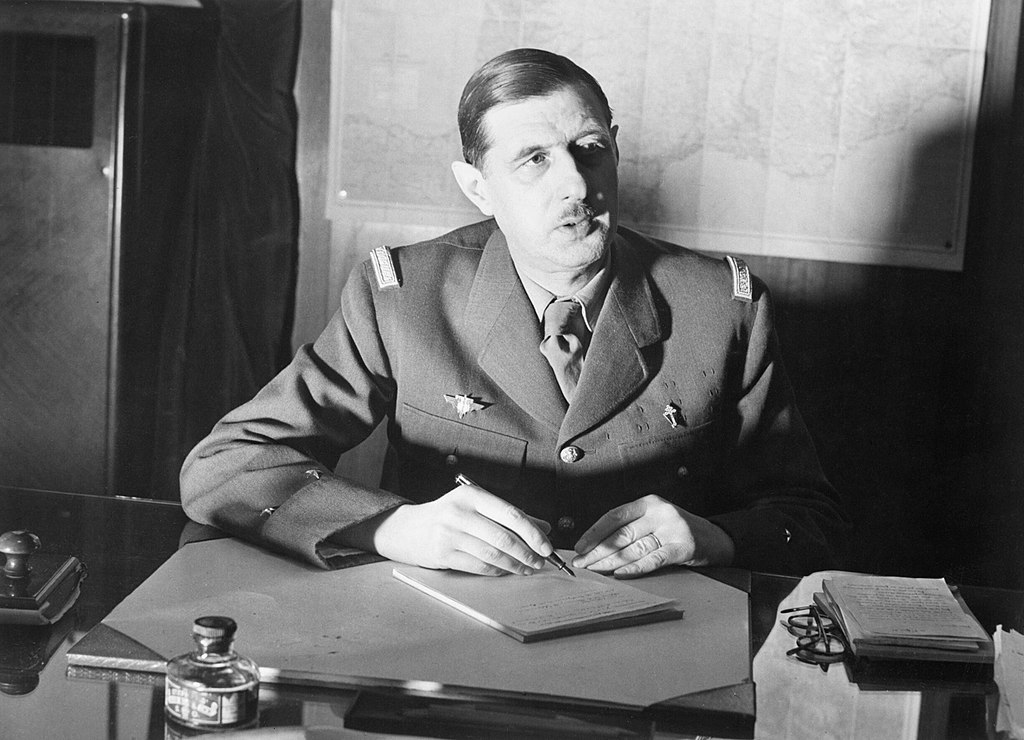
General Charles de Gaulle, Commander of Free French Forces, seated at his desk in London during the Second World War.
Photo via Wikimedia Commons.

When it came to what de Gaulle thought was the pivotal moment in his life, when he could become virtual monarch of France under conditions chosen wholly by himself, he was as ruthless as Lenin. He had, it is often said, a “certain idea of France.” But the ultra-conservative lawyer, Jacques Isorni, whose clients included the collaborationist Vichy leader Marshal Philippe Pétain and de Gaulle’s would-be assassin, Jean-­Marie Bastien-Thiry, concluded that it was “an abstract idea of France, indifferent to the sufferings of the French people.” There is something to this. De Gaulle represented the steely warlike France, summoned up by Bonaparte and again a century later at Verdun, for which the French were required to die and mourn uncomplainingly. For him, Paris was well worth a lie or a betrayal, because his supremacy was so essential for the country he loved.

The costs of de Gaulle’s idea of France were high. As the general himself once mused, “There is no action in which the devil has no part.” The two massacres, and the charnel-house stench which clings to them, are evidence of the reliable rule that even — often especially — the greatest and best of men have terrible flaws and can do terrible things; and also of the other rule that power tends to corrupt. I have begun with them because they are a necessary antidote to the feelings of admiration and liking which any reader of this thrilling, witty, ceaselessly moving, beautifully written account of a truly great man is bound to feel.

Charles de Gaulle’s life would perhaps have been better lived in the seventeenth or eighteenth century, in times when personal courage, mystical imagination, chivalry, and religious fervor were more welcome than they are now. In this world of the United Nations, risk assessment, lawyers, Geneva Conventions, television and superpowers, there is not really enough room for such a man to swing his sword, just as there is no room for old-fashioned great powers in the shadow of superpowers. Had he not been so magnificent, he would have been ridiculous. He looked, more than anything else, like a camel, not least because of the superior expression on his face suggesting that he alone knew the secret One Hundredth Name of God, which camels are supposed to know.

He was filled with shining, old-fashioned beliefs about honor, courage, shame and humiliation, glory and infamy. And as those who conversed with him found, he was perhaps the last great man to make it his business to know those things that it is proper for a king to know. He could talk fluently with philosophers and literary novelists. He had a minute knowledge of history: not just that of France, but of Europe and the world. After many, many conversations with Winston Churchill, a large number of them furious quarrels, he concluded that England’s savior was not in fact very intelligent. He believed wartime, with its austerity and tests of manhood, was more virtuous than peacetime. He believed nothing important could be achieved without recklessness. He stood up to people with considerable courage, even when he was a powerless and lonely figure without soldiers, money, or supporters. He once justified his bloody-minded awkwardness by pointing out that if he were not so difficult, he would himself have been a collaborator. He said “If I were easy to work with, I would be on Marshal Petain’s staff.” He had no time for people like himself. He confessed, “I only esteem those who stand up to me but unfortunately I cannot stand them.”

De Gaulle possessed that great chivalrous virtue of being ready to walk unbowed and defiant in front of the powerful, while being gentle and even submissive to the defenseless and weak. He once became so angry with Churchill that he smashed a chair in his presence to emphasize his rage. Likewise, he defied Franklin Roosevelt over and over again. But he would go home after these battles to sing tender love songs to his daughter Anne, who suffered from Down syndrome. The tiny glimpses we have of this part of his life, obtained from the accidental observations of others, tear at the heart. His concern for Anne was entirely private and not at all feigned. After any long absence from home his first act was to rush up to her room. She died, aged twenty, in his arms. At her funeral, he comforted his wife Yvonne with the words, “Maintenant, elle est comme les autres” (“Now she is like the ­others”), which must be one of the most ­moving things said in the whole twentieth century.

December 7, 2018

“A date that will live in infamy” – Speech

Filed under: History, Japan, Military, Pacific, USA, WW2 — Tags: , , — Nicholas @ 02:00

FootageArchive – Videos From The Past
Published on 19 Mar 2015

Welcome to FootageArchive! On this channel you’ll find historic and educational videos from the 1900s. Watch, learn, and take a trip back in time as we gain insight into a previous time. Subscribe for more.

Note: this video contains archived public domain / licensed footage. This footage serves documentary purposes on world history and is to be viewed as educational.

August 29, 2018

Out of Context: How to Make Bad History Worse | World War 2

Filed under: Australia, Britain, Germany, History, India, Japan, Military, USA, WW2 — Tags: , , , — Nicholas @ 02:00

Knowing Better
Published on 5 Mar 2018

Churchill was a genocidal maniac. The Japanese were rounded up into concentration camps. FDR let Pearl Harbor happen. When you take history out of context, you can make it say whatever you want – including making bad things worse.

A long list of links to sources is included, but I’m too lazy to re-link ’em all, just go to YouTube to see them. Back in 2009, I did a short fisking of Pat Buchanan’s hit-piece on Churchill’s “reponsibility” for the outbreak of WW2.

January 25, 2018

QotD: The New Deal

Filed under: History, Politics, Quotations, USA — Tags: , — Nicholas @ 01:00

Of such sorts are the wizards who now run the country. Here is the perfect pattern of a professional world-saver. His whole life has been devoted to the art and science of spending other people’s money. He has saved millions of the down-trodden from starvation, pestilence, cannibalism, and worse – always at someone else’s expense, and usually at the taxpayer’s. He has been going at it over and over again at Washington. And now, with $4,800,000,000 of your money and mine in his hands, he is preparing to save fresh multitudes, that they may be fat and optimistic on the Tuesday following the first Monday in November, 1936, and so mark their ballots in the right box.

H.L Mencken, “The New Deal”, Baltimore Sun, 1935-05-27.

August 26, 2017

QotD: The American Constitution

Filed under: History, Politics, Quotations, USA — Tags: , , , , — Nicholas @ 01:00

All things considered, this New Republic piece on Randy Barnett and the libertarian constitutional movement is really pretty good. But I thought this part was revealing:

    Barnett believes the Constitution exists to secure inalienable property and contract rights for individuals. This may sound like a bland and inconsequential opinion, but if widely adopted by our courts and political systems it would prohibit or call into question basic governmental protections — minimum wages, food-safety regulations, child-labor laws — that most of us take for granted. For nearly a century now, a legal counterculture has insisted that the whole New Deal project was a big, unconstitutional error, and Barnett is a big part of that movement today.

If your entire program is called into question by the notion that individuals have property and contract rights, maybe the problem is with your program.

And to the extent that, as believed by many, the Supreme Court’s eventual accommodation to the New Deal was the product of duress in the form of FDR’s court-packing scheme, then isn’t that accommodation, in fact, illegitimate?

Glenn Reynolds, Instapundit, 2015-08-31.

July 30, 2017

The Greenback cases

Filed under: Government, History, Law, USA — Tags: , , , , — Nicholas @ 03:00

At Samizdata, Paul Marks discusses why it is so difficult to prevent governments from expanding their powers far beyond what the constitution may allow:

… a Constitution is only as good as the enforcement mechanisms to make sure it is obeyed – and as Luther Martin warned at the Constitutional Convention in Philadelphia, trusting government appointed judges to limit the powers of the very government that appointed them is a fatally flawed idea.

This is not a recent problem. Even in the 19th century the Supreme Court often ruled that the Federal Government has powers that the Constitution does NOT give it. For example the infamous “Second Greenback Case” where the Supreme Court, with newly appointed “justices” (appointed, in part, for this corrupt purpose) overturned the “First Greenback Case” where the court had declared, quite correctly, that the Federal Government has no power to print (or have printed) money – only to “coin money” (Article One, Section Eight of the Constitution of the United States) and that only gold or silver coin (not paper money) may be “legal tender” in any State (Article One, Section Ten of the Constitution of the United States). Nothing could be plainer than that paper money is unconstitutional – indeed the very reason the United States Constitution was written in the first place was to prevent the “not worth a Continental” paper money issued by the Continental Congress to finance its government – those who support the Articles of Confederation system forget that one of its fundamental flaws was that it allowed the government to print money, as it gave no reliable source of taxation to finance the United States Armed Forces. Without a large scale and professional armed forces there is no point in having a United States of America at all – and each State might as well go its own way till conquered by European powers in the 18th century or by the People’s Republic of China in the 21st century.

[…]

To return to the Greenback Cases… – Chief Justice Salmon P. Chase (the former “slaves lawyer” famous for his anti slavery legal work before the Civil War) de facto ruled that the Treasury Secretary during the Civil War had acted unconstitutionally in having money printed, even though the the Treasury Secretary of the time was Salmon P. Chase (himself). It is not necessary to recuse yourself if you intend, de facto, to find yourself guilty. However, more “justices” were added to the court – and the judgement (and the Constitution) was overturned. The argument being that no more paper money was being printed – it would gradually go over time, so there was no need to make a fuss… still less to declare that the “United States Dollars” in the pockets of people were just bits of paper with ink on them (not “money”).

In 1935 the Supreme Court de facto ruled (by five votes to four) that the Federal Government could steal all monetary gold and void all private and public contracts that had gold (or silver) clauses in the contracts. There was no Constitutional basis for this decision (none whatever – just “lawyer’s cant”) and the Federal Reserve notes declared valid money came from an organisation (the Federal Reserve system created in 1913) that the Congress had no Constitutional power to create. The Supreme Court, led by the Chief Justice, might as well have chanted “Death to America!” and “Hail Satan!” as they announced their judgement – as some of the dissenting judges pointed out. Thus the unconstitutional Credit Bubble financial system was pushed forward. The doubts of Luther Martin at the Constitutional Convention were vindicated – government appointed judges sitting without a jury can not be trusted.

July 10, 2017

The end of the British Empire

Filed under: Britain, History, India, USA, WW2 — Tags: , , — Nicholas @ 03:00

Kai Melling takes an unusually anti-American stand in this quick explanation of the decline and fall of the British Empire:

The common narrative is that the USA inherited the British Empire as an aftermath of World War 2. But this phrasing is misleading, because the USA actively designed and exploited the political, mental and military framework of WW2 to Britain’s disadvantage.

Churchill believed that Britain and the USA would be eternal partners, with British statesmen playing Greeks to America’s Romans. But when Britain was in her darkest hour, Roosevelt shook her down for every dime. Poring over a list of British assets in the Western Hemisphere, FDR “reacted with the coolness of a WASP patrician: ‘Well, they aren’t bust — there’s lots of money there.’” (Alan Clark)

Looking back, Alan Clark was appalled by Churchill’s groveling to the Americans: “Churchill’s abasement of Britain before the United States has its origins in the same obsession (with Hitler). The West Indian bases were handed over; the closed markets for British exports were to be dismantled; the entire portfolio of (largely private) holdings in America was liquidated. “A very nice little list,” was Roosevelt’s comment when the British ambassador offered it. “You guys aren’t broken yet.”

Before Lend-Lease aid could begin, Britain was forced to sell all her commercial assets in the United States and turn over all her gold. FDR sent his own ship to pick up the last $50 million in British gold reserves.

“We are not only to be skinned but flayed to the bone,” Churchill wailed to his colleagues, and he was not far off. Churchill drafted a letter to FDR saying that if America continued along this line, she would “wear the aspect of a sheriff collecting the last assets of a helpless debtor.” It was, said the prime minister, “not fitting that any nation should put itself wholly in the hands of another.” But dependent as Britain was on America, Churchill reconsidered, and rewrote his note in more conciliatory tones.

FDR knew exactly what he was doing. “We have been milking the British financial cow, which had plenty of milk at one time, but which has now about become dry,” Roosevelt confided to one Cabinet member. “Great Britain became a poor, though deserving cousin—not to Roosevelt’s regret. So far as it is possible to read his devious mind, it appears that he expected the British to wear down both Germany and themselves. When all independent powers had ceased to exist, the United States would step in and run the world.” (A.J.P. Taylor)

H/T to Sean Gabb for the link.

July 8, 2017

Demonizing the Koch brothers

Filed under: Business, Liberty, Media, Politics, USA — Tags: , , , , , — Nicholas @ 03:00

Julian Adorney on the amazing contrast between the way the Koch brothers actually spend their money and the demonic sins they are regularly accused of by progressives:

The Koch Brothers recently announced a $21 million anti-poverty program in Dallas, designed to reduce gang violence and encourage young entrepreneurs. But their efforts to end poverty are unlikely to earn credit from progressives, who frequently demonize the family. Senate Majority Leader Harry Reid routinely blasts them for, “crooked works” and “nefarious actions”; and when Charles and David Koch donated $100 million to New York-Presbyterian Hospital, leftists demanded (unsuccessfully) that the hospital return the gift.

Why are the Kochs so often criticized by the left, while far less progressive individuals are given a free pass?

Unlikely Alliances

The Koch brothers have spent at least $1.5 billion working to advance traditionally progressive causes. They have funded public television, museums, and hospitals. They contributed $25 million to the United Negro College Fund, the nation’s largest minority education group. The donation offers scholarships and support for historically black universities.

Politically, the Kochs have pushed for criminal justice reform. The brothers worked with Van Jones on his Cut50 project, which aims to cut America’s incarcerated population in half over the next ten years. The Kochs have partnered with the American Civil Liberties Union and the Center for American Progress to reduce prison populations and enact more humane criminal sentencing. And in 2011, the National Association of Criminal Defense Lawyers gave Charles Koch its annual Defender of Justice award.

But criminal justice reform is far from the only progressive cause the Kochs have embraced. They publicly oppose corporate tax breaks and subsidies — including the ethanol subsidies that boost their bottom line.

In spite of this, many progressives disdain the Kochs as far-right extremists. On his Senate website, Bernie Sanders claims that the goal of these, “right wing billionaires” is to, “repeal every major piece of legislation … that has protected the middle class, the elderly, the children, the sick, and the most vulnerable in this country.” The Koch’s high-profile efforts to help the most vulnerable population in the nation, those victimized by the criminal justice system, receives no mention.

[…]

Progressives vilify the Kochs for the same reason that many venerate FDR: politics encourages black and white formulations. Prominent Democrats lambast the Kochs as ill-intentioned billionaires, and the specter of the Kochs has played heavily in Democratic fundraising attempts. Fear motivates, and boogeymen inspire fiercer opposition than the complicated reality of the Koch brothers.

Similarly, Democrats may turn a blind eye to FDR’s anti-progressive actions because they don’t wish to tarnish one of their own. FDR’s economic policies owe much to fascism: Roosevelt admitted that he was, “deeply impressed by what [Mussolini] has accomplished.” Roosevelt’s National Recovery Administration stated it more directly: “The Fascist Principles are very similar to those we have been evolving here in America.”

This similarity is easy to brush off if FDR is perceived as a leftists titan, because in the public eye progressives and fascists are diametrically opposed. It is harder to ignore when one accepts that FDR’s record on human rights was only a few degrees better than Mussolini’s.

May 26, 2017

A Brief History of Politicians Body-Slamming Journalists

Filed under: Media, Politics, USA — Tags: , , , , , — Nicholas @ 06:00

Published on 25 May 2017

In the twilight hours of a special election to replace Montana’s lone congressman, Republican hopeful Greg Gianforte reportedly “body slammed” and punched a Guardian reporter after the journalist tried to ferret out an answer about GOP health care plans. In this video Reason TV imagines a world in which other, high profile politicians give into violent impulses when confronted by the press.

Polls opened in Montana less than twenty-four hours after Gianforte’s confrontation with Guardian reporter Ben Jacobs, and his subsequent assault charge. In the event that Mr. Gianforte is elected to Congress there is a reasonable chance he will interact with more journalists in the future, and possibly even have to formulate responses to Republican legislation at some point.

Written by Andrew Heaton, Austin Bragg, and Meredith Bragg
Performed by Andrew Heaton and Austin Bragg
Produced by Meredith Bragg and Austin Bragg

April 27, 2017

QotD: Canada the (self-imagined) “moral superpower” … the military midget

Filed under: Cancon, History, Military, Quotations, USA — Tags: , , , , — Nicholas @ 01:00

… Canada has no influence whatever in the world. It is unique in this condition among G7 countries, because it has a monstrously inadequate defence capability and takes no serious initiatives in the Western alliance or in international organizations.

Canadians seem to imagine that influence can be had in distant corners of the world just by being virtuous and altruistic and disinterested. That is not how international relations work. The powers that have the money and the applicable military strength have the influence, although those elements may be reinforced if a country or its leader is able to espouse a noble or popular cause with great persuasiveness. This last was the case in the Second World War, where Winston Churchill, Franklin D. Roosevelt, Charles de Gaulle and Adolf Hitler were all, in their different ways, inspiring public speakers who could whip up the enthusiasm of their peoples. Churchill and Roosevelt stirred the masses of the whole world who loved and sought freedom. There are no world leaders now with any appreciable ability to stir world opinion, and influence in different theatres is measured exclusively in military and economic strength, unless there is a colossal moral imbalance between contending parties. Even where such a moral imbalance exists, as in the contest between civilized and terrorism-supporting countries, the advantage is not easily asserted.

[…]

But we are almost entirely dependent on the United States for our own defence. When President Roosevelt said at Queen’s University in Kingston in 1938 that the U.S. would protect Canada from foreign invasion, Mackenzie King accepted the responsibility of assuring that invaders could not reach the U.S. through Canada. Since the Mulroney era, we have just been freeloaders. If we want to be taken seriously, we have to make a difference in the Western alliance, which the Trump administration has set out to revitalize. As I have written here before, a defence build-up: high-tech, increased numbers, and adult education, is a win-double, an added cubit to our national stature influence (and pride), and the best possible form of public-sector economic stimulus. It is frustrating that successive governments of both major parties have not seen these obvious truths. Strength, not amiable piety, creates national influence.

Conrad Black, “Being nice gets Canada liked. But we won’t be respected until we pull our weight”, National Post, 2017-04-14.

January 22, 2017

The media’s Great Depression nostalgia

Filed under: History, Media, Politics, USA — Tags: , , , , , — Nicholas @ 03:00

Ed Driscoll on the recurring media nostalgia for a long-ago, much-worse-than-today time:

The month after Obama won the election in 2008, Virginia Postrel noted that a lot of journalists (read: Democrat operatives with bylines) had heavily invested in the notion that it was the 1930s all over again, and had a major case of what Virginia dubbed “Depression Lust,” and were busy cranking out “Depression Porn” in service to the Office of the President-Elect. Not least of which was Time magazine’s infamous cover of Obama Photoshopped into the second coming of FDR and the headline “The New, New Deal,” thinking it was a compliment, and not an ominous prediction of an economy as similarly atrophied as Roosevelt’s. Pretending that Trump is Hitler allows you, oh brave foot-soldier in the DNC-MSM, to pose as the new Dietrich Bonhoeffer. It’s simply the funhouse mirror image version of the same sclerotic meme.

For the modern left, if the economy is relatively good*, and the incoming president has a (D) after his name, he’s the second coming of JFK (see: Clinton, Bill); if the economy is bad, and he has a (D) after his name, he’s FDR — and no matter what the shape of the economy, if the president has an (R) after his name, he’s Hitler (QED: Nixon, Reagan, Bush #43, and Trump).

* And it was, despite Clinton’s rhetoric. Would Time magazine lie to you? Well yes, of course. But look what they admitted in December of 1992.

« Newer PostsOlder Posts »

Powered by WordPress