Quotulatiousness

June 6, 2016

QotD: What really ended the Great Depression in the United States?

Filed under: Economics, History, Quotations, USA, WW2 — Tags: , , — Nicholas @ 01:00

The Great Depression was the worst economic crisis in U.S. history. From 1931 to 1940 unemployment was always in double digits. In April 1939, almost ten years after the crisis began, more than one in five Americans still could not find work.

On the surface, World War II seems to mark the end of the Great Depression. During the war more than 12 million Americans were sent into the military, and a similar number toiled in defense-related jobs. Those war jobs seemingly took care of the 17 million unemployed in 1939. Most historians have therefore cited the massive spending during wartime as the event that ended the Great Depression.

Some economists — especially Robert Higgs […] challenged that conclusion. Let’s be blunt. If the recipe for economic recovery is putting tens of millions of people in defense plants or military marches, then having them make or drop bombs on our enemies overseas, the value of world peace is called into question. In truth, building tanks and feeding soldiers — necessary as it was to winning the war — became a crushing financial burden. We merely traded debt for unemployment. The expense of funding World War II hiked the national debt from $49 billion in 1941 to almost $260 billion in 1945. In other words, the war had only postponed the issue of recovery.

Even President Roosevelt and his New Dealers sensed that war spending was not the ultimate solution; they feared that the Great Depression — with more unemployment than ever — would resume after Hitler and Hirohito surrendered. Yet FDR’s team was blindly wedded to the federal spending that (as I argue in my 2009 book New Deal or Raw Deal?) had perpetuated the Great Depression during the 1930s.

FDR had halted many of his New Deal programs during the war — and he allowed Congress to kill the WPA, the CCC, the NYA, and others — because winning the war came first. In 1944, however, as it became apparent that the Allies would prevail, he and his New Dealers prepared the country for his New Deal revival by promising a second bill of rights. Included in the President’s package of new entitlements was the right to “adequate medical care,” a “decent home,” and a “useful and remunerative job.” These rights (unlike free speech and freedom of religion) imposed obligations on other Americans to pay taxes for eyeglasses, “decent” houses, and “useful” jobs, but FDR believed his second bill of rights was an advance in thinking from what the Founders had conceived.

Burton Folsom, “If FDR’s New Deal Didn’t End the Depression, Then It Was World War II that Did”, The Freeman, 2014-12-26.

June 1, 2016

The “Trump as scary autocrat” scenario

Filed under: History, Politics, USA — Tags: , , , — Nicholas @ 02:00

Last week, Megan McArdle responded to a “my hair is on fire” diatribe from The New Yorker about a Donald Trump presidency being the end of America as we know it. She’s not convinced:

There are two stages to becoming a scary autocrat. First, you have to get into a position to seize power. The most traditional routes are the military (a task for which Donald Trump’s bone spurs left him tragically disqualified), or winning elected office to abolish or corrupt the electoral process. The former route has its risks, but once you’ve safely arrived in the presidential palace, it’s pretty easy to dispense with democracy, since you have all the guns. The latter route means you need the rest of government, including all the folks with guns, to go along with you.

This certainly does happen, even in countries that have been practicing democracies for a while. But it’s by no means a given. Franklin D. Roosevelt took a certain amount of constitutional liberty with his wackier notions, and when the courts pushed back, he hit on the scary idea of basically throwing out some Supreme Court justices and replacing them with others who would rubber-stamp his policies. (The phrasing was nicer than that, but this was the basic idea, and just the sort of first step that dictators like to take toward cementing themselves as Autocrat for Life). FDR’s own party rebelled, but the Supreme Court began cooperating, too.

There were also civil liberties violations under FDR, notably the internment of the West Coast Japanese population. But while these were appalling abuses, and a stain on the national honor, they are within the (unfortunately) normal range of government behavior in your ordinary, middling-decent democracy of the era.

So the question is not just whether Trump wants to be a dictator, but what the other branches of government will do if he tries to actually become one. I don’t just mean Congress and the courts; I mean “will the bureaucrats of the civil service follow his orders, and will the people with guns agree to go out and arrest his enemies?”

There’s clearly a portion of the electorate that thrills to the more authoritarian and violent parts of his message, and presumably some of those folks are in the military and the civil service. But I’m still fairly confident that the FBI is not, say, going to start tapping journalists’ phones to find out if they’re making fun of President Trump’s comb-over, or disappearing the ones who do.

I worry more about Silvio Berlusconi-style corruption and abuse of regulatory agencies, an impulsive foreign policy that could lead us into open conflict with a nuclear-armed power, and executive-power overreach. I also worry about simple incompetence, given how uninterested Trump seems to be in policy. All-out dictatorship is pretty low on the list, because American institutions do not seem weak enough to allow it.

March 16, 2016

QotD: The Great Depression

Filed under: Economics, Government, History, Quotations, USA — Tags: , , , — Nicholas @ 01:00

How bad was the Great Depression? Over the four years from 1929 to 1933, production at the nation’s factories, mines, and utilities fell by more than half. People’s real disposable incomes dropped 28 percent. Stock prices collapsed to one-tenth of their pre-crash height. The number of unemployed Americans rose from 1.6 million in 1929 to 12.8 million in 1933. One of every four workers was out of a job at the Depression’s nadir, and ugly rumors of revolt simmered for the first time since the Civil War.

Old myths never die; they just keep showing up in college economics and political science textbooks. Students today are frequently taught that unfettered free enterprise collapsed of its own weight in 1929, paving the way for a decade-long economic depression full of hardship and misery. President Herbert Hoover is presented as an advocate of “hands-off,” or laissez-faire, economic policy, while his successor, Franklin Roosevelt, is the economic savior whose policies brought us recovery. This popular account of the Depression belongs in a book of fairy tales and not in a serious discussion of economic history, as a review of the facts demonstrates.

To properly understand the events of the time, it is appropriate to view the Great Depression as not one, but four consecutive depressions rolled into one. The late economist Hans F. Sennholz labeled these four “phases” as follows: the business cycle; the disintegration of the world economy; the New Deal; and the Wagner Act. The first phase explains why the crash of 1929 happened in the first place; the other three show how government intervention kept the economy in a stupor for over a decade.

The Great Depression was not the country’s first depression, though it proved to be the longest. The common thread woven through the several earlier debacles was disastrous manipulation of the money supply by government. For various reasons, government policies were adopted that ballooned the quantity of money and credit. A boom resulted, followed later by a painful day of reckoning. None of America’s depressions prior to 1929, however, lasted more than four years and most of them were over in two. The Great Depression lasted for a dozen years because the government compounded its monetary errors with a series of harmful interventions.

Lawrence W. Reed, “The Great Depression was a Calamity of Unfettered Capitalism”, The Freeman, 2014-11-28.

March 8, 2016

QotD: The Civil Works Administration, the Works Progress Administration and the Wagner Act

Filed under: Bureaucracy, Economics, History, Quotations, USA — Tags: , , , — Nicholas @ 01:00

Roosevelt created the Civil Works Administration in November 1933 and ended it in March 1934, though the unfinished projects were transferred to the Federal Emergency Relief Administration. Roosevelt had assured Congress in his State of the Union message that any new such program would be abolished within a year. “The federal government,” said the President, “must and shall quit this business of relief. I am not willing that the vitality of our people be further stopped by the giving of cash, of market baskets, of a few bits of weekly work cutting grass, raking leaves, or picking up papers in the public parks.”

But in 1935 the Works Progress Administration came along. It is known today as the very government program that gave rise to the new term, “boondoggle,” because it “produced” a lot more than the 77,000 bridges and 116,000 buildings to which its advocates loved to point as evidence of its efficacy. The stupefying roster of wasteful spending generated by these jobs programs represented a diversion of valuable resources to politically motivated and economically counterproductive purposes.

The American economy was soon relieved of the burden of some of the New Deal’s excesses when the Supreme Court outlawed the NRA in 1935 and the AAA in 1936, earning Roosevelt’s eternal wrath and derision. Recognizing much of what Roosevelt did as unconstitutional, the “nine old men” of the Court also threw out other, more minor acts and programs which hindered recovery.

Freed from the worst of the New Deal, the economy showed some signs of life. Unemployment dropped to 18 percent in 1935, 14 percent in 1936, and even lower in 1937. But by 1938, it was back up to 20 percent as the economy slumped again. The stock market crashed nearly 50 percent between August 1937 and March 1938. The “economic stimulus” of Franklin Roosevelt’s New Deal had achieved a real “first”: a depression within a depression!

The stage was set for the 1937–38 collapse with the passage of the National Labor Relations Act in 1935 — better known as the Wagner Act and organized labor’s “Magna Carta.” To quote Hans Sennholz again:

    This law revolutionized American labor relations. It took labor disputes out of the courts of law and brought them under a newly created Federal agency, the National Labor Relations Board, which became prosecutor, judge, and jury, all in one. Labor union sympathizers on the Board further perverted this law, which already afforded legal immunities and privileges to labor unions. The U.S. thereby abandoned a great achievement of Western civilization, equality under the law.

Armed with these sweeping new powers, labor unions went on a militant organizing frenzy. Threats, boycotts, strikes, seizures of plants, and widespread violence pushed productivity down sharply and unemployment up dramatically. Membership in the nation’s labor unions soared; by 1941 there were two and a half times as many Americans in unions as in 1935.

From the White House on the heels of the Wagner Act came a thunderous barrage of insults against business. Businessmen, Roosevelt fumed, were obstacles on the road to recovery. New strictures on the stock market were imposed. A tax on corporate retained earnings, called the “undistributed profits tax,” was levied. “These soak-the-rich efforts,” writes economist Robert Higgs, “left little doubt that the president and his administration intended to push through Congress everything they could to extract wealth from the high-income earners responsible for making the bulk of the nation’s decisions about private investment.”

Higgs draws a close connection between the level of private investment and the course of the American economy in the 1930s. The relentless assaults of the Roosevelt administration — in both word and deed — against business, property, and free enterprise guaranteed that the capital needed to jumpstart the economy was either taxed away or forced into hiding. When Roosevelt took America to war in 1941, he eased up on his anti-business agenda, but a great deal of the nation’s capital was diverted into the war effort instead of into plant expansion or consumer goods. Not until both Roosevelt and the war were gone did investors feel confident enough to “set in motion the postwar investment boom that powered the economy’s return to sustained prosperity.”

Lawrence W. Reed, “The Great Depression was a Calamity of Unfettered Capitalism”, The Freeman, 2014-11-28.

February 18, 2016

QotD: FDR’s New Deal

Filed under: Economics, Government, Quotations, USA — Tags: , , , , — Nicholas @ 01:00

Franklin Delano Roosevelt won the 1932 presidential election in a landslide, collecting 472 electoral votes to just 59 for the incumbent Herbert Hoover. The platform of the Democratic Party whose ticket Roosevelt headed declared, “We believe that a party platform is a covenant with the people to be faithfully kept by the party entrusted with power.” It called for a 25 percent reduction in federal spending, a balanced federal budget, a sound gold currency “to be preserved at all hazards,” the removal of government from areas that belonged more appropriately to private enterprise, and an end to the “extravagance” of Hoover’s farm programs. This is what candidate Roosevelt promised, but it bears no resemblance to what President Roosevelt actually delivered.

In the first year of the New Deal, Roosevelt proposed spending $10 billion while revenues were only $3 billion. Between 1933 and 1936, government expenditures rose by more than 83 percent. Federal debt skyrocketed by 73 percent.

Roosevelt secured passage of the Agricultural Adjustment Act (AAA), which levied a new tax on agricultural processors and used the revenue to supervise the wholesale destruction of valuable crops and cattle. Federal agents oversaw the ugly spectacle of perfectly good fields of cotton, wheat, and corn being plowed under. Healthy cattle, sheep, and pigs by the millions were slaughtered and buried in mass graves.

Even if the AAA had helped farmers by curtailing supplies and raising prices, it could have done so only by hurting millions of others who had to pay those prices or make do with less to eat.

Perhaps the most radical aspect of the New Deal was the National Industrial Recovery Act (NIRA), passed in June 1933, which set up the National Recovery Administration (NRA). Under the NIRA, most manufacturing industries were suddenly forced into government-mandated cartels. Codes that regulated prices and terms of sale briefly transformed much of the American economy into a fascist-style arrangement, while the NRA was financed by new taxes on the very industries it controlled. Some economists have estimated that the NRA boosted the cost of doing business by an average of 40 percent — not something a depressed economy needed for recovery.

Like Hoover before him, Roosevelt signed into law steep income tax rate increases for the high brackets and introduced a 5 percent withholding tax on corporate dividends. In fact, tax hikes became a favorite policy of the president’s for the next ten years, culminating in a top income tax rate of 94 percent during the last year of World War II.

Lawrence W. Reed, “The Great Depression was a Calamity of Unfettered Capitalism”, The Freeman, 2014-11-28.

February 14, 2016

QotD: President Herbert Hoover’s lasting economic legacy

Until March 1933, these were the years of President Herbert Hoover — the man that anti-capitalists depict as a champion of non-interventionist, laissez-faire economics.

Did Hoover really subscribe to a “hands off the economy,” free-market philosophy? His opponent in the 1932 election, Franklin Roosevelt, didn’t think so. During the campaign, Roosevelt blasted Hoover for spending and taxing too much, boosting the national debt, choking off trade, and putting millions of people on the dole. He accused the president of “reckless and extravagant” spending, of thinking “that we ought to center control of everything in Washington as rapidly as possible,” and of presiding over “the greatest spending administration in peacetime in all of history.” Roosevelt’s running mate, John Nance Garner, charged that Hoover was “leading the country down the path of socialism.” Contrary to the modern myth about Hoover, Roosevelt and Garner were absolutely right.

The crowning folly of the Hoover administration was the Smoot-Hawley Tariff, passed in June 1930. It came on top of the Fordney-McCumber Tariff of 1922, which had already put American agriculture in a tailspin during the preceding decade. The most protectionist legislation in U.S. history, Smoot-Hawley virtually closed the borders to foreign goods and ignited a vicious international trade war.

Officials in the administration and in Congress believed that raising trade barriers would force Americans to buy more goods made at home, which would solve the nagging unemployment problem. They ignored an important principle of international commerce: trade is ultimately a two-way street; if foreigners cannot sell their goods here, then they cannot earn the dollars they need to buy here.

Foreign companies and their workers were flattened by Smoot-Hawley’s steep tariff rates, and foreign governments soon retaliated with trade barriers of their own. With their ability to sell in the American market severely hampered, they curtailed their purchases of American goods. American agriculture was particularly hard hit. With a stroke of the presidential pen, farmers in this country lost nearly a third of their markets. Farm prices plummeted and tens of thousands of farmers went bankrupt. With the collapse of agriculture, rural banks failed in record numbers, dragging down hundreds of thousands of their customers.

Hoover dramatically increased government spending for subsidy and relief schemes. In the space of one year alone, from 1930 to 1931, the federal government’s share of GNP increased by about one-third.

Hoover’s agricultural bureaucracy doled out hundreds of millions of dollars to wheat and cotton farmers even as the new tariffs wiped out their markets. His Reconstruction Finance Corporation ladled out billions more in business subsidies. Commenting decades later on Hoover’s administration, Rexford Guy Tugwell, one of the architects of Franklin Roosevelt’s policies of the 1930s, explained, “We didn’t admit it at the time, but practically the whole New Deal was extrapolated from programs that Hoover started.”

To compound the folly of high tariffs and huge subsidies, Congress then passed and Hoover signed the Revenue Act of 1932. It doubled the income tax for most Americans; the top bracket more than doubled, going from 24 percent to 63 percent. Exemptions were lowered; the earned income credit was abolished; corporate and estate taxes were raised; new gift, gasoline, and auto taxes were imposed; and postal rates were sharply hiked.

Can any serious scholar observe the Hoover administration’s massive economic intervention and, with a straight face, pronounce the inevitably deleterious effects as the fault of free markets?

Lawrence W. Reed, “The Great Depression was a Calamity of Unfettered Capitalism”, The Freeman, 2014-11-28.

August 26, 2015

QotD: When “pragmatism” is far from pragmatic

Filed under: Media, Politics, Quotations, USA — Tags: , , , , — Nicholas @ 01:00

Obama was alluding to FDR’s famous promise (at Oglethorpe University in 1932) to pursue “bold, persistent experimentation” to end the Great Depression. Roosevelt’s vow was itself a homage to the reigning philosophical pose of American liberalism at the time: pragmatism. Self-anointed champions of the “pragmatic method,” the progressives believed they were anti-ideologues, experts and technicians using the most scientifically advanced methods to replace the failed liberal-democratic capitalism of the 19th century. Words like “philosophy,” “dogma,” “principle,” and “ideology” were out, and terms like “progress,” “method,” “action,” “technique,” and “disinterestedness” were in. When Herbert Croly, founder of The New Republic and author of the progressive bible The Promise of American Life, was accused of violating liberal principles when he supported Italy’s great modernizer, Benito Mussolini, Croly replied that the flagship journal of American liberalism was in fact “not an exponent of liberal principles.” Indeed, “if there are any abstract liberal principles, we do not know how to formulate them. Nor if they are formulated by others do we recognize their authority. Liberalism, as we understand it, is an activity.”

This has been the primary disguise of liberalism ever since: “We’re not ideologues, we’re pragmatists! And if only you crazy ideologues” — “market fundamentalists,” “right-wingers,” “zealots,” “dogmatists,” etc. — “would just get out of the way and let us do what all smart people agree is the smart thing to do, we could fix all the problems facing us today.” It’s a variant of the old “scientific socialism” that exonerated the Left from the charge of ideological bias. “We’re not seizing the means of production and these great vacation homes because we want to — it’s science!” The subtext is always clear: People who disagree with liberalism do so because they are deranged, brainwashed, corrupt, selfish, or stupid. In his 1962 Yale commencement address, President Kennedy explained that “political labels and ideological approaches are irrelevant to the solution” of today’s challenges. At a press conference the previous March he had told the country, “Most of the problems … that we now face, are technical problems, are administrative problems.” And therefore we needed people like him and his Whiz Kids to “deal with questions which are now beyond the comprehension of most men.”

“Pragmatism” and “ideology” have themselves become clichés. Liberals are smart and realistic because they do smart and realistic things; smart and realistic things are the things liberals do. Conservatives, meanwhile, are ideologues who don’t live in the reality-based community; the things they do are by definition ideological, because conservatives do them.

Jonah Goldberg, excerpt from The Tyranny of Clichés, published by National Review, 2012-04-22.

December 8, 2014

The Luftwaffe attack at Bari in 1943

Filed under: Europe, Germany, History, Italy, Military, WW2 — Tags: , , — Nicholas @ 00:03

Patrick K. O’Donnell discusses one of the Luftwaffe‘s most deadly attacks and why most people have never heard of it:

Americans remember December 7 as Pearl Harbor Day, but most Americans have never even heard of the “Little Pearl Harbor,” which occurred in Bari Harbor, Italy, on December 2, 1943. More than 100 Luftwaffe bombers mounted a surprise attack on Allied ships moored in the harbor. Their bombs sank or rendered inoperable 28 of these ships. Nearly a thousand Allied troops were killed or wounded. along with hundreds of civilians.

Unbeknownst to those in the port, one of the ships carried liquid death in its belly. The American freighter John Harvey was secretly carrying mustard agent, in violation of international agreements that banned its use. President Franklin Roosevelt had covertly ordered the shipment of 100 tons of mustard agent to Italy for retaliation in the event that the Germans used chemical warfare against the Allied troops. The incident was covered up and remained a secret for decades.

When the German bombs hit the John Harvey, the ship’s hold immediately exploded with devastating violence, killing all those who knew about the mustard [gas]. Deadly liquid and gas flew high into the air and then slowly settled back down into the harbor, coating everything and everyone in the vicinity. Casualties would mount over the coming days and weeks as the agent slowly and painfully claimed the lives of many who had survived the initial attack.

Mustard gas was one of the nastiest relics of the attempts to break the trench lines during the First World War. Wikipedia says:

The sulfur mustards, or sulphur mustards, commonly known as mustard gas, are a class of related cytotoxic and vesicant chemical warfare agents with the ability to form large blisters on the exposed skin and in the lungs. Pure sulfur mustards are colorless, viscous liquids at room temperature. When used in impure form, such as warfare agents, they are usually yellow-brown in color and have an odor resembling mustard plants, garlic, or horseradish, hence the name. Mustard gas was originally assigned the name LOST, after the scientists Wilhelm Lommel and Wilhelm Steinkopf, who developed a method for the large-scale production of mustard gas for the Imperial German Army in 1916.

Mustard agents are regulated under the 1993 Chemical Weapons Convention (CWC). Three classes of chemicals are monitored under this Convention, with sulfur and nitrogen mustard grouped in Schedule 1, as substances with no use other than in chemical warfare. Mustard agents could be deployed on the battlefield by means of artillery shells, aerial bombs, rockets, or by spraying from warplanes.

September 21, 2014

The Roosevelts and the foundation of the Imperial Presidency

Amity Shlaes on the recent Ken Burns documentary on Teddy Roosevelt, FDR, and Eleanor Roosevelt:

“He is at once God and their intimate friend,” wrote journalist Martha Gellhorn back in the 1930s of President Franklin Roosevelt. The quote comes from The Roosevelts, the new Ken Burns documentary that PBS airs this month. But the term “documentary” doesn’t do The Roosevelts justice. “Extravaganza” is more like it: In not one but 14 lavish hours, the series covers two great presidents, Theodore Roosevelt, who served in the first decade of the last century, and Franklin Roosevelt, who led our nation through the Great Depression and to victory in World War II. In his use of the plural, Burns correctly includes a third Roosevelt: Eleanor, who as first lady also affected policy, along with her spouse.

[…]

Absent, however, from the compelling footage is any display of the negative consequences of Rooseveltian action. The premise of Theodore Roosevelt’s trustbusting was that business was too strong. The opposite turned out to be true when, bullied by TR, the railroads promptly collapsed in the Panic of 1907. In the end it fell to TR’s very target, J. P. Morgan, to organize the rescue on Wall Street.

The documentary also neglects to mention that the economy of the early 1920s proved likewise fragile — casualty, in part, to President Woodrow Wilson’s fortification of TR’s progressive policies. Presidents Warren Harding and Calvin Coolidge poured their own energy into halting the expansion of an imperial presidency and sustaining the authority of the states. This endeavor, anti-progressive, also won approbation: In 1920, the Harding-Coolidge ticket beat Cox-Roosevelt. The result of the Harding-Coolidge style of presidency was genuine and enormous prosperity. The 1920s saw the arrival of automobiles, indoor toilets, and the very radios that FDR would later use so effectively to his advantage. Joblessness dropped; the number of new patents soared. TR had enjoyed adulation, but so did his mirror opposite, the refrainer Coolidge.

When it comes to the 1930s, such twisting of the record becomes outright distortion. By his own stated goal, that of putting people to work, Roosevelt failed. Joblessness remained above 10 percent for most of the decade. The stock market did not come back. By some measures, real output passed 1929 levels monetarily in the mid 1930s only to fall back into a steep depression within the Depression. As George Will comments, “the best of the New Deal programs was Franklin Roosevelt’s smile.” The recovery might have come sooner had the smile been the only New Deal policy.

So great is Burns’s emphasis on the Roosevelt dynasty that William Howard Taft, Woodrow Wilson, Warren Harding, Calvin Coolidge, and Herbert Hoover come away as mere seat warmers in the White House. Especially puzzling is the neglect of TR’s progressive heirs, Taft and Wilson, who, after all, set the stage for FDR. This omission can be explained only by Burns’s desire to cement the reign of the Roosevelts. On the surface, the series’ penchant for grandees might seem benign, like the breathless coverage of Princess Kate’s third trimester in People magazine. In this country, elevating presidential families is a common habit of television producers; the Kennedys as dynasty have enjoyed their share of airtime. Still, Burns does go further than the others, ennobling the Roosevelts as if they were true monarchs, gods almost, as in Martha Gellhorn’s above mentioned line. Burns equates progressive policy with the family that promulgates it. And when Burns enthrones the Roosevelts, he also enthrones their unkingly doctrine, progressivism.

June 5, 2014

QotD: Churchill, Roosevelt and de Gaulle

Filed under: Europe, France, History, Quotations, USA, WW2 — Tags: , , , — Nicholas @ 12:08

The central problem of relations with de Gaulle stemmed from President Roosevelt’s distrust. Roosevelt saw him as a potential dictator. This view had been encouraged by Admiral Leahy, formerly his ambassador to Marshal Petain in Vichy, as well as several influential Frenchmen in Washington, including Jean Monnet, later seen as the founding father of European unity.

Roosevelt had become so repelled by French politics that in February he suggested changing the plans for the post-war Allied occupation zones in Germany. He wanted the United States to take the northern half of the country, so that it could be resupplied through Hamburg rather than through France. “As I understand it,” Churchill wrote in reply, “your proposal arises from an aversion to undertaking police work in France and a fear that this might involve the stationing of US Forces in France over a long period.”

Roosevelt, and to a lesser extent Churchill, refused to recognize the problems of what de Gaulle himself described as “an insurrectional government”. De Gaulle was not merely trying to assure his own position. He needed to keep the rival factions together to save France from chaos after the liberation, perhaps even civil war. But the lofty and awkward de Gaulle, often to the despair of his own supporters, seemed almost to take a perverse pleasure in biting the American and British hands which fed him. De Gaulle had a totally Franco-centric view of everything. This included a supreme disdain for inconvenient facts, especially anything which might undermine the glory of France. Only de Gaulle could have written a history of the French army and manage to make no mention of the Battle of Waterloo.

Anthony Beevor, D-Day: The Battle for Normandy, 2009.

January 29, 2014

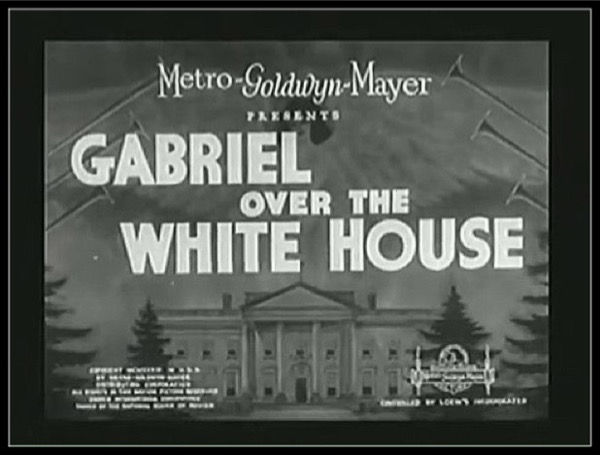
Pitching the New Deal through film – Gabriel Over the White House

Filed under: History, Media, Politics, USA — Tags: , , , — Nicholas @ 10:01

I’d never heard of Gabriel Over the White House, so Jonah Goldberg‘s summary was quite interesting:

The legendary media tycoon William Randolph Hearst believed America needed a strongman and that Franklin D. Roosevelt would fit the bill. He ordered his newspapers to support FDR and the New Deal. At his direction, Hearst’s political allies rallied around Roosevelt at the Democratic convention, which some believe sealed the deal for Roosevelt’s nomination.

But all that wasn’t enough. Hearst also believed the voters had to be made to see what could be gained from a president with a free hand. So he financed the film Gabriel Over the White House, starring Walter Huston. The film depicts an FDR look-alike president who, after a coma-inducing car accident, is transformed from a passive Warren Harding type into a hands-on dictator. The reborn commander-in-chief suspends the Constitution, violently wipes out corruption, and revives the economy through a national socialist agenda. When Congress tries to impeach him, he dissolves Congress.

The Library of Congress summarizes the film nicely. “The good news: He reduces unemployment, lifts the country out of the Depression, battles gangsters and Congress, and brings about world peace. The bad news: He’s Mussolini.”

Hearst wanted to make sure the script got it right, so he sent it to what today might be called a script doctor, namely Roosevelt. FDR loved it, but he did have some changes, which Hearst eagerly accepted. A month into his first term, FDR sent Hearst a thank-you note. “I want to send you this line to tell you how pleased I am with the changes you made in Gabriel Over the White House,” Roosevelt wrote. “I think it is an intensely interesting picture and should do much to help.”

You can probably get the overall tone of the movie from this clip:

Even the editors at Wikipedia — hardly a hotbed of proto-fascists — describe it as “an example of totalitarian propaganda”:

Controversial since the time of its release, Gabriel Over the White House is widely acknowledged to be an example of totalitarian propaganda. Tweed, the author of the original novel, was a “liberal champion of government activism” and trusted adviser to David Lloyd George, the Liberal Prime Minister who brought Bismarck’s welfare state to the United Kingdom. The decision to buy the story was made by producer Walter Wanger, variously described as “a liberal Democrat” or a “liberal Hollywood mogul.” After two weeks of script preparation, Wanger secured the financial backing of media magnate William Randolph Hearst, one of President Franklin D. Roosevelt’s staunchest supporters, who had helped him get the Democratic presidential nomination and who enlisted his entire media empire to campaign for him. Hearst intended the film to be a tribute to FDR and an attack on previous Republican administrations.

Although an internal MGM synopsis had labeled the script “wildly reactionary and radical to the nth degree,” studio boss Louis B. Mayer “learned only when he attended the Glendale, California preview that Hammond gradually turns America into a dictatorship,” writes film historian Leonard J. Leff. “Mayer was furious, telling his lieutenant, ‘Put that picture back in its can, take it back to the studio, and lock it up!'”

Released only a few weeks after Franklin Roosevelt’s inauguration, the film was labeled by The New Republic “a half-hearted plea for Fascism.” Its purpose, agreed The Nation, was “to convert innocent American movie audiences to a policy of fascist dictatorship in this country.” Newsweek‘s Jonathan Alter concurred in 2007 that the movie was meant to “prepare the public for a dictatorship,” as well as to be an instructional guide for FDR, who read the script during the campaign. He liked it so much that he took time during the hectic first weeks of his presidency to suggest several script rewrites that were incorporated into the film. “An aroma of fascism clung to the heavily edited release print,” according to Leff. Roosevelt saw an advance screening, writing, “I want to send you this line to tell you how pleased I am with the changes you made in Gabriel Over the White House. I think it is an intensely interesting picture and should do much to help.” Roosevelt saw the movie several times and enjoyed it. After a private screening, First Lady Eleanor Roosevelt wrote that “if a million unemployed marched on Washington … I’d do what the President does in the picture!”

Update, 5 November, 2018: James Lileks takes the opportunity to review this film on the eve of tomorrow’s US midterm elections.

For Election week, a remarkable movie. And I don’t mean “astonishingly good, technically superb, visually ingenious.” I mean utterly insane.

November 20, 2013

An app like this may justify the existence of Google Glass

Filed under: Randomness, Technology — Tags: , , , , , — Nicholas @ 08:38

I have a terrible memory for people’s names (and no, it’s not just early senility … I’ve always had trouble remembering names). For example, I’ve been a member of the same badminton club for nearly 15 years and there are still folks there whose names just don’t register: not just new members, but people I’ve played with or against on dozens of occasions. I know them … I just can’t remember their names in a timely fashion. David Friedman suggests that Google Glass might be the solution I need:

I first encountered the solution to my problem in Double Star, a very good novel by Robert Heinlein. It will be made possible, in a higher tech version, by Google glass. The solution is the Farley File, named after FDR’s campaign manager.

A politician such as Roosevelt meets lots of people over the course of his career. For each of them the meeting is an event to be remembered and retold. It is much less memorable to the politician, who cannot possibly remember the details of ten thousand meetings. He can, however, create the illusion of doing so by maintaining a card file with information on everyone he has ever met: The name of the man’s wife, how many children he has, his dog, the joke he told, all the things the politician would have remembered if the meeting had been equally important to him. It is the job of one of the politician’s assistants to make sure that, any time anyone comes to see him, he gets thirty seconds to look over the card.

My version will use more advanced technology, courtesy of Google glass or one of its future competitors. When I subvocalize the key word “Farley,” the software identifies the person I am looking at, shows me his name (that alone would be worth the price) and, next to it, whatever facts about him I have in my personal database. A second trigger, if invoked, runs a quick search of the web for additional information.

Evernote has an application intended to do some of this (Evernote Hello), but it still requires the immersion-breaking act of accessing your smartphone to look up your contact information. Something similar in a Google Glass or equivalent environment might be the perfect solution.

December 9, 2012

Sheldon Richman decries “Romanticizing Taxation”

Filed under: Government, History — Tags: , — Nicholas @ 12:25

Of all the topics you might try to romanticize, taxation would certainly be at the bottom of the list:

In the debate over avoiding the “fiscal cliff” — especially over whose taxes should and shouldn’t be raised — I detect an annoying attempt to romanticize taxation. I read this as an act of desperation on the part of those who want higher taxes on the wealthy, for there is nothing romantic about taxation.

The other day MSNBC’s Chris Hayes invoked Franklin Roosevelt in support of higher taxes on the top 2 percent. Pulling out all the stops, Hayes quoted from one of FDR’s October 1936 campaign speeches […]

Roosevelt’s claim that we can judge the social conscience of the government by how it collects taxes is true in a way he could not have imagined. Contrary to FDR and Justice Holmes, taxes are neither a price (in the voluntary-transaction sense) nor club dues. On the contrary, they are exactions by threat of violence. Some social conscience! How ironic that organized society and civilization itself are said to depend on the government’s threatening peaceful people if they fail to surrender their property as demanded by politicians who presumptuously and self-servingly claim to “represent” all the people.

Far from some enlightened institution, taxation began when conquerors realized that formal and continuing appropriation of a subject population’s wealth was preferable to hit-and-run pillaging. For this to work, however, the rulers needed to convince the peasants that the regime would protect them from predators in return for their regular remittances. That’s right: It was a protection racket, from which the racketeers and their cronies profited handsomely. For the taxpayers, there was little choice in the matter. They weren’t buying protection as people buy insurance in the market, and they weren’t paying dues as they would later pay dues to mutual-aid societies. They paid or they were punished. The ideology of benevolent state protection reduced enforcement costs because the ruled outnumbered the rulers and widespread tax resistance would have doomed the regime. Things have changed little in our time.

February 3, 2012

Reason.tv: A non-hagiographic analysis of FDR, the New Deal, and the expansion of federal power

Filed under: Economics, History, USA, WW2 — Tags: , , , , — Nicholas @ 14:16

August 7, 2011

Mitchell: Obama bears only 15% of the blame for the downgrade

Filed under: Economics, Government, History, USA — Tags: , , , , , , , — Nicholas @ 17:57

In a blog post guaranteed to tick off members of both parties, Daniel Mitchell tries a first approximation of where the blame should be assigned:

Well, it turns out that Social Security is a relatively minor part of the problem, so even though President Roosevelt’s policies exacerbated and extended the Great Depression, the program he created is only responsible for a small share of the fiscal crisis. To give the illusion of scientific exactitude, let’s assign FDR 13.2 percent of the blame.

The health care numbers are much harder to disentangle because it’s not apparent how much of the increase is due to Medicare, Medicaid, Bush’s prescription drug entitlement, and Obamacare. A healthcare policy wonk may know these numbers, but the CBO long-run forecast didn’t provide much detail.

So with a big caveat that these are just wild estimations, I feel reasonably comfortable in saying that both Bush and Obama made matters worse with their reckless entitlement expansions, but that they merely deepened a fiscal hole that was created when President Johnson imposed Medicare and Medicaid.

« Newer PostsOlder Posts »

Powered by WordPress