My initial impression is that the Juggs operate like the commies do/did. Fill in the boxes, even if nothing makes sense. Don’t take responsibility. It’s how one somehow gets a Brandon at the top.
The Trump movement does have some real [historical Nazi] characteristics. Many low-level people feel remarkably empowered to do things, to get creative to help the cause (and also make some coin; how many Trump medals, flags, and coffee cups does one buy?), and to get out there and just stir the pot for the Orange guy. Then we saw The Donald at the top not exercising real power, other than to exhort others to get shit done, whatever unnamed shit that needed doing.
My first run-through suggests that calling the Juggs and their minions “filthy commies” actually is not just a kneejerk response, but it lands mostly true, in the ways that matter. The Jugg argument that Trump and his people are a bunch of Nazis also has some real truthy elements to it as well (though the true elements are generally probably far afield from the Nazi stuff the Juggs have in mind).
Commies and Nazis gain traction when the basic job of governance is found lacking, and the caliber of people tasked with getting things back in line is not up to the task. Then the various totalitarian solutions become more popular. Even when the intentions are pure (I will give most of the Trump people that assumption), unfettered ambitions, allowed to flower, will go bad if the normal checks and balances of the system are all out of whack. It is just human nature.
Our systems are all out of whack. That is why AOC can call for impeachment of [six US Supreme Court justices] with a straight face, and there is no broadly based “hey, wait a minute, Bucko” response. Things might be too far gone, and there is no way to pull back into a system that actually well serves the average American (think of what constituencies the typical elected official actually serves — the deep state apparat, the ultra-rich guys, and the corporate lobbyists). It all means the Trump movement is a tool, not to restore something, but to accelerate the “get through it and start afresh”. With that in mind, the November results tend to be more of “six of one, half a dozen of the other” than people think they are.
“Dutch”, commenting on “How Juggs Think the World Works”, Founding Questions, 2024-07-02.
October 3, 2024
QotD: Historical echoes in the American left and right
September 29, 2024
Yankee Go Home!
There’s a major war in continental Europe that might further embroil the NATO alliance in hot combat, so it’s the perfect time for … pulling the US military out of Europe and letting the European NATO allies handle their own defence needs, right?

“Finland flag raising at NATO Headquarters 4 April 2023” by UK Government Picture by Rory Arnold / No 10 Downing Street is licensed under CC BY 2.0 
 .
.
For decades, U.S. policy toward Europe stayed the same: Washington anchored itself to the continent via NATO and acted as the region’s main security provider while the European members of NATO accepted U.S. leadership. Today, however, much of the Republican Party has departed from this consensus, opting instead for a policy summed up by Donald Trump’s comments on “delinquent” NATO countries: “If they’re not going to pay, we’re not going to protect.” In other words, the United States may remain committed to Europe, but only if European states pay up. Democrats, for their part, have dug in deeper in response to this shift. President Joe Biden has affirmed the “sacred” Democratic commitment to European defense and trumpeted the admission of Finland and Sweden to NATO as a great achievement of his administration. Kamala Harris has signaled no departure from Biden’s position as the presumptive Democratic presidential nominee.
A debate about the U.S. role in Europe is long overdue, but both sides have wrongly defined the issues and interests at play. In fact, the United States has the same cardinal interest in Europe today that it has had since at least the early 1900s: keeping the continent’s economic and military power divided. In practice, pursuing this goal has meant preventing the emergence of a European hegemon. Unlike the continent in the mid-twentieth century, however, Europe today lacks a candidate for hegemony and, thanks in part to the success of U.S. efforts after 1945 to rebuild and restore prosperity to Western Europe, another hegemonic threat is unlikely to emerge.
The United States should recognize that it has achieved its main goal in Europe. Having successfully ensured that no country can dominate the continent, it should embrace a new approach to the region. Under a revised strategy, the United States would reduce its military presence on the continent, Europeanize NATO, and hand principal responsibility for European security back to its rightful owners: the Europeans.
A Fine Balance
For more than 100 years, the United States has had one enduring national interest in Europe: keeping the continent’s economic and military power split among multiple states by preventing the emergence of a European hegemon that sought to consolidate that power for itself.
In World War I and World War II, Washington went to war to stop Germany from dominating Europe. NATO, founded in 1949, was designed to foreclose the possibility that a single country could take over the continent. As Secretary of State Dean Acheson remarked that year, the two world wars “taught us that the control of Europe by a single aggressive, unfriendly power would constitute an intolerable threat to the national security of the United States.”
U.S. support for NATO was a reasonable move at a time when the Soviet Union was threatening to overrun the continent, wartime memories were fresh, and Germany’s future was unclear. Yet even back then, Washington’s goal was not to take permanent responsibility for European security. Instead, NATO was intended as a temporary expedient to protect Western European states as they recovered from World War II, facilitate Western European efforts to balance Soviet power, and integrate West Germany into a counter-Soviet coalition that would also help civilize German power. In 1951, as the supreme Allied commander in Europe, Dwight Eisenhower noted, “If in ten years, all American troops stationed in Europe for national defense purposes have not been returned to the United States, then this whole project will have failed.”
To that end, Presidents Harry Truman and Eisenhower tried to pull together a “Third Force” of European power by encouraging France, the United Kingdom, West Germany, and other Western European states to combine their political, economic, and military resources against the Soviet Union. Once formed, this Third Force would relieve the United States of the duty to serve as Europe’s first line of defense. Only as it became clear in the late 1950s and early 1960s that Western European states worried as much about Germany as they worried about the Soviet Union did the United States reluctantly accept a more enduring role in the alliance.
September 26, 2024
The government is too big to let Donald Trump get his hands on it, so here’s what we do …
Chris Bray finds himself — surprisingly — agreeing with someone he previously dismissed out-of-hand, even writing that “father-of-anti-Trump-lawfare Norm Eisen as a fool, a sad sack, and the central figure in ‘a George Grosz painting come to life’.”

America, I was wrong. Norm Eisen is a genius, and I declare myself to be his political ally.
Eisen is circulating a “No Dictators Declaration”, and asking elected officials to sign on to the thing. He warns that the federal government is dangerously large and powerful, and the ORANGE DEVIL may return to the presidency and use all that power, and so we have to limit the power of the federal government as much as possible so we can protect against Dictator Trump. It’s quite rare to see a former Obama administration official, a longtime progressive activist and D.C. insider, arguing in public that the federal government is dangerous and should have much less power. And, look, what can I possibly say against that? I concede. Norm Eisen is right.
Let’s look at the details:
- To reduce the threat of dictatorship, Congress should limit the president’s ability to declare bogus domestic and foreign emergencies to seize power and bypass Congressional legislative authority.
- The U.S. currently has 42 national emergencies declared, some decades-old. Under emergency powers, a president can claim the authority to divert funds, seize property, and bypass Congress.
This is terrifying, see, because Trump might use those extensive emergency powers that are very good and progressive when every other president uses them. So the progressive Norm Eisen wants to sharply limit the power of the President of the United States to declare emergencies without congressional authority. You know, to stop Trump.
I … uh … yes? We definitely need to stop Trump by making it almost impossible for a president, or for any executive branch official, to unilaterally declare an emergency that confers substantial authority on federal officers. I’m especially worried that Trump might use public health emergencies to be a dictator, so we should restrain this very frightening man Trump with immediate and permanent restrictions on the emergency public health powers of the federal government. Imagine a dictator using the authority of an Anthony Fauci figure to impose a lot of harsh restrictions on Americans! That … would be scary … if … Trump did that.
- To reduce the threat of dictatorship, Congress should ensure that presidents who abuse their powers to commit crimes can be prosecuted like all other people.
Again, Eisen just absolutely nails the danger that Donald Trump poses, and I agree. We should ensure that any President of the United States who might abuse their power in order to commit crimes can be sent to prison. Like, hypothetically, if any POTUS ordered a drone strike that killed a US citizen who was a minor and not a terrorist, or sent his own son out to gather cash from foreign powers in exchange for political influence, we would for sure want to send that president to prison. To stop Trump, I’m saying. This is a great idea, Norm Eisen. We should make it much easier to prosecute presidents, and I have a whole list right here, ready to go.
Glimmers of hope for lower taxes on US taxpayers
J.D. Tuccille welcomes the discussion among the Presidential candidates about lowering the taxes Americans have to pay, and points out that the economic distortions of the current tax code (including “temporary” measures introduced during WW2) make everyone less well-off:

Three months after proposing to end federal taxing of tips — an idea promptly confiscated without compensation by Kamala Harris’s campaign — Donald Trump doubled down by saying “we will end all taxes on overtime” if he’s elected president. Without a doubt, millions of Americans who resent government’s ravenous bite out of their paychecks immediately began contemplating just how much of their income they could shield from the tax man that way.
Tips and Overtime for Everybody!
“Can someone get paid in primarily tips and overtime?” quipped the Cato Institute’s Scott Lincicome. “Asking for a few million friends.”
On a more serious note, the Competitive Enterprise Institute’s Sean Higgins thought exempting overtime pay “wouldn’t necessarily be a bad idea … but, overall, it is not likely to make that much of a difference to most workers because overtime isn’t that common”. He’d been more strongly supportive of exempting tips because that “would put more money directly in the pockets of working Americans without either costing employers more or raising prices for customers”. He also liked that freeing tips from taxation would “keep tipping out of the reach of the regulatory state”.
But what if overtime pay becomes more common precisely because it’s not taxed?
The people at the Tax Foundation expect that’s exactly what will happen, just as Lincicome joked. Thinking through the implications of exempting overtime pay from taxation, Garrett Watson and Erica York warned that “exempting overtime pay from income tax would significantly distort labor market decisions. Employees would be encouraged to take more overtime work, and hourly or salaried non-exempt jobs may become more attractive if the benefit is not extended to salaried employees who are exempt from Fair Labor Standards Act (FLSA) overtime rules.”
The Tax Foundation’s Alex Muresianu had a similar reaction to the proposals to exempt tips from taxes from both Trump and Harris. He thinks “the proposal would make more employees and businesses interested in moving from full wages to a tip-based payment approach”. He foresaw “substantial behavioral responses, such as previously untipped occupations introducing tipping”.
Of course, a world in which more Americans receive their pay beyond the reach of the tax man is a welcome prospect to many of us. If politicians want to phase out income taxes, even unintentionally, who are we to complain? Hang on a minute while I set up my virtual tip jar. In fact, there’s precedent for government policy around wages to cause major unintended consequences. Take, for example, employer-provided healthcare coverage.
Government Policy Has Distorted Compensation Before
“One of the most important spurs to growth of employment-based health benefits was — like many other innovations — an unintended outgrowth of actions taken for other reasons during World War II,” according to the 1993 book, Employment and Health Benefits: A Connection at Risk. “In 1943 the War Labor Board, which had one year earlier introduced wage and price controls, ruled that contributions to insurance and pension funds did not count as wages. In a war economy with labor shortages, employer contributions for employee health benefits became a means of maneuvering around wage controls. By the end of the war, health coverage had tripled.”
Given that health benefits became a substitute form of compensation to escape a wage freeze, it’s not difficult to imagine the United States moving toward a situation in which a lot more people receive the bulk of their pay from untaxed tips and overtime pay.
September 13, 2024
“The problem [with America] is and has always been the people and their beliefs”
Chris Bray puts on the old biohazard suit and goes wading into the political book section, this time looking at two recent tomes by NeverTrumpers Robert Kagan and Tom Nichols:
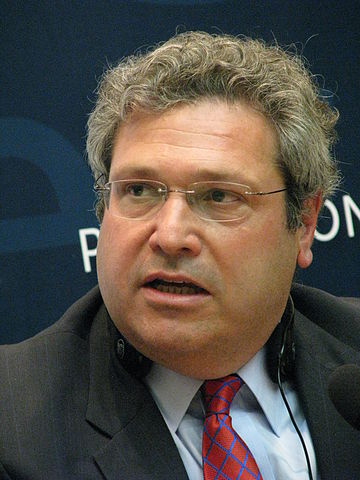
Robert Kagan speaking in Warsaw, 2008-04-17.
Photo by Mariusz Kubik via Wikimedia Commons.
If you want to know where we are as a country, get your hands on a copy of Robert Kagan’s new book, Rebellion. Don’t worry, you won’t even need to crack the spine and open it. Kagan, who married the Queen of Eternal War Victoria Nuland and helped found the now defunct neoconservative Project for a New American Century, has written a warning about the dangerous renascence of antiliberalism in American political life: intolerance, a rejection of minority rights, hatred of progress. America is in deep trouble, Kagan warns. We’re close to losing our democracy! You can already see the freshness and originality of his thought.
Flip it. Take the book, turn it around, and look at that back cover, which carries an excerpt from inside, getting right to the meat of the thing. The problem isn’t the media, Kagan concludes. And it isn’t government. It isn’t a problem with institutions at all: “The problem is and has always been the people and their beliefs”. The thing that’s wrong with America is Americans, full stop. The country works brilliantly, except for the existence of the population. Imagine how healthy we would become if we could just get rid of them.
Should you make the mistake of opening the book, your experience will get worse in a hurry. The intellectual muddle is fatal. Here’s Kagan’s summary of the one big problem that runs through all of American history: “A straight line runs from the slaveholding South in the early to mid-nineteenth century to the post-Reconstruction South of the late nineteenth and early twentieth centuries, to the second Ku Klux Klan of the 1920s, to the Dixiecrats of the 1940s and 1950s, to Joseph McCarthy and the John Birch Society of the 1950s and 60s, to the burgeoning Christian nationalist movement of recent decades, to the New Right of the Reagan Era, to the Republican Party of today.”
All of those movements are precisely the same, you see. Ronald Reagan was a latter-day Ben Tillman, the Birchers merely a rebrand for the 1940s Southern Democrats, and Barry Goldwater was a fitting heir to Nathan Bedford Forrest. A shrewd mind is at work here. All, Kagan concludes, were figures representing “antiliberal groups”: “All have sought to ‘make America great again,’ by defending and restoring the old hierarchies and traditions that predated the Revolution.” The American Revolution, he means. The Dixiecrats and the Birchers and Reagan and Trump all want to restore Parliamentary supremacy and the landed aristocracy, or … something.
But pretend, for a moment, that Kagan has made some form of coherent statement about American history. He is arguing for the protection of the liberal order, the dignity of the common man and the premise that we’re all created equal. At the same time, he says, the biggest problem with America is … the American people themselves. How do those two claims fit together? What kind of politics can we frame around the dignity and inherent worth of the common man, who is stupid and worthless?
See also, on this theme, anything the former U.S. Naval War College professor Tom Nichols has written in the last decade, such as his warning in Our Own Worst Enemy: The Assault from Within on Modern Democracy that “our fellow citizens are an intolerable threat to our own safety” — a claim that closely mirrors Kagan’s warning about America being plagued by Americans. Consider this framing very carefully: if a threat is intolerable, what do you have to do about it?
Kagan’s base argument sounded better in the original German.
September 9, 2024
Update your Overton Window – “[A]nyone to the immediate right of 2024 liberal democracy is a fascist”
In Niccolo Soldo’s weekly commentary, a few insights into European “mainstream” political views on extreme right-wing crypto-fascists like … everyone who doesn’t support far left positions:
If you think that US media is bad, you should check out just how awful their German colleagues are. Their media is filled to the brim with daily hysteria about the Russians, Nazis, fascists, and so on. Every single day is a struggle to survive against these existential threats.
To the mainstream German media, a conservative Christian Democrat (the kind that ruled much of Western Europe during the Cold War) like Viktor Orban is a fascist in disguise. To the mainstream German media, a statist centrist like Vladimir Putin is Hitler without the disguise. A 90s Clinton Liberal like Donald Trump is both.
Thankfully, Der Spiegel reached out to writers and researchers who specialize in fascism to tell us that all of the above are fascists, and some are Nazis too:
The reversion to fascism is a deep-seated fear of modern democratic societies. Yet while it long seemed rather unlikely and unimaginable, it has now begun to look like a serious threat. Vladimir Putin’s imperial ambitions in Russia. Narendra Modi’s Hindu nationalism in India. The election victory of Giorgia Meloni in Italy. Marine Le Pen’s strategy of normalizing right-wing extremism in France. Javier Milei’s victory in Argentina. Viktor Orbán’s autocratic domination of Hungary. The comebacks of the far-right FPÖ party in Austria and of Geert Wilders in the Netherlands. Germany’s AfD. Nayib Bukele’s autocratic regime in El Salvador, which is largely under the radar despite being astoundingly single-minded, even using the threat of armed violence to push laws through parliament. Then there is the possibility of a second Trump administration, with fears that he could go even farther in a second term than he did during his first. And the attacks on migrant hostels in Britain. The neo-Nazi demonstration in Bautzen. The pandemic. The war in Ukraine. The inflation.
Meloni, Modi, Milei, Wilders, Bukele … all are suspected of crypto-fascism here.
Trump? “Fascist”, says neo-conservative Robert Kagan:
In May 2016, Donald Trump emerged as the last Republican standing following the primaries, and the world was still a bit perplexed and rather concerned when the historian Robert Kagan published an article in the Washington Post under the headline “This is how fascism comes to America.”
The piece was one of the first in the U.S. to articulate concerns that Trump is a fascist. It received significant attention around the world and DER SPIEGEL published the article as well. It was an attention-grabbing moment: What if Kagan is right? Indeed, it isn’t inaccurate to say that Kagan reignited the fascism debate with his essay. Interestingly, it was the same Robert Kagan who had spent years as an influential member of the Republican Party and was seen as one of the thought leaders for the neocons during the administration of George W. Bush.
The article has aged well. Its characterization of Trump as a “strongman”. Its description of his deft use of fear, hatred and anger. “This is how fascism comes to America, not with jackboots and salutes,” Kagan wrote, “but with a television huckster, a phony billionaire, a textbook egomaniac ‘tapping into’ popular resentments and insecurities, and with an entire national political party – out of ambition or blind party loyalty, or simply out of fear – falling into line behind him.”
Jason Stanley, the Jacob Urowsky Professor of Philosophy at Yale University, says that fascism has already come to America:
Six years ago, Stanley published a book in the U.S. called How Fascism Works: The Politics of Us and Them. The German translation only appeared two months ago, a source of annoyance for Stanley. He also has German citizenship and says that he loves the country despite everything.
So how does fascism work? Modern-day fascism, Stanley writes, is a cult of the leader in which that leader promises rebirth to a disgraced country. Disgraced because immigrants, leftists, liberals, minorities, homosexuals and women have taken over the media, the schools and cultural institutions. Fascist regimes, Stanley argues, begin as social and political movements and parties – and they tend to be elected rather than overthrowing existing governments.
Timothy Snyder says that both Trump AND Putin are fascists:
Timothy Snyder speaks thoughtfully and quietly, but with plenty of confidence. Putin is a fascist. Trump is a fascist. The difference: One holds power. The other does not. Not yet.
“The problem with fascism,” Snyder says, “is that it’s not a presence in the way we want it to be. We want political doctrines to have clear definitions. We don’t want them to be paradoxical or dialectical.” Still, he says, fascism is an important category when it comes to understanding both history and the present, because it makes differences visible.
Austrian Political Scientist Natascha Strobl says that fascists are now everywhere:
But this kind of violence can be seen everywhere, says the Austrian political scientist Natascha Strobl. It merely manifests itself differently than it did in the 1920s, when, early on in the fascist movement in northern Italy, gangs of thugs were going from village to village attacking farmer organizations and the offices of the socialist party, killing people and burning homes to the ground. Today, says Strobl, violence is primarily limited to the internet. “And it is,” says Strobl, “just as real. The people who perpetrate it believe they are involved in a global culture war, a struggle that knows no boundaries. An ideological civil war against all kinds of chimeras, such as ‘cultural Marxism’ or the ‘Great Replacement’.”
For Bulgarian think-tanker Ivan Krastev, AfD is a fascist organization:
It is all rather perplexing. Back in Berlin, Ivan Krastev makes one of his Krastevian jokes. An American judge, he relates, once said that he may not be able to define pornography, “but I know it when I see it”. The reverse is true with fascism, says Krastev: It is simple to define, but difficult to recognize when you see it.
The “F-word”. F as in fascism or F as in “Fuck you”. It is permissible, as a court in Meiningen ruled, to refer to Höcke as a fascist. The question remains, though, what doing so actually achieves.
So there you have it: anyone to the immediate right of 2024 liberal democracy is a fascist.
September 7, 2024
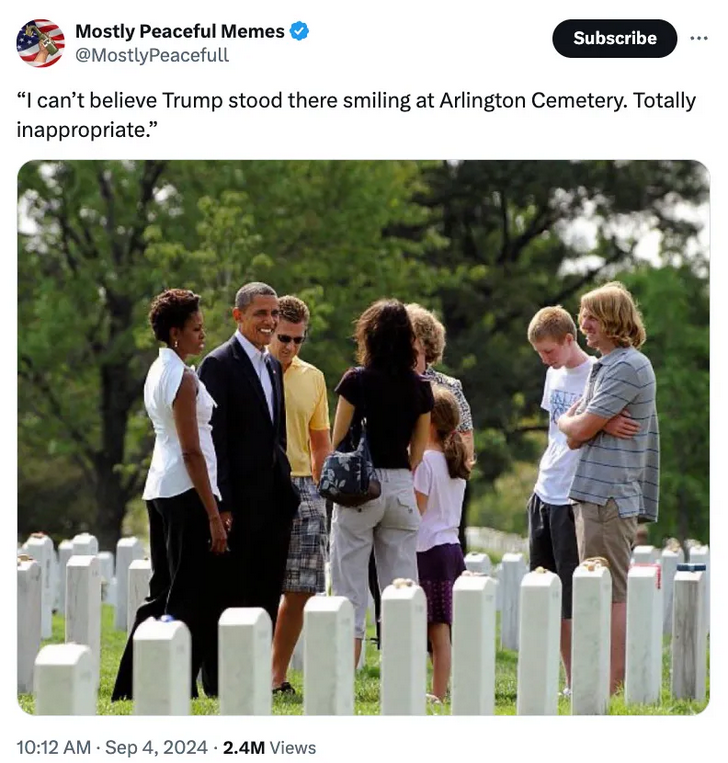
Trump’s visit to Arlington broke all the norms – no President has ever done this before!
Not being an American, I didn’t realize that sitting and former Presidents were banned from the grounds of Arlington National Cemetery, so Trump’s norm-obliterating visit has attracted widespread vilification from all corners of the nation:
If you read the news, Donald Trump recently did something so shocking and unprecedented that observers are staggered by his descent into evil:
He went to Arlington National Cemetery and brought a photographer, so the only possible comparison is to Literally Adolf Hitler. It was so outrageous for Trump to perform the Nazi maneuver of being photographed at Arlington that the son of the late Senator John McCain was forced to make an announcement to the world, revealing that the horror of the event had forced him to change his party registration and support the Democratic presidential candidate:
Sample framing from that story:
Jimmy McCain, who has served for 17 years in the military and is an intelligence officer, said he was angered by Trump’s conduct at the cemetery last week, adding “it was a violation.”
“It just blows me away,” he told CNN. “These men and women that are laying in the ground there have no choice” about being in a political ad.
See how evil Donald Trump is? No McCain man would ever stand for some bastard shooting a political ad at Arlington National Cemetery. Also, you can click here to watch the political ad that John McCain shot at Arlington National Cemetery.
[…]


August 28, 2024
H.R. McMaster dishes on Trump’s first term in office
In Reason, Liz Wolfe covers some of the head-scratchers former National Security Advisor H.R. McMaster revealed about working for Donald Trump:
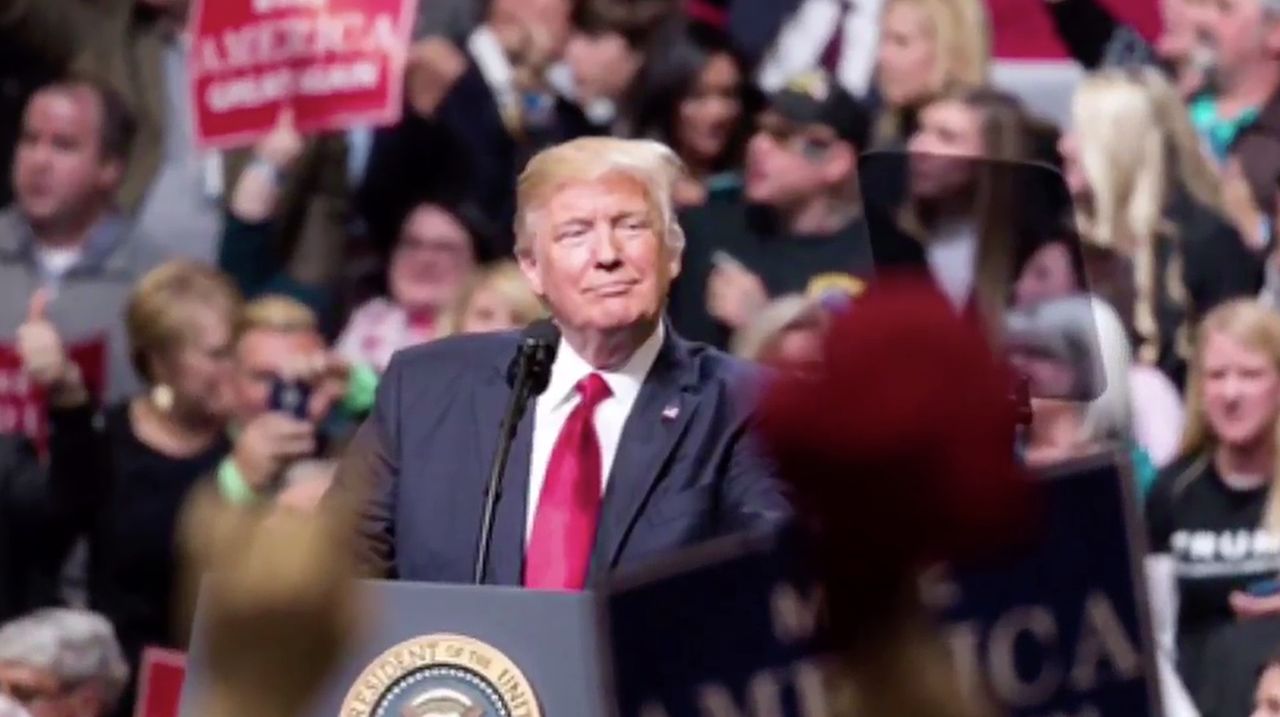
Donald Trump addresses a rally in Nashville, TN in March 2017.
Photo released by the Office of the President of the United States via Wikimedia Commons.
What might a second Trump White House be like? In his new book, At War with Ourselves: My Tour of Duty in the Trump White House, Lt. Gen. H.R. McMaster, who served as national security adviser to Donald Trump (for one year), characterizes Oval Office meetings as “exercises in competitive sycophancy” where advisers would greet him with lines like “your instincts are always right” or “no one has ever been treated so badly by the press”.
Trump, meanwhile, would come up with crazy concepts, and float them: “Why don’t we just bomb the drugs?” (Also: “Why don’t we take out the whole North Korean Army during one of their parades?”)
This is one man’s account, of course. McMaster’s word should not be taken as gospel, and some of his frustration might stem from his dismissal, or his foreign-policy prescriptions being at times ignored by his boss. But it’s a somewhat revealing look behind the curtain at policy-setting in a White House helmed by an especially mercurial commander in chief, who “enjoyed and contributed to interpersonal drama in the White House and across the administration”.
It also shows how quickly Trump fantasies have percolated through the Republican Party, namely the “let’s just bomb Mexico to get rid of the cartels” line, which Trump has been toying with since roughly 2019 (or possibly more like 2017, after he chatted with Rodrigo Duterte, former president of the Philippines, who had promised to kill 100,000 drug traffickers during his first six months as president). A few years prior, in 2015, he had suggested that Mexico was sending rapist and drug-traffickers across the southern border, and that we’d need to build a wall between the two countries, but it wasn’t until nine American citizens were killed in Mexico that Trump trotted out the idea of declaring cartels foreign terrorist organizations and using military might to eradicate them.
Trump’s line from 2019 has now become standard fare, notes The Economist: The Republican primary debates included lots of tough talk on Mexico, specifically on the bombing front, with Florida Gov. Ron DeSantis claiming he’d send special forces down there on Day One. Right-wing think tanks have embraced the messaging, with articles headlined “It’s Time to Wage War on Transnational Drug Cartels”. Taking cues from other members of her party, Georgia Rep. Marjorie Taylor Greene asked why “we’re fighting a war in Ukraine, and we’re not bombing the Mexican cartels”. Whether it’s economic protectionism (10 percent across-the-board tariffs, with 60 percent tariffs imposed on Chinese imports) or Mexico-bombing, Trump has near-magical abilities to get other members of his party to accept something previously regarded as absurd.
August 26, 2024
David Friedman – “my fargroup … are being attacked by my outgroup. My enemy’s enemy …”
I’m much of David Friedman‘s opinion on the candidates for both the Democratic and Republican parties in the current US presidential election … and I also find myself leaning more toward Trump even though his re-election would almost certainly be worse for Canada:
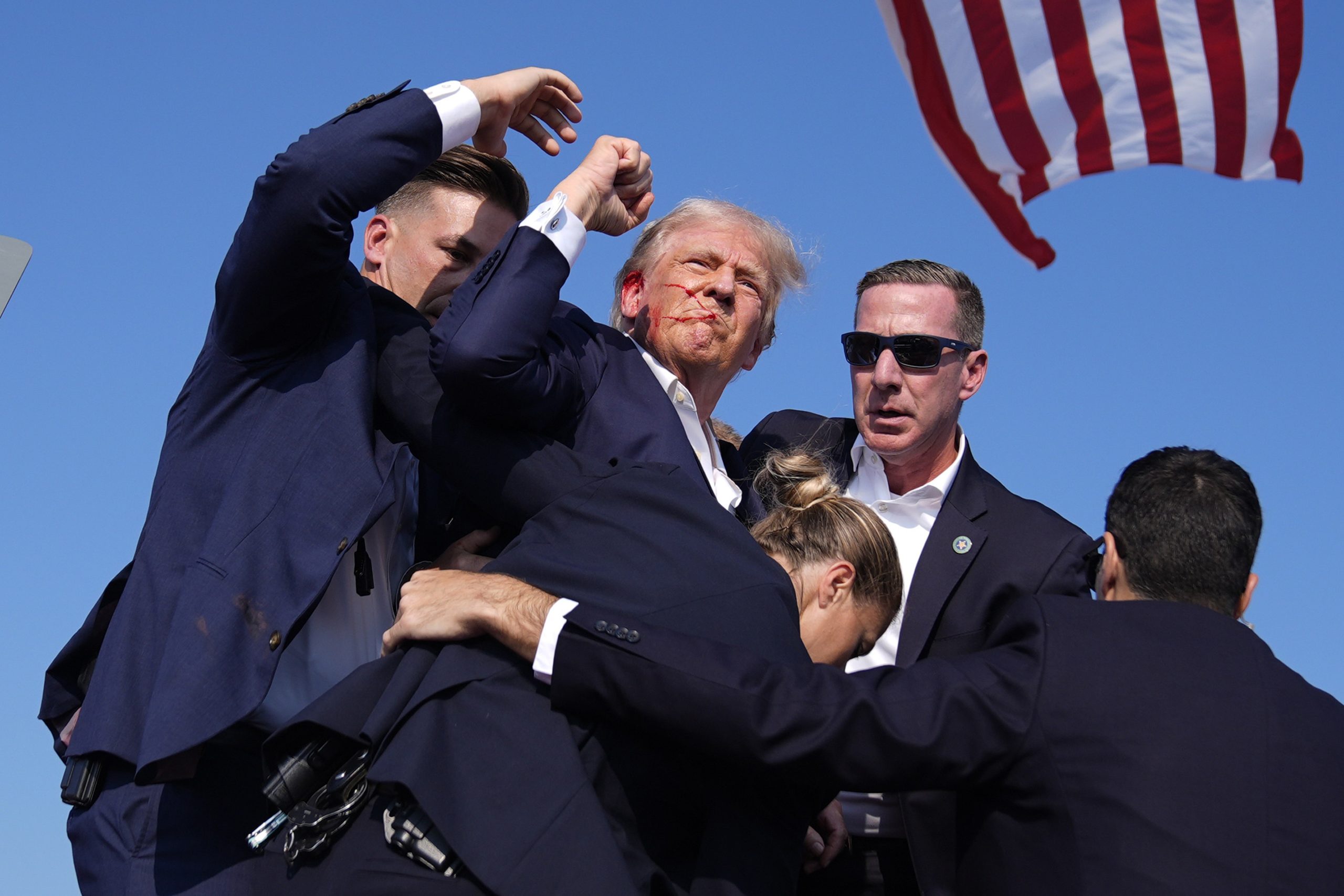
Donald Trump, surrounded by Secret Service agents, raises his fist after an attempt on his life during a campaign speech in Butler, PA on 13 July, 2024.
My opinion of the election is “a plague on both your houses”. Kamala Harris is an extreme representative of an ideology I have opposed for most of my life. Donald Trump has three major positions on two of which, immigration and trade, he manages to be even worse than his opponent. While I have some sympathy for his views on the third — I have been arguing against an interventionist foreign policy for something over fifty years now — I do not trust him to execute a consistent and competent alternative. His disinterest in whether what he says is true, extreme even for a politician, I find offensive.
That is my intellectual view of the matter. It is not my emotional view. Reading news stories and observing the effect on my feelings, I note that I am reacting like a Trump partisan. Poll results that look good for him make me happy, poll results that look bad for him make me sad. Accounts of outrageous statements by Trump or Vance I ignore — I don’t expect them to tell the truth. Accounts of demagoguery by Harris or Waltz arouse feelings of indignation. If Harris wins I will feel disappointed. If Trump wins I will feel relieved, at least until the first outrageous thing he does.
The explanation of my inconsistent reaction is provided by Scott Alexander in “I Can Tolerate Anything Except The Outgroup“, one of the best of his many good essays. In it he points out that someone’s outgroup, the group for whom he feels and expresses strongly negative views, is typically made up not of people distant from him, geographically and intellectually, but of people close. The outgroup of the Nazis was not their Japanese allies or the Chinese the Japanese were fighting, it was German Jews, people with the same language and, in most respects, the same appearance and culture. The outgroup of American leftists is not Muslim fundamentalists but American conservatives.
Conservatives have doubts about gay marriage. Muslim fundamentalists view homosexual intercourse as a capital offense.1 American conservatives would like their schools to be more tolerant of creationism. Muslim fundamentalists want their schools to teach the truth of Islam. And yet, when conservatives criticize Muslims, leftists defend them. When Muslims kill Jews and Jews respond by killing Muslims, it is the Muslims that the American leftists support, the Jews that they blame — although Israelis have much more in common, ideologically as well as culturally, with American leftists than Palestinians do.
We think of groups close to us in Near Mode, judging them on their merits as useful allies or dangerous enemies. We think of more distant groups in Far Mode – usually, we exoticize them. Sometimes it’s positive exoticization of the Noble Savage variety (understood so broadly that our treatment of Tibetans counts as an example of the trope). Other times it’s negative exoticization, treating them as cartoonish stereotypes of evil who are more funny or fascinating than repulsive. Take Genghis Khan – objectively he was one of the most evil people of all time, killing millions of victims, but since we think of him in Far Mode he becomes fascinating or even perversely admirable – “wow, that was one impressively bloodthirsty warlord”. (Scott Alexander, “Post-Partisanship Is Hyper-Partisanship“)
Conservatives are the leftists’ outgroup, Muslims their far group. The far group can be ignored; large parts of the world are more sexist and more racist than any part of America but invisible to progressives campaigning against sexism and racism. The far group can even be supported, at least if the outgroup is attacking it. My enemy’s enemy is my friend. Muslim fundamentalists. Hamas.
Kamala Harris is an American leftist. American leftists are my outgroup. Trump and Vance are American populists. I disagree with their views, in some cases more than I disagree with the views of American leftists, but I have nothing against them, just as I have nothing against believing Catholics or Orthodox Jews or Black Muslims or believers in Christian Science.
Trump and his movement are my fargroup. They are being attacked by my outgroup. My enemy’s enemy …
1. In some times and places Muslim culture has been tolerant of homosexuality; there are two famous medieval essays on the relative attractions of homosexual and heterosexual intercourse and quite a lot of poetry celebrating homosexual love. But the religious doctrine, which fundamentalists take seriously, holds homosexuality to be forbidden.
August 25, 2024
“Does your vote count?” or how to set up an automatic vote-generation scheme
Elizabeth Nickson on recent reporting about voting scams in various US states:

After engineer and data scientist Kim Brooks worked on cleaning the voter rolls in Georgia for a year, she realized she was on a stationary bicycle. She’d clear a name for various reasons, dead, felon, stolen ID, living at a seasonal campground for twenty years, duplicate, moved out of state, 200 years old, etc., and back it would come within a month. At that juncture she realized that a program within the Georgia voter registration database was methodically adding back fake names.
She looked deeper. For new registrants, the culprit was principally Driver’s Services creating new registrations and in this case, the manufacturer was a person, or persons. Within the government office, someone was stealing names and duplicating, even tripling that person’s vote and then forging their signature. Sometimes it was someone who just died, or a teacher who had no voting record. In the case of a nurse who died in 2022 with three registrations, she was registered to vote in two counties, and all three of her voted in the 2022 election and the 2024 primary. Each signature was slightly different, the last three letters spelled, ly, ley, and lley
This operation works under AVR, or automatic voter registration, and is being used to register migrants. They will not vote, but their names have been entered into the Voter Registration database when they apply for a driver’s license and their vote will be voted for them. I imagine that this is repeating something everyone knows, but the borders are open for precisely this reason, so the Democrat/RINO machine can steal their votes. By the way, the process for advancing permanent residency has been cut from 11 months to two.
In 2020, twenty states used operation AVR. Of those, Trump lost 18.
That’s because there are registration fraud rings, as identified in the Arabella doc. and in the work of Omega4America. This worked well in Michigan, where, according to Captain Seth Keshel, who is one of the leads on this fight, believes that Trump likely got 576,443 more votes than were counted and won Michigan by 8.5%.
Every state is host to a dozen or more NGO’s which do nothing but fill out ballots for the faked registrants. Peter Bernegger’s team in Wisconsin has video of NGO functionaries doing just that in Wisconsin in 2020 at 1 am, early morning after Election Day.
Michigan has two million more registered voters than they should have. 83.5% of the state is registered to vote but only 77.9% is over 18. – Seth Keshel
Seth works with demographic trends and does detailed statistical analysis; travelling almost ceaselessly to teach Americans how to stop the cheat. AVR was launched in Michigan, after Trump’s win in 2016. By 2020 there were 547,460 net new registrants in Michigan. Today, more voters are registered to vote than there are people old enough to vote. Keshel:
Per Keshel’s analysis, the Democrats and RINOs are frantically operating a dying political coalition which began to shift hard after Obama’s performance in his first four years, when not only did nothing change for the working class, it worsened. Democrat registrations in Michigan collapsed to the point where the Dems lost 16,000 as of 2016. Enter AVR and boom, 500+K new registrants.

August 20, 2024
German magazine Der Spiegel warns about “The Secret Hitlers” of the far right who threaten western civilization
The spectre of Hitlerian fascism looms over the western world once again, but Der Spiegel won’t take this threat lying down:

“How Fascism Begins”: The present cover of Der Spiegel, depicting Björn Höcke, Marine le Pen and Donald Trump as the new fascists. Establishment German hysteria about “the right” is now achieving an intensity to rival American hysteria about race during the Summer of Floyd.
Hitler is not like other mortals; he may not really be dead, and his spirit is likely to return at any moment. Perhaps it already has. This is why our foremost news magazine, Der Spiegel, chose this image to head their cover story on “The Secret Hitlers“, a bizarre opus of current-year political lunacy penned by Lothar Gorris and Tobias Rapp.
“Is fascism returning?” Gorris and Rapp want to know. “Or is it already here, in the form of [Donald] Trump, [Viktor] Orbán [or Björn] Höcke? And if so, could it disappear again?” What follows, they explain, is “an attempt to identify evil”.
This is the kind of insanity that comes over you when you elevate establishment political ideology into a civic religion. You reduce the entire project of state politics to a dubious exercise in piety, where the aim is not to achieve good outcomes or develop pragmatic solutions, but to engage in moral peacockery. For the Gorrises and the Rapps of our discourse, the greatest problem facing the liberal faithful of the Federal Republic is not mass migration, deindustrialisation, soon-to-be-insolvent pension programmes or the overblown state entitlement system, oh no. It is finding and rooting out mythological political demons and preventing the second coming of the secular antichrist.
Gorris and Rapp (for convenience, I will refer to these feeble-minded men henceforth as Grapp) open with an extended anecdote about a 2016 board game called Secret Hitler.
The setting is the year 1932, the Reichstag in Berlin. The players are divided into two groups: Fascists and Democrats, with the Democrats making up the majority, which sounds familiar. The Fascists have a decisive advantage at the start: they know who the other Fascists are, which also reflects the truth in the history books. The Democrats don’t have this information; every other player could be friend or foe. The fascists win the game if they get six laws through the Reichstag or if Hitler is elected Chancellor. To win, the Democrats must pass five laws or expose and kill Hitler.
The basic premise of the game is that everyone pretends to be democrats. In truth, the real democrats would only have to trust each other and the fascists wouldn’t stand a chance. But it’s not that simple, because sometimes the democrats have to vote in favour of a fascist law for lack of options and therefore fall under suspicion of fascism. Which is exactly what the fascists want.
One realisation: there is no guarantee of the right strategy that will ultimately see the good guys win and the bad guys lose. One wrong decision that feels right, and Hitler is Reich Chancellor. It was all chance, just as there was no inevitability in 1933. The other realisation: it can be fun to be a fascist.
The cryptofascist myth will never cease to amaze me. Absolutely everybody in 1933 knew who “the fascists” were. The ones in Italy literally called themselves fascists, which was one way to identify them. The ones in Germany openly derided liberalism and dreamed of a nationalist revolution that would put an end to the hated bourgeois democracy of the Weimar Republic. Hitler was a national politician who wrote and spoke openly of his aims. Secret Hitler in no way “reflects the truth in the history books”. It is a deformed fantasy about modern politics, which reflects nothing so much as the burning demand for and the vanishing supply of actual Nazis to hyperventilate about.
Now it is true that a lot of erstwhile liberals went over to National Socialism after the Nazis seized power, but these were not the secret fascists of Grappian fever dreams. The were just followers, as are a great many of the self-professed liberals active today. Were communists or illiberal nationalists to take over tomorrow, millions of people would line up behind the new political ideology like the sheep that they are, and I suspect that Grapp would be right at the head of that line.
Because our crack fascist identifiers suffer from a crushing lack of self-awareness, they declare that “relapsing into fascism is the primal fear of modern democratic societies”. Such a relapse, they explain, “long sounded hysterical and unimaginable”, but “now it seems serious and real”.
August 19, 2024
If you’ve never worked in the private sector, you have no idea how regulations impact businesses
In the National Post, J.D. Tuccille explain why Democratic candidates like Kamala Harris and Tim Walz who have spent little or no time in the non-government world have such rosy views of the benefits of government control with no concept of the costs such control imposes:
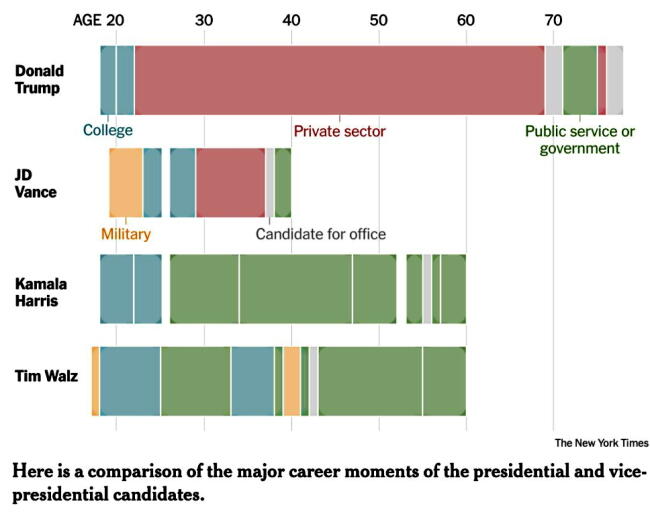
The respective public versus private sector experiences of the 2024 Presidential/Vice Presidential candidates.
New York Times
In broad terms, Democrats have faith in government while the GOP is skeptical — though a lot of Republicans are willing to suspend disbelief when their party controls the executive branch.
The contrast between the two parties can be seen in stark terms in the resumes of the two presidential and vice-presidential tickets. The New York Times made it easier to compare them earlier this month when it ran charts of the career timelines of Trump, J.D. Vance, Kamala Harris and Tim Walz. Their roles at any given age were colour-coded for college, military, private sector, public service or politics, federal government and candidate for federal office.
Peach is the colour used by the Times to indicate employment in the private sector, which produces the opportunities and wealth that are mugged away (taxation is theft by another name, after all) to fund all other sectors. It appears under the headings of “businessman” and “television personality” for Trump and as “lawyer and venture capitalist” for Vance. But private-sector peach appears nowhere in the timelines for Harris and Walz. Besides, perhaps, some odd jobs when they were young, neither of the Democrats has worked in the private sector.
Now, not all private-sector jobs are created equal. Some of the Republican presidential candidate’s ventures, like Trump University, have been highly sketchy, as are some of his practices — he’s openly boasted about donating to politicians to gain favours (though try to do business in New York without greasing palms). I’m not sure I’d want The Apprentice on my resume. But there must be some value to working on the receiving end of the various regulations and taxes government officials foist on society rather than spending one’s career brainstorming more rules without ever suffering the consequences.
In 1992, former U.S. senator and 1972 Democratic presidential candidate George McGovern penned a column for the Wall Street Journal about the challenges he encountered investing in a hotel after many years in government.
“In retrospect, I … wish that during the years I was in public office, I had had this firsthand experience about the difficulties business people face every day,” he wrote. He bemoaned “federal, state and local rules” passed with seemingly good intentions but little thought to the burdens and costs they imposed.
The lack of private sector stints in the career timelines of Harris and Walz means that, like pre-hotel McGovern, they’ve never had to worry about what it’s like to suffer the policies of a large and intrusive government.
That said, it’s possible to overstate the lessons learned by Republicans and Democrats from their different experiences. Vance, despite having worked to fund and launch businesses, has, since being elected to the U.S. Senate, advocated capturing the regulatory state and repurposing it for political uses, including punishing enemies.
Not only does power corrupt, but it does so quickly.
August 16, 2024
After the Trump livestream, Elon Musk’s been “charged with coercive chuckling, a legal first”
Chris Bray has been following the legal sideshow of the United Auto Workers union filing charges with the US National Labour Relations Board (NLRB), alleging that Trump and Musk made threats against organized labour during the recent livestreamed event:
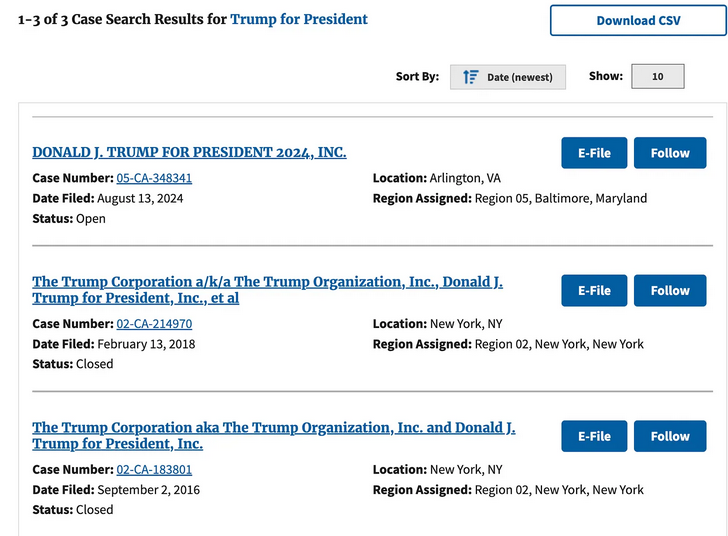
The UAW complaints against Tesla and Trump for President 2024 have been listed on the NLRB website. They really did it, and I got it wrong. The delay in listing the complaints, and the lunacy of the charges, led me to the wrong conclusion. The complaints are real: there are forms with vague and obviously ridiculous complaints on them, and they filed the things.
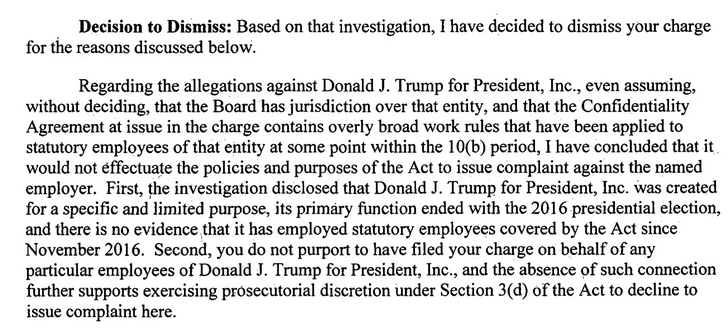
But they’re still functionally fake, and they’ll die quickly. Anti-Trump organizations have been doing this for years, without success; this is the third complaint filed with the NLRB against Trump campaign organizations.
In the first of those previous cases, the NLRB raised the obvious question about jurisdiction, expressing doubt (“without deciding”) that they can police presidential campaigns using labor law:
The NLRB has previously declined to pursue labor complaints against Trump for President, and the UAW has filed a labor complaint against Trump for President. We can make educated guesses about what happens next. I’ve emailed professors who teach labor law to ask them if the National Labor Relations Act governs the political speech of presidential candidates, but they haven’t responded.
As for the complaint against Tesla, Elon Musk had a livestreamed discussion with Donald Trump in which Trump said that striking workers should be fired; Musk laughed, but didn’t say anything in response. This news report includes audio of that exchange. The complaint alleges that Musk therefore made coercive statements
August 14, 2024
All the news the legacy media chooses to share
Mark Steyn grudgingly pays a bit of attention to US politics, or more accurately, the parts of US politics that the legacy media wants Americans to know:
Donald Trump, surrounded by Secret Service agents, raises his fist after an attempt on his life during a campaign speech in Butler, PA on 13 July, 2024. One spectator was killed and two others were reported to be in critical condition. The shooter was killed by Pennsylvania State Troopers, according to reports in the succeeding hours.
In one party, the presidential candidate came within maybe an eighth-of-an-inch of having his head blown off on live TV.
In the other party, the presidential candidate was more successfully dispatched — and the millions of primary votes he’d supposedly received simply nullified.
Either of these would be extraordinary events in any other country. And yet, under the smooth narrative management of the American press, they were mere spasms of momentary discombobulation before the normal somnolent service was resumed. “Democracy Dies in Darkness”, The Washington Post informs its readers every morning. In fact, under the court eunuchs of the US media, democracy dies in broad daylight.
First, the Pennsylvania assassination attempt was memory-holed — in an industrial-strength illustration of Orwell’s brilliant coinage: any day now there will be some poll showing thirty-seven per cent of registered voters are entirely unaware that a would-be killer hit Trump in the ear. And this despite the fact that every few hours there are — oh, what’s the word they use in nations with a real press? — newsworthy revelations about all that the Secret Service did to facilitate the operation, to scrub the evidence afterwards, and to lie to Congress about both.
At this stage, they might as well remake In the Line of Fire with Clint lying on the roof next to the goofball lining up his shot and helpfully suggesting, “Think you might be maybe a half-centimeter off there, sonny …” (On the other hand, if you’re looking for some guys to break into a Massachusetts hair salon to use the toilet for two hours and then leave the joint unlocked for the rest of the weekend, this is the federal agency for you.)
In the American media, a tree can fall in the forest in front of twenty million people — and it still doesn’t make a sound.
On the other hand, we have … wossname, you know, the stiff who was nose-diving off the steps to Air Force One just twenty minutes ago. In the entirety of last week the so-called “President of the United States” had only one bit of state business to perform — a Monday telephone call with the King of Jordan. Her late Majesty Queen Elizabeth II had a heavier workload the day before she died at ninety-six. But the same people who’ve spent the last three-and-a-half years insisting that Joe Biden was the chief executive of the United States can no longer be bothered with the elaborate pretence: the show supposedly has five months to run, but they’ve struck the set and sent the crew home, and left the star sitting slack-jawed and drooling in his Chinese Barcalounger in the dark on an empty stage. Joe’s sole residual presence in the news cycle is when Nancy Pelosi goes on TV and breezily claims to be the one who had him whacked (although the party’s other “senior powerbrokers” are reported to be mildly irked by her braggadocio: they assert that, as in Murder on the Re-Orient Express, everybody did it).
So who is running the United States? If the presidency is so important it’s worth holding a two-year contest to decide who gets to occupy it, why isn’t who’s exercising those powers right now of any interest?
Well, that’s been memory-holed, too. America’s uniquely unique “peaceful transfer of power” has begun six months early, that’s all.
So, on the one side, 24/7 coverage of the candidate being indicted, sued, tried, convicted and (coming soon!) banged up in Rikers Island will continue … but it doesn’t leave any resources to investigate him getting shot in the head on live TV.
And, on the other side, a candidate with not a single primary vote to her name has been imposed on the party by who knows who … but it would be grossly disrespectful to the majesty of her office (President-Designate) to expect her to sit down for a puffball interview with George Stephanopoulos. (“Do you think all these GOP demands that you be able to answer questions on your platform and if you know where it’s being kept are because many Republican men are still uncomfortable with the idea of a strong black Montreal schoolgirl running for president?”)
But it’s not just the regime-aligned mainstream media who want to control what you get to see and hear — the European Union seems to think it can dictate to American social media companies what they’re allowed to share:
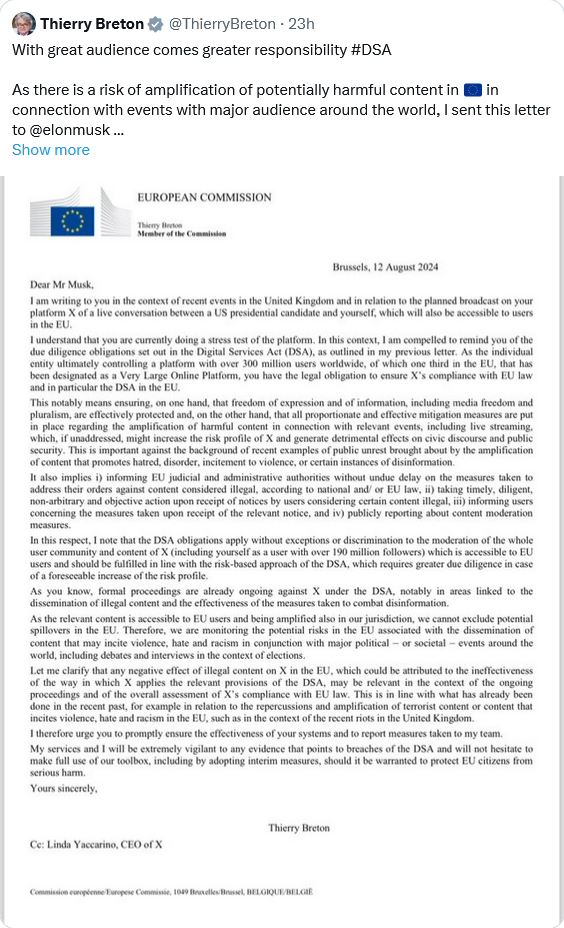
“The European Union’s digital enforcer wrote an open letter to tech mogul Elon Musk on Monday ahead of a planned interview with former United States President Donald Trump to remind him of the EU’s rules on promoting hate speech,” reports Politico.
“As the relevant content is accessible to EU users and being amplified also in our jurisdiction, we cannot exclude potential spillovers in the EU,” wrote Digital Commissioner Thierry Breton on X. “With great audience comes greater responsibility.”
Meanwhile, The Guardian reports that Bruce Daisley, Twitter’s former vice-president for Europe, the Middle East and Africa, has said Musk should face “personal sanctions” — which are “much more effective on executives than the risk of corporate fines” — and even, possibly, an “arrest warrant” if he “continue[s] stirring up unrest” on the platform.
“The question we are presented with is whether we’re willing to allow a billionaire oligarch to camp off the UK coastline and take potshots at our society,” says Daisley. “The idea that a boycott — whether by high-profile users or advertisers — should be our only sanction is clearly not meaningful.” (All Musk has done, for the record, is criticize British Prime Minister Keir Starmer for his handling of riots over immigration, calling him a “hypocrite” and “two-tier Keir“.)
August 1, 2024
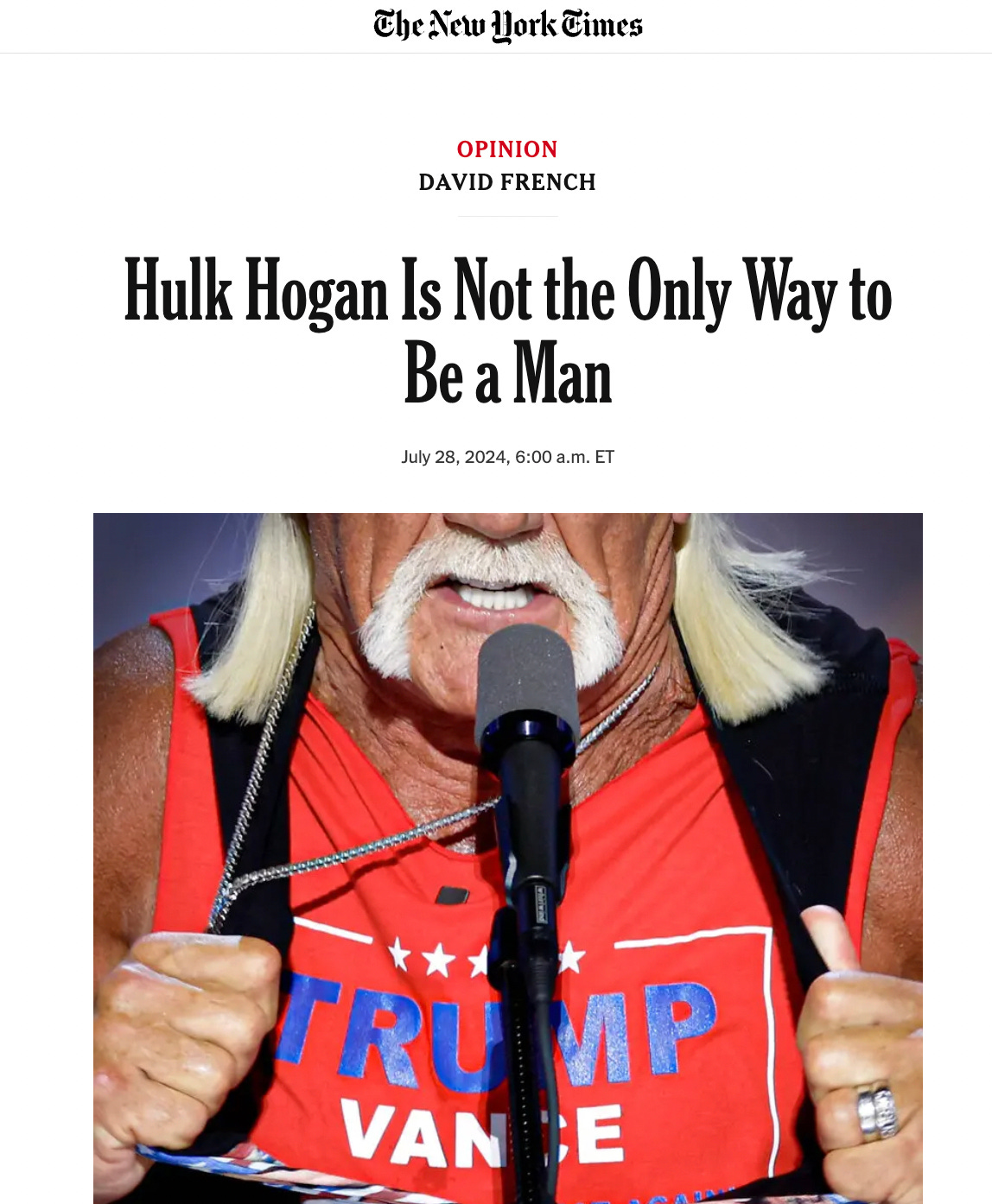
“Donald Trump isn’t a real man, because Hulk Hogan”
It’s always appropriate to criticize public figures — it goes with the job — but you actually should find things to criticize when you do it, otherwise it comes across as lazy bitching:
I’m a charter member of the “no one is above criticism” club. Everyone is fair game. People who run for office are really fair game. So I think it’s just fine to criticize Donald Trump, and to criticize JD Vance, and to criticize Trump/Vance 2024.
But what’s so obvious, over and over again, is that the people writing the most insistent criticism are playing critic. They know that they’re supposed to say that Donald Trump is very very very bad, so they … do that? A lot? But the substance of the criticism tends, with remarkable frequency, to be a set of non-sequiturs and self-refuting rhetorical dead-ends. They’re criticizing because they’re supposed to, not because they have criticisms to offer.
Take David French. Please. Here’s his latest: Donald Trump isn’t a real man, because Hulk Hogan.
The I-didn’t-think-this-through flavor of this piece can’t be exaggerated. It makes so little sense, so poorly, with such odd structure and framing, that it nears the level of Thomas Friedmanism. David French doesn’t know anything, or understand anything, but he really throws himself into it.
So.
Hulk Hogan, Kid Rock, and Dana White were at the Republican National Convention, French writes, so the Republicans are being macho, unlike Democrats, who are demonstrating a style of manhood that focuses on being kind, decent, and nurturing. Republican manhood is about complaints and empty rage; Democratic manhood is about building things and caring for others. Making the comparison concrete, French explicitly compares the macho grievance artist Trump to precisely four wonderfully gentle and caring men: Admiral William McRaven, the US Senator and former astronaut and fighter pilot Mark Kelly, “Mark Hertling, my former division commander in Iraq”, and the former Marine Corps General and Secretary of Defense James Mattis. Those four men are the model of a masculinity that nurtures, loves, and builds; Trump is the model of a masculinity that only destroys and tears down. David French hates machismo, so the list of men he admires is made up entirely of combat arms officers.
Do you … see the problem? Because David French doesn’t. At all. Donald Trump is a real estate developer, someone who spent his entire adult life actually building things:
It’s just fine to criticize Trump as a businessman, if you feel inclined to do that. But he’s a builder and a developer; that’s his actual background. He makes things. He spent his life making things. And his political message is about making things and protecting people who make things, whether you agree with the specifics of his policy arguments or not