
World War Two
Published 12 Nov 2021To smooth the way for the Allied invasion of French North Africa, Operation Torch, a massive spy operation is set up in 1941 and 42.
(more…)
November 13, 2021
Here’s Looking at You, Bill – The Secret Preparations for Operation Torch – WW2 – Spies & Ties 10
Comments Off on Here’s Looking at You, Bill – The Secret Preparations for Operation Torch – WW2 – Spies & Ties 10
Creation of Israel
The Cold War
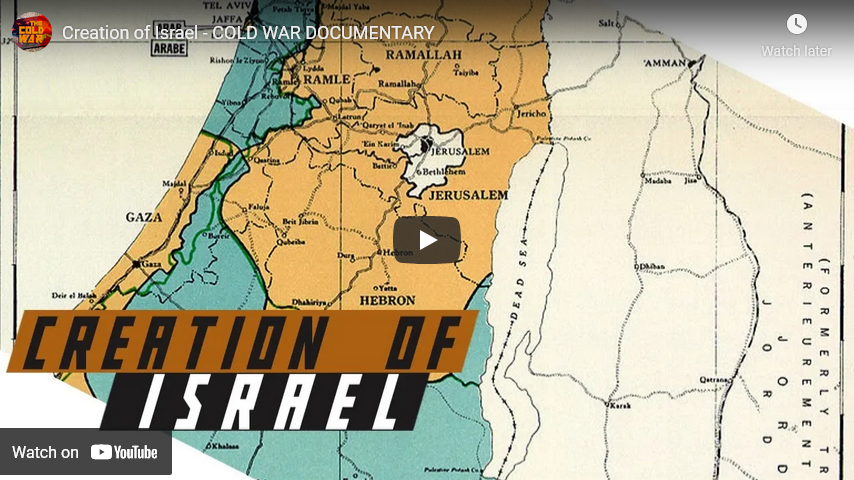
Published 1 Jun 2019Our series on the history of the Cold War period continues with a documentary on the creation of Israel, Zionist movement, reactions and diplomatic maneuvers of other states and the build-up to first Arab-Israeli war
Consider supporting us on Patreon: https://www.patreon.com/thecoldwar
Comments Off on Creation of Israel
November 5, 2021
The 1st (Failed) Paris Commune Uprising During the Franco-Prussian War 1870
Real Time History
Published 4 Nov 2021Sign up for Curiosity Stream and get Nebula bundled in and SAVE 26%: https://curiositystream.com/realtimeh…
The Siege of Paris during the Franco-Prussian War 1870 and the downfall of the French Empire after the Battle of Sedan created a volatile social situation in the French capital. And in November 1870 this situation erupted in an attempt to topple the provisional government and create a self-ruling Paris Commune.
» THANK YOU TO OUR CO-PRODUCERS
John Ozment
James Darcangelo
Jacob Carter Landt
Thomas Brendan
James Giliberto
Kurt Gillies
Albert B. Knapp MD
Tobias Wildenblanck
Richard L Benkin
Scott Deederly
John Belland
Adam Smith
Taylor Allen
Jim F Barlow
Rustem Sharipov» OUR PODCAST
https://realtimehistory.net/podcast – interviews with historians and background info for the show.» LITERATURE
Arand, Tobias: 1870/71. Die Geschichte des Deutsch-Französischen Krieges erzählt in Einzelschicksalen. Hamburg 2018Gouttman, Alain: La grande défaite. Paris 2015
Spiekermann, Uwe: “Die wahre Geschichte der Erbswurst”, unter: https://uwe-spiekermann.com/2018/05/1… (zuletzt besucht am 21.9.2021)
» SOURCES
Chuquet, Arthur: La Guerre 1870-71. Paris 1895Fontane, Theodor: Der Krieg gegen Frankreich. Bd. 3. Berlin 1878
Goncourt, Edmond de: Journal des Goncourts. II.1. 1870-1871. Paris 1890
Hérisson, Maurice d’: Journal d’un officier d’ordonnance. Paris 1885
Heylli, Georges d’ (ed.): M. Thiers à Versailles: l’armistice. Paris 1871
Kürschner, Joseph (Hrsg.): Der große Krieg 1870-71 in Zeitberichten. Leipzig o.J. (1895)
Meisner, Heinrich Otto (Hrsg.): Kaiser Friedrich III. Das Kriegstagebuch von 1870/71. Leipzig 1926
N.N.: Bismarcks Briefe an seine Gattin aus dem Kriege 1870/71. Stuttgart, Berlin 1903
Schikorsky, Isa (Hrsg.): “Wenn doch dies Elend ein Ende hätte”. Ein Briefwechsel aus dem Deutsch-Französischen Krieg 1870/71. Köln, Weimar, Wien 1999
» OUR STORE
Website: https://realtimehistory.net»CREDITS
Presented by: Jesse Alexander
Written by: Cathérine Pfauth, Prof. Dr. Tobias Arand, Jesse Alexander
Director: Toni Steller & Florian Wittig
Director of Photography: Toni Steller
Sound: Above Zero
Editing: Toni Steller
Motion Design: Philipp Appelt
Mixing, Mastering & Sound Design: http://above-zero.com
Maps: Battlefield Design
Research by: Cathérine Pfauth, Prof. Dr. Tobias Arand
Fact checking: Cathérine Pfauth, Prof. Dr. Tobias ArandChannel Design: Battlefield Design
Contains licensed material by getty images
All rights reserved – Real Time History GmbH 2021
Comments Off on The 1st (Failed) Paris Commune Uprising During the Franco-Prussian War 1870
October 29, 2021
The Last Imperial Army Surrenders at Metz – Battle of Le Bourget 1870
Real Time History
Published 28 Oct 2021Much of the remaining French hope to stem the tide against the German armies comes from the more than 200,000 professional troops trapped in Metz since August. French Marshal Bazaine tries to negotiate with the Germans and even offers to march against the French republic. But to no avail.
» THANK YOU TO OUR CO-PRODUCERS
John Ozment
James Darcangelo
Jacob Carter Landt
Thomas Brendan
James Giliberto
Kurt Gillies
Albert B. Knapp MD
Tobias Wildenblanck
Richard L Benkin
Scott Deederly
John Belland
Adam Smith
Taylor Allen
Jim F Barlow
Rustem Sharipov» OUR PODCAST
https://realtimehistory.net/podcast – interviews with historians and background info for the show.» LITERATURE
Arand, Tobias: 1870/71. Die Geschichte des Deutsch-Französischen Krieges erzählt in Einzelschicksalen. Hamburg 2018Gouttman, Alain: La grande défaite de 1870-1871. Paris 2015
Milza, Pierre: L’année terrible. Paris 2009
» SOURCES
Braun, Lily (Hrsg.): Kriegsbriefe aus den Jahren 1870/71 von Hans v. Kretschman. Berlin 1911Crombrugghe, Ida de: Journal d’une infirmière. Paris 1871
Engels, Friedrich: Der Deutsch-Französische Krieg. Sechzig Artikel aus der “Pall Mall Gazette”. Berlin (Ost) 1957
Fontane, Theodor: Der Krieg gegen Frankreich. Bd. 3. Berlin 1873–1876
Großer Generalstab (Hrsg.): Der Deutsch-Französische Krieg, 1870–71. Bd. 1–3. Berlin 1874 ff.
Historischer Verein der Höhen von Spicheren des 67. Kaiserlichen Linienregiments der Infaterie (Hrsg.): Das Kriegstagebuch von Clovis Hardy. Soldat im 63. Linienregiment. Deutsch-Französischer Krieg 1870/71. Vom Lager in Châlons bis nach Ansbach in Bayern. O.O. [Esvres] O.J. [2011]
Kürschner, Joseph (Hrsg.): Der große Krieg 1870–71 in Zeitberichten. Leipzig o. J. (1895)
Meisner, Heinrich Otto (Hrsg.): Kaiser Friedrich III. Das Kriegstagebuch von 1870/71. Berlin, Leipzig 1926
Sternegg, Johann Khoss von: Schlachtenatlas des XIX. Jahrhunderts. Leipzig 1886
Steenackers, François-Frédéric: Histoire du gouvernement de la défense nationale en province, 4 septembre 1870-8 février 1871. Band 2. Paris o.J. (1884-1885)
» OUR STORE
Website: https://realtimehistory.net»CREDITS
Presented by: Jesse Alexander
Written by: Cathérine Pfauth, Prof. Dr. Tobias Arand, Jesse Alexander
Director: Toni Steller & Florian Wittig
Director of Photography: Toni Steller
Sound: Above Zero
Editing: Toni Steller
Motion Design: Philipp Appelt
Mixing, Mastering & Sound Design: http://above-zero.com
Maps: Battlefield Design
Research by: Cathérine Pfauth, Prof. Dr. Tobias Arand
Fact checking: Cathérine Pfauth, Prof. Dr. Tobias ArandChannel Design: Battlefield Design
Contains licensed material by getty images
All rights reserved – Real Time History GmbH 2021
Comments Off on The Last Imperial Army Surrenders at Metz – Battle of Le Bourget 1870
October 15, 2021
The Battle of Orléans 1870 – French Raw Recruits vs. Experienced German Soldiers
Real Time History
Published 14 Oct 2021All across France French Armies have been raised from any available troops. From international volunteers to raw teenaged recruits. How these sub-par soldiers fare against professional German soldiers is not hard to guess and we can see how that goes in the first battles for Orléans.
Special Thanks to Jonathan Ferguson from Royal Armouries. Check out their Channel: https://www.youtube.com/RoyalArmouries
» THANK YOU TO OUR CO-PRODUCERS
John Ozment
James Darcangelo
Jacob Carter Landt
Thomas Brendan
James Giliberto
Kurt Gillies
Albert B. Knapp MD
Tobias Wildenblanck
Richard L Benkin
Scott Deederly
John Belland
Adam Smith
Taylor Allen
Jim F Barlow
Rustem Sharipov» OUR PODCAST
https://realtimehistory.net/podcast – interviews with historians and background info for the show.» LITERATURE
Arand, Tobias: 1870/71. Der Deutsch-Französische Krieg erzählt in Einzelschicksalen. Hamburg 2018Milza, Pierre: L’année terrible. La guerre franco-prussienne. Septembre 1870 – mars 1871. Paris 2009
» SOURCES
Bernhardt, Sarah: Mein Doppelleben. Leipzig 1908Hérisson, Maurice Graf d’: Journal d’un officier d’ordonannce. Juillet 1870 – Février 1871. Paris 1885
Kühnhauser, Florian: Kriegs-Erinnerungen eines Soldaten des königlich bayerischen Infanterie Leibregiments. Partenkirchen 1898 (Neudruck 2012)
Meisner, Heinrich Otto (Hrsg.): Kaiser Friedrich III. Das Kriegstagebuch von 1870/71. Berlin, Leipzig 1926
N.N. (Hrsg.): Theodor Fontane. Kriegsgefangen – Erlebtes 1870. Briefe 1870/71. Berlin (Ost) 1984
» OUR STORE
Website: https://realtimehistory.net»CREDITS
Presented by: Jesse Alexander
Written by: Cathérine Pfauth, Prof. Dr. Tobias Arand, Jesse Alexander
Director: Toni Steller & Florian Wittig
Director of Photography: Toni Steller
Sound: Above Zero
Editing: Toni Steller
Motion Design: Philipp Appelt
Mixing, Mastering & Sound Design: http://above-zero.com
Maps: Battlefield Design
Research by: Cathérine Pfauth, Prof. Dr. Tobias Arand
Fact checking: Cathérine Pfauth, Prof. Dr. Tobias ArandChannel Design: Battlefield Design
Contains licensed material by getty images
All rights reserved – Real Time History GmbH 2021
Comments Off on The Battle of Orléans 1870 – French Raw Recruits vs. Experienced German Soldiers
October 13, 2021
Josip Broz Tito — The “Maharaja of the Balkans”
In The Critic, Thomas Gallagher looks at the man and the myth of Yugoslavia’s communist leader, known to the world as “Tito”:
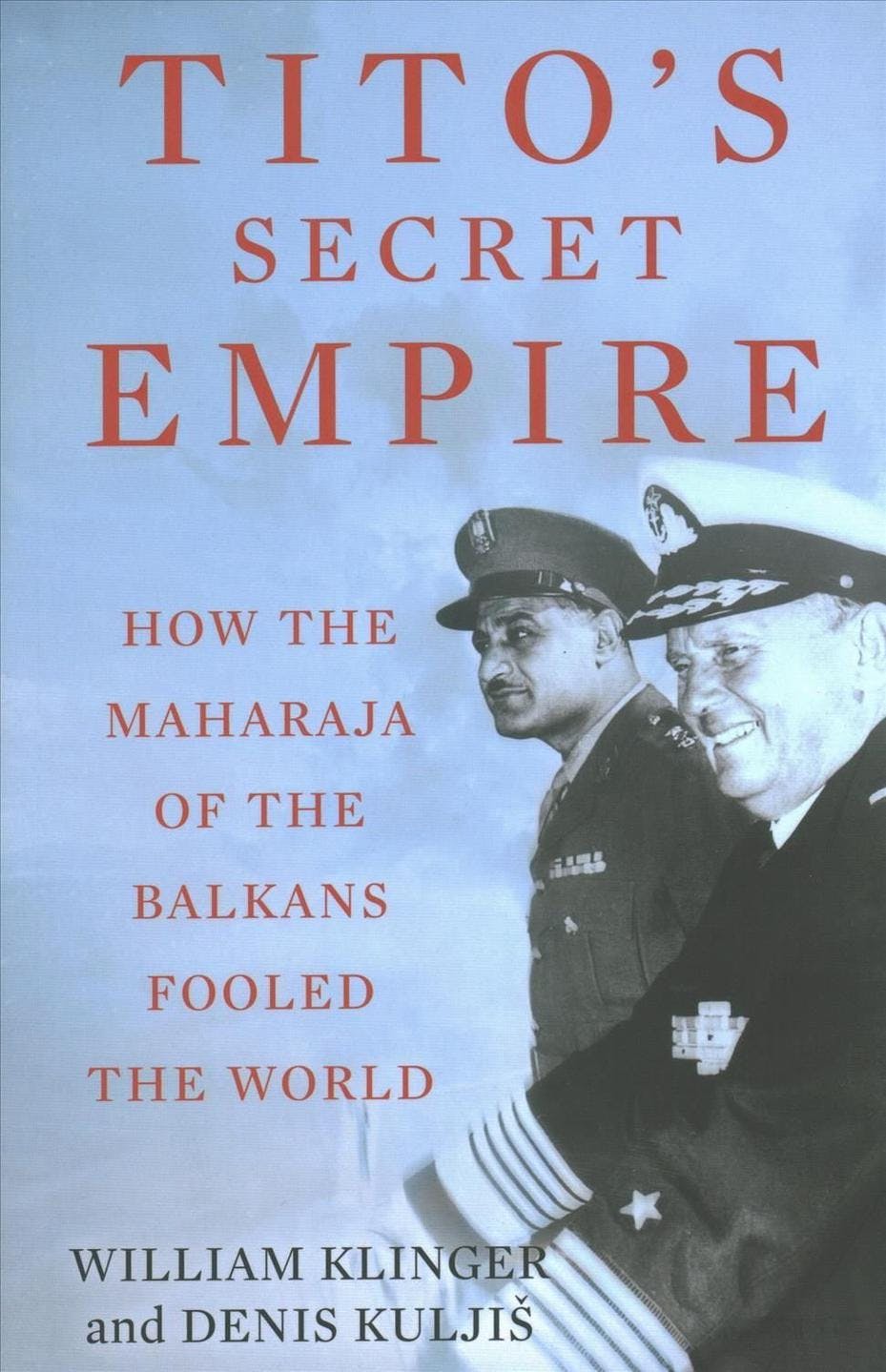
Decades after his death in 1980, Josip Broz Tito still casts a spell as a larger-than-life figure.
The legend portrays him as a famous military leader and anti-fascist guerrilla fighter who fought off the Nazis and defied Stalin. He then went on to be a champion of peace who stood up for various small nations snapping the coils of European overlordship. He was at home on imperial estates or, more often, on his secluded luxury home on the island of Brioni, with Old Masters adorning his walls and kings, emperors and fellow communist strongmen paying homage.
Despite clumsy language and hyperbole in places, as well as some avoidable errors, Tito’s Secret Empire seeks to debunk Tito’s legend and in several key respects it succeeds. The authors William Klinger and Dennis Kuljiš accord some honours to their subject.
He was a unique character well-equipped to surmount various obstacles during his 88-year life. For the British diplomat, Sir Fitzroy Maclean, he was “a fail-proof survivor”. In 1974 he was hailed by Germany’s Chancellor, Helmut Schmidt, as “the greatest of the winners of the Second World War”.
A benign image persisted, despite Tito being responsible for more acts of mass cruelty than any other European communist leader with the exception of the Soviets. He was admired as a wheeler-dealer in international affairs, from murky transactions to the most delicate undertakings in statecraft. This well-researched book deserves attention for those who wish to peer beyond the carefully cultivated image.
[…]
His 1954 state visit to then-royalist Greece, a regime which he had spent years trying to topple, was an unmistakable indication that he was placing himself at the head of a hybrid regime. Britain’s foreign secretary, Anthony Eden, had already visited him and urged the United States to prop up Tito financially. The favour was not returned. Evidence is provided that Tito played a major role in encouraging Egypt to nationalise the Suez Canal. He saw President Nasser as a kindred spirit, a populist unencumbered by ideology. Tito even more keenly sought to end French rule in Algeria, arming the rebels and offering diplomatic support.
In September 1961, he welcomed dozens of leaders from the promising new “non-aligned” bloc to a conference in Belgrade. Next year China invaded India and his soul-mate, Nehru, turned to the West for help. Thereafter, the non-aligned movement’s influence waned, as did Tito’s with it.
He increasingly became a pensioner of the Soviet Union. American ardour cooled as it became clear how reliant he was on Soviet arms and industrial licences which enabled this supposed ambassador of peace to export weapons to the Third World.
Comments Off on Josip Broz Tito — The “Maharaja of the Balkans”
October 8, 2021
The case for defending Taiwan
Roberto White explains why the west should help protect the Republic of China from the People’s Republic of China:
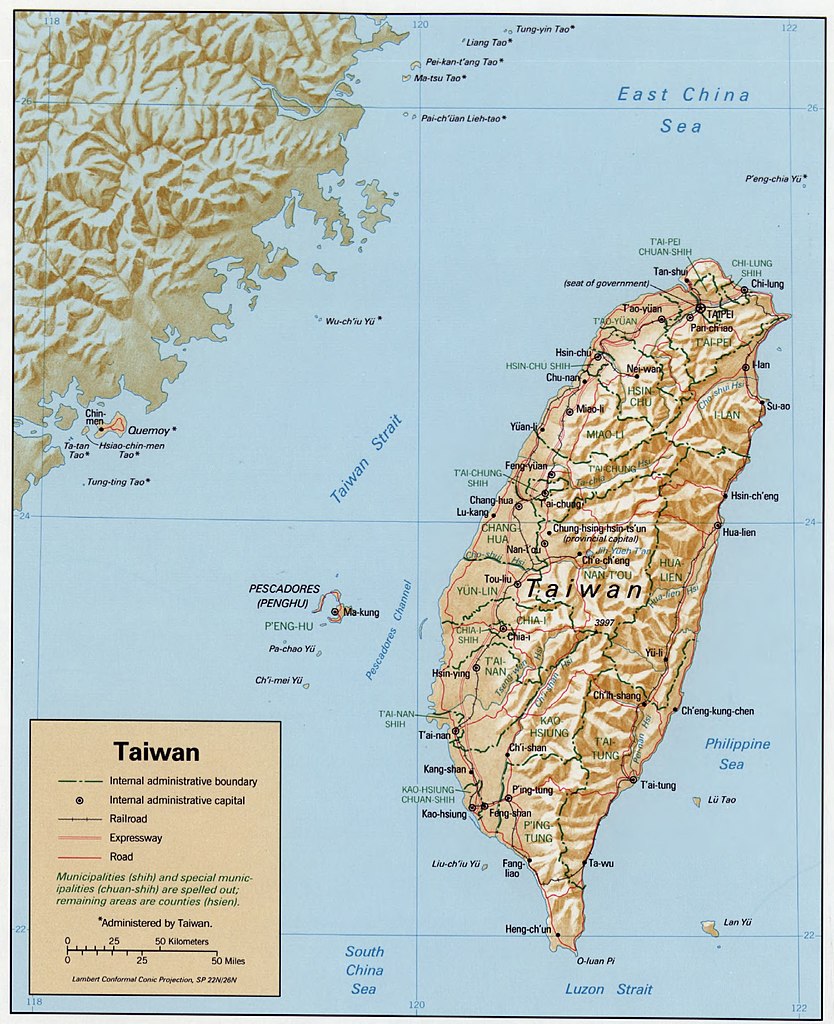
Taiwan relief map.
Library of Congress Geography & Map Division via Wikimedia Commons.
The past few days have seen Taiwan subjected to another wave of continuous harassment by China. Of course this is nothing new; China has violated Taiwan’s airspace since at least 2014. But, on Monday, a record 34 fighter jets were dispatched to Taiwan. Beijing’s increasingly erratic behaviour towards Taiwan brings to the fore why the West must defend them.
Taiwan is a free-market democracy that, despite its overbearing northern neighbour, has managed to create a vibrant economy that ranks as the sixth freest economy in the world. Crucially, it is a major producer of semiconductors (a device that helps power everything from cars to satellites), accounting for 92 per cent of all production of the world’s most sophisticated and important chips. Thus, from both an ideological and strategic standpoint, defending Taiwan is a mutually beneficial move.
The case for Taiwan’s defence is further strengthened when we look at what could happen in Asia should China take Taiwan by force.
With Taiwan’s ports and air bases, the People’s Liberation Army (PLA) could extend its maritime militia northwards through the Ryukyu (the chain of islands between Taiwan and Japan) and the Senkaku Islands (disputed by China and Japan). This would give China increased leverage over Japan in a time of crisis by, for example, restricting its maritime commerce.
The CCP could further use Taiwan as a base for tighter control of the South China Sea by blocking the Luzon Strait (between Taiwan and the Philippines) and the Balintang channel, which would cut off the traditional route used by the US Navy to navigate regional waters. In essence, China would immediately become the foremost power in the Indo-Pacific that could eventually kick the US and its allies out of the region. Unfortunately, the threat of a Chinese invasion is not a distant reality. In March of this year Admiral Philip Davidson, the United States’ top military officer in the Asia-Pacific, warned that China could invade Taiwan by 2027.
Given the perilous scenario that would emerge from a Chinese invasion of Taiwan, it is vital that, should an invasion happen, the West comes to Taiwan’s defence. However, until such a time, Western allies should aim to help Taiwan by promoting its participation in international forums. The first step would be to allow diplomats and other officials with Taiwanese passports to enter UN buildings, which they currently cannot do. This would most likely provoke a backlash from China, yet it would also confer Taiwan the dignity and respect that officials from every other state have.
The West should also stand firm against Chinese attempts to exclude Taiwan from international organisations. Between 2008-2016, Taiwan was invited to be an observer at the World Health Organization (WHO) under the name “Chinese Taipei”. In 2016, after Tsai Ing-Wen was elected Taiwan’s President, Beijing rescinded the invitation and Taiwan has not been allowed to participate since.
Comments Off on The case for defending Taiwan
October 7, 2021
Understatement alert – “… many Canadians are less than confident in our prime minister’s ability to defend Canadian interests when up against Xi Jinping”
In The Line, Jaclyn Victor discusses Canada’s longstanding military freeloading habits and how Chinese interest in the Arctic are only the latest concerns pushing the government to start taking national sovereignty seriously:
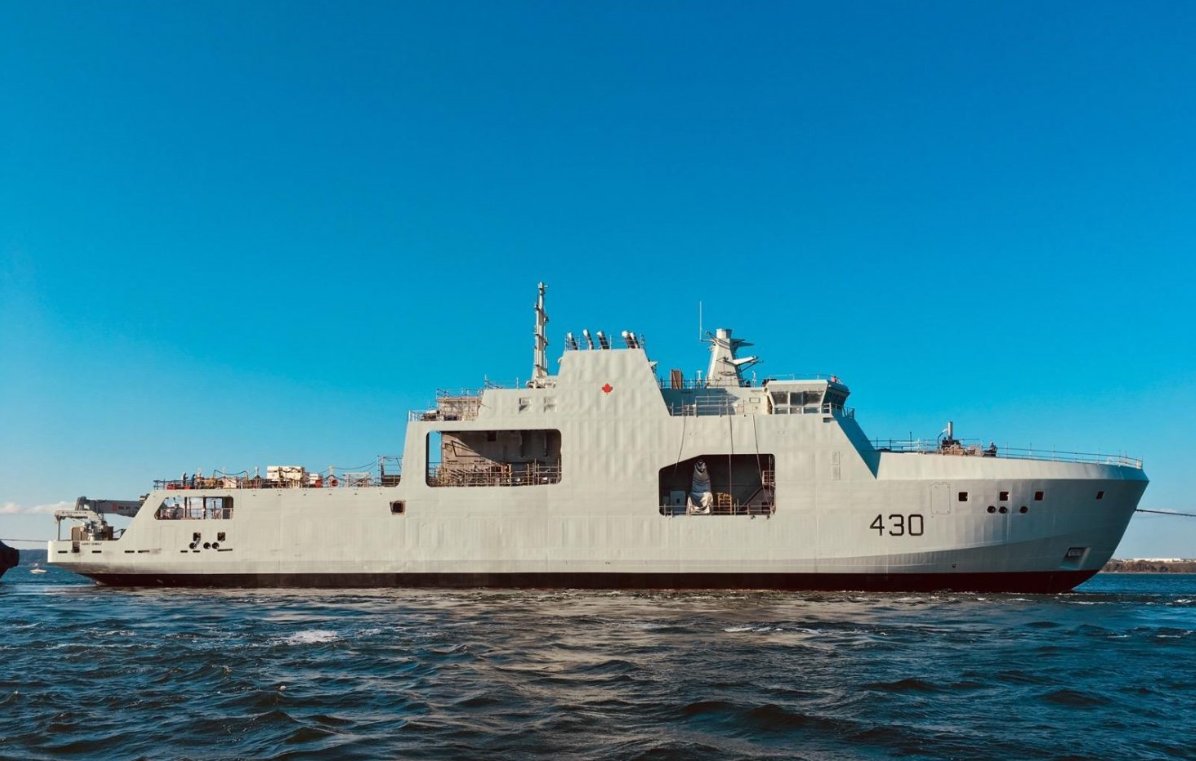
Arctic Offshore Patrol Ship HMCS Harry DeWolf shortly after launch in 2018. The ship was commissioned into the Royal Canadian Navy in June, 2021.
If the West has learned anything about China in recent years, it’s that its leaders will stop at nothing to advance their interests, and will often do so in unpredictable ways. For Canada, the most obvious lesson here was the brazen hostage diplomacy that saw “the two Michaels”, Kovrig and Spavor, imprisoned for nearly three years in retaliation for Canada’s detention of Huawei executive Meng Wanzhou. But there’s another area in which China is flexing its muscles that is much closer to home: the Arctic.
Despite being nearly 1,500 kms from the Arctic Circle, China claims to be a “near-Arctic” state. This alone might not be concerning if it weren’t also for China’s efforts to increase its Arctic presence while simultaneously undermining that of legitimate Arctic states. Although Canada staunchly claims to have sovereignty over the Northwest Passage, China hasn’t accepted this, yet has (concerningly) demonstrated an increased interest in the Arctic. Canada’s periodic military exercises and lack of assertion in the North are clearly not effective in dissuading Chinese interest in the region. As the world recognizes the importance of the Arctic we must do more if we want to maintain our influence.
From claims that Trudeau has personal ties to the Chinese Communist Party to the general belief that he has no backbone in Chinese foreign policy matters, it is clear that many Canadians are less than confident in our prime minister’s ability to defend Canadian interests when up against Xi Jinping. Perhaps the most relevant example of this is the release of the Two Michaels after nearly three years in Chinese captivity — a momentous occasion that filled many Canadians with a renewed hope — but only happened thanks to support from President Biden. And what about China’s alleged election interference, which was aimed at supporting the Trudeau Liberals at the expense of the more hawkish Erin O’Toole? Simply put, China wouldn’t want Trudeau in power if they thought he’d put a damper on their interests.
Our allies, unfortunately, also recognize that our inaction is no match for China’s “coercive diplomacy” and military preparedness. Canada could have contributed to, and hugely benefited from, the recently signed AUKUS pact. The agreement was largely intended to provide Australia with nuclear submarines to fend off Chinese aggression, but it also committed the partners to collaborate on AI and other technologies. Canada seems to have been deliberately excluded. We’re skilled in many of the information-sharing focus areas specified in the agreement, and we clearly need increased submarine capabilities in order to help maintain the Arctic sovereignty we claim to have. On top of this, many of our closest allies have outright denied Canadian claims to the NWP, leaving us with limited defence partnerships as they relate to the Arctic.
In the meantime, China has been establishing itself in the Arctic in an effort to get a foothold. In 2018, China’s Arctic Policy was published — the first of its kind for an Asian state. The policy, which discusses Chinese interest in Arctic resource extraction, brings light to Chinese efforts to develop industry in the region. China currently controls about 90 per cent of the global trade of rare minerals, and they want to maintain this dominance. As Arctic ice melts and additional resources become accessible, one can bet that China will want a piece of the pie. China already has a robust starting point for strategic investments, with US $19 billion invested in Canadian Arctic mining projects. Until the NWP (or “golden waterway” as it’s been called) becomes ice-free in the summers, China will likely continue seeking additional investment opportunities to increase its hold and resulting influence. Once the strait inevitably becomes easy to transit, China will already have a legitimate reason to do so.

Comments Off on Understatement alert – “… many Canadians are less than confident in our prime minister’s ability to defend Canadian interests when up against Xi Jinping”
October 5, 2021
Chris Alexander – “The truth is that ‘normal’ in the People’s Republic of China, at least since 1959, has never included the rule of law”
Writing in The Line, Chris Alexander (former Minister of Citizenship and Immigration) explains why attempts to “return to normal” in Canada’s relationship with mainland China are foredoomed to failure:
Yuen Pau Woo was joined in these arguments by senators Peter Boehm and Peter Harder, both seasoned diplomats, who also urged Canada to suspend its judgement with regard to China’s persecution of the Uighurs. This includes the use of concentration camps and forced labour, as well as the repression of language, culture and religion. These are all blatant acts committed with the “intent to destroy, in whole or in part, a national, ethnical, racial or religious group”, as the 1951 Genocide Convention defines this “odious scourge”.
Throughout this unfortunate saga, Beijing has had a Greek chorus of supporters across Canada — mostly from people with well-remunerated corporate or political backgrounds — for the preposterous notion of a “prisoner exchange” that would get relations with China back to “normal”.
In the end, the Senate’s genocide motion failed by a vote of 29 in favour to 33 opposed, with 13 abstentions. China’s Foreign Ministry praised Woo, Boehm and Harder as “people of vision” who had seen through the “despicable schemes of a few anti-China forces”. The “clumsy trick of attacking China for selfish political gains” and “the hype of ‘genocide’ in Xinjiang is unpopular and doomed to fail”, the Foreign Ministry spokesperson crowed.
Had Woo, a former president and CEO of the Asia Pacific Foundation of Canada, and the “two Peters”, both former deputy ministers of foreign affairs, voted in favour, the Senate’s genocide motion would have passed. Instead all three chose, on an issue directly threatening the identity and lives of millions, to take the position of the Communist Party of China over one unanimously endorsed by Canada’s elected House of Commons — all in the empty hope of getting back to “normal” with Beijing.
The truth is that “normal” in the People’s Republic of China, at least since 1959, has never included the rule of law. From China’s ferocious and brutal invasion of Tibet that same year, through the murderous Great Leap Forward ending in 1962, to the decade-long Cultural Revolution up to Mao’s death in 1976 (and beyond), China has been a legal void. Serious judicial reforms never featured in Deng Xiaoping’s economic relaunch. On the contrary, basic rights were decimated, as Tibetan, Mongolian, Uighur and other refugees attest.
According to Freedom House, the current General Secretary of the Chinese Communist Party Xi Jinping’s relentless push for all-encompassing surveillance and censorship has made China the worst environment in the world for internet freedom for the seventh year running. Compliance with such global gag orders is enforced by the CCP’s Orwellian digital panopticon, the notorious United Front Work Department, which seeks to browbeat, buy, corrupt, blackmail, extort or otherwise leverage people and firms with connections to China in support of Xi’s agenda.
Thanks to United Front subterfuge, some prominent Canadians still take China’s side, even as Beijing’s favourability score in Canadian public opinion plummeted to 14 per cent, mirroring a worldwide nosedive for China’s image driven by the two Michaels’ ordeal and Beijing’s “wolf warrior” belligerence.
Comments Off on Chris Alexander – “The truth is that ‘normal’ in the People’s Republic of China, at least since 1959, has never included the rule of law”
September 28, 2021
Debunking the notion that Stalin was an innocent victim of Hitler
At Instapundit, Ed Driscoll links Jakub Grygiel’s review of a new look at World War 2 in Europe, Stalin’s War by Sean McMeekin, which includes a bit of debunking about the relationship between Hitler and Stalin from 1939 to 1941:
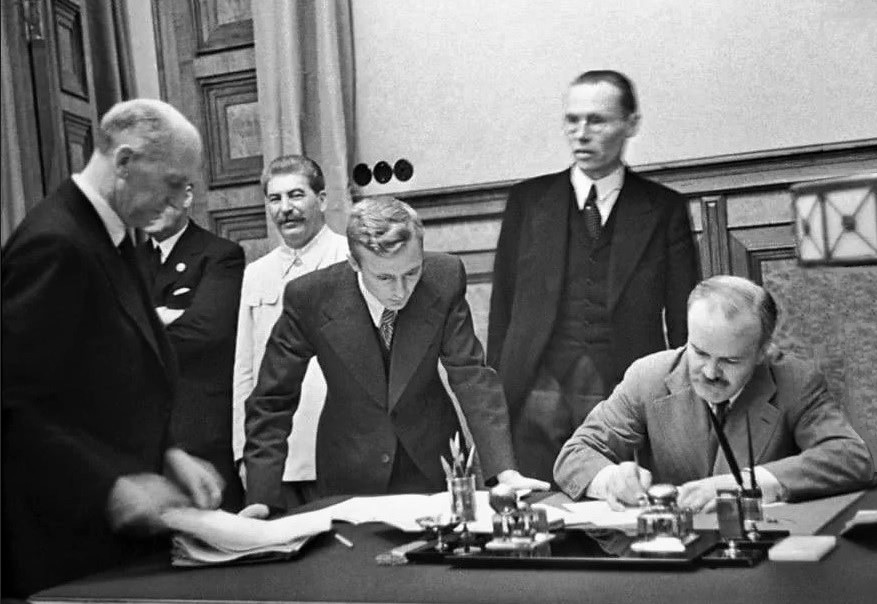
Translation of the Russian caption for this image:
People’s Commissar of Foreign Affairs of the USSR V.M. Molotov signs a friendship and border treaty between the USSR and Germany. Among those present: I.V. Stalin, translator of the Ministry of Foreign Affairs V.N. Pavlov, German diplomat G. Hilger (“truncated” version of the photograph of M. Kalashnikov distributed on the net)
Photograph attributed to Mikhail Mikhaylovich Kalashnikov (1906-1944) via Wikimedia Commons.
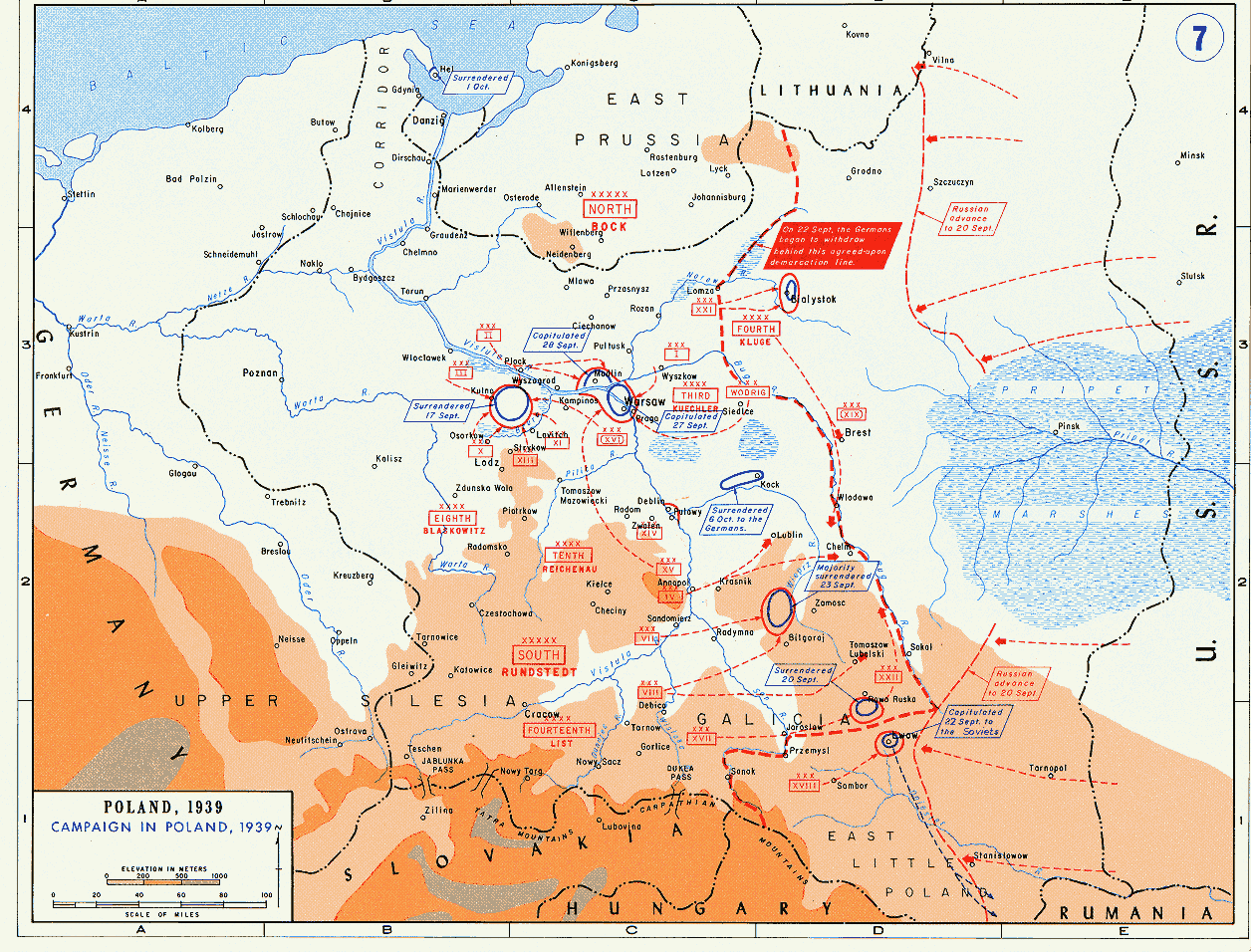
Stalin was always interested in a war, especially one that would pit the other powers against each other. The expansion of Soviet influence and control required the weakening of the other powers, in particular the Western ones that were opposed to the Communist virus. For Stalin, therefore, the growth of Nazi Germany was a great opportunity: a violent and expansionistic power in the middle of Europe that could take the first swing against the polities standing on his path. Unsurprisingly, the Soviet tyrant was deeply disappointed when France and Britain signed the Munich Agreement with Nazi Germany in 1938 postponing the great European war that he desired. The 1939 Ribbentrop-Molotov Pact coordinated the efforts of Hitler and Stalin, but it benefited the latter more, allowing him to conquer a large swath of Polish territory with minimal effort, eliminating one of the staunchest opponents to Russian westward expansion. A year later, by murdering almost 22,000 Polish officers in Soviet captivity, Stalin further weakened the Polish obstacle to his expansion. “Nations which had been ruled by powerful aristocracies,” Stalin told once to the Yugoslav Milovan Djilas, “like the Hungarians and the Poles, were strong nations” — and, fearing them, he sought to eliminate them. Then, while Germany invaded France, Stalin took over the three Baltic states in a further step westward.
Hitler’s decision to invade Russia in mid-1941 was a surprise to Stalin, but not because he was expecting a lasting peace on his western frontier. Rather, as McMeekin documents, Stalin had ordered very rapid and large military preparations, building airbases and placing forces near the border with the Third Reich in the first half of 1941. None of them were in a defensive posture, and presented a vulnerable high value target to Nazi attacks. When Hitler decided to attack the USSR in June 1941, these Soviet forces were easy pickings for the well-organized, trained, and war tested German army. McMeekin here expands and amends a bold thesis offered in 1990 by Viktor Suvorov, a pseudonym for a GRU agent who defected to the West in the late ’70s and became a historian, that argued that Stalin was actively planning an attack on Germany but was preempted by Hitler. While Suvorov was excessive in his claim that the Red Army was ready for an offensive campaign in 1941 (because, among other reasons, the officer corps was still in shambles after Stalin’s purges) and that Stalin had plans to conquer Europe, he argued that the USSR was never a status quo power satisfied in its borders. After all Soviet Russia had already attempted to march westward in 1920 and was stopped only by the Poles in a desperate battle near Warsaw (the “Miracle on the Vistula”). This westward vector and ambition of Moscow did not abate, and had to pause because of Hitler’s rise and the might of Nazi Germany. As McMeekin points out, the Soviet military posture in 1941 makes no sense if the goal was to defend Soviet-held lands, suggesting that Stalin was thinking of pouncing on Berlin, now the last remaining continental power in Europe. As the Soviet tyrant himself put it, the USSR no longer needed to be locked in a defensive posture, and was “a rapacious predator, coiled in tense anticipation, waiting for the chance to ambush its prey.”
Military situation in Poland, 14 September 1939 (map does not show Slovak Army activity in southern Poland).
United States Military Academy, Department of History via Wikimedia Commons.Stalin, that is, was not an innocent victim of Hitler. Not only he was an active partner from 1938 until 1941, but also he had geopolitical aspirations that were more ambitious than those held by Hitler. And he pursued them methodically and ruthlessly, leaving a trail of death that dwarfed the one produced by the Nazis.
McMeekin then focuses on how the Western allies, Churchill but especially FDR, abetted Stalin’s ambitions. This part of the book is fascinating and depressing at the same time. In a nutshell, Stalin obtained from FDR more than he expected: territory, influence, and materiel. And he did not give anything in exchange for it because FDR and his advisors never asked him for it. For instance, FDR supported the Lend-Lease program, putting his friend Harry Hopkins in charge. Under this program of military aid, the United States supplied a massive amount of weapons, trucks, airplanes, tanks, foodstuff to the Soviet Union in the months of its greatest need, as German troops were driving deep into Russia while the vaunted Soviet armies were melting away. Without such aid, the USSR would have likely been unable to stop the German onslaught and certainly would have been incapable of mustering the resources necessary to push westward. Hence, in this moment there was a good strategic rationale for the American support of Stalin’s defensive efforts against Nazi Germany.
Prior to the launch of Operation Barbarossa, you’d have been hard-pressed to find a more anti-Soviet leader than Winston Churchill, but he immediately recognized that Stalin was more useful to the British as an ally than as a passive enemy. Earlier this year, McMeekin wrote that Stalin “could not have asked for a friendlier British government” than Churchill’s wartime coalition. As Connor Daniels wrote in response at The Churchill Project:
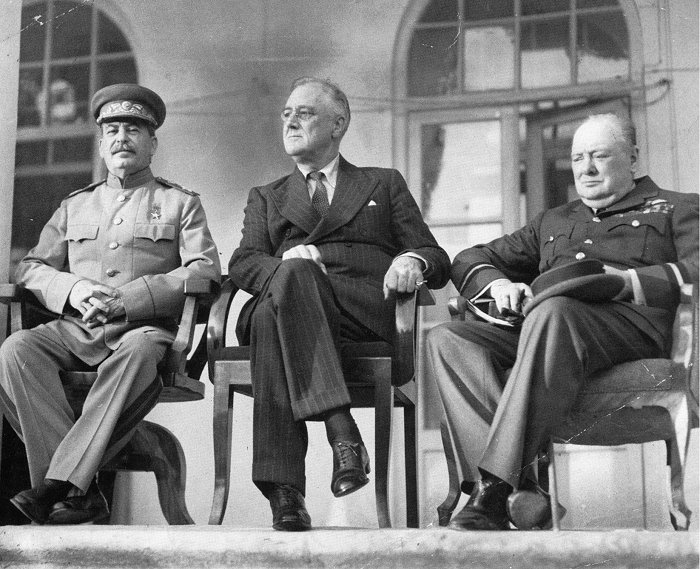
The “Big Three” meet at Tehran, 28 November-1 December, 1943.
Photo attributed to US Army photographer, via Wikimedia Commons.
Churchill’s support for Stalin during the Second World War followed from a simple calculus of the lesser of two evils. Britain could only take on one evil empire at a time, and, of the two, Churchill believed that Nazi Germany posed the greater threat to liberty. He famously remarked, “If Hitler invaded Hell I would make at least a favourable reference to the Devil in the House of Commons.” McMeekin attempts to sidestep this harsh reality, writing: “Whether or not the payoff was worth the price is a question well worth debating.” Churchill’s alliance with the Soviets stands or falls on this question: was Nazi Germany or the Soviet Union the greater danger in 1939?
With hindsight, one can easily marshal facts that portray Soviet communism as the greater evil. According to the best available estimates, the Stalin regime killed 20 millions of its own citizens. Nearly six million of those deaths occurred during the 1932–33 famine brought about by Stalin’s collectivization policies. While Nazi Germany also killed 17 million civilians, most of those deaths occurred after Hitler’s invasion of the Soviet Union in 1941. Thus, on the eve of the Second World War, one could argue — as Chamberlain and the appeasers did — that Nazi Germany served as a useful bulwark against a greater danger: the Soviet Union.
This analysis, however, misses a crucial point — one that Churchill recognized. Until 1939, the horrors of the Soviet regime had been primarily restricted to its own borders, while Nazi Germany had already made its expansionist ambition clear. In 1938, Germany annexed Austria. Later that year, Germany seized the Sudetenland. In 1939, the rest of Czechoslovakia passed under Hitler’s control. The Nazi doctrine of Lebensraum dictated even greater expansion. By contrast, Stalin’s doctrine of “socialism in one country” had kept the Soviet Union relatively peaceful until the Second World War began.
Comments Off on Debunking the notion that Stalin was an innocent victim of Hitler
September 20, 2021
Canada was given advance notice of the AUKUS deal … about five minutes notice
When the news broke about a new western alliance involving Australia, the United Kingdom and the United States, the official line — belatedly — was that our allies had kept Canadian officials “in the loop”, about the negotiations. Now that everyone’s attention is on the vote-counting, it can be safely acknowledged that the Canadian government got a heads-up just a few minutes before the formal announcement, as Ted Campbell discusses:
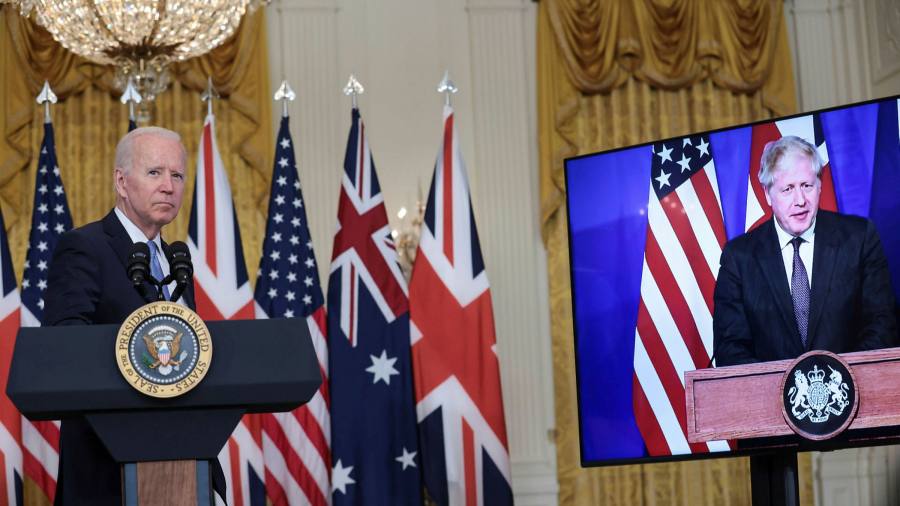
US President Joe Biden with British Prime Minister Boris Johnson (onscreen) during the AUKUS announcement.
Image from businesstelegraph.co.uk.
So, Steven Chase and Robert Fife say, in the Globe and Mail, that “The Canadian government was surprised this week by the announcement of a new security pact between the United States, Britain and Australia, one that excluded Canada and is aimed at confronting China’s growing military and political influence in the Indo-Pacific region, according to senior government officials [and] Three officials, representing Canada’s foreign affairs, intelligence and defence departments, told The Globe and Mail that Ottawa was not consulted about the pact, and had no idea the trilateral security announcement was coming until it was made on Wednesday by U.S. President Joe Biden, British Prime Minister Boris Johnson and Australian Prime Minister Scott Morrison.”
Not only did our oldest and closest friends and allies kick Canada out of the “inner circle”, they didn’t even bother to tell us that the political and diplomatic kick in the arse was coming, although, the Globe journalists say, the Australian and British defence ministers gave Harjit Sajjan a brief “heads up” just minutes before the announcement. Mr Sajjan’s spokesman said that Canada “had been kept in the loop”, I call BS.
Vice Admiral Mark Norman, someone who knows a lot about what happens at the highest echelons of government in Ottawa said that “if Mr. Trudeau was fully briefed” [on this new AUKUS pact, then] “he doesn’t understand what is going on internationally and he doesn’t understand what the significance of an arrangement like this is as it relates to international security.” I don’t think he had heard a word about this until Minister Sajjan’s senior aids called the PCO and PMO on Wednesday afternoon.
One can easily imagine the conversations on Wednesday and Thursday in some of the corridors of power in Ottawa: “
Biden us!” said one senior official. “No,” said another, even more senior, “this has been coming for a long time. It’s a shock, but it really shouldn’t be a surprise.” “They screwed us,” said a third, “we’ve done nothing to deserve this. It’s just because we aren’t spending as much as Biden and Morrison want on the military and it’s because we’re not sending more ships to Asia, more often.” “No,” the second person said, “it’s because we decided, all of us, you and me, too, to not do whatever it took to arrest the changes in our national strategic outlook.” “How can you say that?” the first speaker said, “We all protested, I wrote a long brief explaining why we needed to step up …” “We’re still here,” the more senior official said. “We didn’t resign and go public as soon as we saw how things were shaping up. Almost no one did.” “No one listens when senior officials or admirals or generals resign,” said the third official, “it wouldn’t have done any good.” “You’re right,” the most senior official answered, “resignations are, normally, not news and they rarely change politicians’ minds … not, anyway, when they’re done one at a time. Back in 2016, when many us started to see, clearly, how things were going we should have resigned en masse ~ and not just we three, but dozens of us from PCO, from Foreign Affairs and from DND and the military. If the senior public service had rebelled, as it should when the government makes destructive policy choice against our advice, then there would have been enormous, even irresistible political pressure. But we didn’t, did we? We all stayed on and wrote a couple of arse-covering briefing notes and went about our business. We are as much to blame for this as are those dimwits in Trudeau’s cabinet and inner circle. We failed Canada.” Vice Admiral Norman, the article explains, “said the agreement goes far beyond access to U.S. submarine technology [which is Mr Trudeau’s lame excuse for why Canada was kicked out of the inner circle] This is about accessing both current and emerging technologies, from cyber and artificial intelligence, to acoustics and underwater warfare – a whole range of very important strategic capabilities.” Further, “Mr. Norman said Canada has many national interests in the Indo-Pacific – including trade, promoting the rule of law and democracy, and countering China’s aggressive behaviour and posturing – but he suspects close allies do not take Canadian defence commitments seriously [and he added] I don’t think our allies think we are serious when it comes to defence. I think they have concerns not just about our defence expenditures, but also the extent to which our [international] commitments are both lasting and meaningful.” This has been evident since 2015. Justin Trudeau effectively campaigned on doing less in the world. Everyone knew this was coming ~ especially those who voted for the Liberal Party … it is what they wanted. It’s what Canada got.
Comments Off on Canada was given advance notice of the AUKUS deal … about five minutes notice
September 18, 2021
Paris Fights Back – The French Battle Against German Encirclement I Franco-Prussian War 1870
Real Time History
Published 16 Sep 2021Support Glory & Defeat: https://realtimehistory.net/gloryandd…
The German armies are on their way to encircle the French capital Paris after their victory at Sedan. The new French government is raising new troops all across the country and in Paris itself to stem the tide. Poorly equipped and poorly trained troops fight the Germans at Sceaux/Chatillon. Meanwhile, the German states start their negotiations for German unification.
» THANK YOU TO OUR CO-PRODUCERS
John Ozment
James Darcangelo
Jacob Carter Landt
Thomas Brendan» OUR PODCAST
https://realtimehistory.net/podcast – interviews with historians and background info for the show.» LITERATURE
Arand, Tobias: 1870/71. Die Geschichte des Deutsch-Französischen Krieges erzählt in Einzelschicksalen. Hamburg 2018Bourguinat, Nicolas/Vogt, Gilles: La guerre franco-allemande de 1870. Une histoire globale. Paris 2020
Gouttman, Alain. La grande défaite de 1870-1871. Paris 2015
Haselhorst, Olaf: Operationen der deutschen Heere im Krieg gegen Frankreich 1870/71, in: Der Deutsch-Französische Krieg 1870/71.
Vorgeschichte, Verlauf, Folgen, hrsg. v. J. Ganschow unter anderem Graz 2009, S. 83–120
Milza, Pierre: L’année terrible. Paris 2009
» SOURCES
Chuquet, Arthur: La Guerre 1870-71. Paris 1895Busch, Moritz: Bismarck und seine Leute während des Kriegs mit Frankreich Band. 1. Leipzig 1878.
Goncourt, Edmonde de: Memoires de la vie Litteraire. Paris 1890
Kriegsgeschichtliche Abtheilung des Großen Generalstabes (Hrsg.): Der deutsch-französische Krieg 1870-71. II.1 Berlin. 1878
Russell, William Howard: My diary during the last great war. London and New York, 1874
Sternegg, Generalmajor von: Schlachten-Atlas des 19. Jahrhunderts. Band 10. Deutsch-Französischer Krieg1870/71. Leipzig u.a. o.J. [1885]
» OUR STORE
Website: https://realtimehistory.net»CREDITS
Presented by: Jesse Alexander
Written by: Cathérine Pfauth, Prof. Dr. Tobias Arand, Jesse Alexander
Director: Toni Steller & Florian Wittig
Director of Photography: Toni Steller
Sound: Above Zero
Editing: Toni Steller
Motion Design: Philipp Appelt
Mixing, Mastering & Sound Design: http://above-zero.com
Maps: Battlefield Design
Research by: Cathérine Pfauth, Prof. Dr. Tobias Arand
Fact checking: Cathérine Pfauth, Prof. Dr. Tobias ArandChannel Design: Battlefield Design
Contains licensed material by getty images
All rights reserved – Real Time History GmbH 2021
Comments Off on Paris Fights Back – The French Battle Against German Encirclement I Franco-Prussian War 1870
September 15, 2021
Hansa – Northern Silk Road – Economic History
Kings and Generals
Pubished 14 Sep 2021Use our code
KINGSANDGENERALS10and link: https://bit.ly/3mACCeg to get 10% off (save up to $47!) your own authentic Japanese subscription box from Bokksu! Don’t miss out on this amazing snack-journey through Japan!Kings and Generals animated historical documentary series on medieval history and economic history continues with a video on Hansa, also known as the Hanseatic League, which played a crucial role in the European trade in the late medieval, becoming known as the Northern Silk Road and dominating Baltic and North Sea trade for centuries.
Support us on Patreon: http://www.patreon.com/KingsandGenerals or Paypal: http://paypal.me/kingsandgenerals. We are grateful to our patrons and sponsors, who made this video possible: https://docs.google.com/document/d/1o…
The video was made by Michael Merc https://bit.ly/340tcO2 while the script was researched and written by Matt Hollis. 2d art and animation – amicus verus (https://www.artstation.com/amicus_verus). Narration by Officially Devin (https://www.youtube.com/user/OfficiallyDevin)
✔ Merch store ► https://teespring.com/stores/kingsand…
✔ Podcast ► http://www.kingsandgenerals.net/podcast/
✔ Twitter ► https://twitter.com/KingsGenerals
✔ Instagram ► http://www.instagram.com/Kings_GeneralsProduction Music courtesy of Epidemic Sound: http://www.epidemicsound.com
#Documentary #Hansa #EconomicHistory
This video was sponsored by Bokksu
Comments Off on Hansa – Northern Silk Road – Economic History
September 2, 2021
Road to WWII: A Basic Causal Analysis
Thersites the Historian
Published 19 Nov 2019This video is a primer for undergraduates in broad history survey courses that will hopefully help make sense of the interwar years between World War I and World War II.
Patreon link: https://www.patreon.com/thersites
PayPal link: paypal.me/thersites
Twitter link: https://twitter.com/ThersitesAthens
Minds.com link: https://www.minds.com/ThersitestheHis…
Steemit/dtube link: https://steemit.com/@thersites/feed
BitChute: https://www.bitchute.com/channel/jbyg…
Backup Channel: https://www.youtube.com/channel/UCUrD…
Comments Off on Road to WWII: A Basic Causal Analysis
August 27, 2021
On Which Side is Brazil? – WW2 Special
World War Two
Published 26 Aug 2021Brazilian President, Getúlio Vargas, has led his country as dictator since the 1930s. He has embraced European fascist ideas and fostered close ties with Germany and Italy. Yet, he also maintains a close relationship with the United States. After skilfully playing both sides, he must now choose Axis or Allies.
(more…)
Comments Off on On Which Side is Brazil? – WW2 Special


